
Chapter 2 Representing Motion Vectors and Scalars Quantities

- Slides: 11
Chapter 2 Representing Motion
Vectors and Scalars § Quantities that have magnitude (size) and direction=vectors=BOLD § Numbers with no direction=scalars=regular § scalars= 6+2=8 § Vectors= 6 km east+2 km east=8 km east or 6 km east + 2 km west = 4 km east
Vectors can be added graphically § When adding—make sure they have the same units and describe similar quantities. It is meaningless and incorrect to add them together if they are different units. § For example, it would be meaningless to add a velocity vector to a displacement vector because they describe different physical quantities.
Properties of Vectors 1. Vectors can be moved parallel to themselves in a diagram 2. Vectors can be added in any order 3. To subtract a vector, add its opposite 4. Multiplying or dividing vectors by scalars results in vectors.
The resultant § Always add vectors tip to tail § The vector that represents the sum of the other two vectors § Always points from the tail of the first vector to the tip of the last vector
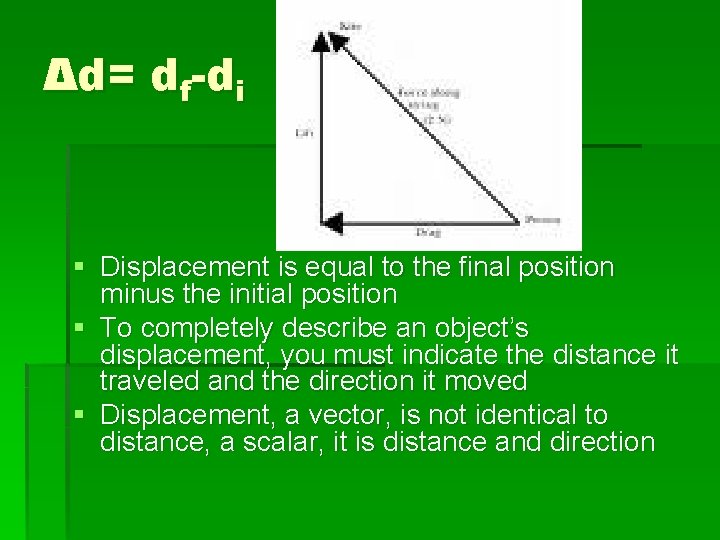
Δd= df-di § Displacement is equal to the final position minus the initial position § To completely describe an object’s displacement, you must indicate the distance it traveled and the direction it moved § Displacement, a vector, is not identical to distance, a scalar, it is distance and direction
Motion Diagram § Shows the position of an object at successive times § In the particle model, the object in the motion diagram is replaced by a series of single points
Coordinate System § You can define any coordinate system you wish in describing motion…but some are more useful than others. 1 mile=1 cm instead of 1 mile=1 mm
Time interval § The difference between two times § Δt = tf - ti
Position-time graphs § Can be used to find the velocity and position of an object…as well as where and when two objects meet. § Any motion can be described using words, motion diagrams, data tables, and graphs
How Fast? § The slope of an object’s position-time graph is the average velocity of the object’s motion § V = Δ d = df - di Δt tf - ti q The average speed is the absolute value of the average velocity q An object’s velocity is how fast it is moving and in what direction it is moving