
Chapter 2 Representative Carbon Compounds Functional Groups Chapter
Chapter 2 Representative Carbon Compounds: Functional Groups Chapter 2
t Carbon-carbon Covalent Bonds l Carbon forms strong covalent bonds to other carbons and to other elements such as hydrogen, oxygen, nitrogen and sulfur èThis accounts for the vast variety of organic compounds possible l Organic compounds are grouped into functional group families èA functional group is a specific grouping of atoms (e. g. carbon double bonds are in the family of alkenes) èAn instrumental technique called infrared (IR) spectroscopy is used to determine the presence of specific functional groups Chapter 2 2
t Hydrocarbons: Representative Alkanes, Alkenes Alkynes, and Aromatic Compounds èHydrocarbons contain only carbon and hydrogen atoms èSubgroups of Hydrocarbons: Alkanes contain only carbon-carbon single bonds H Alkenes contain one or more carbon-carbon double bonds H Alkynes contain one or more carbon-carbon triple bonds H Aromatic hydrocarbons contain benzene-like stable structures (discussed later) H èSaturated hydrocarbons: contain only carbon-carbon single bonds e. g. alkanes èUnsaturated hydrocarbons: contain double or triple carbon-carbon bonds e. g. alkene, alkynes, aromatics Contain fewer than maximum number of hydrogens per carbon H Capable of reacting with H 2 to become saturated H Chapter 2 3
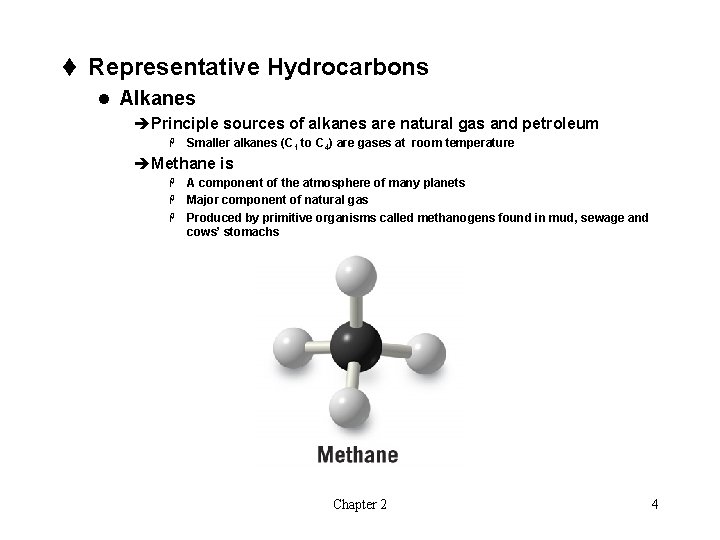
t Representative Hydrocarbons l Alkanes èPrinciple sources of alkanes are natural gas and petroleum H Smaller alkanes (C 1 to C 4) are gases at room temperature èMethane is A component of the atmosphere of many planets H Major component of natural gas H Produced by primitive organisms called methanogens found in mud, sewage and cows’ stomachs H Chapter 2 4
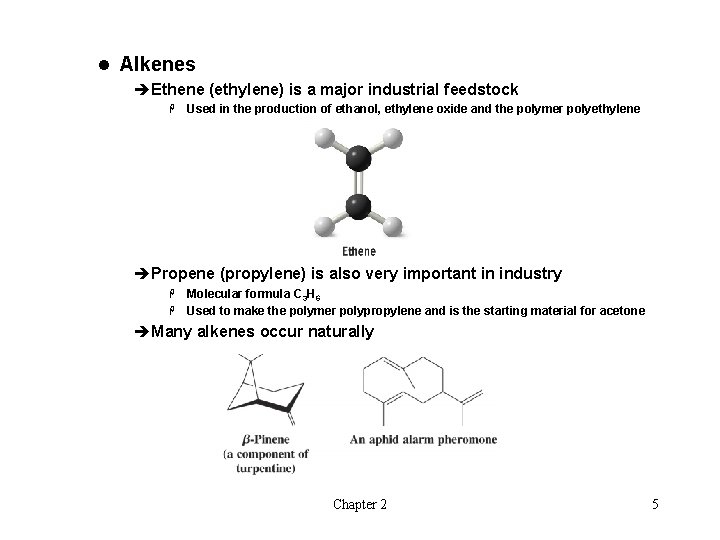
l Alkenes èEthene (ethylene) is a major industrial feedstock H Used in the production of ethanol, ethylene oxide and the polymer polyethylene èPropene (propylene) is also very important in industry Molecular formula C 3 H 6 H Used to make the polymer polypropylene and is the starting material for acetone H èMany alkenes occur naturally Chapter 2 5
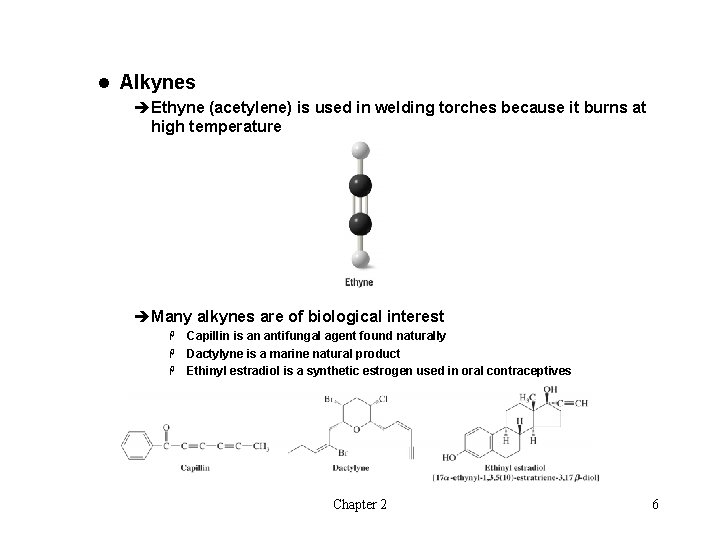
l Alkynes èEthyne (acetylene) is used in welding torches because it burns at high temperature èMany alkynes are of biological interest Capillin is an antifungal agent found naturally H Dactylyne is a marine natural product H Ethinyl estradiol is a synthetic estrogen used in oral contraceptives H Chapter 2 6
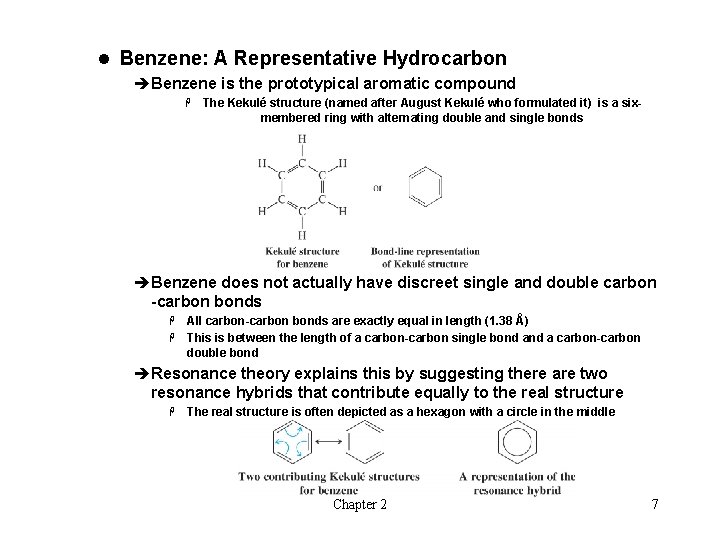
l Benzene: A Representative Hydrocarbon èBenzene is the prototypical aromatic compound H The Kekulé structure (named after August Kekulé who formulated it) is a sixmembered ring with alternating double and single bonds èBenzene does not actually have discreet single and double carbon -carbon bonds All carbon-carbon bonds are exactly equal in length (1. 38 Å) H This is between the length of a carbon-carbon single bond a carbon-carbon double bond H èResonance theory explains this by suggesting there are two resonance hybrids that contribute equally to the real structure H The real structure is often depicted as a hexagon with a circle in the middle Chapter 2 7
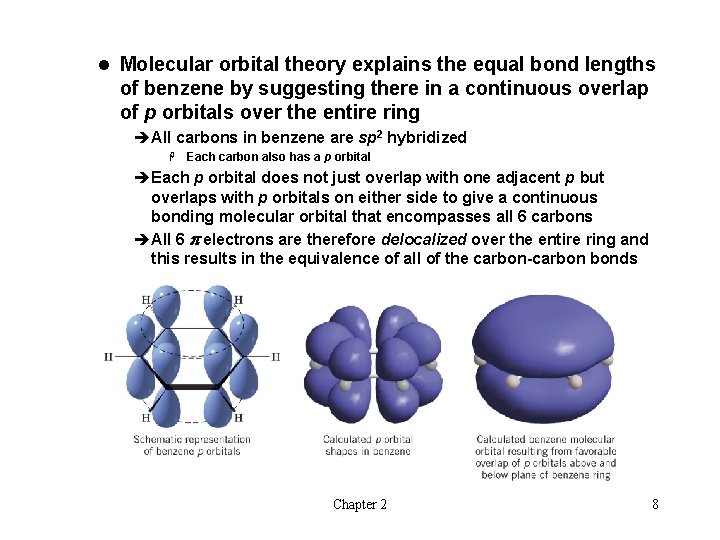
l Molecular orbital theory explains the equal bond lengths of benzene by suggesting there in a continuous overlap of p orbitals over the entire ring èAll carbons in benzene are sp 2 hybridized H Each carbon also has a p orbital èEach p orbital does not just overlap with one adjacent p but overlaps with p orbitals on either side to give a continuous bonding molecular orbital that encompasses all 6 carbons èAll 6 p electrons are therefore delocalized over the entire ring and this results in the equivalence of all of the carbon-carbon bonds Chapter 2 8
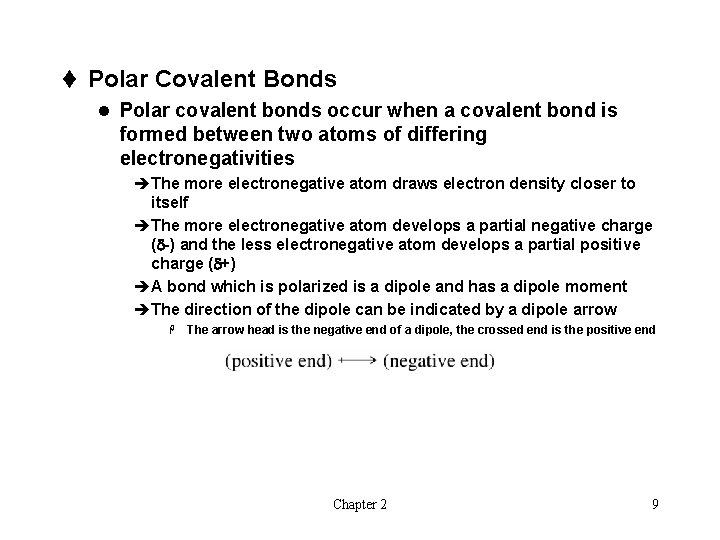
t Polar Covalent Bonds l Polar covalent bonds occur when a covalent bond is formed between two atoms of differing electronegativities èThe more electronegative atom draws electron density closer to itself èThe more electronegative atom develops a partial negative charge (d-) and the less electronegative atom develops a partial positive charge (d+) èA bond which is polarized is a dipole and has a dipole moment èThe direction of the dipole can be indicated by a dipole arrow H The arrow head is the negative end of a dipole, the crossed end is the positive end Chapter 2 9
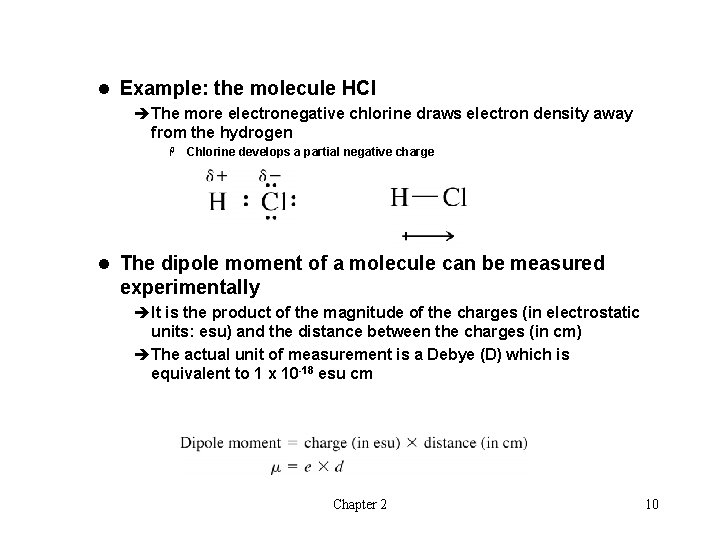
l Example: the molecule HCl èThe more electronegative chlorine draws electron density away from the hydrogen H Chlorine develops a partial negative charge l The dipole moment of a molecule can be measured experimentally èIt is the product of the magnitude of the charges (in electrostatic units: esu) and the distance between the charges (in cm) èThe actual unit of measurement is a Debye (D) which is equivalent to 1 x 10 -18 esu cm Chapter 2 10
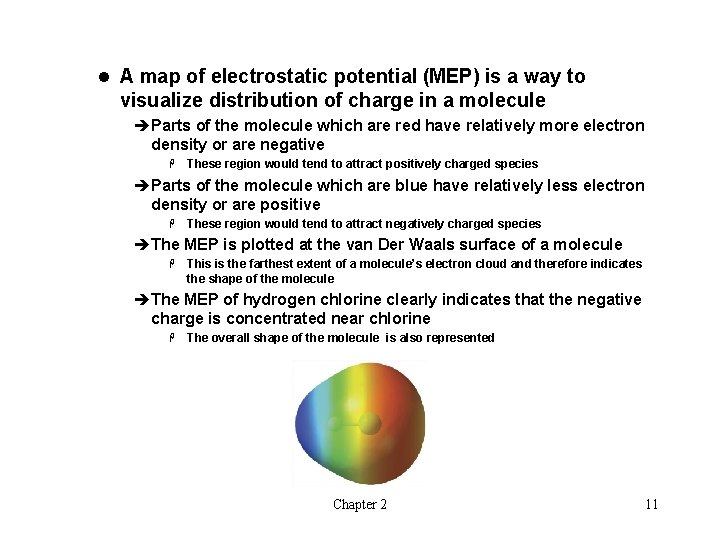
l A map of electrostatic potential (MEP) is a way to visualize distribution of charge in a molecule èParts of the molecule which are red have relatively more electron density or are negative H These region would tend to attract positively charged species èParts of the molecule which are blue have relatively less electron density or are positive H These region would tend to attract negatively charged species èThe MEP is plotted at the van Der Waals surface of a molecule H This is the farthest extent of a molecule’s electron cloud and therefore indicates the shape of the molecule èThe MEP of hydrogen chlorine clearly indicates that the negative charge is concentrated near chlorine H The overall shape of the molecule is also represented Chapter 2 11
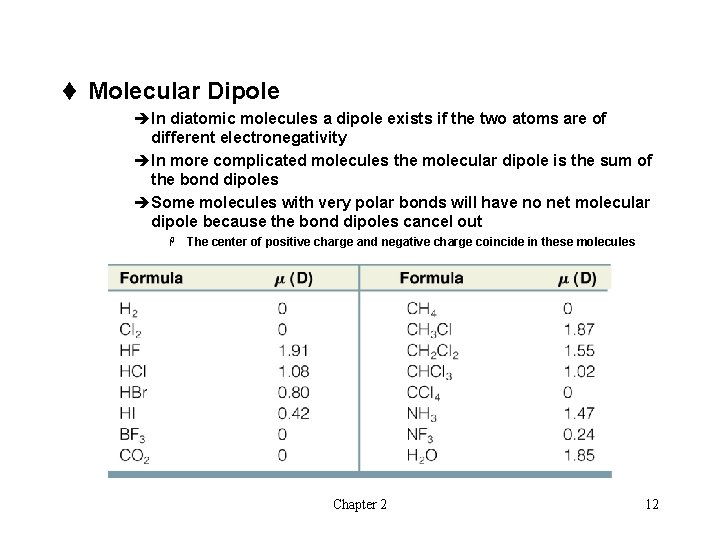
t Molecular Dipole èIn diatomic molecules a dipole exists if the two atoms are of different electronegativity èIn more complicated molecules the molecular dipole is the sum of the bond dipoles èSome molecules with very polar bonds will have no net molecular dipole because the bond dipoles cancel out H The center of positive charge and negative charge coincide in these molecules Chapter 2 12
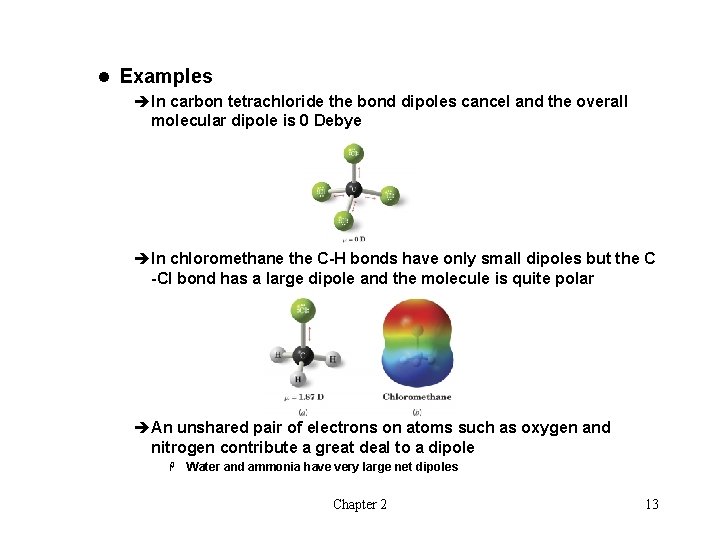
l Examples èIn carbon tetrachloride the bond dipoles cancel and the overall molecular dipole is 0 Debye èIn chloromethane the C-H bonds have only small dipoles but the C -Cl bond has a large dipole and the molecule is quite polar èAn unshared pair of electrons on atoms such as oxygen and nitrogen contribute a great deal to a dipole H Water and ammonia have very large net dipoles Chapter 2 13
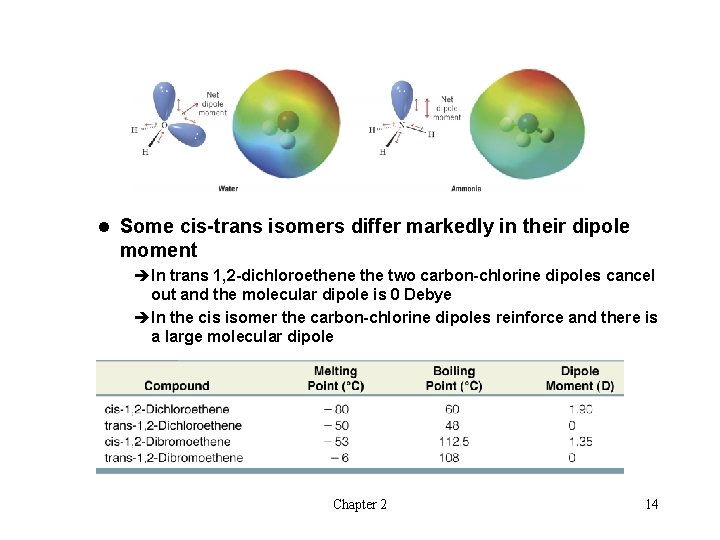
l Some cis-trans isomers differ markedly in their dipole moment èIn trans 1, 2 -dichloroethene the two carbon-chlorine dipoles cancel out and the molecular dipole is 0 Debye èIn the cis isomer the carbon-chlorine dipoles reinforce and there is a large molecular dipole Chapter 2 14
t Functional Groups èFunctional group families are characterized by the presence of a certain arrangement of atoms called a functional group èA functional group is the site of most chemical reactivity of a molecule H The functional group is responsible for many of the physical properties of a molecule èAlkanes do not have a functional groups H Carbon-carbon single bonds and carbon-hydrogen bonds are generally very unreactive Chapter 2 15

l Alkyl Groups and the Symbol R è Alkyl groups are obtained by removing a hydrogen from an alkane è Often more than one alkyl group can be obtained from an alkane by removal of different kinds of hydrogens è R is the symbol to represent a generic alkyl groups H The general formula for an alkane can be abbreviated R-H Chapter 2 16
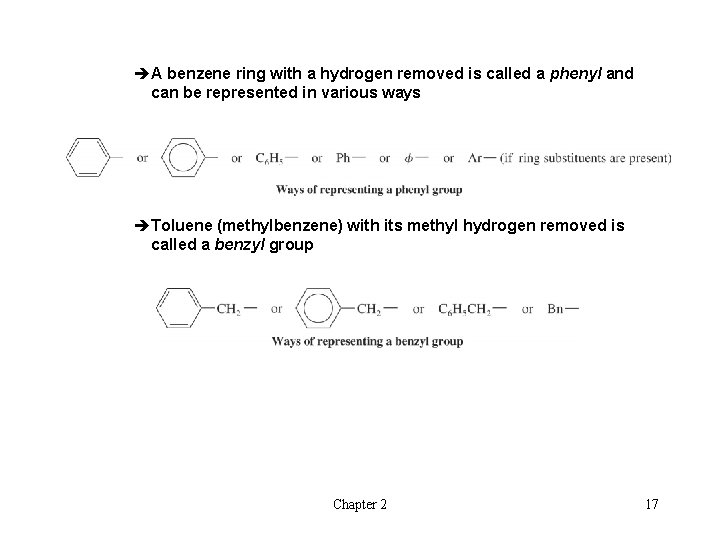
èA benzene ring with a hydrogen removed is called a phenyl and can be represented in various ways èToluene (methylbenzene) with its methyl hydrogen removed is called a benzyl group Chapter 2 17
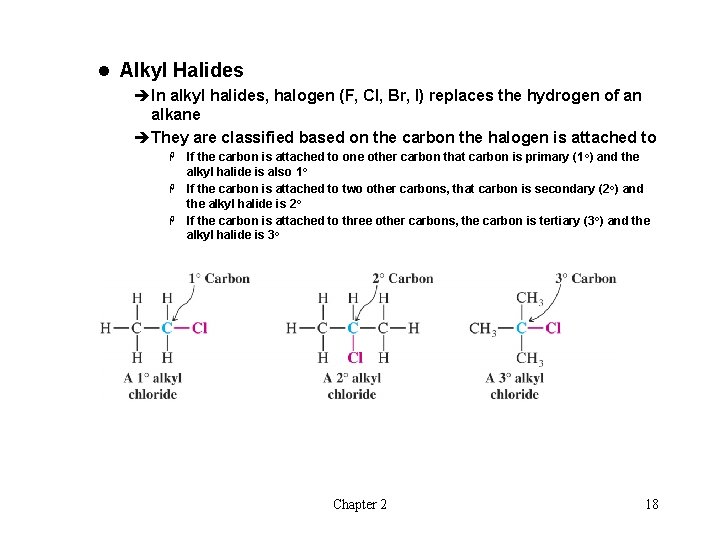
l Alkyl Halides èIn alkyl halides, halogen (F, Cl, Br, I) replaces the hydrogen of an alkane èThey are classified based on the carbon the halogen is attached to If the carbon is attached to one other carbon that carbon is primary (1 o) and the alkyl halide is also 1 o H If the carbon is attached to two other carbons, that carbon is secondary (2 o) and the alkyl halide is 2 o H If the carbon is attached to three other carbons, the carbon is tertiary (3 o) and the alkyl halide is 3 o H Chapter 2 18
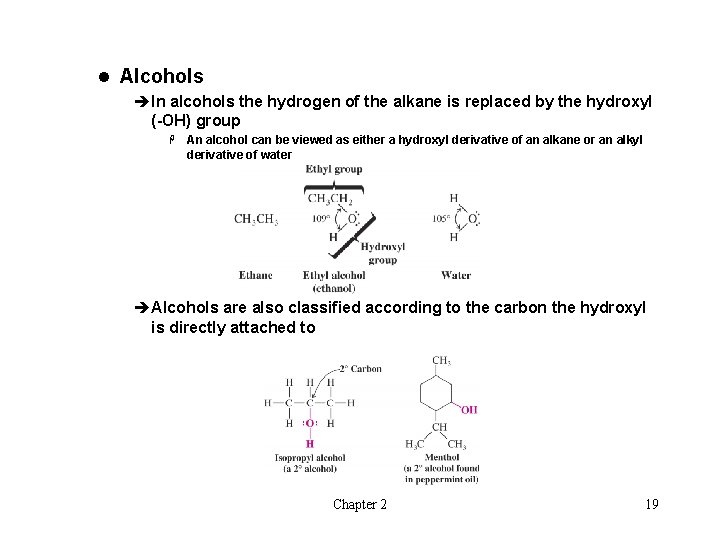
l Alcohols èIn alcohols the hydrogen of the alkane is replaced by the hydroxyl (-OH) group H An alcohol can be viewed as either a hydroxyl derivative of an alkane or an alkyl derivative of water èAlcohols are also classified according to the carbon the hydroxyl is directly attached to Chapter 2 19
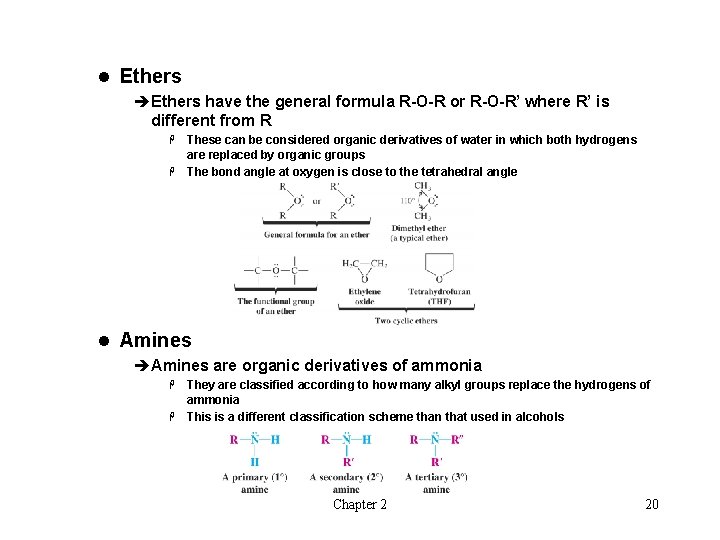
l Ethers èEthers have the general formula R-O-R or R-O-R’ where R’ is different from R These can be considered organic derivatives of water in which both hydrogens are replaced by organic groups H The bond angle at oxygen is close to the tetrahedral angle H l Amines èAmines are organic derivatives of ammonia They are classified according to how many alkyl groups replace the hydrogens of ammonia H This is a different classification scheme than that used in alcohols H Chapter 2 20

l Aldehydes and Ketones è Both contain the carbonyl group è Aldehydes have at least one carbon attached to the carbonyl group è Ketones have two organic groups attached to the carbonyl group è The carbonyl carbon is sp 2 hybridized H It is trigonal planar and has bond angle about 120 o Chapter 2 21
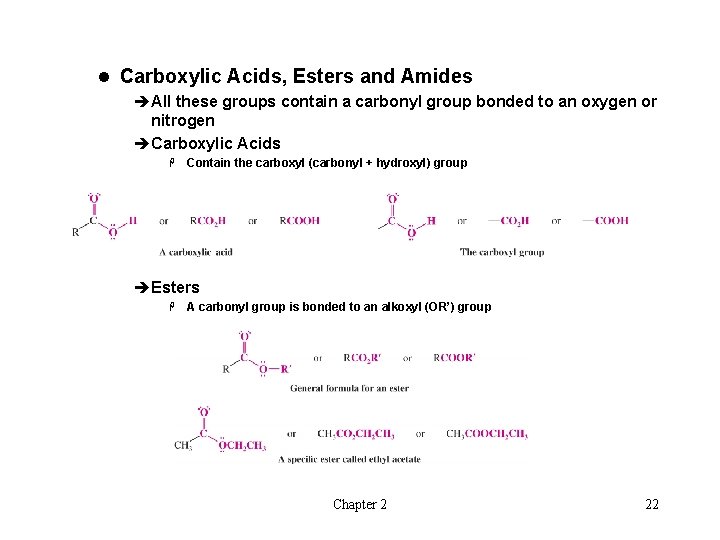
l Carboxylic Acids, Esters and Amides èAll these groups contain a carbonyl group bonded to an oxygen or nitrogen èCarboxylic Acids H Contain the carboxyl (carbonyl + hydroxyl) group èEsters H A carbonyl group is bonded to an alkoxyl (OR’) group Chapter 2 22
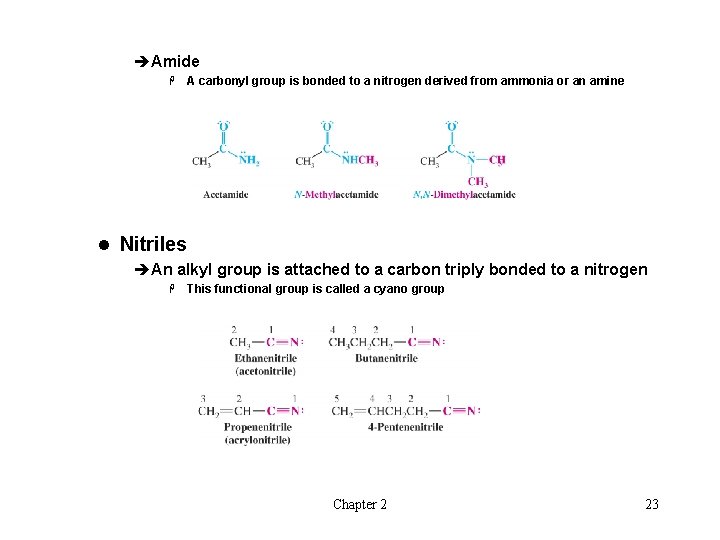
èAmide H A carbonyl group is bonded to a nitrogen derived from ammonia or an amine l Nitriles èAn alkyl group is attached to a carbon triply bonded to a nitrogen H This functional group is called a cyano group Chapter 2 23
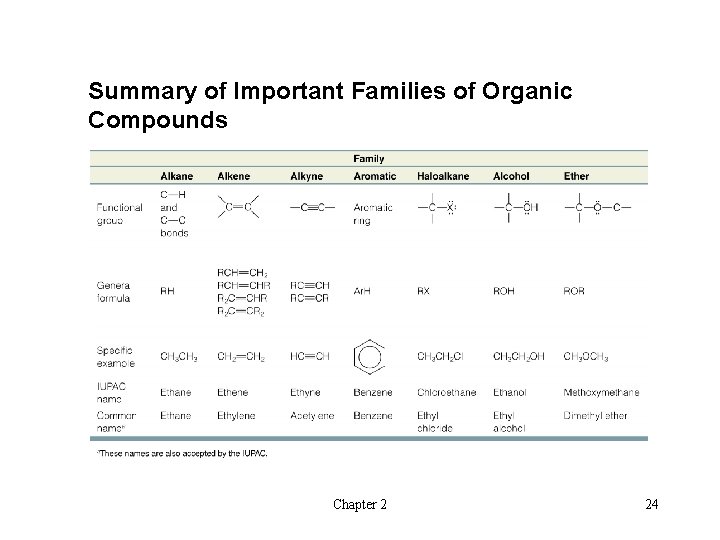
Summary of Important Families of Organic Compounds Chapter 2 24
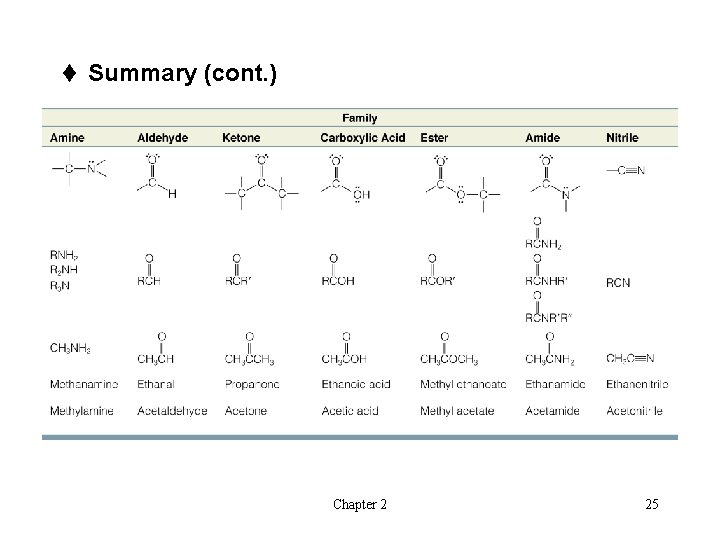
t Summary (cont. ) Chapter 2 25
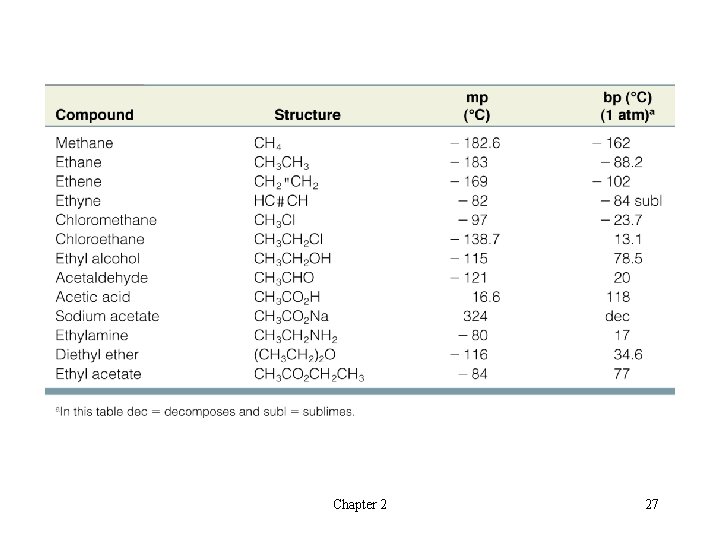
t Physical Properties and Molecular Structure èThe strength of intermolecular forces (forces between molecules) determines the physical properties (i. e. melting point, boiling point and solubility) of a compound èStronger intermolecular forces result in high melting points and boiling points H More energy must be expended to overcome very strong forces between molecules èThe type of intermolecular forces important for a molecule are determined by its structure èThe physical properties of some representative compounds are shown on the next slide Chapter 2 26
Chapter 2 27
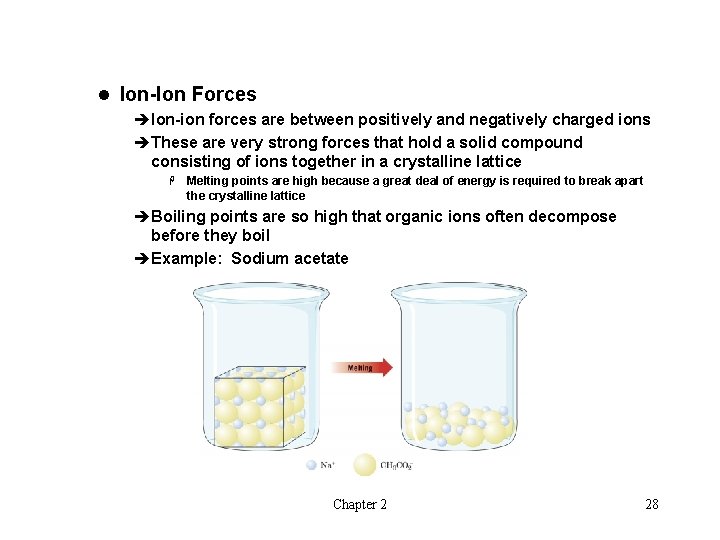
l Ion-Ion Forces èIon-ion forces are between positively and negatively charged ions èThese are very strong forces that hold a solid compound consisting of ions together in a crystalline lattice H Melting points are high because a great deal of energy is required to break apart the crystalline lattice èBoiling points are so high that organic ions often decompose before they boil èExample: Sodium acetate Chapter 2 28
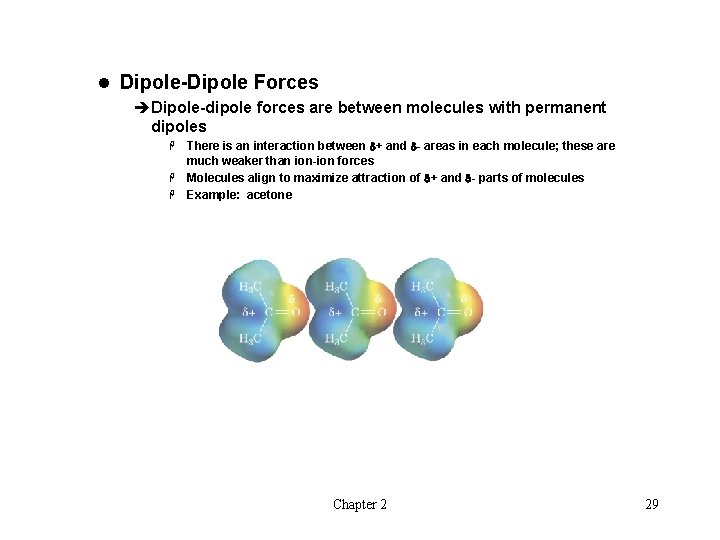
l Dipole-Dipole Forces èDipole-dipole forces are between molecules with permanent dipoles There is an interaction between d+ and d- areas in each molecule; these are much weaker than ion-ion forces H Molecules align to maximize attraction of d+ and d- parts of molecules H Example: acetone H Chapter 2 29
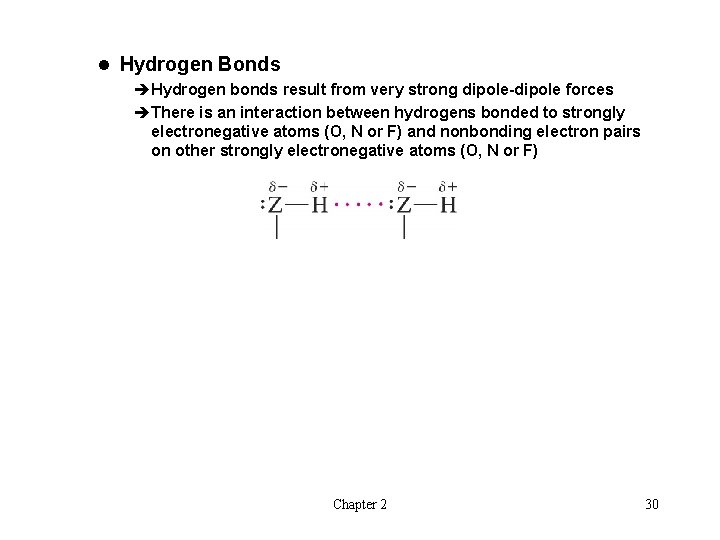
l Hydrogen Bonds èHydrogen bonds result from very strong dipole-dipole forces èThere is an interaction between hydrogens bonded to strongly electronegative atoms (O, N or F) and nonbonding electron pairs on other strongly electronegative atoms (O, N or F) Chapter 2 30
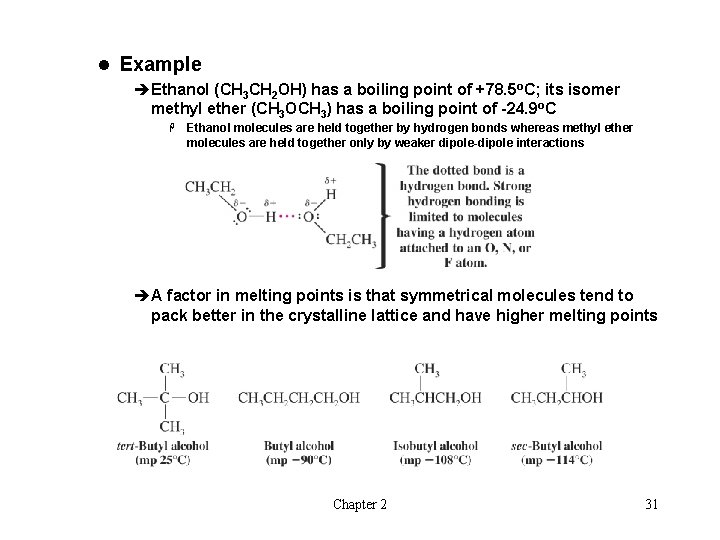
l Example èEthanol (CH 3 CH 2 OH) has a boiling point of +78. 5 o. C; its isomer methyl ether (CH 3 OCH 3) has a boiling point of -24. 9 o. C H Ethanol molecules are held together by hydrogen bonds whereas methyl ether molecules are held together only by weaker dipole-dipole interactions èA factor in melting points is that symmetrical molecules tend to pack better in the crystalline lattice and have higher melting points Chapter 2 31
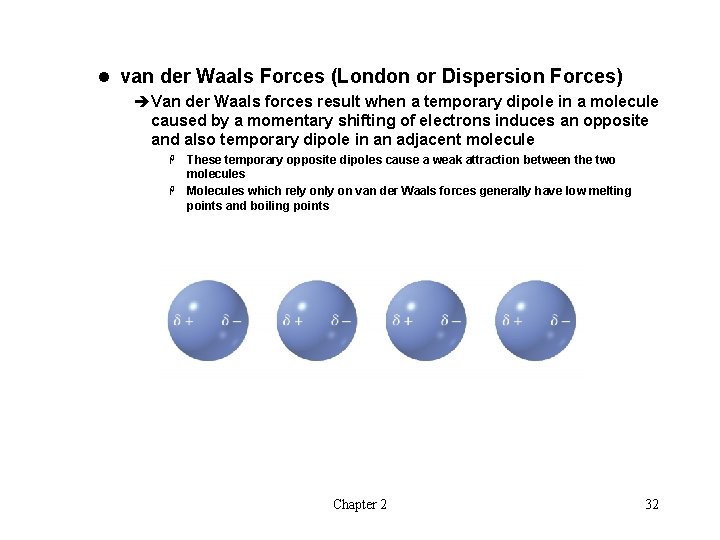
l van der Waals Forces (London or Dispersion Forces) èVan der Waals forces result when a temporary dipole in a molecule caused by a momentary shifting of electrons induces an opposite and also temporary dipole in an adjacent molecule These temporary opposite dipoles cause a weak attraction between the two molecules H Molecules which rely on van der Waals forces generally have low melting points and boiling points H Chapter 2 32

è Polarizability predicts the magnitude of van der Waals Interactions H H Polarizability is the ability of the electrons on an atom to respond to a changing electric field Atoms with very loosely held electrons are more polarizable Iodine atoms are more polarizable than fluorine atoms because the outer shell electrons are more loosely held Atoms with unshared electrons are more polarizable (a halogen is more polarizable than an alkyl of similar size) è All things being equal larger and heavier molecules have higher boiling points H H H Larger molecules need more energy to escape the surface of the liquid Larger organic molecules tend to have more surface area in contact with each other and so have stronger van der Waals interactions Methane (CH 4) has a boiling point of -162 o. C whereas ethane (C 2 H 6) has a boiling point of -88. 2 o. C Chapter 2 33
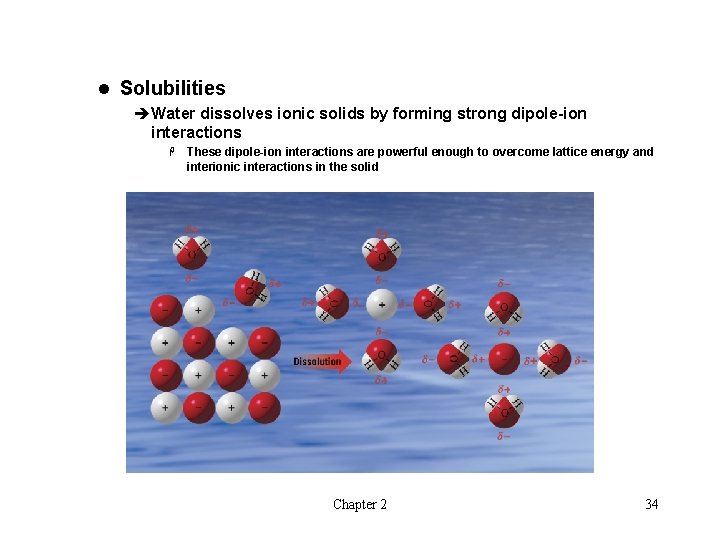
l Solubilities èWater dissolves ionic solids by forming strong dipole-ion interactions H These dipole-ion interactions are powerful enough to overcome lattice energy and interionic interactions in the solid Chapter 2 34
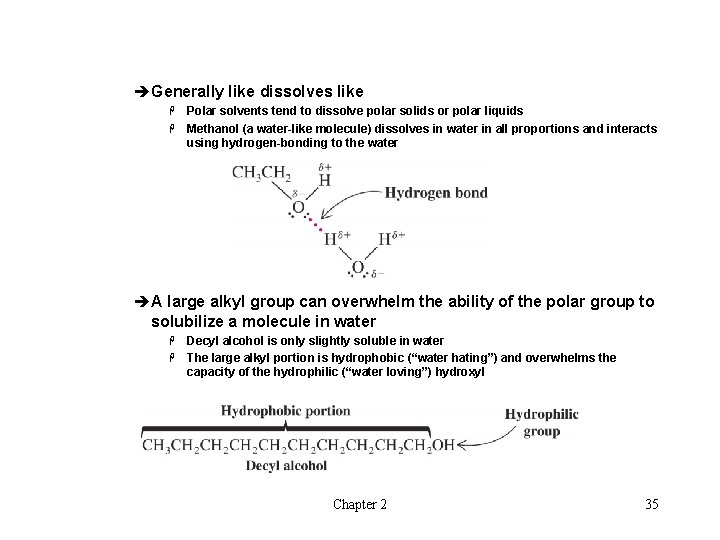
èGenerally like dissolves like Polar solvents tend to dissolve polar solids or polar liquids H Methanol (a water-like molecule) dissolves in water in all proportions and interacts using hydrogen-bonding to the water H èA large alkyl group can overwhelm the ability of the polar group to solubilize a molecule in water Decyl alcohol is only slightly soluble in water H The large alkyl portion is hydrophobic (“water hating”) and overwhelms the capacity of the hydrophilic (“water loving”) hydroxyl H Chapter 2 35
- Slides: 35