
Chapter 2 RDF Syntax 2 Topics Basic concepts
Chapter 2 RDF Syntax 2
Topics • Basic concepts of RDF • • • Vocabularies and modeling • • Vocabularies Blank nodes, data modeling, types, reification Lists, bags, collections Serialization of RDF graphs • • Resources, properties, values, statements, triples URIs and URIrefs RDF graphs Literals, qnames XML, Turtle, Ntriples Critique of RDF
Types
RDF type l RDF has a type predicate that links a resource to another that denotes its type – – ex: john rdf: type foaf: Person. <http: //example. org/john > <http: //www. w 3. org/1999/02/22 -rdf-syntax-ns#type> <http: //xmlns. com/foaf/0. 1/Person>. l RDFS adds sub-type concept & constraints between predicates & types of their arguments l OWL adds still more concepts operating on types
Data Modeling
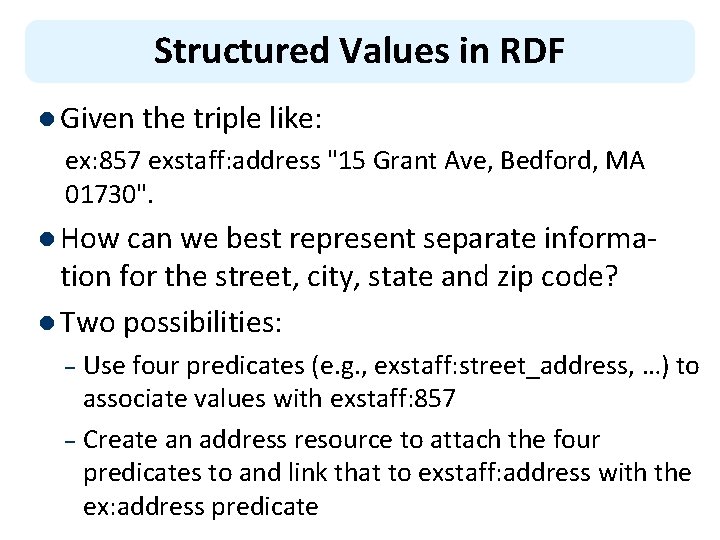
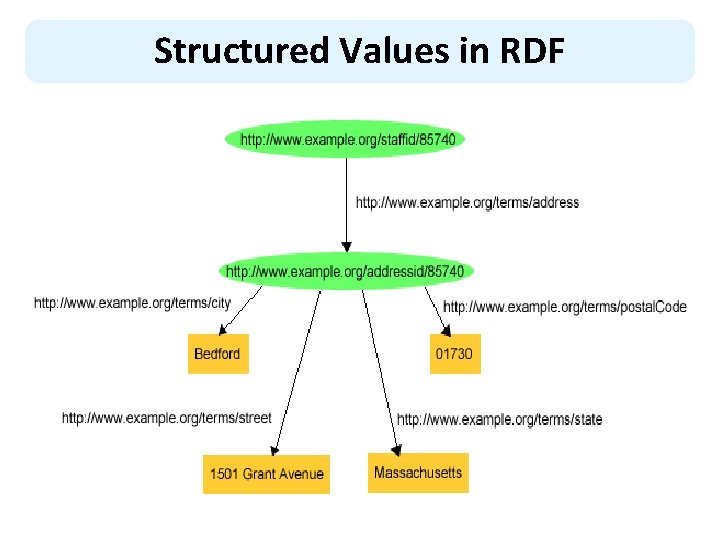
Structured Values in RDF l Given the triple like: ex: 857 exstaff: address "15 Grant Ave, Bedford, MA 01730". l How can we best represent separate informa- tion for the street, city, state and zip code? l Two possibilities: Use four predicates (e. g. , exstaff: street_address, …) to associate values with exstaff: 857 – Create an address resource to attach the four predicates to and link that to exstaff: address with the ex: address predicate –
Structured Values in RDF
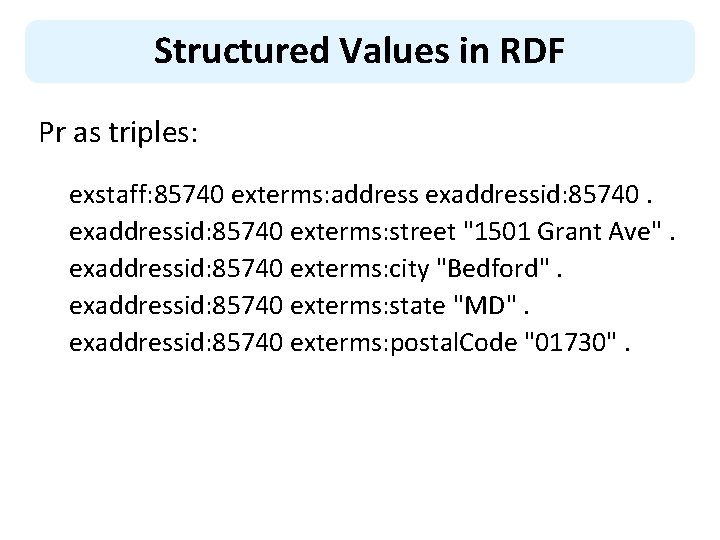
Structured Values in RDF Pr as triples: exstaff: 85740 exterms: address exaddressid: 85740 exterms: street "1501 Grant Ave". exaddressid: 85740 exterms: city "Bedford". exaddressid: 85740 exterms: state "MD". exaddressid: 85740 exterms: postal. Code "01730".
Structured Values in RDF l This approach involves adding many “inter- mediate” URIrefs (e. g. , exaddressid: 85740) for aggregate concepts like John's address l Such concepts may never need to be referred to directly from outside a particular graph, and hence may not require “universal” identifiers l RDF allows us to use blank nodes and blank node identifiers to deal with this issue – Node IDs in the _ namespace are bnodes, e. g. _:
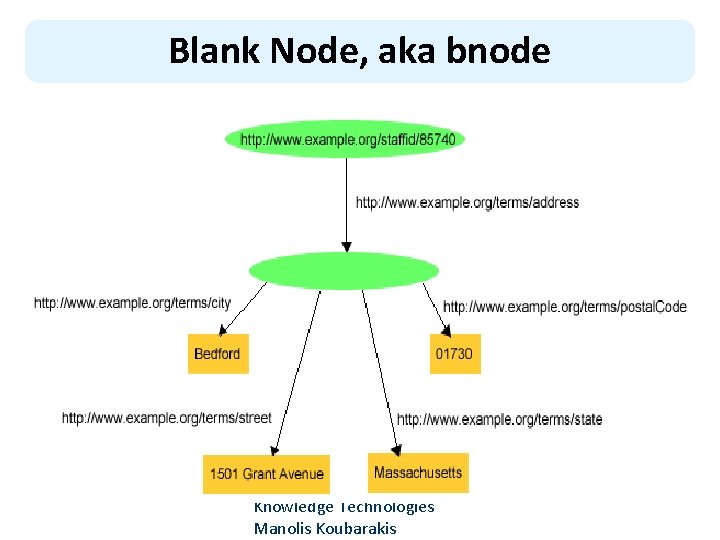
Blank Node, aka bnode Knowledge Technologies Manolis Koubarakis
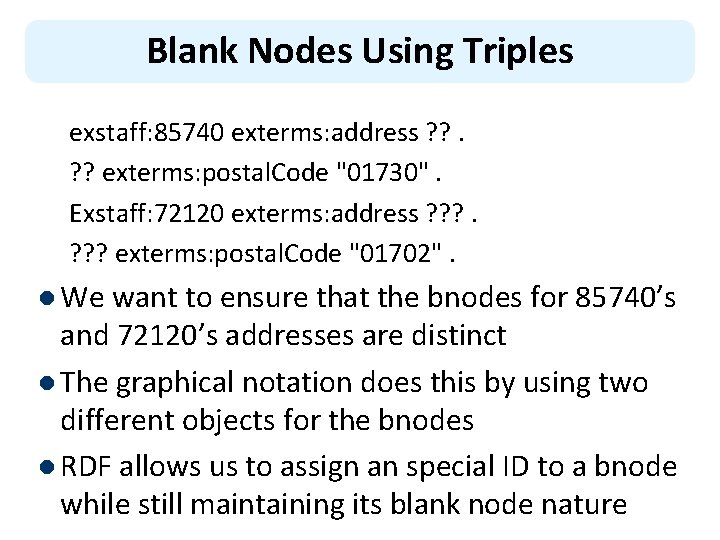
Blank Nodes Using Triples exstaff: 85740 exterms: address ? ? exterms: postal. Code "01730". Exstaff: 72120 exterms: address ? ? ? exterms: postal. Code "01702". l We want to ensure that the bnodes for 85740’s and 72120’s addresses are distinct l The graphical notation does this by using two different objects for the bnodes l RDF allows us to assign an special ID to a bnode while still maintaining its blank node nature
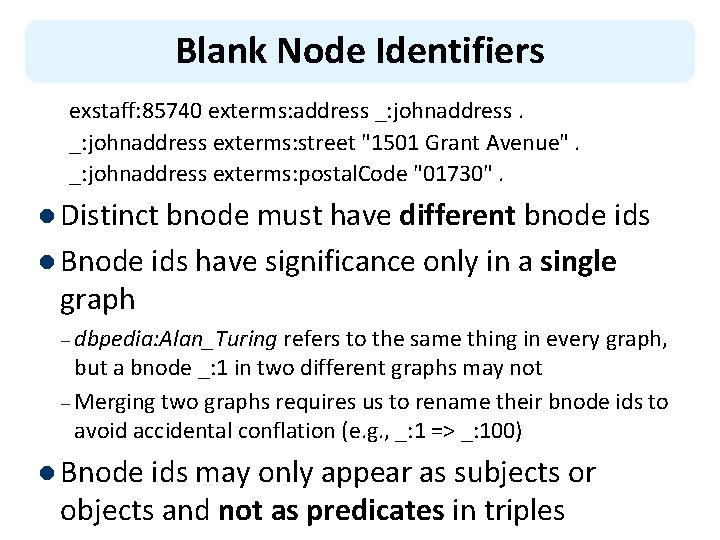
Blank Node Identifiers exstaff: 85740 exterms: address _: johnaddress exterms: street "1501 Grant Avenue". _: johnaddress exterms: postal. Code "01730". l Distinct bnode must have different bnode ids l Bnode ids have significance only in a single graph – dbpedia: Alan_Turing refers to the same thing in every graph, but a bnode _: 1 in two different graphs may not – Merging two graphs requires us to rename their bnode ids to avoid accidental conflation (e. g. , _: 1 => _: 100) l Bnode ids may only appear as subjects or objects and not as predicates in triples
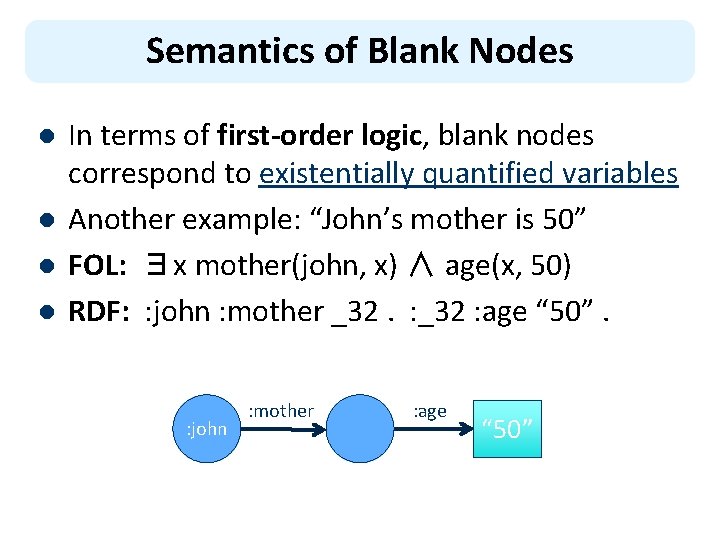
Semantics of Blank Nodes l l In terms of first-order logic, blank nodes correspond to existentially quantified variables Another example: “John’s mother is 50” FOL: ∃x mother(john, x) ∧ age(x, 50) RDF: : john : mother _32. : _32 : age “ 50”. : john : mother : age “ 50”
Blank nodes are good for l Representing n-ary relationships in RDF e. g. , the relationship between John Smith and the street, city, state, and postal code components of his address l To make statements about resources that don’t have URIs but are described by relationships with other resources that do e. g. , John’s mother
Example l To make statements about Jane Smith we could use her email address URI (mailto: jane@example. org) to denote her l Well, if we do so, how are we going to record information both about Jane's mailbox (e. g. , the server it is on) as well as about Jane herself (e. g. , her current physical address)? Similarly, if we use her Web page URI etc.
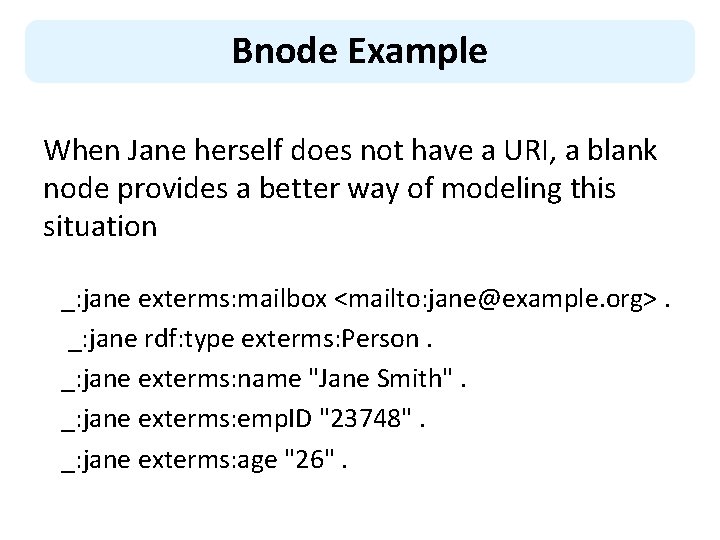
Bnode Example When Jane herself does not have a URI, a blank node provides a better way of modeling this situation _: jane exterms: mailbox <mailto: jane@example. org>. _: jane rdf: type exterms: Person. _: jane exterms: name "Jane Smith". _: jane exterms: emp. ID "23748". _: jane exterms: age "26".
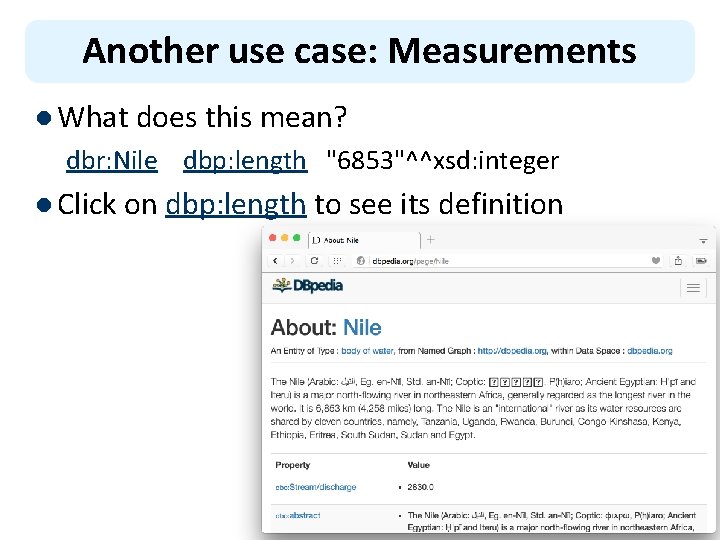
Another use case: Measurements l What does this mean? dbr: Nile dbp: length "6853"^^xsd: integer l Click on dbp: length to see its definition
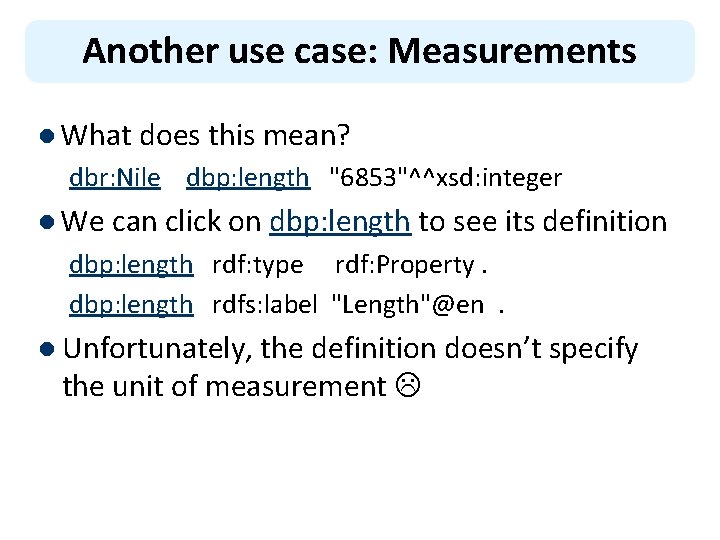
Another use case: Measurements l What does this mean? dbr: Nile dbp: length "6853"^^xsd: integer l We can click on dbp: length to see its definition dbp: length rdf: type rdf: Property. dbp: length rdfs: label "Length"@en. l Unfortunately, the definition doesn’t specify the unit of measurement
Another use case: Measurements l What does this mean? dbr: Nile dbp: length "6853"^^xsd: integer l Measurements typically have a numeric and a unit – – value Weight: 2. 4 pounds vs. 2. 4 kilograms Length: 5 miles vs. 5 kilometers Price: 29. 00 in US Dollars vs. 21. 16 Euro Time: 30 years vs. 3 milliseconds l We can use a bnode to represent a measurement as a pair with a value and unit
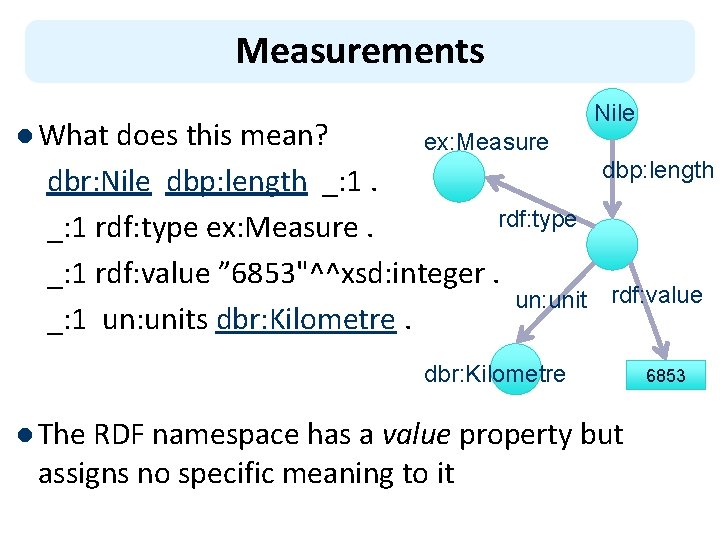
Measurements l What does this mean? Nile ex: Measure dbr: Nile dbp: length _: 1. rdf: type _: 1 rdf: type ex: Measure. _: 1 rdf: value ” 6853"^^xsd: integer. un: unit _: 1 un: units dbr: Kilometre. dbp: length rdf: value dbr: Kilometre l The RDF namespace has a value property but assigns no specific meaning to it 6853
Serialization
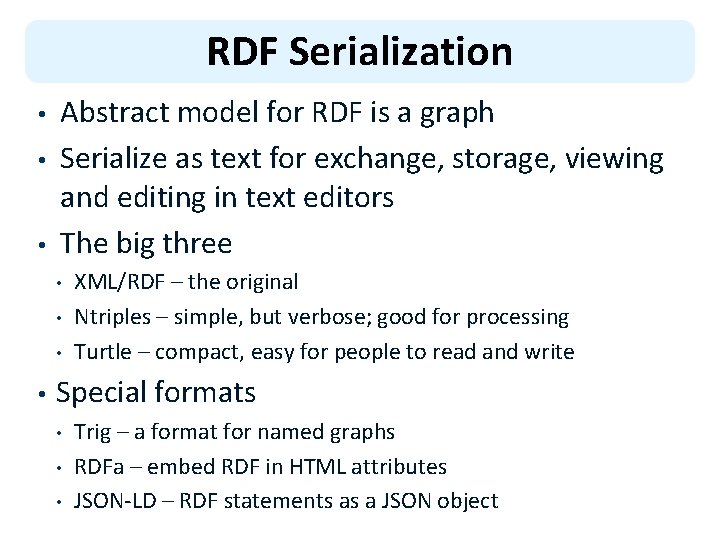
RDF Serialization • • • Abstract model for RDF is a graph Serialize as text for exchange, storage, viewing and editing in text editors The big three • • XML/RDF – the original Ntriples – simple, but verbose; good for processing Turtle – compact, easy for people to read and write Special formats • • • Trig – a format for named graphs RDFa – embed RDF in HTML attributes JSON-LD – RDF statements as a JSON object
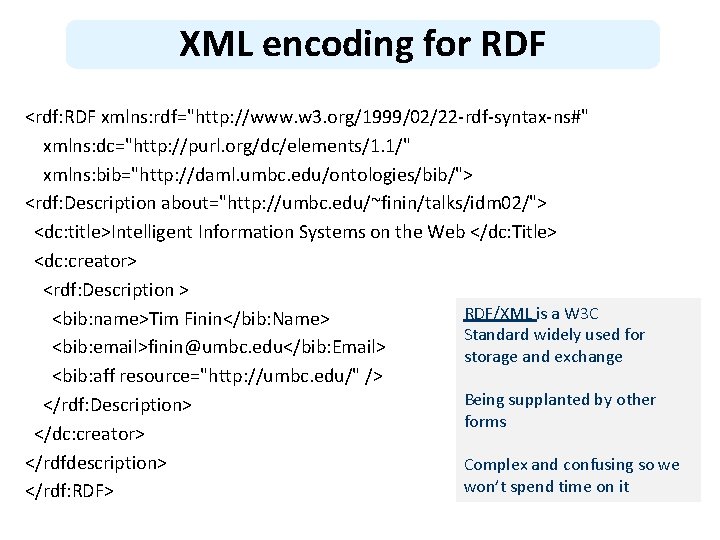
XML encoding for RDF <rdf: RDF xmlns: rdf="http: //www. w 3. org/1999/02/22 -rdf-syntax-ns#" xmlns: dc="http: //purl. org/dc/elements/1. 1/" xmlns: bib="http: //daml. umbc. edu/ontologies/bib/"> <rdf: Description about="http: //umbc. edu/~finin/talks/idm 02/"> <dc: title>Intelligent Information Systems on the Web </dc: Title> <dc: creator> <rdf: Description > RDF/XML is a W 3 C <bib: name>Tim Finin</bib: Name> Standard widely used for <bib: email>finin@umbc. edu</bib: Email> storage and exchange <bib: aff resource="http: //umbc. edu/" /> Being supplanted by other </rdf: Description> forms </dc: creator> </rdfdescription> Complex and confusing so we won’t spend time on it </rdf: RDF>
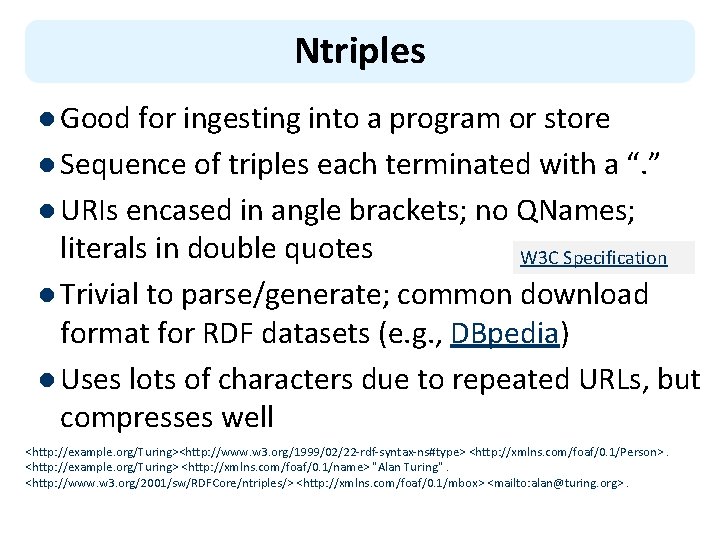
Ntriples l Good for ingesting into a program or store l Sequence of triples each terminated with a “. ” l URIs encased in angle brackets; no QNames; literals in double quotes W 3 C Specification l Trivial to parse/generate; common download format for RDF datasets (e. g. , DBpedia) l Uses lots of characters due to repeated URLs, but compresses well <http: //example. org/Turing><http: //www. w 3. org/1999/02/22 -rdf-syntax-ns#type> <http: //xmlns. com/foaf/0. 1/Person>. <http: //example. org/Turing> <http: //xmlns. com/foaf/0. 1/name> "Alan Turing". <http: //www. w 3. org/2001/sw/RDFCore/ntriples/> <http: //xmlns. com/foaf/0. 1/mbox> <mailto: alan@turing. org>.
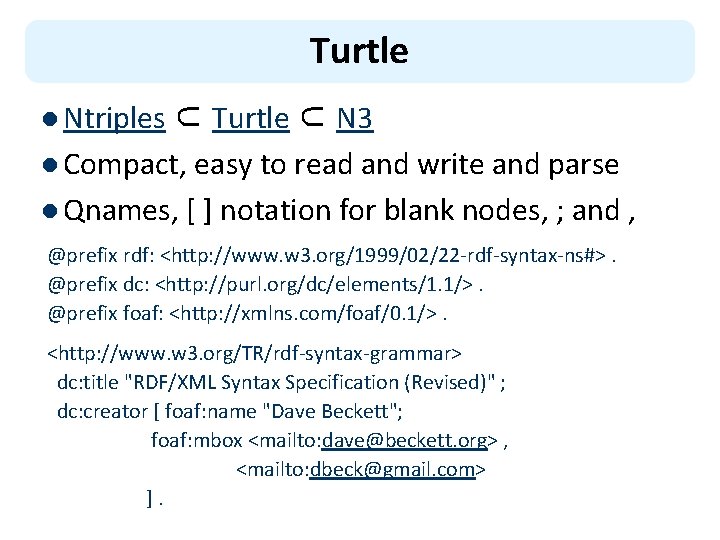
Turtle l Ntriples ⊂ Turtle ⊂ N 3 l Compact, easy to read and write and parse l Qnames, [ ] notation for blank nodes, ; and , @prefix rdf: <http: //www. w 3. org/1999/02/22 -rdf-syntax-ns#>. @prefix dc: <http: //purl. org/dc/elements/1. 1/>. @prefix foaf: <http: //xmlns. com/foaf/0. 1/>. <http: //www. w 3. org/TR/rdf-syntax-grammar> dc: title "RDF/XML Syntax Specification (Revised)" ; dc: creator [ foaf: name "Dave Beckett"; foaf: mbox <mailto: dave@beckett. org> , <mailto: dbeck@gmail. com> ].
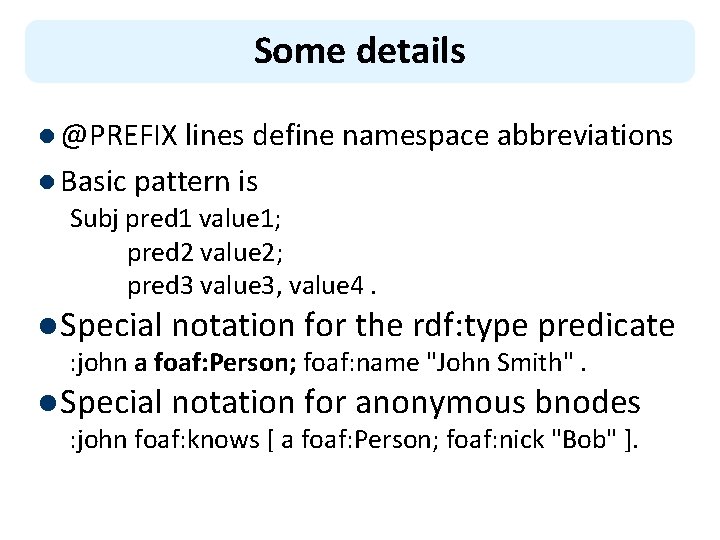
Some details l @PREFIX lines define namespace abbreviations l Basic pattern is Subj pred 1 value 1; pred 2 value 2; pred 3 value 3, value 4. l Special notation for the rdf: type predicate : john a foaf: Person; foaf: name "John Smith". l Special notation for anonymous bnodes : john foaf: knows [ a foaf: Person; foaf: nick "Bob" ].
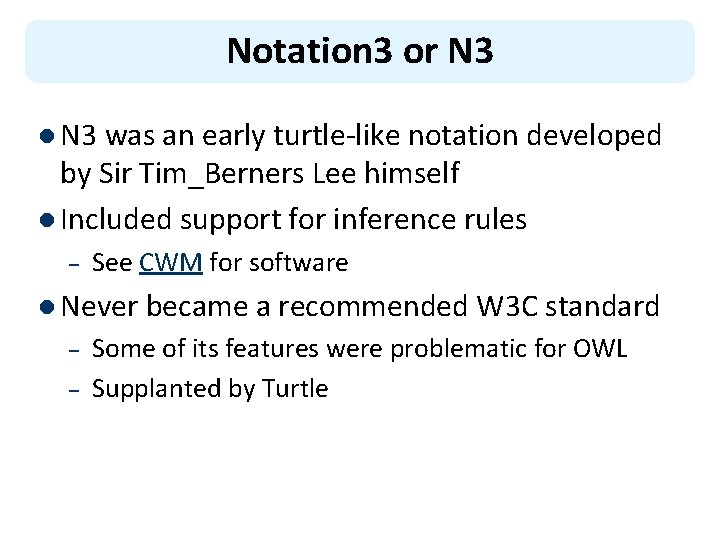
Notation 3 or N 3 l N 3 was an early turtle-like notation developed by Sir Tim_Berners Lee himself l Included support for inference rules – See CWM for software l Never became a recommended W 3 C standard – – Some of its features were problematic for OWL Supplanted by Turtle
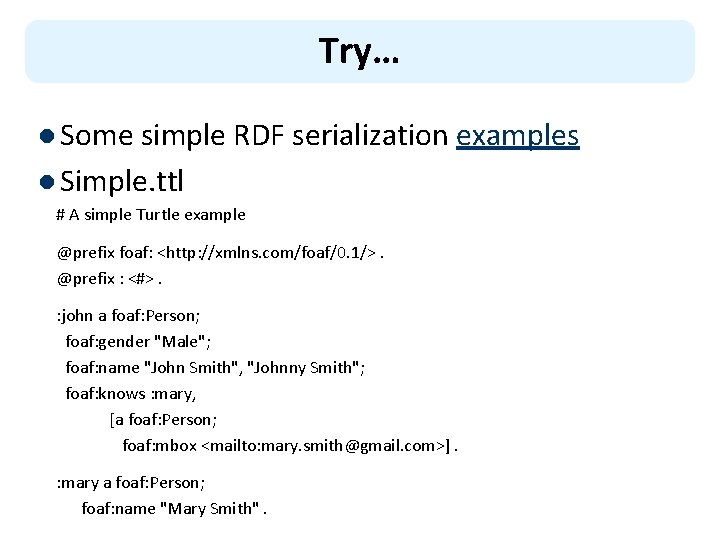
Try… l Some simple RDF serialization examples l Simple. ttl # A simple Turtle example @prefix foaf: <http: //xmlns. com/foaf/0. 1/>. @prefix : <#>. : john a foaf: Person; foaf: gender "Male"; foaf: name "John Smith", "Johnny Smith"; foaf: knows : mary, [a foaf: Person; foaf: mbox <mailto: mary. smith@gmail. com>]. : mary a foaf: Person; foaf: name "Mary Smith".
Notation translation l Most modern Semantic Web software can read and write rdf in all major serializations – E. g. , Protégé, Jena, Sesame, l There also simple programs that can convert between them – rdf 2 rdf is an example written in Java
Reification
Reification l Sometimes we wish to make statements about other statements E. g. , to record provenance data, probability, or to assert : john : believes { : mary : loves : john } l l We must be able to refer to a statement using an identifier RDF allows such reference through a reification mechanism which turns a statement into a resource
Reify l Etymology: Latin res thing l Date: 1854 l To regard (something abstract) as a material or concrete thing
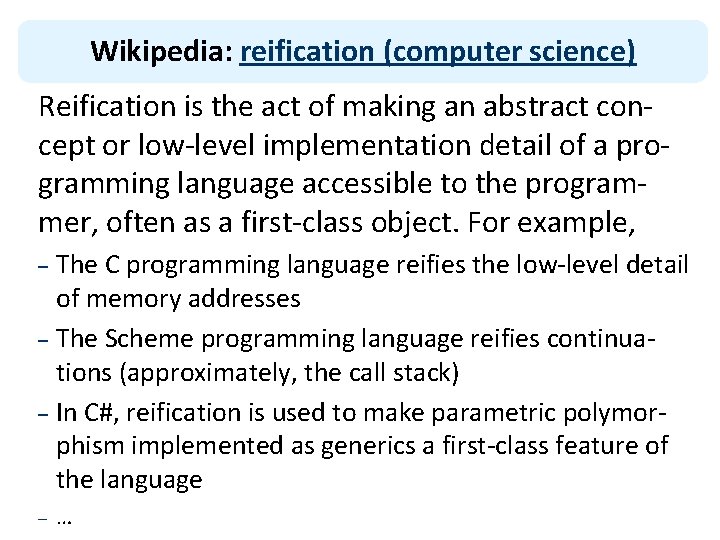
Wikipedia: reification (computer science) Reification is the act of making an abstract concept or low-level implementation detail of a programming language accessible to the programmer, often as a first-class object. For example, The C programming language reifies the low-level detail of memory addresses – The Scheme programming language reifies continuations (approximately, the call stack) – In C#, reification is used to make parametric polymorphism implemented as generics a first-class feature of the language – – …
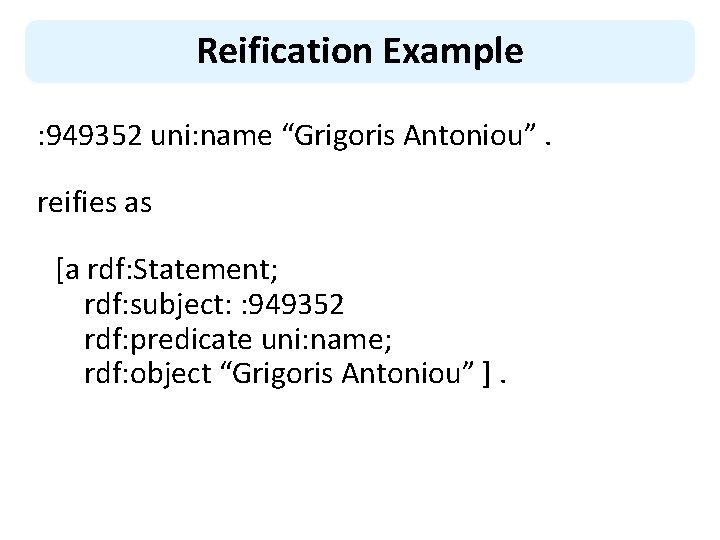
Reification Example : 949352 uni: name “Grigoris Antoniou”. reifies as [a rdf: Statement; rdf: subject: : 949352 rdf: predicate uni: name; rdf: object “Grigoris Antoniou” ].
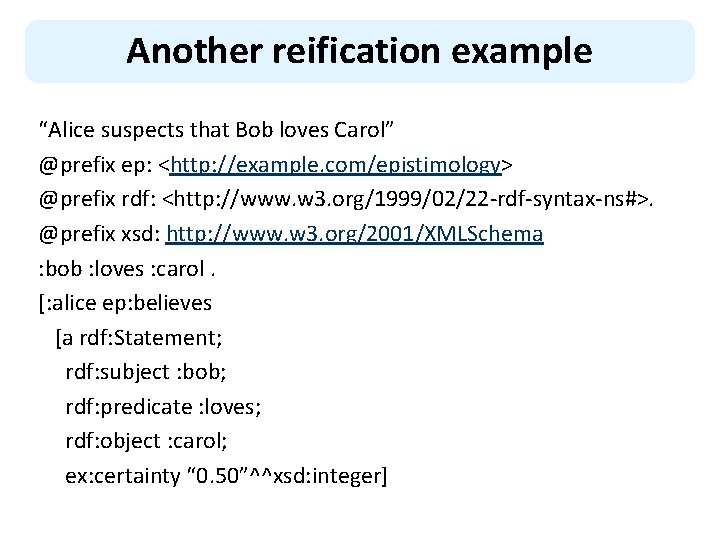
Another reification example “Alice suspects that Bob loves Carol” @prefix ep: <http: //example. com/epistimology> @prefix rdf: <http: //www. w 3. org/1999/02/22 -rdf-syntax-ns#>. @prefix xsd: http: //www. w 3. org/2001/XMLSchema : bob : loves : carol. [: alice ep: believes [a rdf: Statement; rdf: subject : bob; rdf: predicate : loves; rdf: object : carol; ex: certainty “ 0. 50”^^xsd: integer]
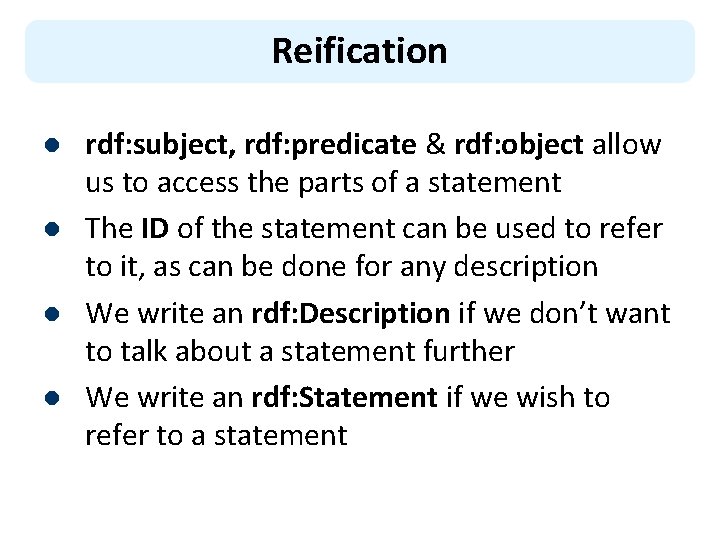
Reification l l rdf: subject, rdf: predicate & rdf: object allow us to access the parts of a statement The ID of the statement can be used to refer to it, as can be done for any description We write an rdf: Description if we don’t want to talk about a statement further We write an rdf: Statement if we wish to refer to a statement
Containers
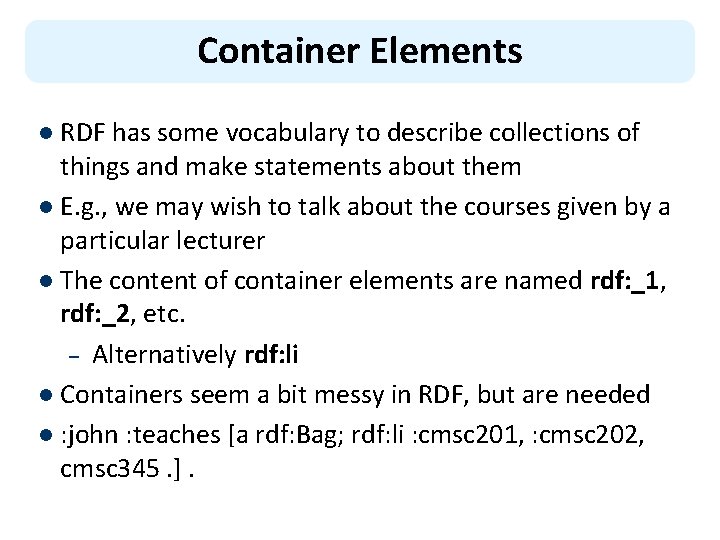
Container Elements l RDF has some vocabulary to describe collections of things and make statements about them l E. g. , we may wish to talk about the courses given by a particular lecturer l The content of container elements are named rdf: _1, rdf: _2, etc. – Alternatively rdf: li l Containers seem a bit messy in RDF, but are needed l : john : teaches [a rdf: Bag; rdf: li : cmsc 201, : cmsc 202, cmsc 345. ].
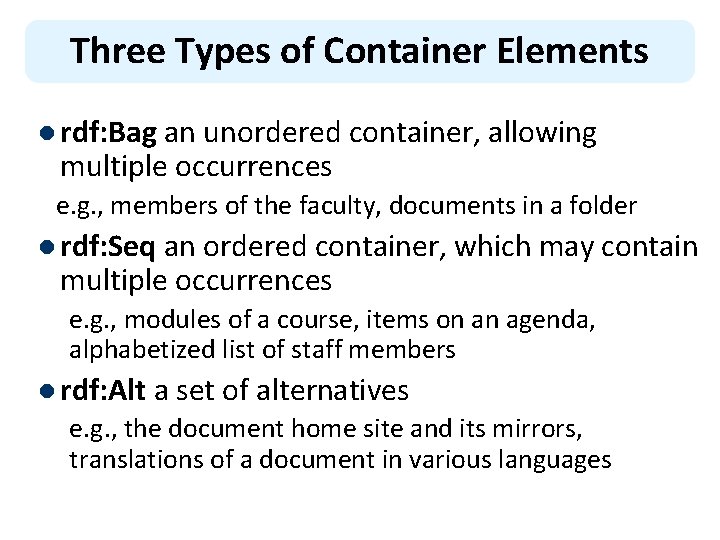
Three Types of Container Elements l rdf: Bag an unordered container, allowing multiple occurrences e. g. , members of the faculty, documents in a folder l rdf: Seq an ordered container, which may contain multiple occurrences e. g. , modules of a course, items on an agenda, alphabetized list of staff members l rdf: Alt a set of alternatives e. g. , the document home site and its mirrors, translations of a document in various languages

Example for a Bag Let’s describe a course with a collection of students
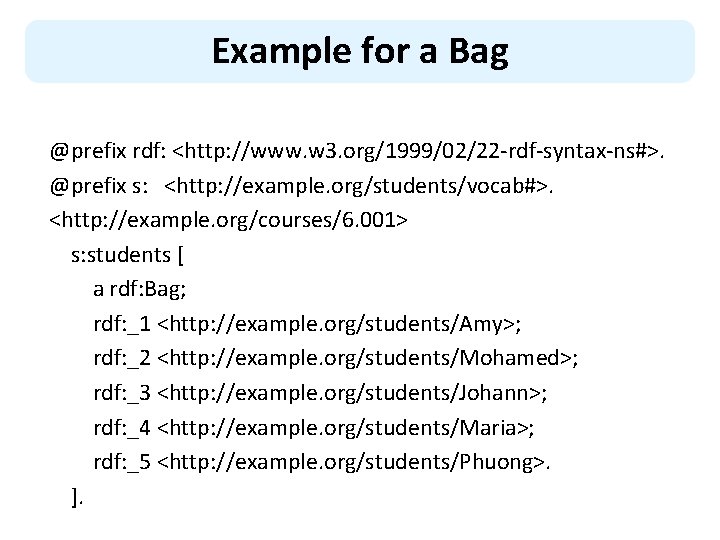
Example for a Bag @prefix rdf: <http: //www. w 3. org/1999/02/22 -rdf-syntax-ns#>. @prefix s: <http: //example. org/students/vocab#>. <http: //example. org/courses/6. 001> s: students [ a rdf: Bag; rdf: _1 <http: //example. org/students/Amy>; rdf: _2 <http: //example. org/students/Mohamed>; rdf: _3 <http: //example. org/students/Johann>; rdf: _4 <http: //example. org/students/Maria>; rdf: _5 <http: //example. org/students/Phuong>. ].
Bags and Seqs are never full! l RDF’s semantics is “open world”, so… – Not possible ”to close” the container, to say: “these are all elements, there are no more” – RDF is a graph, with no way to exclude the possibility that there is another graph somewhere describing additional members l Lists are collections with only the specified members mentioned. l Described using a linked list pattern via: – rdf: List, rdf: first, rdf: rest, rdf: nil
Open vs. closed world semantics l Reasoning systems make a distinction between open and closed world semantics OWS: being unable to prove that something is true or false says nothing about its veracity – CWS: what cannot be proven to be true is false – l. Default model for Semantic Web is OWS This was a design decision made early on
Open vs. closed world semantics l Classical logic uses Open World Semantics Being unable to prove P=NP doesn’t convince us that it’s false l Database systems typically assume CWS The DB includes all trains between NYC and DC l Prolog’s unprovable operator (not or +) supports CWS flys(x) : - bird(x), + flightless(x) : - penguin(x); ostrich(x); emu(x). l Some systems let us specify for which predicates we have complete knowledge and for which we don’t – – If UMBC’s DB doesn’t list you as registered for CMSC 691, you are not registered UMBC’s DB system knows some of your minors but not all
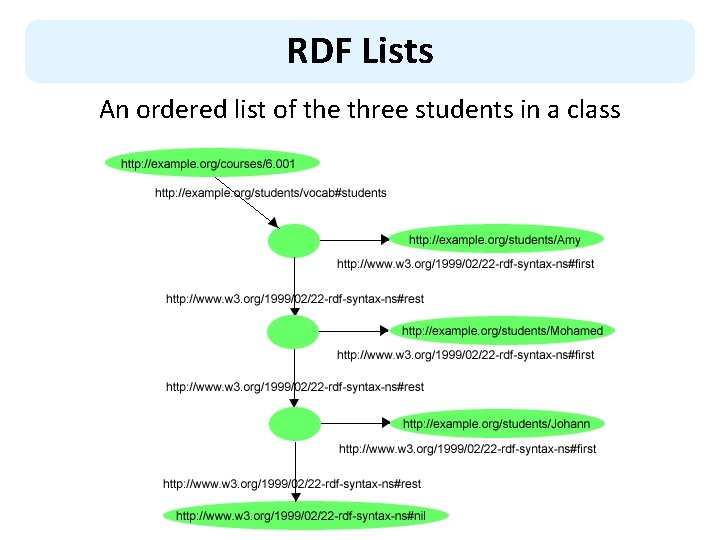
RDF Lists An ordered list of the three students in a class
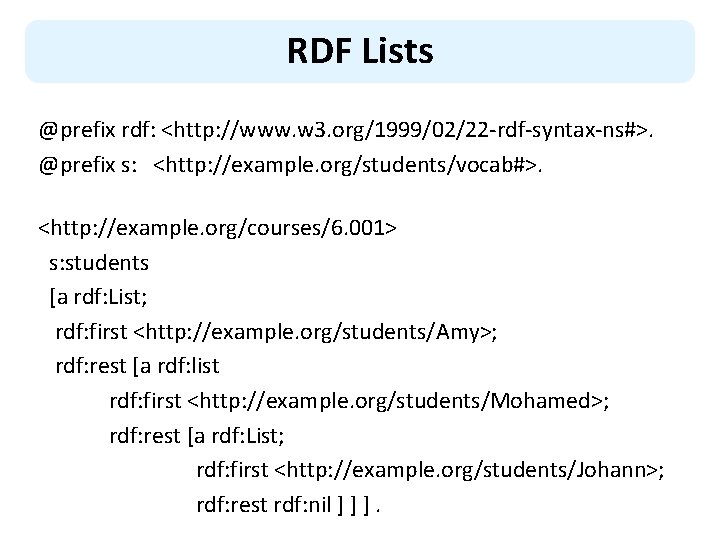
RDF Lists @prefix rdf: <http: //www. w 3. org/1999/02/22 -rdf-syntax-ns#>. @prefix s: <http: //example. org/students/vocab#>. <http: //example. org/courses/6. 001> s: students [a rdf: List; rdf: first <http: //example. org/students/Amy>; rdf: rest [a rdf: list rdf: first <http: //example. org/students/Mohamed>; rdf: rest [a rdf: List; rdf: first <http: //example. org/students/Johann>; rdf: rest rdf: nil ] ] ].
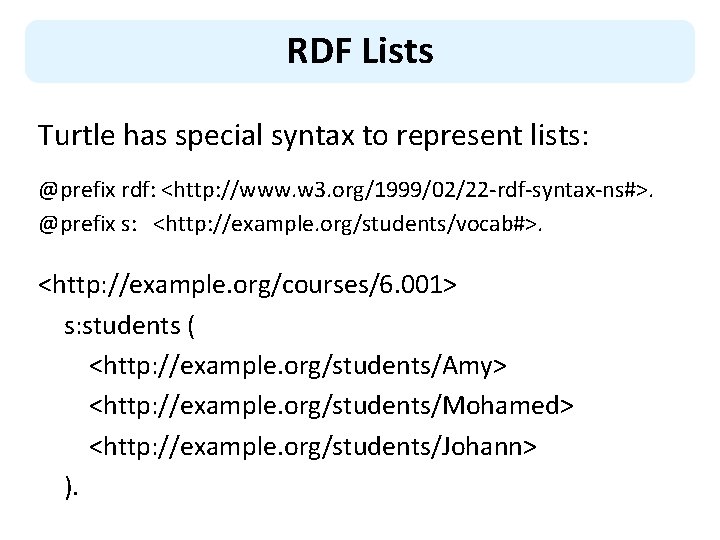
RDF Lists Turtle has special syntax to represent lists: @prefix rdf: <http: //www. w 3. org/1999/02/22 -rdf-syntax-ns#>. @prefix s: <http: //example. org/students/vocab#>. <http: //example. org/courses/6. 001> s: students ( <http: //example. org/students/Amy> <http: //example. org/students/Mohamed> <http: //example. org/students/Johann> ).
Critique of RDF
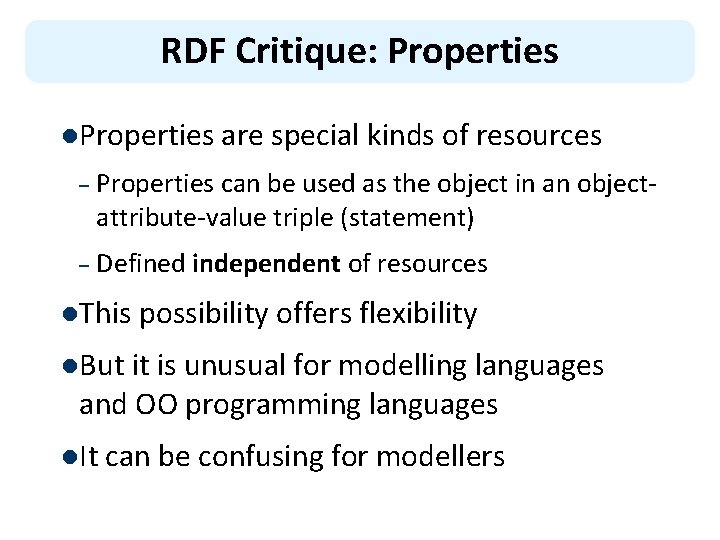
RDF Critique: Properties l. Properties are special kinds of resources – Properties can be used as the object in an objectattribute-value triple (statement) – Defined independent of resources l. This possibility offers flexibility l. But it is unusual for modelling languages and OO programming languages l. It can be confusing for modellers
RDF Critique: Binary Predicates l RDF uses only binary properties This is a restriction because often we use predicates with more than two arguments – But binary predicates can simulate these – l Example: referee(X, Y, Z) – X is the referee in a chess game between players Y and Z
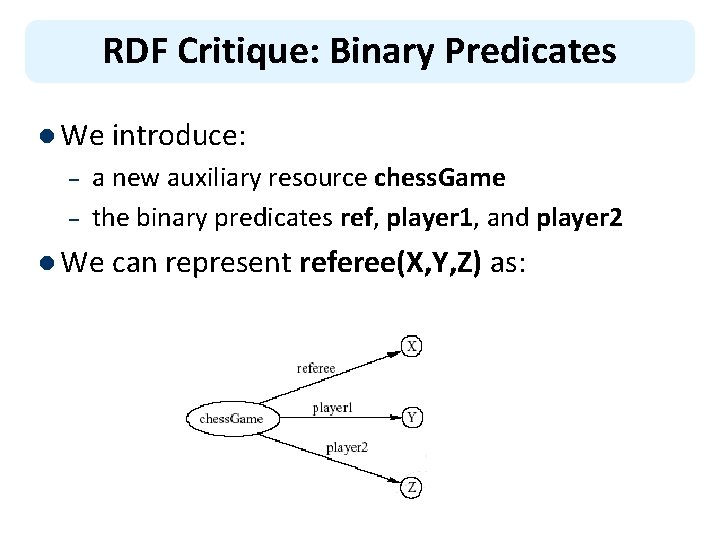
RDF Critique: Binary Predicates l We introduce: – – a new auxiliary resource chess. Game the binary predicates ref, player 1, and player 2 l We can represent referee(X, Y, Z) as:
RDF Critique: Reification l The reification mechanism is quite powerful l It appears misplaced in a simple language like RDF l Making statements about statements introduces a level of complexity that is not necessary for a basic layer of the Semantic Web l Instead, it would have appeared more natural to include it in more powerful layers, which provide richer representational capabilities
RDF Critique: Graph Representation l The simple graph or network representation has more drawbacks l Linear languages introduce ways to represent this with parentheses or a way to represent a block structure l Scoping, for example, is clumsy at best in RDF believe(john, and (love(bob, carol), love(carol, bob)) l Some of these are addressed through the notion of a named graph in RDF
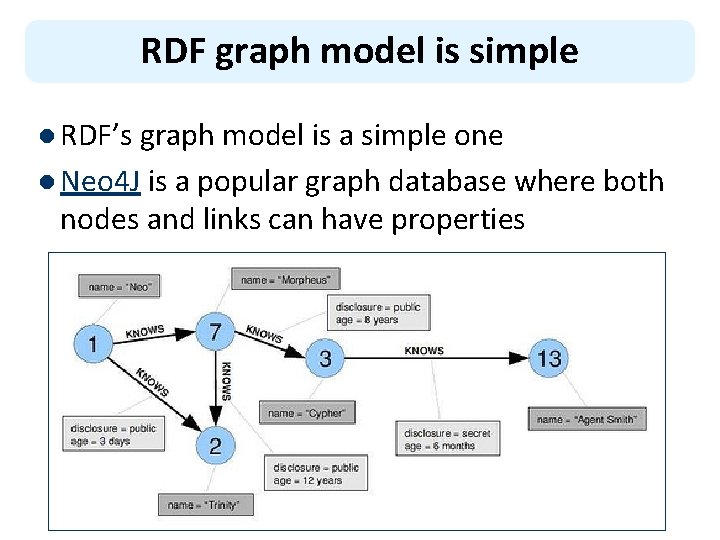
RDF graph model is simple l RDF’s graph model is a simple one l Neo 4 J is a popular graph database where both nodes and links can have properties
RDF Critique: Summary l RDF has its idiosyncrasies and is not an optimal modeling language but l It is already a de facto standard l It has sufficient expressive power – Reasonable foundation on which to build l Using RDF offers the benefit that information maps unambiguously to a model
Conclusion
Topics • Basic concepts of RDF • • • Vocabularies and modeling • • Vocabularies Blank nodes, data modeling, types, reification Lists, bags, collections Serialization of RDF graphs • • Resources, properties, values, statements, triples URIs and URIrefs RDF graphs Literals, qnames XML, Turtle, Ntriples Critique of RDF
- Slides: 57