
Chapter 2 Project Initiation Project Management Requirements Determination


- Slides: 21
Chapter 2: Project Initiation, Project Management & Requirements Determination Power. Point Presentation for Dennis, Wixom, & Tegarden Systems Analysis and Design with UML, 3 rd Edition Copyright © 2009 John Wiley & Sons, Inc. All rights reserved.
Objectives • Understand the importance of linking the information system to business needs. • Be able to create a system request. • Understand how to assess technical, economic, and organizational feasibility. • Be able to perform a feasibility analysis. • Understand how projects are selected in some organizations. Power. Point Presentation for Dennis, Wixom, & Tegarden Systems Analysis and Design with UML, 3 rd Edition Copyright © 2009 John Wiley & Sons, Inc. All rights reserved.
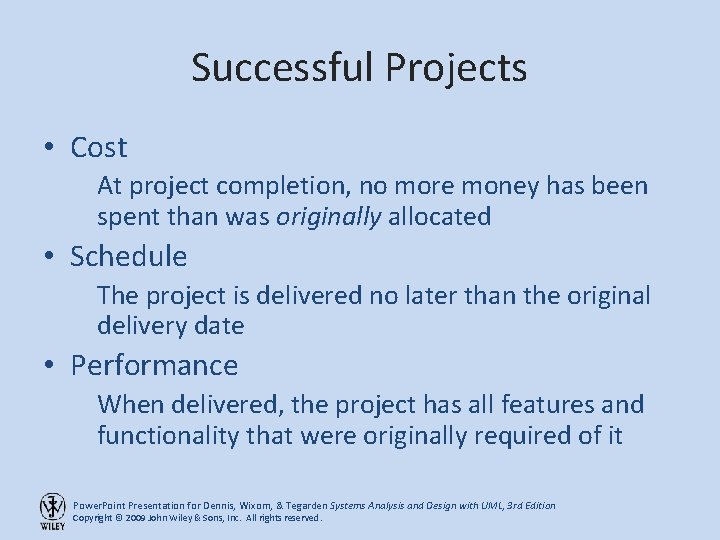
Successful Projects • Cost At project completion, no more money has been spent than was originally allocated • Schedule The project is delivered no later than the original delivery date • Performance When delivered, the project has all features and functionality that were originally required of it Power. Point Presentation for Dennis, Wixom, & Tegarden Systems Analysis and Design with UML, 3 rd Edition Copyright © 2009 John Wiley & Sons, Inc. All rights reserved.
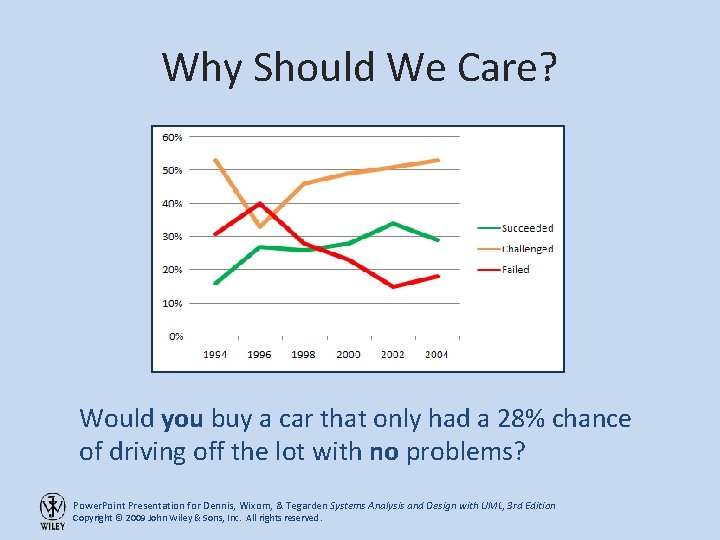
Why Should We Care? Would you buy a car that only had a 28% chance of driving off the lot with no problems? Power. Point Presentation for Dennis, Wixom, & Tegarden Systems Analysis and Design with UML, 3 rd Edition Copyright © 2009 John Wiley & Sons, Inc. All rights reserved.
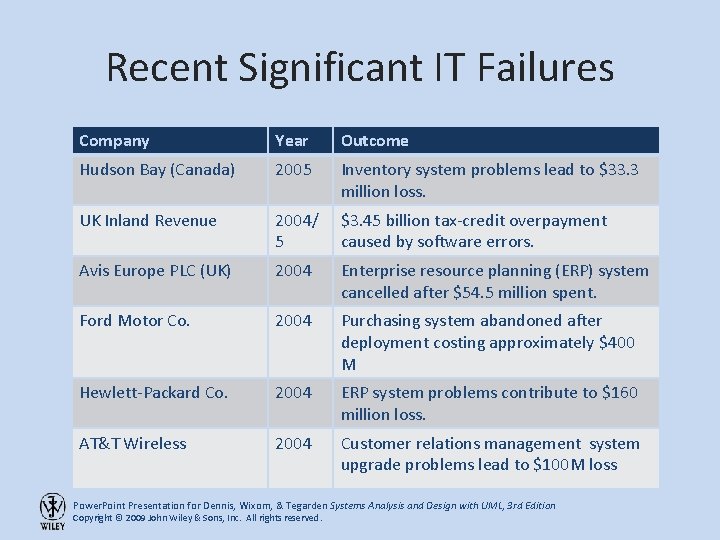
Recent Significant IT Failures Company Year Outcome Hudson Bay (Canada) 2005 Inventory system problems lead to $33. 3 million loss. UK Inland Revenue 2004/ 5 $3. 45 billion tax-credit overpayment caused by software errors. Avis Europe PLC (UK) 2004 Enterprise resource planning (ERP) system cancelled after $54. 5 million spent. Ford Motor Co. 2004 Purchasing system abandoned after deployment costing approximately $400 M Hewlett-Packard Co. 2004 ERP system problems contribute to $160 million loss. AT&T Wireless 2004 Customer relations management system upgrade problems lead to $100 M loss Power. Point Presentation for Dennis, Wixom, & Tegarden Systems Analysis and Design with UML, 3 rd Edition Copyright © 2009 John Wiley & Sons, Inc. All rights reserved.
PROJECT IDENTIFICATION Power. Point Presentation for Dennis, Wixom, & Tegarden Systems Analysis and Design with UML, 3 rd Edition Copyright © 2009 John Wiley & Sons, Inc. All rights reserved.
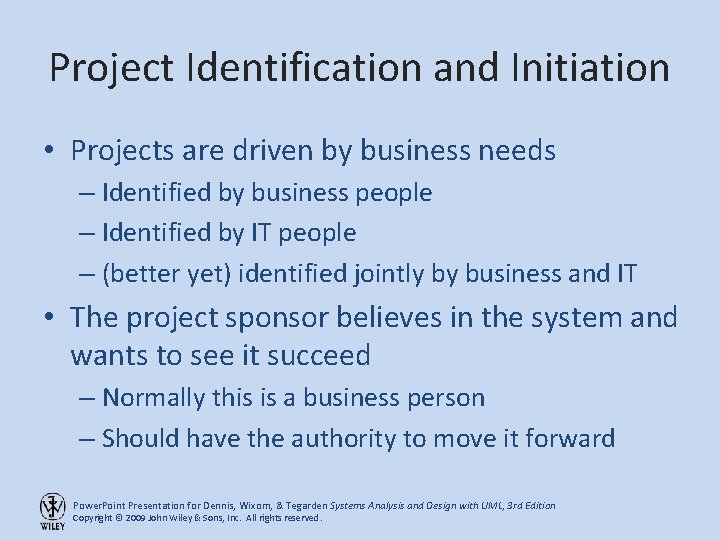
Project Identification and Initiation • Projects are driven by business needs – Identified by business people – Identified by IT people – (better yet) identified jointly by business and IT • The project sponsor believes in the system and wants to see it succeed – Normally this is a business person – Should have the authority to move it forward Power. Point Presentation for Dennis, Wixom, & Tegarden Systems Analysis and Design with UML, 3 rd Edition Copyright © 2009 John Wiley & Sons, Inc. All rights reserved.
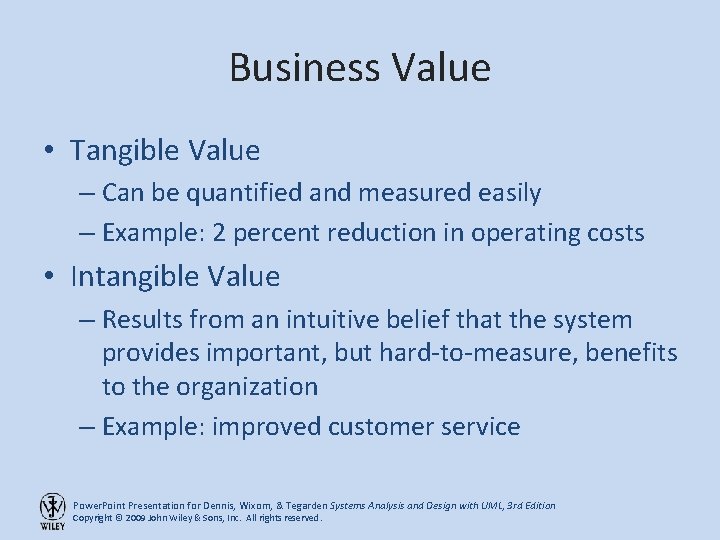
Business Value • Tangible Value – Can be quantified and measured easily – Example: 2 percent reduction in operating costs • Intangible Value – Results from an intuitive belief that the system provides important, but hard-to-measure, benefits to the organization – Example: improved customer service Power. Point Presentation for Dennis, Wixom, & Tegarden Systems Analysis and Design with UML, 3 rd Edition Copyright © 2009 John Wiley & Sons, Inc. All rights reserved.
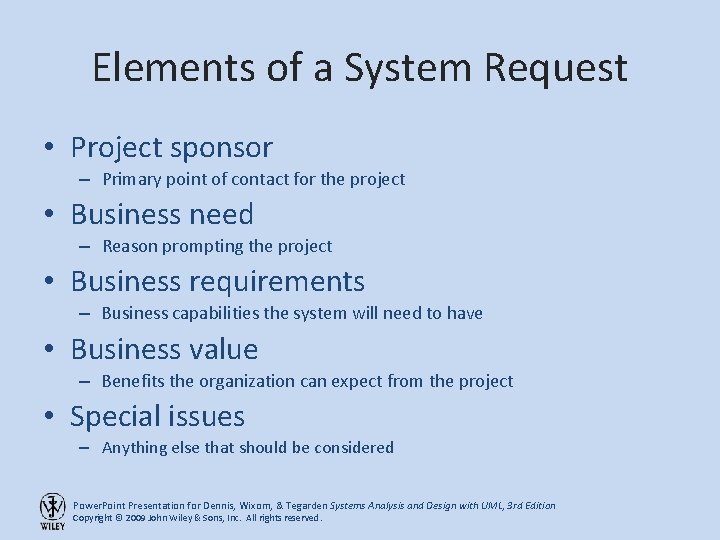
Elements of a System Request • Project sponsor – Primary point of contact for the project • Business need – Reason prompting the project • Business requirements – Business capabilities the system will need to have • Business value – Benefits the organization can expect from the project • Special issues – Anything else that should be considered Power. Point Presentation for Dennis, Wixom, & Tegarden Systems Analysis and Design with UML, 3 rd Edition Copyright © 2009 John Wiley & Sons, Inc. All rights reserved.
FEASIBILITY ANALYSIS Power. Point Presentation for Dennis, Wixom, & Tegarden Systems Analysis and Design with UML, 3 rd Edition Copyright © 2009 John Wiley & Sons, Inc. All rights reserved.
Feasibility Analysis • Guides the organization in determining whether to proceed with a project • Identifies the project’s risks that must be addressed if the project is approved • Mayor components: – Technical feasibility – Economic feasibility – Organizational feasibility Power. Point Presentation for Dennis, Wixom, & Tegarden Systems Analysis and Design with UML, 3 rd Edition Copyright © 2009 John Wiley & Sons, Inc. All rights reserved.
Technical Feasibility • Familiarity with application – Less familiarity generates more risk • Familiarity with technology – Less familiarity generates more risk • Project size – Large projects have more risk • Compatibility – Difficult integration increases the risk Can we build it? Power. Point Presentation for Dennis, Wixom, & Tegarden Systems Analysis and Design with UML, 3 rd Edition Copyright © 2009 John Wiley & Sons, Inc. All rights reserved.
Economic Feasibility • • Development costs Annual operating costs Annual benefits (cost savings and revenues) Intangible costs and benefits Should we build it? Power. Point Presentation for Dennis, Wixom, & Tegarden Systems Analysis and Design with UML, 3 rd Edition Copyright © 2009 John Wiley & Sons, Inc. All rights reserved.
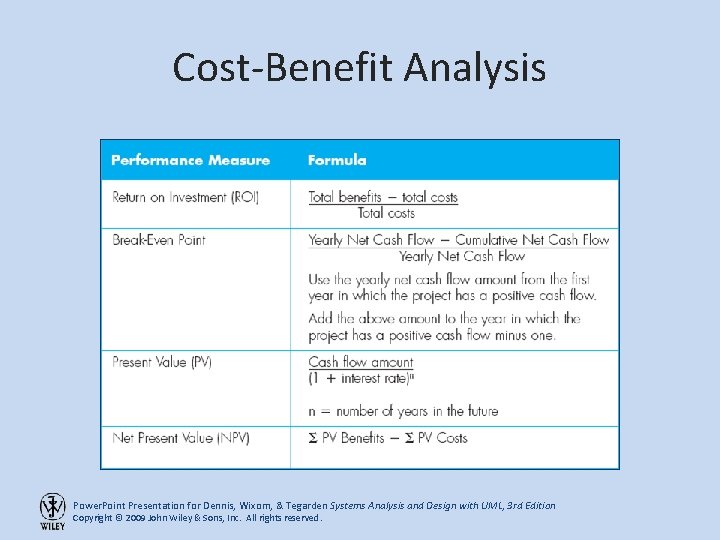
Cost-Benefit Analysis Power. Point Presentation for Dennis, Wixom, & Tegarden Systems Analysis and Design with UML, 3 rd Edition Copyright © 2009 John Wiley & Sons, Inc. All rights reserved.
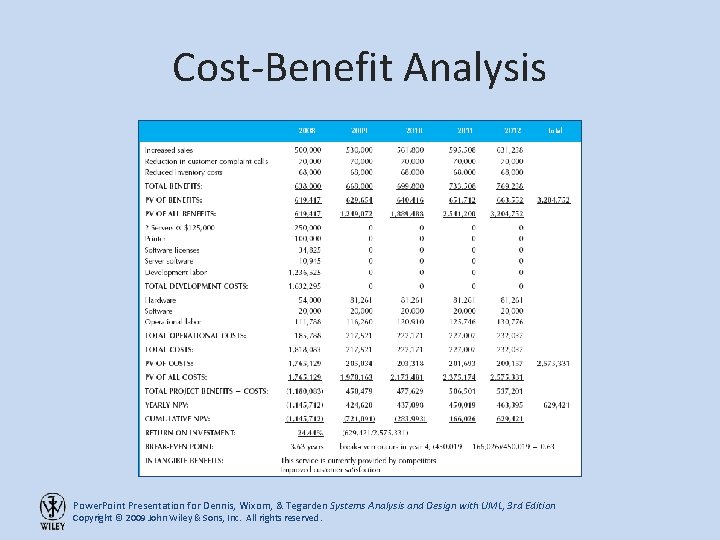
Cost-Benefit Analysis Power. Point Presentation for Dennis, Wixom, & Tegarden Systems Analysis and Design with UML, 3 rd Edition Copyright © 2009 John Wiley & Sons, Inc. All rights reserved.
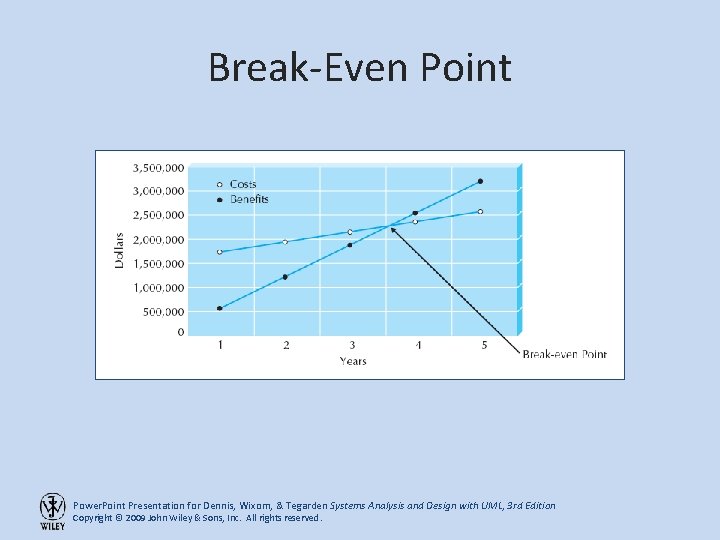
Break-Even Point Power. Point Presentation for Dennis, Wixom, & Tegarden Systems Analysis and Design with UML, 3 rd Edition Copyright © 2009 John Wiley & Sons, Inc. All rights reserved.
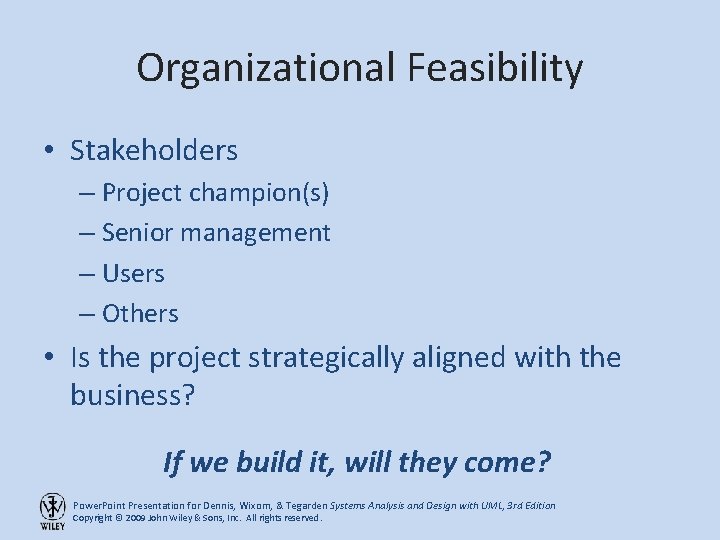
Organizational Feasibility • Stakeholders – Project champion(s) – Senior management – Users – Others • Is the project strategically aligned with the business? If we build it, will they come? Power. Point Presentation for Dennis, Wixom, & Tegarden Systems Analysis and Design with UML, 3 rd Edition Copyright © 2009 John Wiley & Sons, Inc. All rights reserved.
PROJECT SELECTION Power. Point Presentation for Dennis, Wixom, & Tegarden Systems Analysis and Design with UML, 3 rd Edition Copyright © 2009 John Wiley & Sons, Inc. All rights reserved.
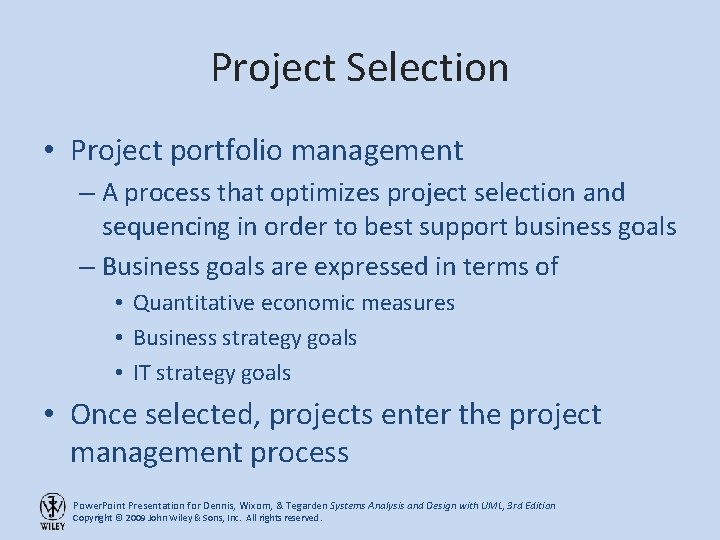
Project Selection • Project portfolio management – A process that optimizes project selection and sequencing in order to best support business goals – Business goals are expressed in terms of • Quantitative economic measures • Business strategy goals • IT strategy goals • Once selected, projects enter the project management process Power. Point Presentation for Dennis, Wixom, & Tegarden Systems Analysis and Design with UML, 3 rd Edition Copyright © 2009 John Wiley & Sons, Inc. All rights reserved.
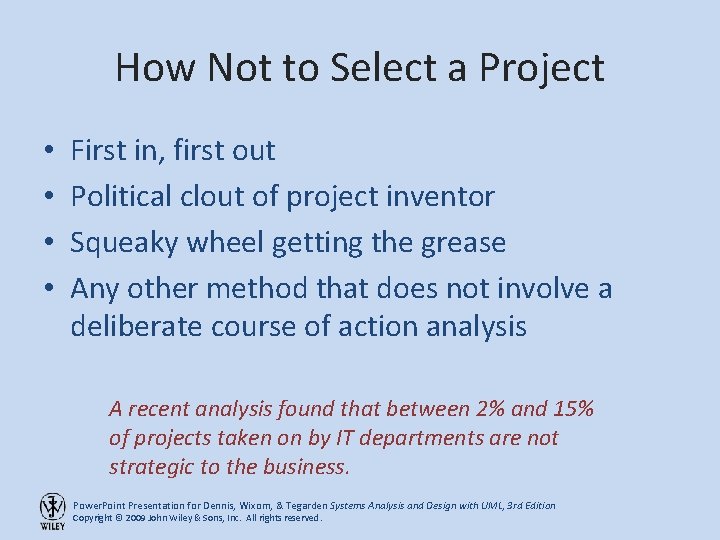
How Not to Select a Project • • First in, first out Political clout of project inventor Squeaky wheel getting the grease Any other method that does not involve a deliberate course of action analysis A recent analysis found that between 2% and 15% of projects taken on by IT departments are not strategic to the business. Power. Point Presentation for Dennis, Wixom, & Tegarden Systems Analysis and Design with UML, 3 rd Edition Copyright © 2009 John Wiley & Sons, Inc. All rights reserved.
Review • Project Initiation • Feasibility Analysis • Project Selection Power. Point Presentation for Dennis, Wixom, & Tegarden Systems Analysis and Design with UML, 3 rd Edition Copyright © 2009 John Wiley & Sons, Inc. All rights reserved.