
Chapter 2 Principles of Ecology 2 1 Organisms
- Slides: 25
Chapter 2 Principles of Ecology 2. 1 Organisms and Their Relationships Ecology § Scientific discipline in which the relationships among living organisms and the interaction the organisms have with their environments are studied § Ecologists observe, experiment, and model using a variety of tools and methods.
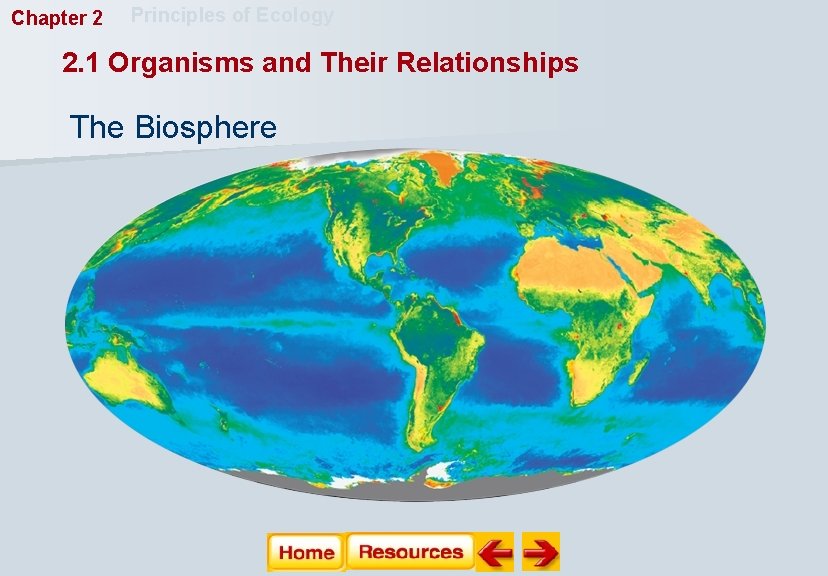
Chapter 2 Principles of Ecology 2. 1 Organisms and Their Relationships The Biosphere § A thin layer around Earth § Extends several kilometers above the Earth’s surface § Extends several kilometers below the ocean’s surface
Chapter 2 Principles of Ecology 2. 1 Organisms and Their Relationships The Biosphere
Chapter 2 Principles of Ecology 2. 1 Organisms and Their Relationships Biotic Factors § Living factors in an organism’s environment Abiotic Factors § Nonliving factors in an organism’s environment § Organisms adapt to survive in the abiotic factors present in their natural environment.
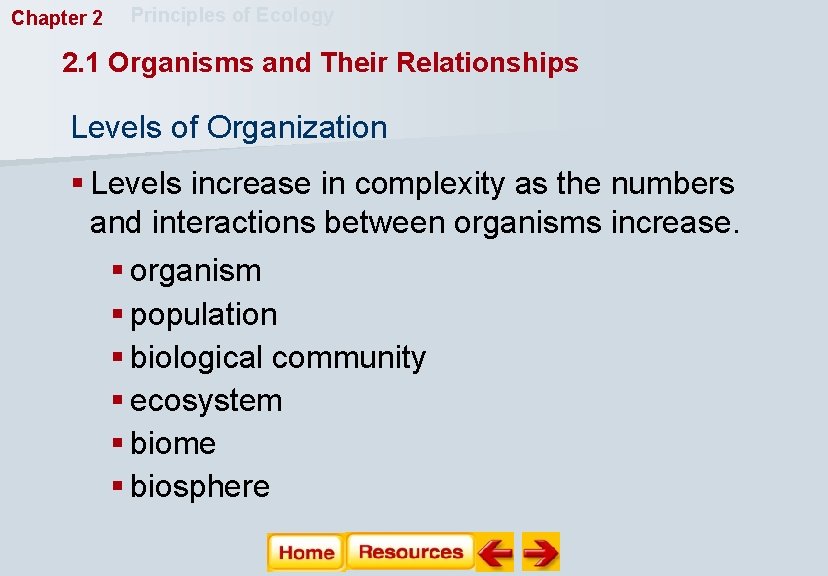
Chapter 2 Principles of Ecology 2. 1 Organisms and Their Relationships Levels of Organization § Levels increase in complexity as the numbers and interactions between organisms increase. § organism § population § biological community § ecosystem § biome § biosphere
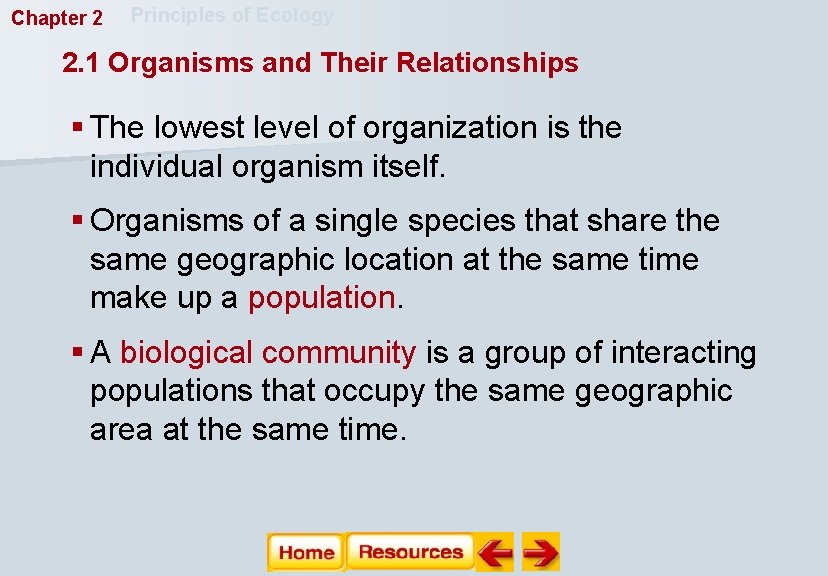
Chapter 2 Principles of Ecology 2. 1 Organisms and Their Relationships § The lowest level of organization is the individual organism itself. § Organisms of a single species that share the same geographic location at the same time make up a population. § A biological community is a group of interacting populations that occupy the same geographic area at the same time.
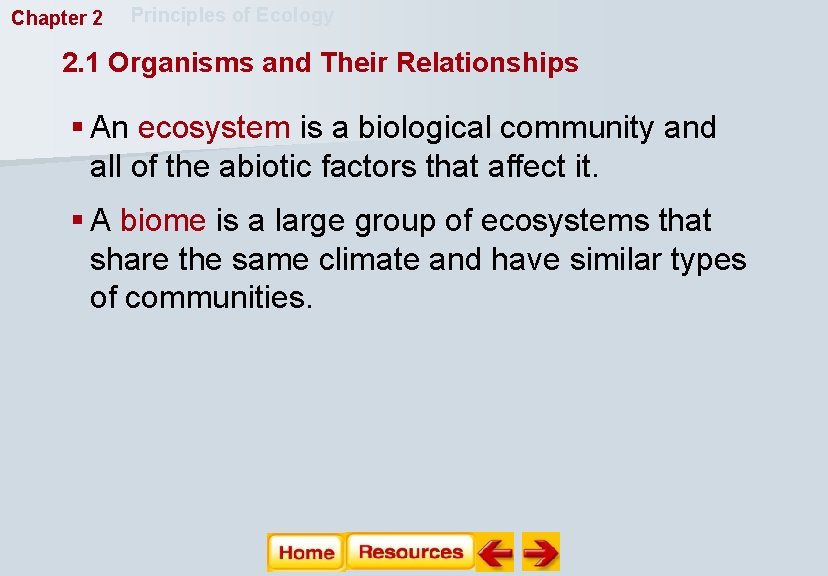
Chapter 2 Principles of Ecology 2. 1 Organisms and Their Relationships § An ecosystem is a biological community and all of the abiotic factors that affect it. § A biome is a large group of ecosystems that share the same climate and have similar types of communities.
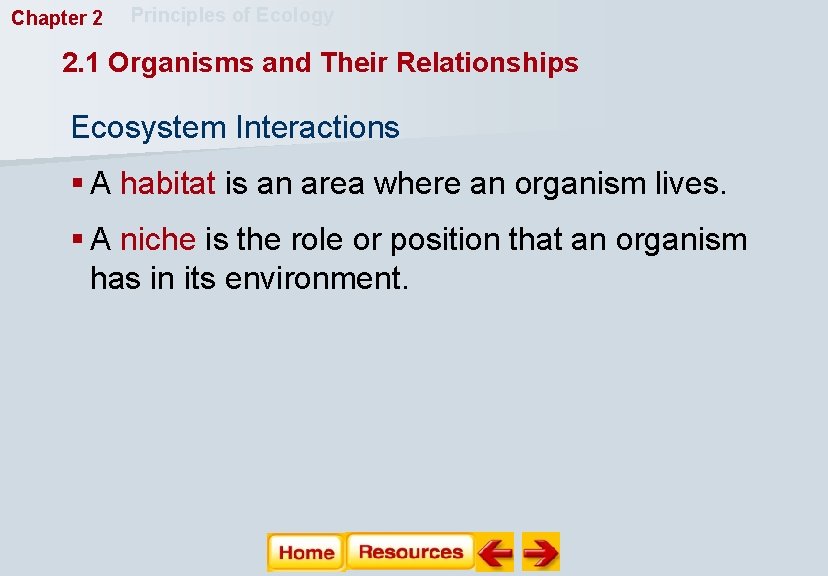
Chapter 2 Principles of Ecology 2. 1 Organisms and Their Relationships Ecosystem Interactions § A habitat is an area where an organism lives. § A niche is the role or position that an organism has in its environment.
Chapter 2 Principles of Ecology 2. 1 Organisms and Their Relationships Community Interactions § Competition § Occurs when more than one organism uses a resource at the same time § Predation § Many species get their food by eating other organisms.
Chapter 2 Principles of Ecology 2. 1 Organisms and Their Relationships Symbiotic Relationships § The close relationship that exists when two or more species live together § Mutualism § Commensalism § Parasitism
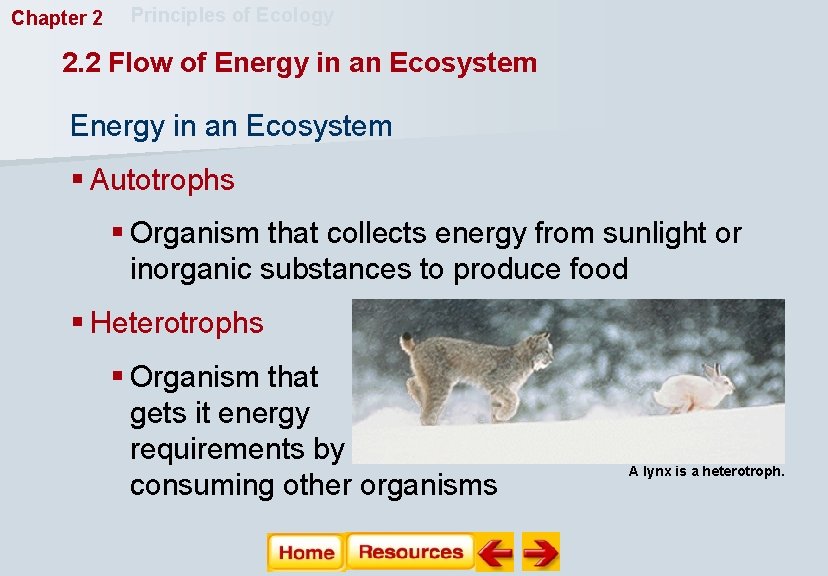
Chapter 2 Principles of Ecology 2. 2 Flow of Energy in an Ecosystem § Autotrophs § Organism that collects energy from sunlight or inorganic substances to produce food § Heterotrophs § Organism that gets it energy requirements by consuming other organisms A lynx is a heterotroph.
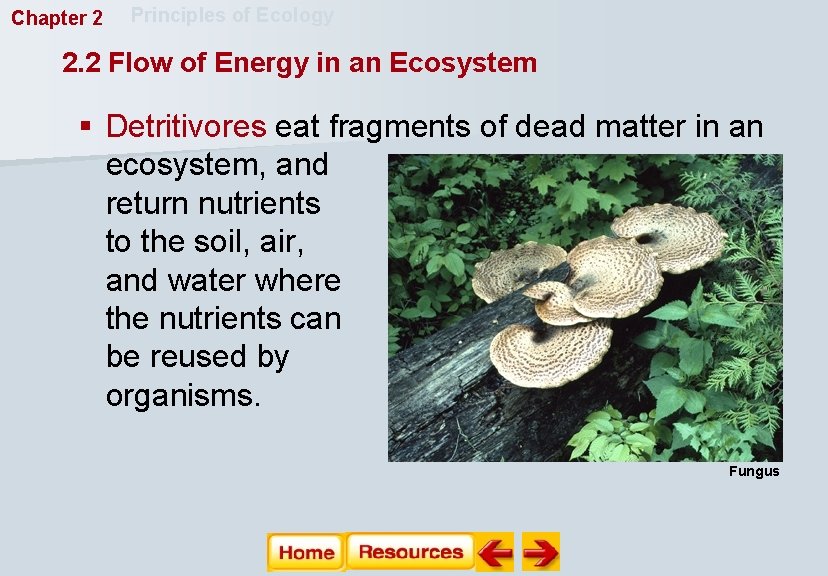
Chapter 2 Principles of Ecology 2. 2 Flow of Energy in an Ecosystem § Detritivores eat fragments of dead matter in an ecosystem, and return nutrients to the soil, air, and water where the nutrients can be reused by organisms. Fungus
Chapter 2 Principles of Ecology 2. 2 Flow of Energy in an Ecosystem Models of Energy Flow § Food chains and food webs model the energy flow through an ecosystem. § Each step in a food chain or food web is called a trophic level.
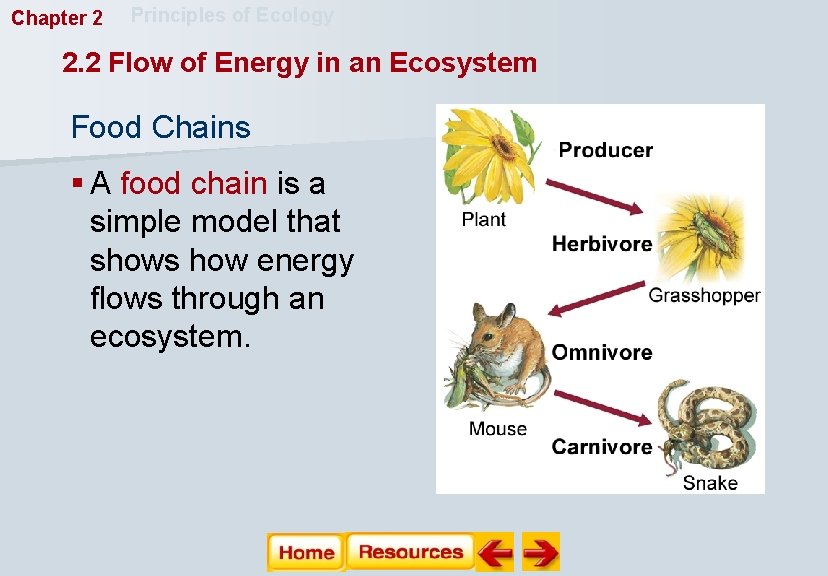
Chapter 2 Principles of Ecology 2. 2 Flow of Energy in an Ecosystem Food Chains § A food chain is a simple model that shows how energy flows through an ecosystem.
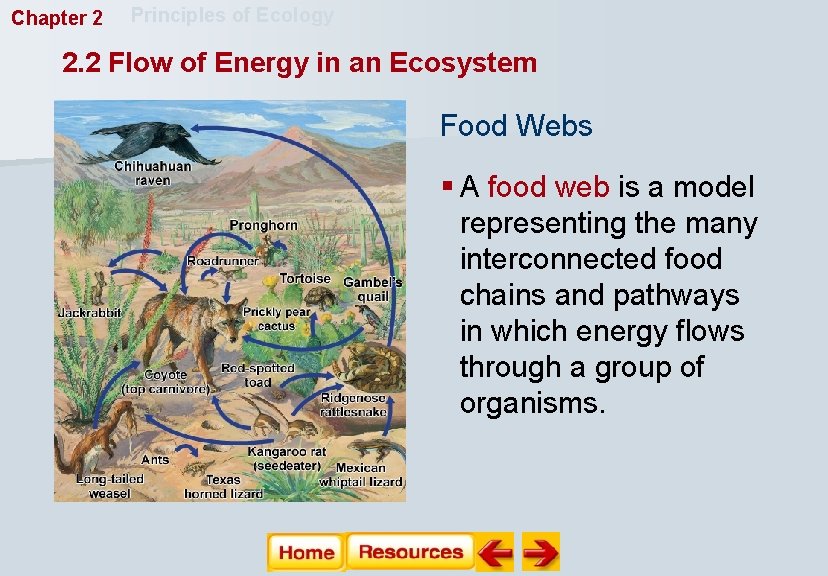
Chapter 2 Principles of Ecology 2. 2 Flow of Energy in an Ecosystem Food Webs § A food web is a model representing the many interconnected food chains and pathways in which energy flows through a group of organisms.
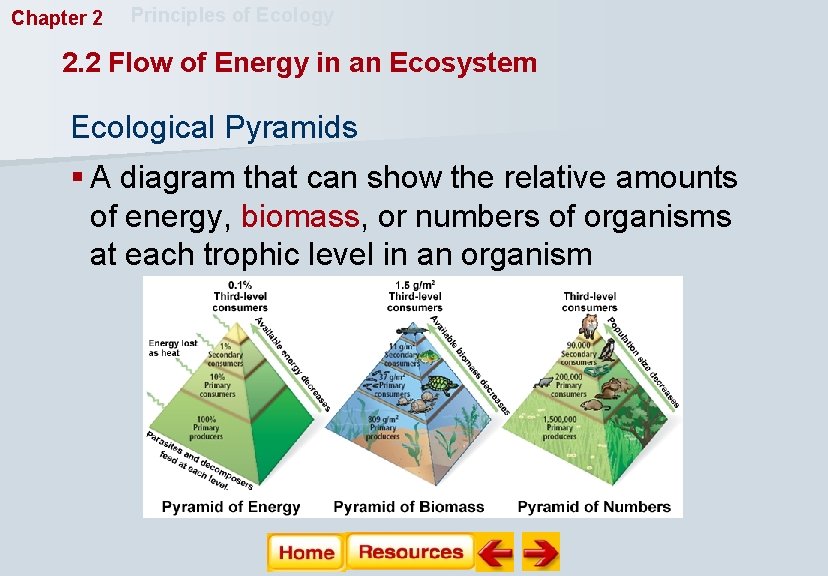
Chapter 2 Principles of Ecology 2. 2 Flow of Energy in an Ecosystem Ecological Pyramids § A diagram that can show the relative amounts of energy, biomass, or numbers of organisms at each trophic level in an organism
Chapter 2 Principles of Ecology 2. 3 Cycling of Matter Cycles in the Biosphere § Energy is transformed into usable forms to support the functions of an ecosystem. § The cycling of nutrients in the biosphere involves both matter in living organisms and physical processes found in the environment such as weathering.
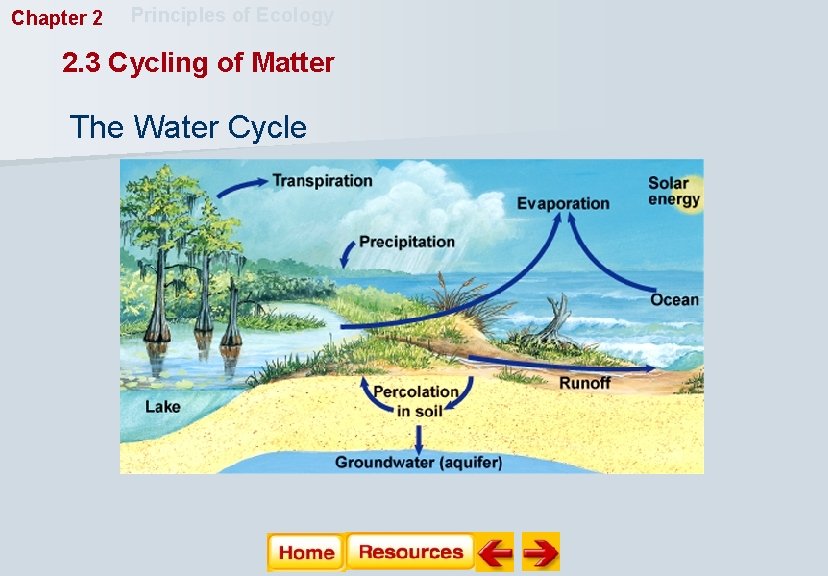
Chapter 2 Principles of Ecology 2. 3 Cycling of Matter The Water Cycle
Chapter 2 Principles of Ecology 2. 3 Cycling of Matter § Approximately 90 percent of water vapor evaporates from oceans, lakes, and rivers; 10 percent evaporates from the surface of plants through a process called transpiration. § Freshwater constitutes only about 3 percent of all water on Earth. § About 69 percent of all freshwater is found in ice caps and glaciers.
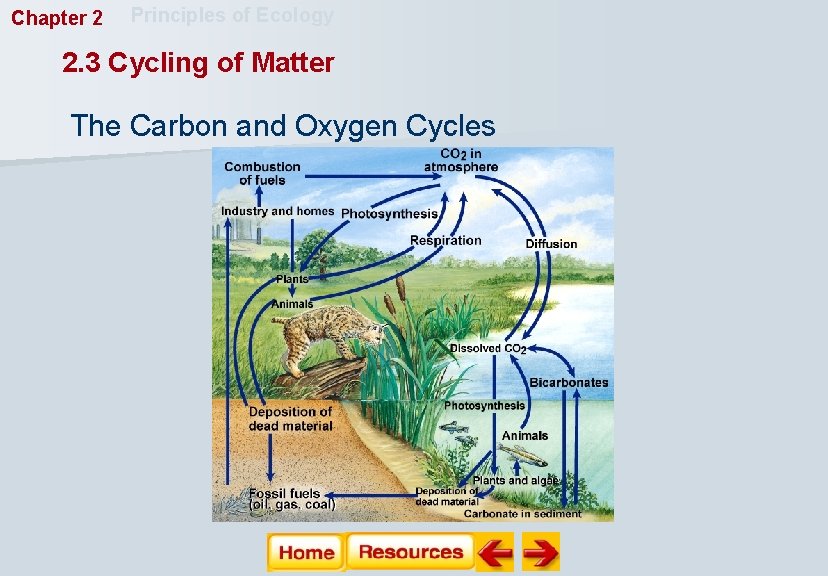
Chapter 2 Principles of Ecology 2. 3 Cycling of Matter The Carbon and Oxygen Cycles
Chapter 2 Principles of Ecology 2. 3 Cycling of Matter § Carbon and oxygen often make up molecules essential for life. § Carbon and oxygen recycle relatively quickly through living organisms.
Chapter 2 Principles of Ecology 2. 3 Cycling of Matter Long-term Cycle § Organic matter converted to peat, coal, oil, or gas deposits (carbon) § Calcium carbonate (carbon and oxygen) Short-term Cycle § Burning fossil fuels (carbon)
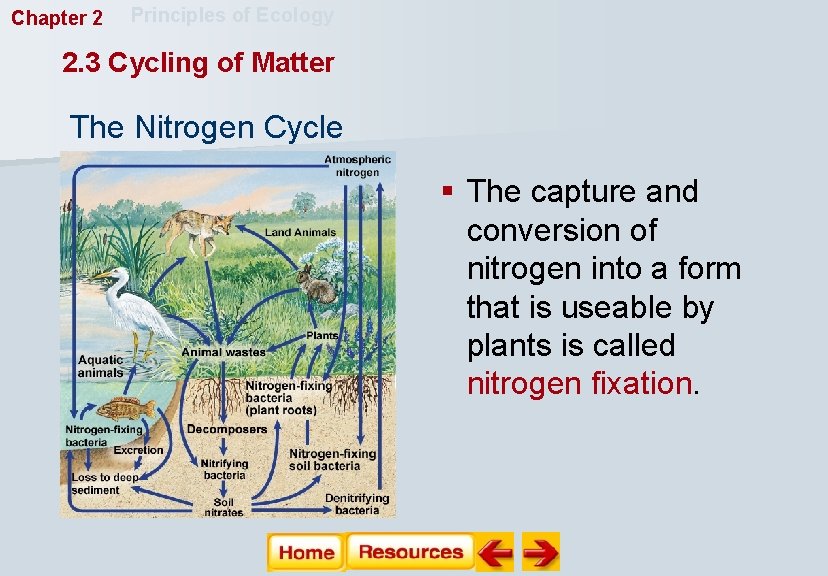
Chapter 2 Principles of Ecology 2. 3 Cycling of Matter The Nitrogen Cycle § The capture and conversion of nitrogen into a form that is useable by plants is called nitrogen fixation.
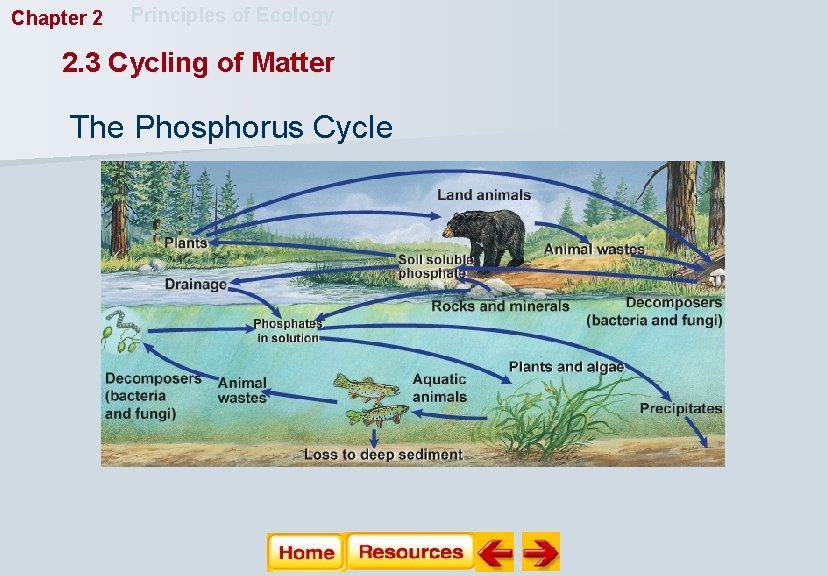
Chapter 2 Principles of Ecology 2. 3 Cycling of Matter The Phosphorus Cycle
Chapter 2 Principles of Ecology 2. 3 Cycling of Matter Short-term Cycle § Phosphorus is cycled from the soil to producers and then from the producers to consumers. Long-term Cycle § Weathering or erosion of rocks that contain phosphorus slowly adds phosphorus to the cycle.