
Chapter 2 Principles of Design History of Floral
- Slides: 35
Chapter 2: Principles of Design History of Floral Design
History of Floral Design n Flower arranging is a work of ___. n We follow certain guidelines to properly arrange flowers so that they become a “work of art”. These guidelines are called _________
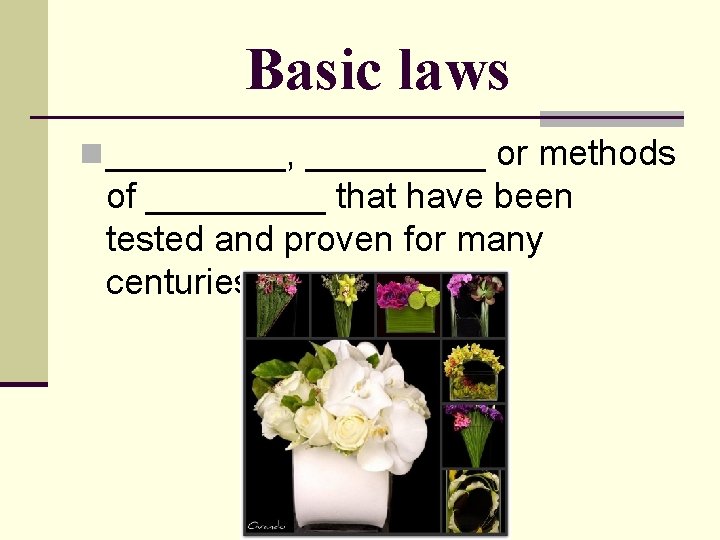
Basic laws n _____, _____ or methods of _____ that have been tested and proven for many centuries.
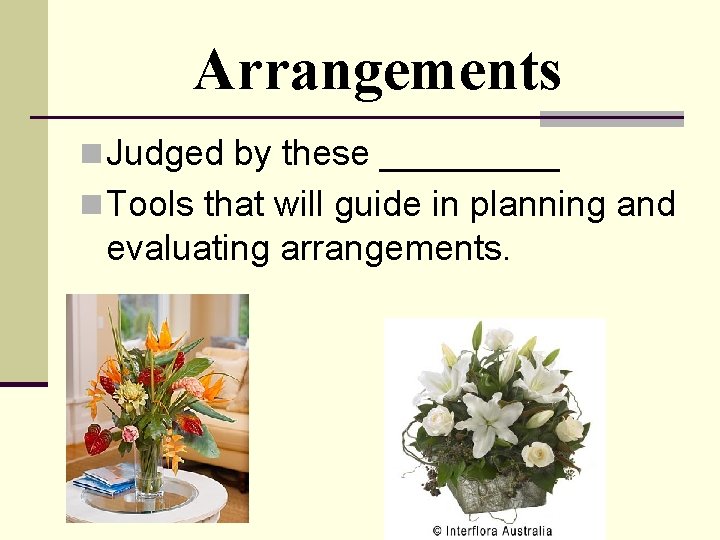
Arrangements n Judged by these _____ n Tools that will guide in planning and evaluating arrangements.
Concepts of floral design n Two concepts developed independently of each other. n _____– evolved in _____ and Middle Eastern Cultures n Further developed by the _____
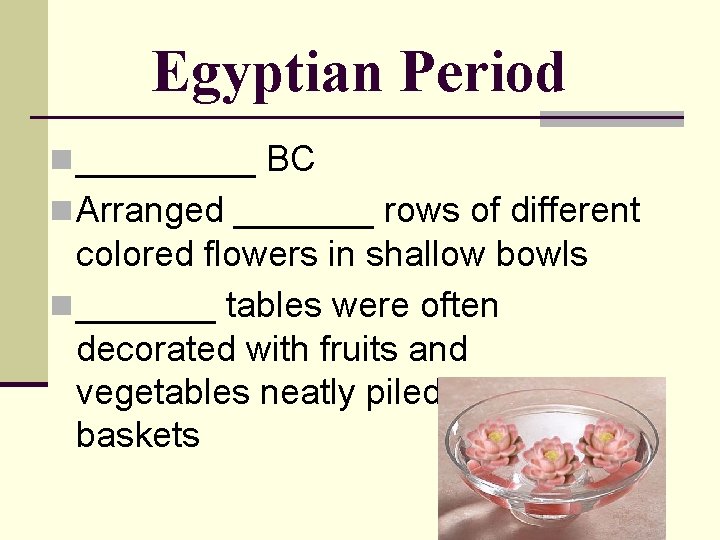
Egyptian Period n _____ BC n Arranged _______ rows of different colored flowers in shallow bowls n _______ tables were often decorated with fruits and vegetables neatly piled in low baskets
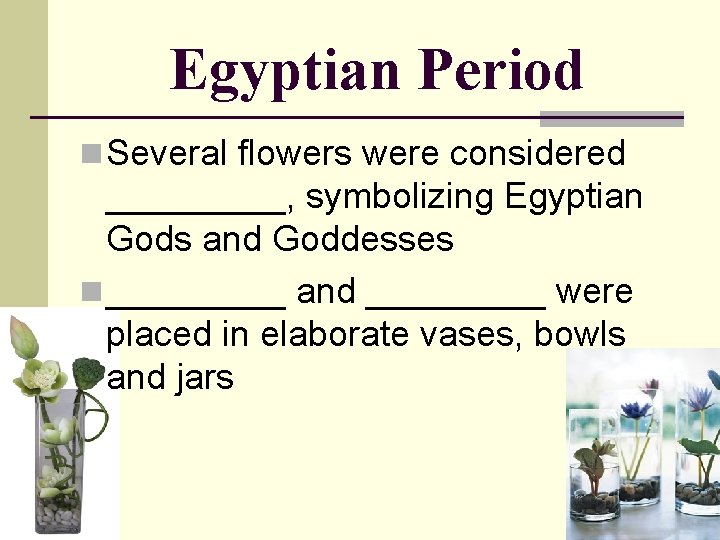
Egyptian Period n Several flowers were considered _____, symbolizing Egyptian Gods and Goddesses n _____ and _____ were placed in elaborate vases, bowls and jars
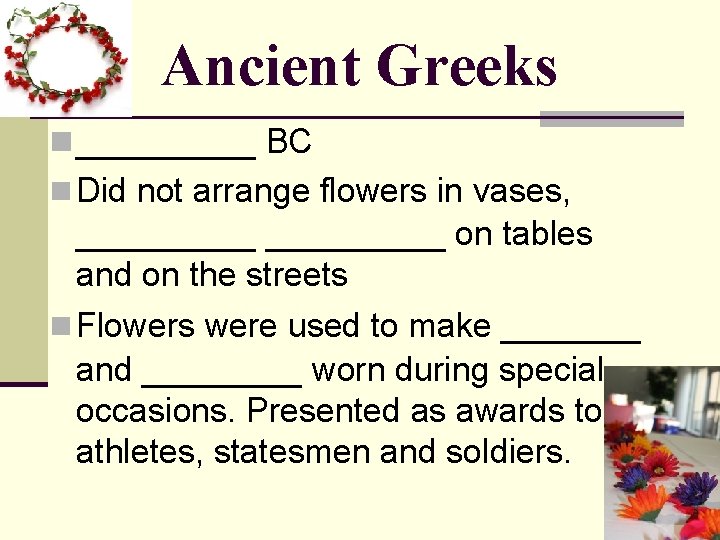
Ancient Greeks n _____ BC n Did not arrange flowers in vases, _________ on tables and on the streets n Flowers were used to make _______ and ____ worn during special occasions. Presented as awards to athletes, statesmen and soldiers.
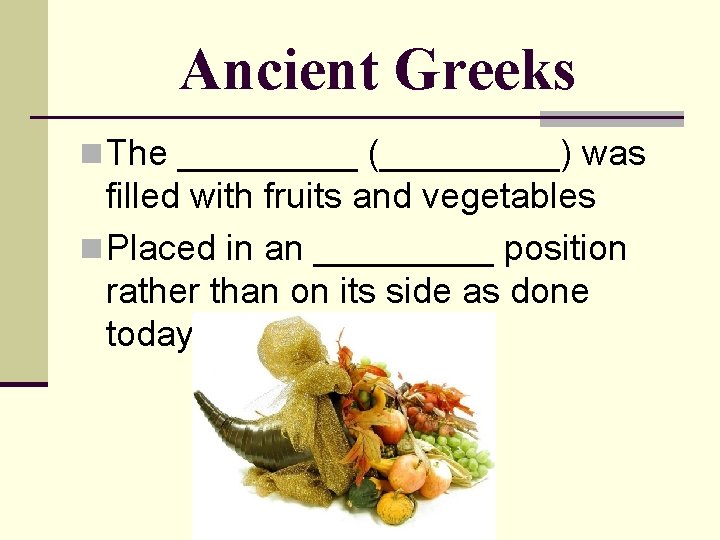
Ancient Greeks n The _____ (_____) was filled with fruits and vegetables n Placed in an _____ position rather than on its side as done today
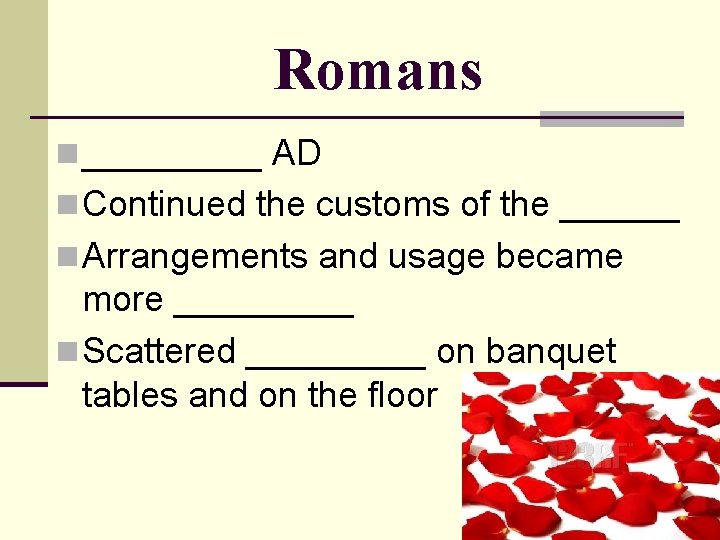
Romans n _____ AD n Continued the customs of the ______ n Arrangements and usage became more _____ n Scattered _____ on banquet tables and on the floor
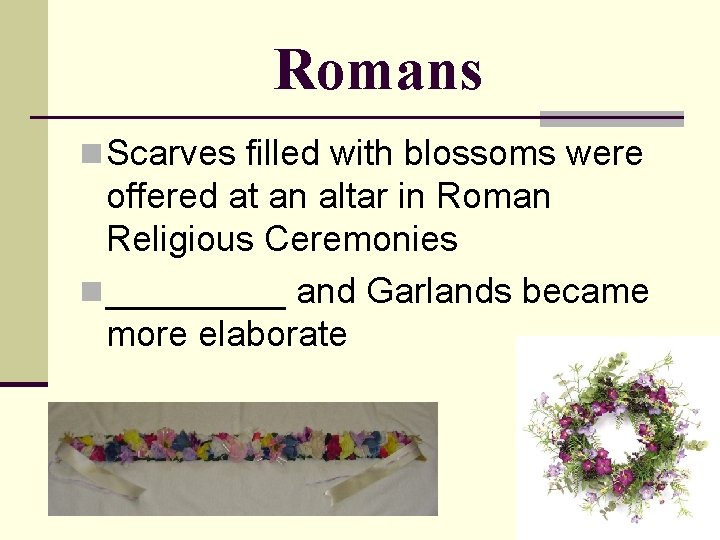
Romans n Scarves filled with blossoms were offered at an altar in Roman Religious Ceremonies n _____ and Garlands became more elaborate
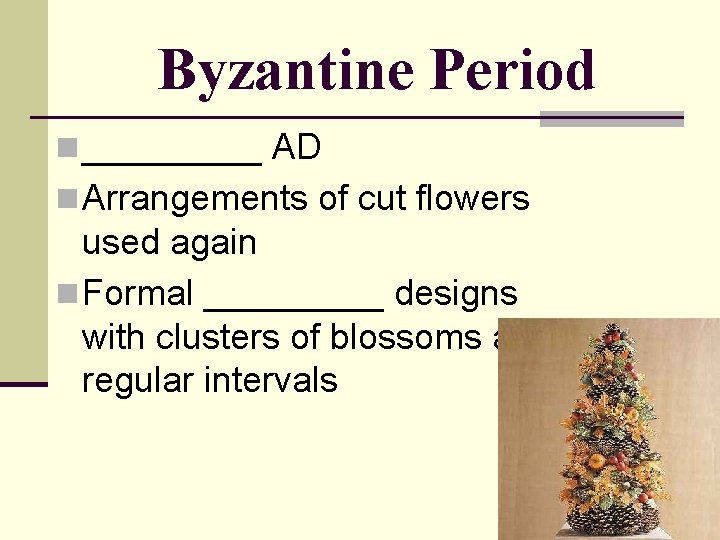
Byzantine Period n _____ AD n Arrangements of cut flowers used again n Formal _____ designs with clusters of blossoms at regular intervals
Middle Ages n _____ AD n Very little is known about floral designs of this time period n _____ were used in medicines and fruits and vegetables and fruits were used for eating n Flowers were often _____ on altars and seen in Persian rugs
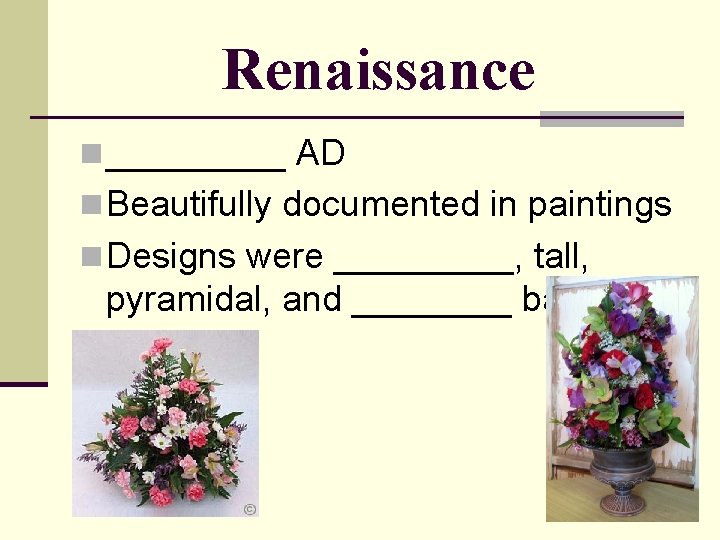
Renaissance n _____ AD n Beautifully documented in paintings n Designs were _____, tall, pyramidal, and ____ balanced
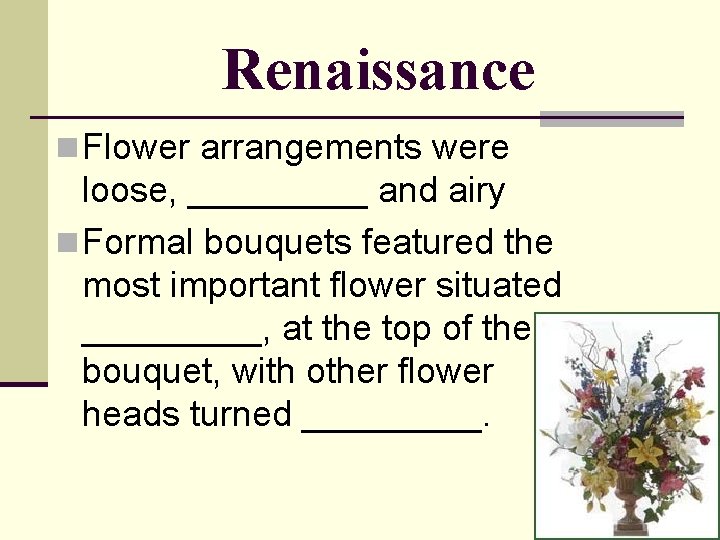
Renaissance n Flower arrangements were loose, _____ and airy n Formal bouquets featured the most important flower situated _____, at the top of the bouquet, with other flower heads turned _____.
Renaissance n Flowers were arranged so that they were about _____ the height of the container n _____ colors were used to create contrast with the white plastered walls of buildings n Several _____ floral designs of today are styled after renaissance arrangements
Baroque Period n Began as _____, oval shaped designs n _____ curves in the shape of a crescent or an “s” were adopted later n The “__” curve and _____ arrangements developed during this period are popular today
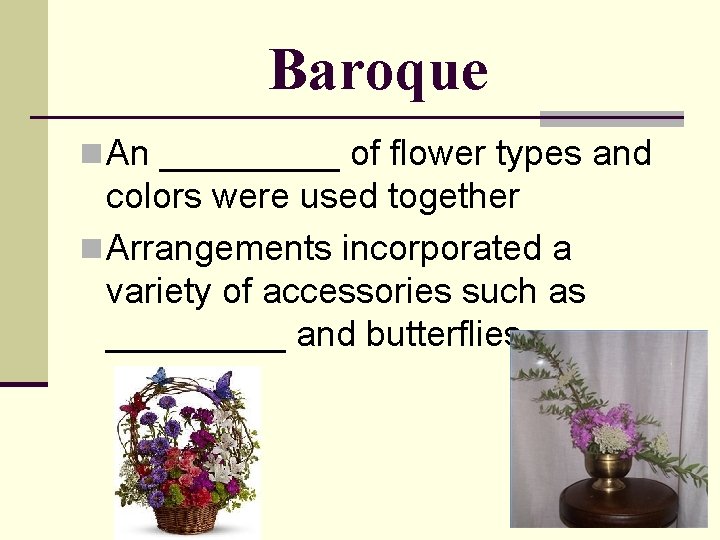
Baroque n An _____ of flower types and colors were used together n Arrangements incorporated a variety of accessories such as _____ and butterflies
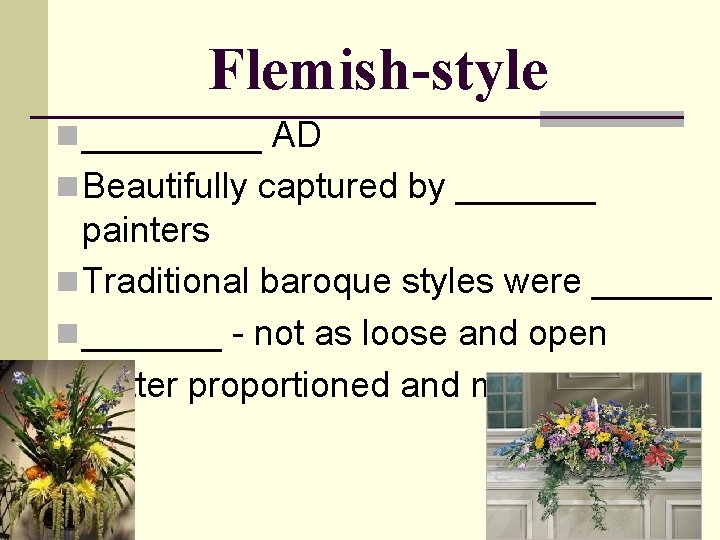
Flemish-style n _____ AD n Beautifully captured by _______ painters n Traditional baroque styles were ______ n _______ - not as loose and open n Better proportioned and more compact
Flemish style n ____ colors and an array of flowers were combined into masses, oval shape bouquets. n The French developed mass arrangements during the same time that were lighter and more airy than those of the Dutch. n Arrangements were made from ______ flowers in light pastel colors.
Georgian period n _____ A. D. n Time period that spanned the reigns of the English kings George I and George II n Arrangements were greatly influenced by _____ arts. n Usually _____ and _____ shaped.
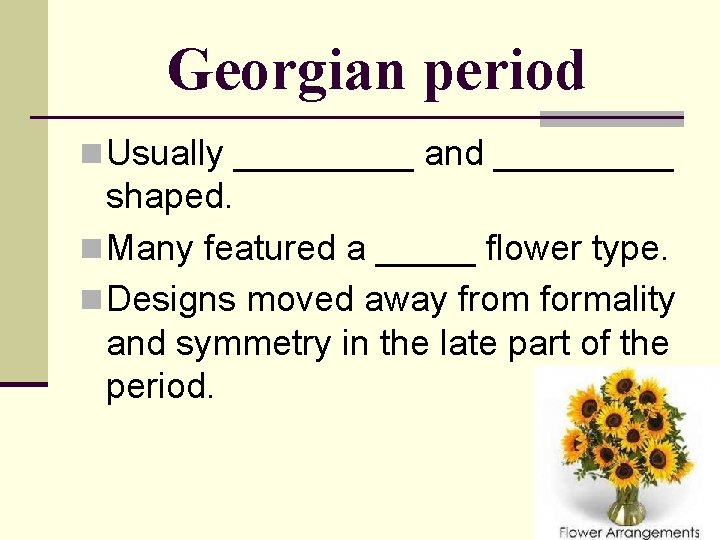
Georgian period n Usually _____ and _____ shaped. n Many featured a _____ flower type. n Designs moved away from formality and symmetry in the late part of the period.
Georgian period n Many featured a single flower type. n Designs moved away from formality and symmetry in the late part of the period. n _____, or handheld bouquet became stylish n Small nosegay bouquets placed in bowls were the first use of table centerpieces as we know them today.
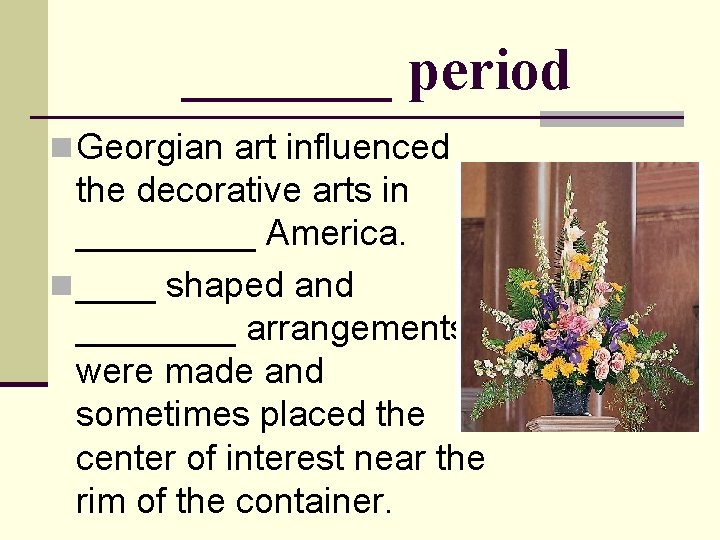
_______ period n Georgian art influenced the decorative arts in _____ America. n ____ shaped and ____ arrangements were made and sometimes placed the center of interest near the rim of the container.
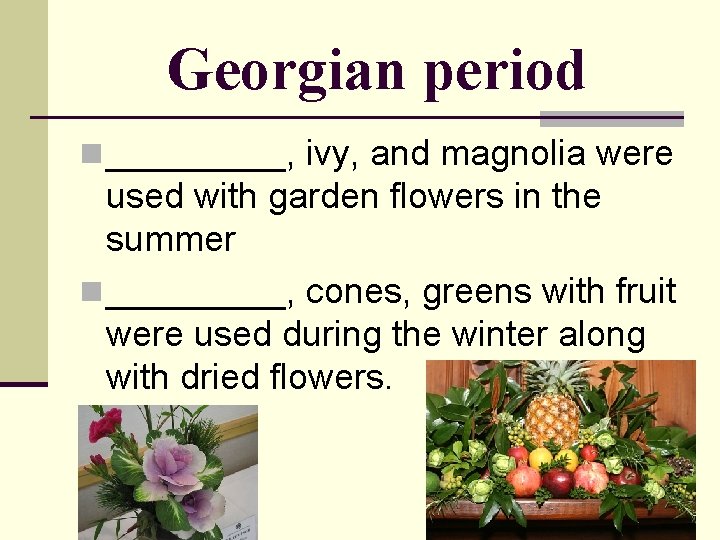
Georgian period n _____, ivy, and magnolia were used with garden flowers in the summer n _____, cones, greens with fruit were used during the winter along with dried flowers.
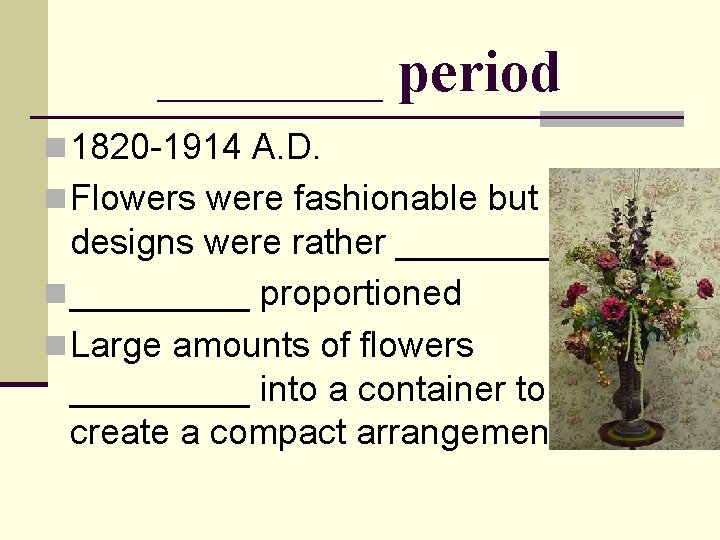
_____ period n 1820 -1914 A. D. n Flowers were fashionable but designs were rather _____. n _____ proportioned n Large amounts of flowers _____ into a container to create a compact arrangement
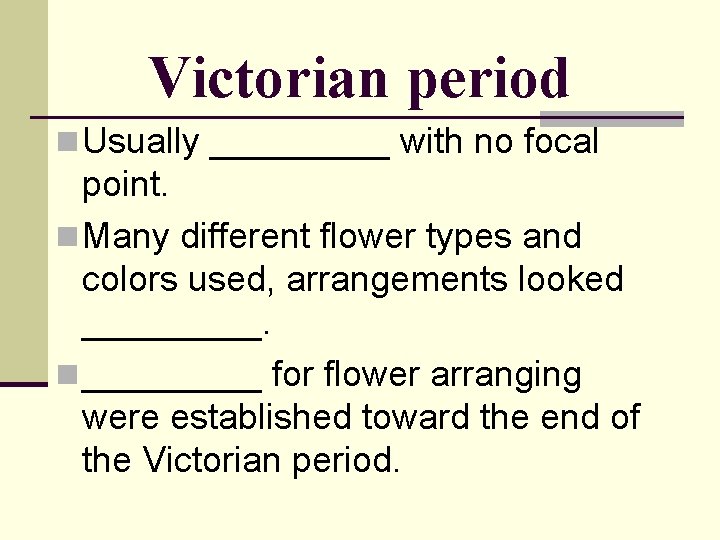
Victorian period n Usually _____ with no focal point. n Many different flower types and colors used, arrangements looked _____. n _____ for flower arranging were established toward the end of the Victorian period.
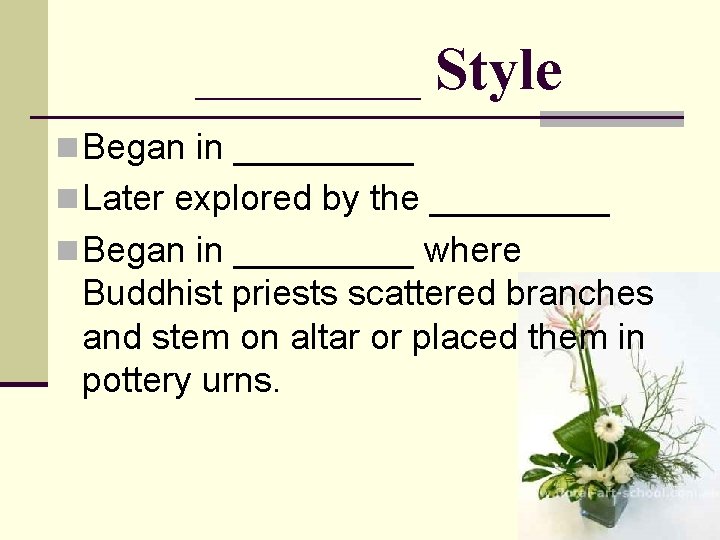
_____ Style n Began in _____ n Later explored by the _____ n Began in _____ where Buddhist priests scattered branches and stem on altar or placed them in pottery urns.
_____ Style n Modified by the _____ during the first century A. D. n Arranged flowers in massive _____ vessels n Felt it was improper to place flowers carelessly on the altar. n Created _____ arrangements n _____ colors were favored.
Oriental Style n Usually large and s _____ with one or two types of foliage and flowers placed around a central branch. n _____ were used at outer portions of design, _____ ones kept nearest the base.
Oriental Style n Sixth Century A. D. _____ adopted many aspects of the Chinese culture, including floral arrangement. n Japanese priest named _____ refined the art. n His instruction was sought by other Buddhist priests. n Began the first school of floral art in Japan which bears his name.
Oriental Style n Name later changed to Ikebana which means “giving life to the flowers. ” n Many schools of Japanese flower arrangements have evolved from this original one, the basic principles can be traced back to Ikenaba.
Oriental Style n Japanese designs are characterized by _____ use of plant material and careful placement of branches and flowers. n Each _____ and _______ has meaning. n This type of arrangement became known as “_____”
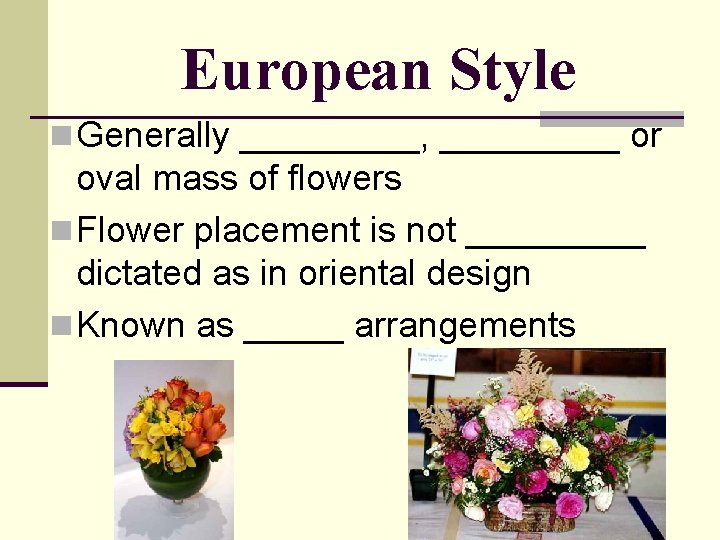
European Style n Generally _____, _____ or oval mass of flowers n Flower placement is not _____ dictated as in oriental design n Known as _____ arrangements
European Style n Most floral designs in the US are referred to as “line mass” and combine _____ and _____ ideas n American floral design uses more materials than the _____ but far fewer than the _____ n US floral design is often built around linear patterns, showing the _____ influence.