
Chapter 2 Prepared By Kamran Lecturer Kardan University

Chapter # 2 Prepared By: Kamran Lecturer Kardan University Email address: kamranuni@yahoo. com

Origin of the terms Debit and Credit The terms Debit and Credit have Latin roots. Debit comes from Debere which means "to owe". The Latin debitum means "debt". Credit comes from the Latin word Credere, which means "to believe" or "to entrust". It is more common to use the plural terms "Debits" and "Credits". 2

Why we use Cr for Credit and Dr for Debit There a few possible explanations. One theory asserts that the DR and CR come from the Latin words debitum and creditum which are "debere" and "credere", respectively. Another theory is that DR stands for "debit record" and CR stands for "credit record". Finally, some believe that DR notation is short for "debtor" and CR is short for "creditor". 3

Classes of Accounts Under American approach the accounts are classified into five categories. 1) Assets Accounts 2)Liabilities Accounts 3)Owner Equity(Capital) 4)Revenue Accounts 5)Expenses Accounts
Assets Whatever Kardan Institute of Higher Education business possesses which have to give future economic benefits are called asset OR All valuables possessed by a business are called assets. For Example land, building, furniture, car etc 5
Liabilities The claim of the external parties on the assets of the business is called Liabilities For Kardan Institute of Higher Education Example Loan payable, Rent payable, Salaries payable etc. I will pay you later 6

Owner Equity It is the amount invested by the owner of the business. OR The residual claim of the owner on the assets of the business is called owner equity. Kardan Institute of Higher Education 7

Revenue The price of goods sold or services rendered is called revenue. For Example If business sells 1000 pens @ 5 per pen then 5*1000= 5000 is its revenue. Kardan Institute of Higher Education If 20 patient comes to a Doctor and he charges 200 fee from every patient then 20 * 200 =4000 is its revenue. 8
Expenses The cost of doing business is called expense. OR The cost of goods and services used up in the process of earning revenue is called expense. Kardan Institute of Higher Education Examples. salaries, utility bills etc 9
Rules of Debit and Credit The rules of debit and credit related to five(5) kinds of accounts are stated as under: 1)For Assets Accounts: Increase in an assets account is recorded as Debit. Decrease in an assets account is recorded as Credit.
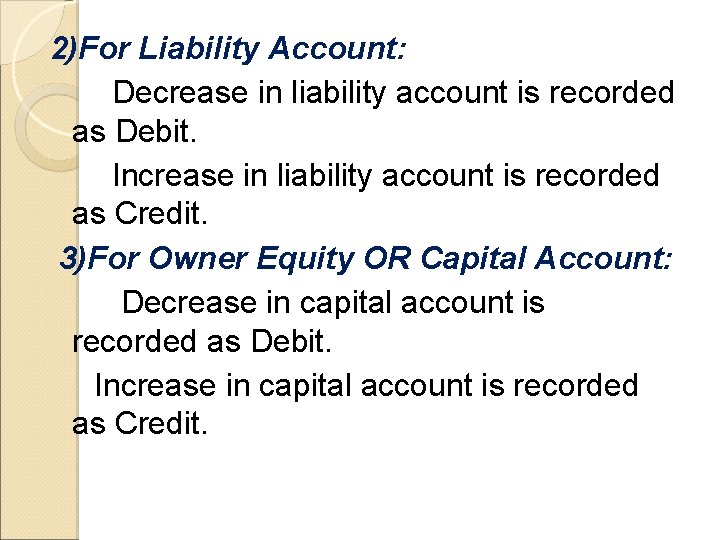
2)For Liability Account: Decrease in liability account is recorded as Debit. Increase in liability account is recorded as Credit. 3)For Owner Equity OR Capital Account: Decrease in capital account is recorded as Debit. Increase in capital account is recorded as Credit.
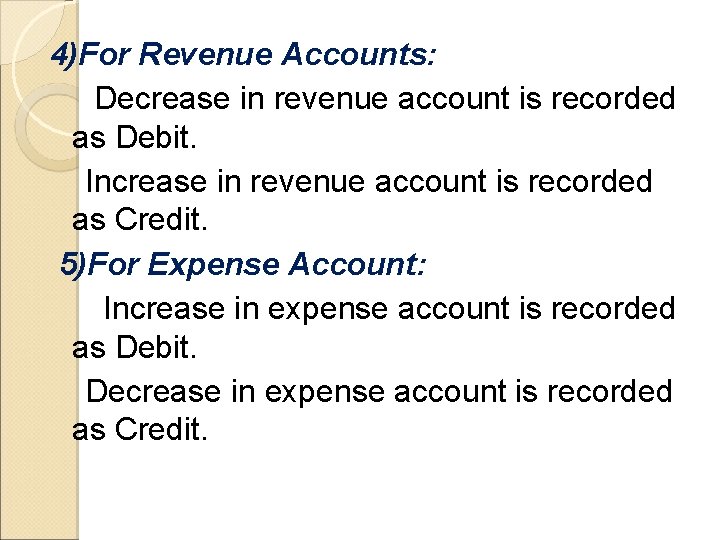
4)For Revenue Accounts: Decrease in revenue account is recorded as Debit. Increase in revenue account is recorded as Credit. 5)For Expense Account: Increase in expense account is recorded as Debit. Decrease in expense account is recorded as Credit.
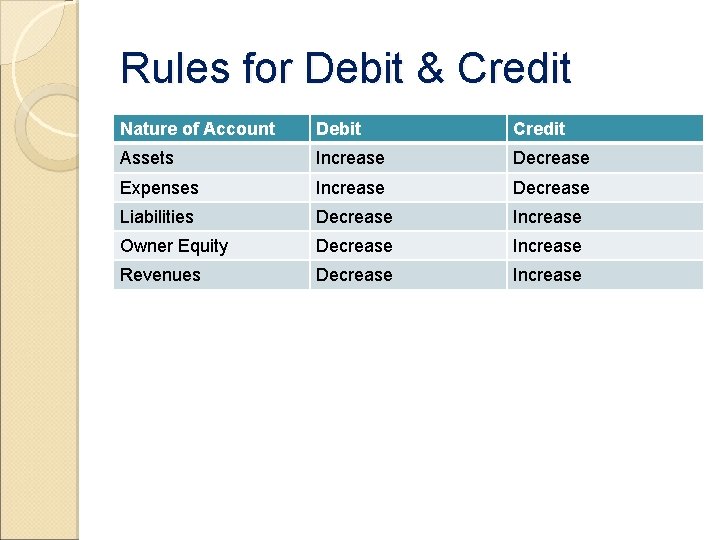
Rules for Debit & Credit Nature of Account Debit Credit Assets Increase Decrease Expenses Increase Decrease Liabilities Decrease Increase Owner Equity Decrease Increase Revenues Decrease Increase

Classify the following into Assets, Liabilities, Owner Equity, Expenses and Revenue Machinery, Bank, Rent Paid, Cash, Sales, Purchases, Goodwill, Capital, Sales Return, Purchase Return, Carriage, Commission Received, Account Receivable, Account Payable Furniture, Salaries, Land, Building, Repair charges, Equipments.
Double-entry Accounting Each transaction affects at least two accounts © 2008 Pearson Prentice Hall. All rights reserved. 215
Double entry system The system under which the double effect of every transaction is recorded is called double entry system.
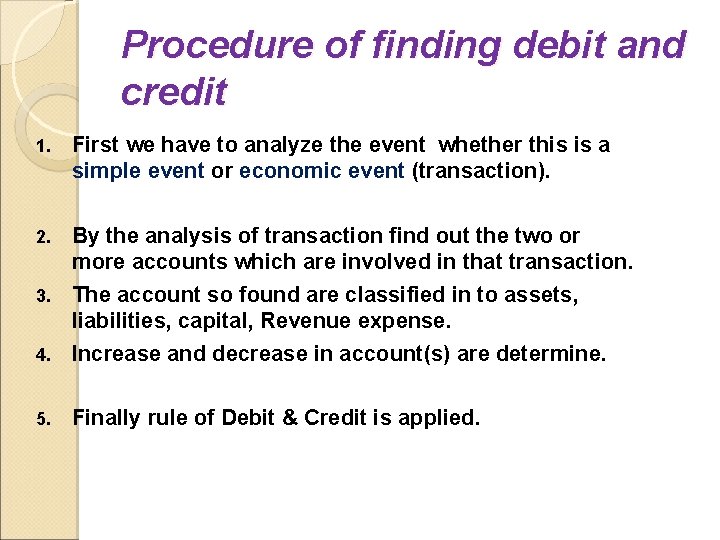
Procedure of finding debit and credit 1. First we have to analyze the event whether this is a simple event or economic event (transaction). By the analysis of transaction find out the two or more accounts which are involved in that transaction. 3. The account so found are classified in to assets, liabilities, capital, Revenue expense. 4. Increase and decrease in account(s) are determine. 2. 5. Finally rule of Debit & Credit is applied.
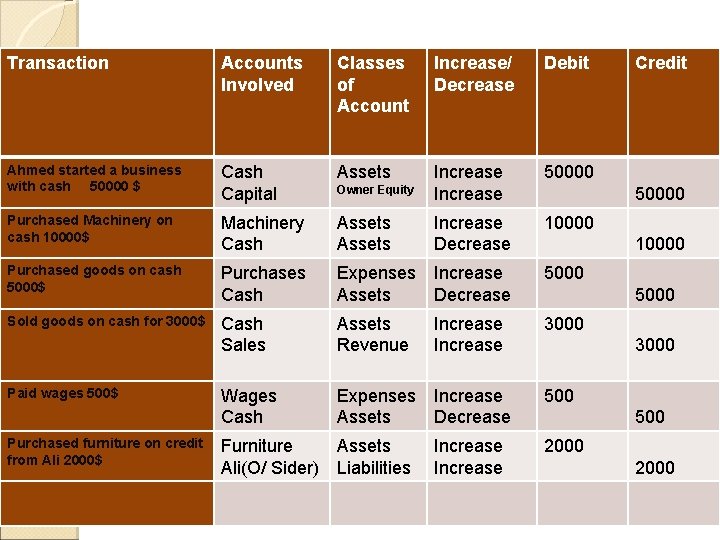
Transaction Accounts Involved Classes of Account Increase/ Decrease Debit Ahmed started a business with cash 50000 $ Cash Capital Assets Increase 50000 Purchased Machinery on cash 10000$ Machinery Cash Assets Increase Decrease 10000 Purchased goods on cash 5000$ Purchases Cash Expenses Increase Assets Decrease 5000 Sold goods on cash for 3000$ Cash Sales Assets Revenue 3000 Wages Cash Expenses Increase Assets Decrease 500 Furniture Ali(O/ Sider) Assets Liabilities 2000 Paid wages 500$ Purchased furniture on credit from Ali 2000$ Owner Equity Increase Credit 50000 10000 5000 3000 500 2000
- Slides: 18