
Chapter 2 Physics of the Skeleton Dr Rafid
- Slides: 20
Chapter 2 Physics of the Skeleton Dr Rafid Al Badr |
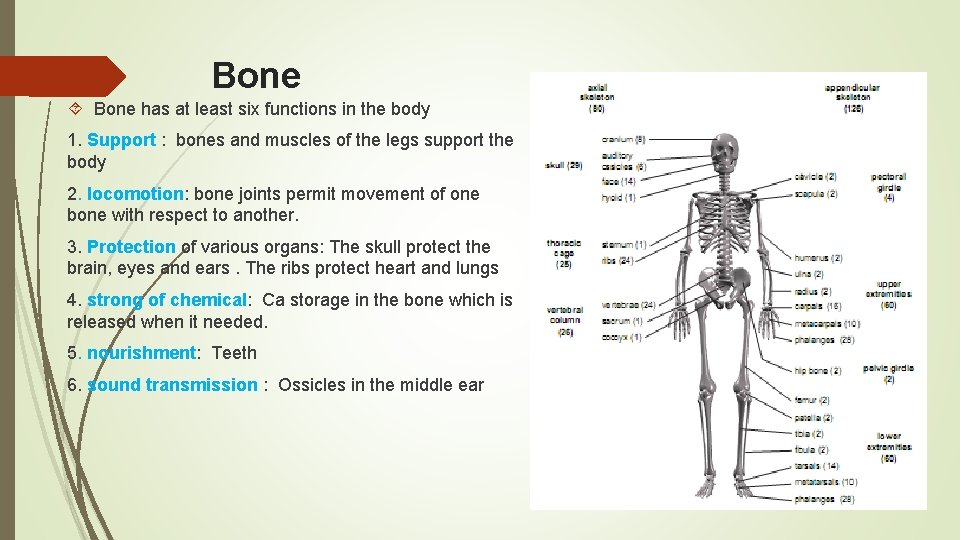
Bone has at least six functions in the body 1. Support : bones and muscles of the legs support the body 2. locomotion: bone joints permit movement of one bone with respect to another. 3. Protection of various organs: The skull protect the brain, eyes and ears. The ribs protect heart and lungs 4. strong of chemical: Ca storage in the bone which is released when it needed. 5. nourishment: Teeth 6. sound transmission : Ossicles in the middle ear
Bones are anisotropic The density of compact bone is surprisingly constant throughout life at about 1. 9 g/cm 3 in old age the bone becomes more porous and disappears from the inside Types of bones Solid or compact bones: Found in the central shaft of bones Spongy or cancellous bones (trabecular bones): Found at the ends of long bones, Weaker than compact bones. The trabecular are relatively flexible and bone can absorb more energy when large forces are involved such as in walking, running and jumping.
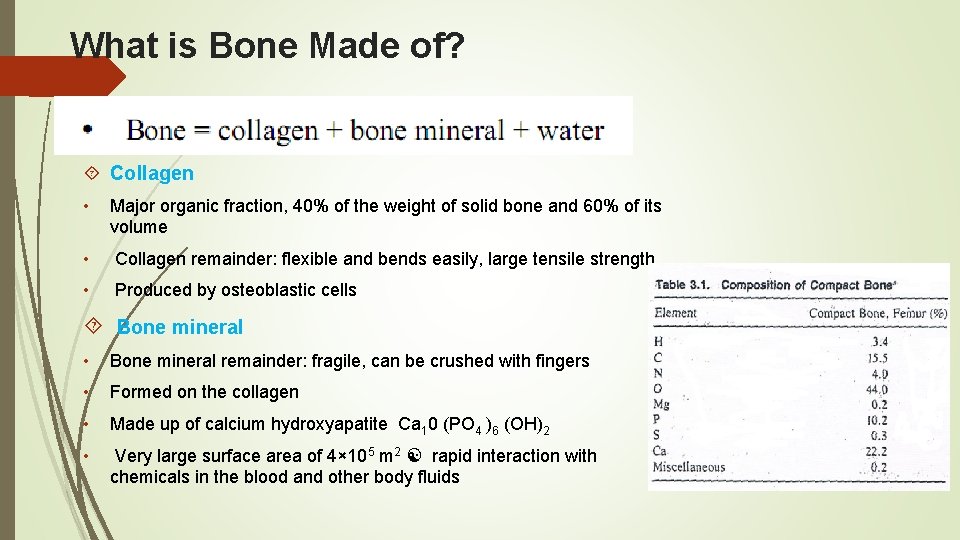
What is Bone Made of? Collagen • Major organic fraction, 40% of the weight of solid bone and 60% of its volume • Collagen remainder: flexible and bends easily, large tensile strength • Produced by osteoblastic cells Bone mineral • Bone mineral remainder: fragile, can be crushed with fingers • Formed on the collagen • Made up of calcium hydroxyapatite Ca 10 (PO 4 )6 (OH)2 • Very large surface area of 4× 10⁵ m 2 rapid interaction with chemicals in the blood and other body fluids
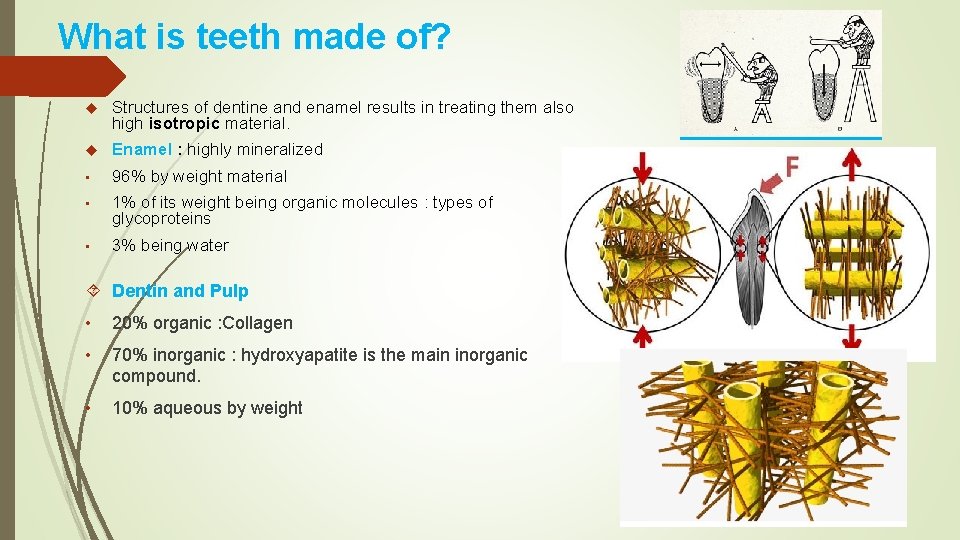
What is teeth made of? Structures of dentine and enamel results in treating them also high isotropic material. Enamel : highly mineralized • 96% by weight material • 1% of its weight being organic molecules : types of glycoproteins • 3% being water Dentin and Pulp • 20% organic : Collagen • 70% inorganic : hydroxyapatite is the main inorganic compound. • 10% aqueous by weight
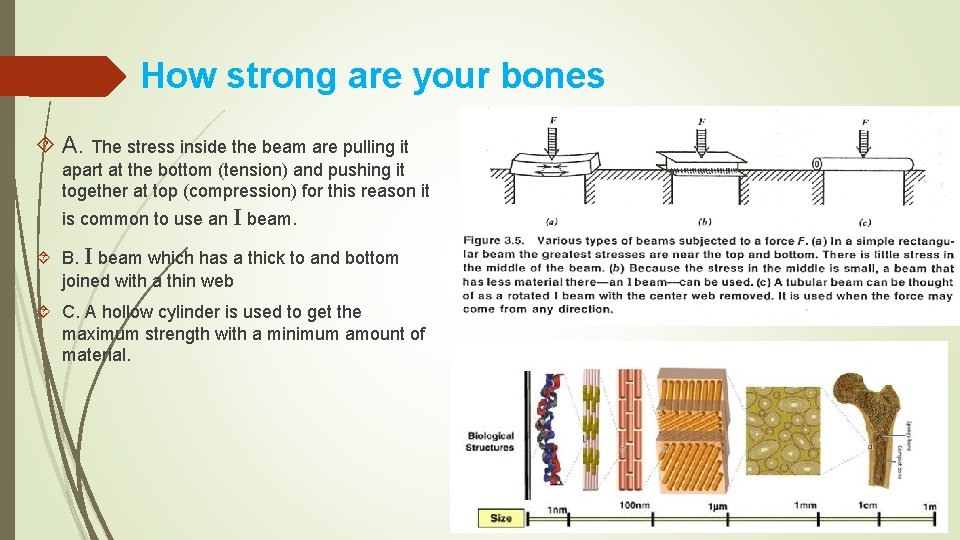
How strong are your bones A. The stress inside the beam are pulling it apart at the bottom (tension) and pushing it together at top (compression) for this reason it is common to use an I beam. B. I beam which has a thick to and bottom joined with a thin web C. A hollow cylinder is used to get the maximum strength with a minimum amount of material.
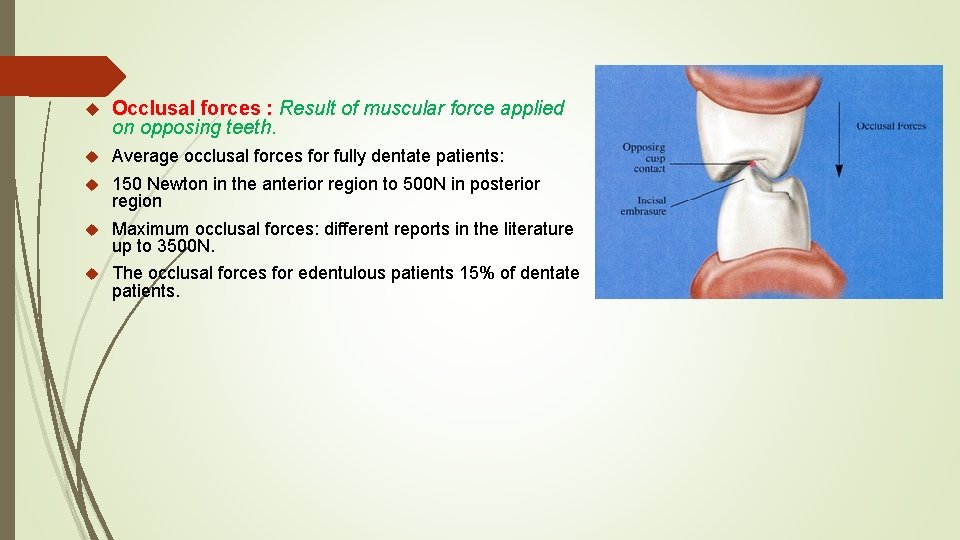
Occlusal forces : Result of muscular force applied on opposing teeth. Average occlusal forces for fully dentate patients: 150 Newton in the anterior region to 500 N in posterior region Maximum occlusal forces: different reports in the literature up to 3500 N. The occlusal forces for edentulous patients 15% of dentate patients.
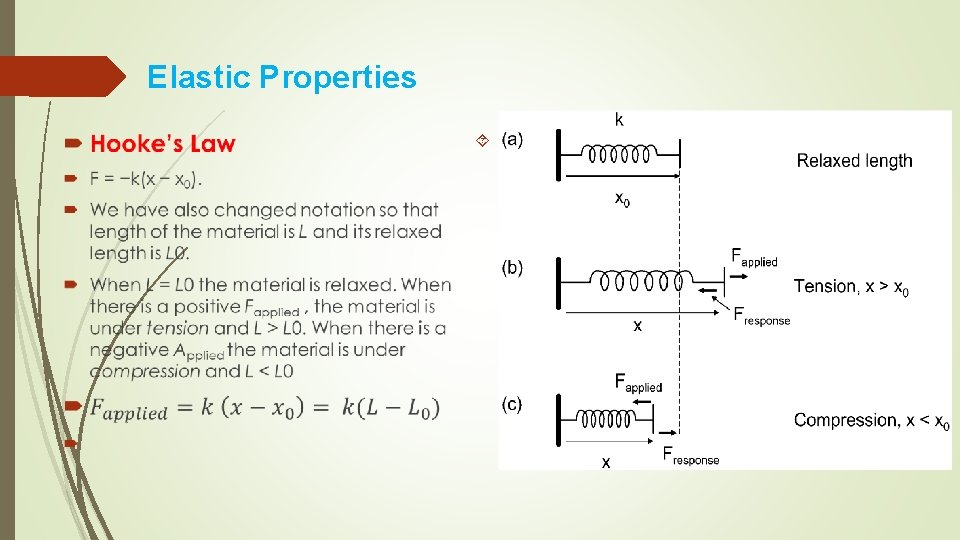
Elastic Properties
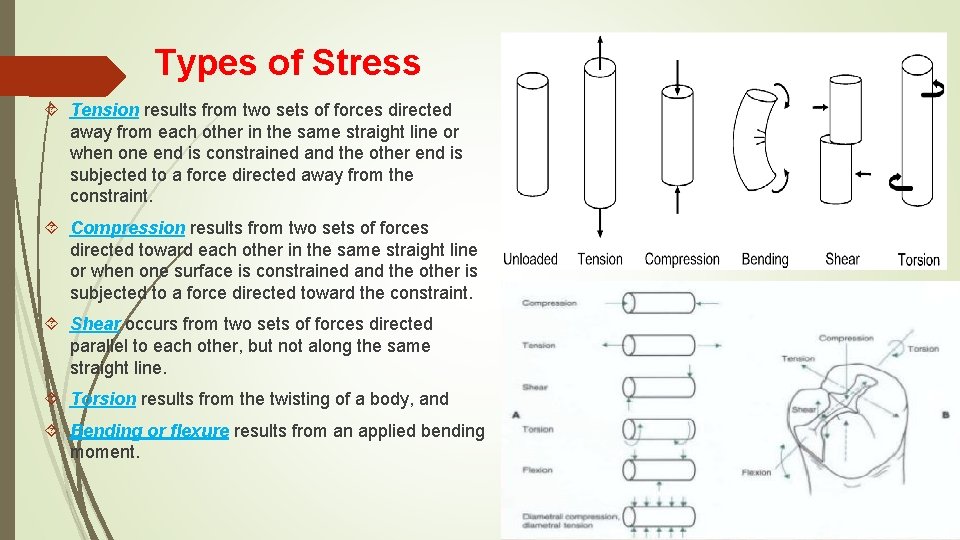
Types of Stress Tension results from two sets of forces directed away from each other in the same straight line or when one end is constrained and the other end is subjected to a force directed away from the constraint. Compression results from two sets of forces directed toward each other in the same straight line or when one surface is constrained and the other is subjected to a force directed toward the constraint. Shear occurs from two sets of forces directed parallel to each other, but not along the same straight line. Torsion results from the twisting of a body, and Bending or flexure results from an applied bending moment.
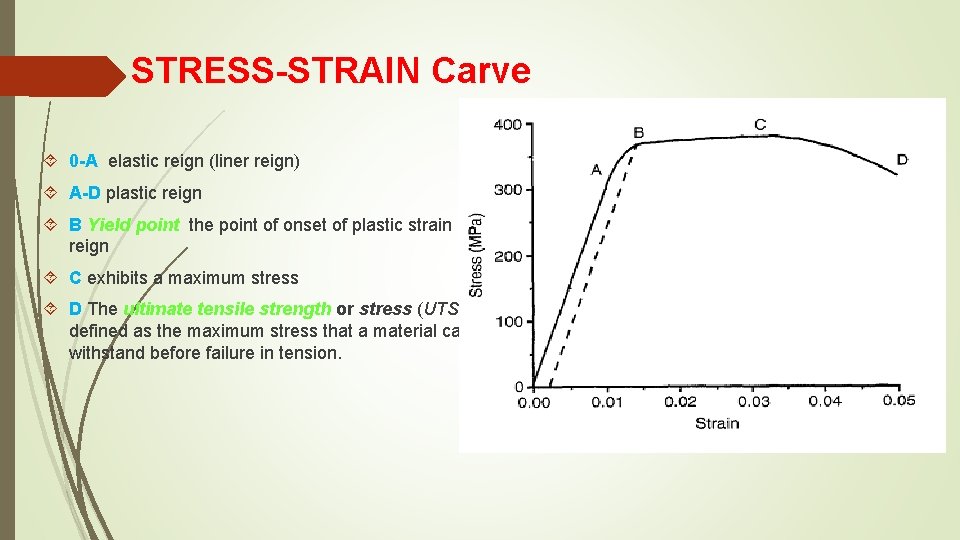
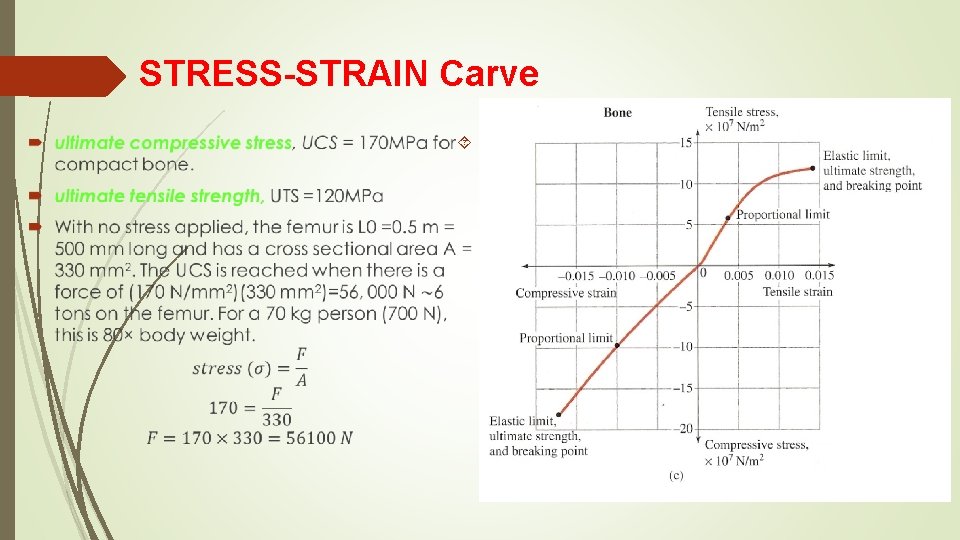
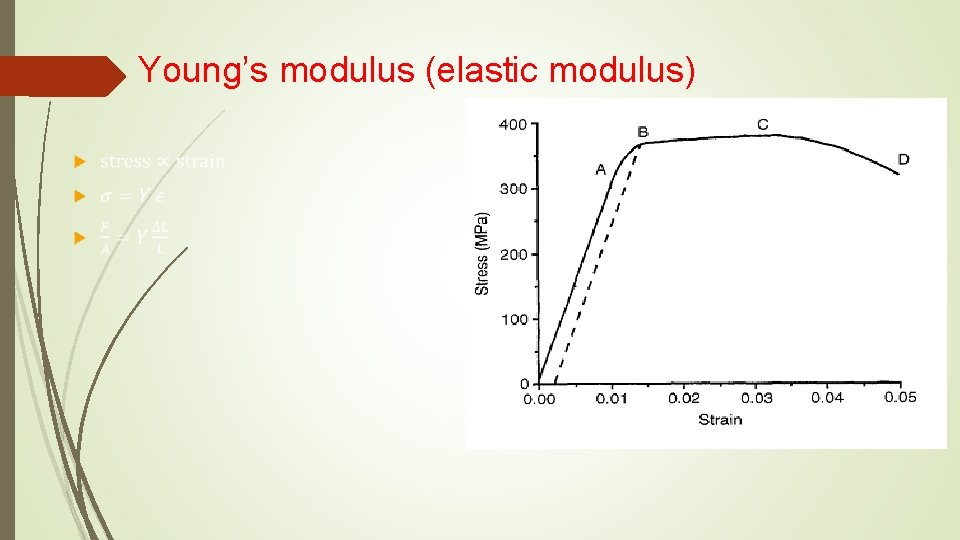
STRESS-STRAIN Carve 0 -A elastic reign (liner reign) A-D plastic reign B Yield point the point of onset of plastic strain reign C exhibits a maximum stress D The ultimate tensile strength or stress (UTS) is defined as the maximum stress that a material can withstand before failure in tension.
STRESS-STRAIN Carve
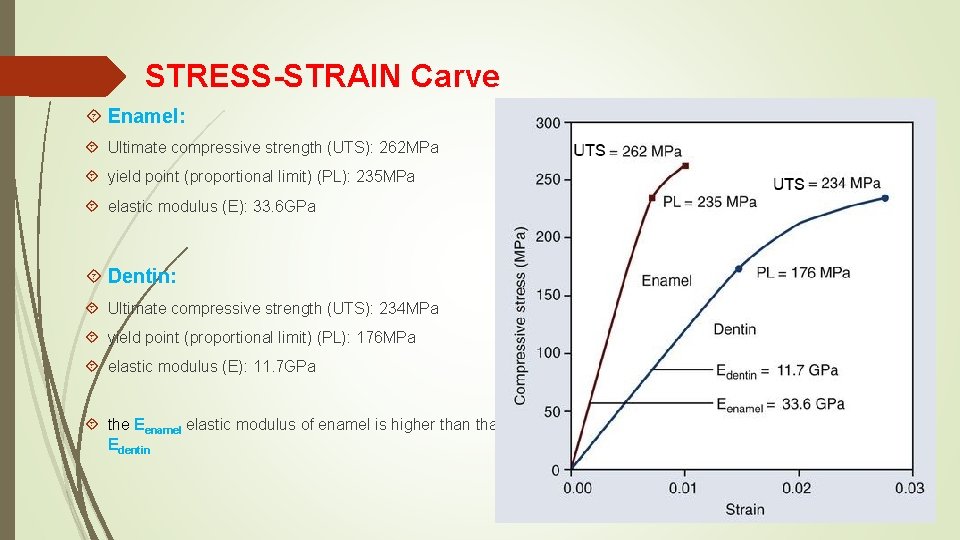
STRESS-STRAIN Carve Enamel: Ultimate compressive strength (UTS): 262 MPa yield point (proportional limit) (PL): 235 MPa elastic modulus (E): 33. 6 GPa Dentin: Ultimate compressive strength (UTS): 234 MPa yield point (proportional limit) (PL): 176 MPa elastic modulus (E): 11. 7 GPa the Eenamel elastic modulus of enamel is higher than that of Edentin
Young’s modulus (elastic modulus)
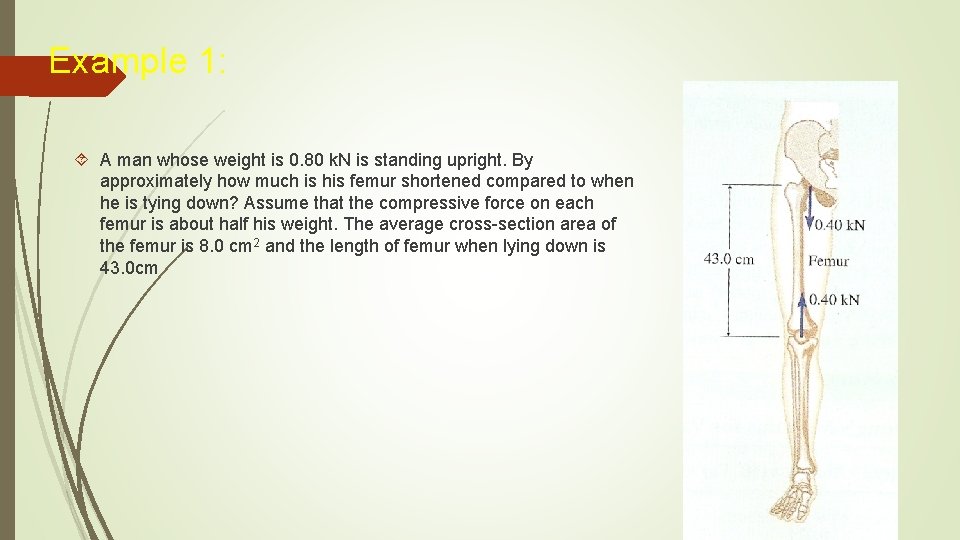
Example 1: A man whose weight is 0. 80 k. N is standing upright. By approximately how much is his femur shortened compared to when he is tying down? Assume that the compressive force on each femur is about half his weight. The average cross-section area of the femur is 8. 0 cm 2 and the length of femur when lying down is 43. 0 cm
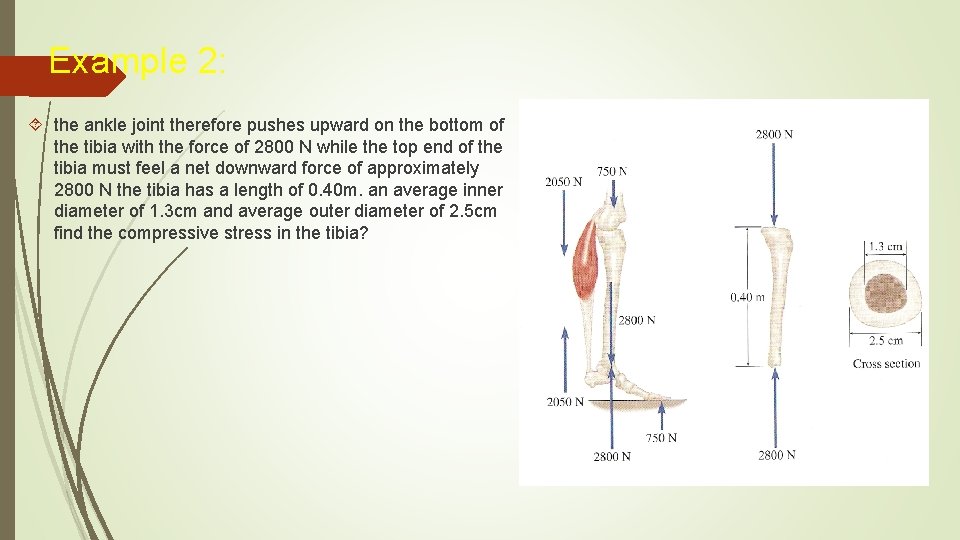
Example 2: the ankle joint therefore pushes upward on the bottom of the tibia with the force of 2800 N while the top end of the tibia must feel a net downward force of approximately 2800 N the tibia has a length of 0. 40 m. an average inner diameter of 1. 3 cm and average outer diameter of 2. 5 cm find the compressive stress in the tibia?
Example 3: A hair break under tension of 1. 2 N what is the diameter of a hear? Strength if 200 MPa.
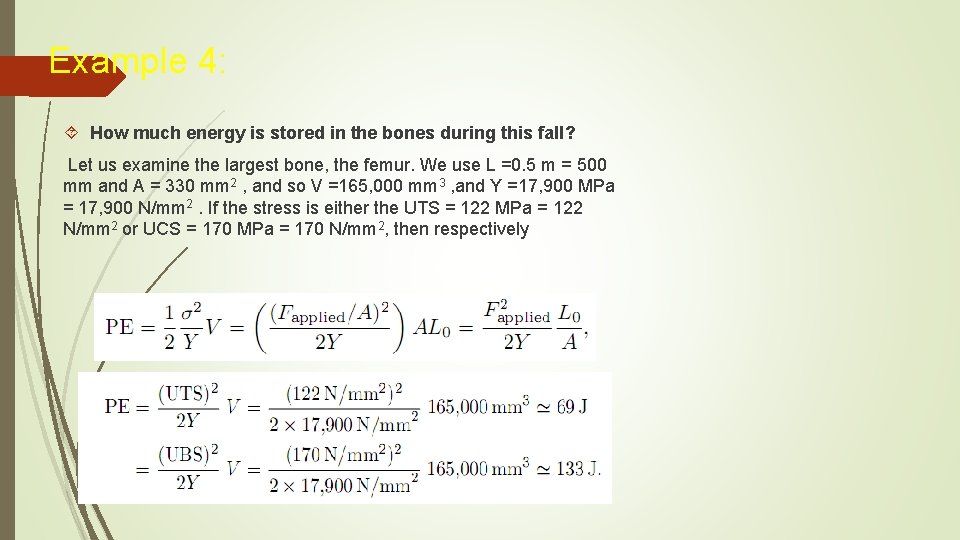
Example 4: How much energy is stored in the bones during this fall? Let us examine the largest bone, the femur. We use L =0. 5 m = 500 mm and A = 330 mm 2 , and so V =165, 000 mm 3 , and Y =17, 900 MPa = 17, 900 N/mm 2. If the stress is either the UTS = 122 MPa = 122 N/mm 2 or UCS = 170 MPa = 170 N/mm 2, then respectively
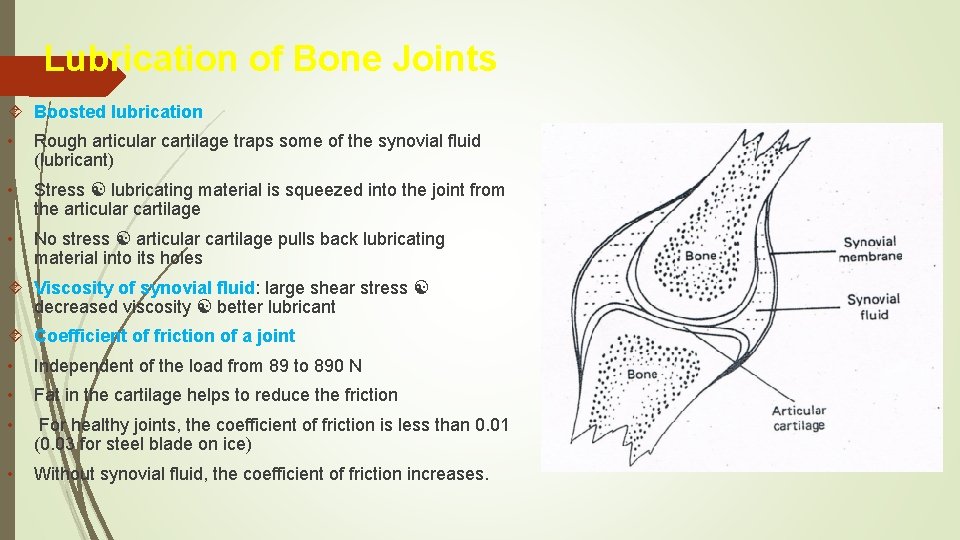
Lubrication of Bone Joints Boosted lubrication • Rough articular cartilage traps some of the synovial fluid (lubricant) • Stress lubricating material is squeezed into the joint from the articular cartilage • No stress articular cartilage pulls back lubricating material into its holes Viscosity of synovial fluid: large shear stress decreased viscosity better lubricant Coefficient of friction of a joint • Independent of the load from 89 to 890 N • Fat in the cartilage helps to reduce the friction • For healthy joints, the coefficient of friction is less than 0. 01 (0. 03 for steel blade on ice) • Without synovial fluid, the coefficient of friction increases.