
Chapter 2 Philosophical Foundations and Theories of Education
- Slides: 38
Chapter 2 Philosophical Foundations and Theories of Education 1
Four Philosophical Stances Idealism n Realism n Existentialism n Pragmatism n 2
Idealism The most significant philosophy; n The quality of life– the intangibles, the whispers; n Material things are evils; n The highest element of man is reason; n Freedom is based on education; n Creative growth; n One’s intellectual and personal life. n 3
An idealist teacher: n stretches oneself through higher-level thinking; n every pupil makes a different, he counts for something; n knows the content, likes to teach, knows his students; n school represents the community; n demonstrates school spirit, good conduct, high moral standards, and fair play; 4
Realism n n n n n Like idealism, one of the oldest; Focuses on scientific method and personal experience; Its crux is science-- empirical, objective, and experimental; Discovers the truth; Rules and regulations are essential; Men are created equal. Education is for all; Accountability; Precision in math and science encouraged; The influx of technology reflects realist philosophical view. 5
Existentialism n n n n One’s total self; Choice, absolute freedom, and total responsibility; Empowering students; Existentialists interested in affective side of man, his capacity to love, to appreciate, to respond emotionally to the world about him; Emphasizes humanities– art, music, and drama. The existential teacher is a free spirit who has no limitations in terms of dress and personal lifestyle; This teacher does as he or she chooses, in short, 6
Pragmatism Ventures forth with the question about truth; n Scientific and technological advances; n Charles Pierce, an American mathematician, scientist, and philosopher, was a promoter of pragmatism in the 1800 s and early 1900 s; n Teaching students survey techniques and equipment. n 7
PHILOSOPHIES OF EDUCATION AND THEIR CLASSROOM APPLICATIONS 8
IDEALISM The teacher n Knows the content area that he/she teaches very well. n Enjoys teaching and serving as a model for student. n Believes each student has value and can make a valuable contribution to society. 9
Teaching strategies n Encourage students to challenge themselves as learners. n Encourage students to “seek the truth”. The student n Is in school to seek the truth. 10
The curriculum n is based on cultural heritage and wisdom. Classroom management n Few discipline problems as teacher’s love of subject matter is transferred to students. n Any problems with student behavior are handled by the teacher who discusses them with the students involved. 11
REALISM The teacher n Relies on test score to place students. n Readily adopts new technology. Teaching strategies n Emphasize realistic novel such as The Color Purple. n Stress precision and accuracy in math, science, social studies, and writing. 12
The student n Is expected to focus on accuracy. The curriculum n Emphasizes accountability. n Stresses concept acquisition. Classroom management n Classroom rules and resultant punishments are established at the beginning of the school year and posted in the classroom. n Violators are punished according to the criteria established. 13
EXISTENTIALISM The teacher n Emphasizes individual choice. Teaching strategies n Stress individual freedom, empowerment of students to make choices about what and how they will learn. The student n Is an individual who gains meaning from within. 14
The curriculum n Stresses the arts and literature. n Has little emphasis on math and science. Classroom management n Emphasis on freedom to do as student pleases in the classroom. 15
PRAGMATISM The teacher n Applies democratic methods. n Classroom is a community of learners. Teaching strategies n Encourage problem solving. n Democratic procedures. The student n Learns by engaging in activity first-hand. 16
Curriculum n Emphasizes concrete experiences. n Emphasis on the three Rs in elementary school. Classroom management n Classroom rules are established by the class in democratic fashion. 17
THEORIES OF EDUCATION n The various philosophies led to the development of theories of education: Experimentalism n Progressivism n Social Reconstructionism n Perennialism n Essentialism n 18
Experimentalism Comes from pragmatic theory; n Tests ideas through experimentation; n Emphasizes experience and childcentered activities; n Stresses final product; n Promotes firsthand experience. n 19
Progressivism Is based on the belief that all people are benevolent and that by using human intellect in combination with the scientific method, the world would be improved. n William Heard Kilpatrick, a follower of Dewey, synthesized Dewey’s experimentalism with progressivism and developed a “project method”. n 20
n He suggested four different types of projects. n The creative project: Ss design plan// Acting out a play. n The enjoyment project: Cultivating aesthetic experiences. n The problem project: Gender discrimination solved// Ss using intellect. n The specific learning project: Acquisition of knowledge and skills// Swimming or playing golf. 21
Social Reconstructionism Has its roots in progressivism; n Ss study their own culture, finding the major causes of problems (poverty or war) and resolving them; n Teachers utilize problem solving and divergent thinking; n Remedies for solutions to social problems are probed. n 22
Perennialism n n n Based on the philosophy of realism; A traditional and conservative view; Follows the beliefs of Aristotle; Insights into art, history, literature, math, and science can be passed from one generation to the next; A perennialist teacher is a reader and writer and Ss do the same; Goals of learning: Acquire organized knowledge, develop intellectual skills, and an enlarged understanding of ideas and values. 23
Essentialism n n n n Very traditional and conservative; In direct opposition to progressive education; Teacher should be well trained in his discipline; American Ss performed poorly in math and science; Lashed out at social promotions for Ss; In the 1970 s, essentialist movement resurfaced as the back-to-basic movement; Ss should be trained in history, science, math, literature, language, art and other disciplines. 24
Now, essentialism is rigorous; n There is a push for national standards for teachers and Ss; n US is lagging behind other nations due to a lack of standards in the schools. n 25
THEORIES OF EDUCATION AND THEIR CLASSROOM APPLICATIONS EXPERIMENTALISM The teacher n Encourages students to test ideas n Develops rapport with students n Play is encouraged for both cooperation and competition 26
Teaching strategies n Use hands-on activities n Place emphasis on problem solving n Include integrated instruction The student n Is encouraged to question ideas The curriculum n Stresses science n Places emphasis on interrelatedness 27
Classroom management n Dialogue is encouraged between student and teacher regarding student behavior 28
PROGRESSIVISM The teacher n Assists rather guides learning n Places emphasis on intrinsic rather than extrinsic rewards n Is more sensitive to student needs than academic subject matter n Follows lead of students as to what should be taught 29
Teaching strategies n Incorporate projects planned, developed, and carried out by students n Stress aesthetics of learning n Stress cooperative learning The student n Is self-directed in learning The curriculum n Stresses skills attainment n Places emphasis on the arts and the aesthetics of learning Classroom management n Liberal classroom discipline with students given lots of freedom 30
Social Reconstructionism n The teacher Is a liberal thinker; n Challenges the established rules of the school district. n n Teaching strategies Encourage Ss to address and attempt to solve social problems; n Stress experimentation and problem solving. n 31
n The Student n Needs to study his or her own culture; n Is encouraged to be divergent thinker. n The Curriculum n Is heavily multicultural; n Places emphasis on social issues. 32
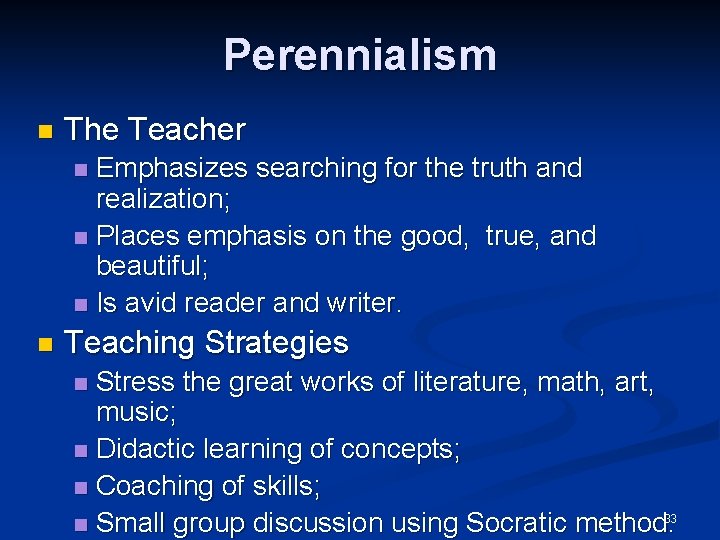
Perennialism n The Teacher Emphasizes searching for the truth and realization; n Places emphasis on the good, true, and beautiful; n Is avid reader and writer. n n Teaching Strategies Stress the great works of literature, math, art, music; n Didactic learning of concepts; n Coaching of skills; 33 n Small group discussion using Socratic method. n
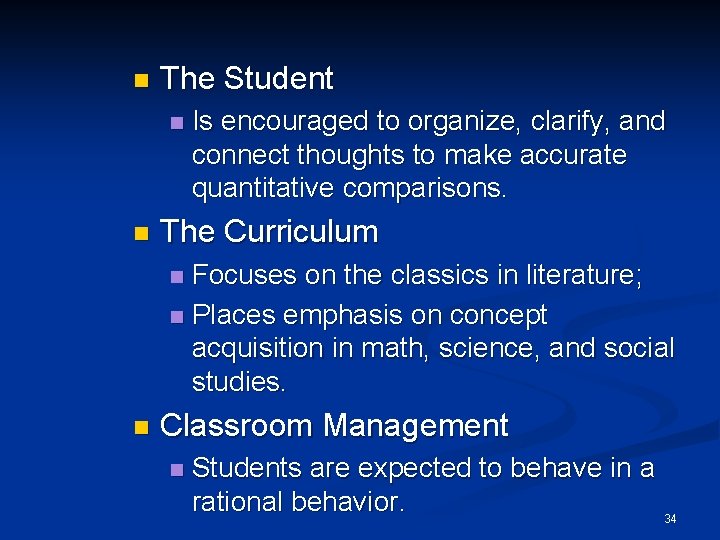
n The Student n n Is encouraged to organize, clarify, and connect thoughts to make accurate quantitative comparisons. The Curriculum Focuses on the classics in literature; n Places emphasis on concept acquisition in math, science, and social studies. n n Classroom Management n Students are expected to behave in a rational behavior. 34
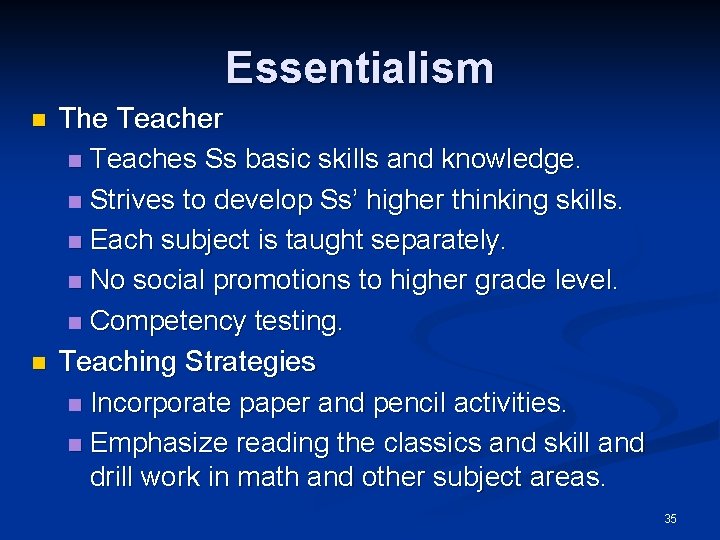
Essentialism n n The Teacher n Teaches Ss basic skills and knowledge. n Strives to develop Ss’ higher thinking skills. n Each subject is taught separately. n No social promotions to higher grade level. n Competency testing. Teaching Strategies n Incorporate paper and pencil activities. n Emphasize reading the classics and skill and drill work in math and other subject areas. 35
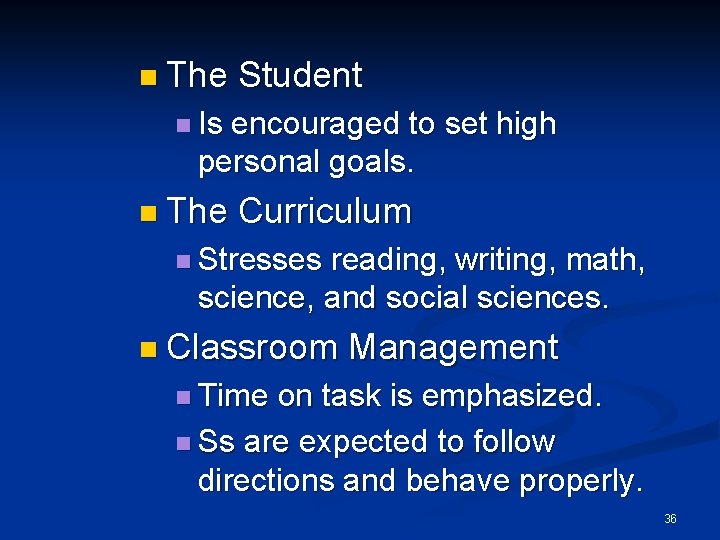
n The Student n Is encouraged to set high personal goals. n The Curriculum n Stresses reading, writing, math, science, and social sciences. n Classroom Management n Time on task is emphasized. n Ss are expected to follow directions and behave properly. 36
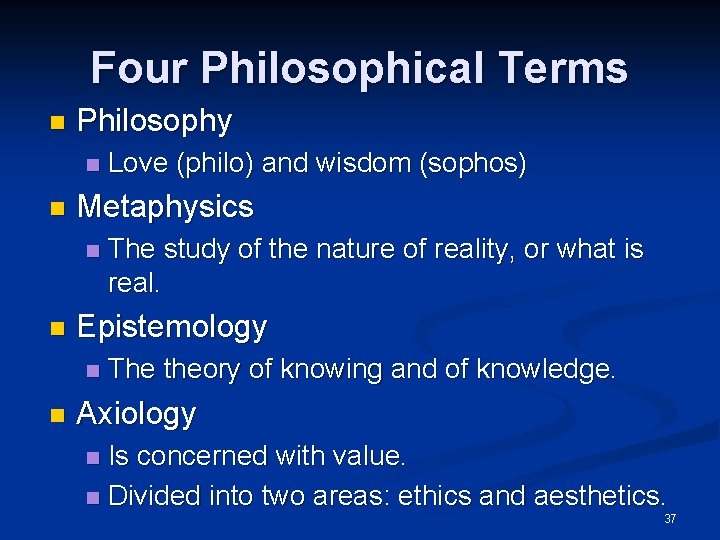
Four Philosophical Terms n Philosophy n n Metaphysics n n The study of the nature of reality, or what is real. Epistemology n n Love (philo) and wisdom (sophos) The theory of knowing and of knowledge. Axiology Is concerned with value. n Divided into two areas: ethics and aesthetics. n 37
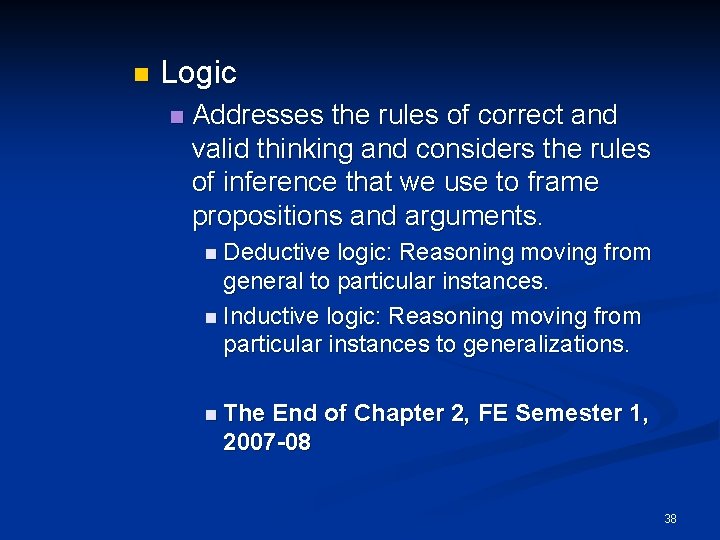
n Logic n Addresses the rules of correct and valid thinking and considers the rules of inference that we use to frame propositions and arguments. n Deductive logic: Reasoning moving from general to particular instances. n Inductive logic: Reasoning moving from particular instances to generalizations. n The End of Chapter 2, FE Semester 1, 2007 -08 38