
Chapter 2 Part II Project Management Project Network
- Slides: 30
Chapter 2 Part -II Project Management Project Network
Project Management n What is a project? n n n Any endeavor with objectives With multiple activities With defined precedent relationships With a specific time period for completion Examples? n n n A major event like a wedding Any construction project Designing a political campaign
Five Project Life Cycle Phases n n Conception: identify the need Feasibility analysis or study: costs benefits, and risks n Planning: who, how long, what to do? n Execution: doing the project n Termination: ending the project
Network Planning Techniques n n Program Evaluation & Review Technique (PERT): n Developed to manage the Polaris missile project n Many tasks pushed the boundaries of science & engineering (tasks’ duration = probabilistic) Critical Path Method (CPM): n Developed to coordinate maintenance projects in the chemical industry n A complex undertaking, but individual tasks are routine (tasks’ duration = deterministic)
Both PERT and CPM n n Graphically display the precedence relationships & sequence of activities Estimate the project’s duration Identify critical activities that cannot be delayed without delaying the project Estimate the amount of slack associated with noncritical activities
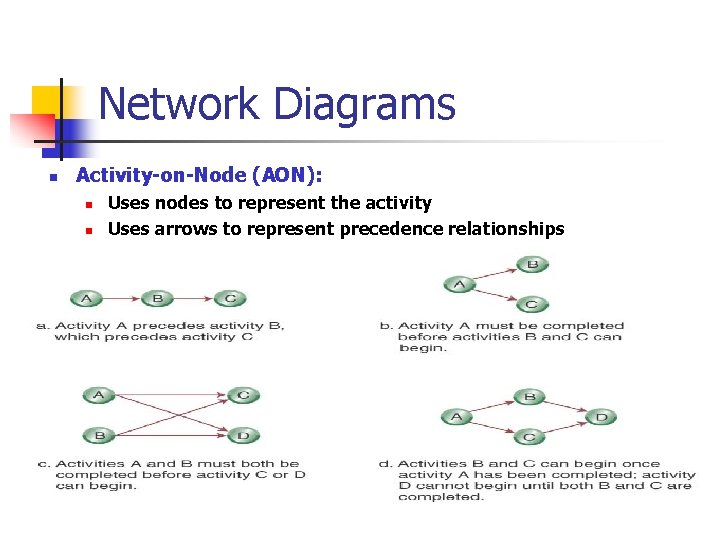
Network Diagrams n Activity-on-Node (AON): n n Uses nodes to represent the activity Uses arrows to represent precedence relationships
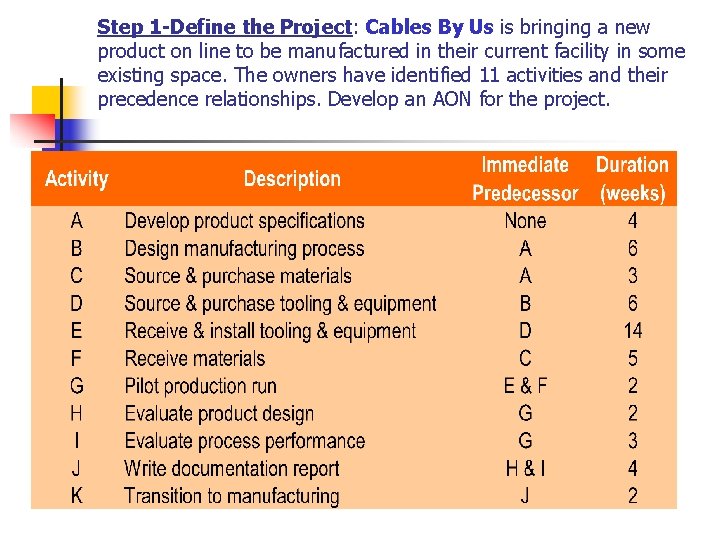
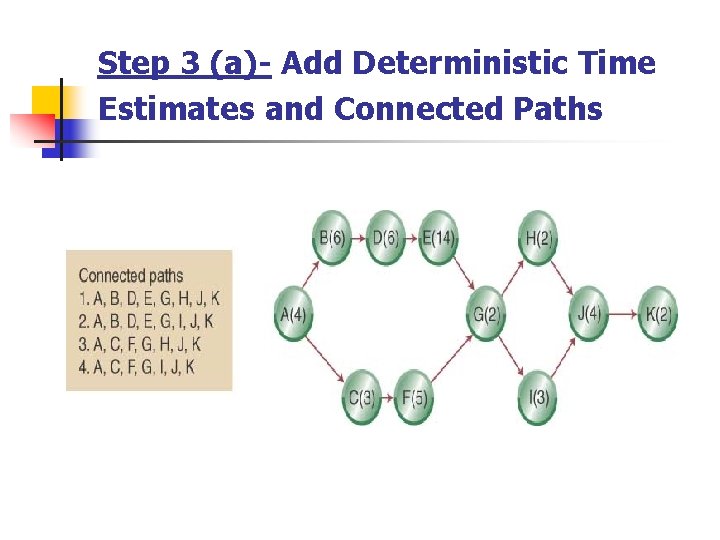
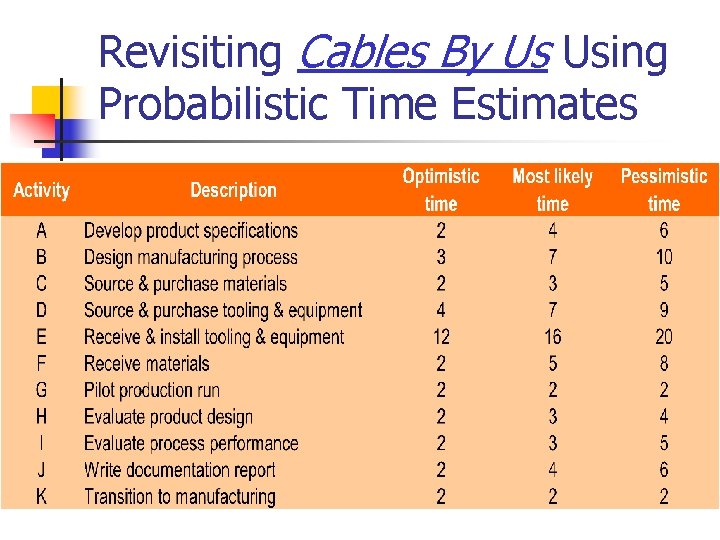
Step 1 -Define the Project: Cables By Us is bringing a new product on line to be manufactured in their current facility in some existing space. The owners have identified 11 activities and their precedence relationships. Develop an AON for the project.
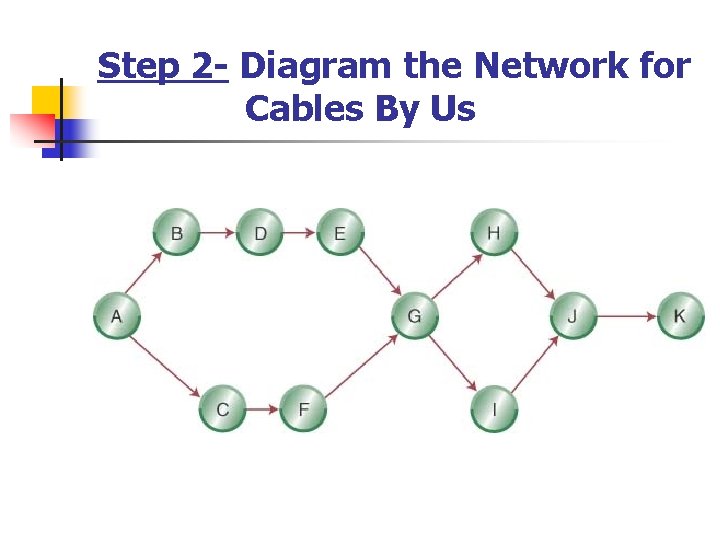
Step 2 - Diagram the Network for Cables By Us
Step 3 (a)- Add Deterministic Time Estimates and Connected Paths
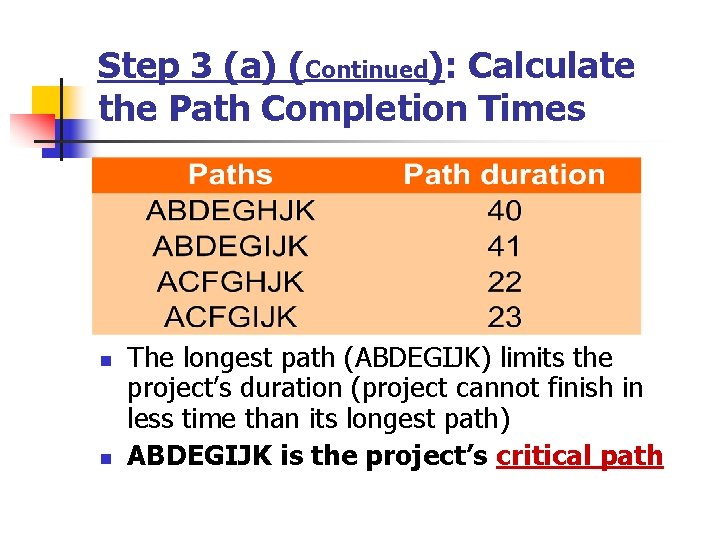
Step 3 (a) (Continued): Calculate the Path Completion Times n n The longest path (ABDEGIJK) limits the project’s duration (project cannot finish in less time than its longest path) ABDEGIJK is the project’s critical path
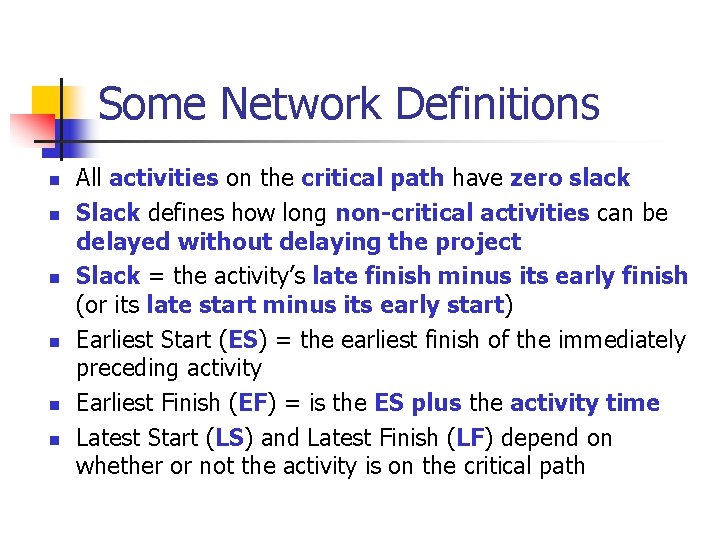
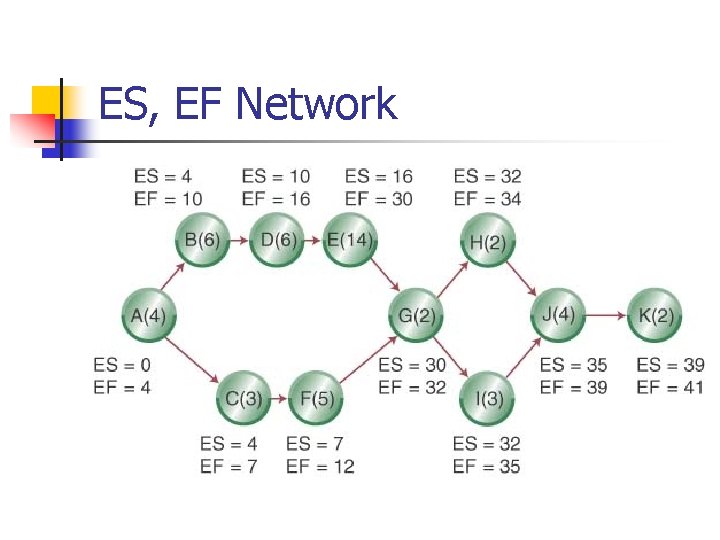
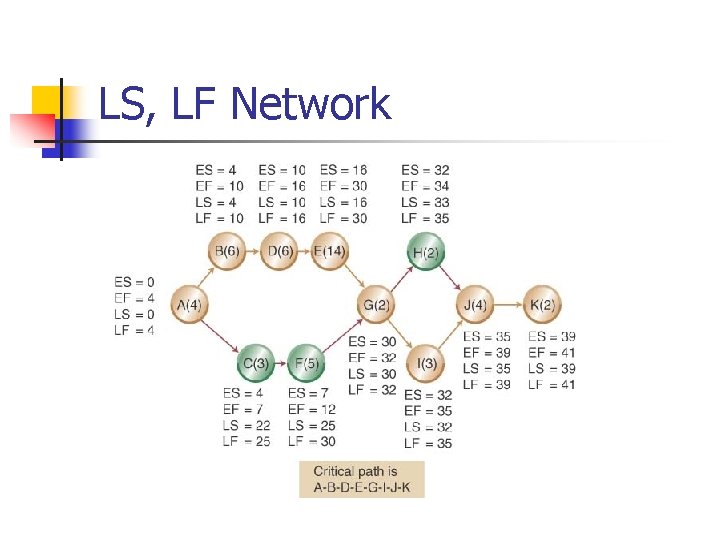
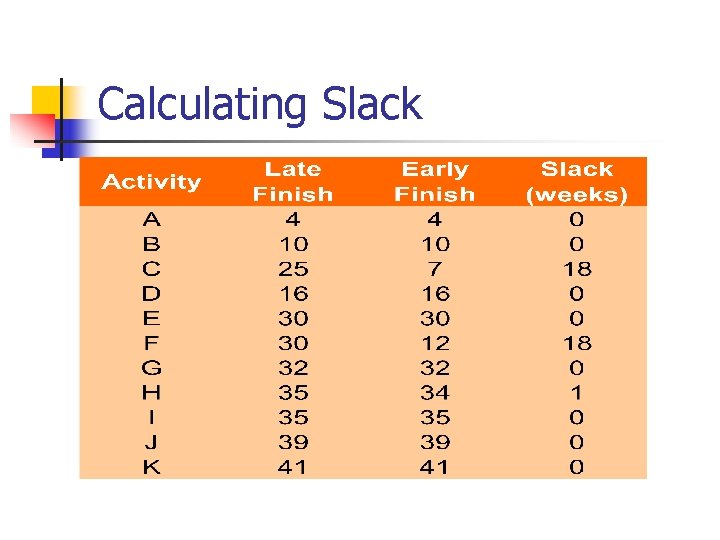
Some Network Definitions n n n All activities on the critical path have zero slack Slack defines how long non-critical activities can be delayed without delaying the project Slack = the activity’s late finish minus its early finish (or its late start minus its early start) Earliest Start (ES) = the earliest finish of the immediately preceding activity Earliest Finish (EF) = is the ES plus the activity time Latest Start (LS) and Latest Finish (LF) depend on whether or not the activity is on the critical path
ES, EF Network
LS, LF Network
Calculating Slack
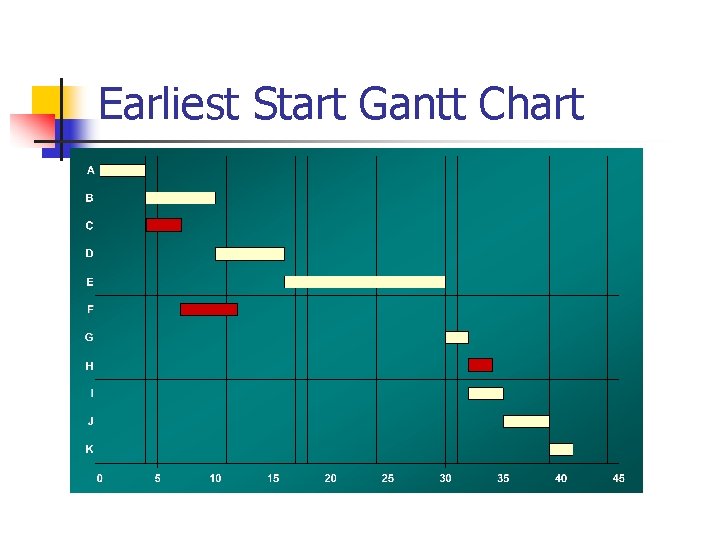
Earliest Start Gantt Chart
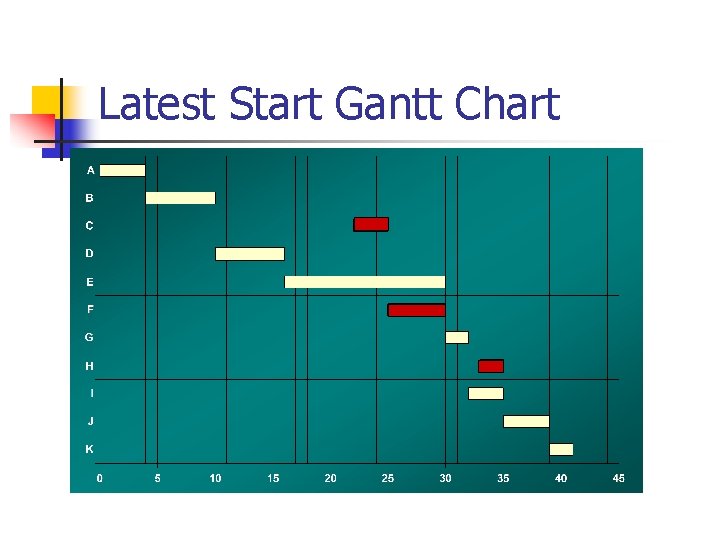
Latest Start Gantt Chart
Revisiting Cables By Us Using Probabilistic Time Estimates
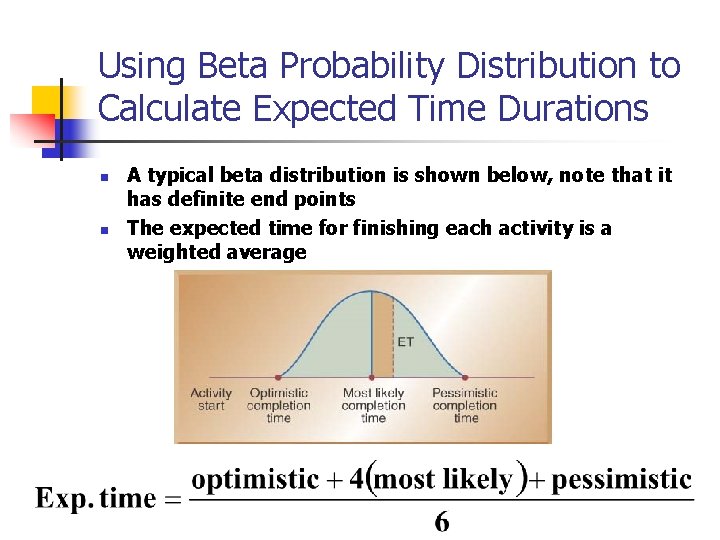
Using Beta Probability Distribution to Calculate Expected Time Durations n n A typical beta distribution is shown below, note that it has definite end points The expected time for finishing each activity is a weighted average
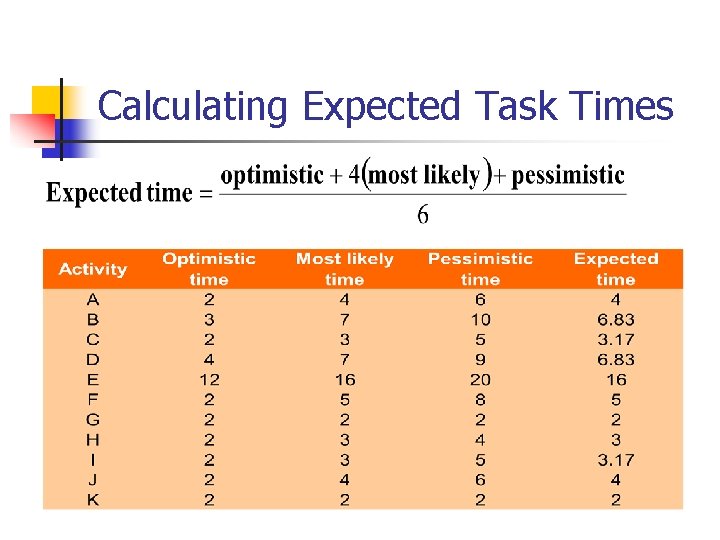
Calculating Expected Task Times
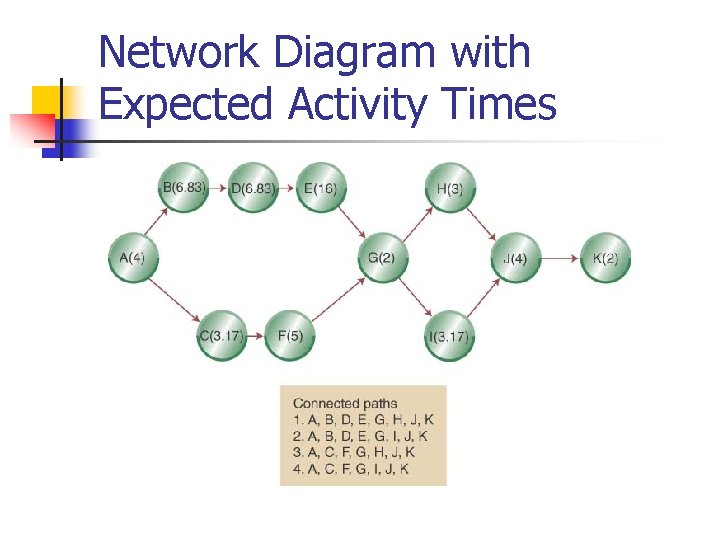
Network Diagram with Expected Activity Times
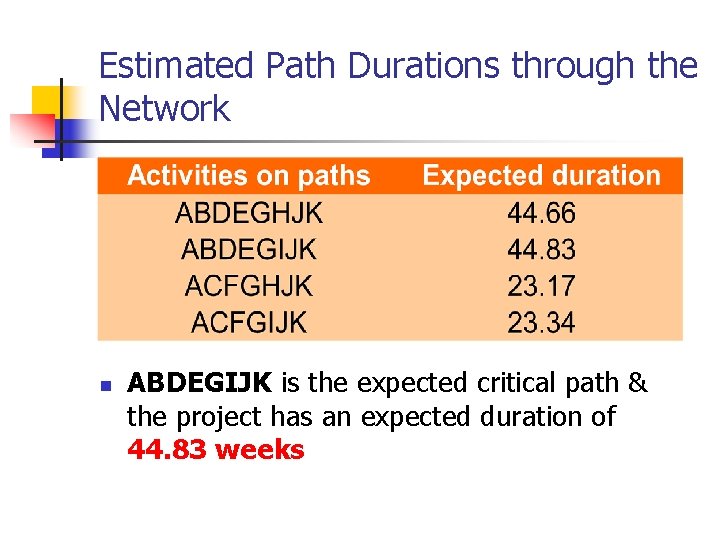
Estimated Path Durations through the Network n ABDEGIJK is the expected critical path & the project has an expected duration of 44. 83 weeks
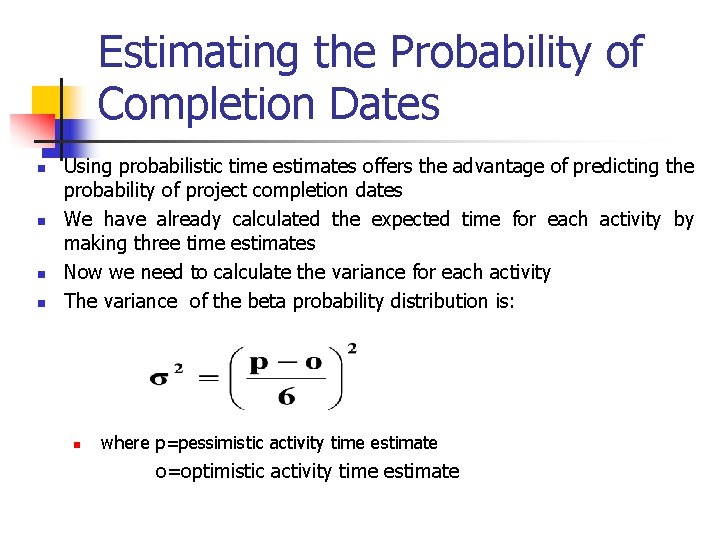
Estimating the Probability of Completion Dates n n Using probabilistic time estimates offers the advantage of predicting the probability of project completion dates We have already calculated the expected time for each activity by making three time estimates Now we need to calculate the variance for each activity The variance of the beta probability distribution is: n where p=pessimistic activity time estimate o=optimistic activity time estimate
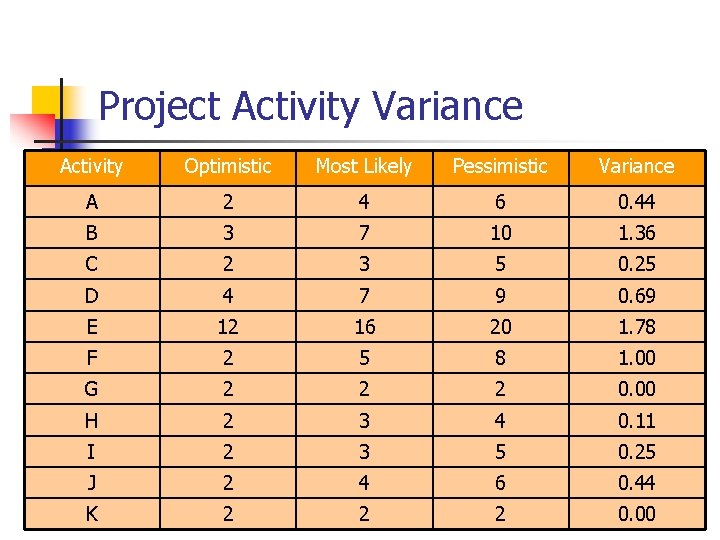
Project Activity Variance Activity Optimistic Most Likely Pessimistic Variance A 2 4 6 0. 44 B 3 7 10 1. 36 C 2 3 5 0. 25 D 4 7 9 0. 69 E 12 16 20 1. 78 F 2 5 8 1. 00 G 2 2 2 0. 00 H 2 3 4 0. 11 I 2 3 5 0. 25 J 2 4 6 0. 44 K 2 2 2 0. 00
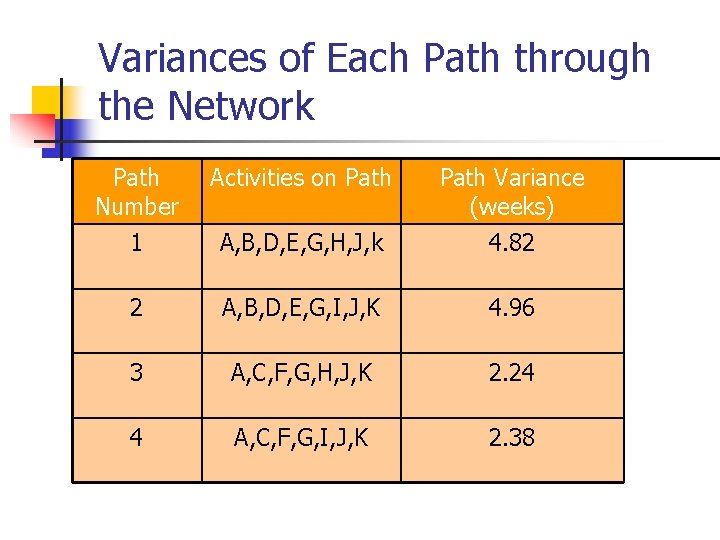
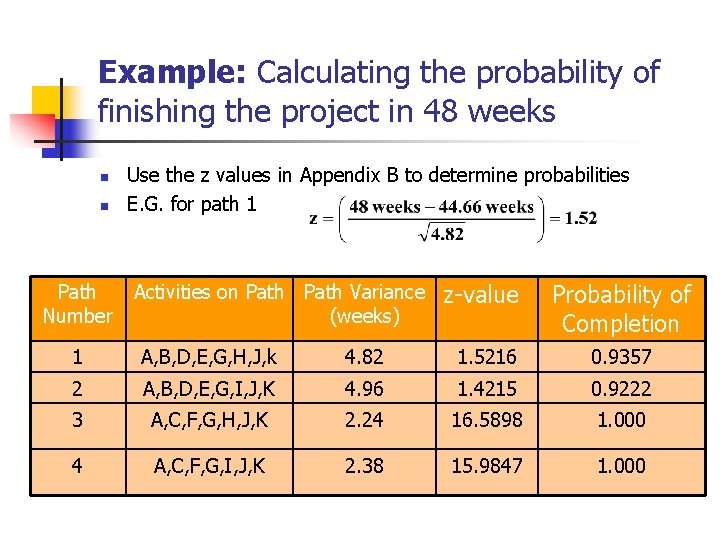
Variances of Each Path through the Network Path Number 1 Activities on Path A, B, D, E, G, H, J, k Path Variance (weeks) 4. 82 2 A, B, D, E, G, I, J, K 4. 96 3 A, C, F, G, H, J, K 2. 24 4 A, C, F, G, I, J, K 2. 38
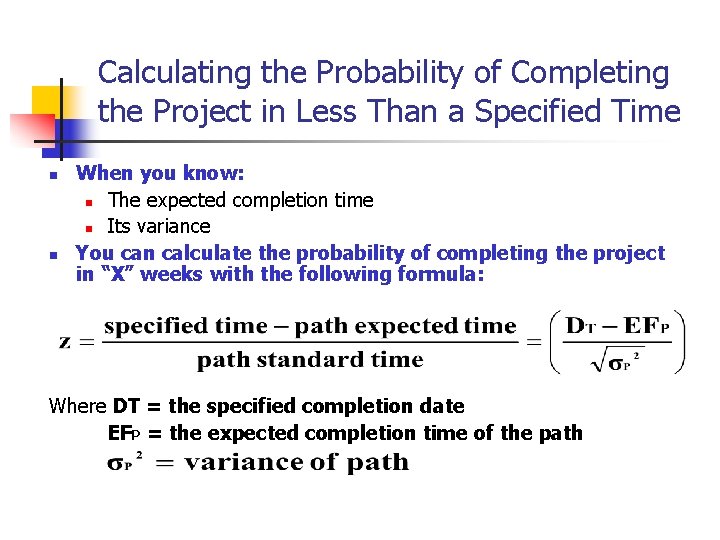
Calculating the Probability of Completing the Project in Less Than a Specified Time n n When you know: n The expected completion time n Its variance You can calculate the probability of completing the project in “X” weeks with the following formula: Where DT = the specified completion date EFP = the expected completion time of the path
Example: Calculating the probability of finishing the project in 48 weeks n n Path Number Use the z values in Appendix B to determine probabilities E. G. for path 1 Activities on Path Variance (weeks) z-value Probability of Completion 1 A, B, D, E, G, H, J, k 4. 82 1. 5216 0. 9357 2 A, B, D, E, G, I, J, K 4. 96 1. 4215 0. 9222 3 A, C, F, G, H, J, K 2. 24 16. 5898 1. 000 4 A, C, F, G, I, J, K 2. 38 15. 9847 1. 000
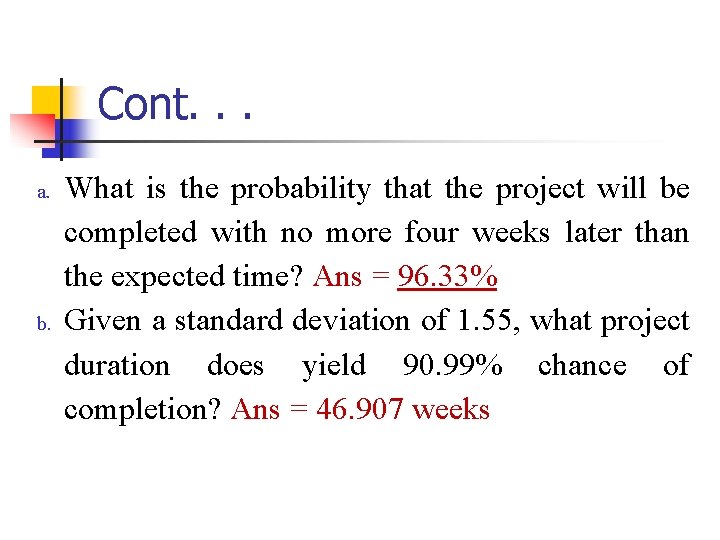
Cont. . . a. b. What is the probability that the project will be completed with no more four weeks later than the expected time? Ans = 96. 33% Given a standard deviation of 1. 55, what project duration does yield 90. 99% chance of completion? Ans = 46. 907 weeks
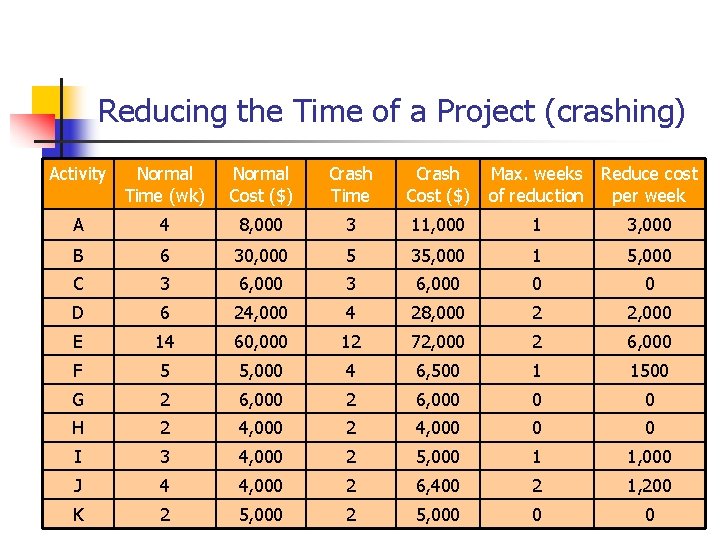
Reducing the Time of a Project (crashing) Activity Normal Time (wk) Normal Cost ($) Crash Time Crash Cost ($) Max. weeks Reduce cost of reduction per week A 4 8, 000 3 11, 000 1 3, 000 B 6 30, 000 5 35, 000 1 5, 000 C 3 6, 000 0 0 D 6 24, 000 4 28, 000 2 2, 000 E 14 60, 000 12 72, 000 2 6, 000 F 5 5, 000 4 6, 500 1 1500 G 2 6, 000 0 0 H 2 4, 000 0 0 I 3 4, 000 2 5, 000 1 1, 000 J 4 4, 000 2 6, 400 2 1, 200 K 2 5, 000 0 0
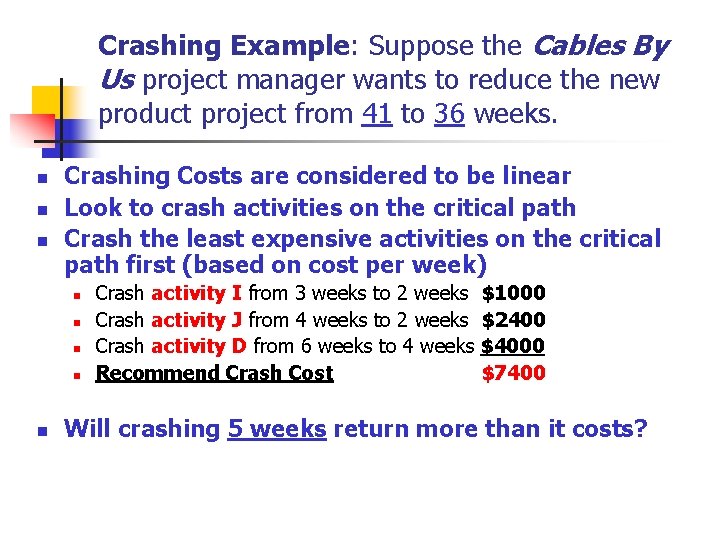
Crashing Example: Suppose the Cables By Us project manager wants to reduce the new product project from 41 to 36 weeks. n n n Crashing Costs are considered to be linear Look to crash activities on the critical path Crash the least expensive activities on the critical path first (based on cost per week) n n n Crash activity I from 3 weeks to 2 weeks Crash activity J from 4 weeks to 2 weeks Crash activity D from 6 weeks to 4 weeks Recommend Crash Cost $1000 $2400 $4000 $7400 Will crashing 5 weeks return more than it costs?
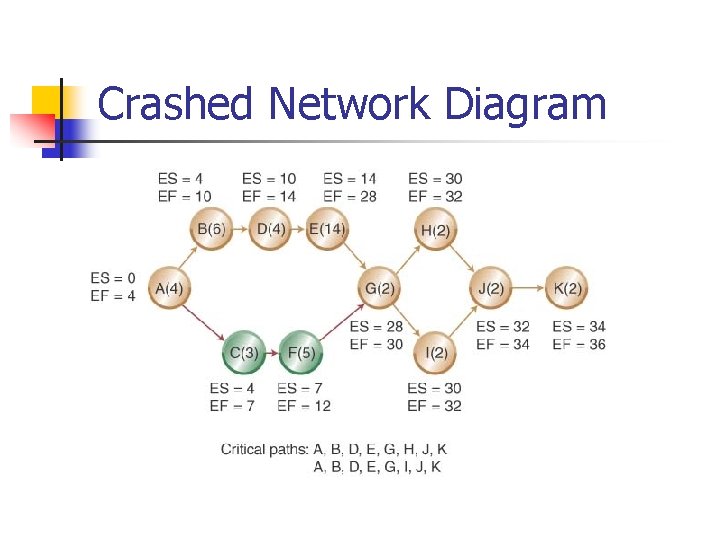
Crashed Network Diagram