
Chapter 2 Part 6 ELEMENTS OF A COMMUNICATION


- Slides: 23
Chapter 2 - Part 6 ELEMENTS OF A COMMUNICATION SYSTEM – IMPEDANCE MATCHING NETWORKS Prepared by Dr M. Murugappan
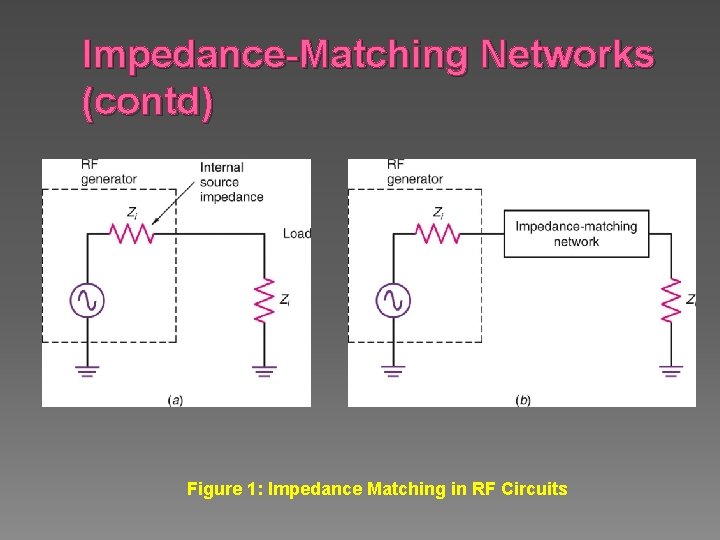
Impedance-Matching Networks Matching networks that connect one stage to another are very important parts of any transmitter. The circuits used to connect one stage to another are known as impedance-matching networks. Typical networks are LC circuits, transformers, or some combination.
Impedance-Matching Networks (contd) The main function of a matching network is to provide for an optimum transfer of power through impedance matching techniques. Matching networks also provide filtering and selectivity.
Impedance-Matching Networks (contd) Figure 1: Impedance Matching in RF Circuits
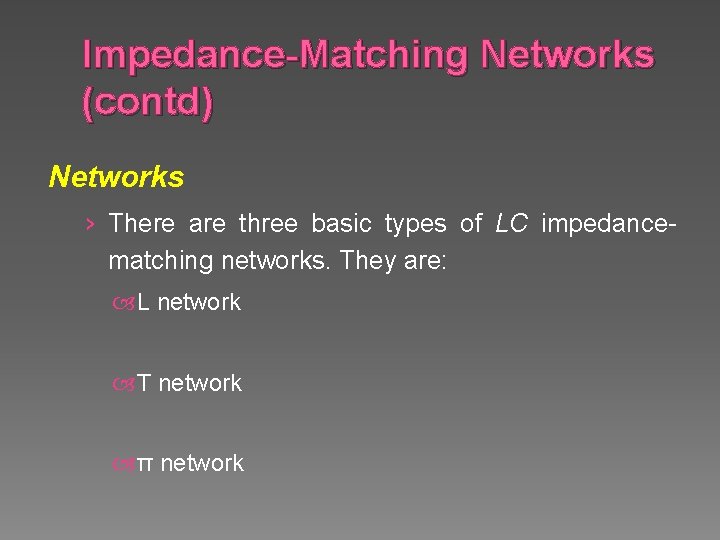
Impedance-Matching Networks (contd) Networks › There are three basic types of LC impedancematching networks. They are: L network T network π network
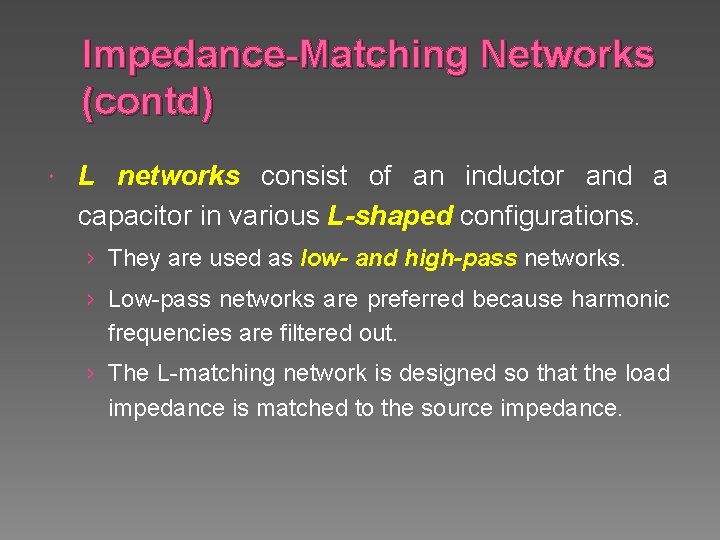
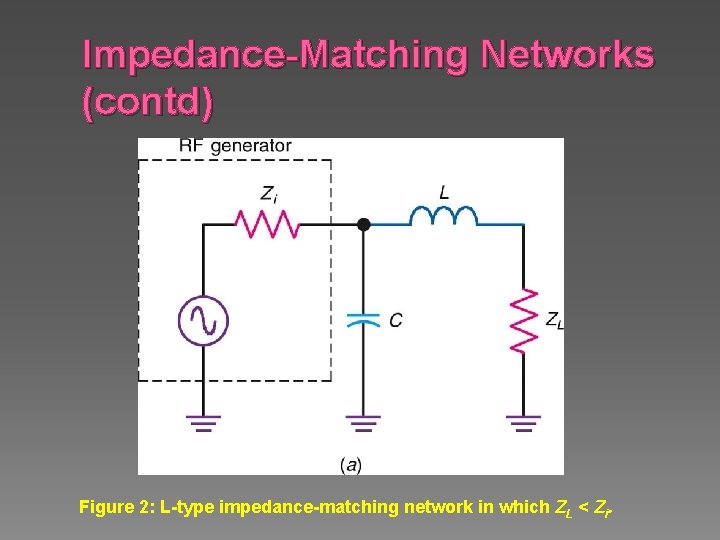
Impedance-Matching Networks (contd) L networks consist of an inductor and a capacitor in various L-shaped configurations. › They are used as low- and high-pass networks. › Low-pass networks are preferred because harmonic frequencies are filtered out. › The L-matching network is designed so that the load impedance is matched to the source impedance.
Impedance-Matching Networks (contd) Figure 2: L-type impedance-matching network in which ZL < Zi.
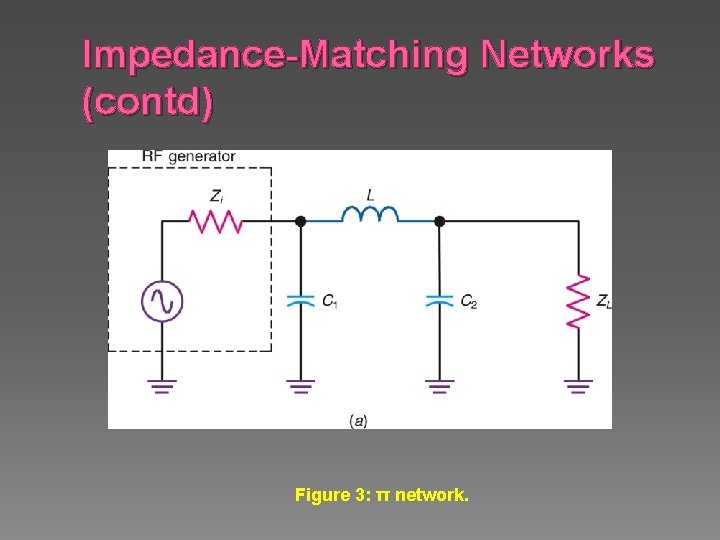
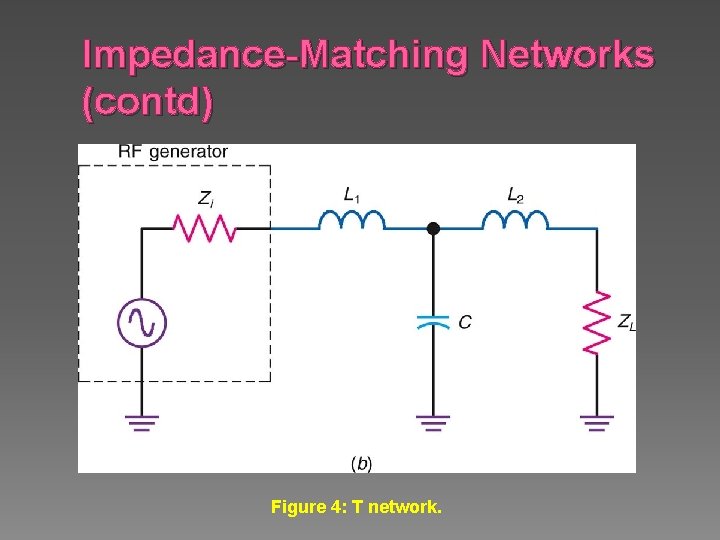
Impedance-Matching Networks (contd) T and π Networks › To get better control of the Q, or selectivity of a circuit, matching networks using three reactive elements can be used. A π network is designed by using reactive elements in a configuration that resembles the Greek letter π A T network is designed by using reactive elements in a configuration that resembles the letter T.
Impedance-Matching Networks (contd) Figure 3: π network.
Impedance-Matching Networks (contd) Figure 4: T network.
Impedance-Matching Networks (contd) Transformers and Baluns › One of the best impedance-matching components is the transformer. Iron-core transformers are widely used at lower frequencies to match impedances. Any load impedance can be made to look like the desired load impedance by selecting the correct value of transformer turns ratio. A transformer used to connect a balanced source to an unbalanced load or vice versa, is called a balun (balanced-unbalanced).
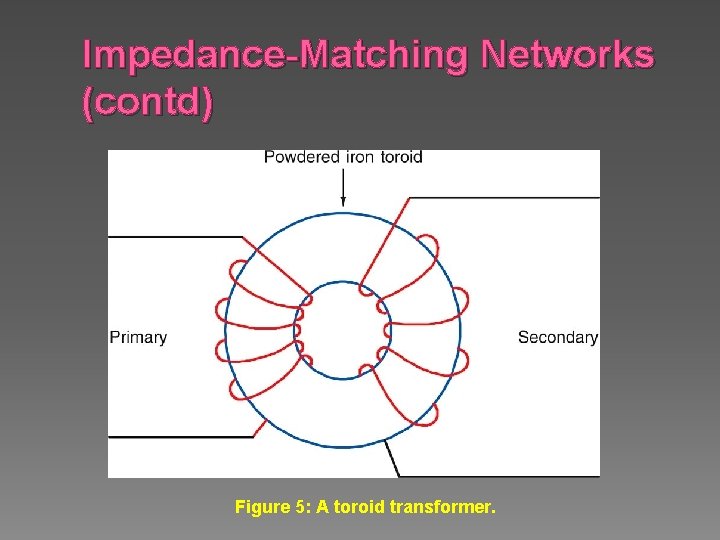
Impedance-Matching Networks (contd) › Although air-core transformers are used widely at RFs, they are less efficient than iron-core transformers. › Single-winding tapped coils called autotransformers are also used for impedance matching between RF stages. › The most widely used type of core for RF transformers is the toroid. A toroid is a circular, doughnut-shaped core, usually made of a special type of powdered iron.
Impedance-Matching Networks (contd) › Toroid transformers cause the magnetic field produced by the primary to be completely contained within the core itself. › This has two important advantages: A toroid does not radiate RF energy. Most of the magnetic field produced by the primary cuts the turns of the secondary winding. Thus, the basic turns ratio, input-output voltage, and impedance formulas for low-frequency transformers apply to high-frequency toroid transformers.
Impedance-Matching Networks (contd) Figure 5: A toroid transformer.
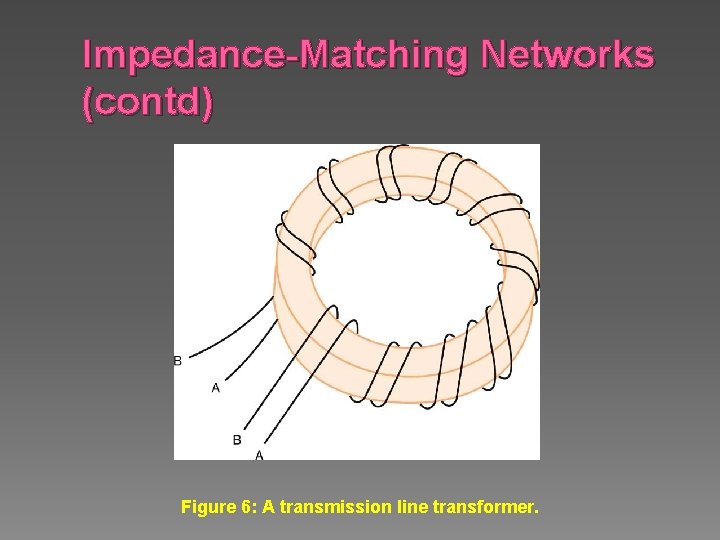
Impedance-Matching Networks (contd) Transmission Line Transformers › A broadband transformer is a unique type of transformer widely used in power amplifiers for coupling between stages and impedance matching. › It is usually constructed by winding two parallel wires (or a twisted pair) on a toroid.
Impedance-Matching Networks (contd) Figure 6: A transmission line transformer.
Typical Transmitter Circuits Many transmitters used in recent equipment designs are a combination of ICs and discrete component circuits. Two examples are: › Low-Power FM Transmitter › Short-Range Wireless Transmitter
Low Power FM Transmitter Circuit A typical circuit might be made up of: › A transmitter chip › Power amplifier › IC voltage regulator › Voltage source.
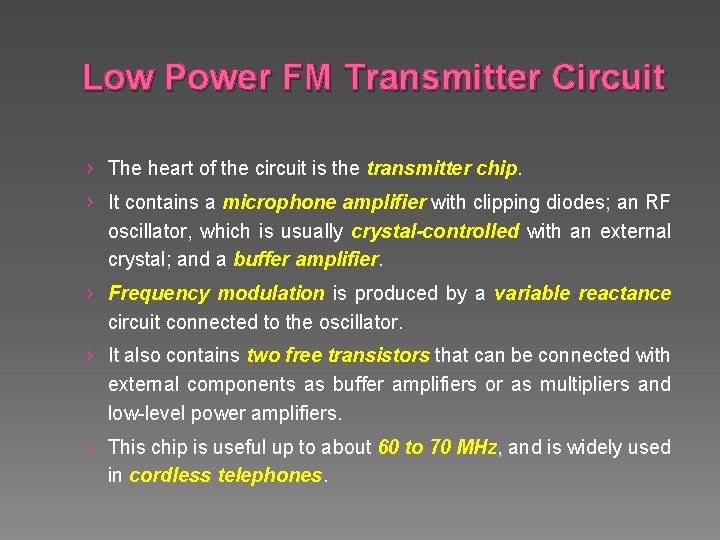
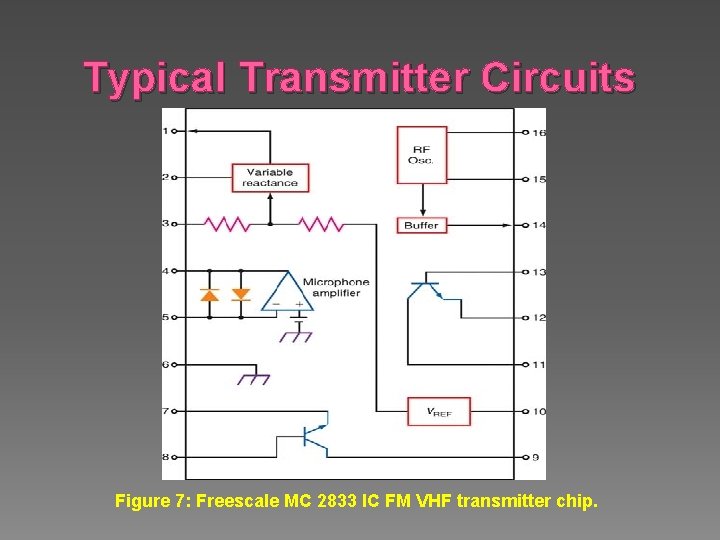
Low Power FM Transmitter Circuit › The heart of the circuit is the transmitter chip. › It contains a microphone amplifier with clipping diodes; an RF oscillator, which is usually crystal-controlled with an external crystal; and a buffer amplifier. › Frequency modulation is produced by a variable reactance circuit connected to the oscillator. › It also contains two free transistors that can be connected with external components as buffer amplifiers or as multipliers and low-level power amplifiers. › This chip is useful up to about 60 to 70 MHz, and is widely used in cordless telephones.
Typical Transmitter Circuits Figure 7: Freescale MC 2833 IC FM VHF transmitter chip.
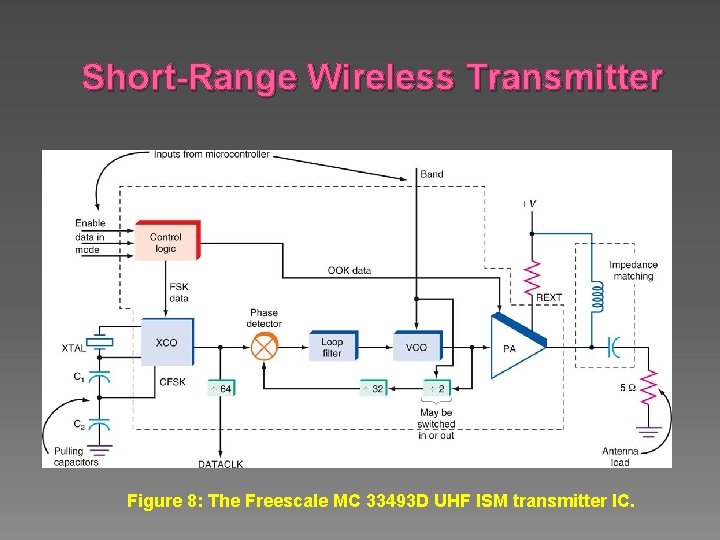
Short-Range Wireless Transmitter There are many short-range wireless applications that require a transmitter to send data or control signals to a nearby receiver. Examples: › Remote keyless entry (RKE) devices used to open car doors Tire pressure sensors Remote-control lights and ceiling fans Garage door openers
Short-Range Wireless Transmitter Such transmitters are unlicensed, use very low power, and operate in the FCC’s industrial -scientific-medical (ISM) bands. A typical transmitter circuit might be composed of: › PLL used as a frequency multiplier › Output power amplifier
Short-Range Wireless Transmitter Figure 8: The Freescale MC 33493 D UHF ISM transmitter IC.