
Chapter 2 part 2 CPUs High Performance Embedded
Chapter 2, part 2: CPUs High Performance Embedded Computing Wayne Wolf High Performance Embedded Computing © 2007 Elsevier
Topics n Memory systems. q q n Memory component models. Caches and alternatives. Code compression. High Performance Embedded Computing © 2007 Elsevier
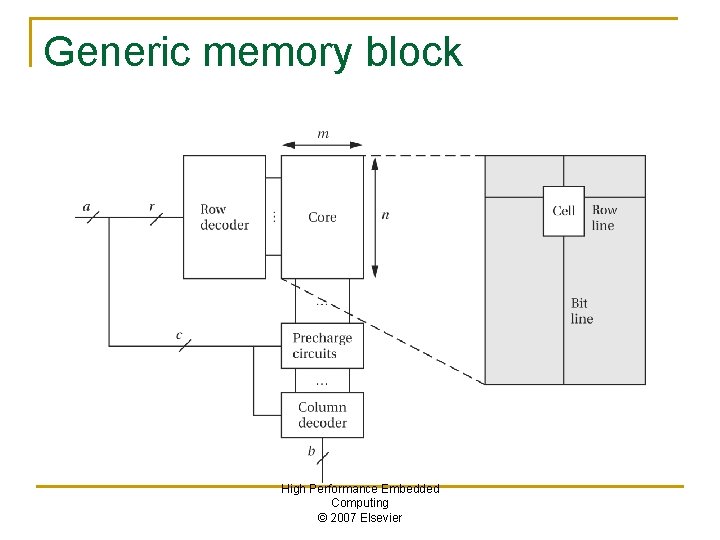
Generic memory block High Performance Embedded Computing © 2007 Elsevier
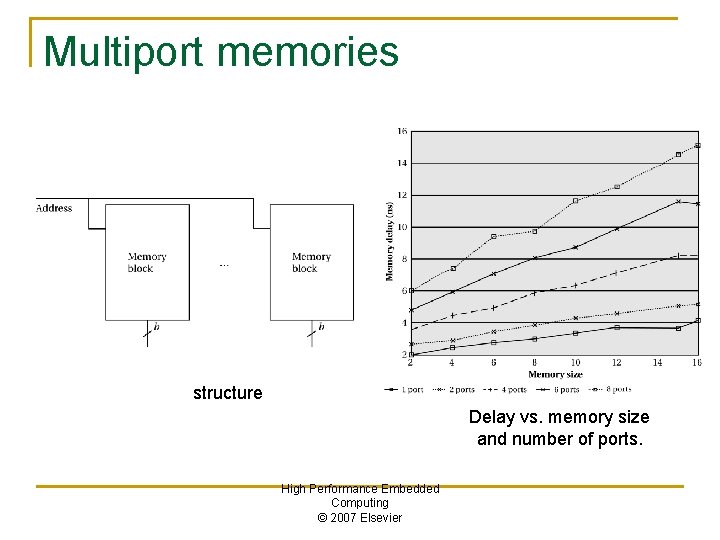
Multiport memories structure Delay vs. memory size and number of ports. High Performance Embedded Computing © 2007 Elsevier
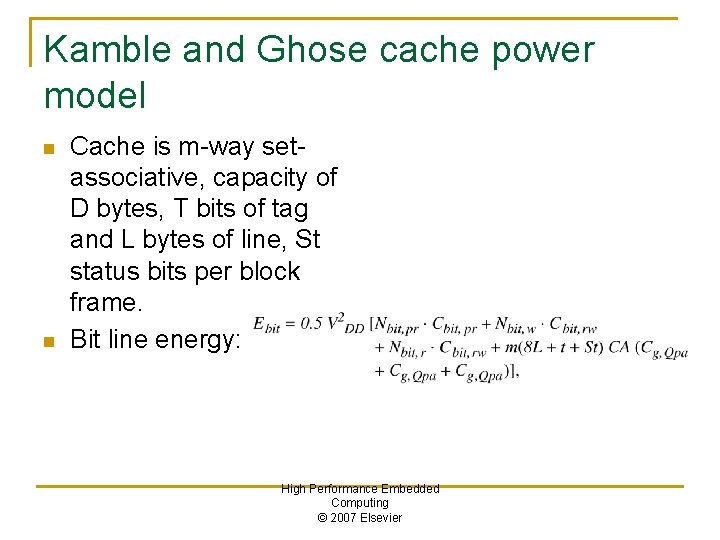
Kamble and Ghose cache power model n n Cache is m-way setassociative, capacity of D bytes, T bits of tag and L bytes of line, St status bits per block frame. Bit line energy: High Performance Embedded Computing © 2007 Elsevier
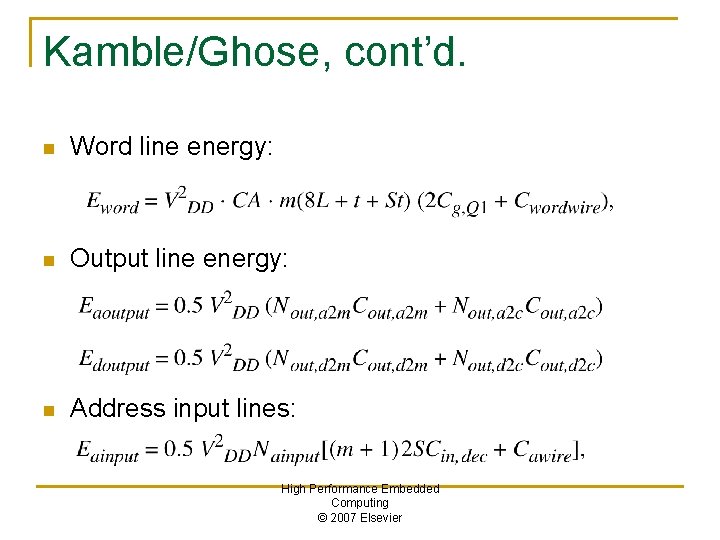
Kamble/Ghose, cont’d. n Word line energy: n Output line energy: n Address input lines: High Performance Embedded Computing © 2007 Elsevier
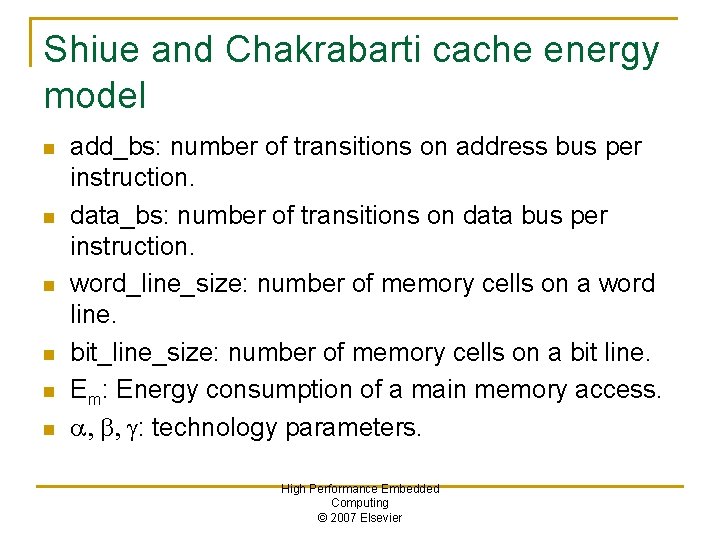
Shiue and Chakrabarti cache energy model n n n add_bs: number of transitions on address bus per instruction. data_bs: number of transitions on data bus per instruction. word_line_size: number of memory cells on a word line. bit_line_size: number of memory cells on a bit line. Em: Energy consumption of a main memory access. a, b, g: technology parameters. High Performance Embedded Computing © 2007 Elsevier
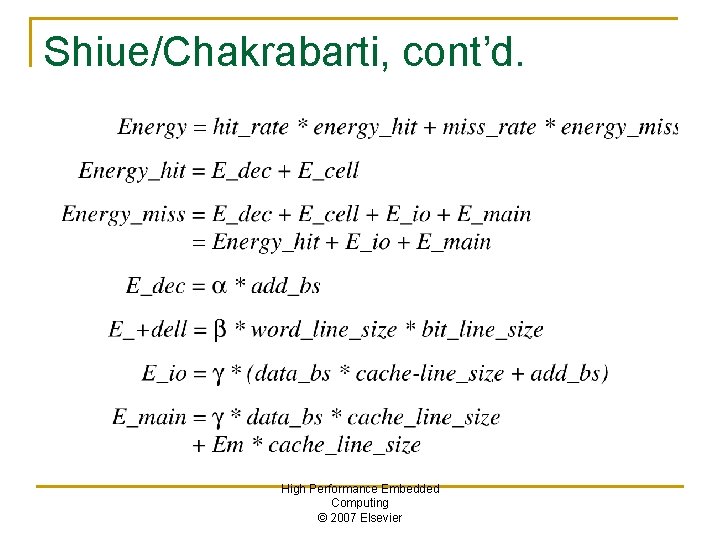
Shiue/Chakrabarti, cont’d. High Performance Embedded Computing © 2007 Elsevier
Register files n n First stage in the memory hierarchy. When too many values are live, some values must be spilled onto main memory and read back later. q n Spills cost time, energy. Register file parameters: q q Number of words. Number of ports. High Performance Embedded Computing © 2007 Elsevier

Performance and energy vs. register file size. [Weh 01] © 2001 IEEE High Performance Embedded Computing © 2007 Elsevier
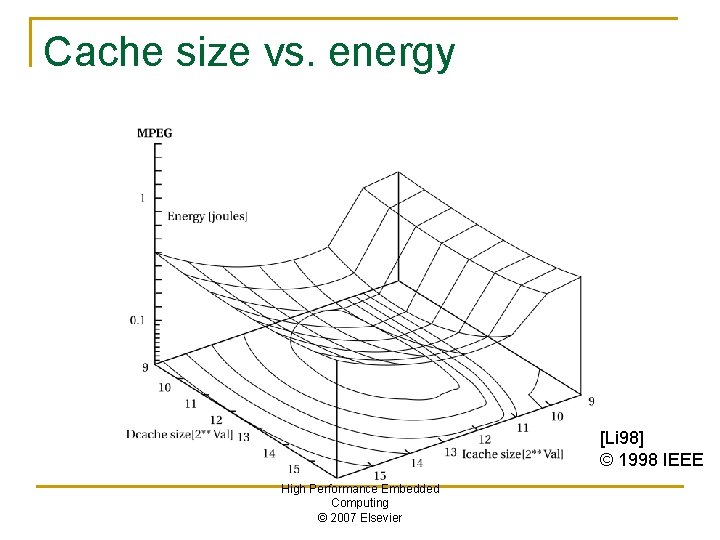
Cache size vs. energy [Li 98] © 1998 IEEE High Performance Embedded Computing © 2007 Elsevier
Cache parameters n Cache size: q n Number of sets: q n Larger caches hold more data, burn more energy, take area away from other functinos. More independent references, more locations mapped onto each line. Cache line length: q Longer lines give more prefetching bandwidth, higher energy consumption. High Performance Embedded Computing © 2007 Elsevier
Wolfe/Lam classification of program behavior in caches n n Self-temporal: same array element is accessed in different loop iterations. Self-spatial reuse: same cache line is accessed in different loop iteraitons. Group-temporal reuse: different parts of the program access the same array element. Group-spatial reuse: different parts of the program access the same cache line. High Performance Embedded Computing © 2007 Elsevier
Multilevel cache optimization n Gordon-Ross et al adjust cache parameters in order: q q q n Cache size. Line size. Associativity. Design cache size for first level, then second level; line size for first, then second level; associativity for first, then second level. High Performance Embedded Computing © 2007 Elsevier
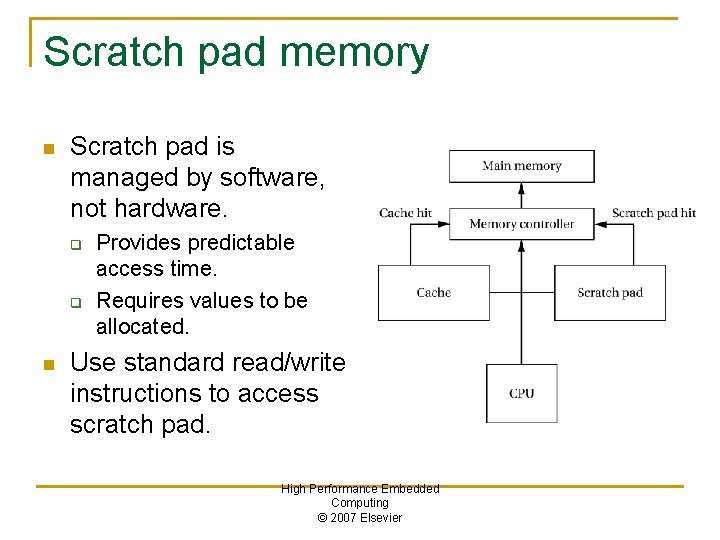
Scratch pad memory n Scratch pad is managed by software, not hardware. q q n Provides predictable access time. Requires values to be allocated. Use standard read/write instructions to access scratch pad. High Performance Embedded Computing © 2007 Elsevier
Code compression n Extreme version of instruction encoding: q q n n n Use variable-bit instructions. Generate encodings using compression algorithms. Generally takes longer to decode. Can result in performance, energy, code size improvements. IBM Code. Pack (Power. PC) used Huffman encoding. High Performance Embedded Computing © 2007 Elsevier

Terms n Compression ratio: q q Compressed code size/uncompressed code size * 100%. Must take into account all overheads. High Performance Embedded Computing © 2007 Elsevier
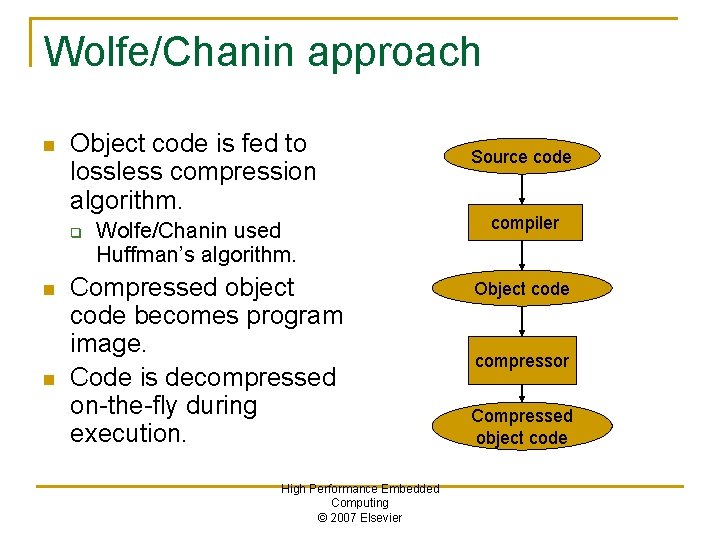
Wolfe/Chanin approach n Object code is fed to lossless compression algorithm. q n n Wolfe/Chanin used Huffman’s algorithm. Compressed object code becomes program image. Code is decompressed on-the-fly during execution. High Performance Embedded Computing © 2007 Elsevier Source code compiler Object code compressor Compressed object code
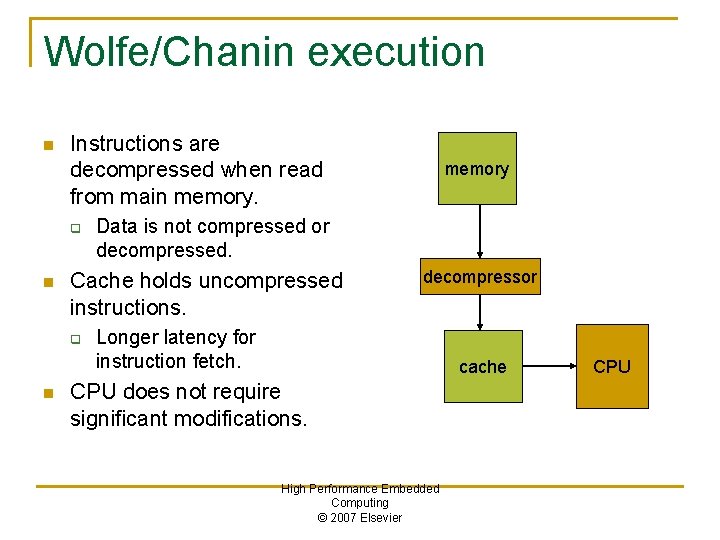
Wolfe/Chanin execution n Instructions are decompressed when read from main memory. q n n Data is not compressed or decompressed. Cache holds uncompressed instructions. q memory decompressor Longer latency for instruction fetch. cache CPU does not require significant modifications. High Performance Embedded Computing © 2007 Elsevier CPU
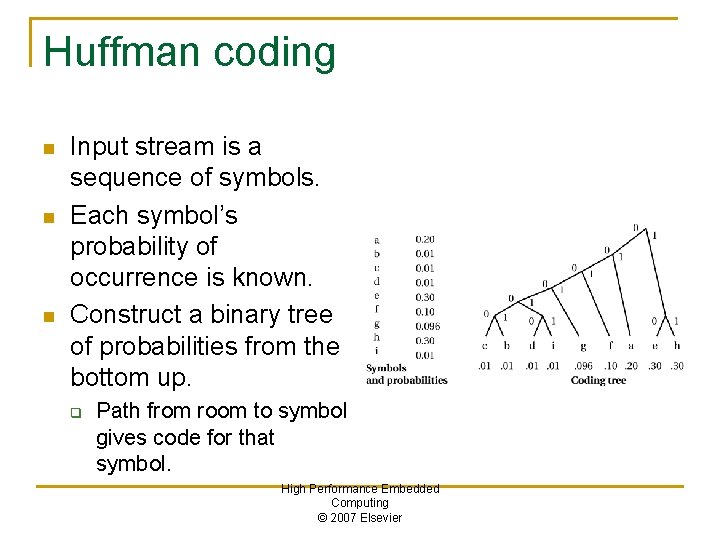
Huffman coding n n n Input stream is a sequence of symbols. Each symbol’s probability of occurrence is known. Construct a binary tree of probabilities from the bottom up. q Path from room to symbol gives code for that symbol. High Performance Embedded Computing © 2007 Elsevier
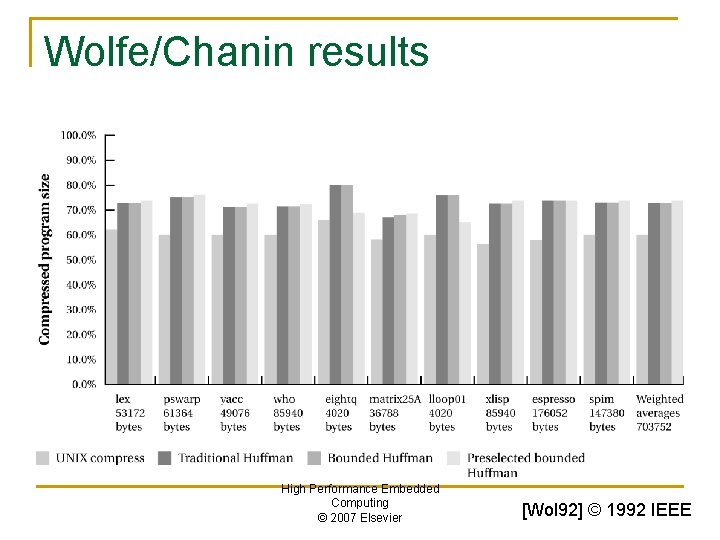
Wolfe/Chanin results High Performance Embedded Computing © 2007 Elsevier [Wol 92] © 1992 IEEE
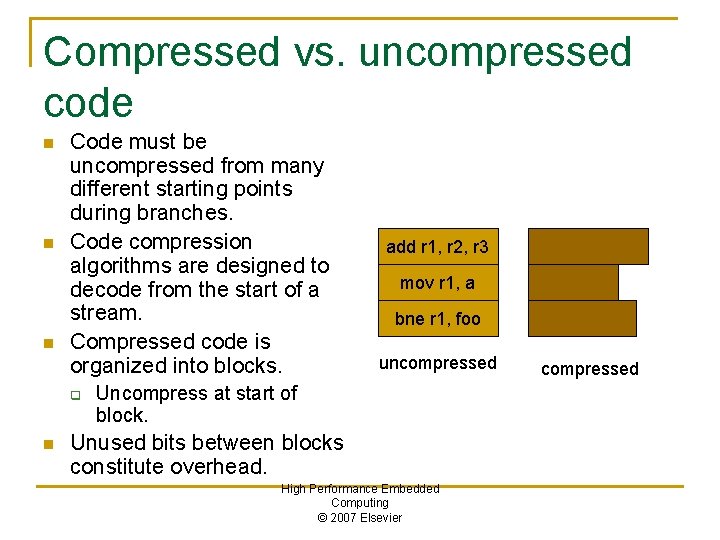
Compressed vs. uncompressed code n n n Code must be uncompressed from many different starting points during branches. Code compression algorithms are designed to decode from the start of a stream. Compressed code is organized into blocks. q n add r 1, r 2, r 3 mov r 1, a bne r 1, foo uncompressed Uncompress at start of block. Unused bits between blocks constitute overhead. High Performance Embedded Computing © 2007 Elsevier compressed
Block structure and compression n Trade-off: q q n n Compression algorithms work best on long blocks. Program branching works best with short blocks. Labels in program move during compression. Two approaches: q q Wolfe and Chanin used branch table to translate branches during execution (adds code size). Lefurgy et al. patched compressed code to refer branches to compressed locations. High Performance Embedded Computing © 2007 Elsevier
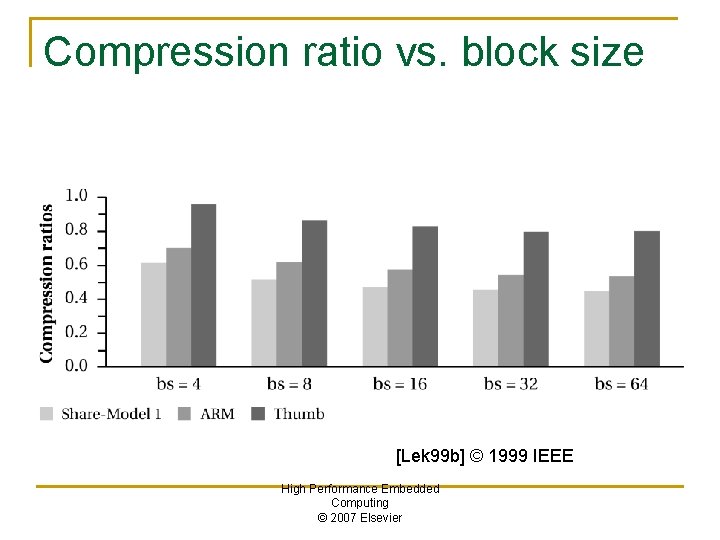
Compression ratio vs. block size [Lek 99 b] © 1999 IEEE High Performance Embedded Computing © 2007 Elsevier
Compression formats n n n Lefurgy et al. used first four bits to define length of compressed sequence (8, 12, 16, 23 bits). Ishiura and Yamaguchi automatically extracted fields from instructions to optimze encoding. Larin and Conte tailored the encoding of fields to the range of values used in that field by the program. High Performance Embedded Computing © 2007 Elsevier
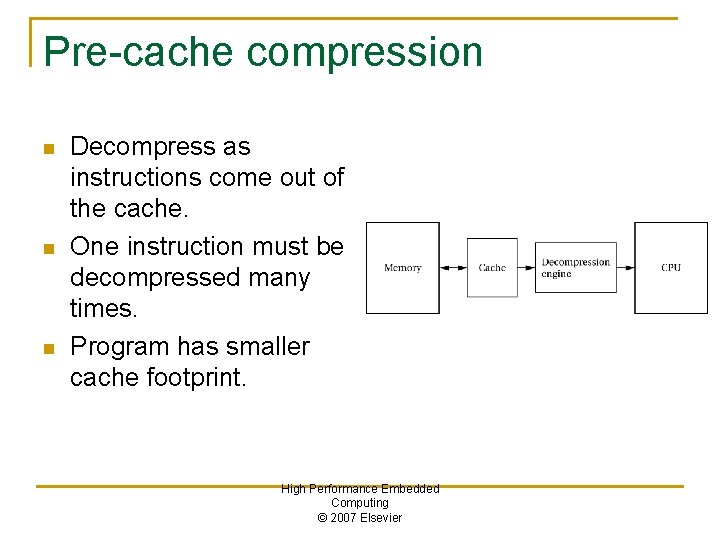
Pre-cache compression n Decompress as instructions come out of the cache. One instruction must be decompressed many times. Program has smaller cache footprint. High Performance Embedded Computing © 2007 Elsevier
Encoding algorithms n n Data compression has developed a large number of compression algorithms. These algorithms were designed for different constraints: q q n Large text files. No real-time or power constraints. Evaluate existing algorithms under the requirements of code compressions, develop new algorithms. High Performance Embedded Computing © 2007 Elsevier
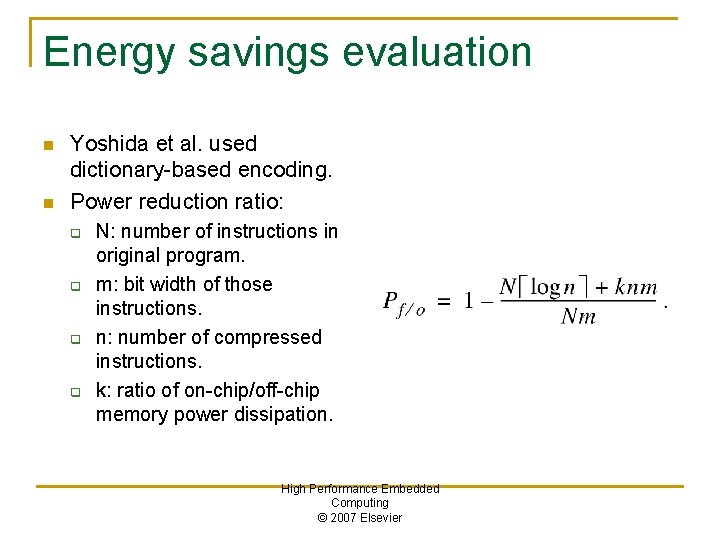
Energy savings evaluation n n Yoshida et al. used dictionary-based encoding. Power reduction ratio: q q N: number of instructions in original program. m: bit width of those instructions. n: number of compressed instructions. k: ratio of on-chip/off-chip memory power dissipation. High Performance Embedded Computing © 2007 Elsevier
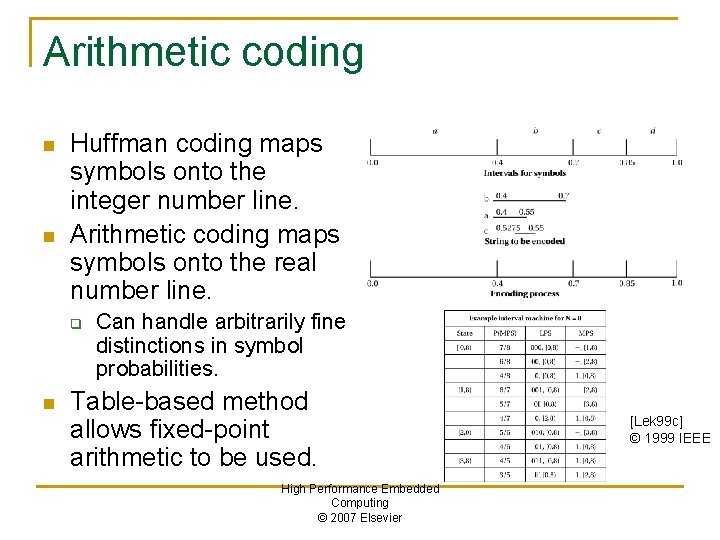
Arithmetic coding n n Huffman coding maps symbols onto the integer number line. Arithmetic coding maps symbols onto the real number line. q n Can handle arbitrarily fine distinctions in symbol probabilities. Table-based method allows fixed-point arithmetic to be used. High Performance Embedded Computing © 2007 Elsevier [Lek 99 c] © 1999 IEEE
Markov models n n A Markovian state machine allows us to define conditional probabilities of sequences of symbols. State in Markov model is a subset of the previously seen sequence. Transitions out of each state are conditioned on next symbol. Probabilities of transitions vary from state to state. High Performance Embedded Computing © 2007 Elsevier
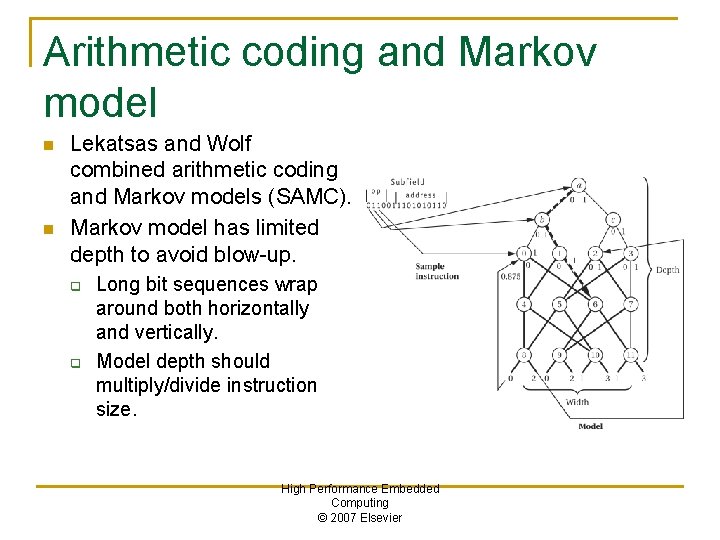
Arithmetic coding and Markov model n n Lekatsas and Wolf combined arithmetic coding and Markov models (SAMC). Markov model has limited depth to avoid blow-up. q q Long bit sequences wrap around both horizontally and vertically. Model depth should multiply/divide instruction size. High Performance Embedded Computing © 2007 Elsevier
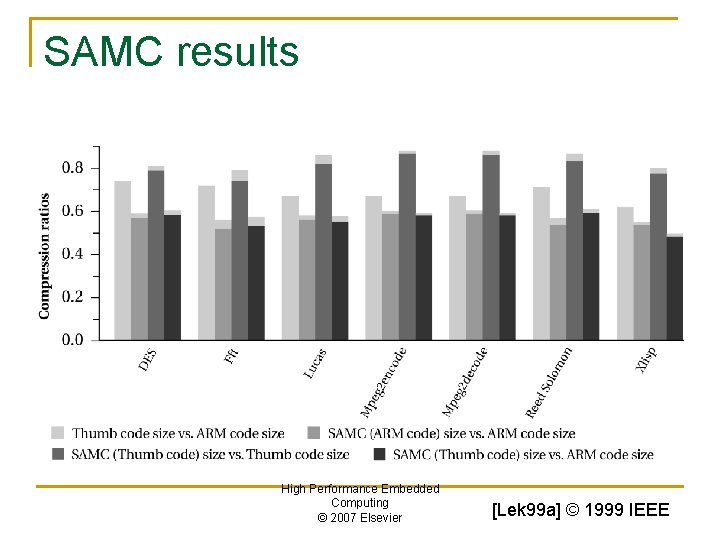
SAMC results High Performance Embedded Computing © 2007 Elsevier [Lek 99 a] © 1999 IEEE
Dictionary-based methods n Liao et al. identified common code sequences, synthesized subroutines. q n Kirovski et al. proposed a procedure cache for software-controlled code compression. q q n n Also proposed hardware implementation. Handler maps procedure identifiers to code during execution. Handler also manages free space. Chen at al. : software-controlled Java byte-code compression. Lefurgy et al. proposed exception mechanism to manage compressed code in the cache. High Performance Embedded Computing © 2007 Elsevier
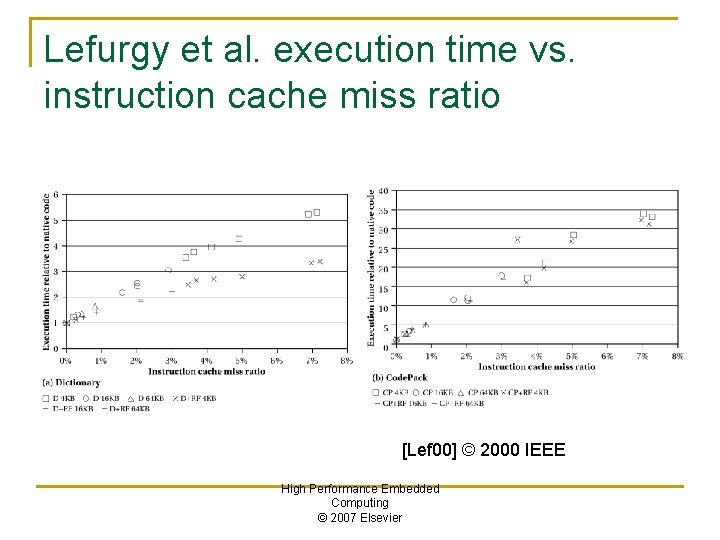
Lefurgy et al. execution time vs. instruction cache miss ratio [Lef 00] © 2000 IEEE High Performance Embedded Computing © 2007 Elsevier
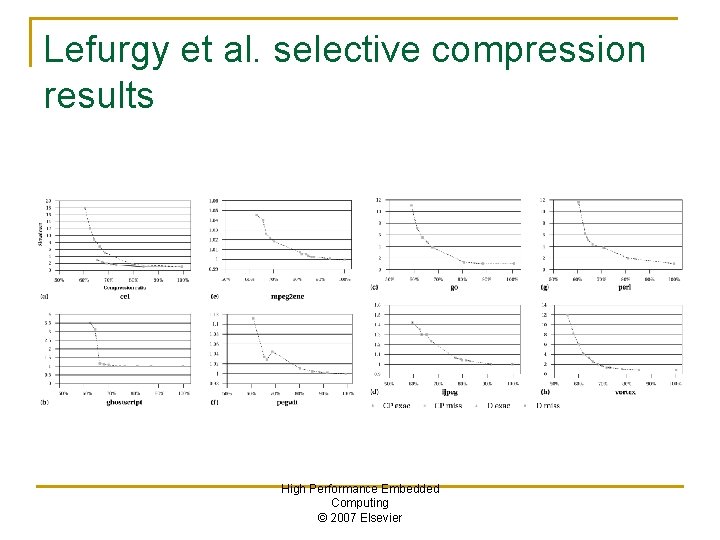
Lefurgy et al. selective compression results High Performance Embedded Computing © 2007 Elsevier
Code and data compression n Unlike (non-modifiable) code, data must be compressed and decompressed dynamically. Can substantially reduce cache footprints. Requires different trade-offs. High Performance Embedded Computing © 2007 Elsevier
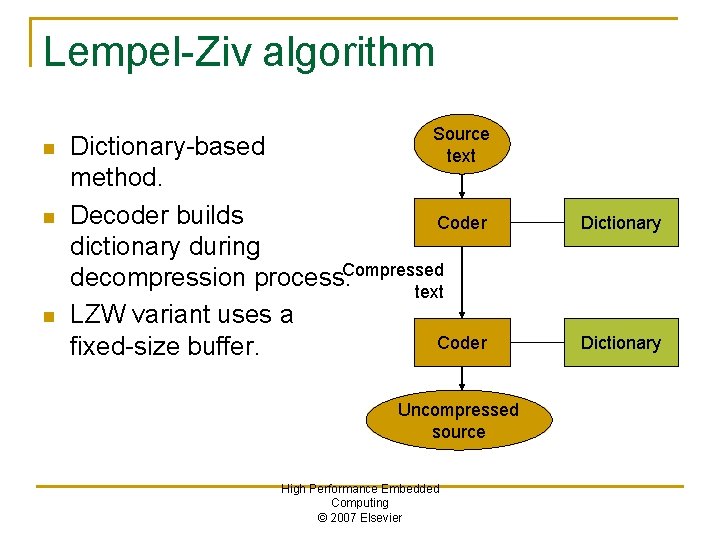
Lempel-Ziv algorithm n n n Source text Dictionary-based method. Decoder builds Coder dictionary during decompression process. Compressed text LZW variant uses a Coder fixed-size buffer. Uncompressed source High Performance Embedded Computing © 2007 Elsevier Dictionary
MXT n Tremaine et al. has 3 -level cache system. q q n Level 3 is shared among several processor, connected to main memory. Data and code are compressed/uncompressed as they move between main memory and level 3 cache. Uses a variant of Lempel-Ziv 1977 algorithm. q q All compression engines share the same dictionary. Typically, 1 KB blocks are divided into 256 -byte compression blocks. High Performance Embedded Computing © 2007 Elsevier
Other applications n Benini et al. evaluated energy savings of post -cache decompression. q n Simple dictionary gave 35% energy savings. Lekatsas et al. combined data and code compression and encryption. q Modified operating system performs compression, encryption at proper point in memory access process. High Performance Embedded Computing © 2007 Elsevier
- Slides: 39