
Chapter 2 Part 2 An interpreter for an
![Abstract Syntax PTREE : : = CLIST : : = [ CTREE+ ] where](https://slidetodoc.com/presentation_image_h/8fe9bab12b14d47d649d9d216211a0b1/image-6.jpg "Abstract Syntax PTREE : : = CLIST : : = [ CTREE+ ] where")
![Interpreter Cases • LTREE : : = [ ID+ ] – Return value? –](https://slidetodoc.com/presentation_image_h/8fe9bab12b14d47d649d9d216211a0b1/image-9.jpg "Interpreter Cases • LTREE : : = [ ID+ ] – Return value? –")
![Interpreter Cases CTREE : : = ["=", LTREE, ETREE] | ["if", ETREE, CLIST] |](https://slidetodoc.com/presentation_image_h/8fe9bab12b14d47d649d9d216211a0b1/image-10.jpg "Interpreter Cases CTREE : : = [\"=\", LTREE, ETREE] | [\"if\", ETREE, CLIST] |")
- Slides: 11
Chapter 2, Part 2: An interpreter for an object-oriented language Xinming (Simon) Ou CIS 505: Programming Languages Kansas State University Fall 2010 1
A different memory organization • The C-like language interpreter uses a sequence of cells as the memory model – Matches closely to actual computer hardware • The object-oriented language interpreter will adopt a more “conceptual-level” memory model – A memory is a “heap” that collects objects – An object has a handle, and is represented as a namespace 2
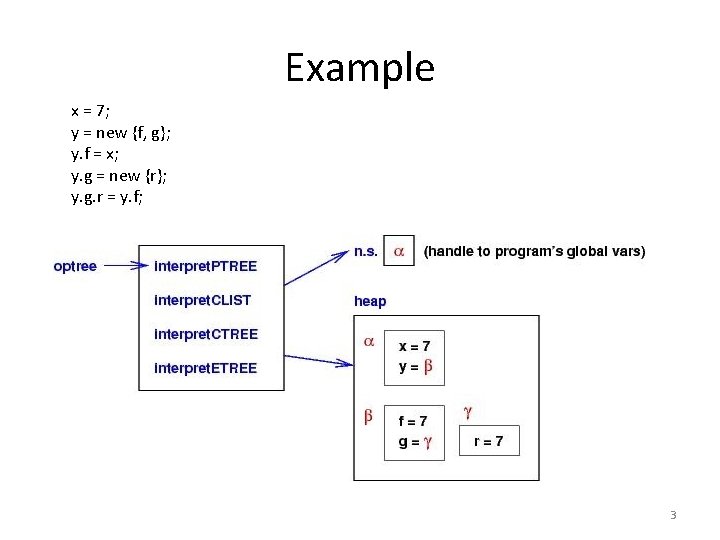
Example x = 7; y = new {f, g}; y. f = x; y. g = new {r}; y. g. r = y. f; 3
Some key points • A handle is intuitively a memory location – In some sense an object variable is a “left value” by default, even if it appears on the rhs of an assignment. – Explicit de-reference is needed to access the “content” of an object • A big difference from C++, which requires explicit pointer declarations. 4
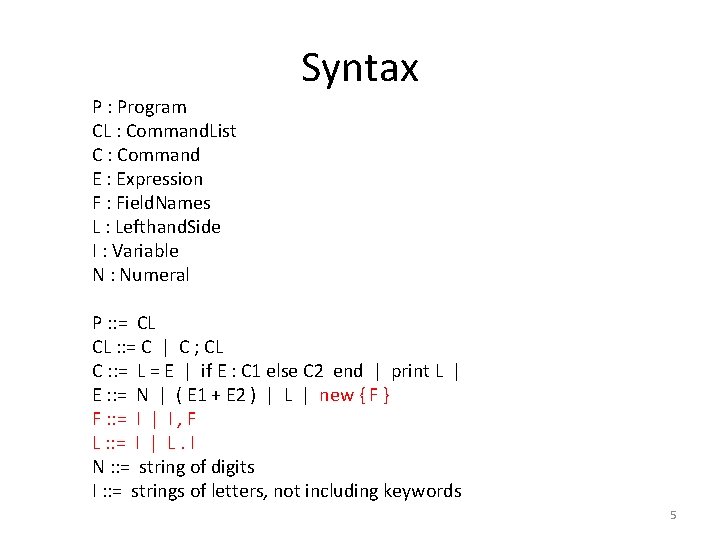
Syntax P : Program CL : Command. List C : Command E : Expression F : Field. Names L : Lefthand. Side I : Variable N : Numeral P : : = CL CL : : = C | C ; CL C : : = L = E | if E : C 1 else C 2 end | print L | E : : = N | ( E 1 + E 2 ) | L | new { F } F : : = I | I , F L : : = I | L. I N : : = string of digits I : : = strings of letters, not including keywords 5
Abstract Syntax PTREE : : = CLIST : : = [ CTREE+ ] where CTREE+ means one or more CTREEs CTREE : : = ["=", LTREE, ETREE] | ["if", ETREE, CLIST] | ["print", LTREE] ETREE : : = NUM | ["+", ETREE] | ["deref", LTREE] | ["new", OB ] OB : : = [ ID+ ] where ID+ means one or more IDs LTREE : : = [ ID+ ] NUM : : = a nonempty string of digits ID : : = a nonempty string of letters 6
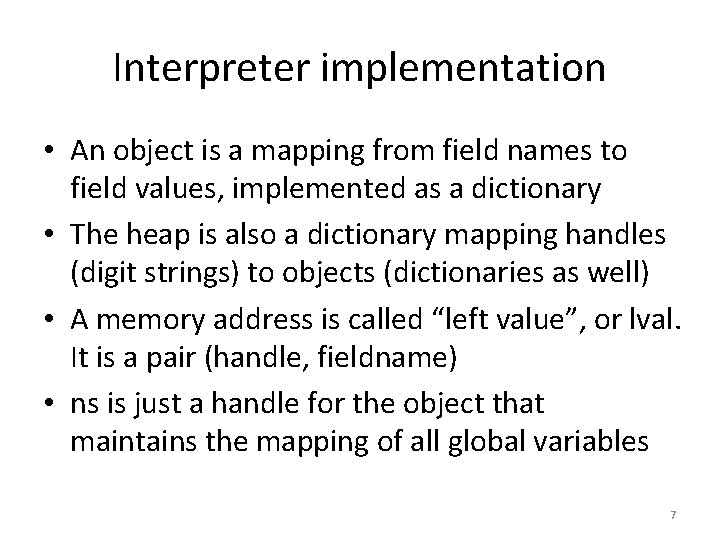
Interpreter implementation • An object is a mapping from field names to field values, implemented as a dictionary • The heap is also a dictionary mapping handles (digit strings) to objects (dictionaries as well) • A memory address is called “left value”, or lval. It is a pair (handle, fieldname) • ns is just a handle for the object that maintains the mapping of all global variables 7
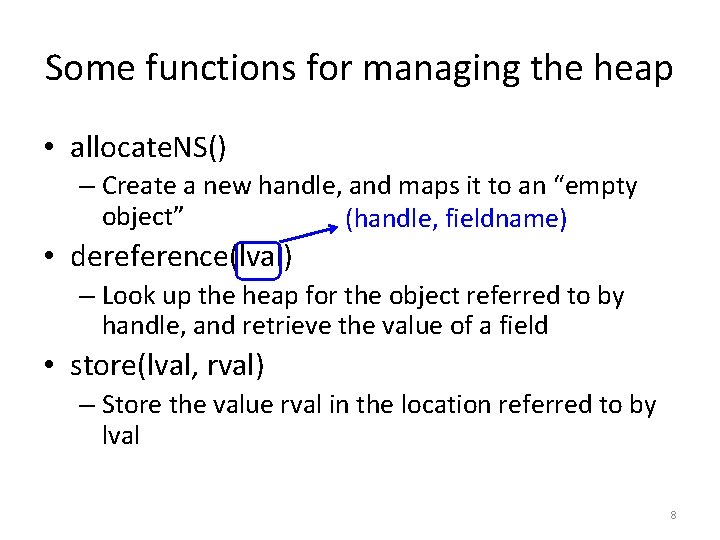
Some functions for managing the heap • allocate. NS() – Create a new handle, and maps it to an “empty object” (handle, fieldname) • dereference(lval) – Look up the heap for the object referred to by handle, and retrieve the value of a field • store(lval, rval) – Store the value rval in the location referred to by lval 8
Interpreter Cases • LTREE : : = [ ID+ ] – Return value? – Operation? • ETREE : : = …|["deref", LTREE] – Return value? – Operation? • ETREE : : = …|["new", OB ] – Return value? – Operation? 9
Interpreter Cases CTREE : : = ["=", LTREE, ETREE] | ["if", ETREE, CLIST] | ["print", LTREE] 10
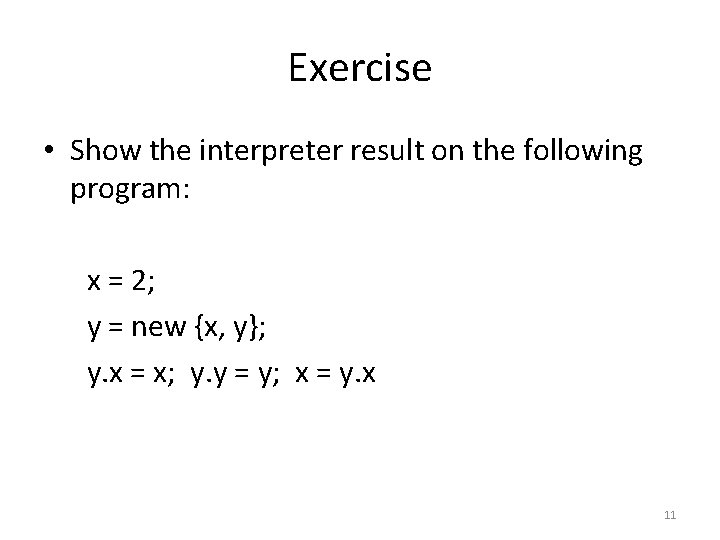
Exercise • Show the interpreter result on the following program: x = 2; y = new {x, y}; y. x = x; y. y = y; x = y. x 11