
Chapter 2 Part 1 DIODE APPLICATIONS ELECTRONIC DEVICES
![Capacitor-Input Filter Ripple factor: indication of the effectiveness of the filter [half-wave rectifier] Vr(pp)](https://slidetodoc.com/presentation_image_h/f2f3c5d84f1aeb9e9fa093b4965c89c9/image-31.jpg "Capacitor-Input Filter Ripple factor: indication of the effectiveness of the filter [half-wave rectifier] Vr(pp)")
- Slides: 43
Chapter 2 (Part 1) DIODE APPLICATIONS ELECTRONIC DEVICES EET 109 PERANTI ELEKTRONIK
OBJECTIVES Ø Explain and analyze the operation of both half and full wave rectifiers Ø Explain and analyze filters and regulators and their characteristics Ø Explain and analyze the operation of diode limiting and clamping circuits Ø Explain and analyze the operation of diode voltage multipliers Ø Interpret and use a diode data sheet Ø Troubleshoot simple diode circuits 2
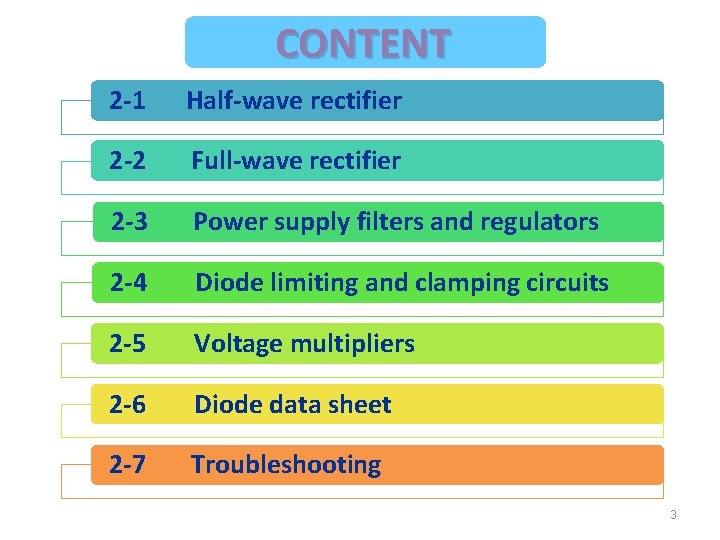
CONTENT 2 -1 Half-wave rectifier 2 -2 Full-wave rectifier 2 -3 Power supply filters and regulators 2 -4 Diode limiting and clamping circuits 2 -5 Voltage multipliers 2 -6 Diode data sheet 2 -7 Troubleshooting 3
2 -1 Half-Wave Rectifiers DIODE ability to conduct current in one direction and block current in other direction used in circuit called RECTIFIER (ac dc) OBJECTIVE • Discuss the operation of half-wave rectifiers • Describe a basic dc power supply & half-wave rectifications • Determine the average value, VAVG of half-waves rectified voltage • Discuss the effect of barrier potential, VP on a half-wave rectifier output • Define Peak Inverse Voltage (PIV) • Describe Transformer-couple half-wave rectifier 4
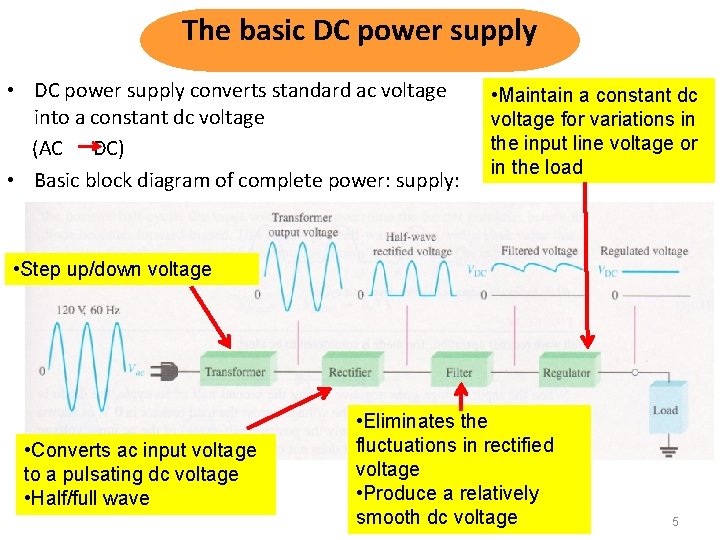
The basic DC power supply • DC power supply converts standard ac voltage into a constant dc voltage (AC DC) • Basic block diagram of complete power: supply: • Maintain a constant dc voltage for variations in the input line voltage or in the load • Step up/down voltage • Converts ac input voltage to a pulsating dc voltage • Half/full wave • Eliminates the fluctuations in rectified voltage • Produce a relatively smooth dc voltage 5
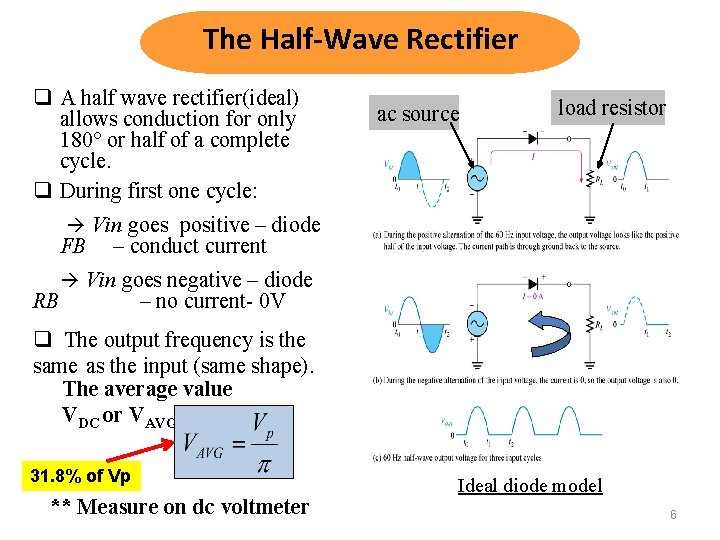
The Half-Wave Rectifier q A half wave rectifier(ideal) allows conduction for only 180° or half of a complete cycle. q During first one cycle: Vin goes positive – diode FB – conduct current ac source load resistor Vin goes negative – diode RB – no current- 0 V q The output frequency is the same as the input (same shape). The average value VDC or VAVG : 31. 8% of Vp ** Measure on dc voltmeter Ideal diode model 6
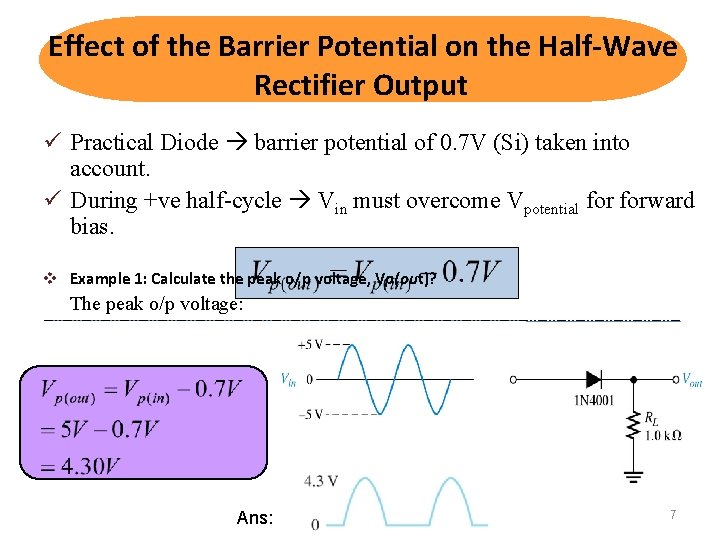
Effect of the Barrier Potential on the Half-Wave Rectifier Output ü Practical Diode barrier potential of 0. 7 V (Si) taken into account. ü During +ve half-cycle Vin must overcome Vpotential forward bias. v Example 1: Calculate the peak o/p voltage, Vp(out)? The peak o/p voltage: Ans: 7
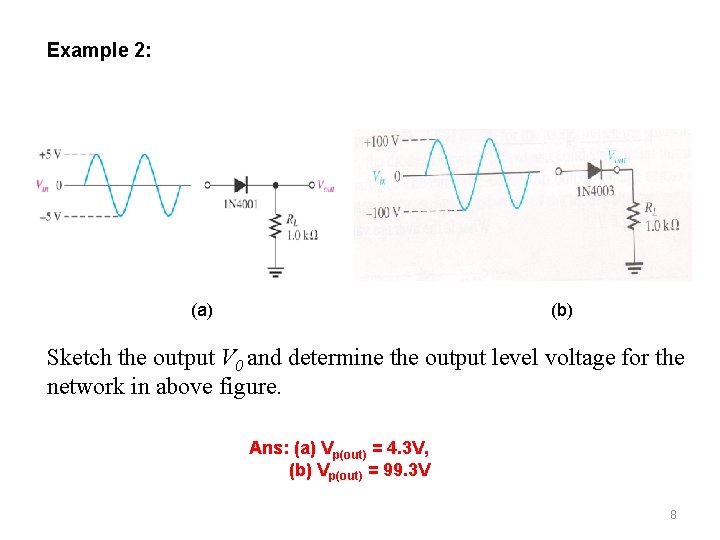
Example 2: (a) (b) Sketch the output V 0 and determine the output level voltage for the network in above figure. Ans: (a) Vp(out) = 4. 3 V, (b) Vp(out) = 99. 3 V 8
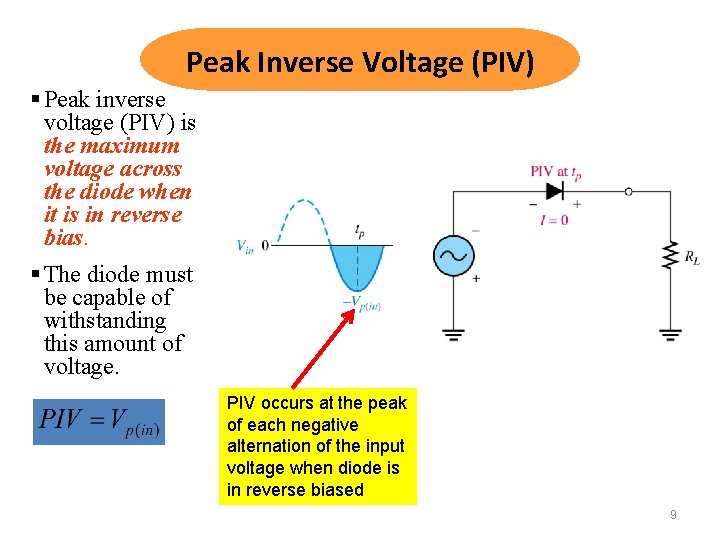
Peak Inverse Voltage (PIV) § Peak inverse voltage (PIV) is the maximum voltage across the diode when it is in reverse bias. § The diode must be capable of withstanding this amount of voltage. PIV occurs at the peak of each negative alternation of the input voltage when diode is in reverse biased 9
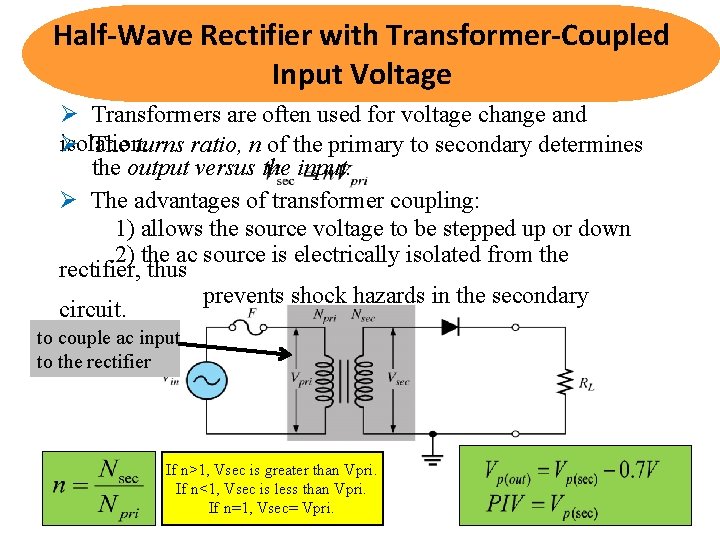
Half-Wave Rectifier with Transformer-Coupled Input Voltage Ø Transformers are often used for voltage change and isolation. Ø The turns ratio, n of the primary to secondary determines the output versus the input. Ø The advantages of transformer coupling: 1) allows the source voltage to be stepped up or down 2) the ac source is electrically isolated from the rectifier, thus prevents shock hazards in the secondary circuit. to couple ac input to the rectifier If n>1, Vsec is greater than Vpri. If n<1, Vsec is less than Vpri. If n=1, Vsec= Vpri. 10
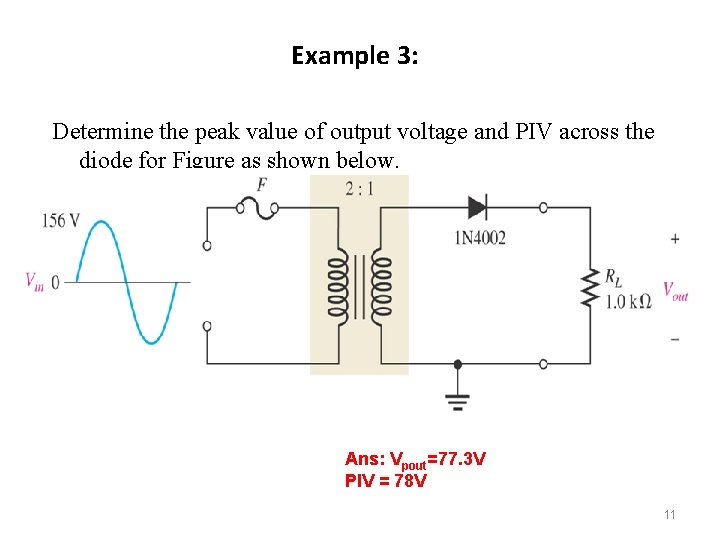
Example 3: Determine the peak value of output voltage and PIV across the diode for Figure as shown below. Ans: Vpout=77. 3 V PIV = 78 V 11
2 -2 Full-Wave Rectifiers OBJECTIVE • Explain & Analyze the operation of Full-Wave Rectifier. • Discuss how full wave rectifier differs from half-wave rectifier • Determine the average value • Describe the operation of center-tapped & bridge. • Explain effects of the transformers turns ratio • PIV • Comparison between center-tapped & bridge. 12
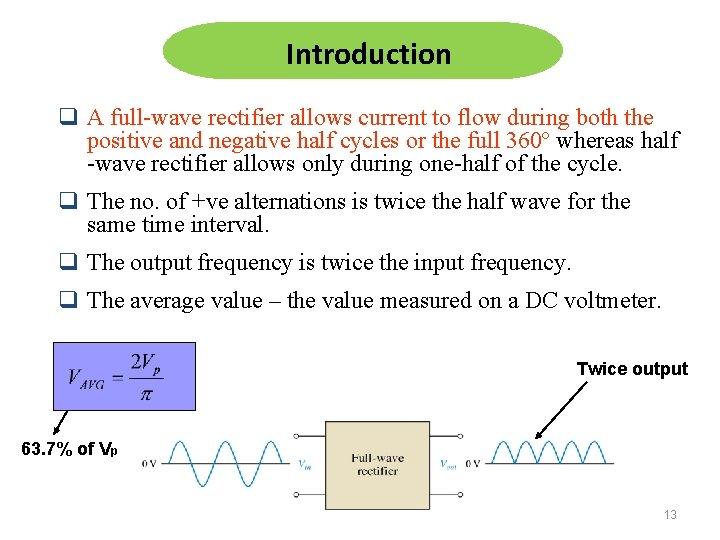
Introduction q A full-wave rectifier allows current to flow during both the positive and negative half cycles or the full 360º whereas half -wave rectifier allows only during one-half of the cycle. q The no. of +ve alternations is twice the half wave for the same time interval. q The output frequency is twice the input frequency. q The average value – the value measured on a DC voltmeter. Twice output 63. 7% of Vp 13
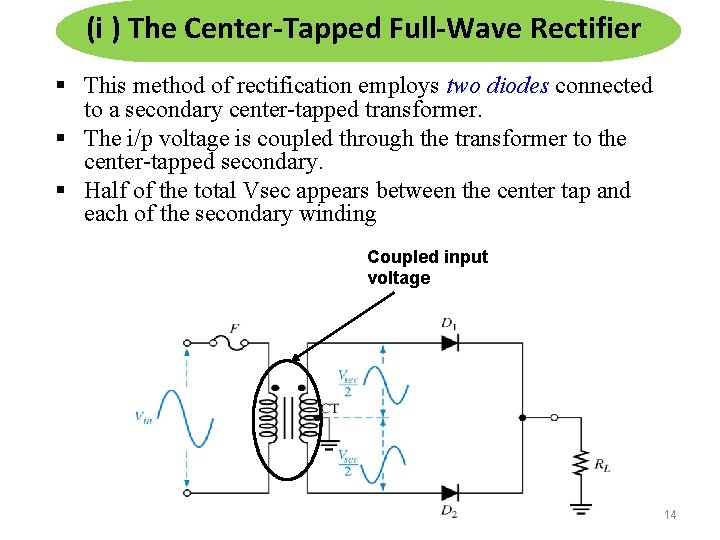
(i ) The Center-Tapped Full-Wave Rectifier § This method of rectification employs two diodes connected to a secondary center-tapped transformer. § The i/p voltage is coupled through the transformer to the center-tapped secondary. § Half of the total Vsec appears between the center tap and each of the secondary winding Coupled input voltage 14
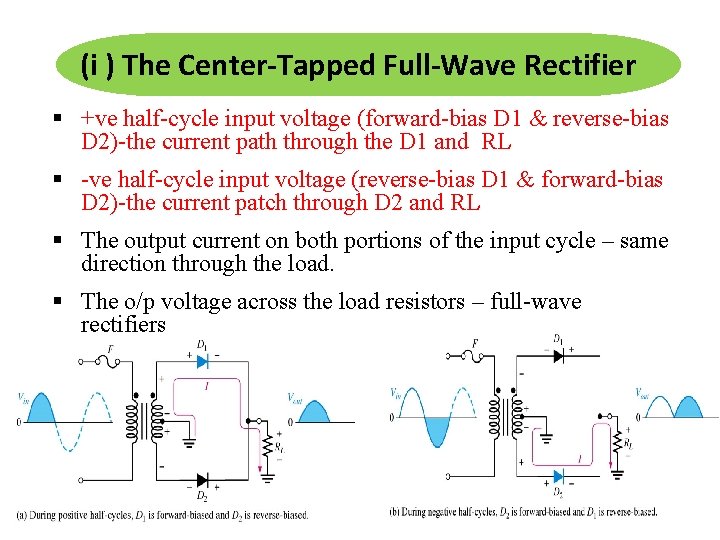
(i ) The Center-Tapped Full-Wave Rectifier § +ve half-cycle input voltage (forward-bias D 1 & reverse-bias D 2)-the current path through the D 1 and RL § -ve half-cycle input voltage (reverse-bias D 1 & forward-bias D 2)-the current patch through D 2 and RL § The output current on both portions of the input cycle – same direction through the load. § The o/p voltage across the load resistors – full-wave rectifiers 15
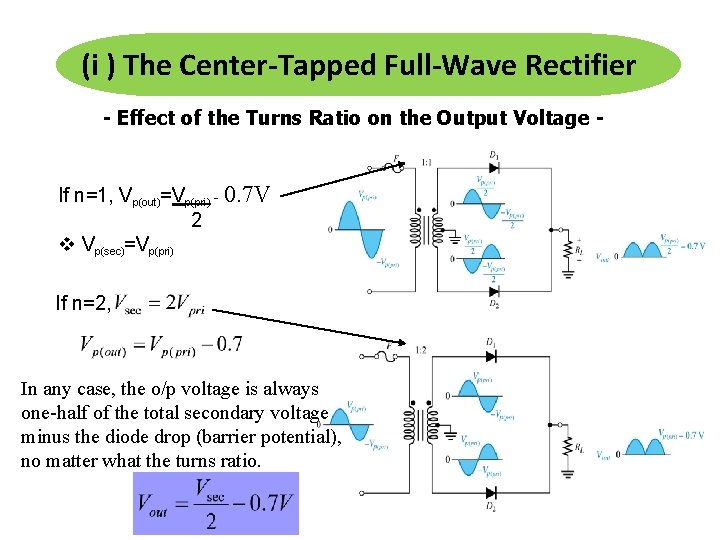
(i ) The Center-Tapped Full-Wave Rectifier - Effect of the Turns Ratio on the Output Voltage - If n=1, Vp(out)=Vp(pri) - 0. 7 V 2 v Vp(sec)=Vp(pri) If n=2, In any case, the o/p voltage is always one-half of the total secondary voltage minus the diode drop (barrier potential), no matter what the turns ratio. 16
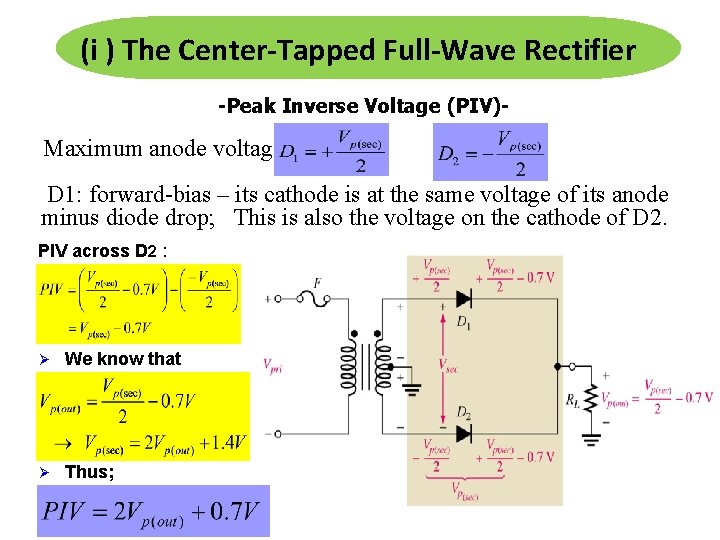
(i ) The Center-Tapped Full-Wave Rectifier -Peak Inverse Voltage (PIV)- Maximum anode voltage: D 1: forward-bias – its cathode is at the same voltage of its anode minus diode drop; This is also the voltage on the cathode of D 2. PIV across D 2 : Ø We know that Ø Thus;
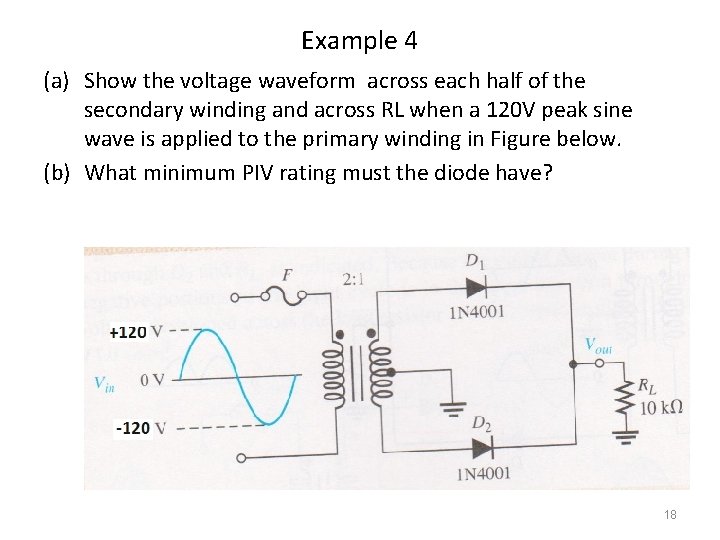
Example 4 (a) Show the voltage waveform across each half of the secondary winding and across RL when a 120 V peak sine wave is applied to the primary winding in Figure below. (b) What minimum PIV rating must the diode have? 18
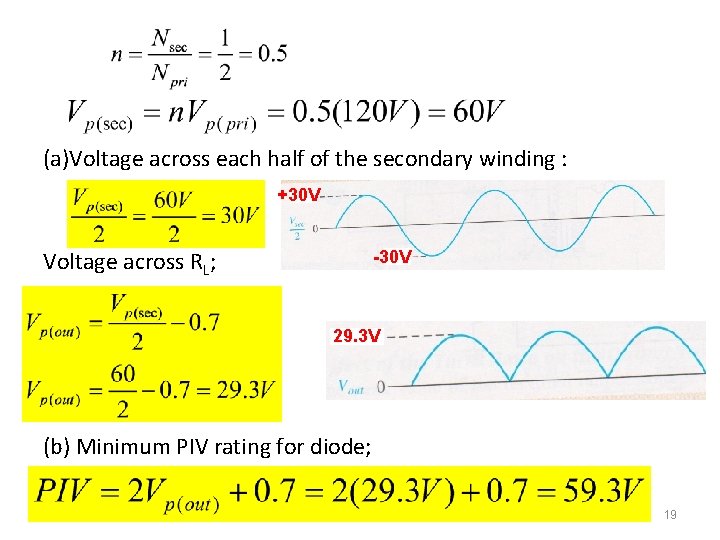
(a)Voltage across each half of the secondary winding : +30 V Voltage across RL; -30 V 29. 3 V (b) Minimum PIV rating for diode; 19
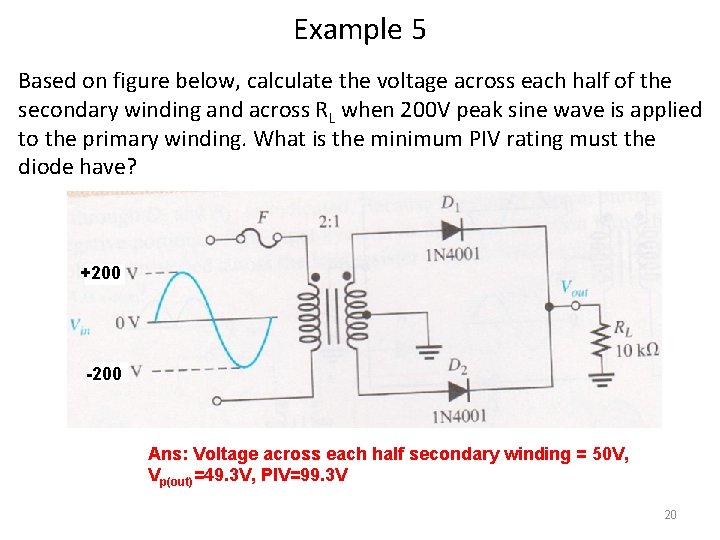
Example 5 Based on figure below, calculate the voltage across each half of the secondary winding and across RL when 200 V peak sine wave is applied to the primary winding. What is the minimum PIV rating must the diode have? +200 -200 Ans: Voltage across each half secondary winding = 50 V, Vp(out)=49. 3 V, PIV=99. 3 V 20
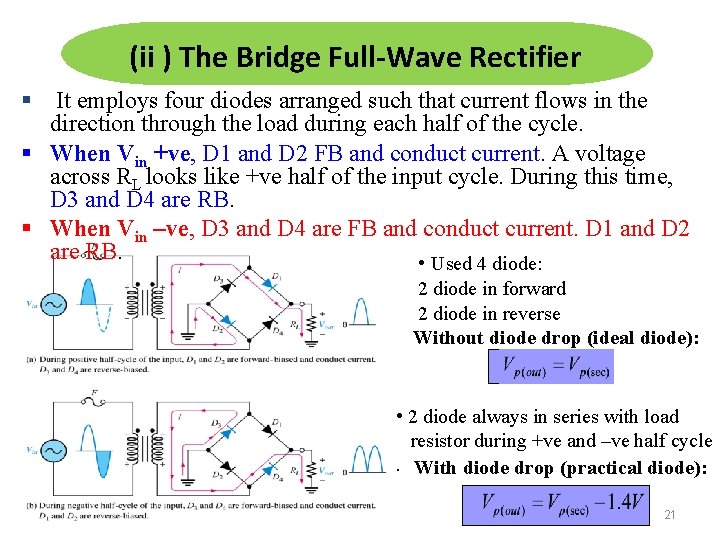
(ii ) The Bridge Full-Wave Rectifier § It employs four diodes arranged such that current flows in the direction through the load during each half of the cycle. § When Vin +ve, D 1 and D 2 FB and conduct current. A voltage across RL looks like +ve half of the input cycle. During this time, D 3 and D 4 are RB. § When Vin –ve, D 3 and D 4 are FB and conduct current. D 1 and D 2 are RB. • Used 4 diode: 2 diode in forward 2 diode in reverse Without diode drop (ideal diode): • 2 diode always in series with load resistor during +ve and –ve half cycle. With diode drop (practical diode): 21
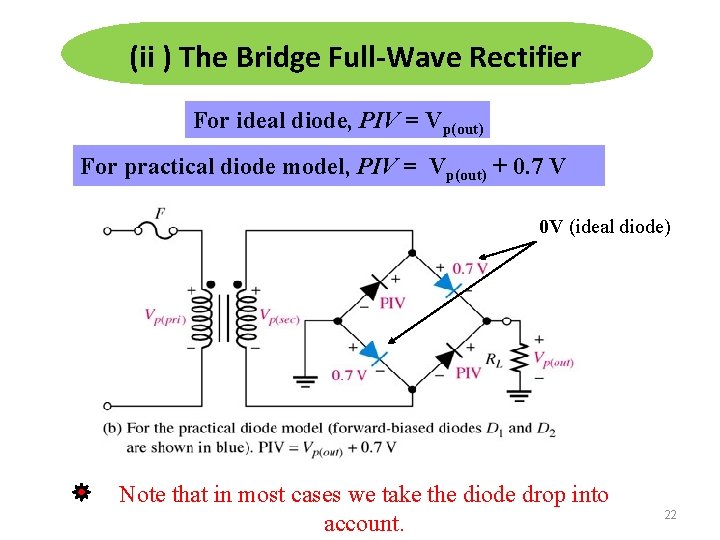
(ii ) The Bridge Full-Wave Rectifier For ideal diode, PIV = Vp(out) For practical diode model, PIV = Vp(out) + 0. 7 V 0 V (ideal diode) Note that in most cases we take the diode drop into account. 22
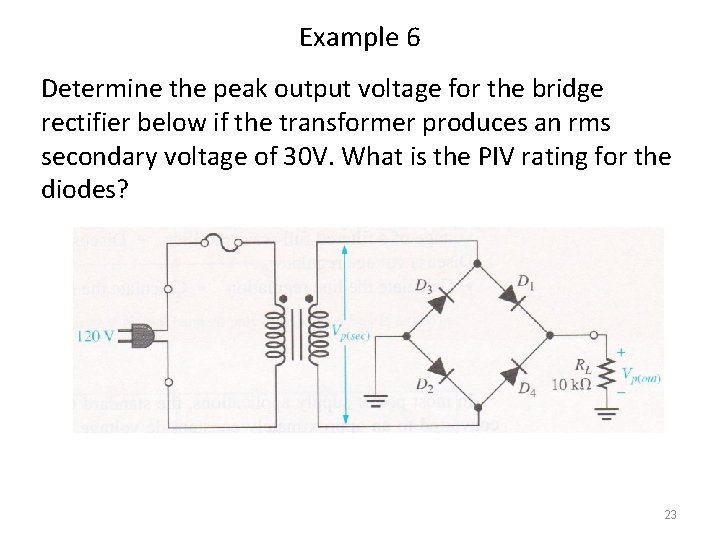
Example 6 Determine the peak output voltage for the bridge rectifier below if the transformer produces an rms secondary voltage of 30 V. What is the PIV rating for the diodes? 23
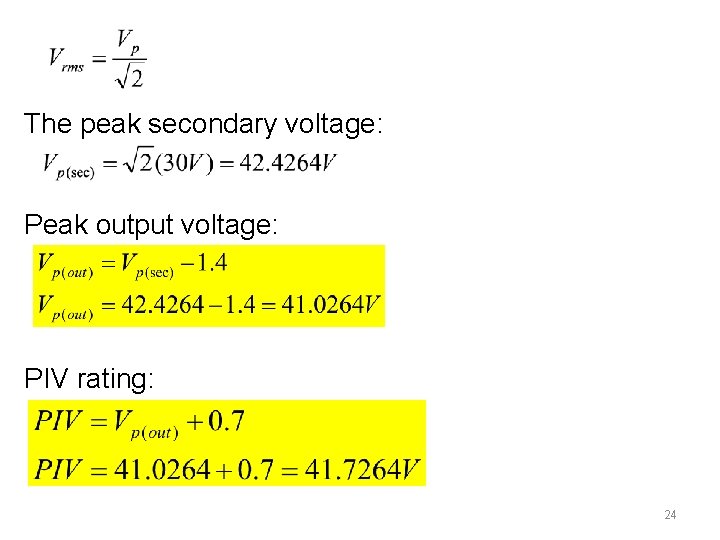
The peak secondary voltage: Peak output voltage: PIV rating: 24
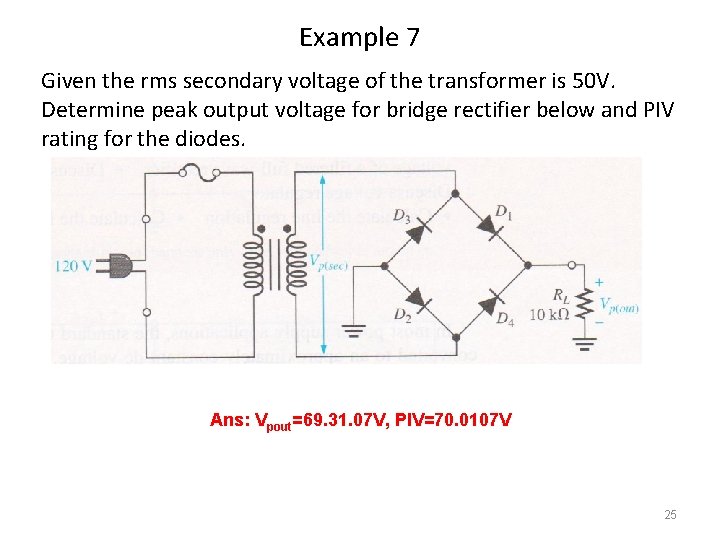
Example 7 Given the rms secondary voltage of the transformer is 50 V. Determine peak output voltage for bridge rectifier below and PIV rating for the diodes. Ans: Vpout=69. 31. 07 V, PIV=70. 0107 V 25
2 -3 Power Supply Filters And Regulators OBJECTIVE Ø Ø Ø Explain & analyze the operation & characteristic of power supply filters & Regulators Explain the purpose of a filter Describe the capacitor-input filter Define ripple voltage & calculate the ripple voltage Discuss surge current in capacitor-input filter Discuss voltage regulation & integrated circuit regulator 26
Introduction Power Supply Filters • To reduce the fluctuations in the output voltage of half / fullwave rectifier – produces constant-level dc voltage. • It is necessary – electronic circuits require a constant source to provide power & biasing for properation. • Filters are implemented with capacitors. Regulators Voltage regulation in power supply done using integrated circuit voltage regulators. Ø To prevent changes in the filtered dc voltage/ to fix output dc voltage due to variations in input voltage or load. Ø 27
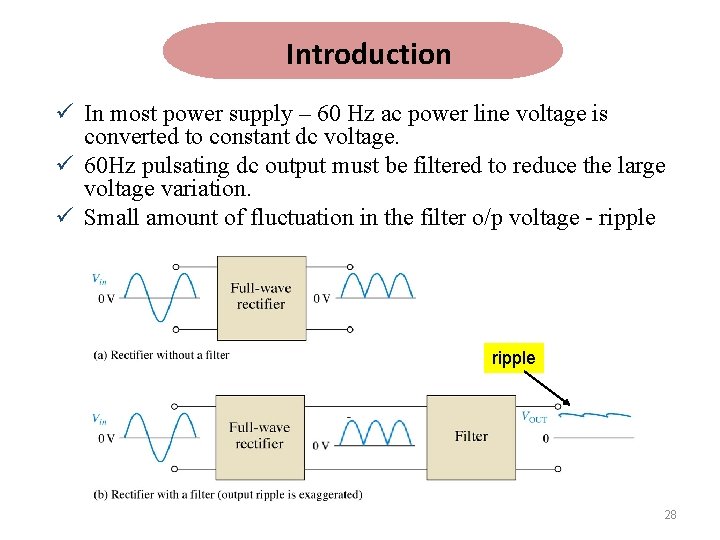
Introduction ü In most power supply – 60 Hz ac power line voltage is converted to constant dc voltage. ü 60 Hz pulsating dc output must be filtered to reduce the large voltage variation. ü Small amount of fluctuation in the filter o/p voltage - ripple 28
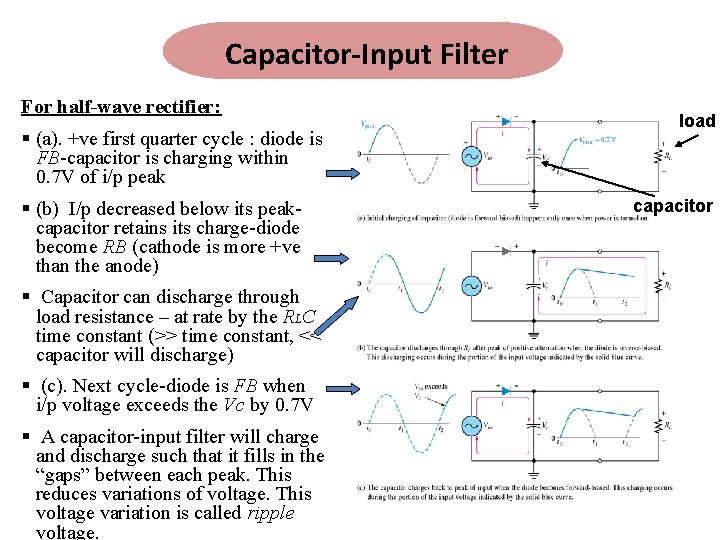
Capacitor-Input Filter For half-wave rectifier: load § (a). +ve first quarter cycle : diode is FB-capacitor is charging within 0. 7 V of i/p peak § (b) I/p decreased below its peakcapacitor retains its charge-diode become RB (cathode is more +ve than the anode) capacitor § Capacitor can discharge through load resistance – at rate by the RLC time constant (>> time constant, << capacitor will discharge) § (c). Next cycle-diode is FB when i/p voltage exceeds the Vc by 0. 7 V § A capacitor-input filter will charge and discharge such that it fills in the “gaps” between each peak. This reduces variations of voltage. This voltage variation is called ripple voltage. 29
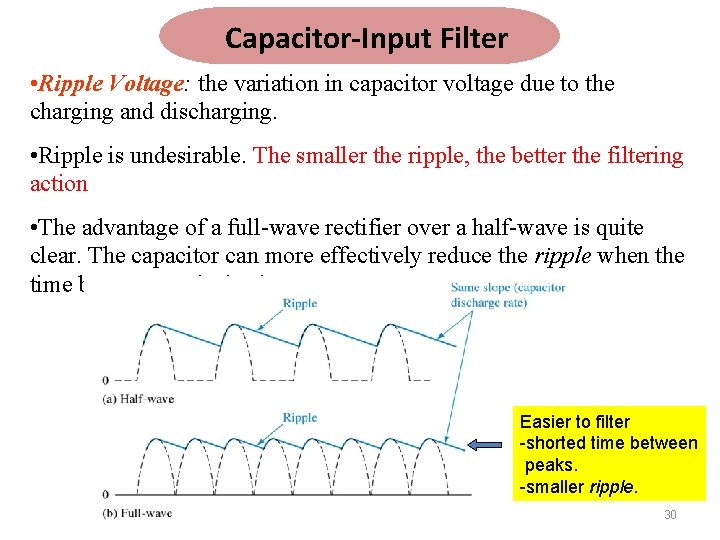
Capacitor-Input Filter • Ripple Voltage: the variation in capacitor voltage due to the charging and discharging. • Ripple is undesirable. The smaller the ripple, the better the filtering action • The advantage of a full-wave rectifier over a half-wave is quite clear. The capacitor can more effectively reduce the ripple when the time between peaks is shorter. Easier to filter -shorted time between peaks. -smaller ripple. 30
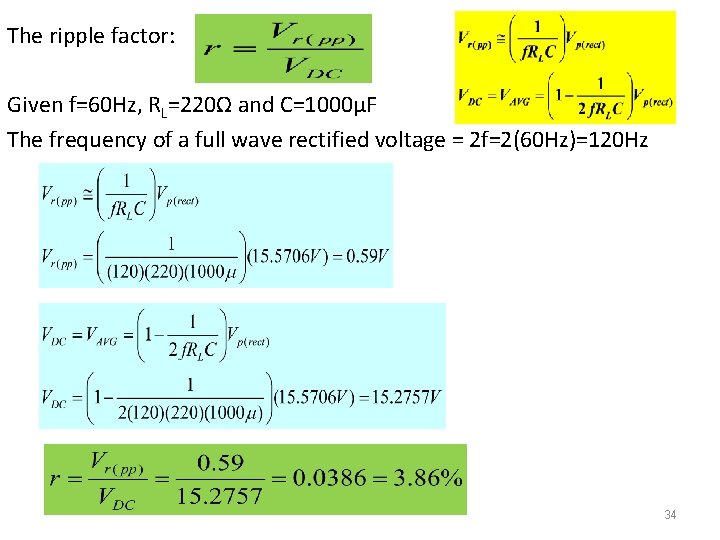
Capacitor-Input Filter Ripple factor: indication of the effectiveness of the filter [half-wave rectifier] Vr(pp) = peak to peak ripple voltage; VDC = VAVG = average value of filter’s output voltage. Lower ripple factor better filter [can be lowered by increasing the value of filter capacitor or increasing the load resistance] For the full-wave rectifier: Vp(rect) = unfiltered peak. 31
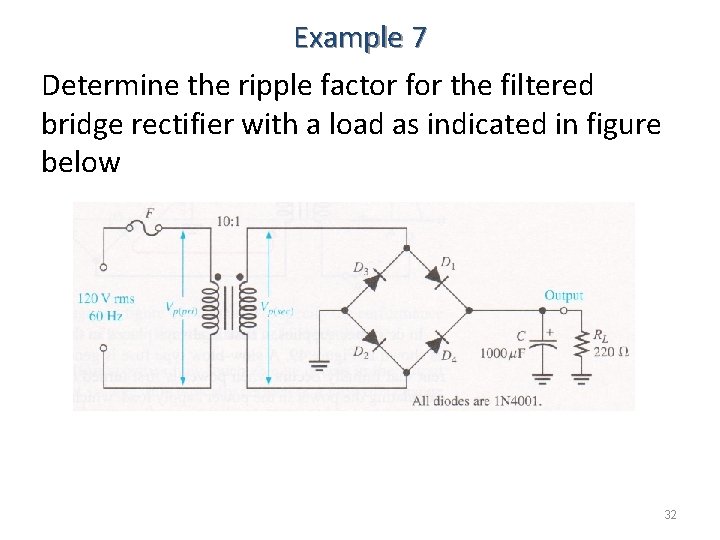
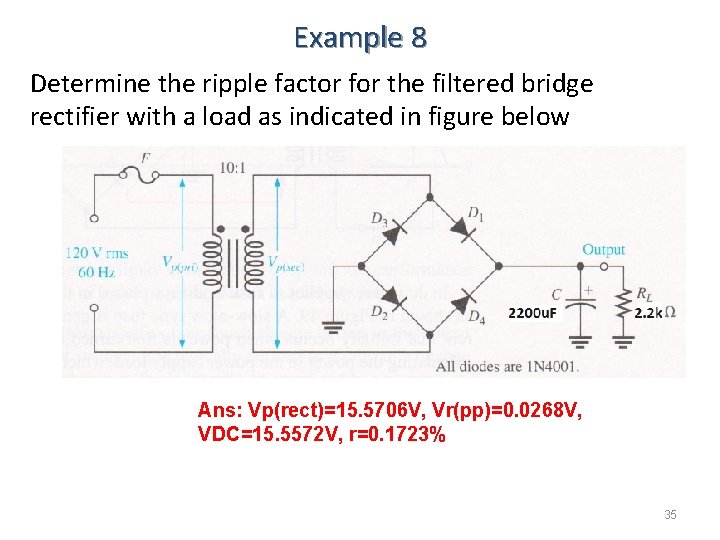
Example 7 Determine the ripple factor for the filtered bridge rectifier with a load as indicated in figure below 32
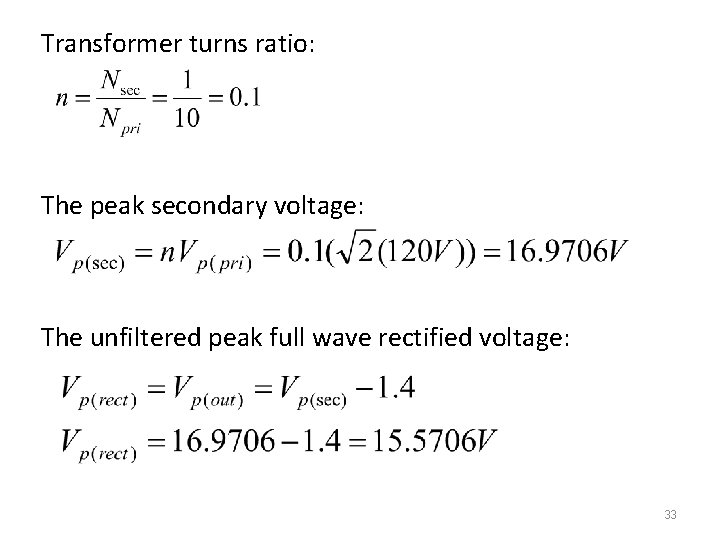
Transformer turns ratio: The peak secondary voltage: The unfiltered peak full wave rectified voltage: 33
The ripple factor: Given f=60 Hz, RL=220Ω and C=1000µF The frequency of a full wave rectified voltage = 2 f=2(60 Hz)=120 Hz 34
Example 8 Determine the ripple factor for the filtered bridge rectifier with a load as indicated in figure below Ans: Vp(rect)=15. 5706 V, Vr(pp)=0. 0268 V, VDC=15. 5572 V, r=0. 1723% 35
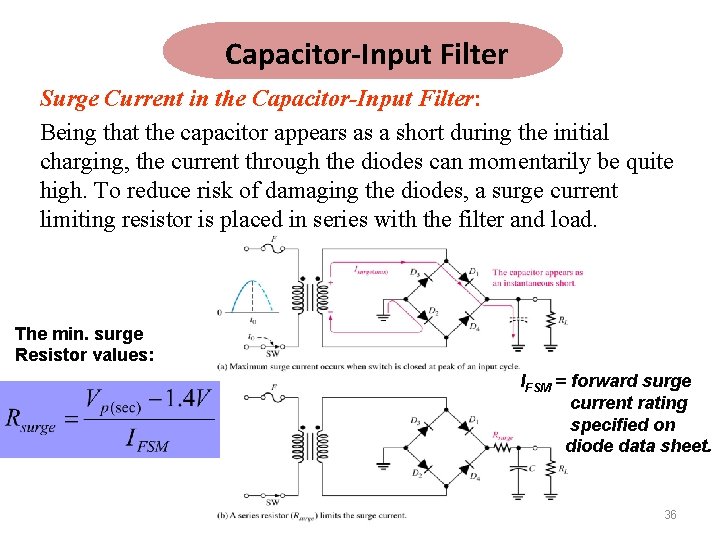
Capacitor-Input Filter Surge Current in the Capacitor-Input Filter: Being that the capacitor appears as a short during the initial charging, the current through the diodes can momentarily be quite high. To reduce risk of damaging the diodes, a surge current limiting resistor is placed in series with the filter and load. The min. surge Resistor values: IFSM = forward surge current rating specified on diode data sheet. 36
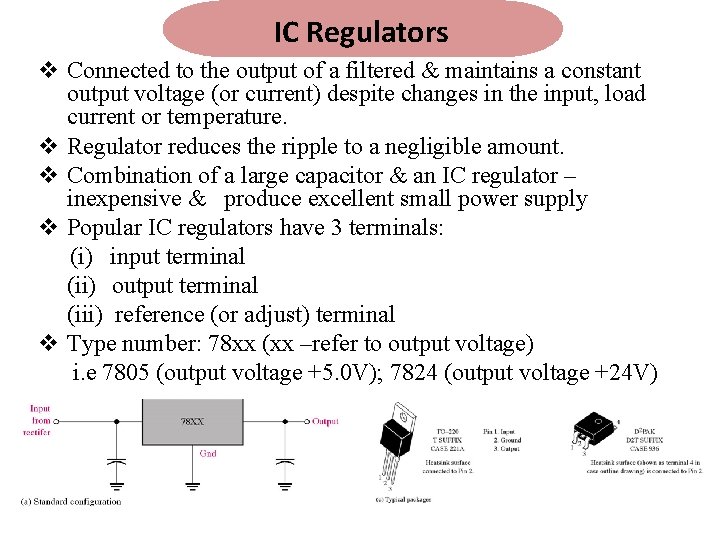
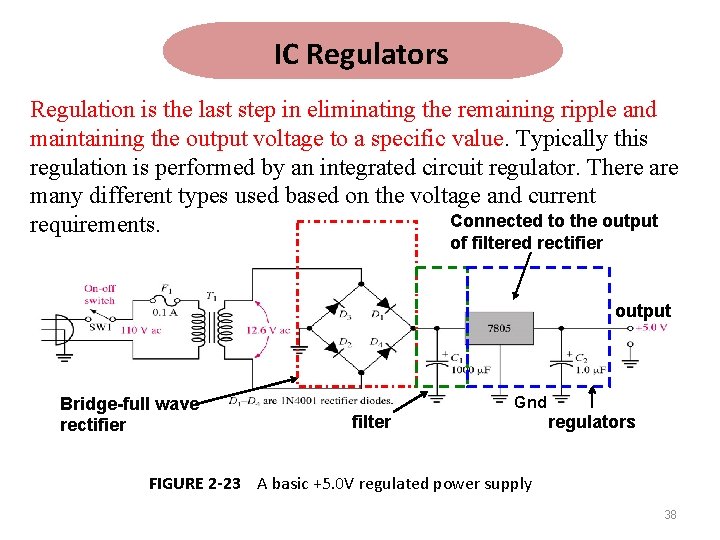
IC Regulators v Connected to the output of a filtered & maintains a constant output voltage (or current) despite changes in the input, load current or temperature. v Regulator reduces the ripple to a negligible amount. v Combination of a large capacitor & an IC regulator – inexpensive & produce excellent small power supply v Popular IC regulators have 3 terminals: (i) input terminal (ii) output terminal (iii) reference (or adjust) terminal v Type number: 78 xx (xx –refer to output voltage) i. e 7805 (output voltage +5. 0 V); 7824 (output voltage +24 V) 37
IC Regulators Regulation is the last step in eliminating the remaining ripple and maintaining the output voltage to a specific value. Typically this regulation is performed by an integrated circuit regulator. There are many different types used based on the voltage and current Connected to the output requirements. of filtered rectifier output Bridge-full wave rectifier Gnd filter regulators FIGURE 2 -23 A basic +5. 0 V regulated power supply 38
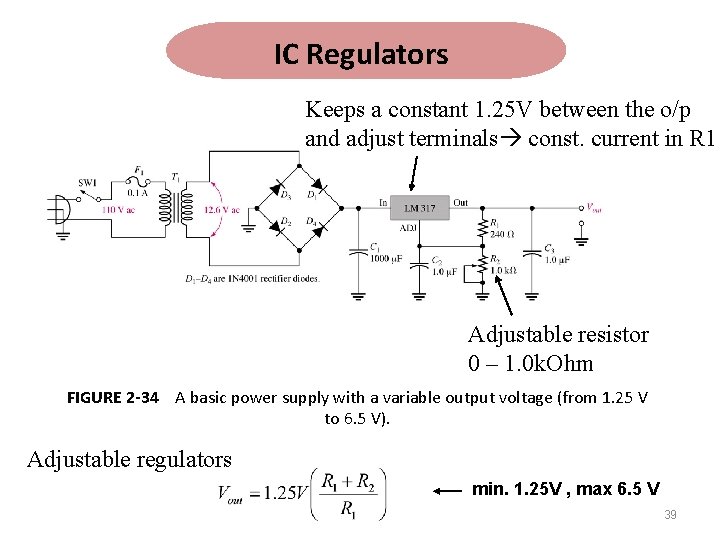
IC Regulators Keeps a constant 1. 25 V between the o/p and adjust terminals const. current in R 1 Adjustable resistor 0 – 1. 0 k. Ohm FIGURE 2 -34 A basic power supply with a variable output voltage (from 1. 25 V to 6. 5 V). Adjustable regulators min. 1. 25 V , max 6. 5 V 39
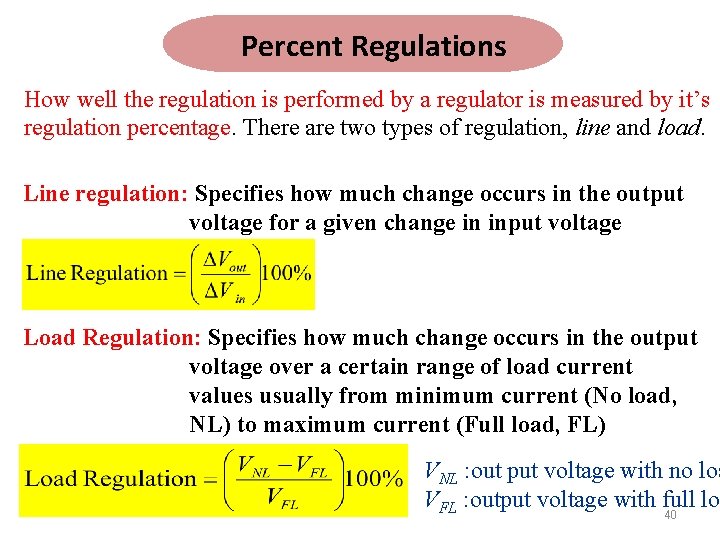
Percent Regulations How well the regulation is performed by a regulator is measured by it’s regulation percentage. There are two types of regulation, line and load. Line regulation: Specifies how much change occurs in the output voltage for a given change in input voltage Load Regulation: Specifies how much change occurs in the output voltage over a certain range of load current values usually from minimum current (No load, NL) to maximum current (Full load, FL) VNL : out put voltage with no loa VFL : output voltage with full lo 40
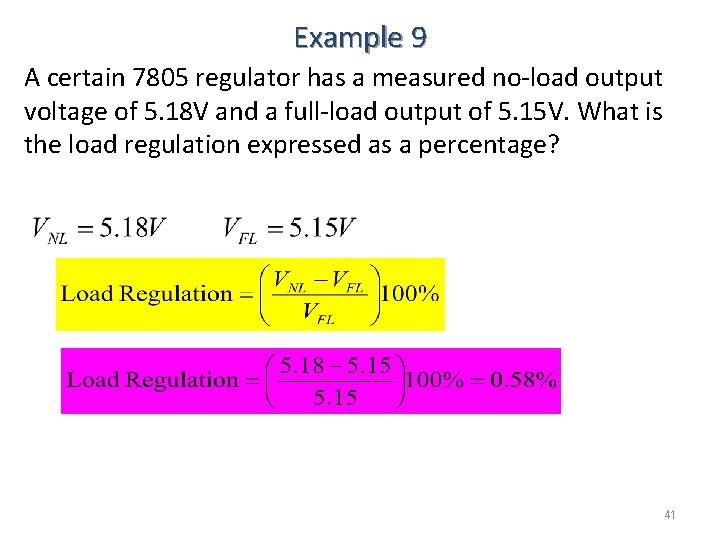
Example 9 A certain 7805 regulator has a measured no-load output voltage of 5. 18 V and a full-load output of 5. 15 V. What is the load regulation expressed as a percentage? 41
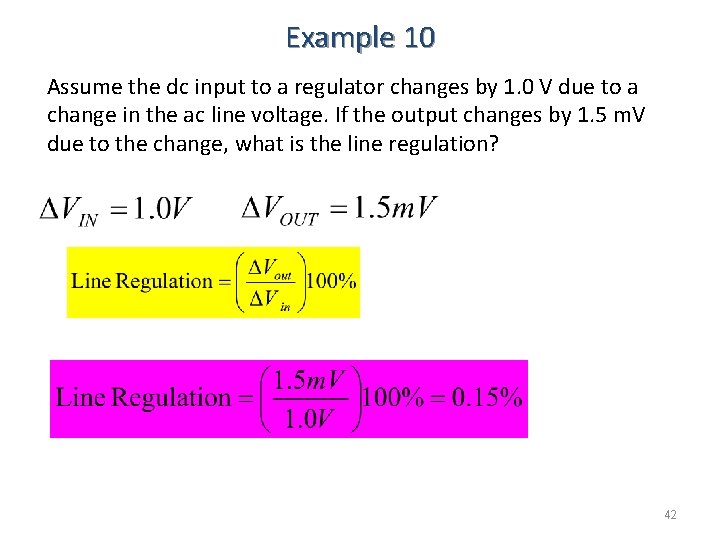
Example 10 Assume the dc input to a regulator changes by 1. 0 V due to a change in the ac line voltage. If the output changes by 1. 5 m. V due to the change, what is the line regulation? 42
Example 11 If the no-load output voltage of a regulator is 24. 8 V and the full-load output is 23. 9 V, what is the load regulation expressed as a percentage? Ans: Load regulation = 3. 77% 43