
Chapter 2 Overview of the Operations Research Modeling
- Slides: 23
Chapter 2 Overview of the Operations Research Modeling Approach © 2015 Mc. Graw-Hill Education. All rights reserved.
2. 1 Defining the Problem and Gathering Data • Elements of problem definition – Identify the appropriate objectives – Identify constraints – Identify interrelationships with other areas of the organization – Identify alternative courses of action – Define the time constraints © 2015 Mc. Graw-Hill Education. All rights reserved. 2
Defining the Problem and Gathering Data • OR team typically works in an advisory capacity – Management makes the final decisions • Identify the decision maker – Probe his/her thinking regarding objectives • Objectives need to be specific – Also aligned with organizational objectives © 2015 Mc. Graw-Hill Education. All rights reserved. 3
Defining the Problem and Gathering Data • Example of an objective in a for-profit organization – Maximum profit in the long run • More typical objective – Satisfactory profit combined with other defined objective © 2015 Mc. Graw-Hill Education. All rights reserved. 4
Defining the Problem and Gathering Data • Parties affected by a business firm operating in a single country – Stockholders (owners) – Employees – Customers – Suppliers – Government (nation) • International firms obligated to follow socially responsible practices © 2015 Mc. Graw-Hill Education. All rights reserved. 5
Defining the Problem and Gathering Data • Gathering relevant data necessary for: – Complete problem understanding – Input into mathematical models • Problem: too little data available – Solution: build management information system to collect data • Problem: too much data available – Solution: data mining methods © 2015 Mc. Graw-Hill Education. All rights reserved. 6
2. 2 Formulating a Mathematical Model • Models – Idealized representations – Examples: model airplanes, portraits, globes • Mathematical models – Expressed in terms of mathematical symbols – Example: Newton’s Law: F = ma • Mathematical model of a business problem – Expressed as system of equations © 2015 Mc. Graw-Hill Education. All rights reserved. 7
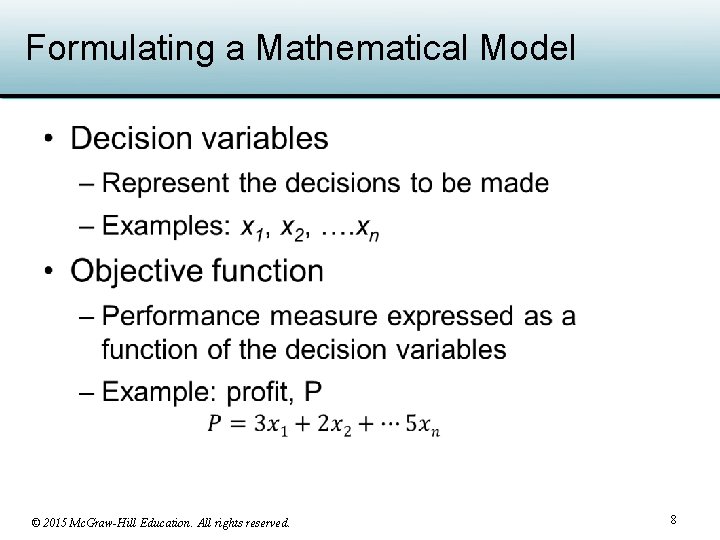
Formulating a Mathematical Model • © 2015 Mc. Graw-Hill Education. All rights reserved. 8
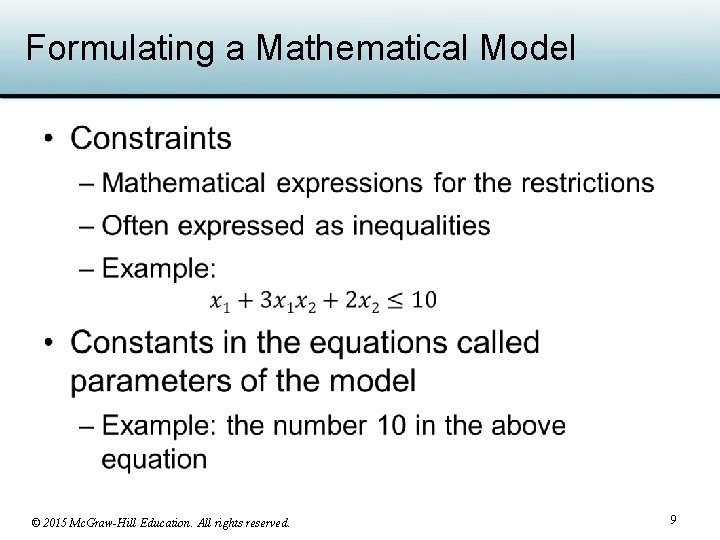
Formulating a Mathematical Model • © 2015 Mc. Graw-Hill Education. All rights reserved. 9
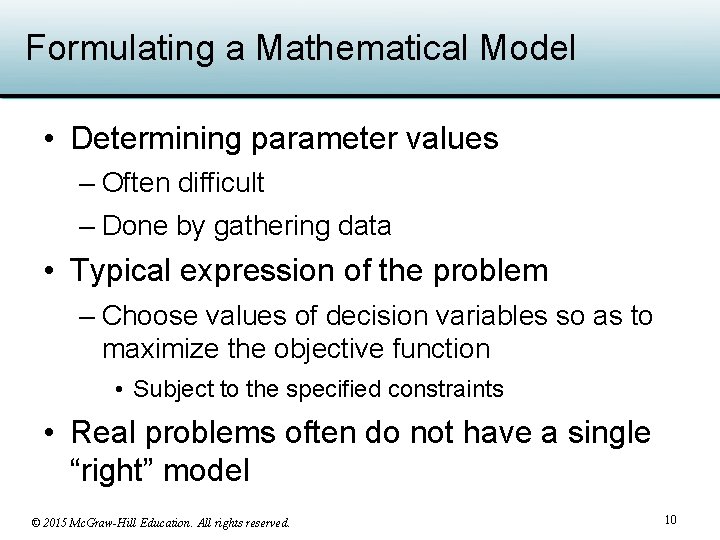
Formulating a Mathematical Model • Determining parameter values – Often difficult – Done by gathering data • Typical expression of the problem – Choose values of decision variables so as to maximize the objective function • Subject to the specified constraints • Real problems often do not have a single “right” model © 2015 Mc. Graw-Hill Education. All rights reserved. 10
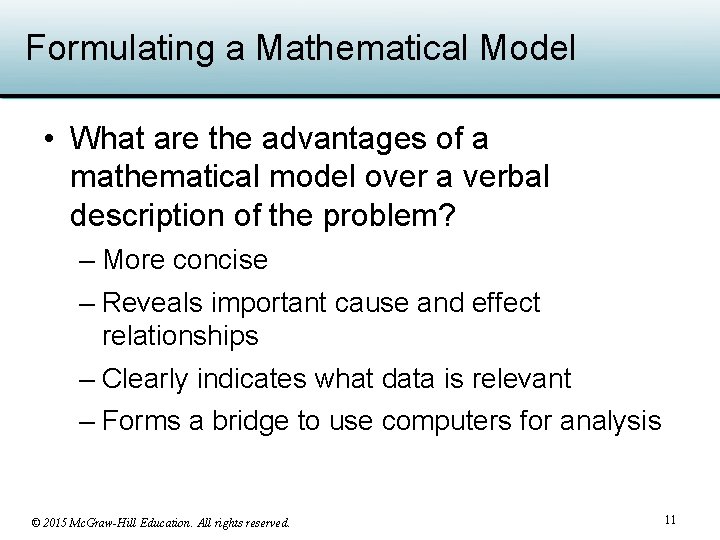
Formulating a Mathematical Model • What are the advantages of a mathematical model over a verbal description of the problem? – More concise – Reveals important cause and effect relationships – Clearly indicates what data is relevant – Forms a bridge to use computers for analysis © 2015 Mc. Graw-Hill Education. All rights reserved. 11
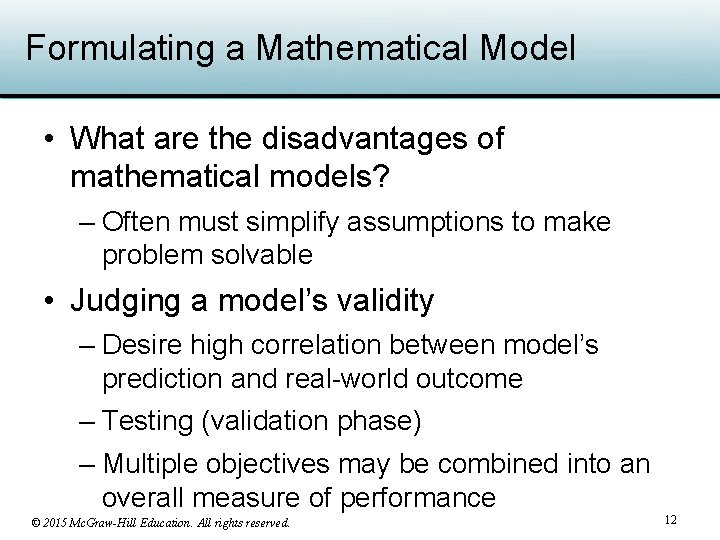
Formulating a Mathematical Model • What are the disadvantages of mathematical models? – Often must simplify assumptions to make problem solvable • Judging a model’s validity – Desire high correlation between model’s prediction and real-world outcome – Testing (validation phase) – Multiple objectives may be combined into an overall measure of performance © 2015 Mc. Graw-Hill Education. All rights reserved. 12
2. 3 Deriving Solutions from the Model • Sometimes a relatively simple step • Algorithms applied in a computer using a commercially-available software package • Search for the optimal solution – Common theme in OR problems – Recognize that the solution is optimal only with respect to model being used – More common goal: seek a satisfactory solution, rather than the optimal © 2015 Mc. Graw-Hill Education. All rights reserved. 13
Deriving Solutions from the Model • Postoptimality analysis – Analysis done after finding an optimal solution – Very important part of most OR studies – Also called “what-if” analysis • What would happen if different assumptions were made? • Sensitivity analysis – Determines which variables affect the solution the most © 2015 Mc. Graw-Hill Education. All rights reserved. 14
2. 4 Testing the Model • Model validation – Process of testing model output and improving the model until satisfied with output • Computer program analogy – Find and correct major bugs – Determine flaws in the model • Example of flaws: – Factors that were not incorporated – Parameters that were estimated incorrectly © 2015 Mc. Graw-Hill Education. All rights reserved. 15
Testing the Model • Process varies with the model • Check for dimensional consistency of units – In all mathematical expressions • Vary values of parameters and/or decision variables – See if output behaves in a plausible way © 2015 Mc. Graw-Hill Education. All rights reserved. 16
Testing the Model • Retrospective test – Uses historical data to reconstruct the past – Determines how well the model and solution would have performed • If it had been used • Disadvantages of the retrospective test – Uses same data as used to formulate the model – The past may not be indicative of the future © 2015 Mc. Graw-Hill Education. All rights reserved. 17
2. 5 Preparing to Apply the Model • Install a well-documented system for applying the model – Includes the model, solution procedure, and implementation procedures – Usually computer-based • Databases and management information systems – Provide up-to-date model input © 2015 Mc. Graw-Hill Education. All rights reserved. 18
Preparing to Apply the Model • Decision-support system – Interactive, computer-based system – Helps managers use data and models to support their decision-making © 2015 Mc. Graw-Hill Education. All rights reserved. 19
2. 6 Implementation • Benefits of the study are reaped during implementation phase • Important for OR team to participate in launch – To make sure model is correctly translated • Success of implementation depends on support from: – Top management – Operations management © 2015 Mc. Graw-Hill Education. All rights reserved. 20
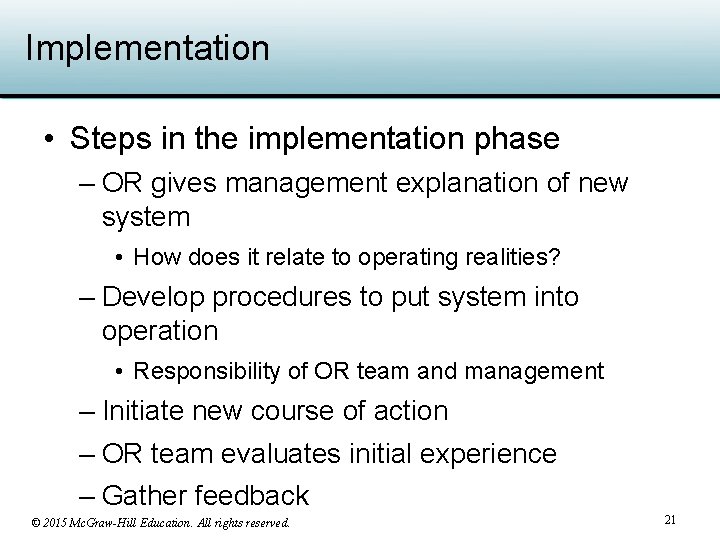
Implementation • Steps in the implementation phase – OR gives management explanation of new system • How does it relate to operating realities? – Develop procedures to put system into operation • Responsibility of OR team and management – Initiate new course of action – OR team evaluates initial experience – Gather feedback © 2015 Mc. Graw-Hill Education. All rights reserved. 21
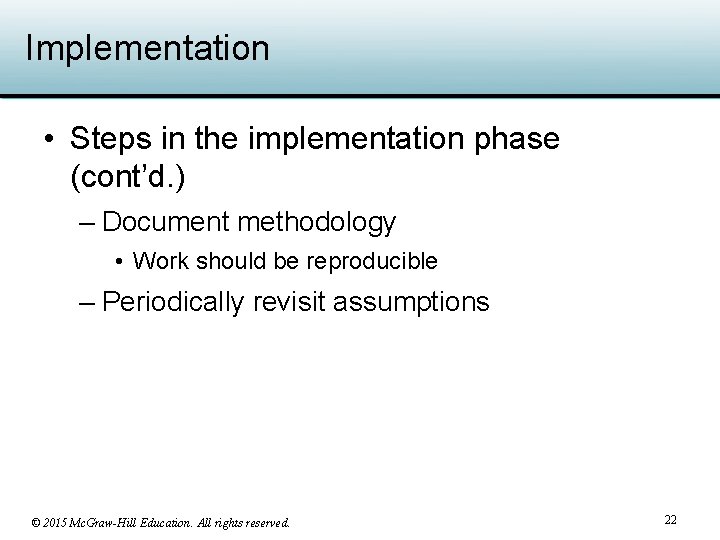
Implementation • Steps in the implementation phase (cont’d. ) – Document methodology • Work should be reproducible – Periodically revisit assumptions © 2015 Mc. Graw-Hill Education. All rights reserved. 22
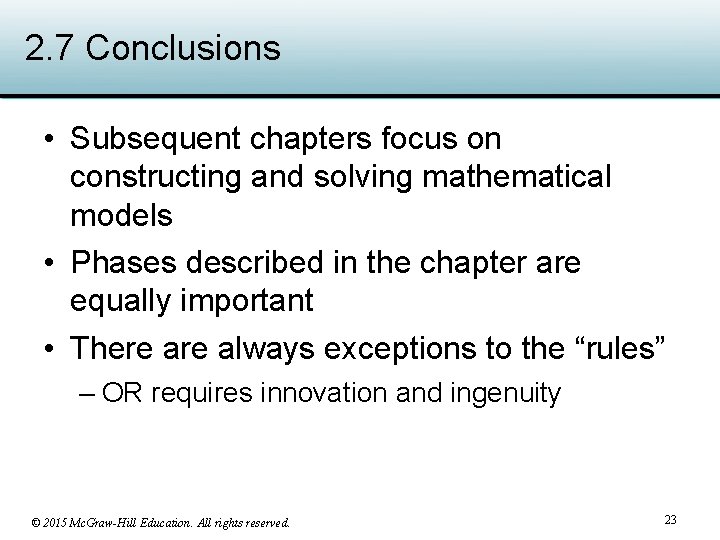
2. 7 Conclusions • Subsequent chapters focus on constructing and solving mathematical models • Phases described in the chapter are equally important • There always exceptions to the “rules” – OR requires innovation and ingenuity © 2015 Mc. Graw-Hill Education. All rights reserved. 23