
Chapter 2 Outline Scientific Management Theory Job Specialization
Chapter 2 Outline • Scientific Management Theory ØJob Specialization and the Division of Labor ØF. W. Taylor and Scientific Management ØThe Gilbreths • Administrative Management Theory ØThe Theory of Bureaucracy ØFayol’s Principles of Management • Behavioral Management Theory ØThe Work of Mary Parker Follett ØThe Hawthorne Studies and Human Relations © Copyright Mc. Graw-Hill. All rights reserved. 1
Chapter Outline (cont’d) • Behavioral Management Theory (cont’d) ØTheory X and Theory Y • Management Science Theory • Organizational Environment Theory ØThe Open Systems View ØContingency Theory © Copyright Mc. Graw-Hill. All rights reserved. 2

The Evolution of Management Theory Source: © Copyright Mc. Graw-Hill. All rights reserved. Figure 2. 1 3

Scientific Management Theory • Evolution of Modern Management ØBegan in the industrial revolution in the late 19 th century as: • Managers of organizations began seeking ways to better satisfy customer needs. • Large-scale mechanized manufacturing began to supplanting small-scale craft production in the ways in which goods were produced. • Social problems developed in the large groups of workers employed under the factory system. • Managers began to focus on increasing the efficiency of the worker-task mix. © Copyright Mc. Graw-Hill. All rights reserved. 4

F. W. Taylor and Scientific Management • Scientific Management ØThe systematic study of the relationships between people and tasks for the purpose of redesigning the work process for higher efficiency. • Defined by Frederick Taylor in the late 1800’s to replace informal rule of thumb knowledge. • Taylor sought to reduce the time a worker spent on each task by optimizing the way the task was done. • Taylor: increase specialization & division of labor to make production process more efficient © Copyright Mc. Graw-Hill. All rights reserved. 5

F. W. Taylor and Scientific Management • Scientific Management (Taylor) Principles Ø Gather data about ways workers perform their tasks; experiment with different ways to improve performance ØCodify methods into written rules and standards ØSelect people who have skills/abilities needed in the task and train them on the particular task ØEstablish acceptable level of performance and reward for performance above that level Organizations chose to select some, rather than all, of these principles. © Copyright Mc. Graw-Hill. All rights reserved. 6
Henry Ford: A matter of ethics Reduced work day and more pay along with Extreme control © Copyright Mc. Graw-Hill. All rights reserved. 7
Frank and Lillian Gilbreth • Refined Taylor’s work and made many improvements to the methodologies of time and motion studies. ØTime and motion studies • Break up each job action into its component actions. • Find better ways to perform the action. • Reorganize each job action to be more efficient. • Also studied worker-related fatigue problems caused by lighting, heating, and the design of tools and machines. © Copyright Mc. Graw-Hill. All rights reserved. 8
Scientific Management Principles: the result … Jobs were more repetitive, boring, monotonous Workers increasingly dissatisfied Workers tried to hide the potential efficiency of the work environment © Copyright Mc. Graw-Hill. All rights reserved. 9
Administrative Management Theory • Administrative Management ØThe study of how to create an organizational structure that leads to high efficiency and effectiveness. • Max Weber ØDeveloped the concept of bureaucracy as a formal system of organization and administration designed to ensure efficiency and effectiveness. © Copyright Mc. Graw-Hill. All rights reserved. 10
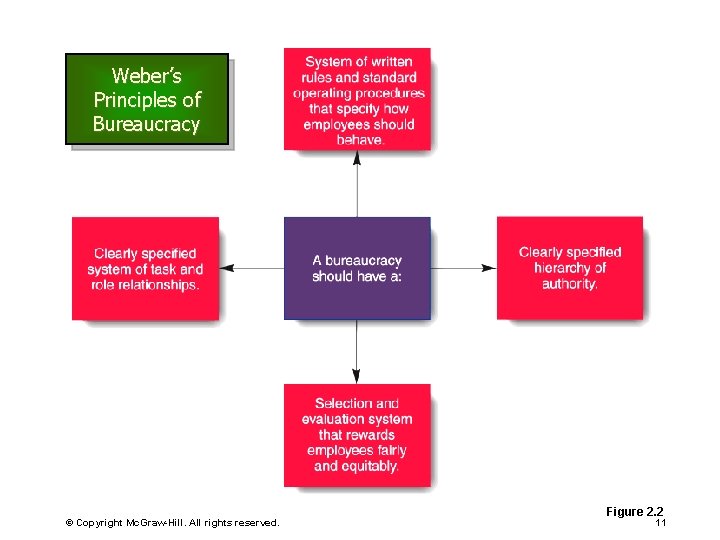
Weber’s Principles of Bureaucracy © Copyright Mc. Graw-Hill. All rights reserved. Figure 2. 2 11
Bureaucracy • Strengths ØClaimed to improve organizational performance ØEasier for managers to organize and control ØFair and equitable raises and promotion • Improves feeling of security • Reduces stress • Encourage ethical behavior • Weaknesses ØWhat if poorly managed? ØDecisions and changes are slow ØInflexibility © Copyright Mc. Graw-Hill. All rights reserved. 12
Fayol’s Principles of Management • Division of Labor: allows for job specialization. ØFayol noted jobs can have too much specialization leading to poor quality and worker dissatisfaction. • Authority and Responsibility ØFayol included both formal and informal authority resulting from special expertise. • Unity of Command ØEmployees should have only one boss. © Copyright Mc. Graw-Hill. All rights reserved. 13
Fayol’s Principles of Management (cont’d) • Line of Authority ØA clear chain of command from top to bottom of the firm. • Centralization ØThe degree to which authority rests at the top of the organization. • Unity of Direction ØEmployee should receive orders and report to only one supervisor. © Copyright Mc. Graw-Hill. All rights reserved. 14
Fayol’s Principles of Management (cont’d) • Equity ØThe provision of justice and the fair and impartial treatment of all employees. • Order ØThe arrangement of employees where they will be of the most value to the organization and to provide career opportunities. • Initiative ØThe fostering of creativity and innovation by encouraging employees to act on their own. © Copyright Mc. Graw-Hill. All rights reserved. 15
Fayol’s Principles of Management (cont’d) • Discipline ØObedient, applied, respectful employees are necessary for the organization to function. • Remuneration of Personnel ØAn equitable uniform payment system that motivates contributes to organizational success. • Stability of Tenure of Personnel ØLong-term employment is important for the development of skills that improve the organization’s performance. © Copyright Mc. Graw-Hill. All rights reserved. 16
Fayol’s Principles of Management (cont’d) • Subordination of Individual Interest to the Common Interest ØThe interest of the organization takes precedence over that of the individual employee. • Esprit de corps ØComradeship, shared enthusiasm foster devotion to the common cause (organization). © Copyright Mc. Graw-Hill. All rights reserved. 17
Why do companies perform better than their rivals? (62 companies) • Emphasize management autonomy and entrepreneurship • Encourage risk taking and initiative • Top managers closely involved in daily operations • Unity of command unity of direction • Decisions are not made in an isolated tower • Decentralized authority • Organizational goals guide everyone’s actions • Division of work and authority given with individual interests towards the common interest © Copyright Mc. Graw-Hill. All rights reserved. 18
Behavioral Management Theory • Behavioral Management ØThe study of how managers should behave to motivate employees and encourage them to perform at high levels and be committed to the achievement of organizational goals. ØFocuses on the way a manager should personally manage to motivate employees. © Copyright Mc. Graw-Hill. All rights reserved. 19
Behavioral Management • Mary Parker Follett (1868 -1933) ØAn influential leader in early managerial theory ØConcerned that Taylor was ignoring the human side of the organization and the number of ways employees can help managers ØHeld a horizontal view of power and authority • “Authority should go with knowledge …” • Managers should be facilitators rather than monitors or supervisors • Root of the work in self-managed teams, empowerment, and cross-functioning © Copyright Mc. Graw-Hill. All rights reserved. 20
The Hawthorne Studies • Studies of how characteristics of the work setting affected worker fatigue and performance at the Hawthorne Works of the Western Electric Company from 1924 -1932. ØWorker productivity was measured at various levels of light illumination. ØProductivity increased regardless of whether the light levels were raised or lowered. • Why? … the presence of the researchers • Implication … human relations movement © Copyright Mc. Graw-Hill. All rights reserved. 21
Human Relations Movement • Sparked by the Hawthorne Studies Ø Workers attitude towards their managers affect their work performance • Train supervisors to elicit cooperative behavior from subordinates so productivity will increase • Workers making telephone switching equipment Ø The norm of output vs. “ratebusters” vs. “chiselers” Ø Worker’s influence can be as great as the manager’s • Managers must understand the informal organization • The beginning of Organizational Behavior © Copyright Mc. Graw-Hill. All rights reserved. 22
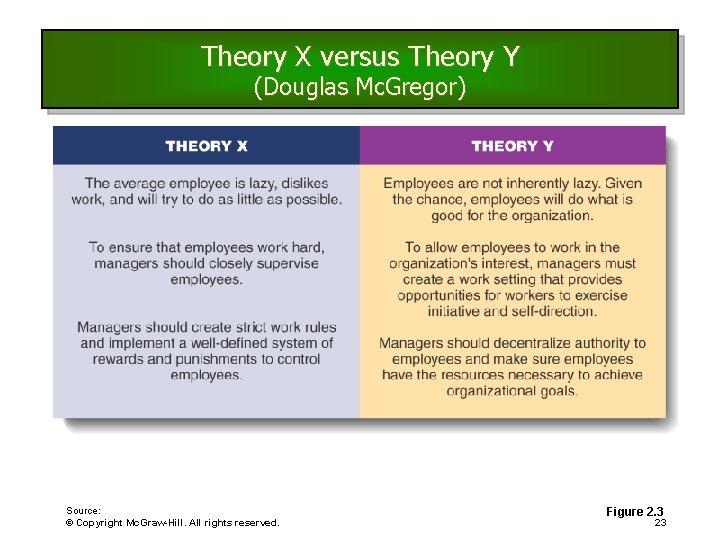
Theory X versus Theory Y (Douglas Mc. Gregor) Source: © Copyright Mc. Graw-Hill. All rights reserved. Figure 2. 3 23
Management Science Theory • An approach to management that uses rigorous quantitative techniques to maximize the use of organizational resources. ØQuantitative management—utilizes linear programming, modeling, simulation systems. ØOperations management—techniques to analyze all aspects of the production system. ØTotal Quality Management (TQM)—focuses on improving quality throughout an organization. ØManagement Information Systems (MIS)— manage information throughout the organization so that it gets to the right people at the right time. © Copyright Mc. Graw-Hill. All rights reserved. 24
Organizational Environment Theory • Organizational Environment ØThe set of forces and conditions that operate beyond an organization’s boundaries but affect a manager’s ability to acquire and utilize resources. • What “forces” are presently in the “environment” that affect the manager’s ability to acquire and utilize resources? © Copyright Mc. Graw-Hill. All rights reserved. 25

The Open-Systems View (Katz, Kahn, Thompson, 1960 s) • Organization takes resources from the external environment and transforms them into goods and services that are sent back out to environment • Organization interacts with environment in order to survive • Not a closed system, which is: Ø self contained Ø likely to experience entropy • The whole is greater than the sum of its parts • Synergy: gains acquired when entities coordinate their efforts © Copyright Mc. Graw-Hill. All rights reserved. 26
Contingency Theory (Burns & Stalker, Britain, 1960 s) • No one best way to organize because the external environment (ability to gain resources) influences the organizational structures and controls • A quickly changing environment works against this … why? • Mechanic vs. Organic structure © Copyright Mc. Graw-Hill. All rights reserved. 27
Summary of Theories • Scientific Management Theory ØJob specialization and division of labor ØTaylor (Scientific Management) ØGilbreths • Administrative Management Theory ØTheory of Bureaucracy ØFayol (14 principles of management) © Copyright Mc. Graw-Hill. All rights reserved. 28
Summary of Theories (continued) • Behavioral Management Theory ØFollett ØHawthorne Studies and Human Relations ØMc. Gregor (Theory X & Theory Y) • Management Science Theory ØQuantitative management • Organizational Environment Theory ØOpen-systems View ØContingency Theory © Copyright Mc. Graw-Hill. All rights reserved. 29
- Slides: 29