
CHAPTER 2 OSHAActs Standards Liability OSHLegislation in Malaysia
CHAPTER 2 : OSHAActs, Standards & Liability
OSHLegislation in Malaysia • • • Selangor Boiler Enactment 1892 Machinery Ordinance 1913 Machinery Enactment 1932 Machinery Ordinance 1953 Factories and Machinery Act 1967 Occupational Safety and Health Act 1994
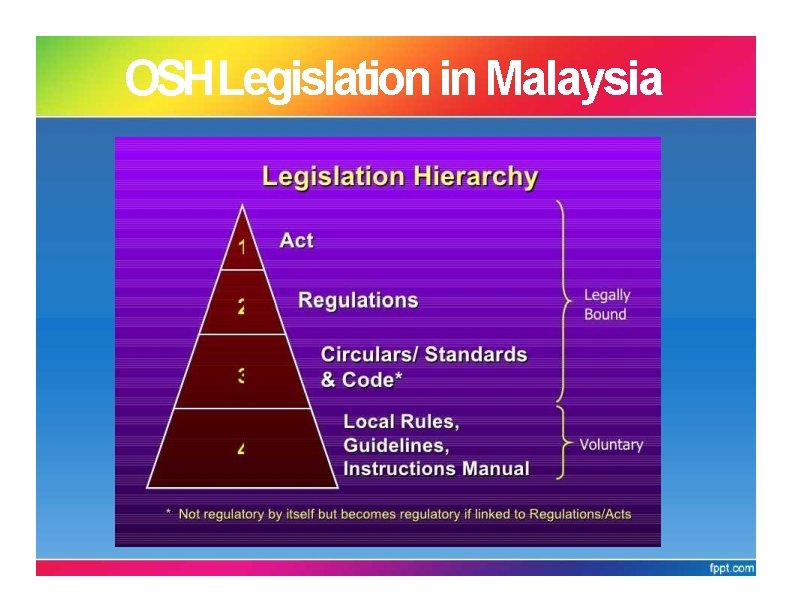
OSHLegislation in Malaysia
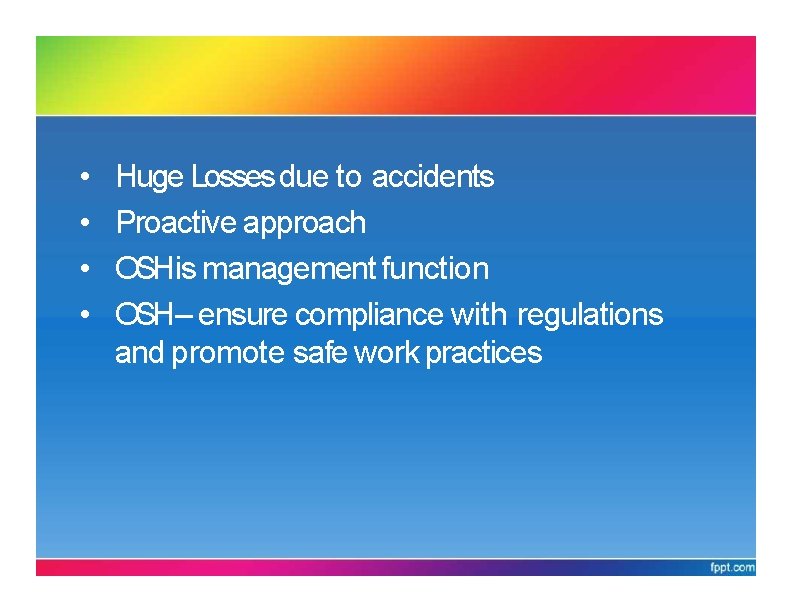
Management of OSHin Malaysia • • Huge Losses due to accidents Proactive approach OSHis management function OSH– ensure compliance with regulations and promote safe work practices
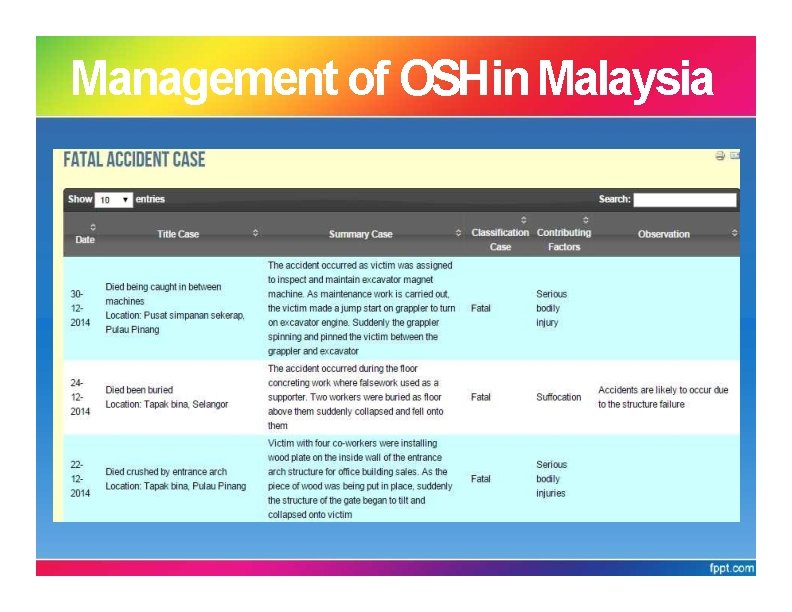
Management of OSHin Malaysia
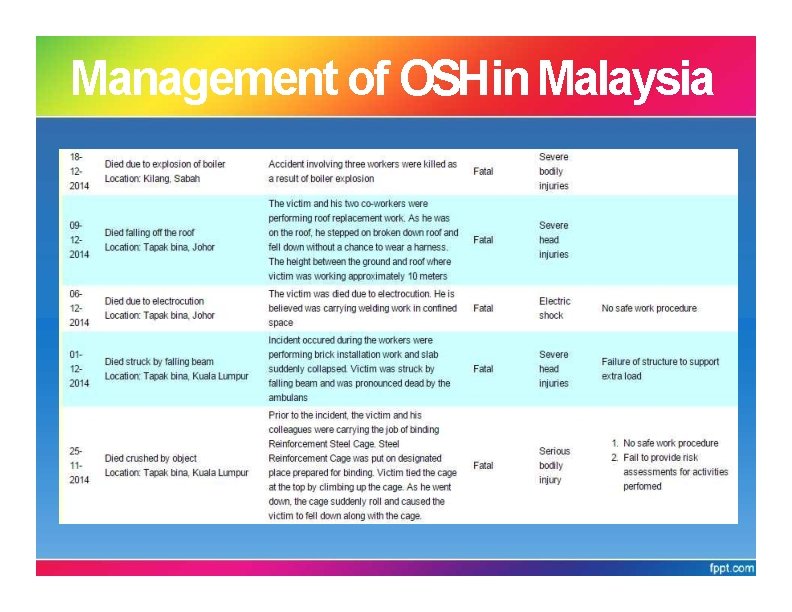
Management of OSHin Malaysia
FACTORIESAND MACHINERIES ACT 1967 & REGULATIONS (FMA 1967)
FMA 1967 • In the year 1967, the Factories and Machinery Act was approved by the Parliament of Malaysia • This act was legislated to overcome weaknesses in the Machinery Ordinance 1953 “They were not protected if they are working in the workplace that doesn’t use machinery”
FMA 1967 • “Factory” refers to places where persons are employed in manual labour related to making, altering, repairing, cleaning and similar activities carried out for the purposes of trade or business • The Act does not apply to any premises that employ five or less persons
FMA 1967 • Provide control of factories related to safety, health & welfare of persons at work, and any matters related to registration & inspection of machinery • Specify dangerous occurrence, types of serious bodily injury & industrial diseases • Specify powers of Inspectors, obstruction and offences
FMA 1967 • Specify requirement for machinery – steamboilers, unfired pressure vessels, gas cylinders, transmission machinery, hoisting machines & etc • Specify duties of persons employed and occupier, person in charge & certificate of competency • Instruct all machinery to have written approval, valid certificate of fitness & periodically inspection by Inspector

FMA 1967 OBJECTIVES • Control of factories operations with respect to safety, health and welfare of persons • Registration & inspection of machinery
FMA 1967 APPLICATION • FMA – limited to manufacturing industry, mining, quarrying & construction • No detail provisions on specific matters – detail provision are stipulated under the regulations.
FMA 1967 APPLICATION • The scope of FMA 1967 covers in the following sectors: – Manufacturing – Mining & quarrying – Construction • FMA 1967 provides prescriptive provisions of which over time, became irrelevant
FMA 1967 APPLICATION • Initially, the Act’s approach was based on the traditional method of using a checklist system • This checklist emphasize on workers, system of work, machineries & working environment by preventing accidents & industrial diseases • This approach gave the impression of a total control by the government in terms of occupational safety & health • Resulting in industries became too dependent on government regulations
FMA 1967 APPLICATION • Unfortunately, many accident cases involving the industries were recorded at an alarming rate, especially fatality & permanent disability cases • Thus the need by the government to add in additional piece of law to control these activities
FMA 1967 Arrangements • Part 1 – Preliminary • Part 2 – Safety, health and welfare • Part 3 – Persons-in-charge & certificates of competency • Part 4 – Notification of accidents, dangerous occurrence & dangerous diseases • Part 5 – Notice of occupation of factory & registration & use of machinery • Part 6 - General
PARTI: PRELIMINARY Definition of Factory • There must be premises & its boundaries can be defined • Within the premises there is manual labor doing process of making, altering, repairing, ornamenting, sorting, finishing, cleaning, washing, breaking, demolishing, constructing, fitting, adjusting • The process must be for trading any business
PARTI: PRELIMINARY • Factory maybe defined as any premises or part of a premises where trade for the purposes of gain to any business, where 5 or more persons are employed • Covers all places of work using machinery including building operations & works of engineering construction
PARTII: SAFETY, HEALTHAND WELFARE Key points: • Premises must be designed with safe access to work areas, material & goods must be safely stacked (S. 10) • Machinery must be properly constructed & dangerous parts must be fenced (S. 14, 15, 16) • Employees must not misuse safety & health equipment (S. 20) • Employees must not to endanger himself or other person
PARTII: SAFETY, HEALTHAND WELFARE • Premises must be kept clean with adequate space, ventilation, lighting & toilets (S. 22) • Persons must be supplied with adequate facilities for clothing, storage, drinking, water, first aid & washing facilities (S. 25) • Employees must be trained on safety of machinery (S. 26)
PARTIII: PERSONSIN CHARGEAND CERTIFICATESOF COMPETENCY • Machinery operators must be adequately trained or under the supervision of a trained person (S. 26) • Young persons (<16) must not operate machinery (S. 28)
PARTIV: NOTIFICATION OFACCIDENT, DANGEROUS OCCURANCE& DANGEROUSDISEASES The occupier must notify the nearest Inspector of accidents & diseasesinclude: • Loss of life • Injury to a person who loses more than 4 days work loss injury time • Serious damage to machinery or other property (S. 31) • Inspectors may investigate accidents & dangerous occurrence & hold inquiries on more serious cases (S. 33)
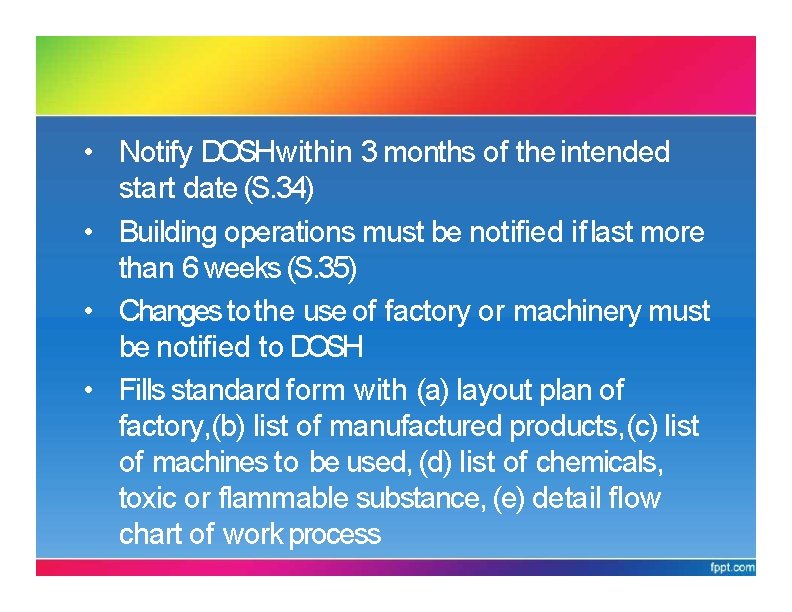
PARTV: NOTICE OFOCCUPATION OFFACTORYAND REGISTRATION AND USEOFMACHINERY • Notify DOSHwithin 3 months of the intended start date (S. 34) • Building operations must be notified if last more than 6 weeks (S. 35) • Changes to the use of factory or machinery must be notified to DOSH • Fills standard form with (a) layout plan of factory, (b) list of manufactured products, (c) list of machines to be used, (d) list of chemicals, toxic or flammable substance, (e) detail flow chart of work process

PARTVI: GENERAL • General penalty RM 2, 000 • Certain sections with penalty RM 5, 000 (S. 51)
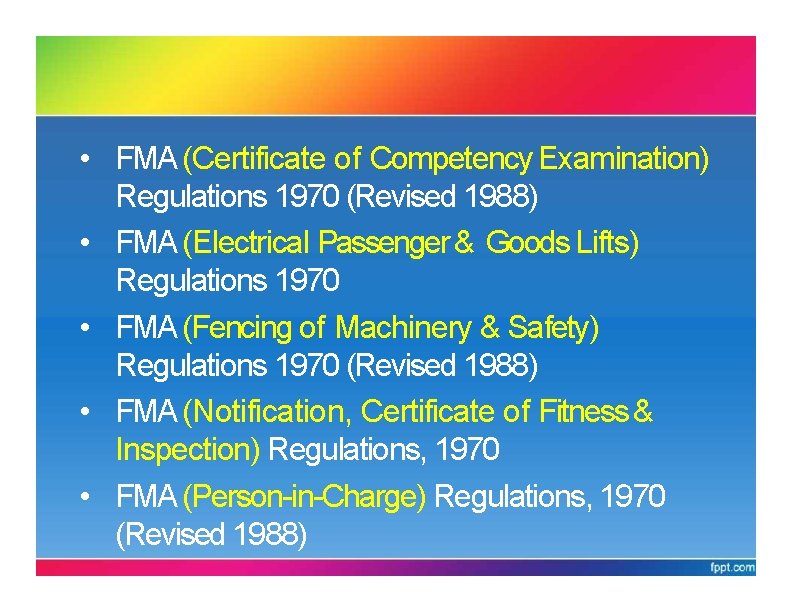
REGULATIONS UNDERFMA • FMA (Certificate of Competency Examination) Regulations 1970 (Revised 1988) • FMA (Electrical Passenger & Goods Lifts) Regulations 1970 • FMA (Fencing of Machinery & Safety) Regulations 1970 (Revised 1988) • FMA (Notification, Certificate of Fitness & Inspection) Regulations, 1970 • FMA (Person-in-Charge) Regulations, 1970 (Revised 1988)
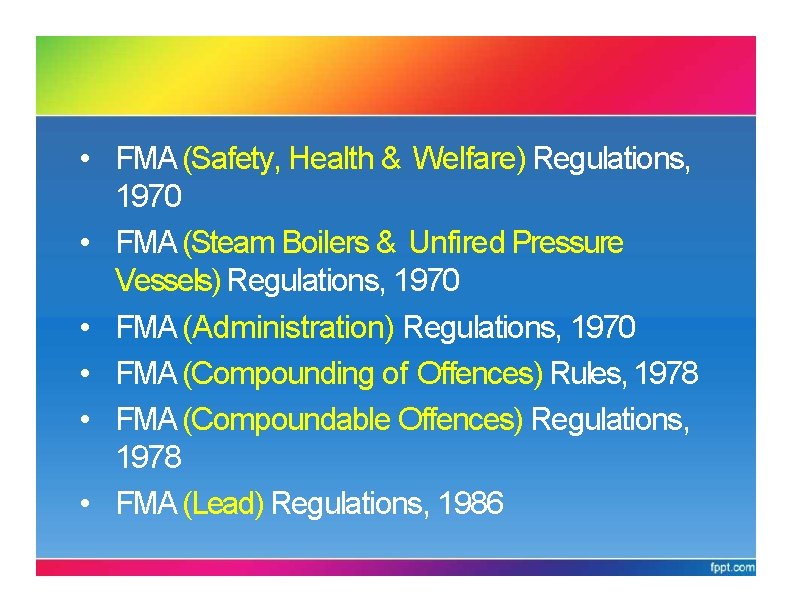
REGULATIONS UNDERFMA • FMA (Safety, Health & Welfare) Regulations, 1970 • FMA (Steam Boilers & Unfired Pressure Vessels) Regulations, 1970 • FMA (Administration) Regulations, 1970 • FMA (Compounding of Offences) Rules, 1978 • FMA (Compoundable Offences) Regulations, 1978 • FMA (Lead) Regulations, 1986
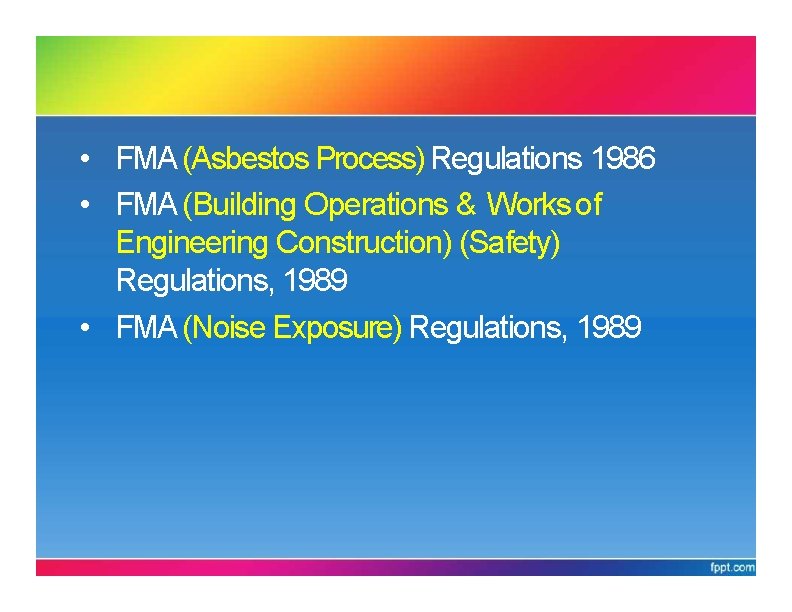
REGULATIONS UNDERFMA • FMA (Asbestos Process) Regulations 1986 • FMA (Building Operations & Works of Engineering Construction) (Safety) Regulations, 1989 • FMA (Noise Exposure) Regulations, 1989
REGULATIONS UNDERFMA • FMA (Mineral Dust) Regulations 1989 • FMA (Notification, Certificate of Fitness & Inspection) (Amendment) Regulations 2004 • FMA (Steam Boilers & Unfired Pressure Vessels) (Amendment) Regulations 2005

OCCUPATIONAL SAFETYAND HEALTH ACT 1994 (OSHA 1994)
OSHA 1994 • OSHAput into force on 24 february 1994 • Provide a legislative framework to stimulate and encourage high standards of safety and health at work • Promote safety and health awareness and establish effective safety organization through self regulation • Consists of 15 parts and an enabling measure superimposed over existing safety and health regulations

OSHA 1994 • OSHAprovisions prevail in the event of any conflict • Defines general duties of employers, manufactures, employees, the self employed, designers, importers and suppliers • Covers all sectors except the armed forces and work on board ships. 1. Merchant shipping ordinance 1952 2. Merchant shipping ordinance 1960
OSHA 1994 It covers throughout Malaysia in the industries specified in the First Schedule: • Manufacturing, Mining and Quarrying, Construction, Agriculture, Forestry and Fishing, Utilities (Electricity, Gas, Water; and Sanitary services), Transport, Storage and Communication, Wholesale and Retail Trades, Hotels and Restaurants, Finance, Insurance, Real Estate and Business Services, Public Services and Statutory Authorities Except: 1. Work on board of ship 2. Armed Forces
OSHA 1994 Philosophy & Guiding Principles: “Responsibilities to ensure safety & health atthe workplace lies on those who create the RISKand those who work with the RISK
MAIN PRINCIPLESOFOSHA 1994 • Self-regulation Employers must develop a good and orderly OSHmanagement system • Consultation-tri partite Where employers, employees and the government must negotiate to settle issues and problems relating to OSHat the workplace

MAIN PRINCIPLESOFOSHA 1994 • Co-operation where employers and employees must cooperate to take care, nurture and to increase the quality of OSHat the workplace.
OSHA 1994 OBJECTIVES • To secure the safety, health & welfare of persons at work • To protect person (other than person at work) against hazard • To promote an occupational environment which is adaptable to the person’s physiological & psychological needs • To provide the means to progressively replaced legislation by a system of regulation and approved industry
CONCEPTOFOSHA 1994 • Accident prevention is an essential part of good management and workmanship • Top management must take the lead • Management and workers must cooperate • A define and known safety and health policy • Organization and resources to achieve policy • Best available knowledge and methods
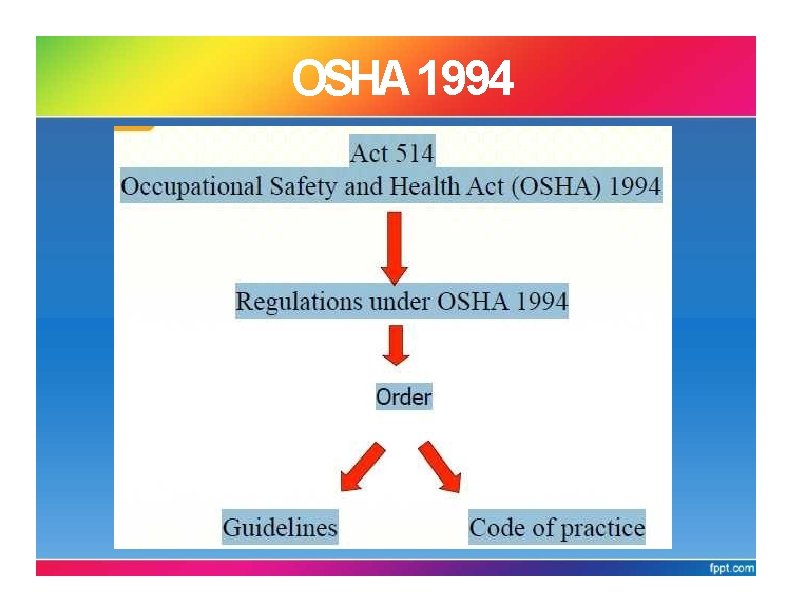
OSHA 1994

OSHA 1994 • The Act contains 67 sections, divided into 15 parts and appended with 3 schedules. • The first three parts state the objects of the Act and provide the infrastructure for appointment of officers and the National Council. • Part IV to VI provides the general duties for those who create the risks e. g. employer, self-employed person, designer, manufacturer, supplier, etc and those who work with the risks i. e employees.
OSHA 1994 • Consists of 15 parts: 1. Preliminary 2. Appointment of officers 3. National Council for Occupational Safety and Health 4. General Duties of Employers and Self-Employed Persons 5. General Duties of Designers, Manufacturers, and Suppliers 6. General Duties of Employees 7. Safety and Health Organizations

OSHA 1994 8. 9. 10. 11. 12. 13. 14. 15. Notification of Accidents, Dangerous Occurrence, Occupational Poisoning and Occupational Diseases, and Inquiry. Prohibition Against Use of Plant or Substance Industry Code of Practice Enforcement and Investigation Liability for Offences Appeals Regulations Miscellaneous
PARTIV: GENERALDUTIES OFEMPLOYER & SELF-EMPLOYED PERSONS • provide and maintain safe plant and system of work • make arrangements for the safe use, operation, handling, storage and transportation of substances and plant • provide information, instruction, training and supervision • provide and maintain place of work and means of access to and egress from any place of work • provide and maintain working environment that is safe and without health risk and adequate welfare facilities
PARTIV: GENERALDUTIES OFEMPLOYER & SELF-EMPLOYED PERSONS • Safe system of work refers to: – Safe premises and plant – Effective preventive maintenance – Adequate lighting and ventilation – Selection, instruction and training for workers – Competent supervision and enforcement of rules and regulations – Additional protection for disabled persons
PARTIV: GENERALDUTIES OFEMPLOYER & SELF-EMPLOYED PERSONS • Keep records of injuries and illnesses • Provide medical exams when required by OSHA standards and provide workers access to their exposure and medical records • Formulate written statement of his policy on OSH • Not discriminate against workers who exercise their rights under the Act (Section 11(c)) • Post OSHAcitations and abatement verification notices • Provide and pay for PPE(personal protective equipment )
PARTV: GENERALDUTIES OFDESIGNERS, MANUFACTURERS & SUPPLIERS • to ensure plant/substance is designed and constructed to be safe and without risk to health when properly used • arrange for carrying out testing and examination • adequate information for designers and manufacturers – arrange for research to eliminate or minimize hazards • safe erection and installation
PARTVI: GENERALDUTIES OF EMPLOYEES • To take care for the safety and health of himself and other persons. • To co-operate with his employer or any other person in the discharge of any duty or requirement imposed on the employer or that other person by this Act. • To wear or use at all times any protective equipment (PPE) or clothing provided by the employer for the purpose of preventing risks to his safety and health. • To obey with any instruction or measure on occupational safety and health instituted by his employer or any other person by or under this Act.
PARTVI: GENERALDUTIES OF EMPLOYEES • Right to have a safe and healthful workplace • Right to know about hazardous chemicals • Right to know information about injuries and illnesses in your workplace • Right to complain or request hazard correction from employer • Right to training • Right to know hazard exposure and medical records • Right to file a complaint with OSHA • Right to participate in an OSHA
PARTVII: SAFETY& HEALTH ORGANIZATION • Employer must employ a competent person to act as a Safety and Health Officer. • The Safety and Health Officer is to ensure that the Safety and Health Act 1994 is complied in promoting a safe and healthy working environment. • Employer shall establish a safety and health committee when: - there are 40 or more employees in the workplace OR - when instructed by the Director General of DOSH
PARTXII: LIABILITY OF OFFENCES • General penalty - Maximum fine of RM 10, 000 or one year imprisonment or both - Continuing offence – maximum of RM 1, 000 per day

PARTXII: LIABILITY OF OFFENCES
REGULATIONS UNDER OSHA 1994 There are 7 regulations: 1. OSH(Employers' Safety and Health General Policy Statements) (Exception) Regulations 1995 2. OSH(Control of Industrial Major Accident Hazards) Regulations 1996 - CIMAH 3. OSH(Safety and Health Committee) Regulations 1996 -SHC 4. OSH(Classification, Packaging and Labeling of Hazardous Chemicals) Regulations 1997 - CPL
REGULATIONS UNDER OSHA 1994 5. OSH(Safety and Health Officer) Regulations 1997 SHO 6. OSH(Use and Standards of Exposure of Chemicals Hazardous to Health) Regulations 2000 – USECHH 7. OSH (Notification of Accident, Dangerous Occurrence, Occupational Poisoning and Occupational Disease) Regulations 2004 NADOOPOD

ORDERUNDER OSHA 1994 • OSH(Safety and Health Officer) Order 1997 • OSH(Prohibition of Use of Substance) Order 1999
GUIDELINES UNDER OSHA 1994 • Guidelines for Public Safety and Health at Construction Site 1994 • Guidelines on Occupational Safety and Health in the Office 1996 • Guidelines on First-Aid Facilities in the Workplace 1996 • Examination Syllabus for Engineer's Certificate of Competency (Steam and Internal Combustion Engines) Examination 1996 • Guidelines on Method of Sampling and Analysis for Airborne Lead 1997
CODEOFPRACTICEOSHA 1994 • Code of Practice on Prevention and Management of HIV/ AIDS at the Work Place • Code of Practice for Safe Working in a Confined Space • Kod Amalan Pencegahan dan Pembasmian Penyalahgunaan Dadah, Alkohol dan di Tempat Kerja
CODEOFPRACTICEOSHA 1994 • Code of Practice on Prevention and Management of HIV/ AIDS at the Work Place • Code of Practice for Safe Working in a Confined Space • Kod Amalan Pencegahan dan Pembasmian Penyalahgunaan Dadah, Alkohol dan di Tempat Kerja
OHSA 1994 vs FMA 1967 • OSHA 1994 supersedes the FMA 1967 in the event of any conflict • FMA 1967 applies to mainly factories & construction sites • FMA & OSHA– enabling act (give power to minister to gazette detail regulations) • Contain some general provision on safety, health and welfare.

FMA 1967 vs OHSA 1994 Scope Approach Objective FMA 1967 (Act 139) Only cover OSHin the manufacturing, mining, quarrying, works of engineering and construction Cover 24% of the manpower OHSA 1994 (Act 514) Cover ALL economic activities and government except armed forces and seafares Cover 90% of the manpower -Prescriptive -Too dependent on government -Concern for inspection by regulation authorities -Self regulation -Supported by code of practices, guidelines, etc. -Tripartite responsibilities -Worker cooperation and participation -Focus on control of factories & machinery -Registration & inspection of machines -Less provision for health - To safeguard health & welfare of employees & those at the place of work e. g visitors, contractors
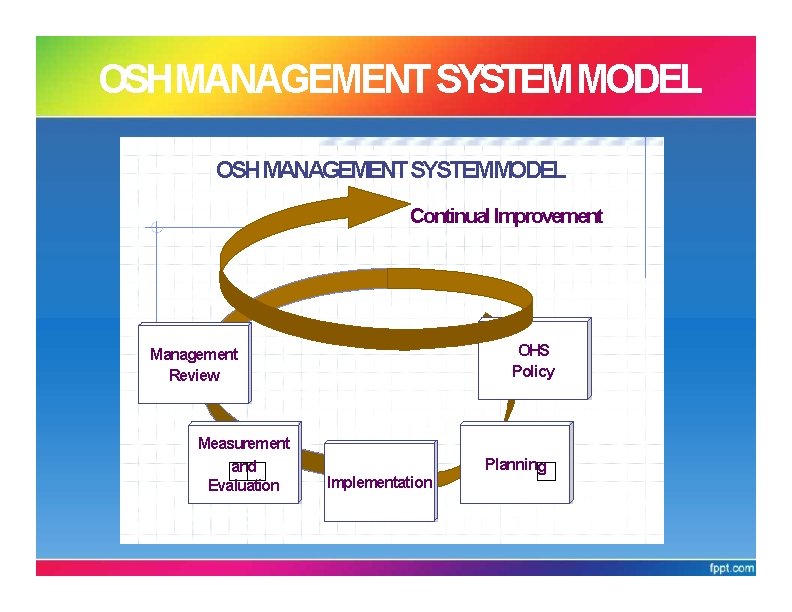
OSHMANAGEMENT SYSTEM MODEL OSHMANAGEMENTSYSTEMMODEL Continual Improvement OHS Policy Management Review Measurement and Evaluation Implementation Planning

THE END
- Slides: 63