
Chapter 2 Operations Strategy in a Global Environment
Chapter 2 Operations Strategy in a Global Environment Professor Ahmadi Slide 1
Learning Objectives DEVELOPING MISSIONS AND STRATEGIES • Mission • Strategy n DEFINING GLOBAL OPERATIONS n n • International business • Multinational corporation • Global company • Transnational company REASONS FOR GLOBALIZATION • Pros • Cons Slide 2

Learning Objectives - Continued n n n ACHIEVING COMPETITIVE ADVANTAGE THROUGH OPERATIONS • Competing on Differentiation • Competing on Cost • Competing on Response TEN STRATEGIC OM DECISIONS STAGES OF PRODUCT LIFE CYCLE • Introduction • Growth • Maturity • Decline Slide 3
Corporate Mission n A corporate mission is a set of long-range goals and including statements about: • • n the kind of business the company wants to be in who its customers are its basic beliefs about business its goals of survival, growth, and profitability Mission - where you are going Slide 4
Business Strategy n n n Business strategy is a long-range game plan of an organization and provides a road map of how to achieve the corporate mission. Inputs to the business strategy are • Assessment of global business conditions - social, economic, political, technological, competitive • Distinctive competencies or weaknesses - workers, sales force, R&D, technology, management Strategy - how you are going to get there; an action plan Slide 5
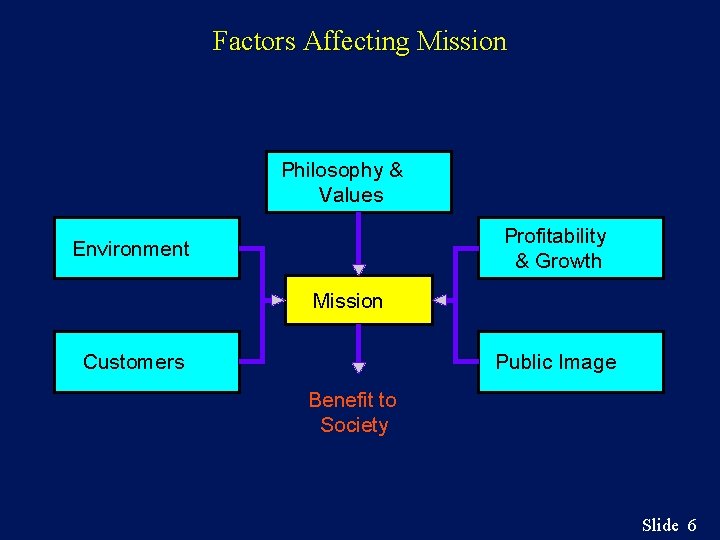
Factors Affecting Mission Philosophy & Values Profitability & Growth Environment Mission Customers Public Image Benefit to Society Slide 6
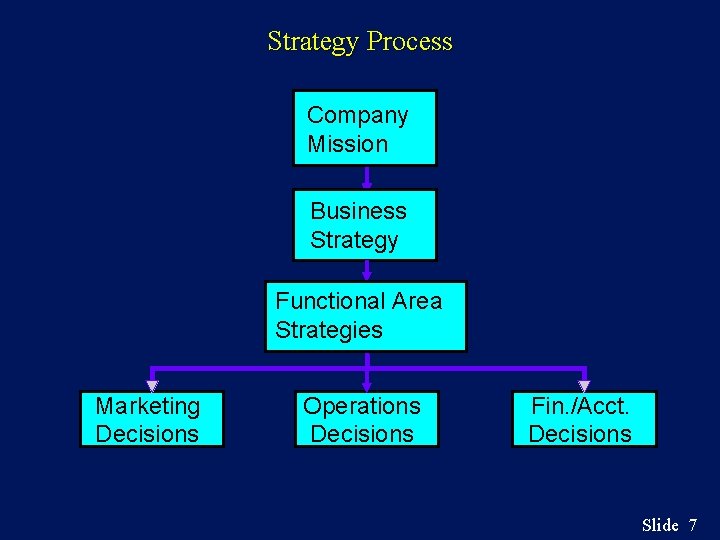
Strategy Process Company Mission Business Strategy Functional Area Strategies Marketing Decisions Operations Decisions Fin. /Acct. Decisions Slide 7
Defining Global Operations n International business - engages in cross-border transactions n Multinational Corporation - has extensive involvement in international business, owning or controlling facilities in more than one country n Global company - integrates operations from different countries, and views world as a single marketplace n Transnational company - seeks to combine the benefits of global-scale efficiencies with the benefits of local responsiveness Slide 8

Reasons to Globalize Operations Tangible n n n Intangible n Reduce costs (labor, taxes, tariffs, etc. ) Improve the supply chain Provide better goods and services Attract new markets Learn to improve operations Attract and retain global talent Slide 9
Pros and Cons of Globalization n Pros (Pluses) • Productivity grows more quickly (living standards can go up faster) • Global competition and cheap imports keep a lid on prices (inflation less likely to derail economic growth) • Open economy spurs innovation (with fresh ideas from abroad) • Export jobs often pay more than other jobs • US has more access to foreign investment (keeps interest rates low) Slide 10
Pros and Cons of Globalization n Cons (Minuses) • Millions of Americans have lost jobs due to imports or production shifts abroad • Most displaced workers find new jobs that pay less • Workers face pay-cuts demands from employers • Service and white-collar jobs are increasingly vulnerable • US employees lose their comparative advantage when companies build advanced factories abroad Slide 11
Costs reduction through globalization Maquiladoras n World Trade Organization (WTC) n North American Free Trade Agreement (NAFTA) n European Union (EU) n Slide 12
Operational Effectiveness and Competitive Advantage n n Operational effectiveness is the ability to perform similar operations activities better than competitors. It is very difficult for a company to compete successfully in the long run based just on operational effectiveness. A firm must also determine how operational effectiveness can be used to achieve a sustainable competitive advantage. An effective competitive strategy is critical. Slide 13
Strategies for Competitive Advantage n Differentiation n Cost leadership n Quick response Slide 14
10 Strategic OM Decisions n n n n n Goods & service design Quality Process & capacity design Location selection Layout design Human resource and job design Supply-chain management Inventory Scheduling Maintenance Slide 15
Stages in a Product’s Life Cycle n n Introduction- Sales begin, production and marketing are developing, profits are negative. Growth - sales grow dramatically, marketing efforts intensify, capacity is expanded, profits begin. Maturity - production focuses on high-volume, efficiency, low costs; marketing focuses on competitive sales promotion; profits are at peak. Decline - declining sales and profit; product might be dropped or replaced. Slide 16
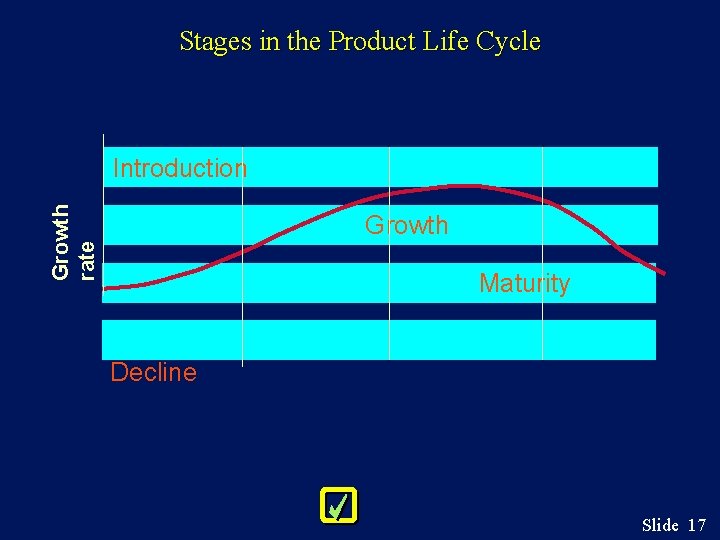
Stages in the Product Life Cycle Growth rate Introduction Growth Maturity Decline Slide 17
- Slides: 17