
Chapter 2 Notes Roots of American Democracy Page
- Slides: 20
Chapter 2 Notes Roots of American Democracy Page 28 -42
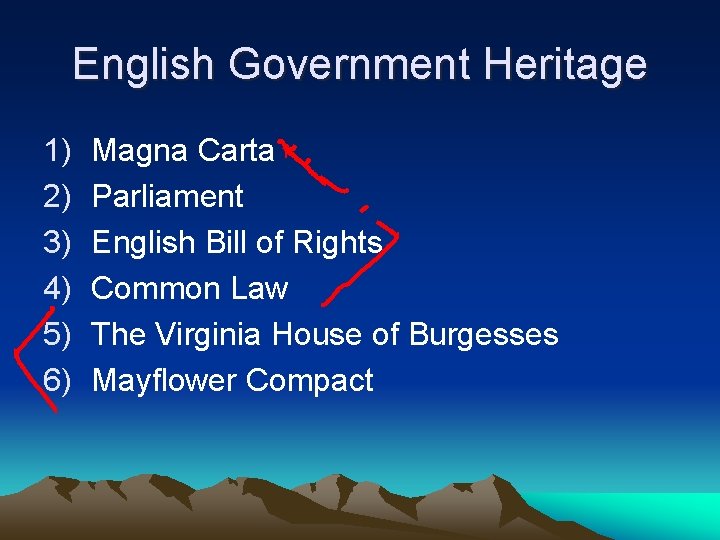
English Government Heritage 1) 2) 3) 4) 5) 6) Magna Carta Parliament English Bill of Rights Common Law The Virginia House of Burgesses Mayflower Compact
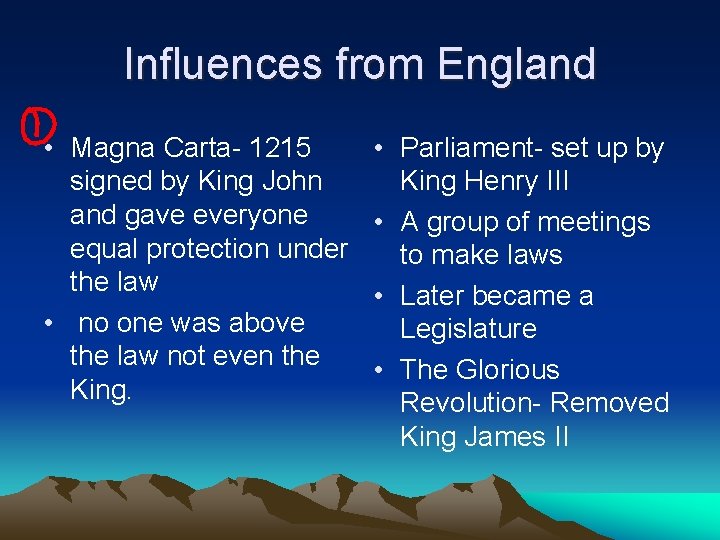
Influences from England • Magna Carta- 1215 signed by King John and gave everyone equal protection under the law • no one was above the law not even the King. • Parliament- set up by King Henry III • A group of meetings to make laws • Later became a Legislature • The Glorious Revolution- Removed King James II
Influences from England • English Bill of Rights • Was used to ensure that the King would not take the power away from the people • Common Law • Early days they had no written laws • Customs later became laws • Judges used precedent to decide cases
Early America • House of Burgesses • Jamestown, Virginia (1607) King James I allowed colonial governments • 1619, two representatives from each county were chosen to make laws • This was the first legislative in the Colonies • 1624, King Charles said that Virginia would be controlled by the Crown
Early America • The Mayflower Compact • Established on the way to America by the Pilgrims • Said that government would make “just and equal laws for the good of the community” • This set up direct democracy and majority rule
Early America • • By 1733 their were 13 colonies Each had it own government All had a governor and a legislature The legislature was modeled after the English form of government
British Action Mercantilism French and Indian War Stamp Act Townshend Act Tea Act Intolerable Act Colonial Response
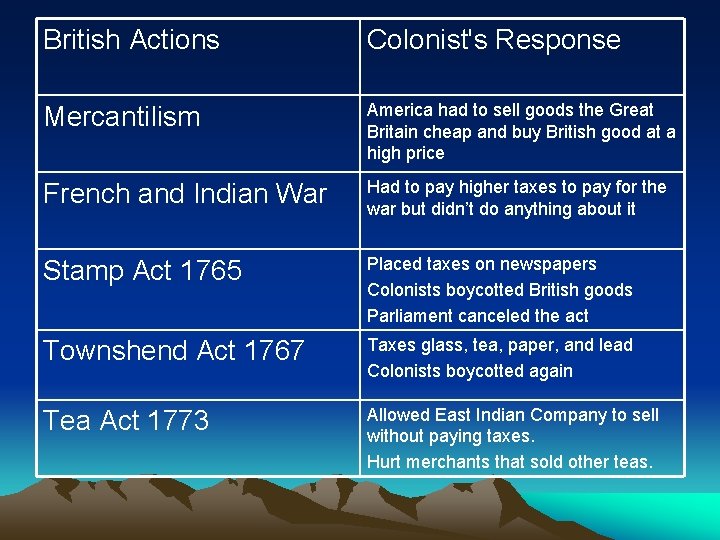
British Actions Colonist's Response Mercantilism America had to sell goods the Great Britain cheap and buy British good at a high price French and Indian War Had to pay higher taxes to pay for the war but didn’t do anything about it Stamp Act 1765 Placed taxes on newspapers Colonists boycotted British goods Parliament canceled the act Townshend Act 1767 Taxes glass, tea, paper, and lead Colonists boycotted again Tea Act 1773 Allowed East Indian Company to sell without paying taxes. Hurt merchants that sold other teas.
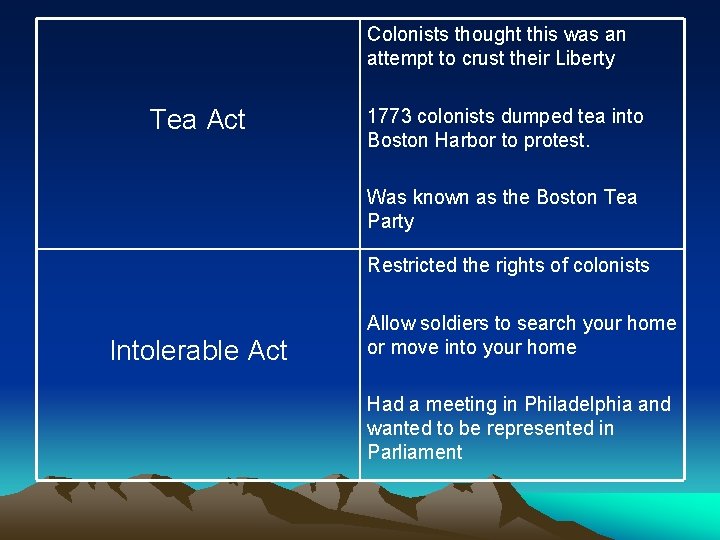
Colonists thought this was an attempt to crust their Liberty Tea Act 1773 colonists dumped tea into Boston Harbor to protest. Was known as the Boston Tea Party Restricted the rights of colonists Intolerable Act Allow soldiers to search your home or move into your home Had a meeting in Philadelphia and wanted to be represented in Parliament
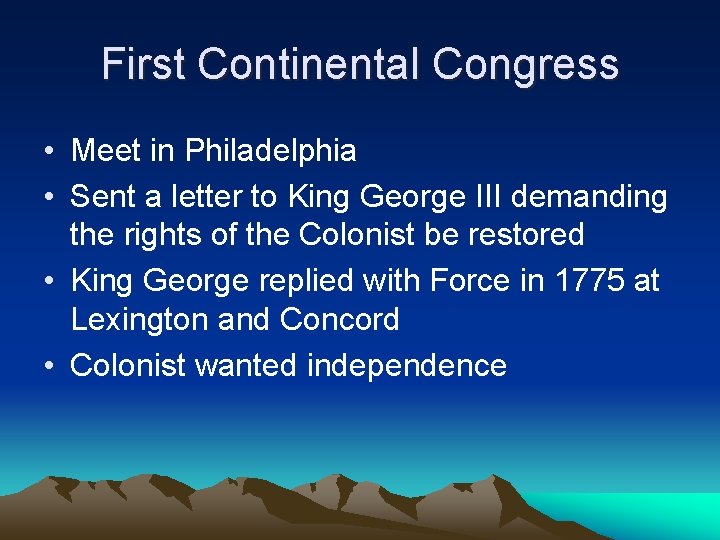
First Continental Congress • Meet in Philadelphia • Sent a letter to King George III demanding the rights of the Colonist be restored • King George replied with Force in 1775 at Lexington and Concord • Colonist wanted independence
Second Continental Congress • Meet in Philadelphia • Not everyone wanted independence because they didn’t think we could win the war • Thomas Paine inspired some with his book Common Sense
Declaration of Independence • Written by Thomas Jefferson • Explained why the US should be free • The purpose of the government is to protect the rights of the citizens • John Locke, a 17 th century philosopher, influenced Jefferson • Was signed on July 4 th, 1776
Early State Constitutions • By 1780 every state had a constitution • Most had a bicameral legislature, divided into two houses, a governor, and a court system. • Most had a Bill of Rights
Massachusetts Constitution • Last state to establish a Constitution • It is still in effect today • Divided the power among the three branches of government
Articles of Confederation • • First Constitution of the United States Had a one house legislature Did not have a single leader Did not have a court system
Weaknesses of the Articles of Confederation • • No power to tax No power to regulate trade No power to enforce laws No single leader No National Court Could not pass a law unless 9 states approved it Could not change the Articles unless all 13 states approved
A Shaky National Government • Then Nation faced financial troubles after the Revolutionary War • They could not collect taxes • They borrowed the money from the states • The states fell into debt also • The states taxed its citizens heavily and taxes goods from other nations and states which hurt trading
Shay’s Rebellion • Daniel Shay, a farmer in Massachusetts, fell into deep debt and was going to lose his farm • He didn’t think the states had a right to punish him for their problems • He led an uprising at an arsenal in Massachusetts • It was stopped but it opened people’s eyes that something needed to change • 1787 12 states sent delegates back to Philadelphia to fix the Articles of Confederation