
CHAPTER 2 Neuroscience and Behavior I NEURAL COMMUNICATION
CHAPTER 2 Neuroscience and Behavior
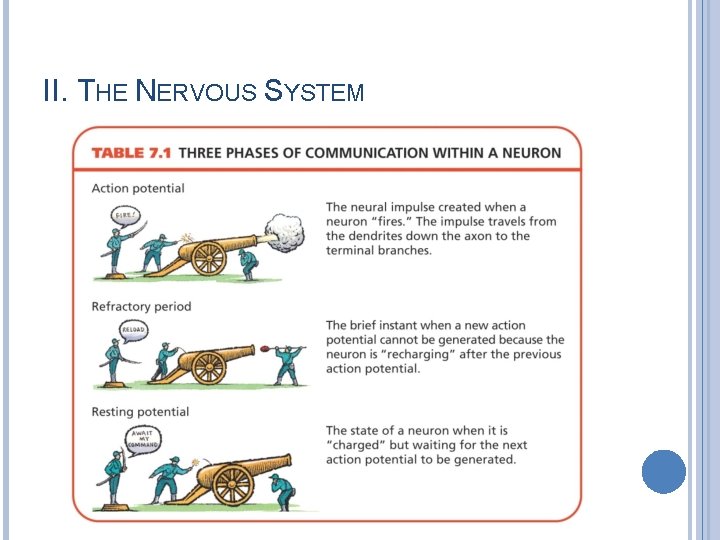
I. NEURAL COMMUNICATION Neurons – Nerve cells; Basic building block of the nervous system. � Dendrite – Bushy, branching extension that receives messages and conducts impulses toward the cell body. � Axon – Extension of a neuron, ending in branching terminal fibers, through which messages are sent to other neurons, muscles or glands. � Myelin Sheath – Layer of fatty tissues encasing the fibers of many neurons. It enables faster transmission speeds for the neural impulse. � Action Potential – Neural impulse; Brief electrical charge that travels down an axon. � Threshold – Level of stimulation required to trigger a neural impulse.

I. NEURAL COMMUNICATION
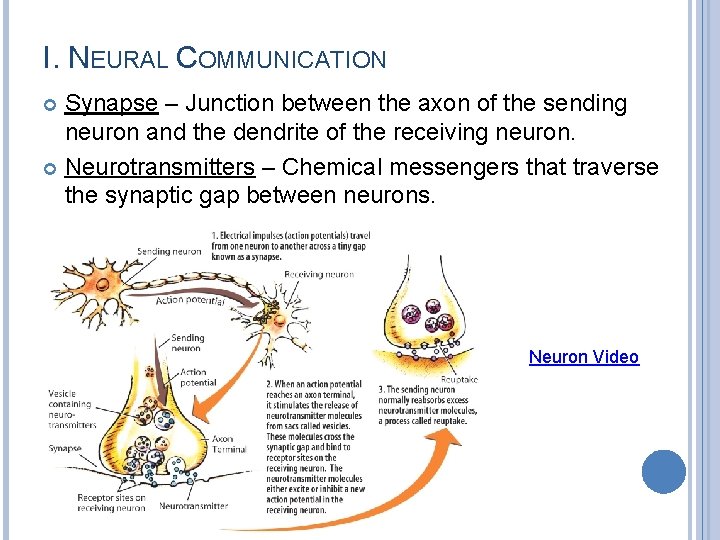
I. NEURAL COMMUNICATION Synapse – Junction between the axon of the sending neuron and the dendrite of the receiving neuron. Neurotransmitters – Chemical messengers that traverse the synaptic gap between neurons. Neuron Video
I. NEURAL COMMUNICATION Neurotransmitter’s influence � Examples of neurotransmitters Dopamine – influences movement, learning, attention and emotion Serotonin – Affects mood, hunger, sleep and arousal Norepinephrine – Control alertness and arousal Acetylcholine (ACh) – Triggers muscle contraction and, if blocked, muscles cannot contract Endorphines – Natural opiate like neurotransmitter linked to pain control � How drugs alter neurotransmission Agonist – Drug that excites by mimicking a neurotransmitter Antagonist – Drug that inhibits by blocking neurotransmitters or diminishing their release Drug and neurotransmission video
II. THE NERVOUS SYSTEM
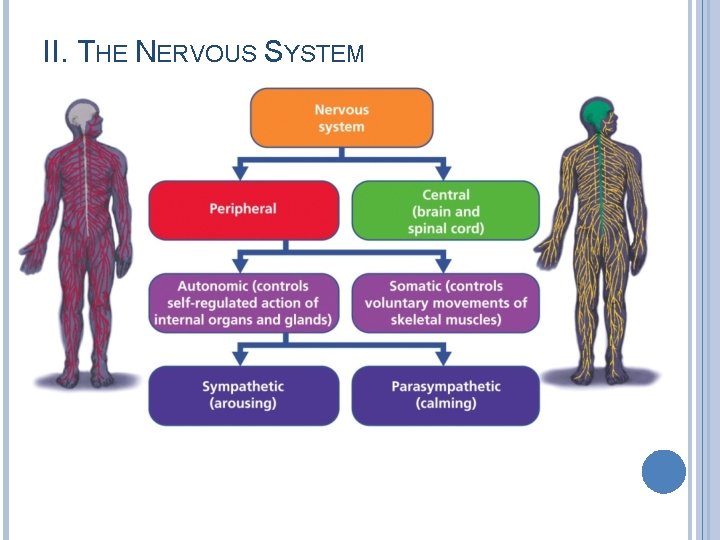
II. THE NERVOUS SYSTEM Nervous System – Body’s speedy electrochemical communication system, consisting of the central nervous system and the peripheral nervous system. (video) Types of Neurons � Sensory Neurons – Carry incoming information from the sense receptors to the central nervous system. � Interneurons – Central nervous system neurons; Internally communicate and intervene between sensory inputs and motor outputs. � Motor Neurons – Carry outgoing information from the central nervous system to the muscles and glands. (video)
II. THE NERVOUS SYSTEM
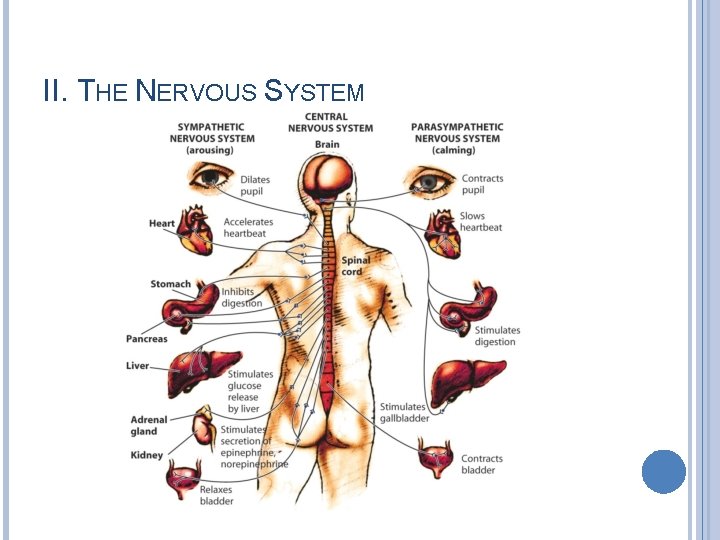
II. THE NERVOUS SYSTEM Peripheral Nervous System – The sensory and motor neurons that connect the central nervous system to the rest of the body. � Somatic nervous system – Controls the body’s skeletal muscles. � Autonomic nervous system – Controls the glands and muscles of the internal organs. Sympathetic nervous systm – Arouses the body, mobilizing its energy in stressful situations (fight or flight) Parasympathetic nervous system – Calms the body, conserving its energy
II. THE NERVOUS SYSTEM
II. THE NERVOUS SYSTEM Central Nervous System – The brain and spinal cord. � Reflexes – A simple automatic response to a sensory stimulus, such as the knee-jerk response. � Paralysis – Brain does not receive neural messages from neurons below the point of the severed spinal cord, resulting in loss of sensation. Neural Networks – Interconnected neural cells.
III. THE BRAIN Tools of Discovery � Lesion – Naturally or experimentally caused destruction of brain tissue. � Clinical observation � Manipulating the brain (ex. Magnetically stimulating the brain. ) � Recording the brain’s electrical activity (ex. EEG) � Neuroimaging techniques CT Scan (Computed Tomography PET Scan (Positron Emission Tomography) MRI (Magnetic Resonance Imaging)
III. THE BRAIN (VIDEO) Brain Structures Brainstem – Central core of the brain, beginning where the spinal cord swells as it enters the skull. Responsible for automatic survival functions. (Medulla and Reticular Formation) � Thalamus – Brain’s sensory switchboard that directs messages to the sensory receiving areas of the cortex and transmits replies to the cerebellum and medulla. � Cerebellum – Helps coordinate voluntary movement and balance. � Limbic System � Amygdala – Almond shaped neural clusters linked to emotion. Hypothalamus – Directs maintenance activities (eating, drinking, body temperature), governs the endocrine system and is linked to emotion.
III. THE BRAIN Brain Structures � Cerebral Cortex – Ultimate control and information processing center (like bark on a tree). Glial cells – Cells in the nervous system that nourish and protect neurons. Frontal lobes – Involved in speaking and movement and making plans and judgment. Parietal lobes – Includes the sensory cortex. Occipital lobes – Includes visual areas which receive information from the opposite visual field. Temporal lobes – Includes auditory areas, receive information from the opposite ear.
III. THE BRAIN Brain Structures � Functions of the cortex Motor cortex – An area at the rear of the front lobes that controls voluntary movements. Sensory cortex – An area at the front of the parietal lobes that registers and processes body sensations. Association areas – Higher mental functions such as learning, remembering, thinking and language. Aphasia – Impairment of language caused by damage to Broca’s Area or Wernicke’s Area Broca’s area – Area that directs the muscle movements involved in speech. (video) Wernicke’s area – Involved in language comprehension and expression located in the temporal lobe. (video) Plasticity – Brain’s capacity for modification.
III. THE BRAIN Our Divided Brain � Splitting the brain Corpus callosum – Large band of neural fibers connecting the two brain hemispheres and carrying messages between them. Split brains – Condition in which the corpus callosum is severed, leaving the two hemispheres isolated. (video) � Hemispheric differences Left – quick, literal interpretation of language Right – excels in making subtle inferences
IV. ENDOCRINE SYSTEM Endocrine system – A set of glands that secrete hormones into the bloodstream. Hormones – Chemical messengers, mostly those manufactured by the endocrine glands, that are produced in one tissue and affect another. Adrenal glands – Pair of glands that secrete the hormones epinephrine (adrenaline) and nor-epinephrine, which help to arouse the body in times of stress. Pituitary gland – Most influential gland, under the influence of the hypothalamus, that regulates growth and controls the other glands. Neurotransmitters are released by neurons and hormones are released by glands.
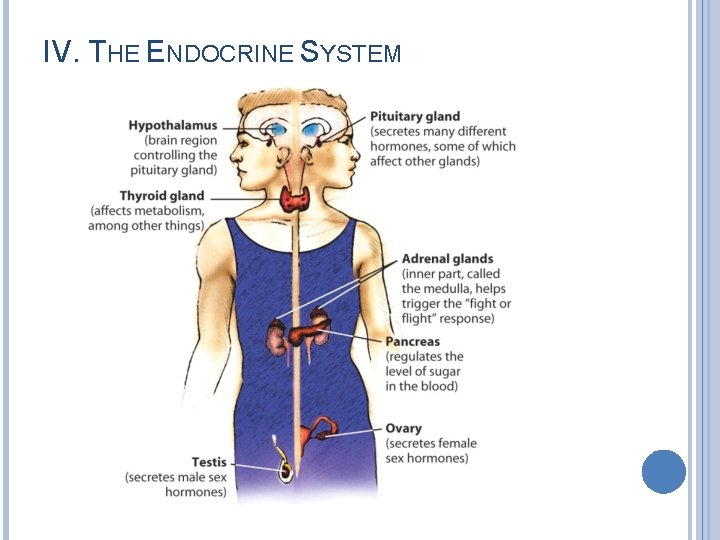
IV. THE ENDOCRINE SYSTEM
- Slides: 18