
Chapter 2 Measurements and Calculations Chapter 2 Table
Chapter 2 Measurements and Calculations
Chapter 2 Table of Contents 2. 1 2. 2 2. 3 2. 4 2. 5 2. 6 2. 7 2. 8 Scientific Notation Units Measurements of Length, Volume, and Mass Uncertainty in Measurement Significant Figures Problem Solving and Dimensional Analysis Temperature Conversions: An Approach to Problem Solving Density Return to TOC Copyright © Cengage Learning. All rights reserved
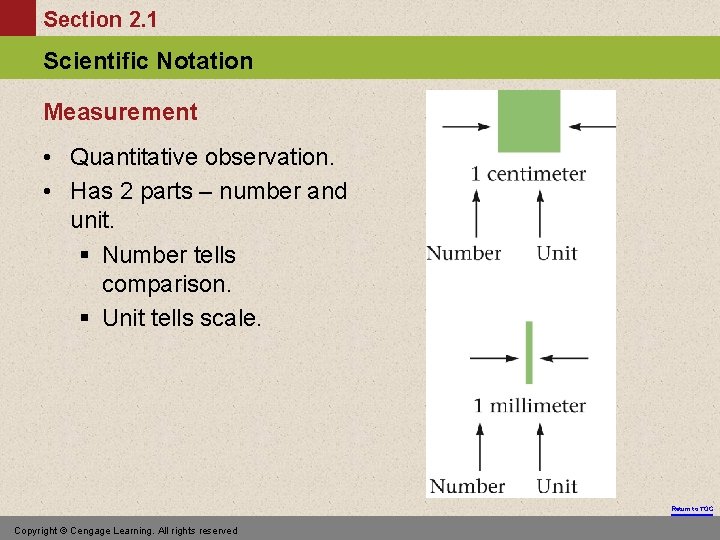
Section 2. 1 Scientific Notation Measurement • Quantitative observation. • Has 2 parts – number and unit. § Number tells comparison. § Unit tells scale. Return to TOC Copyright © Cengage Learning. All rights reserved
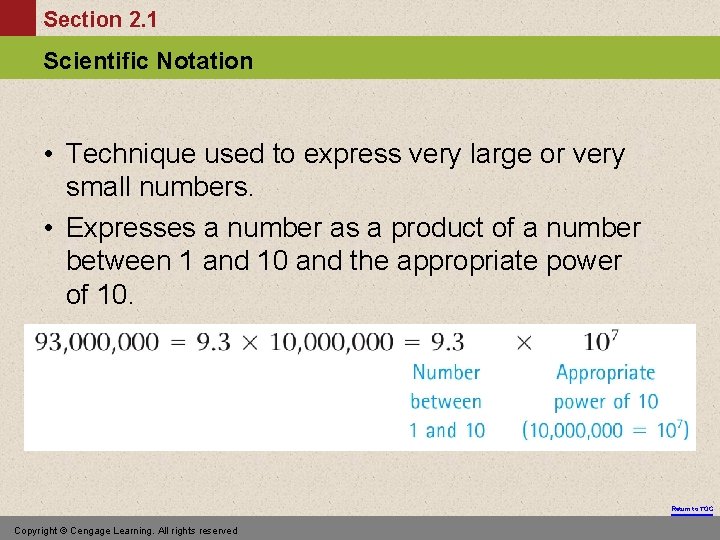
Section 2. 1 Scientific Notation • Technique used to express very large or very small numbers. • Expresses a number as a product of a number between 1 and 10 and the appropriate power of 10. Return to TOC Copyright © Cengage Learning. All rights reserved
Section 2. 1 Scientific Notation Using Scientific Notation • Any number can be represented as the product of a number between 1 and 10 and a power of 10 (either positive or negative). • The power of 10 depends on the number of places the decimal point is moved and in which direction. Return to TOC Copyright © Cengage Learning. All rights reserved
Section 2. 1 Scientific Notation Using Scientific Notation • The number of places the decimal point is moved determines the power of 10. The direction of the move determines whether the power of 10 is positive or negative. Return to TOC Copyright © Cengage Learning. All rights reserved
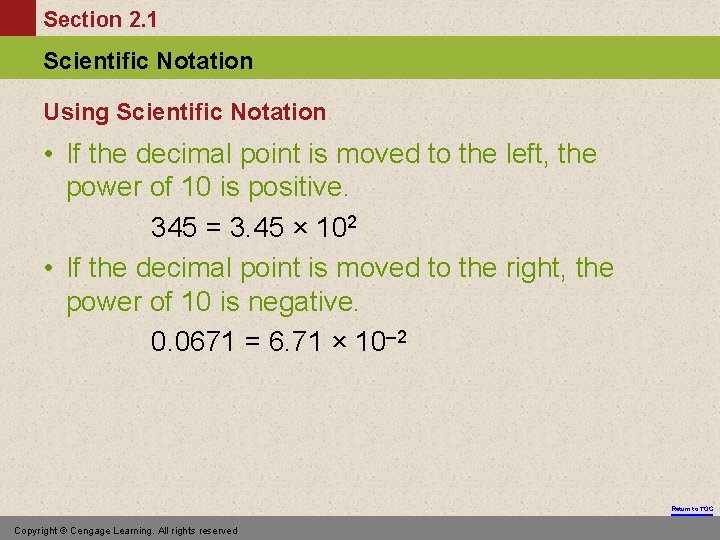
Section 2. 1 Scientific Notation Using Scientific Notation • If the decimal point is moved to the left, the power of 10 is positive. 345 = 3. 45 × 102 • If the decimal point is moved to the right, the power of 10 is negative. 0. 0671 = 6. 71 × 10– 2 Return to TOC Copyright © Cengage Learning. All rights reserved
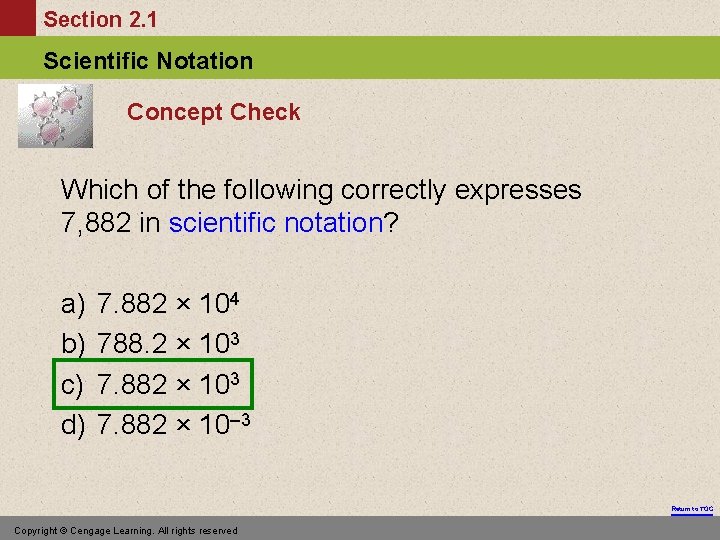
Section 2. 1 Scientific Notation Concept Check Which of the following correctly expresses 7, 882 in scientific notation? a) b) c) d) 7. 882 × 104 788. 2 × 10³ 7. 882 × 10– 3 Return to TOC Copyright © Cengage Learning. All rights reserved
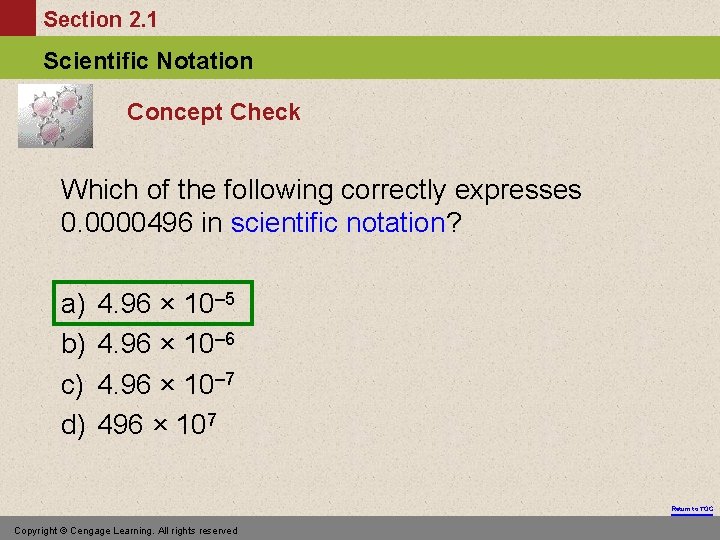
Section 2. 1 Scientific Notation Concept Check Which of the following correctly expresses 0. 0000496 in scientific notation? a) b) c) d) 4. 96 × 10– 5 4. 96 × 10– 6 4. 96 × 10– 7 496 × 107 Return to TOC Copyright © Cengage Learning. All rights reserved
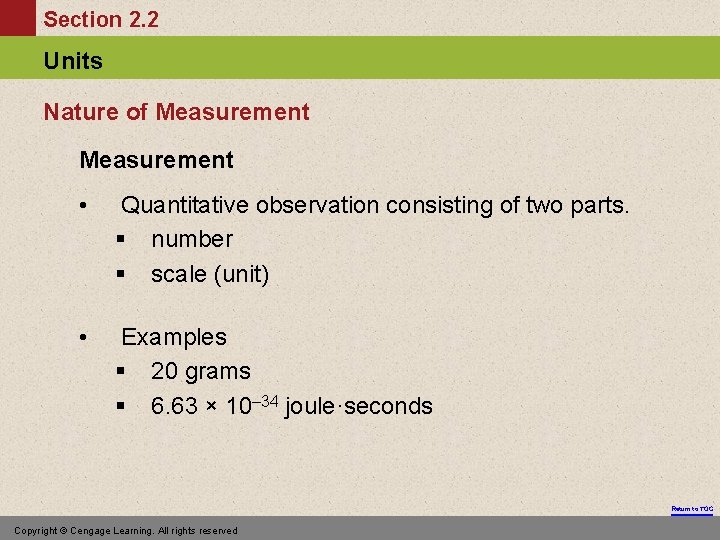
Section 2. 2 Units Nature of Measurement • Quantitative observation consisting of two parts. § number § scale (unit) • Examples § 20 grams § 6. 63 × 10– 34 joule·seconds Return to TOC Copyright © Cengage Learning. All rights reserved
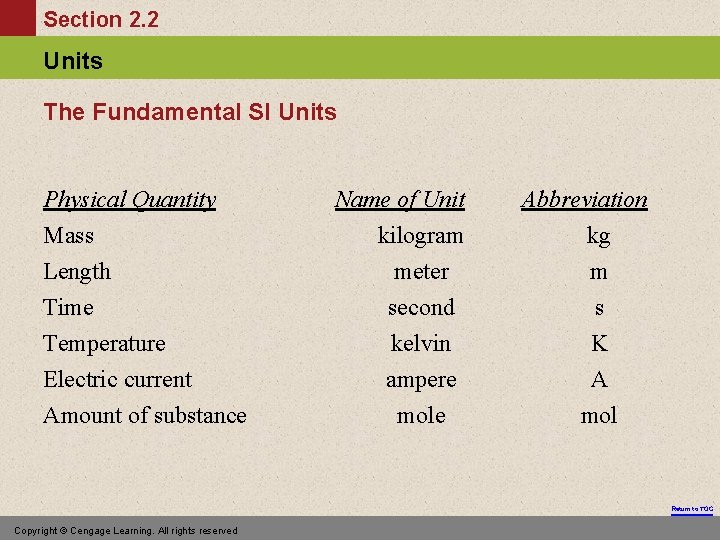
Section 2. 2 Units The Fundamental SI Units Physical Quantity Mass Length Time Temperature Electric current Amount of substance Name of Unit kilogram meter second kelvin ampere mole Abbreviation kg m s K A mol Return to TOC Copyright © Cengage Learning. All rights reserved
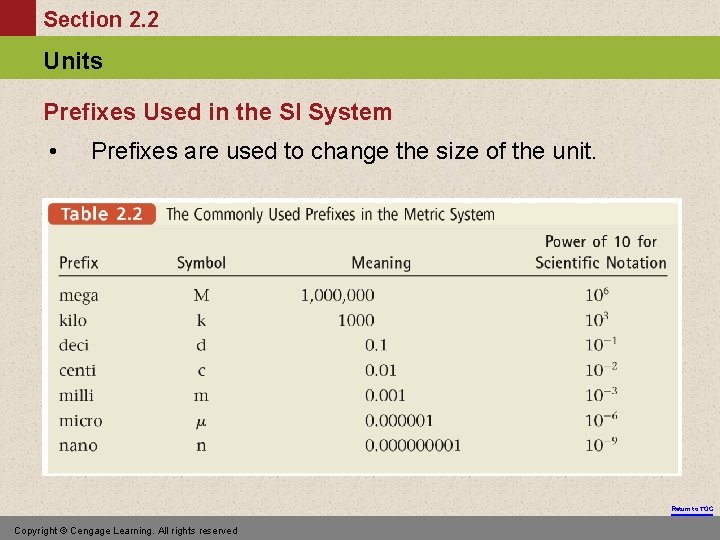
Section 2. 2 Units Prefixes Used in the SI System • Prefixes are used to change the size of the unit. Return to TOC Copyright © Cengage Learning. All rights reserved
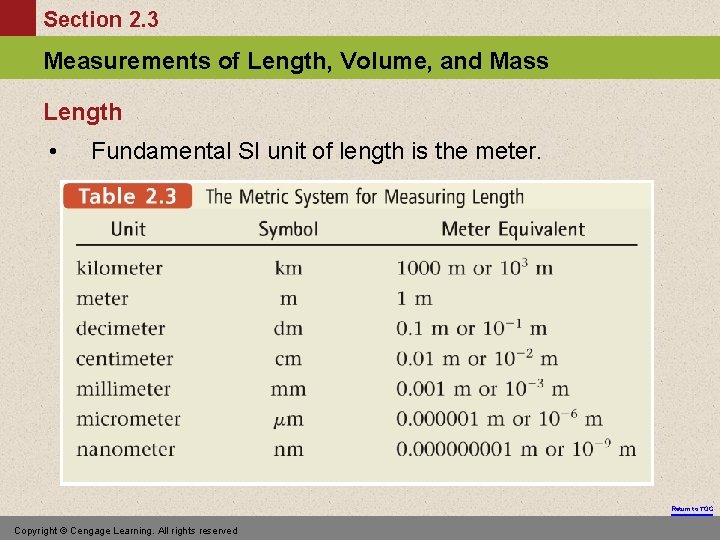
Section 2. 3 Measurements of Length, Volume, and Mass Length • Fundamental SI unit of length is the meter. Return to TOC Copyright © Cengage Learning. All rights reserved
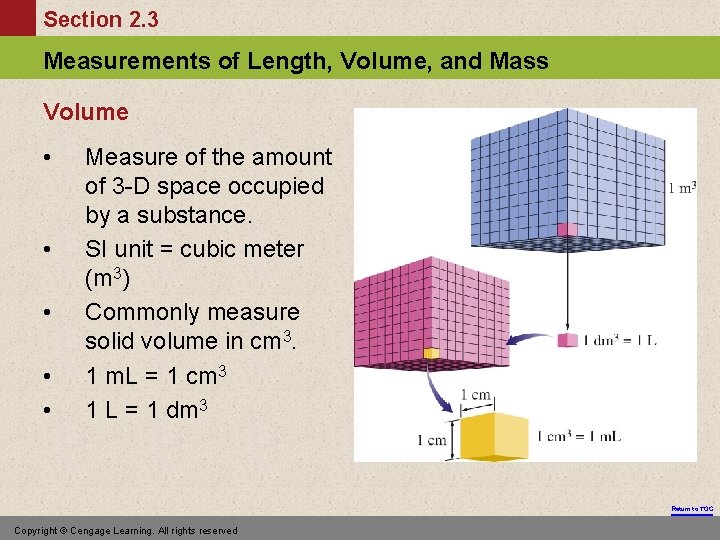
Section 2. 3 Measurements of Length, Volume, and Mass Volume • • • Measure of the amount of 3 -D space occupied by a substance. SI unit = cubic meter (m 3) Commonly measure solid volume in cm 3. 1 m. L = 1 cm 3 1 L = 1 dm 3 Return to TOC Copyright © Cengage Learning. All rights reserved
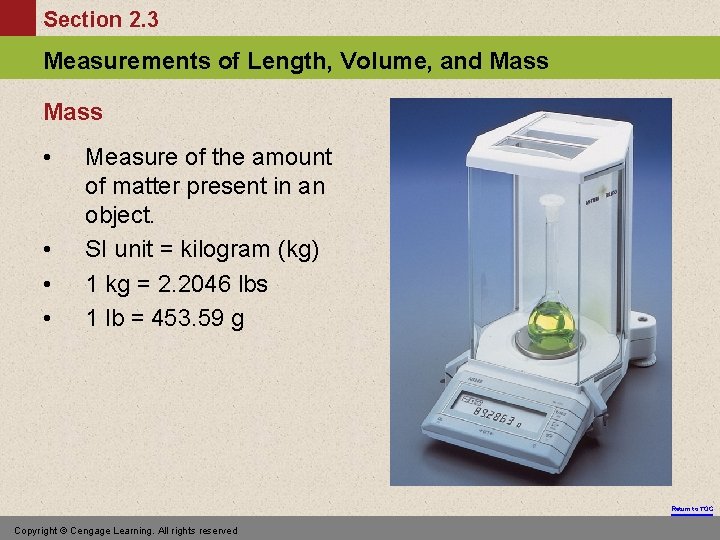
Section 2. 3 Measurements of Length, Volume, and Mass • • Measure of the amount of matter present in an object. SI unit = kilogram (kg) 1 kg = 2. 2046 lbs 1 lb = 453. 59 g Return to TOC Copyright © Cengage Learning. All rights reserved
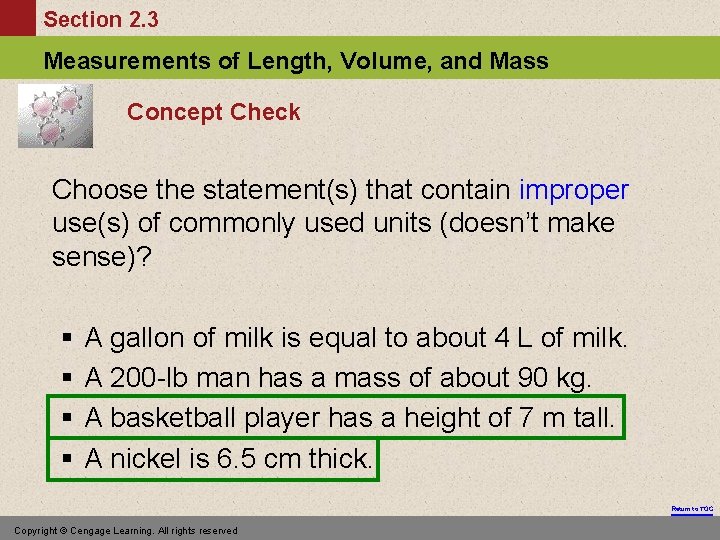
Section 2. 3 Measurements of Length, Volume, and Mass Concept Check Choose the statement(s) that contain improper use(s) of commonly used units (doesn’t make sense)? § § A gallon of milk is equal to about 4 L of milk. A 200 -lb man has a mass of about 90 kg. A basketball player has a height of 7 m tall. A nickel is 6. 5 cm thick. Return to TOC Copyright © Cengage Learning. All rights reserved
Section 2. 4 Uncertainty in Measurement • • • A digit that must be estimated is called uncertain. A measurement always has some degree of uncertainty. Record the certain digits and the first uncertain digit (the estimated number). Return to TOC Copyright © Cengage Learning. All rights reserved
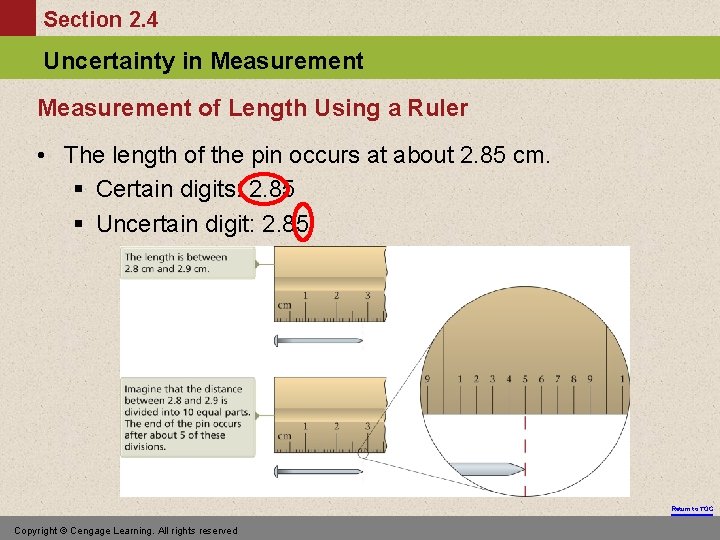
Section 2. 4 Uncertainty in Measurement of Length Using a Ruler • The length of the pin occurs at about 2. 85 cm. § Certain digits: 2. 85 § Uncertain digit: 2. 85 Return to TOC Copyright © Cengage Learning. All rights reserved
Section 2. 5 Significant Figures Rules for Counting Significant Figures 1. Nonzero integers always count as significant figures. § 3456 has 4 sig figs (significant figures). Return to TOC Copyright © Cengage Learning. All rights reserved
Section 2. 5 Significant Figures Rules for Counting Significant Figures • There are three classes of zeros. a. Leading zeros are zeros that precede all the nonzero digits. These do not count as significant figures. § 0. 048 has 2 sig figs. Return to TOC Copyright © Cengage Learning. All rights reserved
Section 2. 5 Significant Figures Rules for Counting Significant Figures b. Captive zeros are zeros between nonzero digits. These always count as significant figures. § 16. 07 has 4 sig figs. Return to TOC Copyright © Cengage Learning. All rights reserved
Section 2. 5 Significant Figures Rules for Counting Significant Figures c. Trailing zeros are zeros at the right end of the number. They are significant only if the number contains a decimal point. § § 9. 300 has 4 sig figs. 150 has 2 sig figs. Return to TOC Copyright © Cengage Learning. All rights reserved
Section 2. 5 Significant Figures Rules for Counting Significant Figures 3. Exact numbers have an infinite number of significant figures. § § 1 inch = 2. 54 cm, exactly. 9 pencils (obtained by counting). Return to TOC Copyright © Cengage Learning. All rights reserved
Section 2. 5 Significant Figures Exponential Notation • Example § § • 300. written as 3. 00 × 102 Contains three significant figures. Two Advantages § § Number of significant figures can be easily indicated. Fewer zeros are needed to write a very large or very small number. Return to TOC Copyright © Cengage Learning. All rights reserved
Section 2. 5 Significant Figures Rules for Rounding Off 1. If the digit to be removed is less than 5, the preceding digit stays the same. § 5. 64 rounds to 5. 6 (if final result to 2 sig figs) Return to TOC Copyright © Cengage Learning. All rights reserved
Section 2. 5 Significant Figures Rules for Rounding Off 1. If the digit to be removed is equal to or greater than 5, the preceding digit is increased by 1. § § 5. 68 rounds to 5. 7 (if final result to 2 sig figs) 3. 861 rounds to 3. 9 (if final result to 2 sig figs) Return to TOC Copyright © Cengage Learning. All rights reserved
Section 2. 5 Significant Figures Rules for Rounding Off 2. In a series of calculations, carry the extra digits through to the final result and then round off. This means that you should carry all of the digits that show on your calculator until you arrive at the final number (the answer) and then round off, using the procedures in Rule 1. Return to TOC Copyright © Cengage Learning. All rights reserved
Section 2. 5 Significant Figures in Mathematical Operations 1. For multiplication or division, the number of significant figures in the result is the same as that in the measurement with the smallest number of significant figures. 1. 342 × 5. 5 = 7. 381 7. 4 Return to TOC Copyright © Cengage Learning. All rights reserved
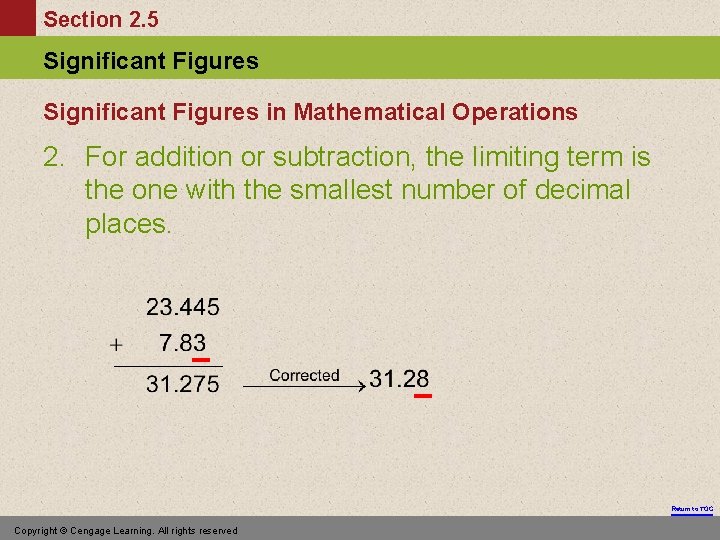
Section 2. 5 Significant Figures in Mathematical Operations 2. For addition or subtraction, the limiting term is the one with the smallest number of decimal places. Return to TOC Copyright © Cengage Learning. All rights reserved
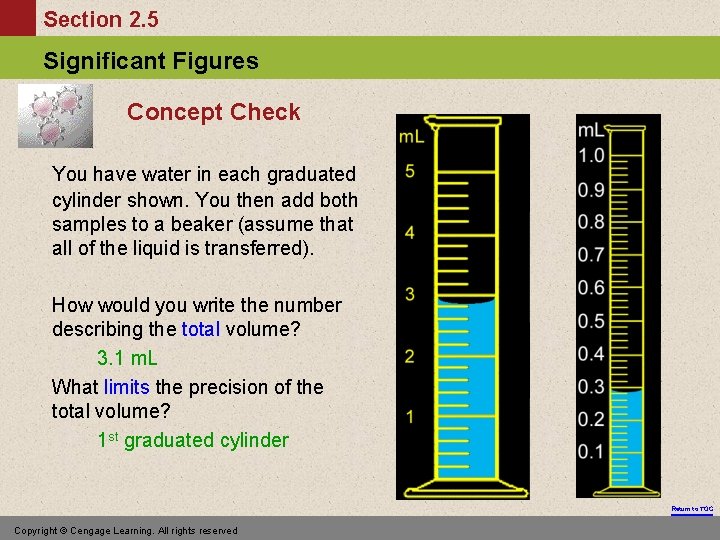
Section 2. 5 Significant Figures Concept Check You have water in each graduated cylinder shown. You then add both samples to a beaker (assume that all of the liquid is transferred). How would you write the number describing the total volume? 3. 1 m. L What limits the precision of the total volume? 1 st graduated cylinder Return to TOC Copyright © Cengage Learning. All rights reserved
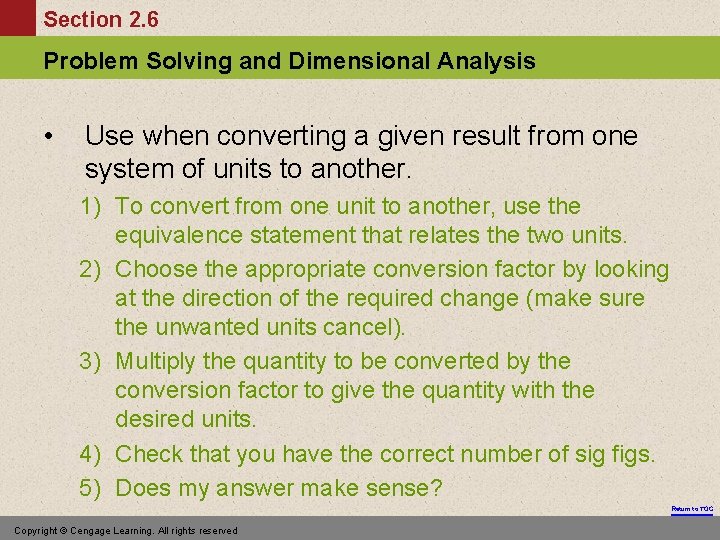
Section 2. 6 Problem Solving and Dimensional Analysis • Use when converting a given result from one system of units to another. 1) To convert from one unit to another, use the equivalence statement that relates the two units. 2) Choose the appropriate conversion factor by looking at the direction of the required change (make sure the unwanted units cancel). 3) Multiply the quantity to be converted by the conversion factor to give the quantity with the desired units. 4) Check that you have the correct number of sig figs. 5) Does my answer make sense? Return to TOC Copyright © Cengage Learning. All rights reserved
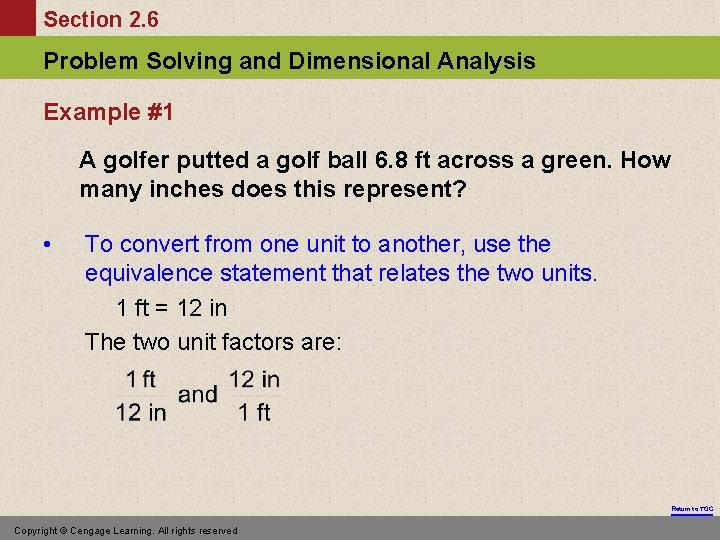
Section 2. 6 Problem Solving and Dimensional Analysis Example #1 A golfer putted a golf ball 6. 8 ft across a green. How many inches does this represent? • To convert from one unit to another, use the equivalence statement that relates the two units. 1 ft = 12 in The two unit factors are: Return to TOC Copyright © Cengage Learning. All rights reserved
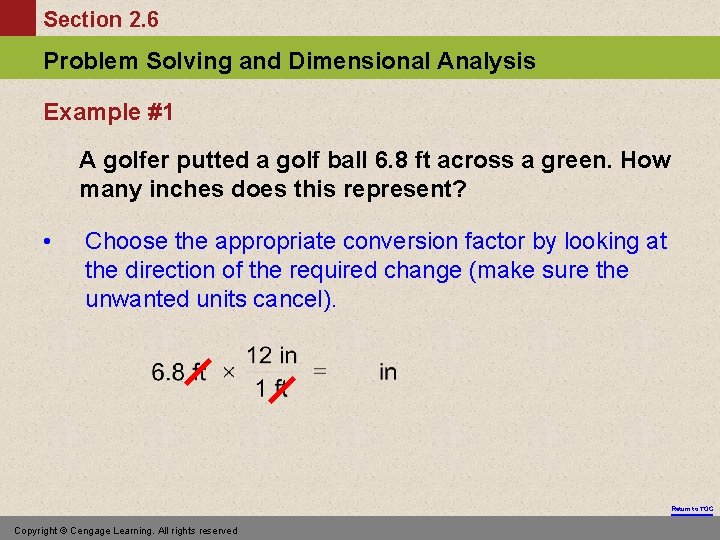
Section 2. 6 Problem Solving and Dimensional Analysis Example #1 A golfer putted a golf ball 6. 8 ft across a green. How many inches does this represent? • Choose the appropriate conversion factor by looking at the direction of the required change (make sure the unwanted units cancel). Return to TOC Copyright © Cengage Learning. All rights reserved
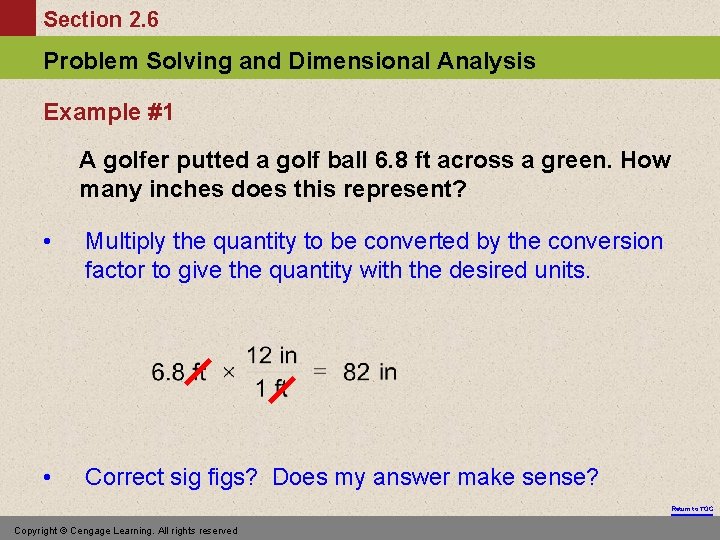
Section 2. 6 Problem Solving and Dimensional Analysis Example #1 A golfer putted a golf ball 6. 8 ft across a green. How many inches does this represent? • Multiply the quantity to be converted by the conversion factor to give the quantity with the desired units. • Correct sig figs? Does my answer make sense? Return to TOC Copyright © Cengage Learning. All rights reserved
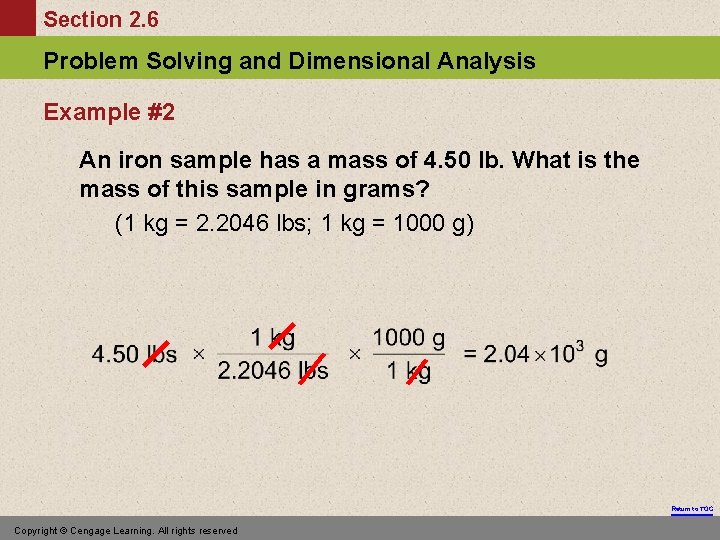
Section 2. 6 Problem Solving and Dimensional Analysis Example #2 An iron sample has a mass of 4. 50 lb. What is the mass of this sample in grams? (1 kg = 2. 2046 lbs; 1 kg = 1000 g) Return to TOC Copyright © Cengage Learning. All rights reserved
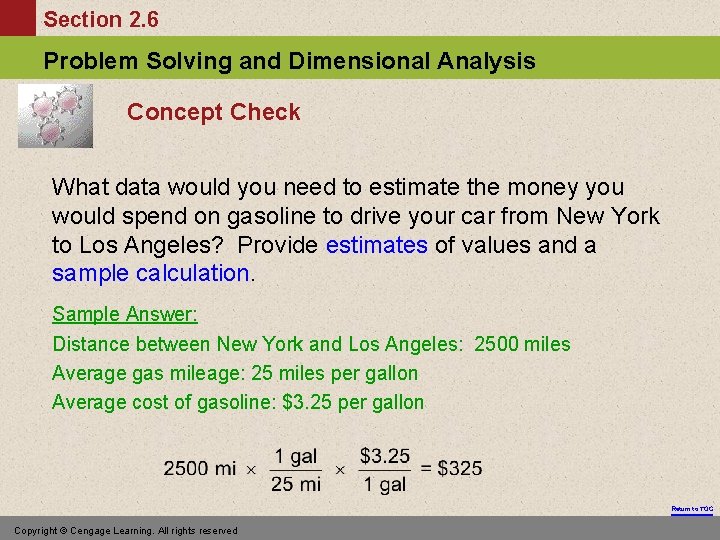
Section 2. 6 Problem Solving and Dimensional Analysis Concept Check What data would you need to estimate the money you would spend on gasoline to drive your car from New York to Los Angeles? Provide estimates of values and a sample calculation. Sample Answer: Distance between New York and Los Angeles: 2500 miles Average gas mileage: 25 miles per gallon Average cost of gasoline: $3. 25 per gallon Return to TOC Copyright © Cengage Learning. All rights reserved
Section 2. 7 Temperature Conversions: An Approach to Problem Solving Three Systems for Measuring Temperature • • • Fahrenheit Celsius Kelvin Return to TOC Copyright © Cengage Learning. All rights reserved
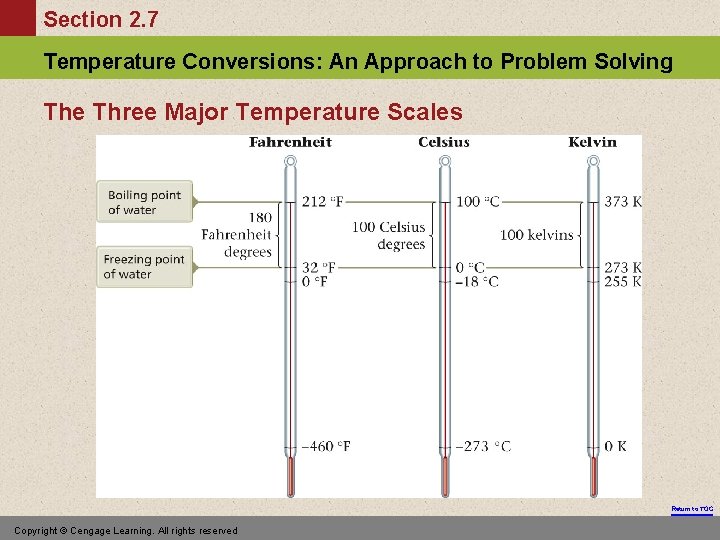
Section 2. 7 Temperature Conversions: An Approach to Problem Solving The Three Major Temperature Scales Return to TOC Copyright © Cengage Learning. All rights reserved
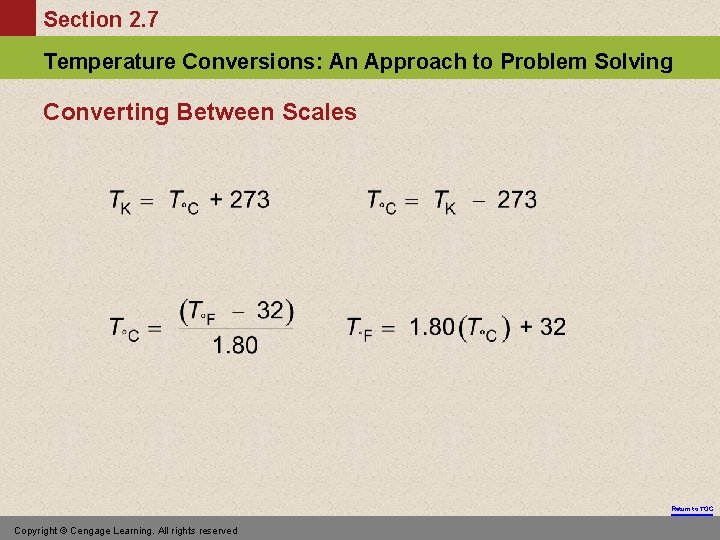
Section 2. 7 Temperature Conversions: An Approach to Problem Solving Converting Between Scales Return to TOC Copyright © Cengage Learning. All rights reserved
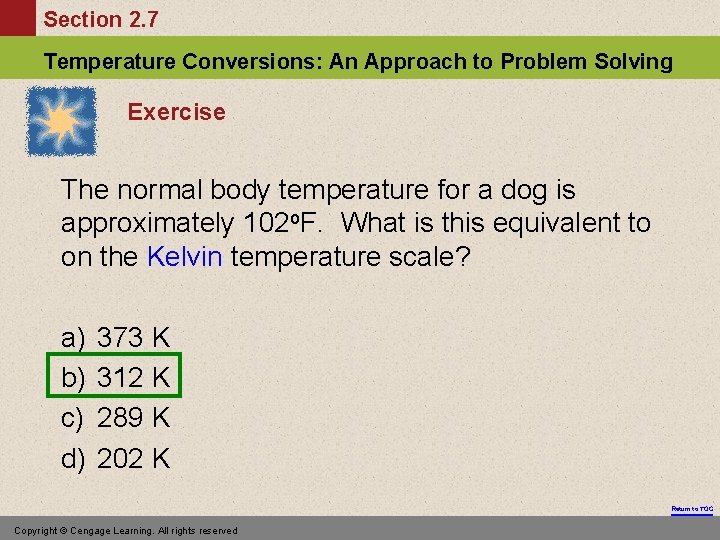
Section 2. 7 Temperature Conversions: An Approach to Problem Solving Exercise The normal body temperature for a dog is approximately 102 o. F. What is this equivalent to on the Kelvin temperature scale? a) b) c) d) 373 K 312 K 289 K 202 K Return to TOC Copyright © Cengage Learning. All rights reserved
Section 2. 7 Temperature Conversions: An Approach to Problem Solving Exercise At what temperature does C = F? Return to TOC Copyright © Cengage Learning. All rights reserved
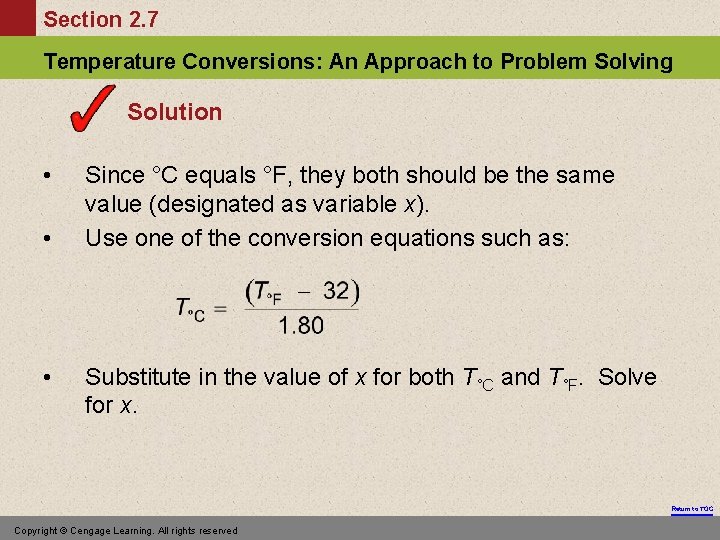
Section 2. 7 Temperature Conversions: An Approach to Problem Solving Solution • • • Since °C equals °F, they both should be the same value (designated as variable x). Use one of the conversion equations such as: Substitute in the value of x for both T°C and T°F. Solve for x. Return to TOC Copyright © Cengage Learning. All rights reserved
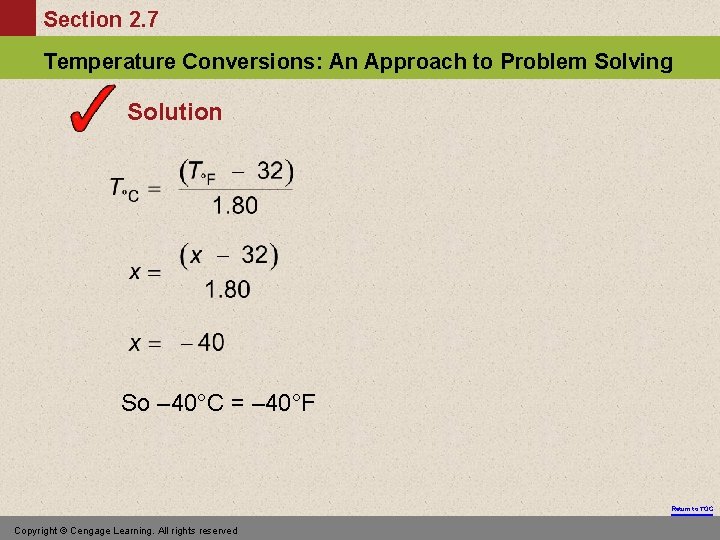
Section 2. 7 Temperature Conversions: An Approach to Problem Solving Solution So – 40°C = – 40°F Return to TOC Copyright © Cengage Learning. All rights reserved
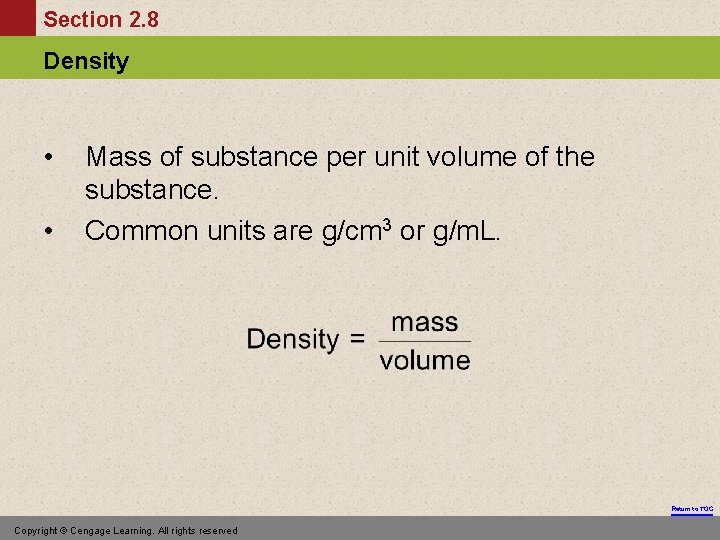
Section 2. 8 Density • • Mass of substance per unit volume of the substance. Common units are g/cm 3 or g/m. L. Return to TOC Copyright © Cengage Learning. All rights reserved
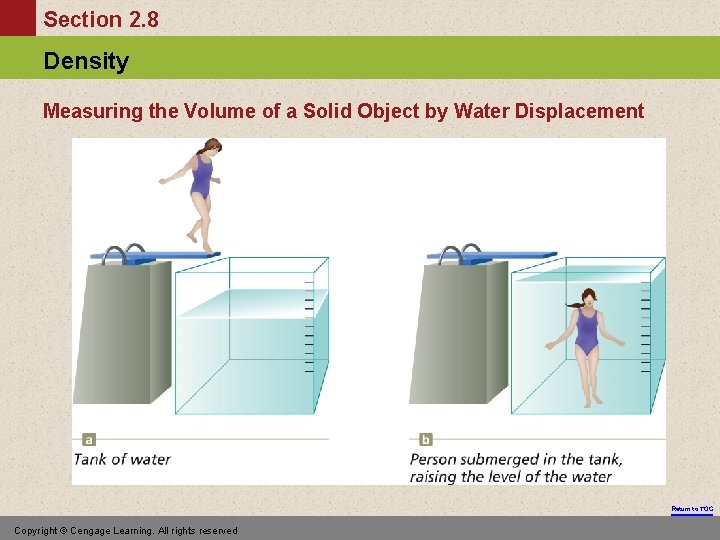
Section 2. 8 Density Measuring the Volume of a Solid Object by Water Displacement Return to TOC Copyright © Cengage Learning. All rights reserved
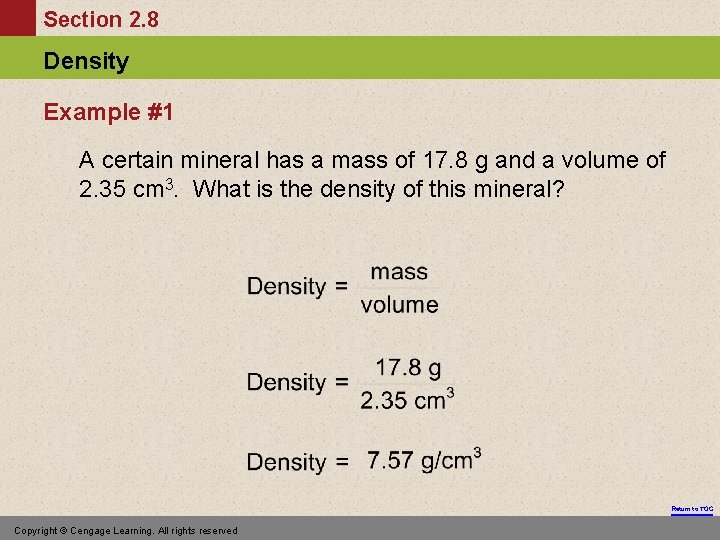
Section 2. 8 Density Example #1 A certain mineral has a mass of 17. 8 g and a volume of 2. 35 cm 3. What is the density of this mineral? Return to TOC Copyright © Cengage Learning. All rights reserved
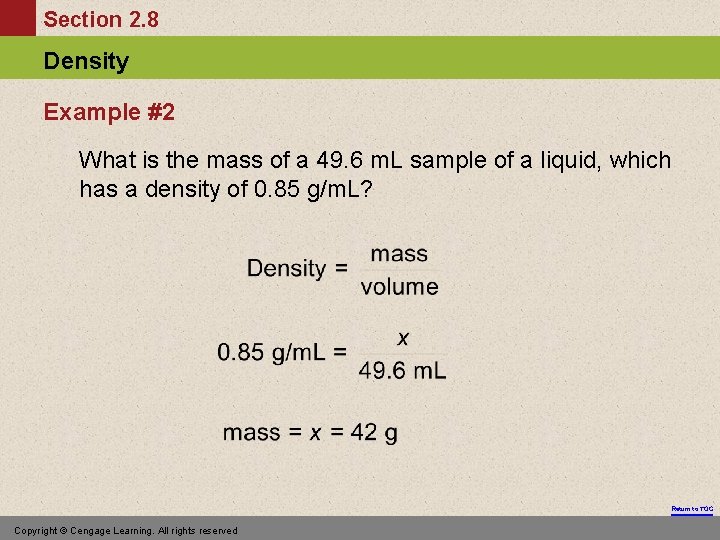
Section 2. 8 Density Example #2 What is the mass of a 49. 6 m. L sample of a liquid, which has a density of 0. 85 g/m. L? Return to TOC Copyright © Cengage Learning. All rights reserved
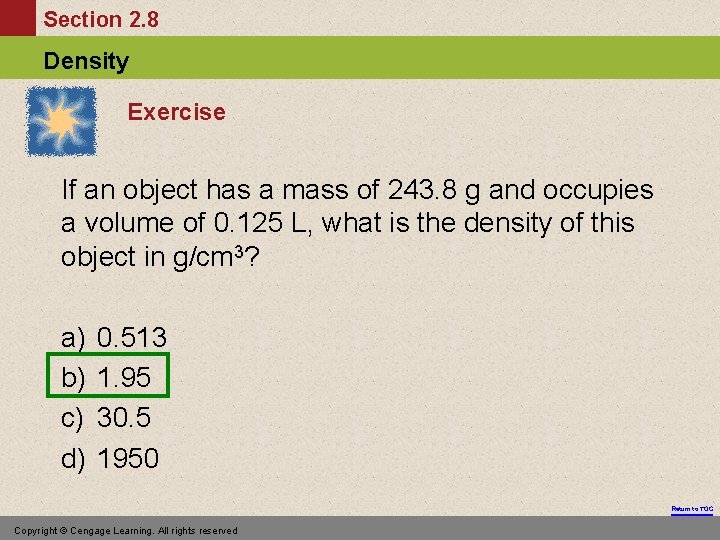
Section 2. 8 Density Exercise If an object has a mass of 243. 8 g and occupies a volume of 0. 125 L, what is the density of this object in g/cm 3? a) b) c) d) 0. 513 1. 95 30. 5 1950 Return to TOC Copyright © Cengage Learning. All rights reserved
Section 2. 8 Density Concept Check Copper has a density of 8. 96 g/cm 3. If 75. 0 g of copper is added to 50. 0 m. L of water in a graduated cylinder, to what volume reading will the water level in the cylinder rise? a) b) c) d) 8. 4 m. L 41. 6 m. L 58. 4 m. L 83. 7 m. L Copyright © Cengage Learning. All rights reserved Return to TOC
- Slides: 49