
Chapter 2 Meaning as Sign Semiology the study
- Slides: 21
Chapter 2 Meaning as Sign
• Semiology = the study of signs & symbols • (also known as: the study of meaning) • Language can have meaning in two ways: 1 -what it says – encoded sign – (Semantics) 2 - what it does in context – action – (Pragmatics)
The linguistic sign • Human’s unique capacity to create ‘signs’ to communicate. • Sign = signifier + signified 1 - Signifier: sound or word (e. g. rose) 2 - Signified: concept or object or idea • Sign ‘refers to the relationship between the two’ • Clip
• The linguistic sign is ‘arbitrary’ – Arbitrary: subject to individual will, preference, or judgment - not to laws • i. e. there is no direct relation bet the signifier and signified. – e. g. ‘table’ for both English and German speakers
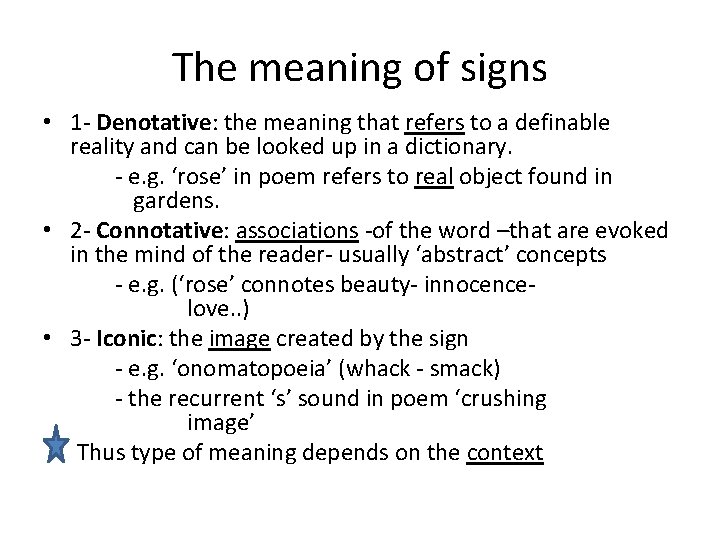
The meaning of signs • 1 - Denotative: the meaning that refers to a definable reality and can be looked up in a dictionary. - e. g. ‘rose’ in poem refers to real object found in gardens. • 2 - Connotative: associations -of the word –that are evoked in the mind of the reader- usually ‘abstract’ concepts - e. g. (‘rose’ connotes beauty- innocencelove. . ) • 3 - Iconic: the image created by the sign - e. g. ‘onomatopoeia’ (whack - smack) - the recurrent ‘s’ sound in poem ‘crushing image’ Thus type of meaning depends on the context
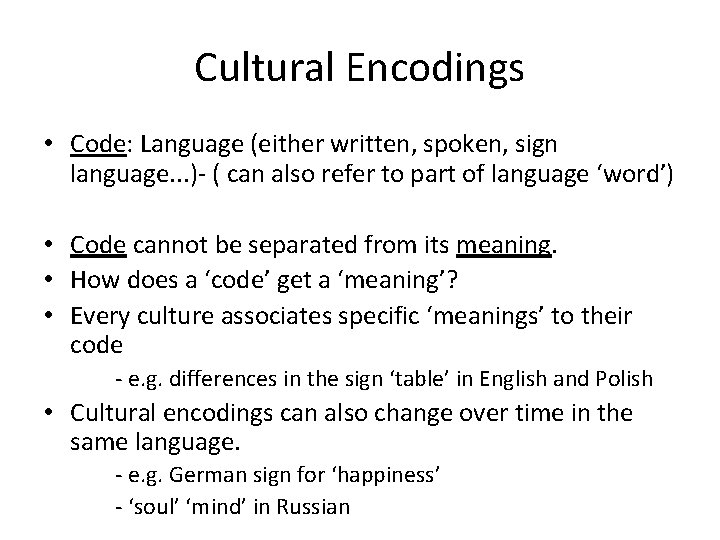
Cultural Encodings • Code: Language (either written, spoken, sign language. . . )- ( can also refer to part of language ‘word’) • Code cannot be separated from its meaning. • How does a ‘code’ get a ‘meaning’? • Every culture associates specific ‘meanings’ to their code - e. g. differences in the sign ‘table’ in English and Polish • Cultural encodings can also change over time in the same language. - e. g. German sign for ‘happiness’ - ‘soul’ ‘mind’ in Russian
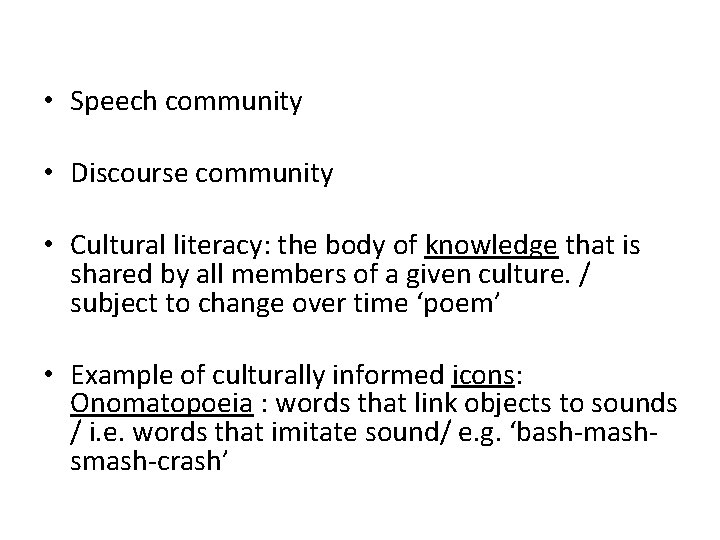
• Speech community • Discourse community • Cultural literacy: the body of knowledge that is shared by all members of a given culture. / subject to change over time ‘poem’ • Example of culturally informed icons: Onomatopoeia : words that link objects to sounds / i. e. words that imitate sound/ e. g. ‘bash-mashsmash-crash’
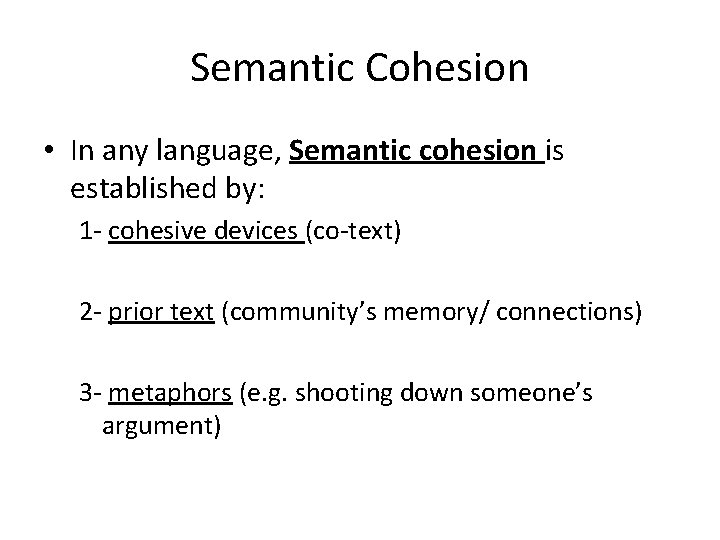
Semantic Cohesion • In any language, Semantic cohesion is established by: 1 - cohesive devices (co-text) 2 - prior text (community’s memory/ connections) 3 - metaphors (e. g. shooting down someone’s argument)
The non-arbitrary nature of signs • Signs have no natural connection with the outside world arbitrary • Native speakers do not feel that words are arbitrary signs natural (feel its non-arbitrary) • Why? – Reason of the Naturalization of culturally created signs their motivated nature. – Motivated by the desire of language users to communicate and influence others. – The linguistic sign is therefore a ‘motivated’ sign.
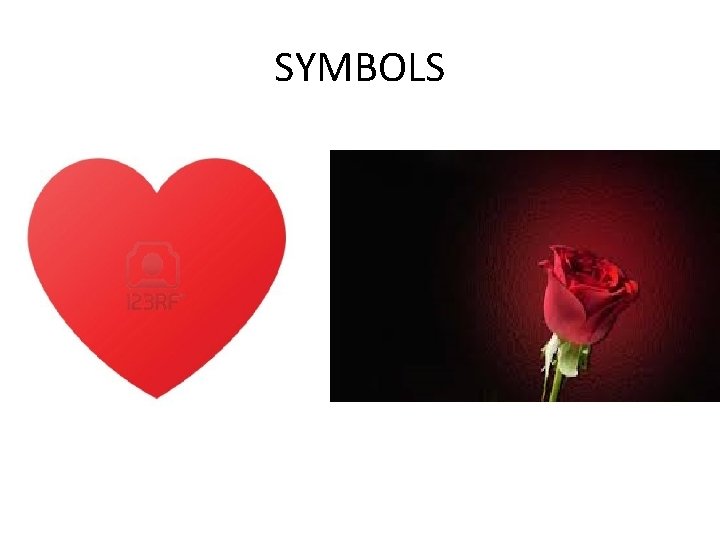
SYMBOLS
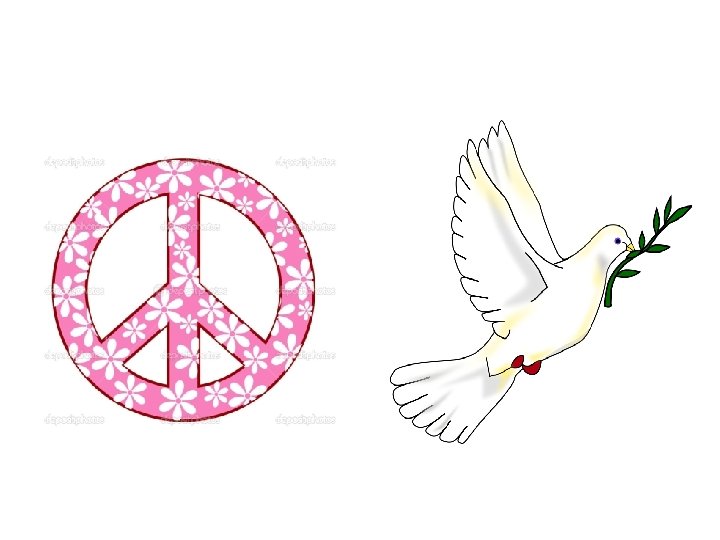
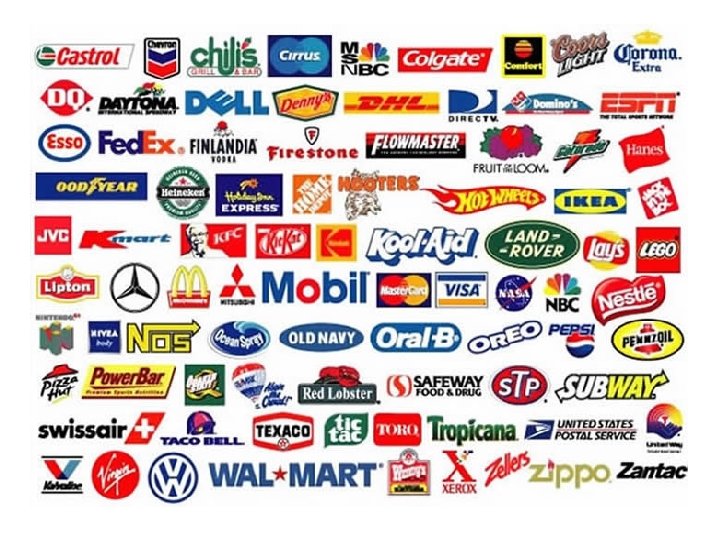
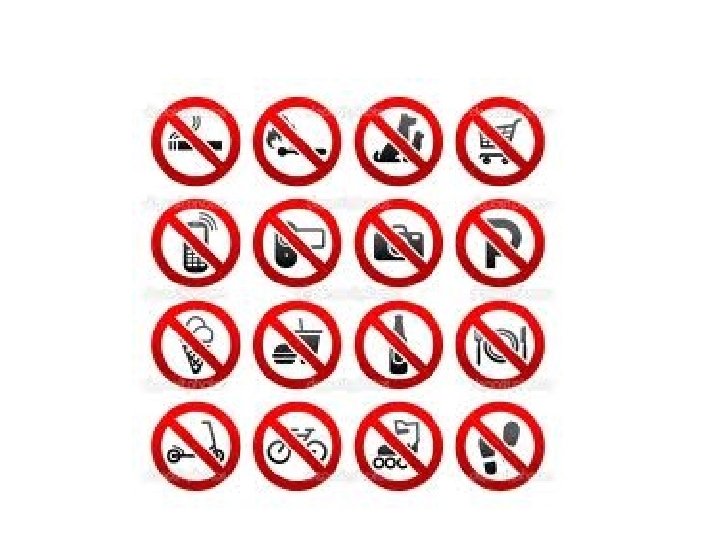
• Overtime, ‘signs’ become: – 1 - naturalized – 2 - conventionalized (following an accepted standard/ general agreement) – Symbols: Signs are Taken out of their original context (lose their denotative and/or connotative meaning) and used as a symbolic shorthand/ example of conventionalized signs. – The recurrence of ; symbols’ shapes the memory of their users.
• Symbol: a thing that represents something else, usually sth physical that represents sth more abstract. • They help us communicate thoughts & feelings • Types: visual (heart) / written (an image, setting. . in book) • What it represents depends on context surrounding it. • Clip (symbols & symbolism)/ symbols
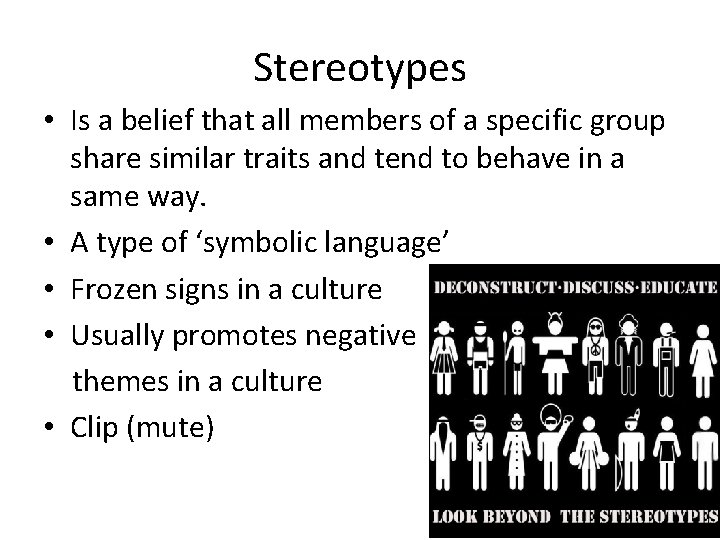
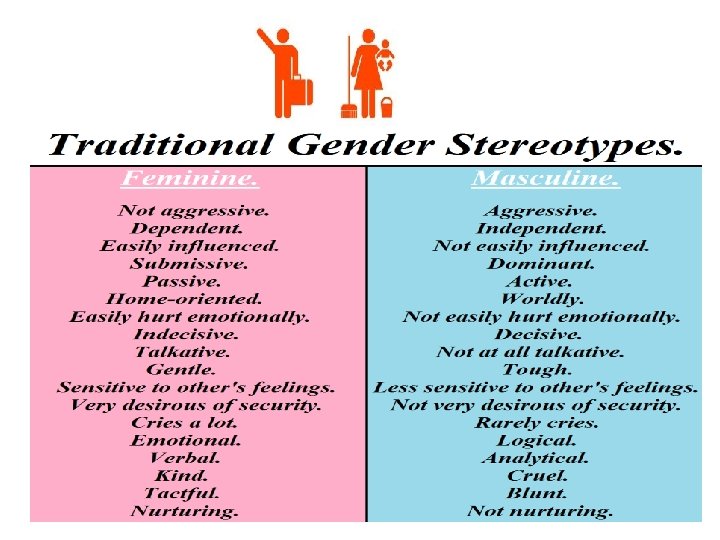
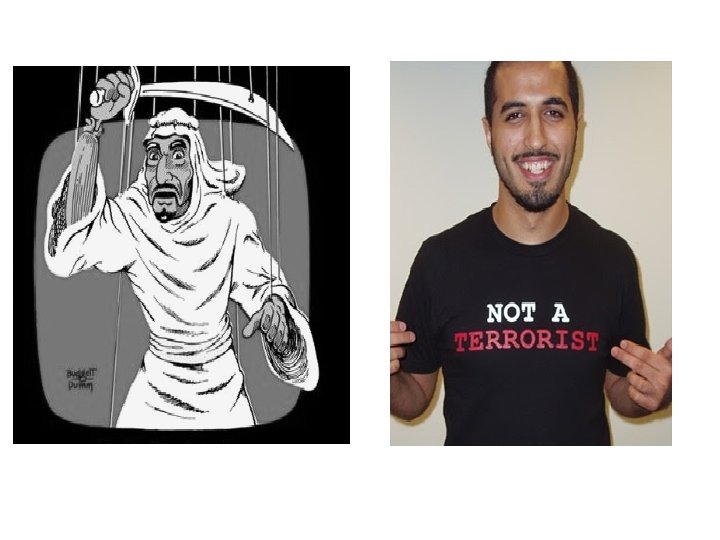
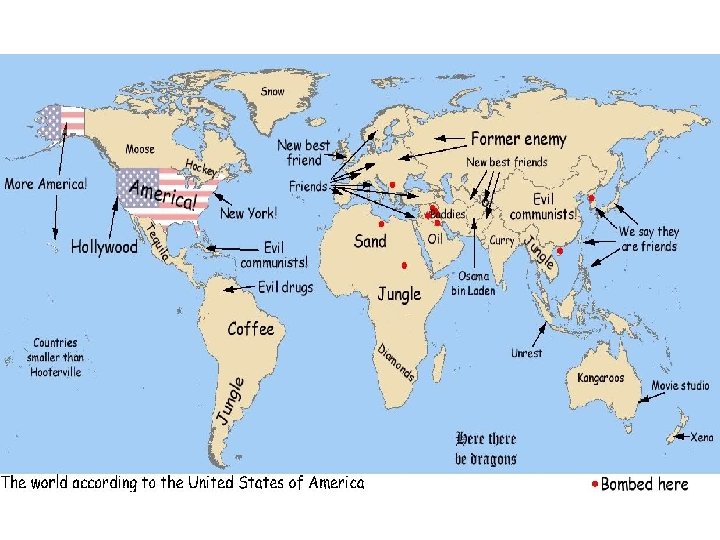
Stereotypes • Is a belief that all members of a specific group share similar traits and tend to behave in a same way. • A type of ‘symbolic language’ • Frozen signs in a culture • Usually promotes negative themes in a culture • Clip (mute)