
Chapter 2 MANAGEMENT YESTERDAY AND TODAY Prentice Hall
- Slides: 34
Chapter 2 MANAGEMENT YESTERDAY AND TODAY © Prentice Hall, 2003 Developed by Prof. Dr. Majed El-Farra 2 -1 1
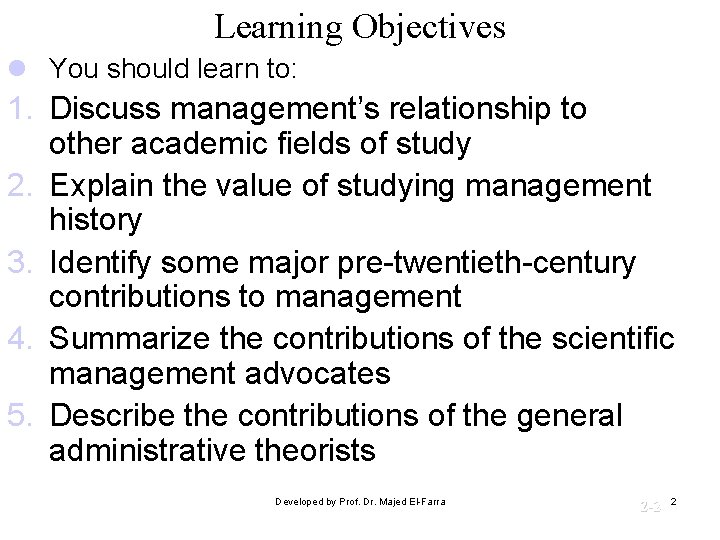
Learning Objectives l You should learn to: 1. Discuss management’s relationship to other academic fields of study 2. Explain the value of studying management history 3. Identify some major pre-twentieth-century contributions to management 4. Summarize the contributions of the scientific management advocates 5. Describe the contributions of the general administrative theorists © Prentice Hall, 2003 Developed by Prof. Dr. Majed El-Farra 2 -2 2
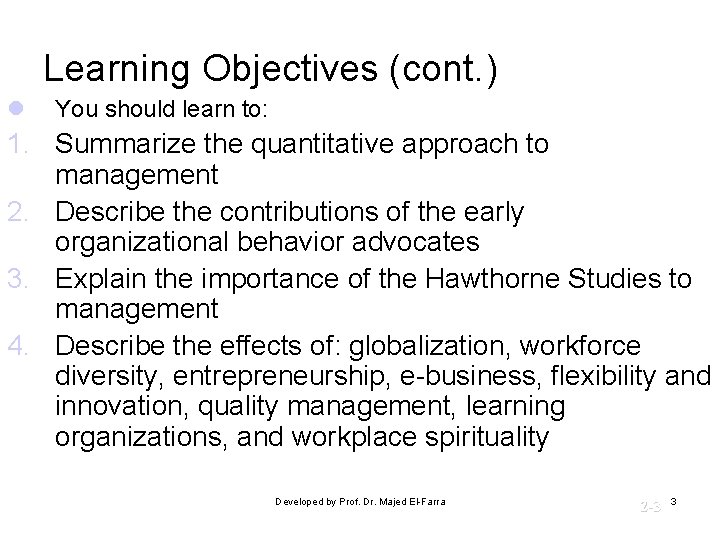
Learning Objectives (cont. ) l You should learn to: 1. Summarize the quantitative approach to management 2. Describe the contributions of the early organizational behavior advocates 3. Explain the importance of the Hawthorne Studies to management 4. Describe the effects of: globalization, workforce diversity, entrepreneurship, e-business, flexibility and innovation, quality management, learning organizations, and workplace spirituality © Prentice Hall, 2002 Developed by Prof. Dr. Majed El-Farra 2 -3 3
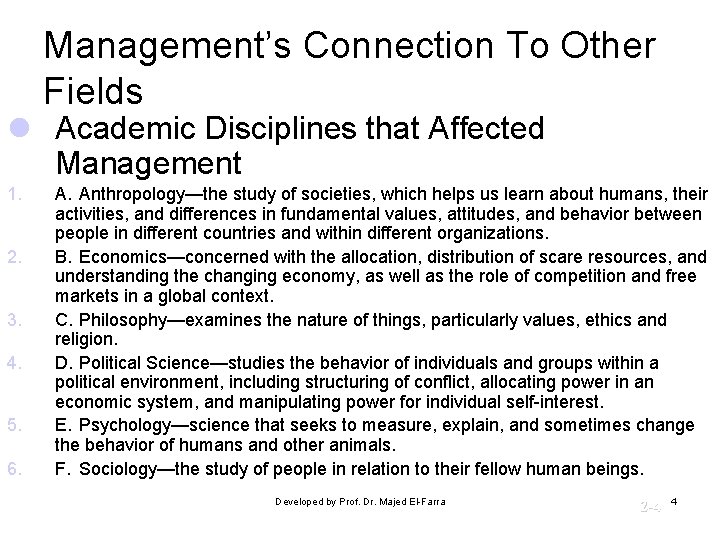
Management’s Connection To Other Fields l Academic Disciplines that Affected Management 1. 2. 3. 4. 5. 6. A. Anthropology—the study of societies, which helps us learn about humans, their activities, and differences in fundamental values, attitudes, and behavior between people in different countries and within different organizations. B. Economics—concerned with the allocation, distribution of scare resources, and understanding the changing economy, as well as the role of competition and free markets in a global context. C. Philosophy—examines the nature of things, particularly values, ethics and religion. D. Political Science—studies the behavior of individuals and groups within a political environment, including structuring of conflict, allocating power in an economic system, and manipulating power for individual self-interest. E. Psychology—science that seeks to measure, explain, and sometimes change the behavior of humans and other animals. F. Sociology—the study of people in relation to their fellow human beings. © Prentice Hall, 2002 Developed by Prof. Dr. Majed El-Farra 2 -4 4
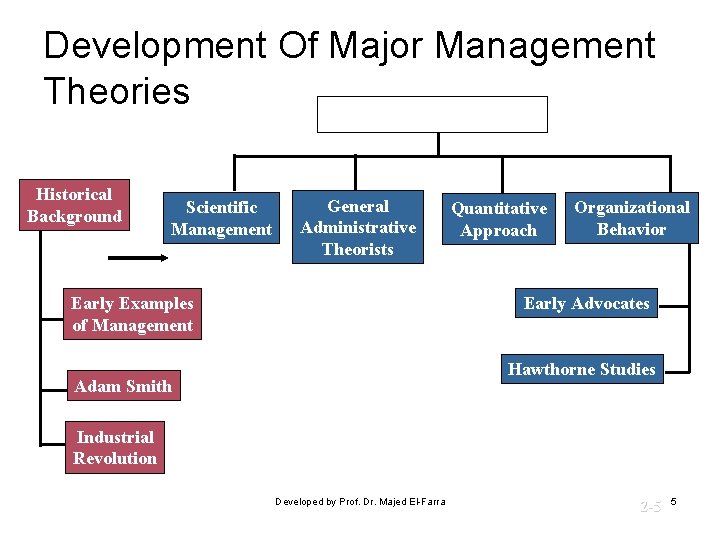
Development Of Major Management Theories Historical Background Scientific Management General Administrative Theorists Early Examples of Management Quantitative Approach Organizational Behavior Early Advocates Hawthorne Studies Adam Smith Industrial Revolution © Prentice Hall, 2002 Developed by Prof. Dr. Majed El-Farra 2 -5 5
Historical Background Of Management l There are many examples from past history that illustrate how management has been practiced for thousands of years. l A. The Egyptian pyramids and the Great Wall of China are good examples of projects of tremendous scope and magnitude that employed tens of thousands of people. How was it possible for these projects to be completed? The answer is management. l B. Other examples of early management practices can be seen at the Arsenal of Venice. For instance, assembly lines, accounting systems, and personnel functions are just a few of the processes and activities in organizations at that time that are also common to today’s organizations. l C. Adam Smith, author of the classical economics doctrine, The Wealth of Nations, argued brilliantly about the economic advantages that division of labor (the breakdown of jobs into narrow, repetitive tasks) would bring to organizations and society. l D. The Industrial Revolution can be thought of as possibly the most important pretwentieth-century influence on management. The introduction of machine powers, combined with the division of labor, made large, efficient factories possible. Planning, organizing, leading, and controlling became necessary. l E. The development of management theories has been characterized by differing beliefs about what managers do and how they should do it. © Prentice Hall, 2002 Developed by Prof. Dr. Majed El-Farra 2 -6 6
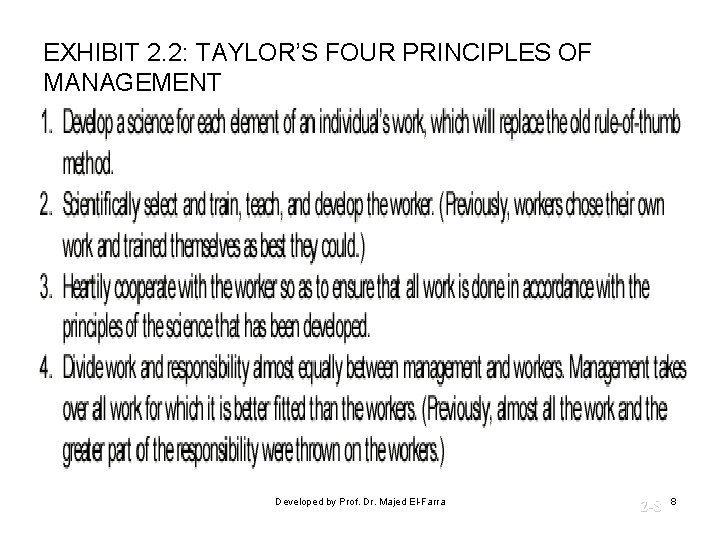
Scientific Management l Scientific management is defined as the use of the scientific method to define the “one best way” for a job to be done. l A. Important Contributions l 1. Frederick W. Taylor is known as the “father” of scientific management. Taylor’s work at the Midvale and Bethlehem Steel companies motivated his interest in improving efficiency. l a. Taylor sought to create a mental revolution among both workers and managers by defining clear guidelines for improving production efficiency. He defined four principles of management (Exhibit 2. 2). l b. His “pig iron” experiment is probably the most widely cited example of scientific management. l c. Using his principles of scientific management, Taylor was able to define the one best way for doing each job. l d. Overall, Taylor achieved consistent improvements in productivity in the range of 200 percent. He affirmed the role of managers to plan and control and of workers to perform as they were instructed. © Prentice Hall, 2002 Developed by Prof. Dr. Majed El-Farra 2 -7 7
EXHIBIT 2. 2: TAYLOR’S FOUR PRINCIPLES OF MANAGEMENT © Prentice Hall, 2002 Developed by Prof. Dr. Majed El-Farra 2 -8 8
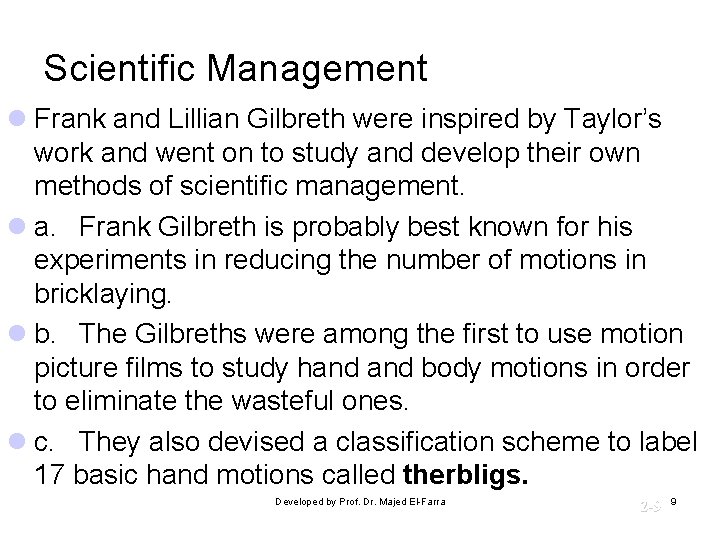
Scientific Management l Frank and Lillian Gilbreth were inspired by Taylor’s work and went on to study and develop their own methods of scientific management. l a. Frank Gilbreth is probably best known for his experiments in reducing the number of motions in bricklaying. l b. The Gilbreths were among the first to use motion picture films to study hand body motions in order to eliminate the wasteful ones. l c. They also devised a classification scheme to label 17 basic hand motions called therbligs. © Prentice Hall, 2002 Developed by Prof. Dr. Majed El-Farra 2 -9 9
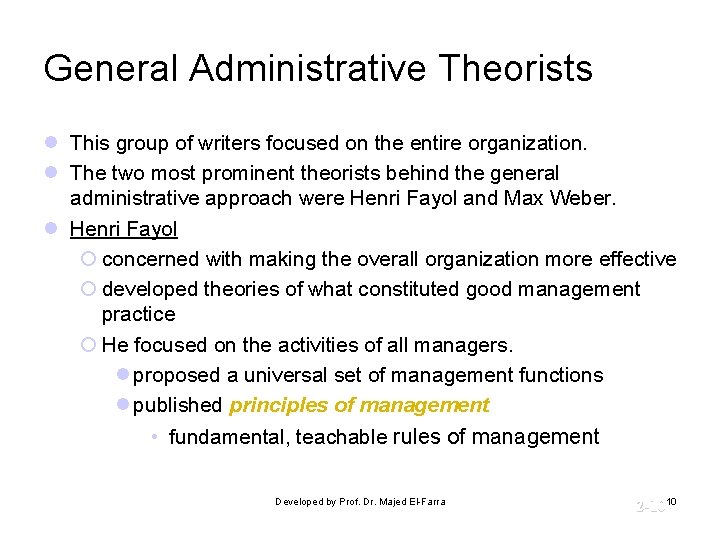
General Administrative Theorists l This group of writers focused on the entire organization. l The two most prominent theorists behind the general administrative approach were Henri Fayol and Max Weber. l Henri Fayol ¡ concerned with making the overall organization more effective ¡ developed theories of what constituted good management practice ¡ He focused on the activities of all managers. l proposed a universal set of management functions l published principles of management • fundamental, teachable rules of management © Prentice Hall, 2002 Developed by Prof. Dr. Majed El-Farra 2 -1010
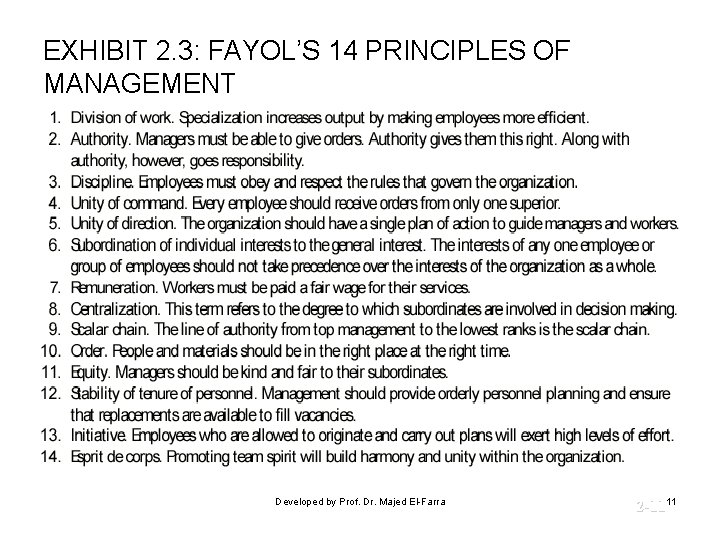
EXHIBIT 2. 3: FAYOL’S 14 PRINCIPLES OF MANAGEMENT © Prentice Hall, 2002 Developed by Prof. Dr. Majed El-Farra 2 -1111
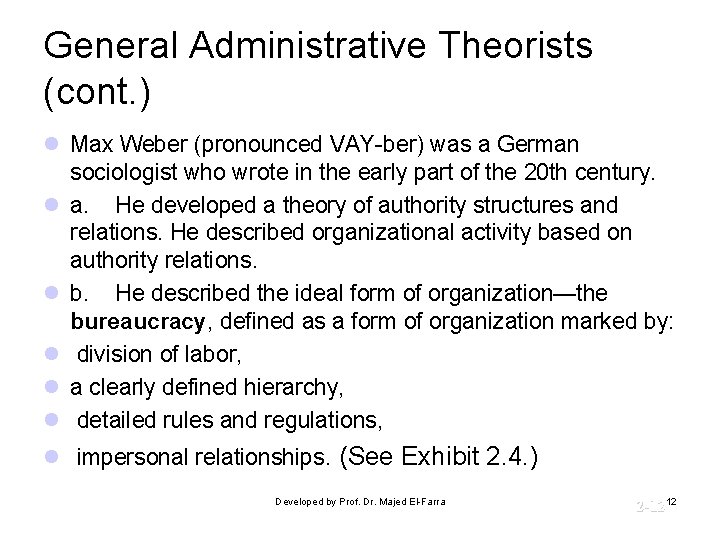
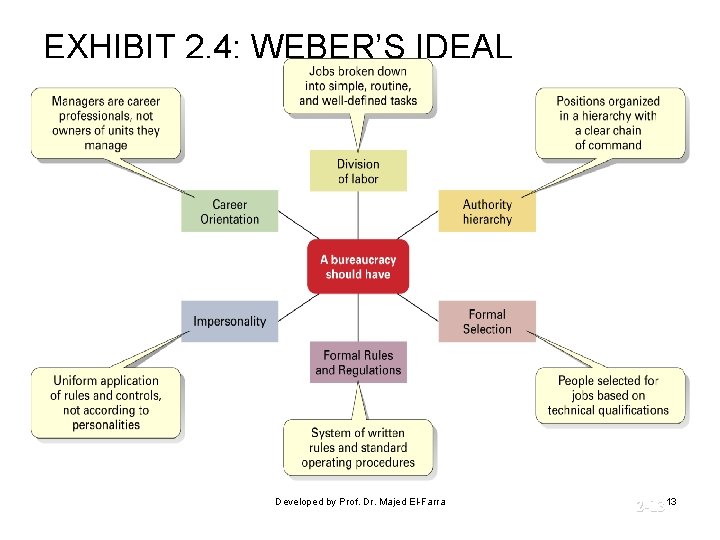
General Administrative Theorists (cont. ) l Max Weber (pronounced VAY-ber) was a German sociologist who wrote in the early part of the 20 th century. l a. He developed a theory of authority structures and relations. He described organizational activity based on authority relations. l b. He described the ideal form of organization—the bureaucracy, defined as a form of organization marked by: l division of labor, l a clearly defined hierarchy, l detailed rules and regulations, l impersonal relationships. (See Exhibit 2. 4. ) © Prentice Hall, 2002 Developed by Prof. Dr. Majed El-Farra 2 -1212
EXHIBIT 2. 4: WEBER’S IDEAL BUREAUCRACY © Prentice Hall, 2002 Developed by Prof. Dr. Majed El-Farra 2 -1313
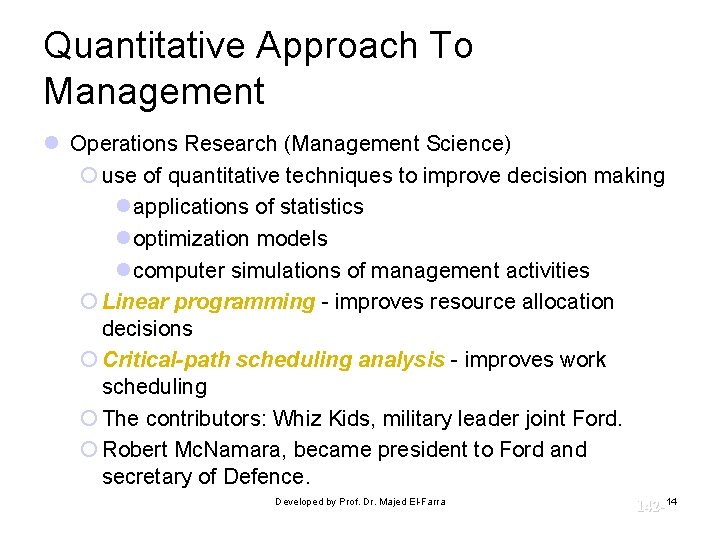
Quantitative Approach To Management l Operations Research (Management Science) ¡ use of quantitative techniques to improve decision making l applications of statistics l optimization models l computer simulations of management activities ¡ Linear programming - improves resource allocation decisions ¡ Critical-path scheduling analysis - improves work scheduling ¡ The contributors: Whiz Kids, military leader joint Ford. ¡ Robert Mc. Namara, became president to Ford and secretary of Defence. © Prentice Hall, 2002 Developed by Prof. Dr. Majed El-Farra 142 -14
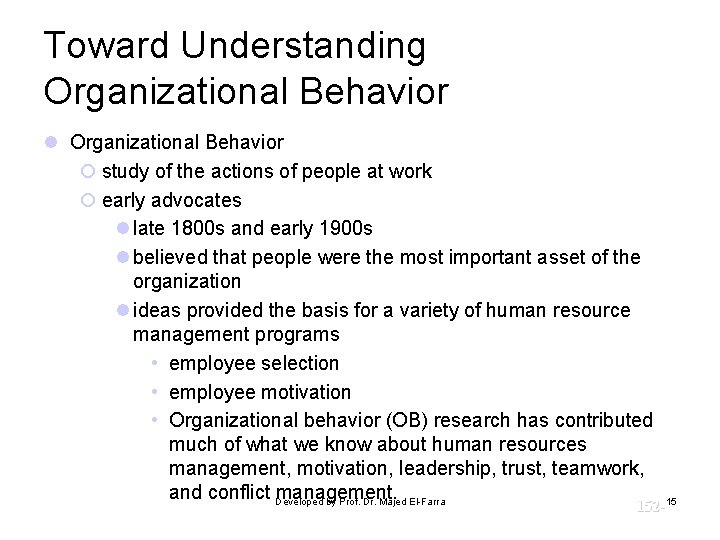
Toward Understanding Organizational Behavior l Organizational Behavior ¡ study of the actions of people at work ¡ early advocates l late 1800 s and early 1900 s l believed that people were the most important asset of the organization l ideas provided the basis for a variety of human resource management programs • employee selection • employee motivation • Organizational behavior (OB) research has contributed much of what we know about human resources management, motivation, leadership, trust, teamwork, and conflict Developed management. by Prof. Dr. Majed El-Farra © Prentice Hall, 2002 152 -15
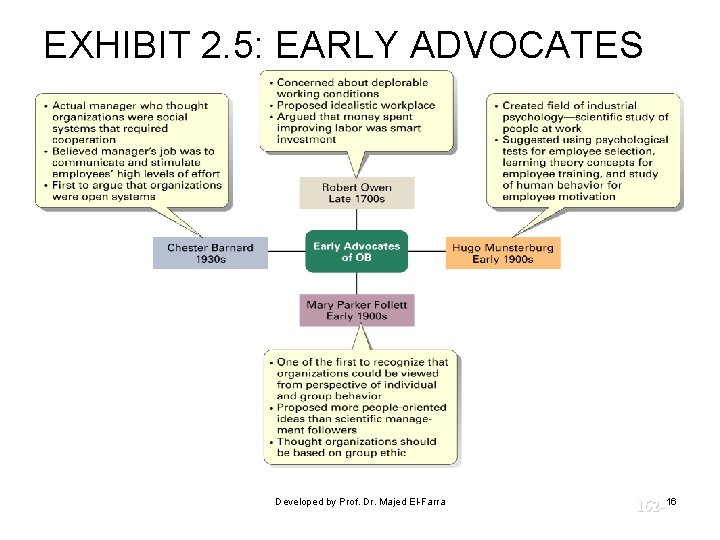
EXHIBIT 2. 5: EARLY ADVOCATES OF OB © Prentice Hall, 2002 Developed by Prof. Dr. Majed El-Farra 162 -16
Early Advocates of OB l l l l Four people stand out as early advocates of the OB approach. These include Robert Owen, Hugo Munsterberg, Mary Parker Follett, and Chester Barnard. (See Exhibit 2. 5 for a summary of the most important ideas of these early advocates. ) 1. Robert Owen, a successful Scottish businessman, proposed a workplace. Utopian criticizm 2. Hugo Munsterberg created the field of industrial psychology—the scientific study of individuals at work to maximize their productivity and adjustment. 3. Mary Parker Follett was a social philosopher who thought the manager’s job was to harmonize and coordinate group efforts. 4. Chester Barnard, president of New Jersey Bell Telephone Company, saw organizations as social systems that required human cooperation. a. He believed that managers’ major roles were to communicate and stimulate subordinates to high levels of effort. b. He also introduced the idea that managers have to examine the environment and then adjust the organization to maintain a state of equilibrium. Developed by Prof. Dr. Majed El-Farra 17
Organizational Behavior (cont. ) l Hawthorne Studies ¡started in 1924 at Western Electric Company lbegan with illumination studies lintensity of illumination not related to productivity ¡Elton Mayo - studies of job design lrevealed the importance of social norms as determinants of individual work behavior ¡changed the dominant view that employees were no different from any other machines © Prentice Hall, 2002 Developed by Prof. Dr. Majed El-Farra 182 -18
The Hawthorne Studies l The Hawthorne Studies were, the most important contribution to the developing OB field. l 1. These were a series of experiments conducted from 1924 to the early 1930 s at Western Electric Company’s Hawthorne Works in Cicero, Illinois. l 2. The studies were initially devised as a scientific management experiment to assess the impact of changes in various physical environment variables on employee productivity. l 3. Other experiments looked at redesigning jobs, making changes in workday and workweek length, introducing rest periods, and introducing individual versus group wage plans. l 4. The researchers concluded that social norms or group standards were the key determinants of individual work behavior. (group standards, attitudes, and security). l 5. Although not without critics (of procedures, analyses of findings, and the conclusions), the Hawthorne studies did stimulate an interest in human behavior in organizations. Developed by Prof. Dr. Majed El-Farra 19
CURRENT TRENDS AND ISSUES l what current concepts and practices are shaping today’s management history and changing the way that managers do their jobs? Developed by Prof. Dr. Majed El-Farra 20
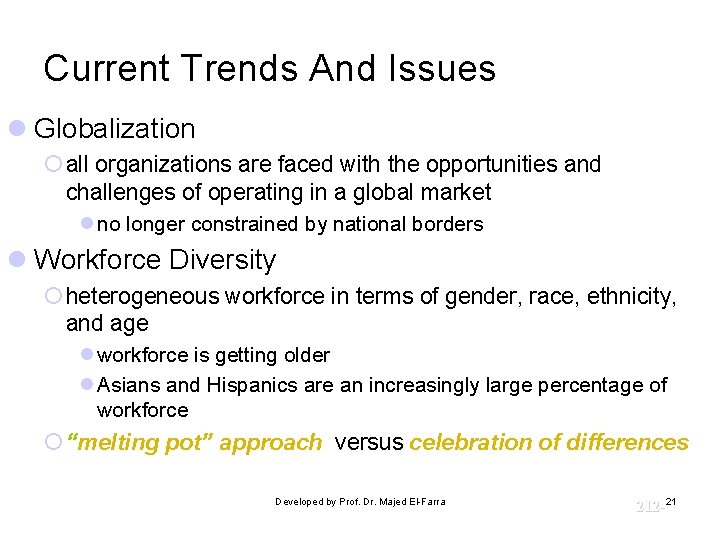
Current Trends And Issues l Globalization ¡ all organizations are faced with the opportunities and challenges of operating in a global market l no longer constrained by national borders l Workforce Diversity ¡ heterogeneous workforce in terms of gender, race, ethnicity, and age l workforce is getting older l Asians and Hispanics are an increasingly large percentage of workforce ¡ “melting pot” approach versus celebration of differences © Prentice Hall, 2002 Developed by Prof. Dr. Majed El-Farra 212 -21
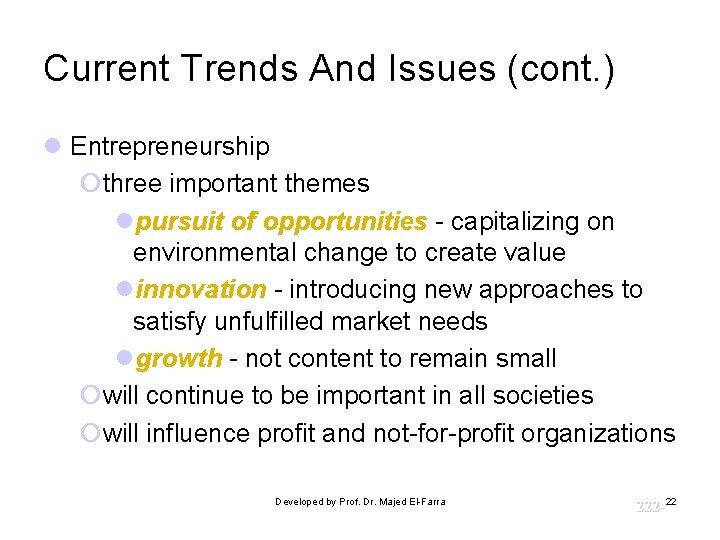
Current Trends And Issues (cont. ) l Entrepreneurship ¡three important themes lpursuit of opportunities - capitalizing on environmental change to create value linnovation - introducing new approaches to satisfy unfulfilled market needs lgrowth - not content to remain small ¡will continue to be important in all societies ¡will influence profit and not-for-profit organizations © Prentice Hall, 2002 Developed by Prof. Dr. Majed El-Farra 222 -22
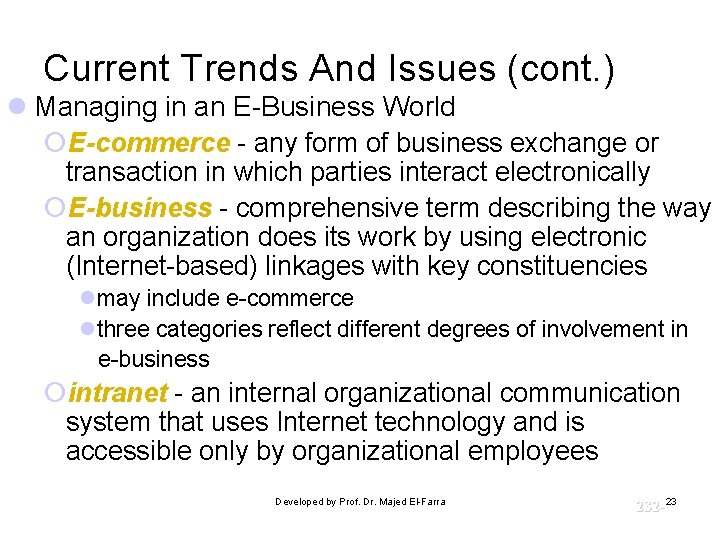
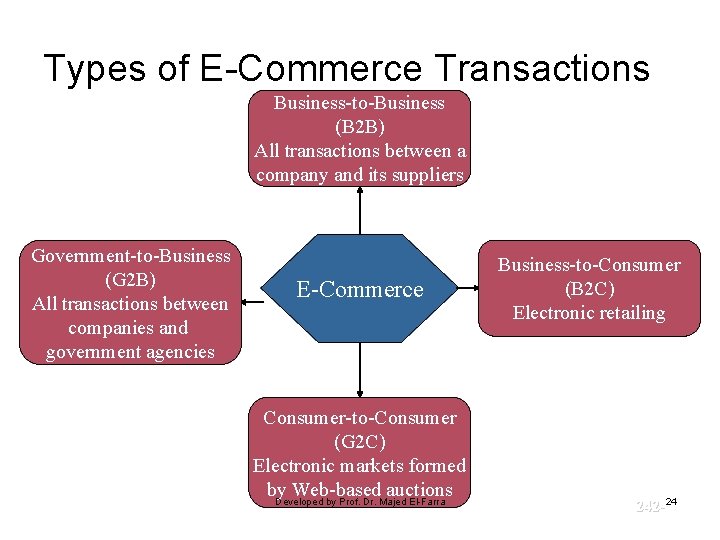
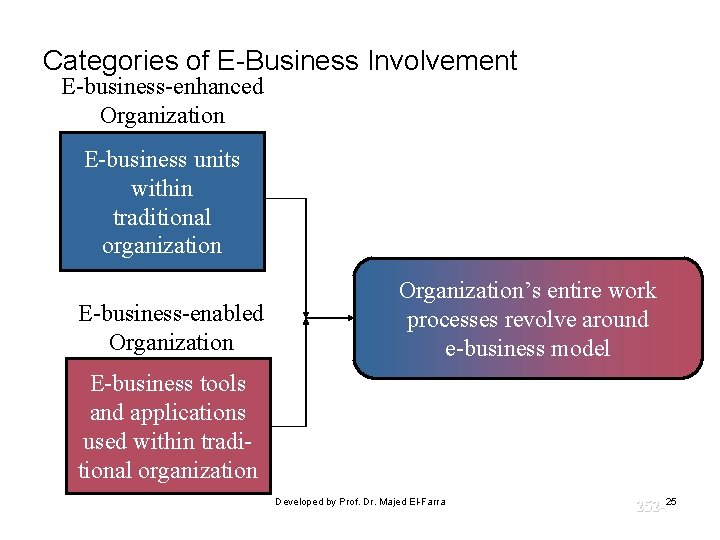
Current Trends And Issues (cont. ) l Managing in an E-Business World ¡E-commerce - any form of business exchange or transaction in which parties interact electronically ¡E-business - comprehensive term describing the way an organization does its work by using electronic (Internet-based) linkages with key constituencies lmay include e-commerce lthree categories reflect different degrees of involvement in e-business ¡intranet - an internal organizational communication system that uses Internet technology and is accessible only by organizational employees © Prentice Hall, 2002 Developed by Prof. Dr. Majed El-Farra 232 -23
Types of E-Commerce Transactions Business-to-Business (B 2 B) All transactions between a company and its suppliers Government-to-Business (G 2 B) All transactions between companies and government agencies © Prentice Hall, 2002 E-Commerce Consumer-to-Consumer (G 2 C) Electronic markets formed by Web-based auctions Developed by Prof. Dr. Majed El-Farra Business-to-Consumer (B 2 C) Electronic retailing 242 -24
Categories of E-Business Involvement E-business-enhanced Organization E-business units within traditional organization E-business-enabled Organization’s entire work processes revolve around e-business model E-business tools and applications used within traditional organization © Prentice Hall, 2002 Developed by Prof. Dr. Majed El-Farra 252 -25
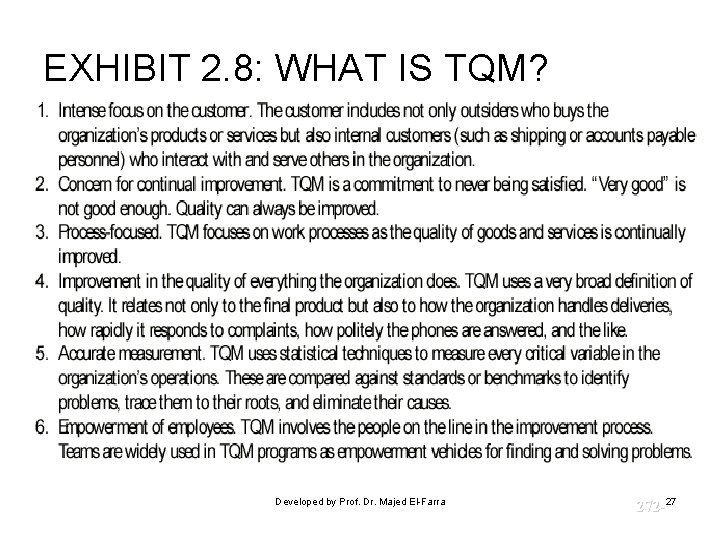
Current Trends And Issues (cont. ) l Need for Innovation and Flexibility ¡ without a constant flow of new ideas, an organization is doomed to obsolescence or even worse ¡ must be flexible to accommodate changing customers’ needs, appearance of new competitors, and shifting employees from project to project l Quality Management ¡ Total Quality Management (TQM) - philosophy of management based on continual improvement and responding to customer needs and expectations ¡ customer - refers to internal and external entities that interact with the organization’s product or service © Prentice Hall, 2002 Developed by Prof. Dr. Majed El-Farra 262 -26
EXHIBIT 2. 8: WHAT IS TQM? © Prentice Hall, 2002 Developed by Prof. Dr. Majed El-Farra 272 -27
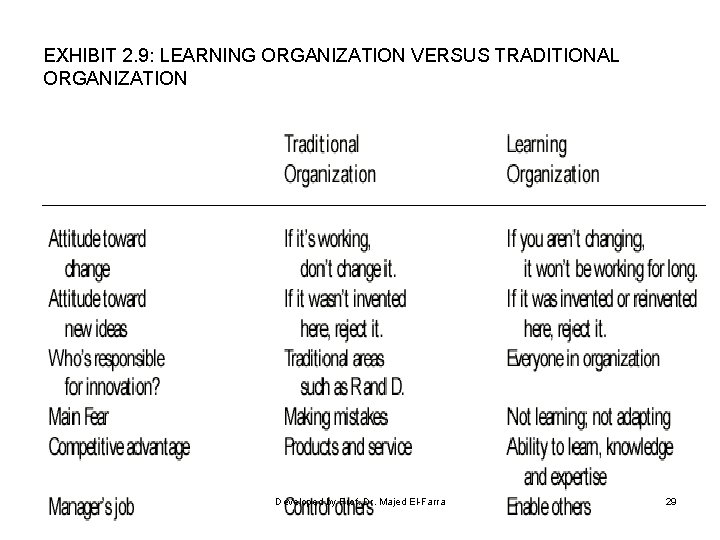
Current Trends And Issues (cont. ) l Learning Organizations and Knowledge Management ¡learning organization - one that has developed the capacity to continuously learn, adapt, and change ¡create learning capabilities throughout the organization lunderstanding that knowledge is an important resource ¡knowledge management - involves cultivating a learning culture where organizational members systematically gather knowledge and share it with others in the organization so as to achieve better performance ¡managers must transform themselves from bosses to team leaders llearn to listen, motivate, coach, and nurture © Prentice Hall, 2002 Developed by Prof. Dr. Majed El-Farra 282 -28
EXHIBIT 2. 9: LEARNING ORGANIZATION VERSUS TRADITIONAL ORGANIZATION © Prentice Hall, 2002 Developed by Prof. Dr. Majed El-Farra 292 -29
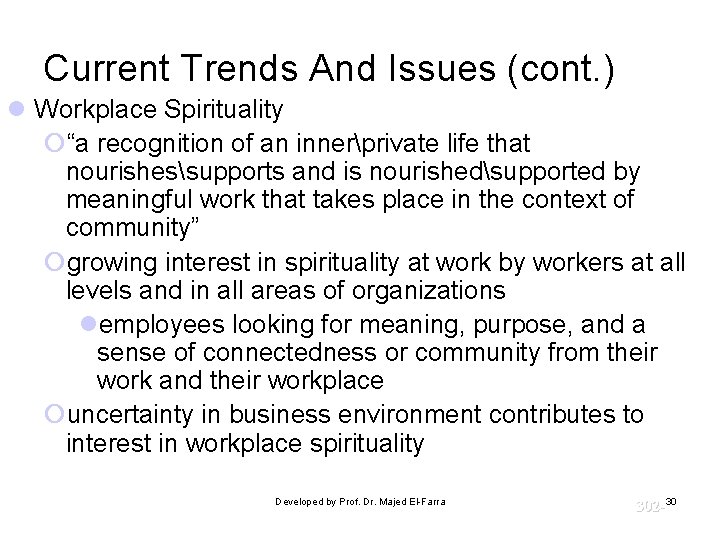
Current Trends And Issues (cont. ) l Workplace Spirituality ¡“a recognition of an innerprivate life that nourishessupports and is nourishedsupported by meaningful work that takes place in the context of community” ¡growing interest in spirituality at work by workers at all levels and in all areas of organizations lemployees looking for meaning, purpose, and a sense of connectedness or community from their work and their workplace ¡uncertainty in business environment contributes to interest in workplace spirituality © Prentice Hall, 2002 Developed by Prof. Dr. Majed El-Farra 302 -30
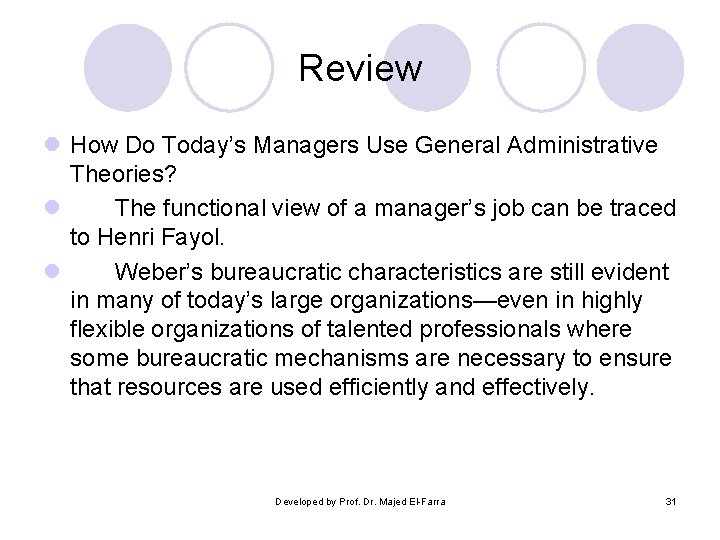
Review l How Do Today’s Managers Use General Administrative Theories? l The functional view of a manager’s job can be traced to Henri Fayol. l Weber’s bureaucratic characteristics are still evident in many of today’s large organizations—even in highly flexible organizations of talented professionals where some bureaucratic mechanisms are necessary to ensure that resources are used efficiently and effectively. Developed by Prof. Dr. Majed El-Farra 31
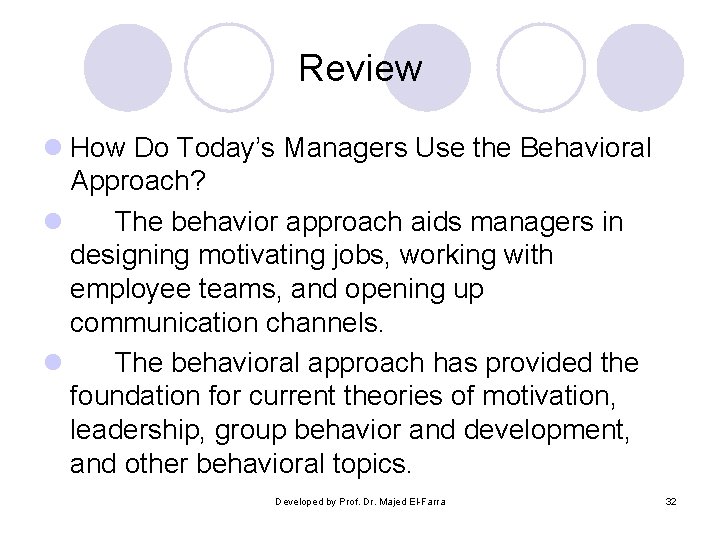
Review l How Do Today’s Managers Use the Behavioral Approach? l The behavior approach aids managers in designing motivating jobs, working with employee teams, and opening up communication channels. l The behavioral approach has provided the foundation for current theories of motivation, leadership, group behavior and development, and other behavioral topics. Developed by Prof. Dr. Majed El-Farra 32
l “Entrepreneurship is only for small, start-up businesses. ” Do you agree or disagree with this statement? Explain. l Entrepreneurship by definition is the process whereby an individual or a group of individuals uses organized efforts and means to pursue opportunities to create value and grow by fulfilling wants and needs through innovation and uniqueness, no matter what resources are currently controlled. It involves the discovery of opportunities and resources to exploit them. So, yes, entrepreneurship is for small, start-up businesses, but it is also important for larger organizations. Organizations, regardless of size, must be innovative and flexible, which is closely related to entrepreneurship. Developed by Prof. Dr. Majed El-Farra 33
Review l Would you feel more comfortable in a learning organization or in a traditional organization? Why? l The answers for these questions will vary according to each student. However, the important part of the answer is how well each student explains or supports his/her preference. Developed by Prof. Dr. Majed El-Farra 34