
CHAPTER 2 MAASTRICHT TREATY 10 December 1991 Maastricht

CHAPTER 2
MAASTRICHT TREATY (10 December 1991) Maastricht is important both for naming the European Union and for advancing integration. The economies of the countries must be ready to integrate into the economic and monetary union. Main innovations provided by the Maastricht Treaty; q 1. Economic and Monetary Union; It has been decided to examine whether at least seven member states meet the criteria: low inflation rate, low deficit in public finances, stability in monetary policies and long-term interest rates. q At this stage, it is envisaged that the only(single) money to be managed by an independent European Central Bank will come into force. This took the form of today.
q 2. Common Foreign and Security Policy a. Defense: Includes future identification of a common defense policy that will take the community to “Common Defense” b. European Citizenship: It is decided that EU citizens residing in another member state will be elected and elected in the European Parliament elections and municipal elections, residence and act on EU territory, and all EU citizens will benefit diplomatic protection in third countries.
q 2. Common Foreign and Security Policy c. Extension of Majority Voting at the Council: Qualified decisions can be taken in the Council on issues such as consumer protection, aid to developing countries, some educational issues, health, transportation, environment, and infrastructure of Trans. European networks. d. European Parliament: The powers of the European Parliament are expanded, and in some cases a new method is created to enable it to take joint decisions with the Council. e. Economic and Social Cohesion: In this framework, it is decided that the contributions of member states to the own resources system will be directly proportional to their opportunities.
3. Cooperation in Justice and Home Affairs Member States have established a European Police Office (Europol) to increase cooperation between migration and political asylum.
With this treaty, it was decided to complete monetary union until 1999, establish European citizenship and establish cooperation policies in common foreign and security, justice and home affairs.
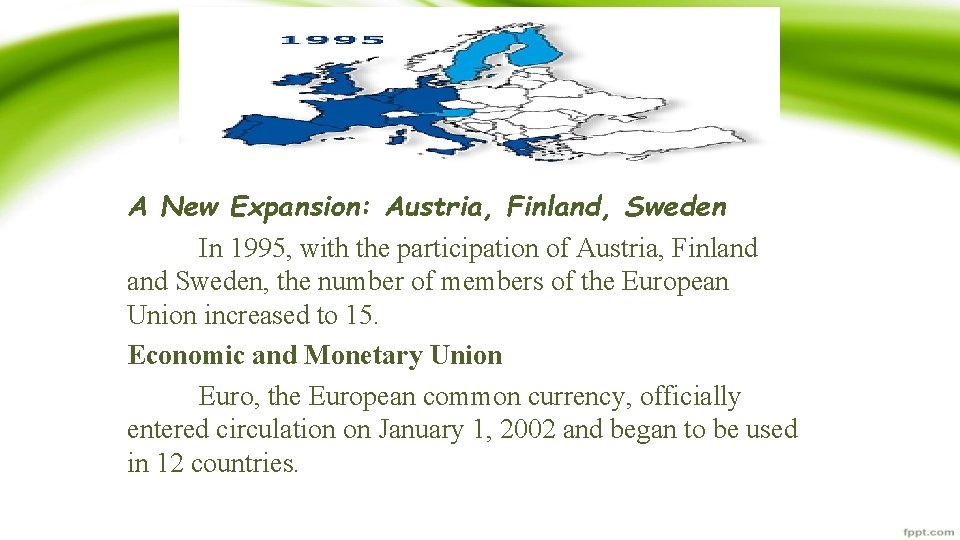
A New Expansion: Austria, Finland, Sweden In 1995, with the participation of Austria, Finland Sweden, the number of members of the European Union increased to 15. Economic and Monetary Union Euro, the European common currency, officially entered circulation on January 1, 2002 and began to be used in 12 countries.
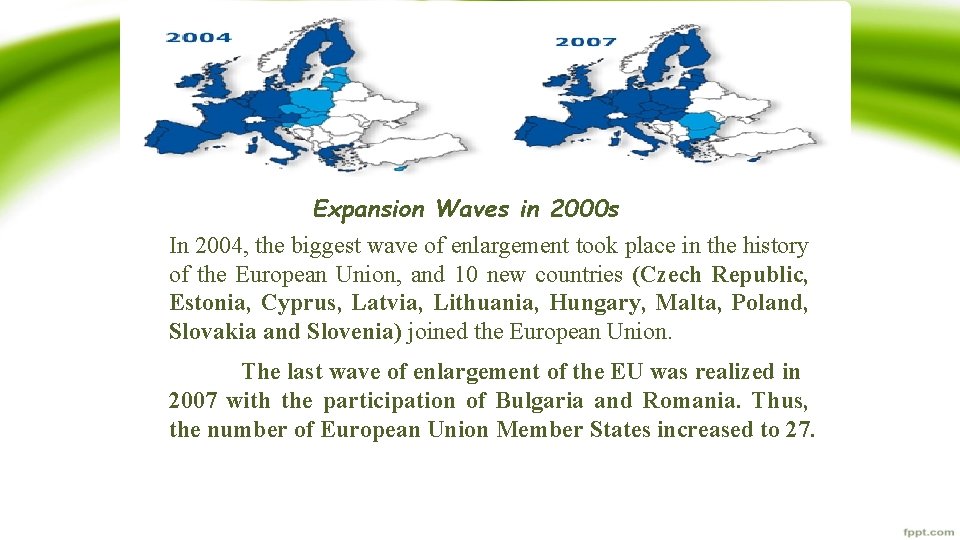
Expansion Waves in 2000 s In 2004, the biggest wave of enlargement took place in the history of the European Union, and 10 new countries (Czech Republic, Estonia, Cyprus, Latvia, Lithuania, Hungary, Malta, Poland, Slovakia and Slovenia) joined the European Union. The last wave of enlargement of the EU was realized in 2007 with the participation of Bulgaria and Romania. Thus, the number of European Union Member States increased to 27.
NICE TREATY (10 DECEMBER 2000) 1 -Changes in Institutional Structure: (According to an EU with 27 members) Preparation of European Union decision processes for the new wave of enlargement Preparation of European Union institutions for the new wave of enlargement 2 -Changes In Policy Areas Preparation of the EU fundamental rights requirement and signing by the EU institutions Development of existing policy areas
Treaty of Lisbon The last important step in the deepening process of the European Union was with the Lisbon Treaty, which came into force. The Treaty was signed by the Heads of State and Government at the EU Summit on 13 December 2007, and entered into force on 1 December 2009 after the approval process was completed in 27 member states. With this treaty, it was aimed mainly to eliminate the bottlenecks in the EU's decision-making mechanisms and to achieve a more democratic and effective functioning of the Union.
- Slides: 10