
Chapter 2 Lifes Chemical Basis Living things are

Chapter 2: Life’s Chemical Basis Living things are made up of non-living particles; elements, molecules, compound….
Introduction § Chemicals are the stuff that make up matter. Living organisms are composed of matter, which is anything that __________ Matter is composed of chemical elements. – An ________ is a substance that cannot be broken down to other substances. – There are 92 elements in nature—only a few exist in a pure state. § Life’s chemistry is tied to water. © 2012 Pearson Education, Inc.
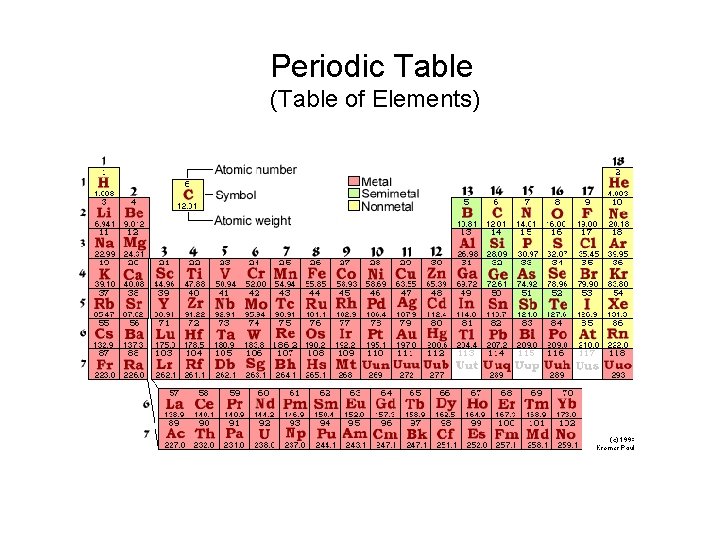
Periodic Table (Table of Elements)
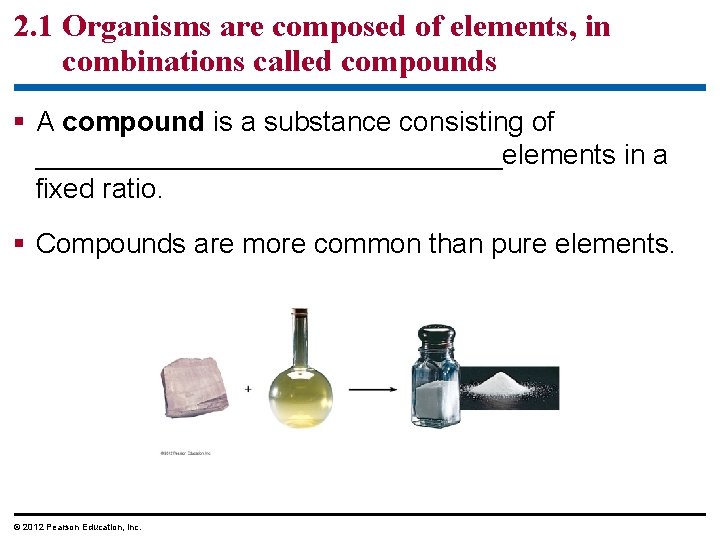
2. 1 Organisms are composed of elements, in combinations called compounds § A compound is a substance consisting of _______________elements in a fixed ratio. § Compounds are more common than pure elements. © 2012 Pearson Education, Inc.
2. 1 Organisms are composed of elements, in combinations called compounds § About 25 elements are essential to life. § Four elements make up about 96% of the weight of most living organisms. These are – 1. – 2. – 3. – 4. § Trace elements are essential but are only needed in minute quantities. © 2012 Pearson Education, Inc.
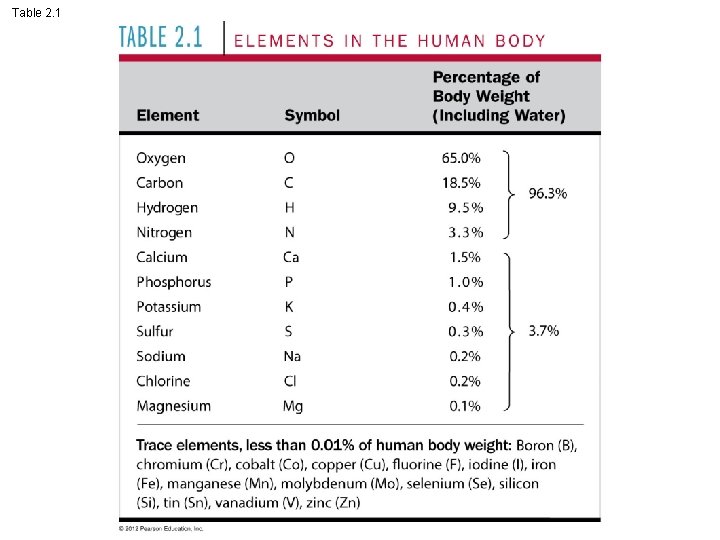
Table 2. 1
2. 2 CONNECTION: Trace elements are common additives to food and water § Some trace elements are required to prevent disease. Examples: 1. 2. 3. © 2012 Pearson Education, Inc.
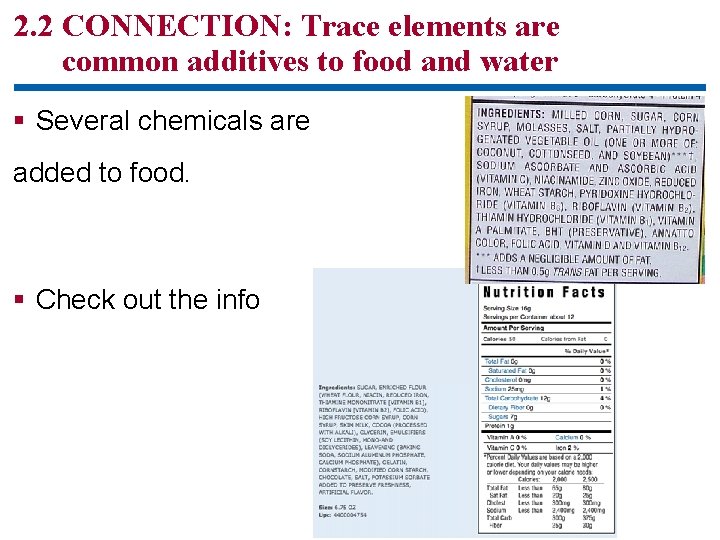
2. 2 CONNECTION: Trace elements are common additives to food and water § Several chemicals are added to food. § Check out the info
2. 3 Atoms consist of protons, neutrons, and electrons § Each element consists of one kind of atom. § An atom is the smallest unit of matter that still retains the properties of an element. § Three subatomic particles – _________________ – _________ © 2012 Pearson Education, Inc.
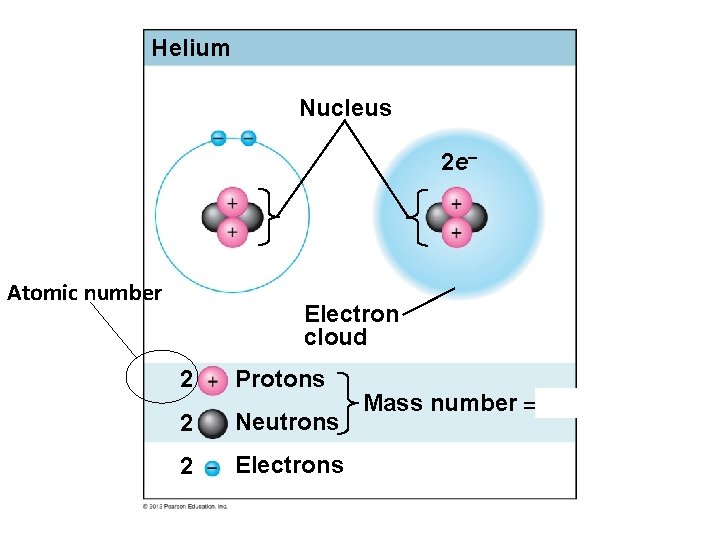
Helium Nucleus 2 e Atomic number Electron cloud 2 Protons 2 Neutrons 2 Electrons Mass number 4
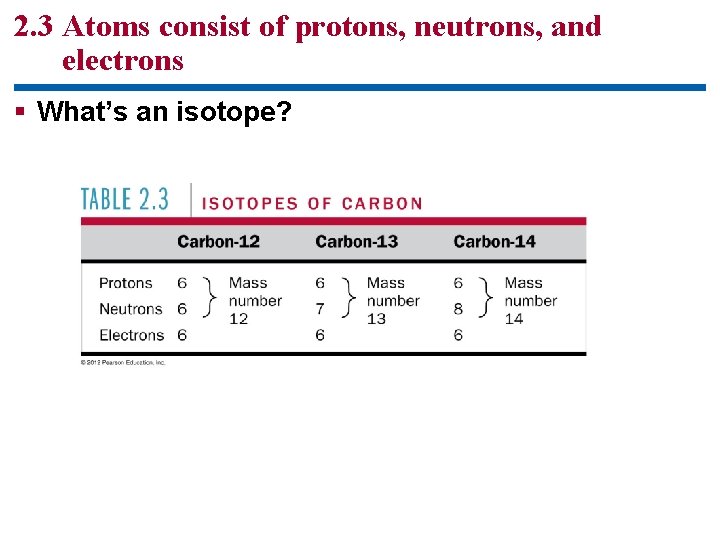
2. 3 Atoms consist of protons, neutrons, and electrons § What’s an isotope?
2. 4 CONNECTION: Radioactive isotopes can help or harm us In radioactive isotopes, the nucleus decays spontaneously, giving off particles and energy. § DANGER § BENEFITS © 2012 Pearson Education, Inc.
2. 5 The distribution of electrons determines an atom’s chemical properties § Of the three subatomic particles—protons, neutrons, and electrons—only electrons are directly involved in chemical activity. § Electrons occur in energy levels called electron shells. © 2012 Pearson Education, Inc.
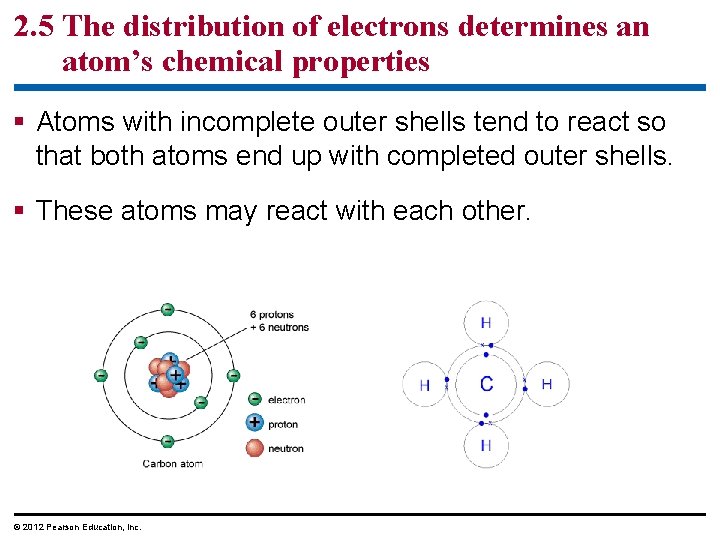
2. 5 The distribution of electrons determines an atom’s chemical properties § Atoms with incomplete outer shells tend to react so that both atoms end up with completed outer shells. § These atoms may react with each other. © 2012 Pearson Education, Inc.
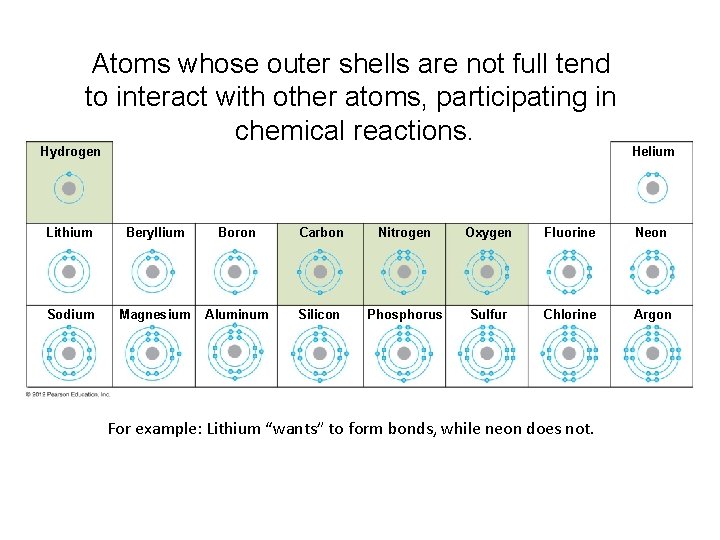
Atoms whose outer shells are not full tend to interact with other atoms, participating in chemical reactions. Hydrogen Helium Lithium Beryllium Boron Carbon Nitrogen Oxygen Fluorine Neon Sodium Magnesium Aluminum Silicon Phosphorus Sulfur Chlorine Argon For example: Lithium “wants” to form bonds, while neon does not.
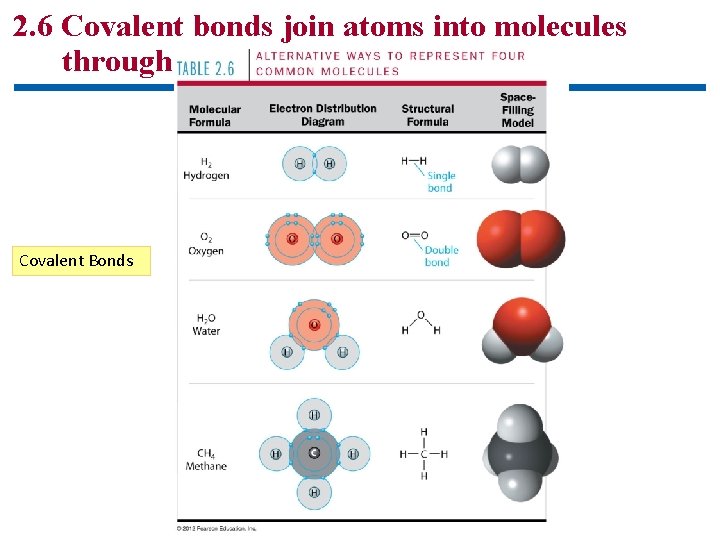
2. 6 Covalent bonds join atoms into molecules through electron sharing Covalent Bonds
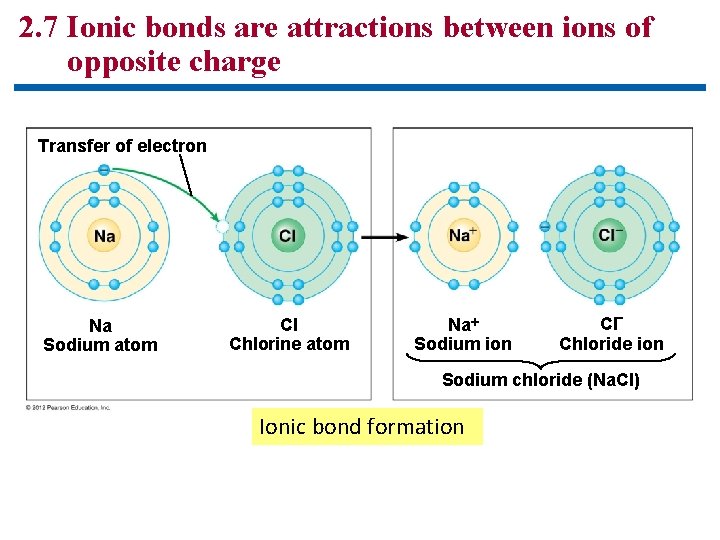
2. 7 Ionic bonds are attractions between ions of opposite charge Transfer of electron Na Sodium atom Cl Chlorine atom Na Sodium ion Cl Chloride ion Sodium chloride (Na. Cl) Ionic bond formation
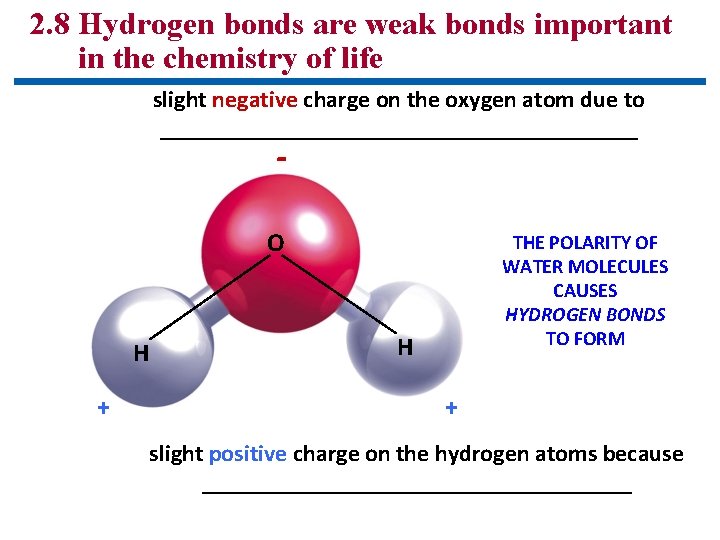
2. 8 Hydrogen bonds are weak bonds important in the chemistry of life slight negative charge on the oxygen atom due to ____________________ - O H + THE POLARITY OF WATER MOLECULES CAUSES HYDROGEN BONDS TO FORM H + slight positive charge on the hydrogen atoms because __________________
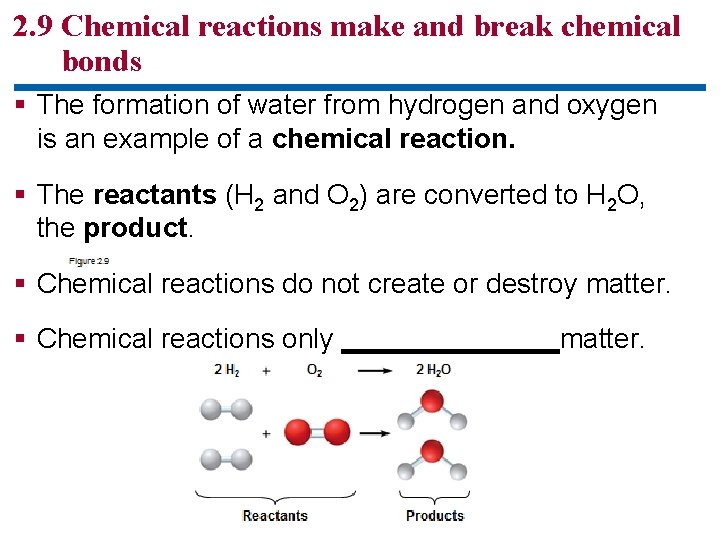
2. 9 Chemical reactions make and break chemical bonds § The formation of water from hydrogen and oxygen is an example of a chemical reaction. § The reactants (H 2 and O 2) are converted to H 2 O, the product. § Chemical reactions do not create or destroy matter. § Chemical reactions only _______matter.
2. 9 Chemical reactions make and break chemical bonds § Photosynthesis is a chemical reaction that is essential to life on Earth. © 2012 Pearson Education, Inc.
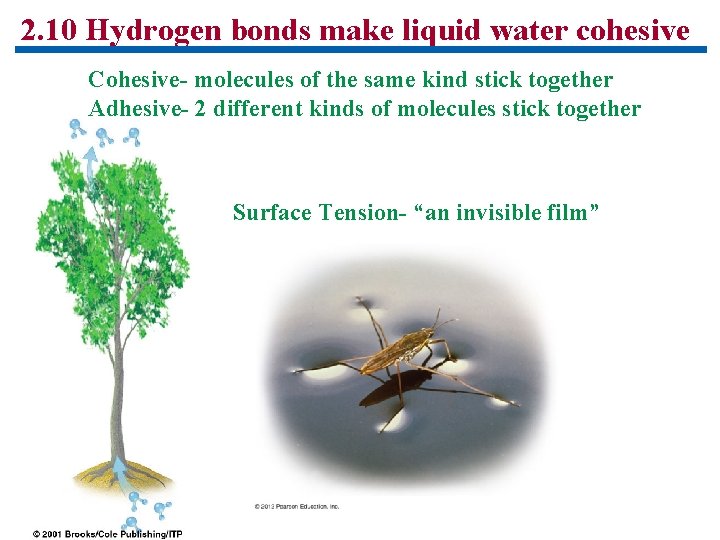
2. 10 Hydrogen bonds make liquid water cohesive Cohesive- molecules of the same kind stick together Adhesive- 2 different kinds of molecules stick together Surface Tension- “an invisible film”
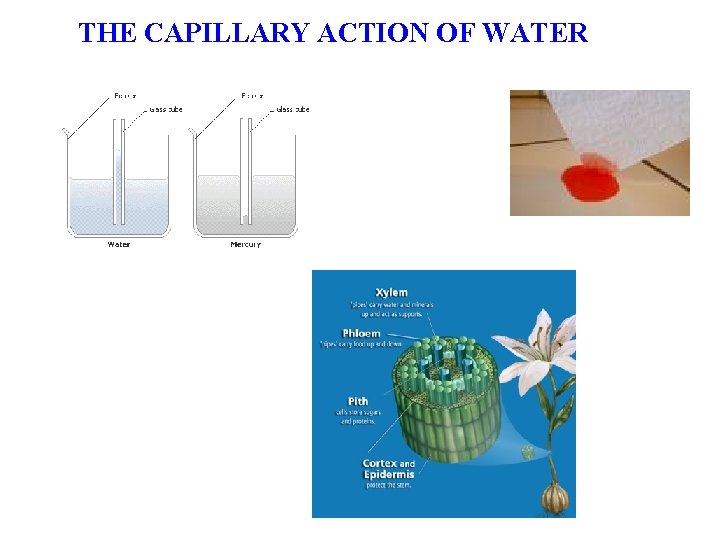
THE CAPILLARY ACTION OF WATER
2. 11 Water’s hydrogen bonds moderate temperature 2. 13 Water is the solvent of life © 2012 Pearson Education, Inc.
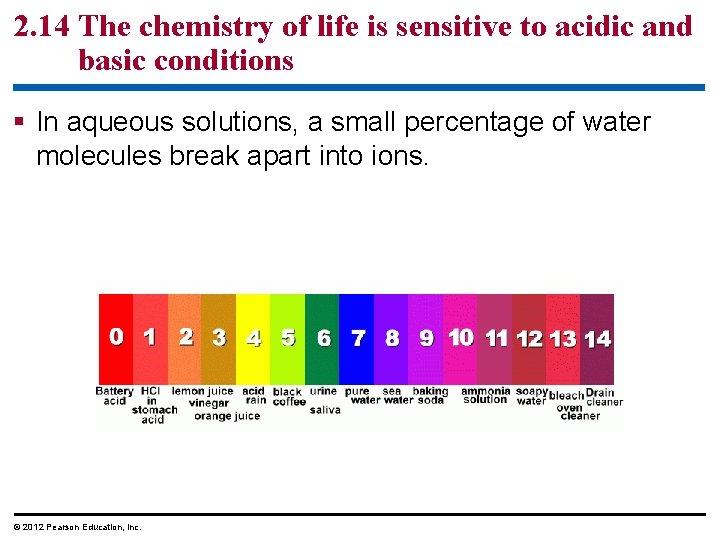
2. 14 The chemistry of life is sensitive to acidic and basic conditions § In aqueous solutions, a small percentage of water molecules break apart into ions. © 2012 Pearson Education, Inc.
2. 15 CONNECTION: Acid precipitation and ocean acidification threaten the environment § When we burn fossil fuels (coal, oil, and gas), airpolluting compounds and CO 2 are released into the atmosphere. – Sulfur and nitrous oxides react with water in the air to form acids. – These acids fall to Earth as acid precipitation, which is rain, snow, or fog with a p. H lower than 5. 2. – CO 2 dissolving in seawater lowers ocean p. H in a process known as ocean acidification. © 2012 Pearson Education, Inc.
2. 16 EVOLUTION CONNECTION: The search for extraterrestrial life centers on the search for water § The emergent properties of water support life on Earth. § When astrobiologists search for signs of extraterrestrial life on distant planets, they look for evidence of water. § The National Aeronautics and Space Administration (NASA) has found evidence that water was once abundant on Mars. © 2012 Pearson Education, Inc.
You should now be able to 1. Name the most common chemical elements in organisms. 2. Explain the formation of compounds. 3. Describe the structure of an atom. Be able to describe/draw an atom for any element. 4. Distinguish between ionic, hydrogen, and covalent bonds. 5. Define a chemical reaction and explain how it changes the composition of matter. © 2012 Pearson Education, Inc.
You should now be able to 6. List and define the life-supporting properties of water. 7. Explain the p. H scale and the formation of acid and base solutions. 8. Define these terms: compound, molecule, element, isotope, radioactive isotope, reactant, product © 2012 Pearson Education, Inc.
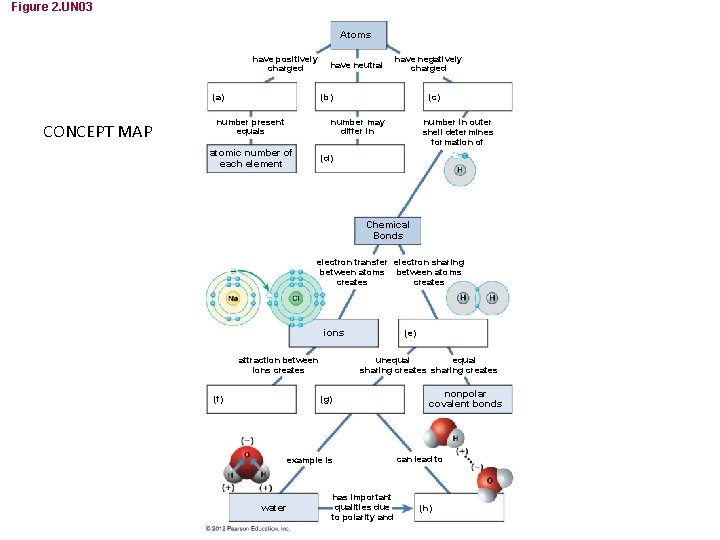
Figure 2. UN 03 Atoms have positively charged (a) CONCEPT MAP have neutral have negatively charged (b) number present equals (c) number may differ in atomic number of each element number in outer shell determines formation of (d) Chemical Bonds electron transfer electron sharing between atoms creates ions attraction between ions creates (e) unequal sharing creates (g) (f) example is water has important qualities due to polarity and nonpolar covalent bonds can lead to (h)
- Slides: 29