
Chapter 2 Life Skills Learning Objectives List the
Chapter 2 Life Skills
Learning Objectives • List the principles that contribute to personal and professional success. • Create a mission statement. • Explain long-term and short-term goals. • Discuss the most effective ways to manage time. • Demonstrate good study habits. • Define ethics. • List the characteristics of a healthy, positive attitude.
Introduction • Learning and applying sound life skills are important. • In the salon you are expected to exercise artistic talent, exceptional communication, decisionmaking, image-building, customer service, selfactualization, goal-setting, and time management skills. • These life skills are the foundation of success.
Life Skills In Action Important Life Skills for a Satisfying Career • Being caring and helpful. • Making good friends. • Feeling good about oneself. • Having a sense of humor. • Maintaining a cooperative attitude. • Approaching work with a strong sense of responsibility. (continues)
Life Skills In Action (continued) • Being consistent in your work. • Adapting successfully to different situations. • Sticking to a goal and seeing a job through to completion. • Mastering techniques to become more organized. • Developing sound decision-making skills.
![[insert student activity icon here]](http://slidetodoc.com/presentation_image_h2/75d5b74c535eb19e0c910501a422e0df/image-6.jpg "[insert student activity icon here]")
[insert student activity icon here]
Interpret the Psychology of Success Self Actualization • Fulfilling one’s full potential, requires lifelong commitment. Action Steps for Success • Build self-esteem. • Visualize success. • Build on your strengths. • Be kind to yourself. (continues)
Interpret the Psychology of Success (continued) • Stay true to yourself. • Practice new behaviors. • Keep personal life separate from work. • Keep your energy up. • Respect others. • Stay productive. (continues)
Interpret the Psychology of Success (continued) Three bad habits: • Procrastination • Perfectionism • Lack of a game plan
Motivation and Self-Management • Motivation and self-management skills will help you move to the next level in your career. • To be successful, you must feel a sense of personal excitement and a good reason for staying the course. • You are the one in charge of managing your own life and learning. To do this successfully, use creativity.
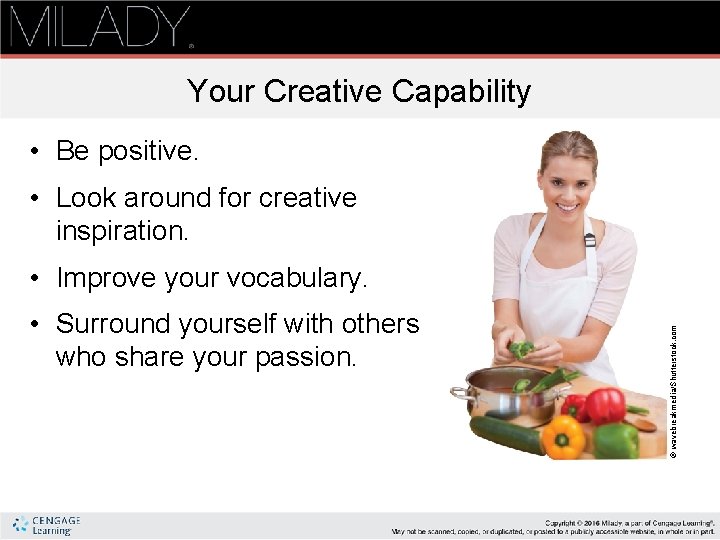
Your Creative Capability • Be positive. • Look around for creative inspiration. • Surround yourself with others who share your passion. © wavebreakmedia/Shutterstock. com • Improve your vocabulary.
Design a Mission Statement A mission statement establishes the purpose and values for which an individual or institution lives and works by.
![[Insert student activity icon here]](http://slidetodoc.com/presentation_image_h2/75d5b74c535eb19e0c910501a422e0df/image-13.jpg "[Insert student activity icon here]")
[Insert student activity icon here]
Set Goals • Goal setting is the identification of long-term and short term goals. • Once goals have been established, build a plan for achieving them.
How Goal Setting Works Short-term Goals • Short-term goals are usually accomplished in one year or less. Long-term Goals • Long-term goals usually take more than a year to accomplish. They are often measured in increments of two, five, and ten years or more. • Write goals down in short-term and long-term columns and divide each into workable segments. Have a plan, and reexamine it often to stay on track.
Demonstrate Time Management 1. Prioritize. 3. Don’t take on too much. 4. Learn and use problem solving techniques. 5. Plan downtime. 6. Carry a notepad, organizer, tablet, or other digital application. © Caroline Eibl/Shutterstock. com 2. Personalize your system. (continues)
Demonstrate Time Management (continued) 7. Make schedules. 8. Identify the best times for productivity and relaxation. 9. Reward yourself. 10. Plan exercise. 11. Schedule a block of free time daily. 12. Use to-do lists. 13. Make time management a habit.
Employ Successful Learning Tools • Attend all classes. • Arrive for class early. • Have all necessary materials ready. • Listen attentively to your instructor. • Take notes. • Highlight important points. • Pay attention during summary and review sessions. • Ask for clarification.
Establishing Good Study Habits When preparing to study • Focus on small tasks one at a time. • Study in smaller chunks of time. • Write down key words or phrases as your instructor discusses them, and use these as a study tool. • If you are confused about anything, stay after class and ask questions based on your notes. • Create or join a study group. (continues)
Establishing Good Study Habits (continued) Part of developing good study habits is knowing: • Where • When • How (continues)
Practice Ethical Standards Ethics • Moral principles by which we live and work. • Guide your conduct with clients and fellow employees. (continues)
Practice Ethical Standards (continued) Practice ethical behavior in the salon by employing these five professional actions: 1. Provide skilled and competent services 2. Be honest, courteous, and sincere 3. Keep client confidences 4. Participate in continuing education 5. Give clients accurate information about treatments and products
Develop a Positive Personality and Attitude • Diplomacy • Pleasing tone of voice • Emotional stability • Sensitivity • Values and goals • Receptivity • Effective communication skills
Summary and Review • Use your time effectively! • Attitudes and perceptions shape the condition of our life. • School is the perfect time to practice the skills and concepts that will take you successfully through life!
Chapter Review Questions 1. What principles contribute to personal and professional success? 2. How do you create a mission statement? (Give an example. ) 3. How do you go about setting long- and short-term goals? (continues)
Chapter Review Questions (continued) 4. What are some of the most effective ways to manage time? 5. How do you describe good study habits? 6. What is the definition of ethics? 7. What are the characteristics of a healthy, positive attitude?
- Slides: 26