
CHAPTER 2 Lesson 1 Matter and Its Properties
- Slides: 24
CHAPTER 2 Lesson 1: Matter and Its Properties
Standards • 7. PS 1. 5 - Use the periodic table as a model to analyze and interpret evidence relating to physical and chemical properties to identify a sample of matter.
Essential Questions • How do particles move in solids, liquids, and gases? • How are physical properties different from chemical properties? • How are properties used to identify a substance?
Vocabulary • Chemical property - ability or inability of a substance to combine with or change into one or more new substances • Density - mass per unit volume of a substance • Gas - state of matter with no definite shape or volume
Vocabulary • Liquid - state of matter with definite volume but not definite shape • Mass - amount of matter in an object • Matter - anything that has mass and takes up space
Vocabulary • Physical property - any characteristic of a material that you can observe without changing the identity of the material • Solid - state of matter with definite shape and volume • Solubility - ability of one material to dissolve in another
Vocabulary • State - condition or physical property of matter • Volume - amount of space a material occupies
What are the properties? • What are the properties of this ball? • Raise your hand please!
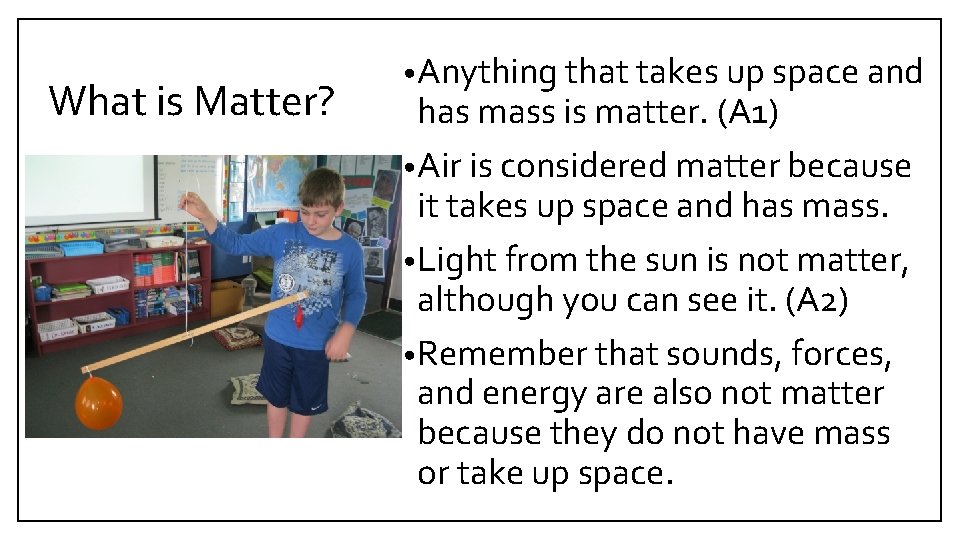
What is Matter? • Anything that takes up space and has mass is matter. (A 1) • Air is considered matter because it takes up space and has mass. • Light from the sun is not matter, although you can see it. (A 2) • Remember that sounds, forces, and energy are also not matter because they do not have mass or take up space.
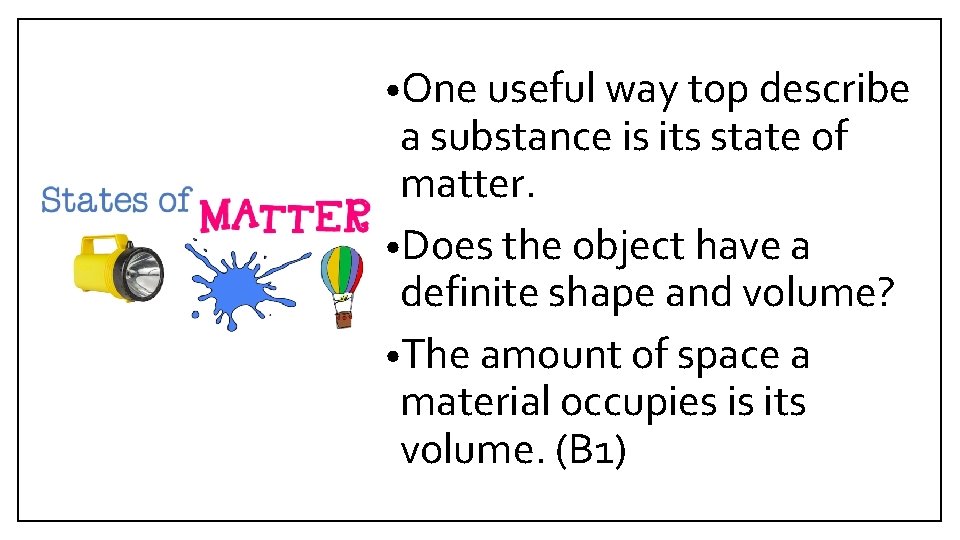
• One useful way top describe a substance is its state of matter. • Does the object have a definite shape and volume? • The amount of space a material occupies is its volume. (B 1)
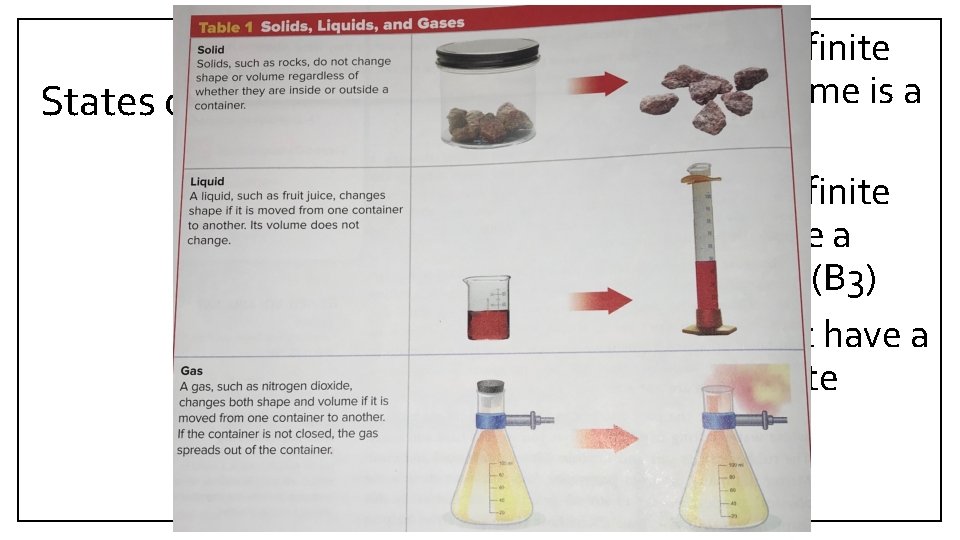
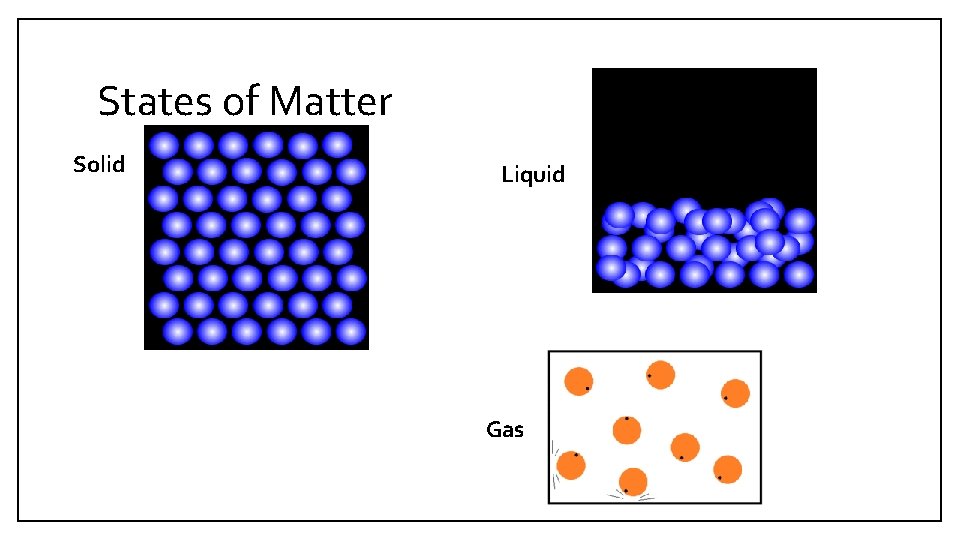
• Any matter that has a definite States of Matter shape and a definite volume is a solid. (B 2) • Any matter that has a definite volume but does not have a definite shape is a liquid. (B 3) • Any matter that does not have a definite shape or a definite volume is a gas. (B 4) • Page 42, Table 1
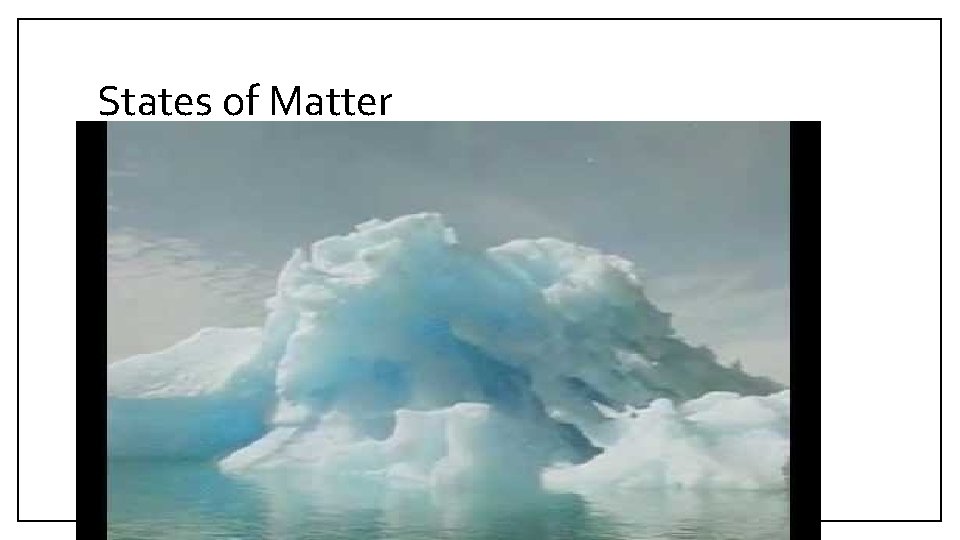
States of Matter
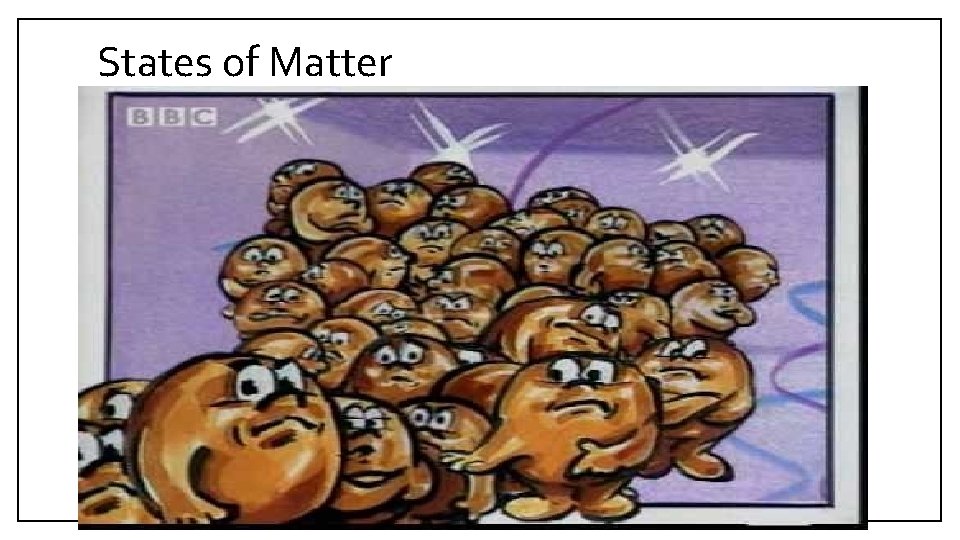
States of Matter • All matter is formed of tiny particles that are constantly moving. (B 5) • The particles in a solid stay in one place but move quickly back and forth in all directions. (B 5 a) • The particles in a liquid can slide past one another. (B 5 b) • The particles in a gas move freely. (B 5 c) • The particles in matter attract one another. (B 6)
States of Matter Solid Liquid Gas
States of Matter
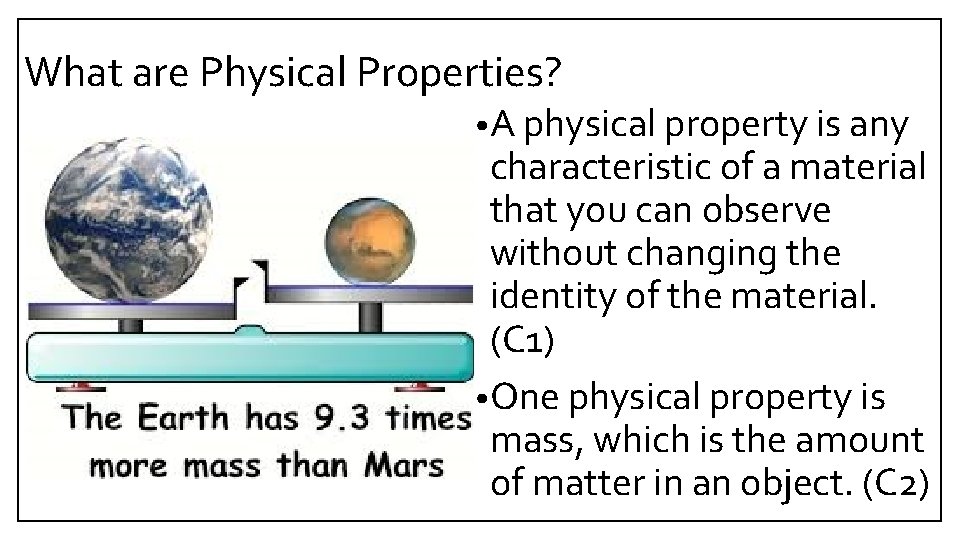
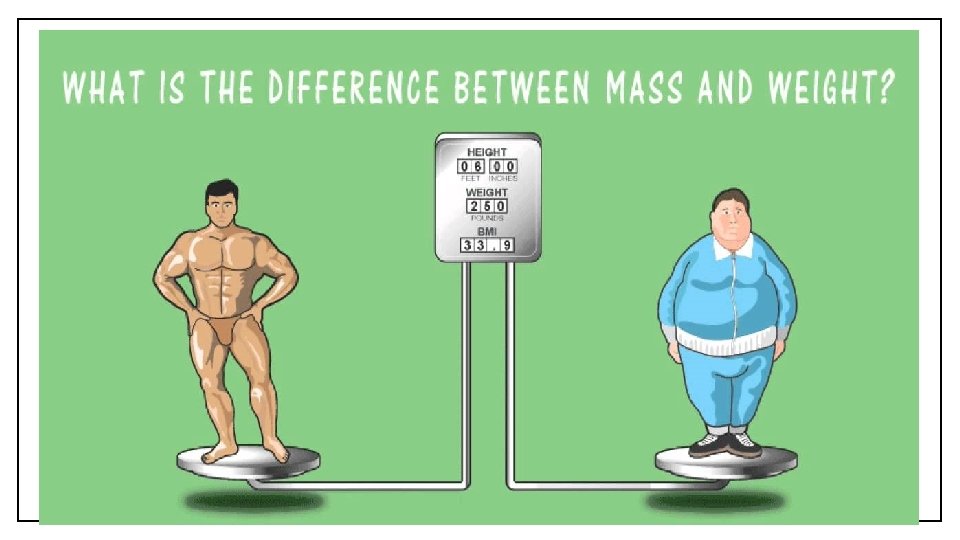
What are Physical Properties? • A physical property is any characteristic of a material that you can observe without changing the identity of the material. (C 1) • One physical property is mass, which is the amount of matter in an object. (C 2)
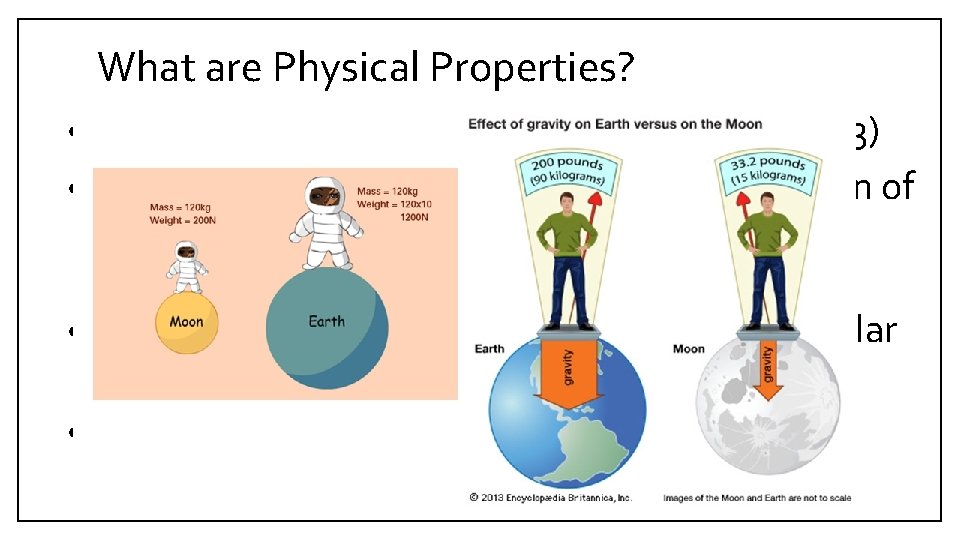
What are Physical Properties? • Weight is the gravitational pull on an object. (C 3) • The weight of an object depends on the location of an object; for example, objects weigh more on Earth than on the Moon. (C 4) • Multiply the length, width, and height of a regular object to calculate its volume. (C 5) • The mass per unit volume of a substance is its density. (C 6)
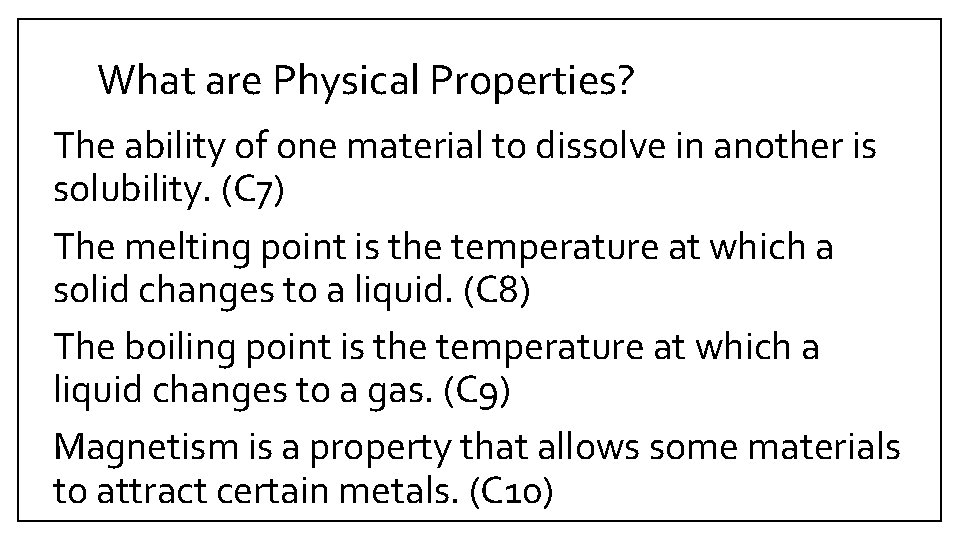
What are Physical Properties? The ability of one material to dissolve in another is solubility. (C 7) The melting point is the temperature at which a solid changes to a liquid. (C 8) The boiling point is the temperature at which a liquid changes to a gas. (C 9) Magnetism is a property that allows some materials to attract certain metals. (C 10)
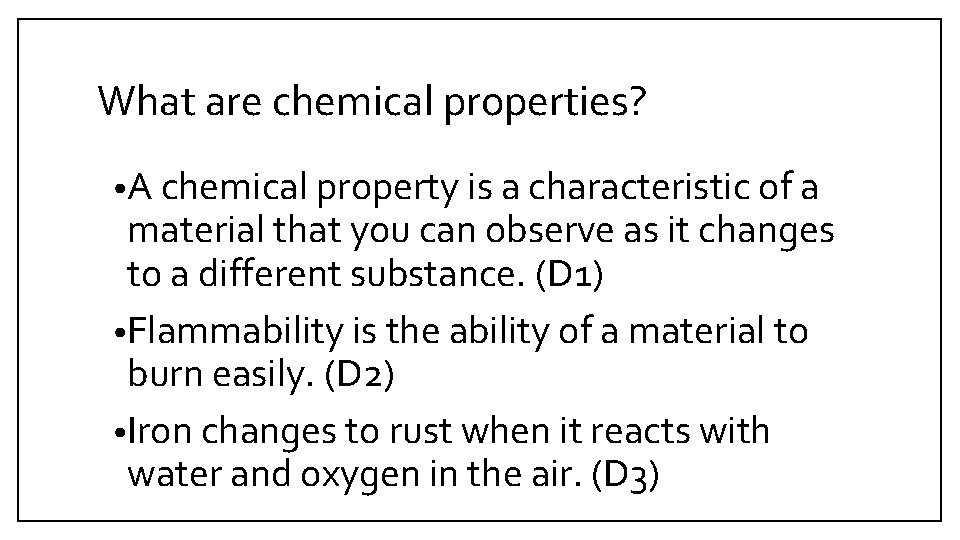
What are chemical properties? • A chemical property is a characteristic of a material that you can observe as it changes to a different substance. (D 1) • Flammability is the ability of a material to burn easily. (D 2) • Iron changes to rust when it reacts with water and oxygen in the air. (D 3)
Identifying Matter Using Physical Properties • Melting and boiling points do not depend on the amount of the material, so they are good properties for identifying unknown substances. (E 1) • Sometimes you have to observe more than one property to identify an unknown material. (E 2)
Sorting Materials Using Properties • Physical properties and chemical properties are useful for sorting materials. (F 1) • An example of a chemical property is the tendency for milk or yogurt to spoil. (F 2)
Separating Mixtures Using Physical Properties • You can separate mixed materials by melting or boiling the mixture. (G 1) • You can separate some mixed materials using a magnet to attract some materials and not others. (G 2)