
Chapter 2 Lecture Pearson Physics Introduction to Motion

- Slides: 27
Chapter 2 Lecture Pearson Physics Introduction to Motion Prepared by Chris Chiaverina © 2014 Pearson Education, Inc.
Chapter Contents • • Describing Motion Speed and Velocity Position-Time Graphs Equation of Motion © 2014 Pearson Education, Inc.
Describing Motion • A frame of reference is referred to as a coordinate system. • A coordinate system in one dimension is represented by an x axis with the origin located at x = 0. • Once an origin and a positive direction are chosen, they must be used consistently. © 2014 Pearson Education, Inc.
Describing Motion • The letter x is used to label position. • An arrow drawn from the origin of a coordinate system to an object is referred to as the object's position vector. • Whenever an object is in motion, its position is changing. © 2014 Pearson Education, Inc.
Describing Motion • Initial and final positions are indicated with xi and xf, respectively. © 2014 Pearson Education, Inc.
Describing Motion • Distance is the total length of the path taken on a trip. – No direction is associated with distance. It is a scalar quantity. – The SI unit of distance is the meter (m). – When walking, distance is measured with a pedometer. – In a car, the distance is measured using an odometer. © 2014 Pearson Education, Inc.
Describing Motion • Displacement is defined as an object's change in position. – Displacement is a vector having both magnitude and direction. – The SI unit of displacement is the meter (m). – The sign of the displacement vector indicates the direction of motion. Motion in the positive direction has a positive displacement. Motion in the negative direction produces a negative displacement. © 2014 Pearson Education, Inc.
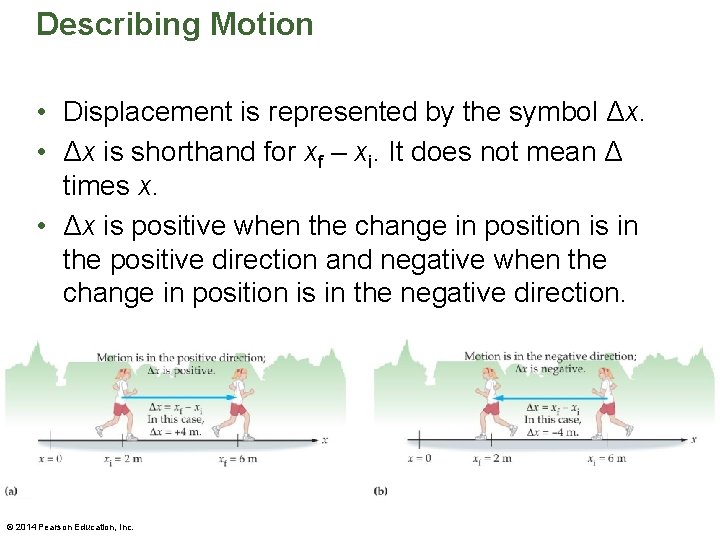
Describing Motion • Displacement is represented by the symbol Δx. • Δx is shorthand for xf – xi. It does not mean Δ times x. • Δx is positive when the change in position is in the positive direction and negative when the change in position is in the negative direction. © 2014 Pearson Education, Inc.
Describing Motion • Distance is the total length traveled; displacement is the net change in position. • An object's displacement is zero when it returns to its starting point, even though it may have traveled a considerable distance. © 2014 Pearson Education, Inc.
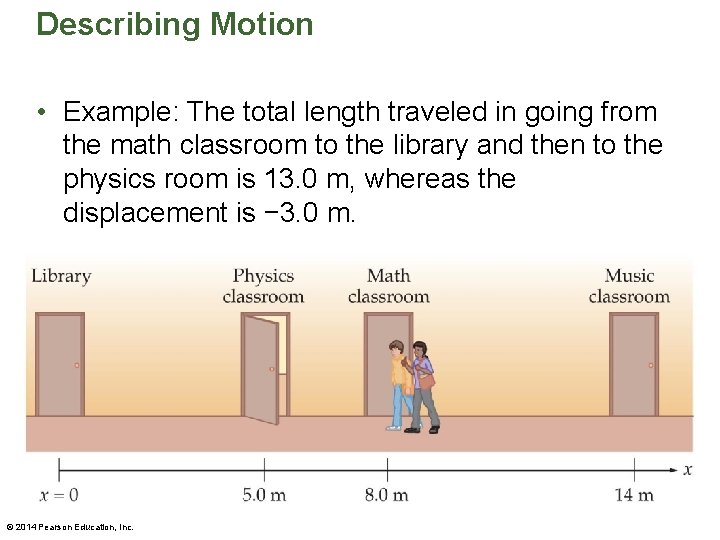
Describing Motion • Example: The total length traveled in going from the math classroom to the library and then to the physics room is 13. 0 m, whereas the displacement is − 3. 0 m. © 2014 Pearson Education, Inc.
Speed and Velocity • The rate of motion is referred to as speed. • Speed describes how fast or slow something moves. • The average speed is defined as the distance traveled divided by the elapsed time: average speed = distance/elapsed time • The SI units of average speed are meters per second (m/s). • Like distance, average speed is always positive. © 2014 Pearson Education, Inc.
Speed and Velocity • An object's average velocity is defined as its displacement per unit time: average velocity = displacement/elapsed time • The SI units of average velocity are meters per second (m/s). • The average velocity describes, on average, how fast something is moving as well as the average direction in which the object is moving. • An object moving in the positive direction has a positive average velocity. An object moving in the negative direction has a negative average velocity. © 2014 Pearson Education, Inc.
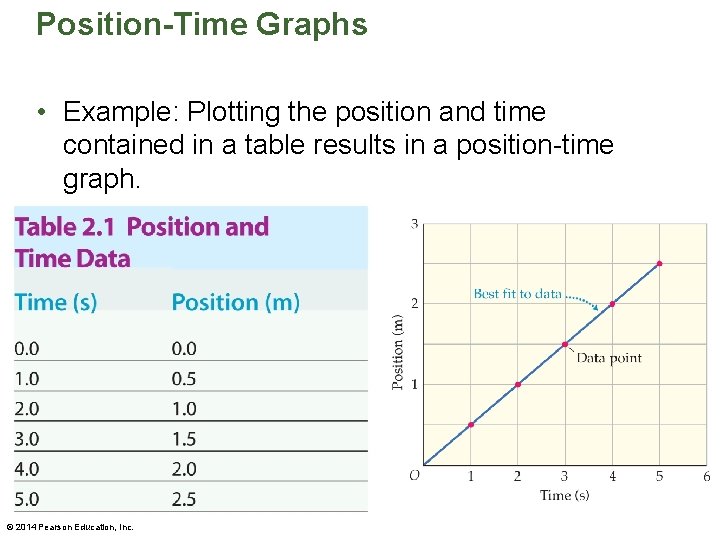
Position-Time Graphs • A position-time graph is an alternative way of representing data in a table. • On a position-time graph, position data are plotted on the y axis; time data are plotted on the x axis. © 2014 Pearson Education, Inc.
Position-Time Graphs • Example: Plotting the position and time contained in a table results in a position-time graph. © 2014 Pearson Education, Inc.
Position-Time Graphs • A best-fit line drawn through data points can be used to learn additional information about an object's motion. © 2014 Pearson Education, Inc.
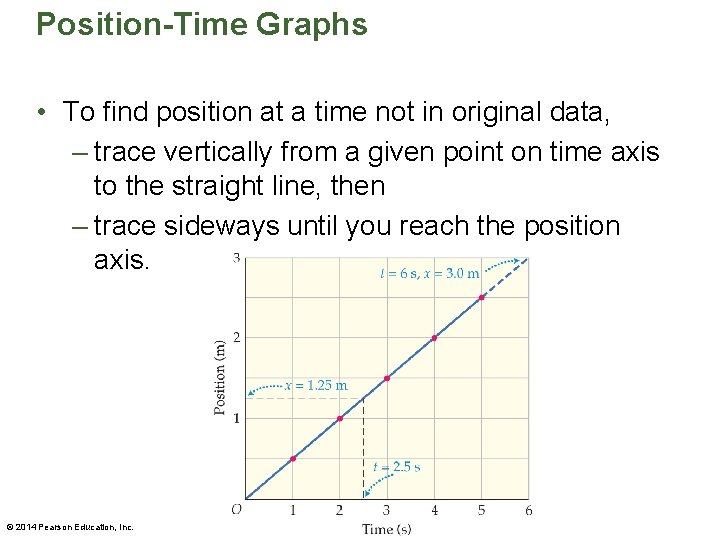
Position-Time Graphs • To find position at a time not in original data, – trace vertically from a given point on time axis to the straight line, then – trace sideways until you reach the position axis. © 2014 Pearson Education, Inc.
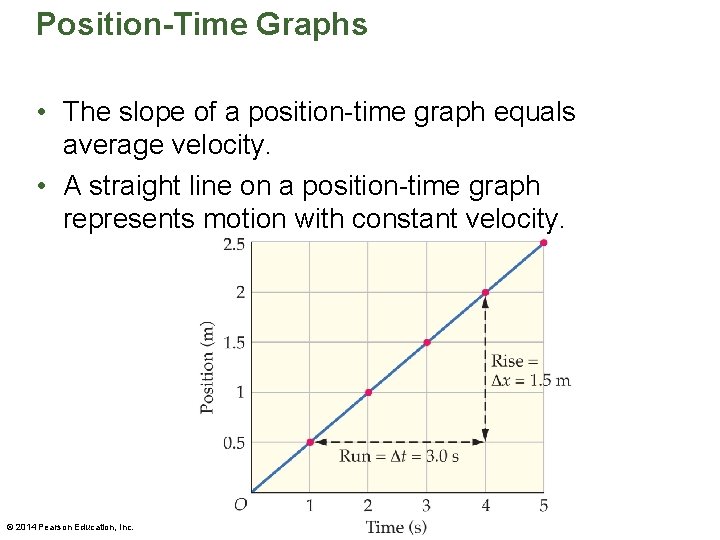
Position-Time Graphs • The slope of a straight line is equal to its rise over its run. • Any two points may be used to calculate the slope of a straight line. • On a position-time graph the rise corresponds to the an object's position and the run to the elapsed time. © 2014 Pearson Education, Inc.
Position-Time Graphs • The slope of a position-time graph equals average velocity. • A straight line on a position-time graph represents motion with constant velocity. © 2014 Pearson Education, Inc.
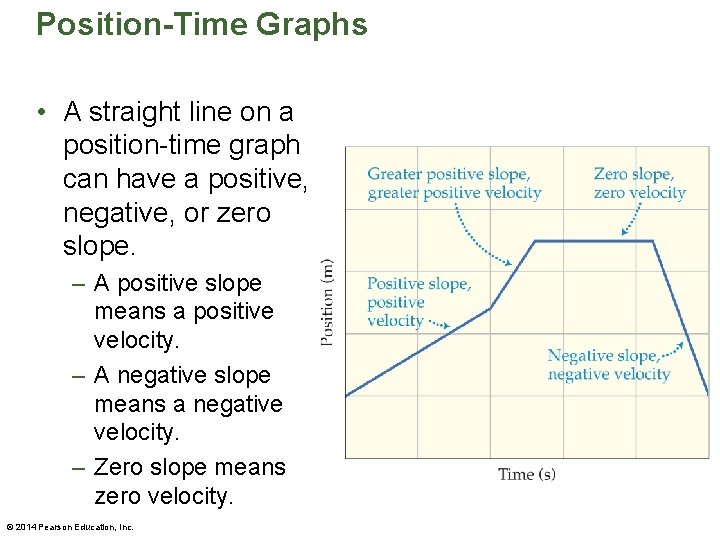
Position-Time Graphs • A straight line on a position-time graph can have a positive, negative, or zero slope. – A positive slope means a positive velocity. – A negative slope means a negative velocity. – Zero slope means zero velocity. © 2014 Pearson Education, Inc.
Position-Time Graphs • The greater the slope of a position-time graph, the greater the velocity. • The slope of a tangent line to a position-time graph at a given instant equals the instantaneous velocity. © 2014 Pearson Education, Inc.
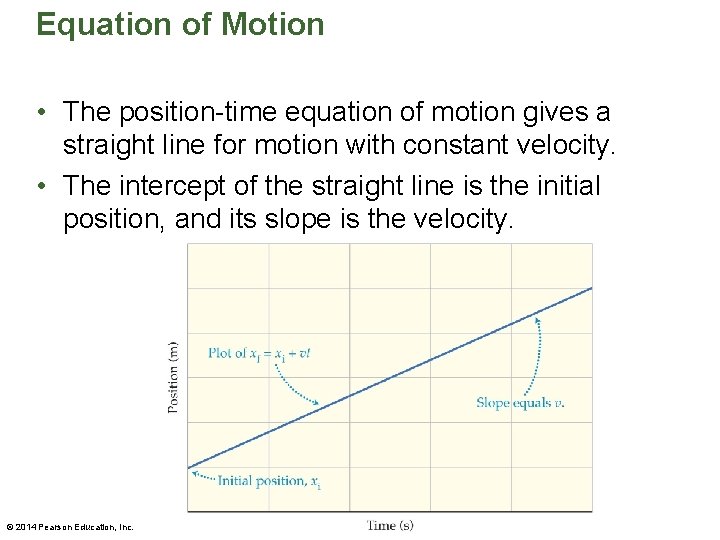
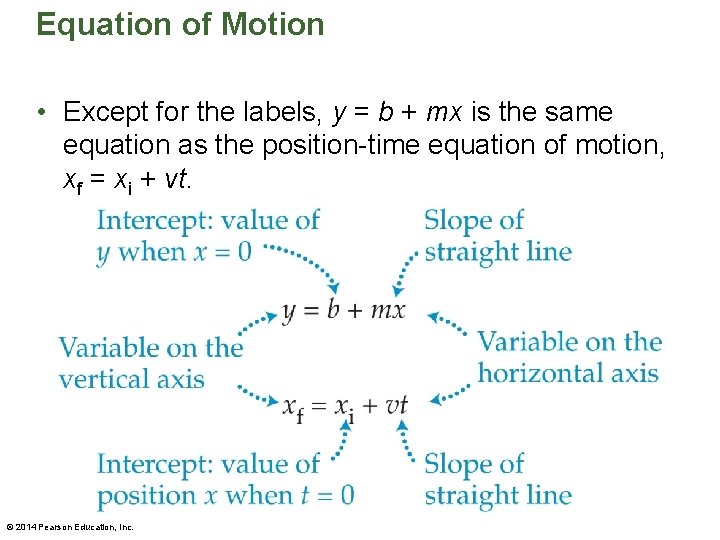
Equation of Motion • The position-time equation of motion gives an object's position x at any time t if its initial position and constant velocity are known. • The position-time equation states that final position = initial position + (velocity)(elapsed time), or xf = xi + vt. © 2014 Pearson Education, Inc.
Equation of Motion • The position-time equation of motion gives a straight line for motion with constant velocity. • The intercept of the straight line is the initial position, and its slope is the velocity. © 2014 Pearson Education, Inc.
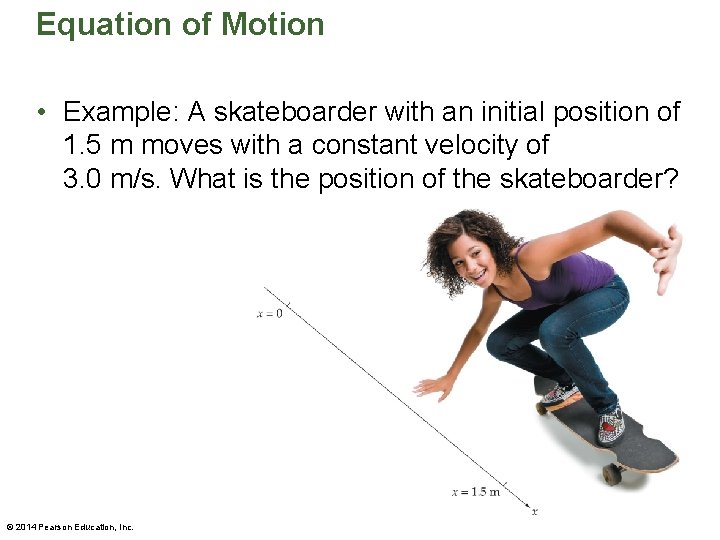
Equation of Motion • Example: A skateboarder with an initial position of 1. 5 m moves with a constant velocity of 3. 0 m/s. What is the position of the skateboarder? © 2014 Pearson Education, Inc.
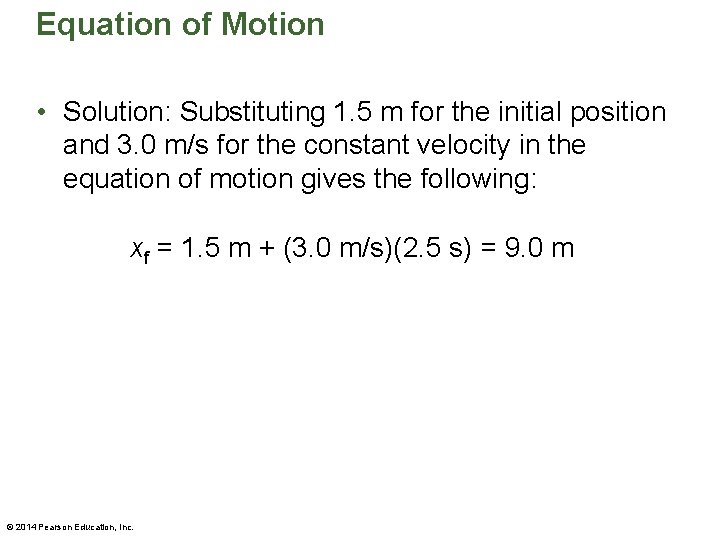
Equation of Motion • Solution: Substituting 1. 5 m for the initial position and 3. 0 m/s for the constant velocity in the equation of motion gives the following: xf = 1. 5 m + (3. 0 m/s)(2. 5 s) = 9. 0 m © 2014 Pearson Education, Inc.
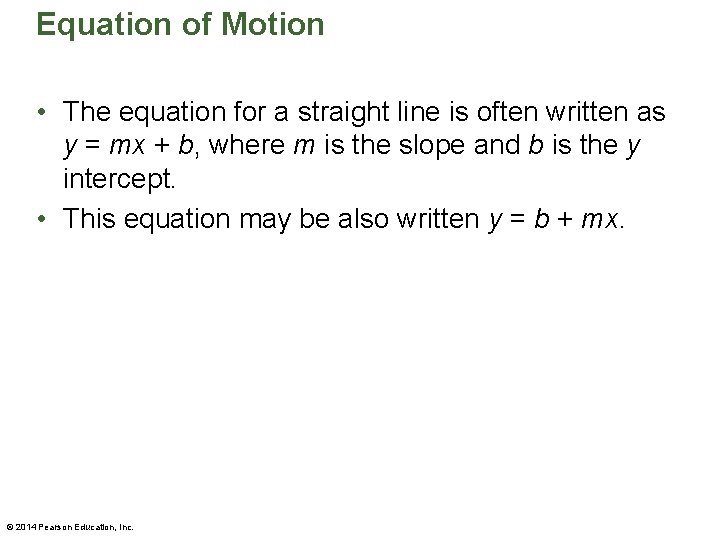
Equation of Motion • The equation for a straight line is often written as y = mx + b, where m is the slope and b is the y intercept. • This equation may be also written y = b + mx. © 2014 Pearson Education, Inc.
Equation of Motion • Except for the labels, y = b + mx is the same equation as the position-time equation of motion, xf = xi + vt. © 2014 Pearson Education, Inc.
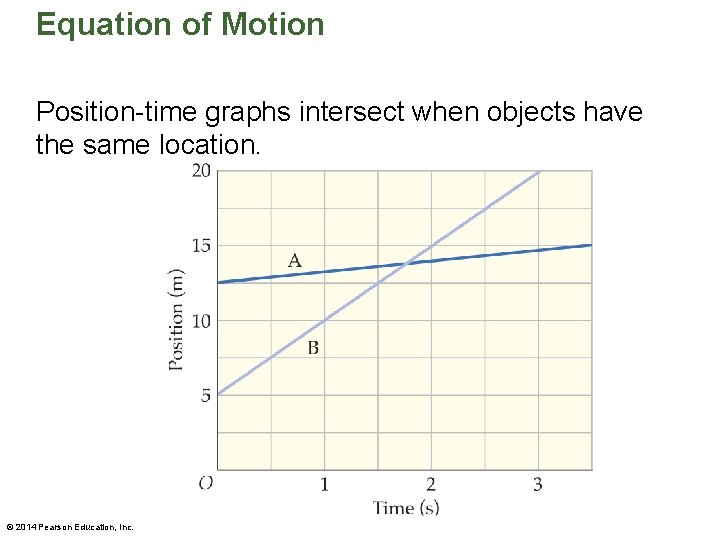
Equation of Motion Position-time graphs intersect when objects have the same location. © 2014 Pearson Education, Inc.