
Chapter 2 Lecture Essential Chemistry for Biology Power
Chapter 2 Lecture Essential Chemistry for Biology Power. Point® Lectures created by Edward J. Zalisko for Campbell Essential Biology, Seventh Edition, and Campbell Essential Biology with Physiology, Sixth Edition – Eric J. Simon, Jean L. Dickey, and Jane B. Reece © 2019 Pearson Education, Inc.
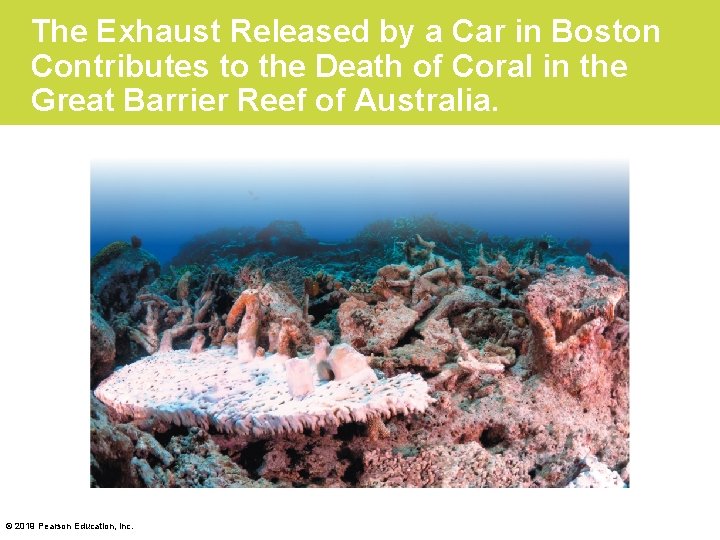
The Exhaust Released by a Car in Boston Contributes to the Death of Coral in the Great Barrier Reef of Australia. © 2019 Pearson Education, Inc.
Biology and Society: Nuclear Medicine • Radioactivity, the emission of high-energy particles, can kill cells by damaging DNA. • Radiation can also be medically beneficial, helping to treat cancer. • Radiation therapy exposes only a small part of the body to a precise dosage of radiation. • Knowledge of chemistry is essential to understanding biology. © 2019 Pearson Education, Inc.
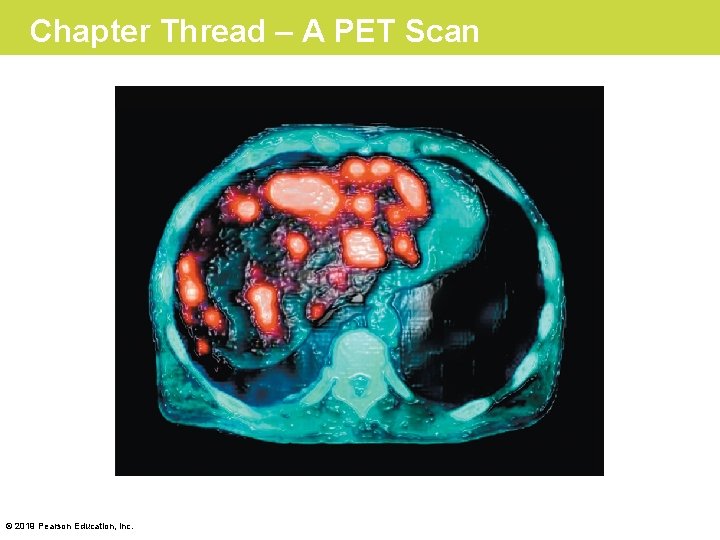
Chapter Thread – A PET Scan © 2019 Pearson Education, Inc.
Matter: Elements and Compounds • Take any biological system apart, and you eventually end up at the chemical level. – Matter is anything that occupies space and has mass. – Mass is a measure of the amount of material in an object. – Weight is the attraction of one object by another. – An element is a substance that cannot be broken down into other substances by chemical reactions. – All matter is composed of chemical elements. © 2019 Pearson Education, Inc.
Matter: Elements and Compounds • Metabolism is the sum of all chemical reactions that occur in a cell (e. g. bacterium) or an organism © 2019 Pearson Education, Inc.
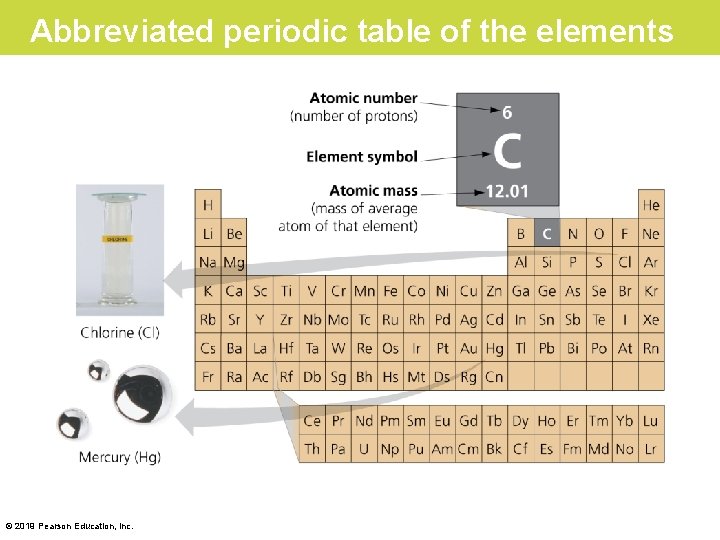
Abbreviated periodic table of the elements © 2019 Pearson Education, Inc.
Matter: Elements and Compounds (Cont. ) • Of the 92 naturally occurring elements, 25 are essential to people. – Four of these elements make up about 96% of the weight of the body. (Carbon, Nitrogen, Oxygen, Hydrogen) – Trace elements are required in only very small amounts and are essential for life. – Elements can combine to form compounds, substances that contain two or more elements in a fixed ratio. © 2019 Pearson Education, Inc.
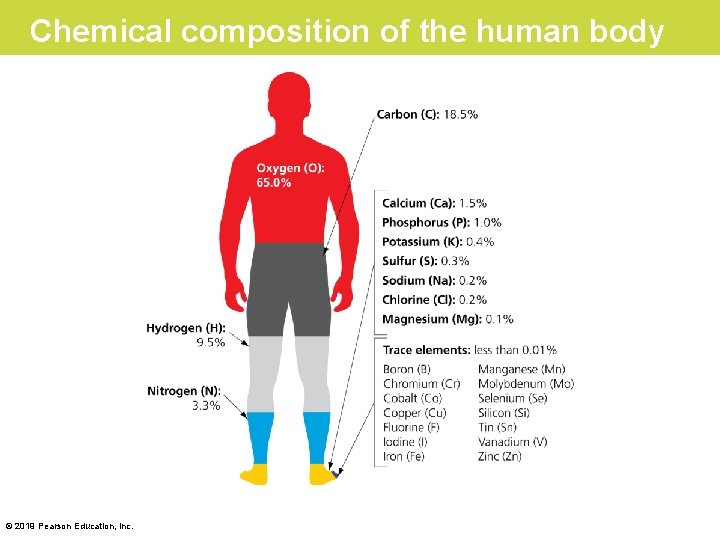
Chemical composition of the human body © 2019 Pearson Education, Inc.
Matter: Elements and Compounds (Cont. ) • Iodine is required by the thyroid gland to make a hormone called thyroxine • Overactive thyroid – hyperthyroidism – is treated by using radioactive iodine to destroy this tissue • Underproduction of thyroxine – hypothyroidism – results in a large bulge in the neck called a goiter. © 2019 Pearson Education, Inc.
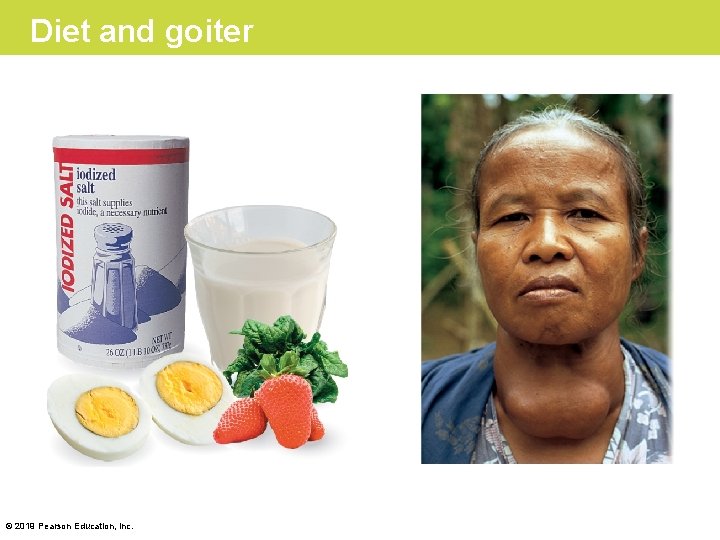
Diet and goiter © 2019 Pearson Education, Inc.
Matter: Elements and Compounds (Cont. ) • Flourine is required for strong teeth and bones • It is added to dental products and drinking water © 2019 Pearson Education, Inc.
Matter: Elements and Compounds (Cont. ) • Elements can combine to form compounds, substances that contain two or more elements in a fixed ratio. • Na. Cl – sodium chloride or table salt • H 2 O – water • CO 2 – carbon dioxide • C 6 H 12 O 6 – glucose (a simple sugar molecule) © 2019 Pearson Education, Inc.
Atoms • Each element consists of one kind of atom. • An atom is the smallest unit of matter that still retains the properties of an element. • Atoms are composed of subatomic particles. – A proton is positively charged. – An electron is negatively charged. – A neutron is electrically neutral. © 2019 Pearson Education, Inc.
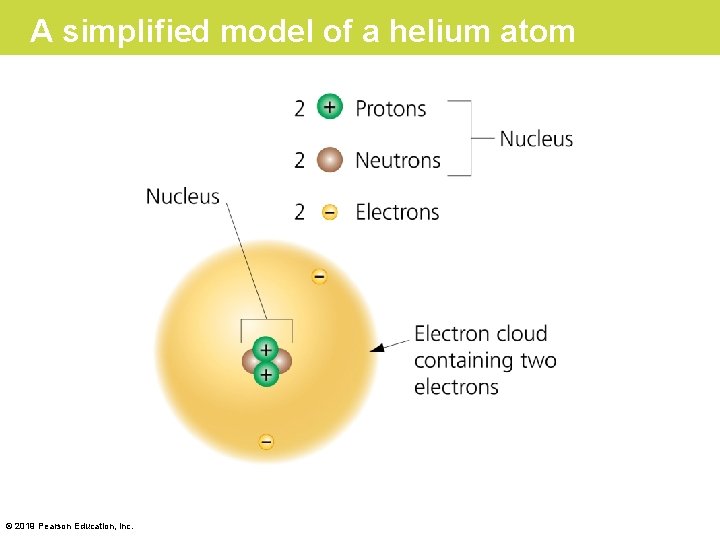
A simplified model of a helium atom © 2019 Pearson Education, Inc.
Atoms (Cont. ) • All atoms of a particular element have the same unique number of protons. This number is the element’s atomic number. • An atom’s mass number is the sum of the number of protons and neutrons in its nucleus. – Isotopes have the same number of protons and behave identically in chemical reactions, but they have different numbers of neutrons. – A radioactive isotope is one in which the nucleus decays spontaneously. © 2019 Pearson Education, Inc.
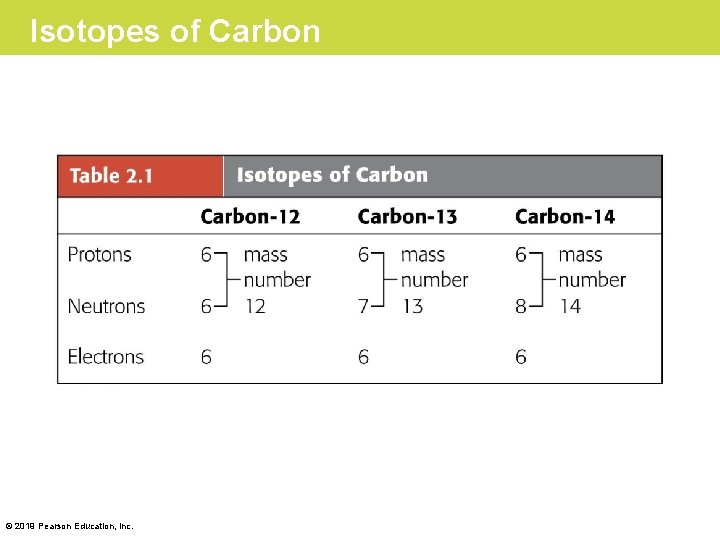
Isotopes of Carbon © 2019 Pearson Education, Inc.
The Process of Science: How Effective is Radiation in Treating Prostate Cancer? • Among American men, prostate cancer is the most frequently diagnosed cancer. • Common treatments are surgery and radiation. • Studies of the effectiveness of different methods, such as surgery and external radiation, are problematic, because the groups of patients are not controlled for all characteristics. • It would be unethical to withhold treatment from cancer patients. © 2019 Pearson Education, Inc.
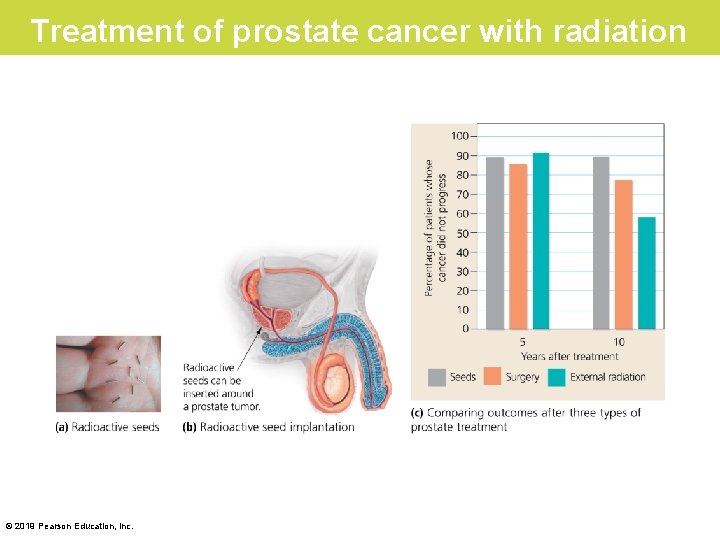
Treatment of prostate cancer with radiation © 2019 Pearson Education, Inc.
Chemical Bonding and Molecules • Only electrons are directly involved in chemical reactions. – The number of electrons in an atom determines the chemical properties of that atom. – Chemical reactions enable atoms to transfer or share electrons. – These interactions usually result in atoms staying close together, held by attractions called chemical bonds. © 2019 Pearson Education, Inc.
Ionic Bonds • When an atom loses or gains electrons, it becomes electrically charged. – Ions are atoms or molecules that are electrically charged as a result of gaining or losing electrons. – Ionic bonds are formed between oppositely charged ions. – Compounds, such as table salt, that are held together by ionic bonds are called ionic compounds. – They are also known as salts. © 2019 Pearson Education, Inc.
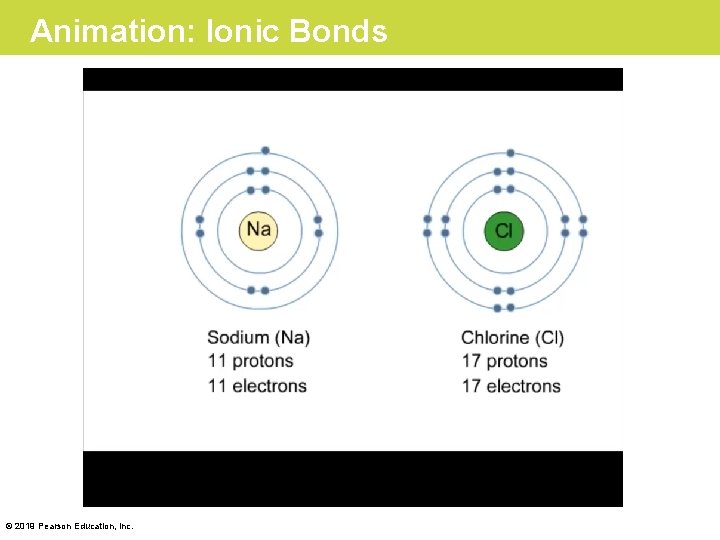
Animation: Ionic Bonds © 2019 Pearson Education, Inc.
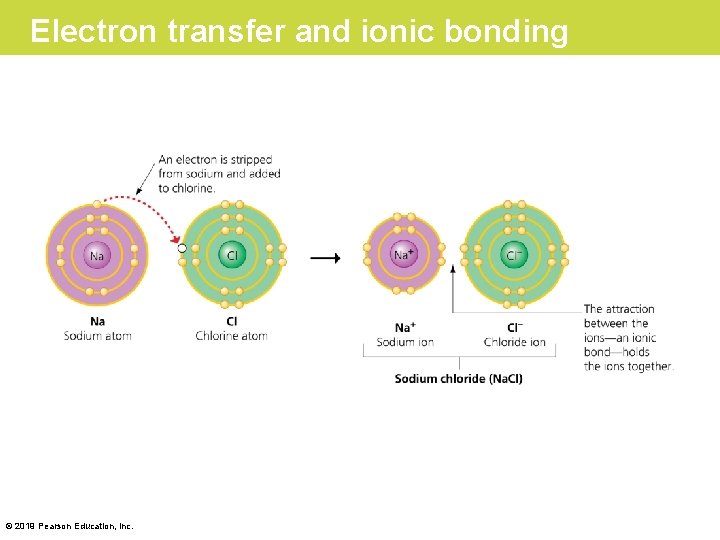
Electron transfer and ionic bonding © 2019 Pearson Education, Inc.
Covalent Bonds • A covalent bond forms when two atoms share one or more pairs of electrons. • Covalent bonds – are the strongest of the various bonds and – hold atoms together in a molecule. © 2019 Pearson Education, Inc.
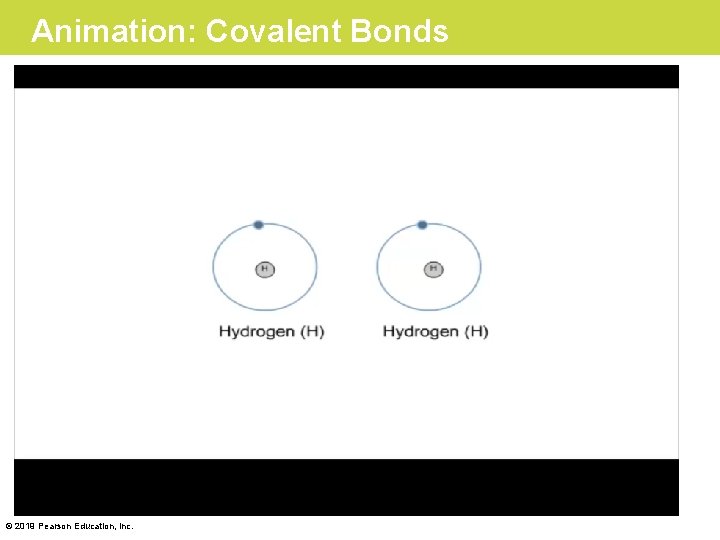
Animation: Covalent Bonds © 2019 Pearson Education, Inc.
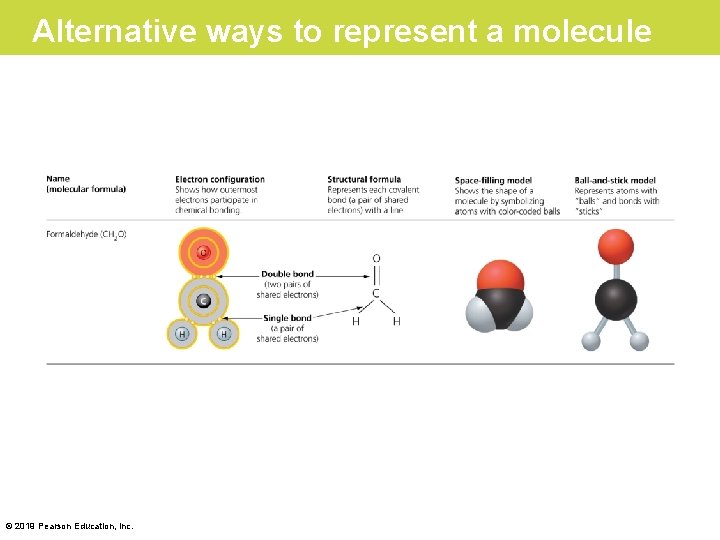
Alternative ways to represent a molecule © 2019 Pearson Education, Inc.
Hydrogen Bonds • A molecule of water (H 2 O) consists of two hydrogen atoms joined to one oxygen atom by covalent bonds. • But the electrons are not shared equally between the oxygen and hydrogen atoms. • This causes water to be a polar molecule, one with an uneven distribution of charge. • The polarity of water results in weak electrical attractions, called hydrogen bonds, between neighboring water molecules. © 2019 Pearson Education, Inc.
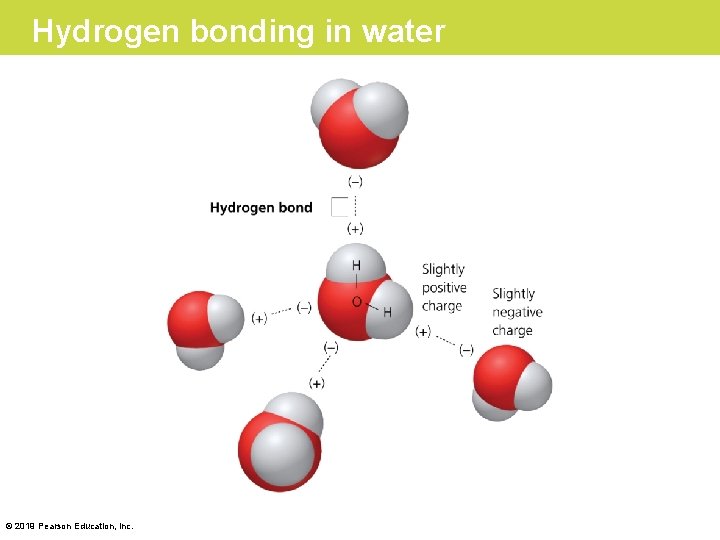
Hydrogen bonding in water © 2019 Pearson Education, Inc.
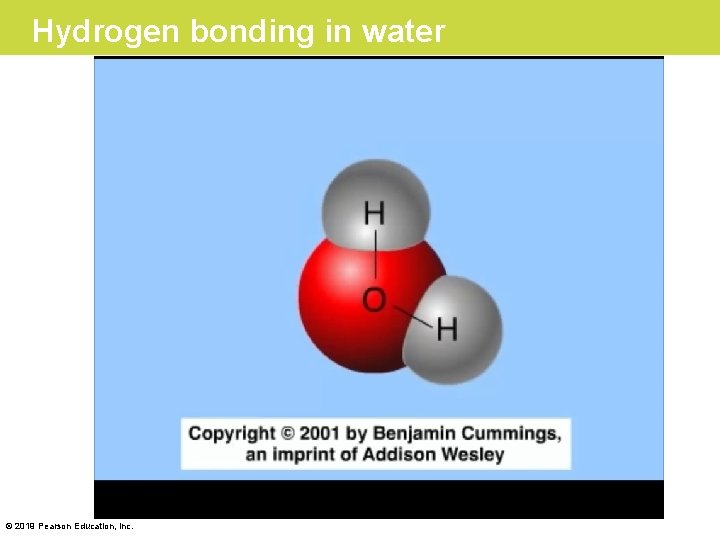
Hydrogen bonding in water © 2019 Pearson Education, Inc.
Hydrogen Bonds https: //www. youtube. com/watch? v=Py. C 5 r 2 m. B 4 d 4 Hydrogen Bonding (8. 59) © 2019 Pearson Education, Inc.
Chemical Bonding and Molecules Checkpoint: When a lithium ion (Li+) joins a bromide ion (Br−) to form lithium bromide, the resulting bond is a(n) ______ bond. © 2019 Pearson Education, Inc.
Chemical Reactions • Cells constantly rearrange molecules. • Such changes in the chemical composition of matter are called chemical reactions, and include – reactants, the starting materials, and – products, the end materials. • Chemical reactions can rearrange matter but cannot create or destroy matter. © 2019 Pearson Education, Inc.
Chemical Reactions https: //www. youtube. com/watch? v=Mi. Iuwtn. E 0 do Chemical Reactions (8. 25) © 2019 Pearson Education, Inc.
Identifying Major Themes • Cells constantly rearrange molecules by breaking existing chemical bonds and forming new ones. Which major theme is illustrated by this action? 1) The relationship of structure to function 2) Information flow 3) Pathways that transform energy and matter 4) Interactions within biological systems 5) Evolution © 2019 Pearson Education, Inc.
Water and Life • Life on Earth began in water and evolved there for 3 billion years before spreading onto land. – Modern life is still tied to water. – Your cells are composed of 70– 95% water. • The abundance of water is a major reason that Earth is habitable. • The polarity of water molecules and the hydrogen bonding that results explain most of water’s lifesupporting properties. © 2019 Pearson Education, Inc.

A watery world © 2019 Pearson Education, Inc.
The Cohesion of Water • Water molecules stick together as a result of hydrogen bonding. • This tendency of molecules of the same kind to stick together is called cohesion and is much stronger for water than for most other liquids. – Trees depend on cohesion to help transport water from their roots to their leaves. – Surface tension is a measure of how difficult it is to stretch or break the surface of a liquid. Hydrogen bonds give water unusually high surface tension. © 2019 Pearson Education, Inc.
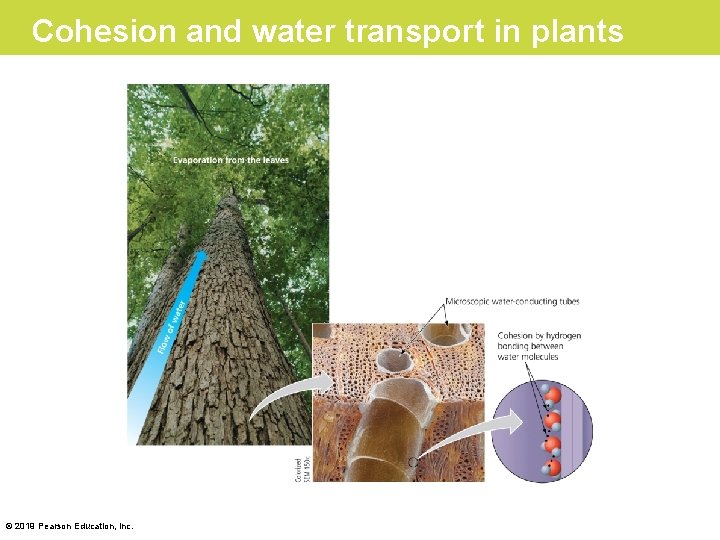
Cohesion and water transport in plants © 2019 Pearson Education, Inc.
Cohesion and water transport in plants Cohesion of water in plants https: //youtu. be/j 27 x. O 2 rf. O 3 w © 2019 Pearson Education, Inc.
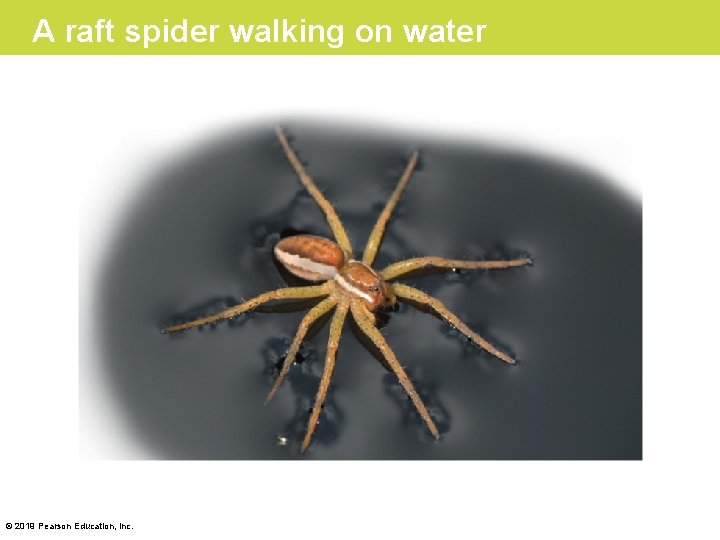
A raft spider walking on water © 2019 Pearson Education, Inc.
How Water Moderates Temperature • Because of hydrogen bonding, water has a stronger resistance to temperature change than most other substances. – Because heat is first used to break hydrogen bonds, water absorbs and stores a large amount of heat while warming up only a few degrees. – Conversely, when water cools, hydrogen bonds form, a process that releases heat. – Evaporative cooling occurs when a substance evaporates and the surface of the liquid remaining behind cools down. © 2019 Pearson Education, Inc.
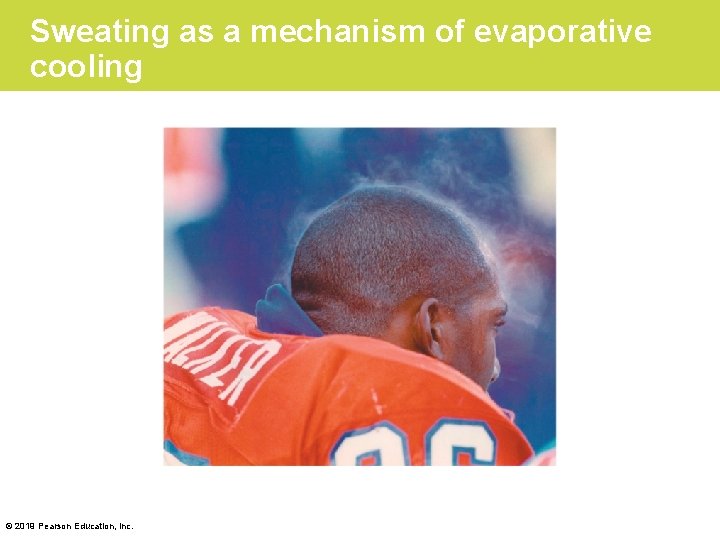
Sweating as a mechanism of evaporative cooling © 2019 Pearson Education, Inc.
The Biological Significance of Ice Floating • When water molecules get cold enough, they move apart, forming ice. • A chunk of ice floats because it is less dense than the liquid water in which it is floating. – Floating ice acts as an insulating “blanket” over liquid water, allowing life to persist under the frozen surface. – If ice did not float, ponds, lakes, and even the oceans would freeze solid. © 2019 Pearson Education, Inc.
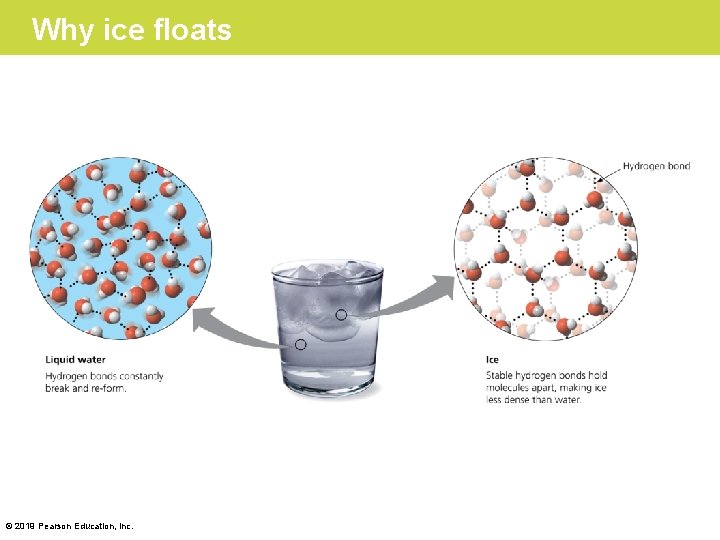
Why ice floats © 2019 Pearson Education, Inc.
Water as the Solvent of Life • A solution is a liquid consisting of a homogeneous mixture of two or more substances. – The dissolving agent is the solvent. – The dissolved substance is the solute. • When water is the solvent, the result is an aqueous solution. © 2019 Pearson Education, Inc.
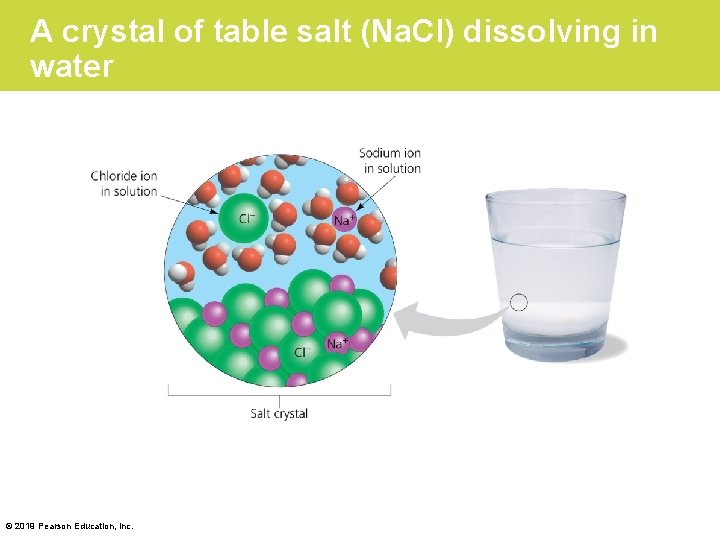
A crystal of table salt (Na. Cl) dissolving in water © 2019 Pearson Education, Inc.
https: //www. youtube. com/watch? v=HVT 3 Y 3_g. HGg Properties of Water (11. 16) © 2019 Pearson Education, Inc.
Identifying Major Themes • The polarity of water molecules helps explain water’s ability to support life. Which major theme is illustrated by this action? 1) The relationship of structure to function 2) Information flow 3) Pathways that transform energy and matter 4) Interactions within biological systems 5) Evolution © 2019 Pearson Education, Inc.
Acids, Bases, and p. H • A chemical compound that releases H+ to a solution is an acid. • A compound that accepts H+ and removes them from solution is a base. • To describe the acidity of a solution, chemists use the p. H scale, a measure of the hydrogen ion (H+) concentration in a solution. • Buffers minimize changes in p. H. © 2019 Pearson Education, Inc.
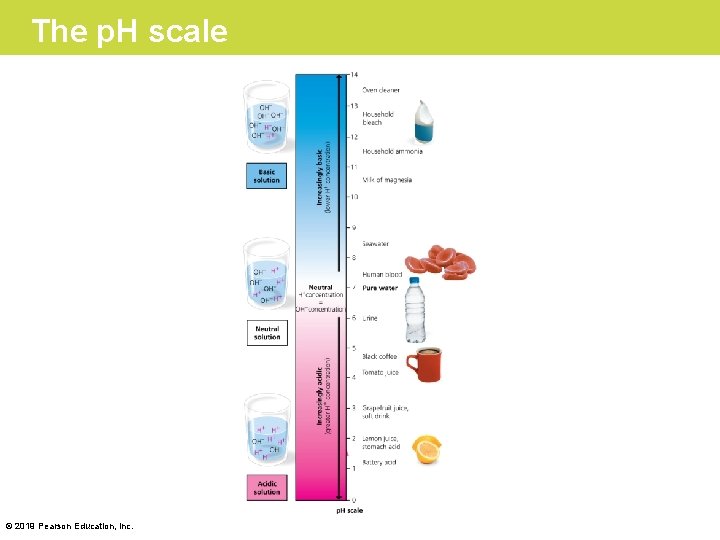
The p. H scale © 2019 Pearson Education, Inc.
Acids, Bases, and p. H • https: //www. youtube. com/watch? v=Xeuyc 55 Lqi. Y Acids Bases and p. H (8. 53) © 2019 Pearson Education, Inc.
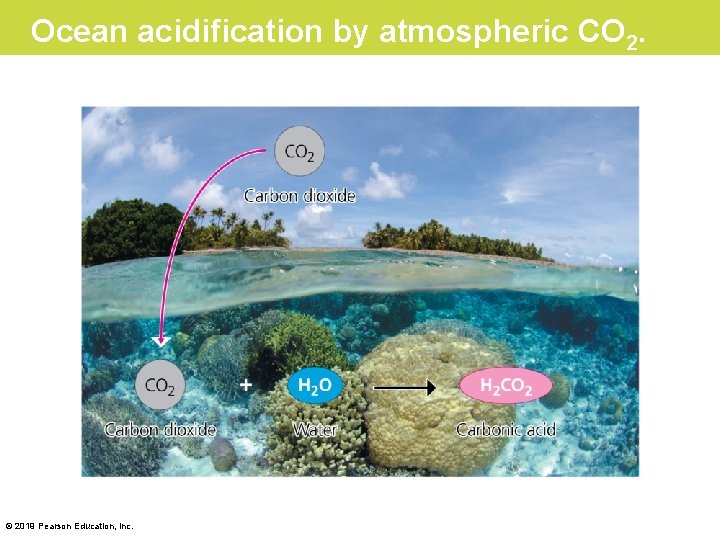
Ocean acidification by atmospheric CO 2. © 2019 Pearson Education, Inc.
Ocean acidification by atmospheric CO 2. © 2019 Pearson Education, Inc.
Identifying Major Themes • The release of CO 2 from a factory in one region cause ocean acidification that affects coral reefs in another region. Which major theme is illustrated by this action? 1) The relationship of structure to function 2) Information flow 3) Pathways that transform energy and matter 4) Interactions within biological systems 5) Evolution © 2019 Pearson Education, Inc.
Evolution Connection: Radioactivity as an Evolutionary Clock • Radioactive decay can be used to obtain important data about the evolutionary history of life on Earth. • Fossils are reliable chronological records of life. • A fossil’s age can be estimated by measuring the ratio of the two isotopes to learn how many half-life reductions have occurred since it died. • Using such techniques, scientists can estimate the ages of fossils and place them in an ordered sequence called the fossil record. © 2019 Pearson Education, Inc.
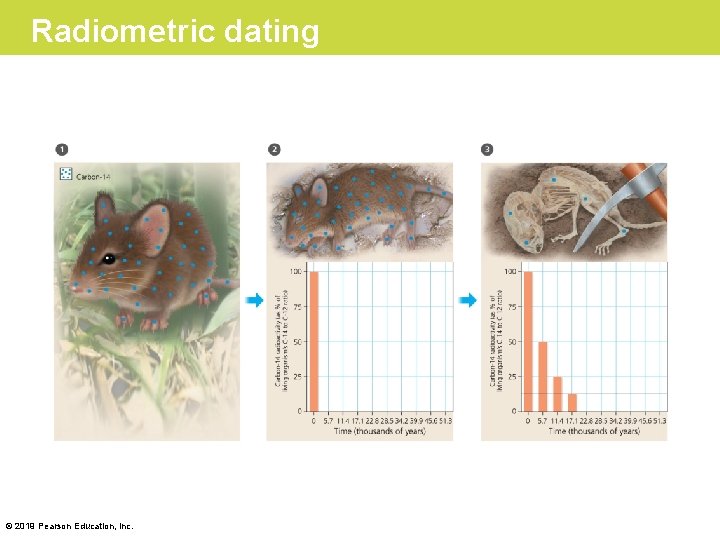
Radiometric dating © 2019 Pearson Education, Inc.
- Slides: 56