
Chapter 2 Lecture and Animation Outline To run

![Acids and bases • Pure water – [H+] of 10– 7 mol/L – Considered](https://slidetodoc.com/presentation_image_h2/8de9bdf4ffba2fb2bbb16a3f44c2562a/image-42.jpg "Acids and bases • Pure water – [H+] of 10– 7 mol/L – Considered")
- Slides: 47
Chapter 2 Lecture and Animation Outline To run the animations you must be in Slideshow View. Use the buttons on the animation to play, pause, and turn audio/text on or off. Please Note: Once you have used any of the animation functions (such as Play or Pause), you must first click on the slide’s background before you can advance to the next slide. See separate Power. Point slides for all figures and tables pre-inserted into Power. Point without notes and animations. 1 Copyright © The Mc. Graw-Hill Companies, Inc. Permission required for reproduction or display.
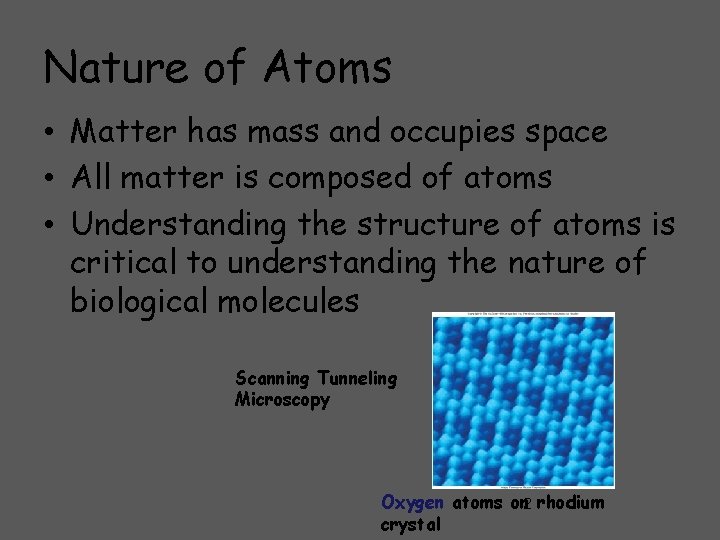
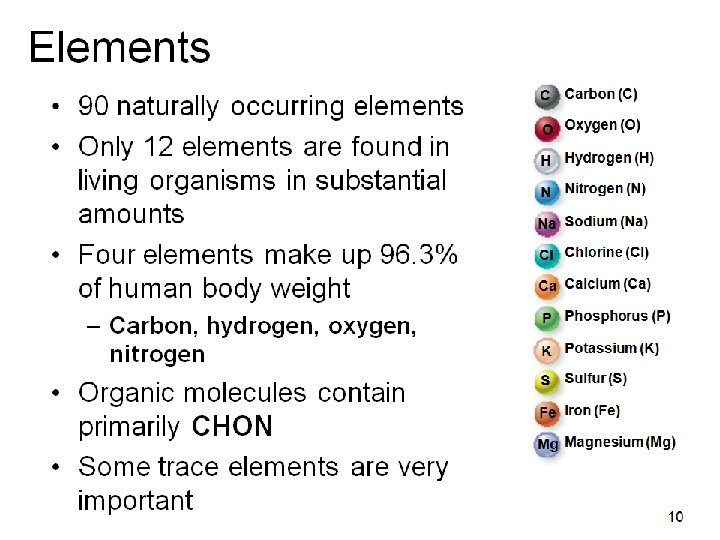
Nature of Atoms • Matter has mass and occupies space • All matter is composed of atoms • Understanding the structure of atoms is critical to understanding the nature of biological molecules Scanning Tunneling Microscopy Oxygen atoms on 2 rhodium crystal
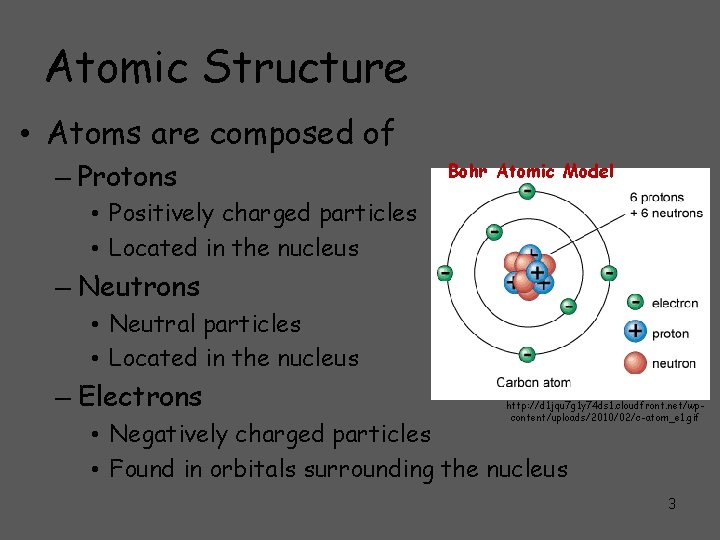
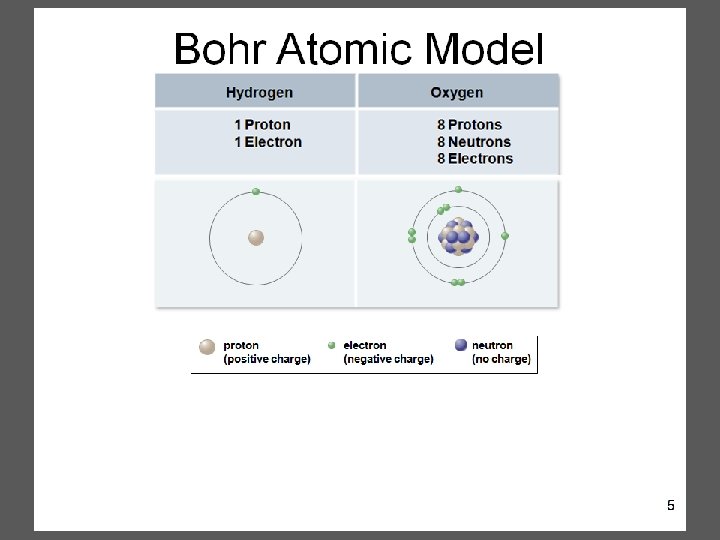
Atomic Structure • Atoms are composed of – Protons Bohr Atomic Model • Positively charged particles • Located in the nucleus – Neutrons • Neutral particles • Located in the nucleus – Electrons http: //d 1 jqu 7 g 1 y 74 ds 1. cloudfront. net/wpcontent/uploads/2010/02/c-atom_e 1. gif • Negatively charged particles • Found in orbitals surrounding the nucleus 3
Atomic number • Number of protons equals number of electrons • Atomic number = number of protons • Number of protons determines atom’s identity 5
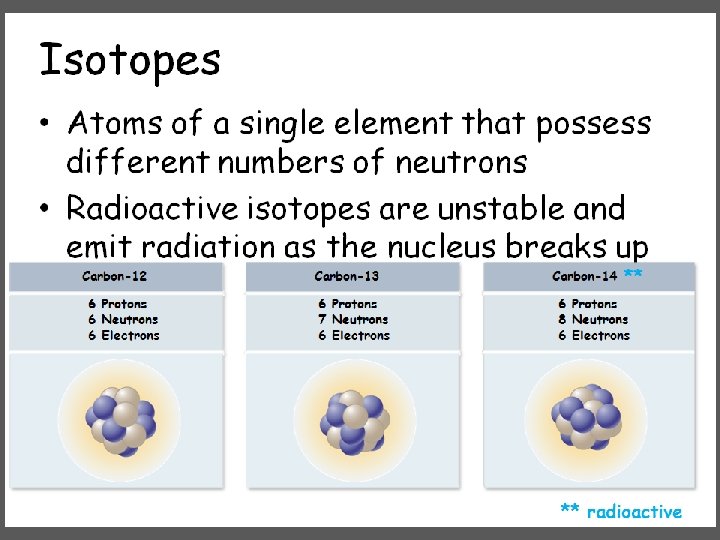
Atomic mass • Mass or weight? – Mass – refers to amount of substance – Weight – refers to force gravity exerts on substance – An object has the same mass despite if it’s on Earth or the Moon which would change the weight • Sum of protons and neutrons is the atom’s atomic mass • Each proton and neutron has a mass of approximately 1 Dalton or atomic mass unit (a. m. u. ) 6
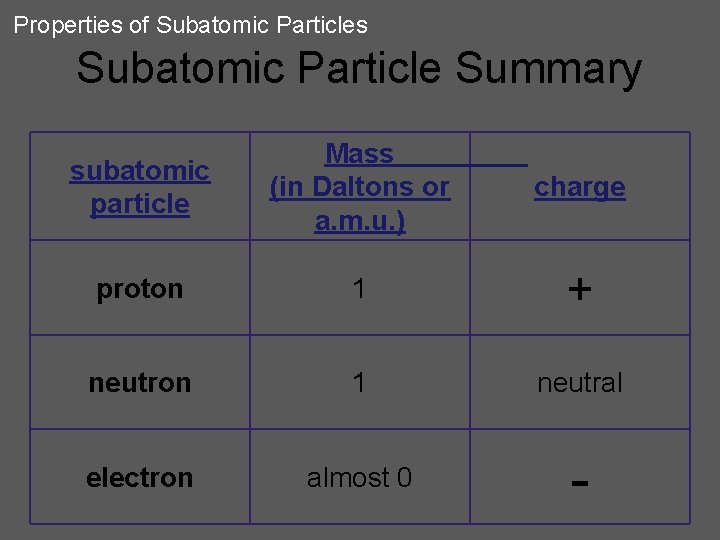
Properties of Subatomic Particles Subatomic Particle Summary subatomic particle Mass (in Daltons or a. m. u. ) charge proton 1 + neutron 1 neutral electron almost 0 -
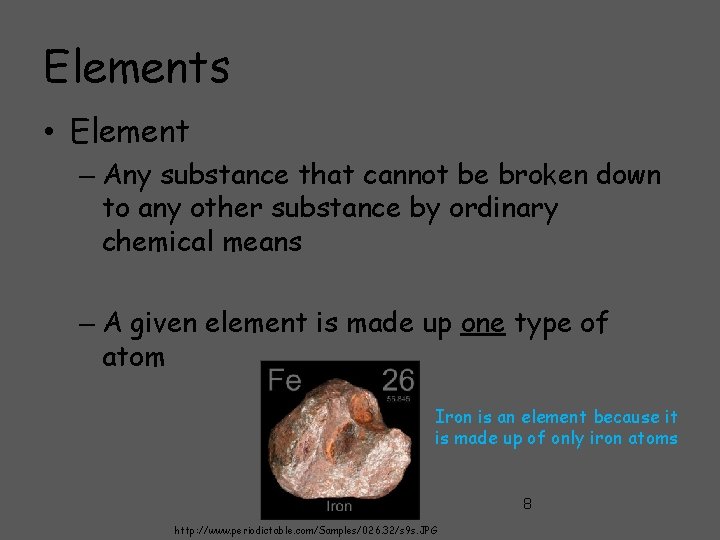
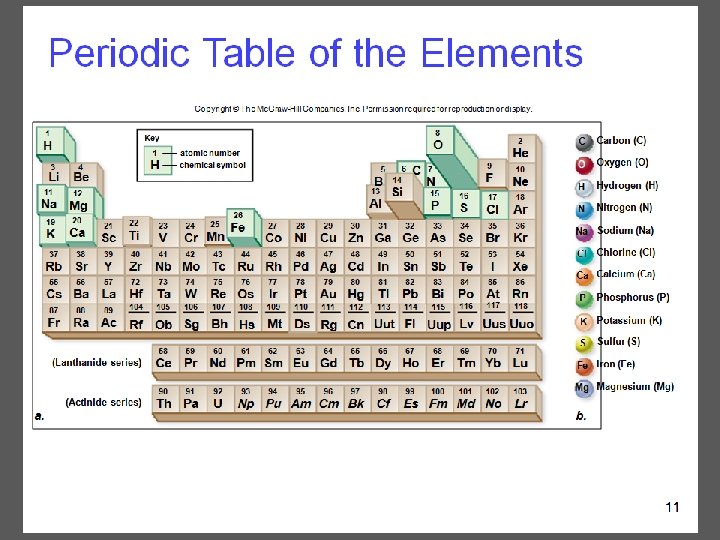
Elements • Element – Any substance that cannot be broken down to any other substance by ordinary chemical means – A given element is made up one type of atom Iron is an element because it is made up of only iron atoms 8 http: //www. periodictable. com/Samples/026. 32/s 9 s. JPG
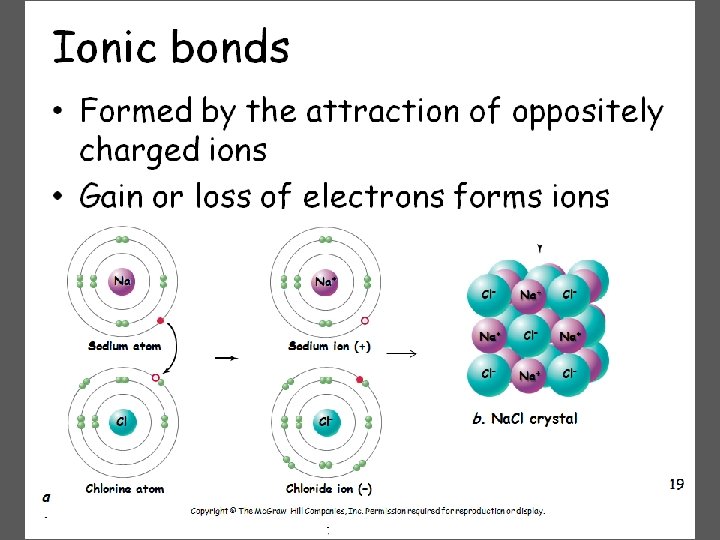
Electrons • Negatively charged particles located in orbitals • Neutral atoms have same number of electrons and protons • Ions are charged particles – unbalanced – Cation – more protons than electrons = net positive charge – Anion – fewer protons than electrons = net negative charge 12
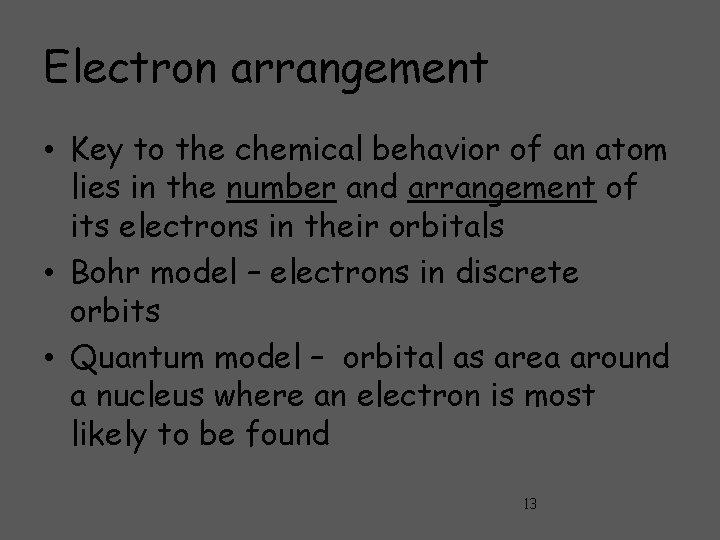
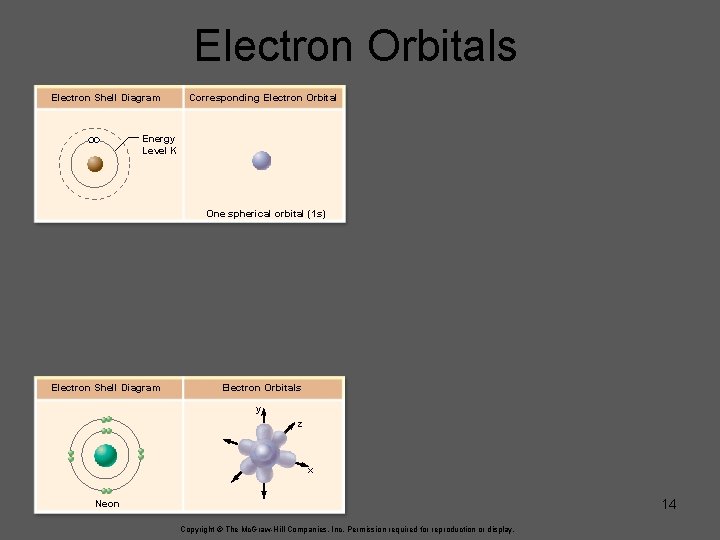
Electron arrangement • Key to the chemical behavior of an atom lies in the number and arrangement of its electrons in their orbitals • Bohr model – electrons in discrete orbits • Quantum model – orbital as area around a nucleus where an electron is most likely to be found 13
Electron Orbitals Electron Shell Diagram Corresponding Electron Orbital Energy Level K One spherical orbital (1 s) Electron Shell Diagram Electron Orbitals y z x 14 Neon Copyright © The Mc. Graw-Hill Companies, Inc. Permission required for reproduction or display.
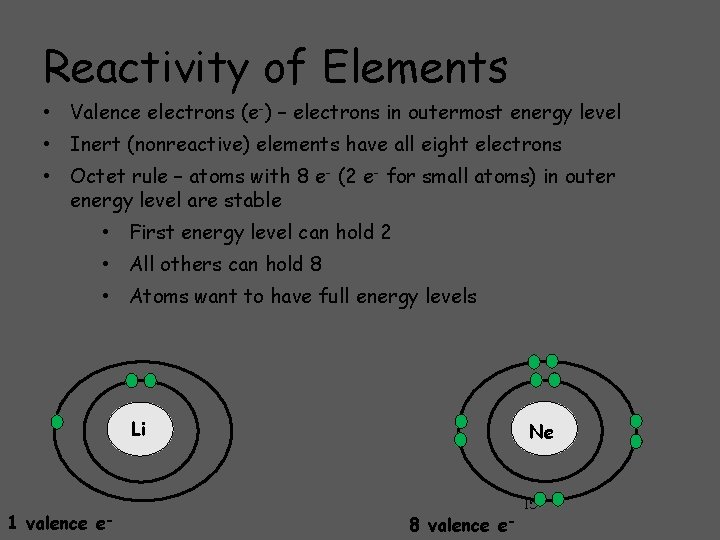
Reactivity of Elements • Valence electrons (e-) – electrons in outermost energy level • Inert (nonreactive) elements have all eight electrons • Octet rule – atoms with 8 e- (2 e- for small atoms) in outer energy level are stable • First energy level can hold 2 • All others can hold 8 • Atoms want to have full energy levels Li 1 valence e- Ne 8 valence e- 15
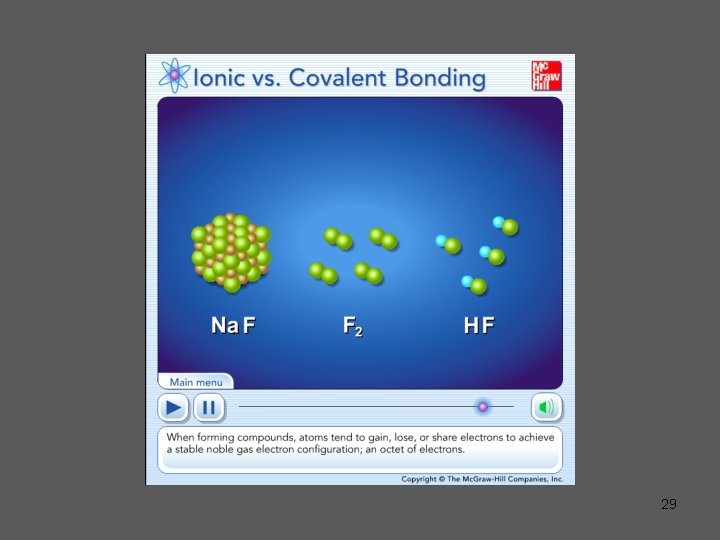
Reactivity of Elements • Octet rule – • Chemical bonds between atoms are based on unfilled outer energy levels • Atom will want to gain, lose, or share electrons 16
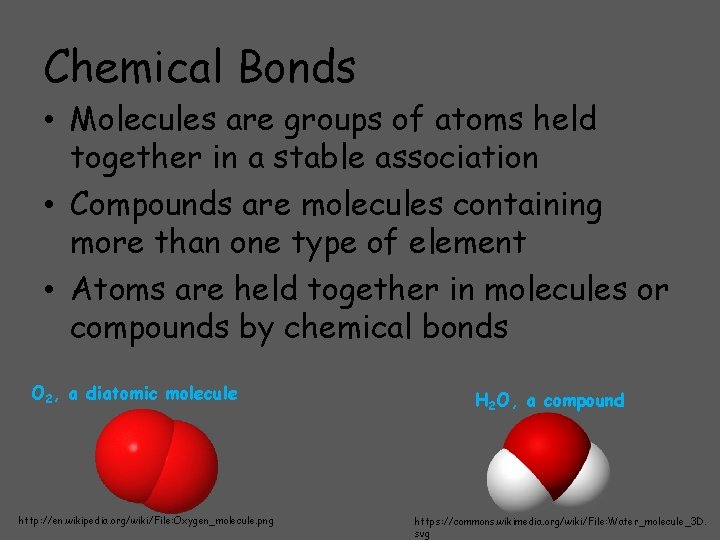
Chemical Bonds • Molecules are groups of atoms held together in a stable association • Compounds are molecules containing more than one type of element • Atoms are held together in molecules or compounds by chemical bonds O 2, a diatomic molecule http: //en. wikipedia. org/wiki/File: Oxygen_molecule. png H 2 O, a compound 17 https: //commons. wikimedia. org/wiki/File: Water_molecule_3 D. svg
Covalent bonds • Form when atoms share 2 or more valence electrons • Results in no net charge, satisfies octet rule, no unpaired electrons • Strength of covalent bond depends on the number of shared electrons 19
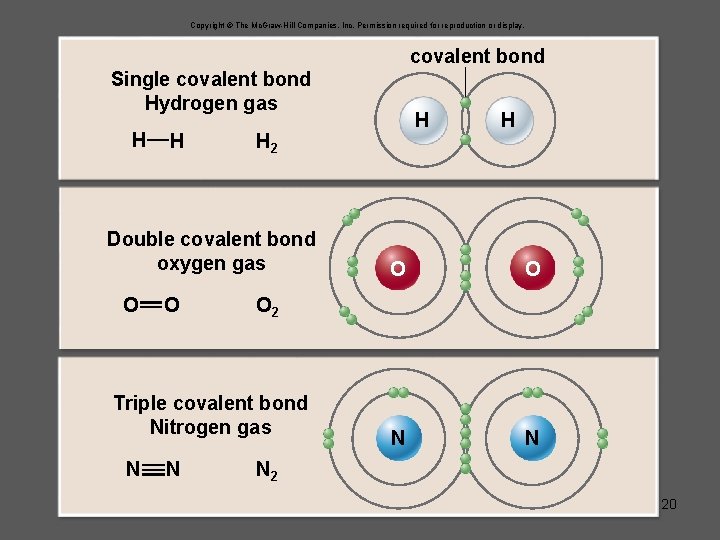
Copyright © The Mc. Graw-Hill Companies, Inc. Permission required for reproduction or display. covalent bond Single covalent bond Hydrogen gas H H H 2 Double covalent bond oxygen gas O O N H O O N N O 2 Triple covalent bond Nitrogen gas N H N 2 20
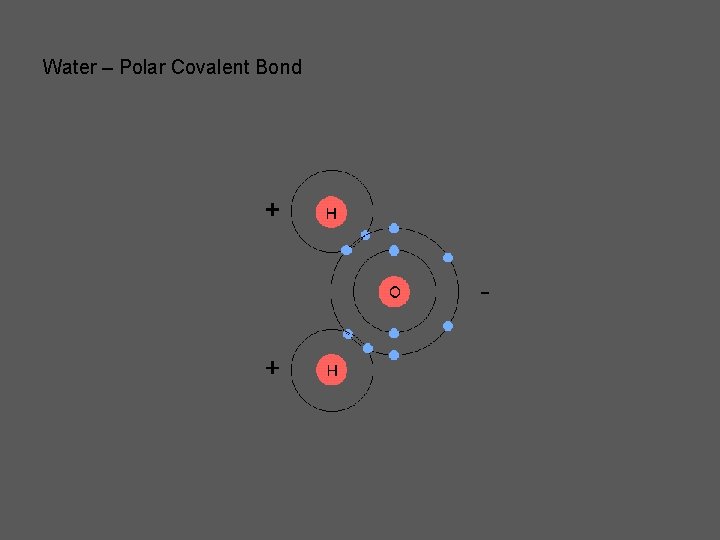
Covalent Bonds • Polar covalent bonds • Electrons not shared equally • Example is water • Nonpolar covalent bonds • Electrons shared equally
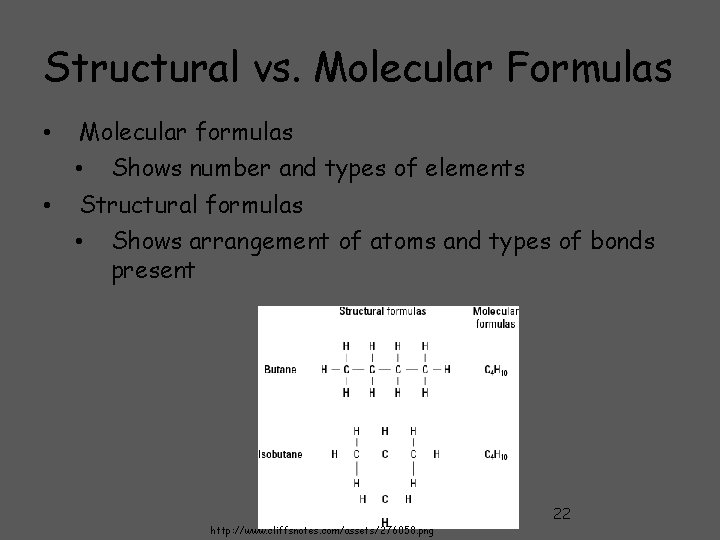
Structural vs. Molecular Formulas • Molecular formulas • Shows number and types of elements • Structural formulas • Shows arrangement of atoms and types of bonds present http: //www. cliffsnotes. com/assets/276058. png 22
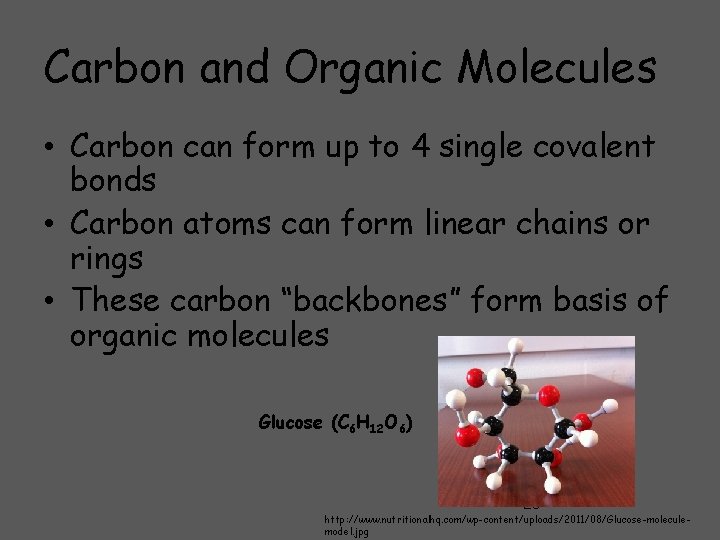
Carbon and Organic Molecules • Carbon can form up to 4 single covalent bonds • Carbon atoms can form linear chains or rings • These carbon “backbones” form basis of organic molecules Glucose (C 6 H 12 O 6) 23 http: //www. nutritionalhq. com/wp-content/uploads/2011/08/Glucose-moleculemodel. jpg
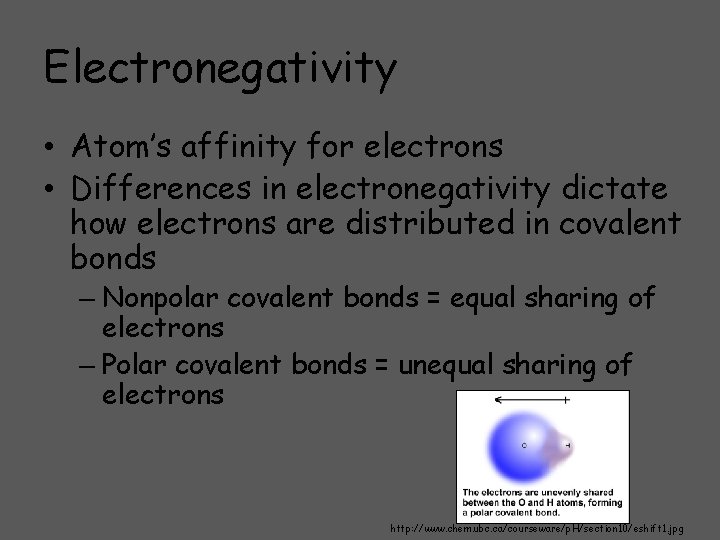
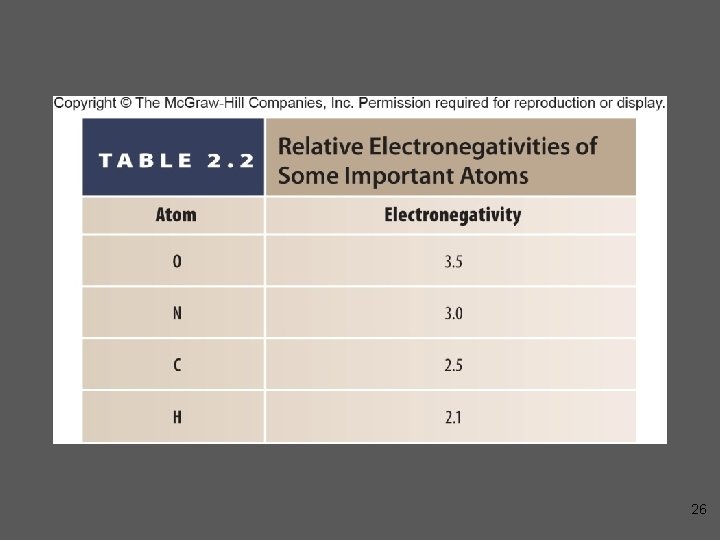
Electronegativity • Atom’s affinity for electrons • Differences in electronegativity dictate how electrons are distributed in covalent bonds – Nonpolar covalent bonds = equal sharing of electrons – Polar covalent bonds = unequal sharing of electrons 24 http: //www. chem. ubc. ca/courseware/p. H/section 10/eshift 1. jpg
Water – Polar Covalent Bond
26
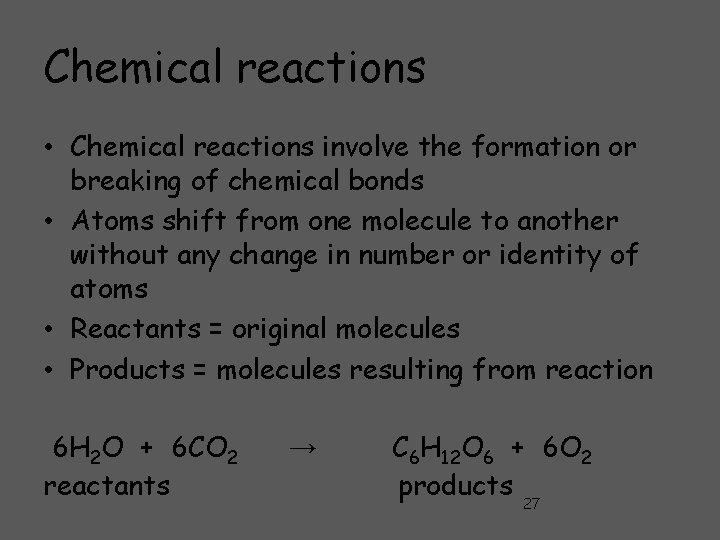
Chemical reactions • Chemical reactions involve the formation or breaking of chemical bonds • Atoms shift from one molecule to another without any change in number or identity of atoms • Reactants = original molecules • Products = molecules resulting from reaction 6 H 2 O + 6 CO 2 reactants → C 6 H 12 O 6 + 6 O 2 products 27
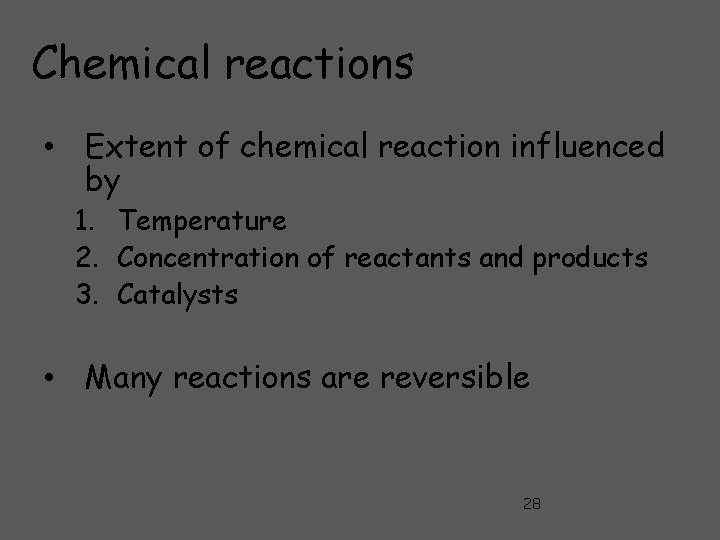
Chemical reactions • Extent of chemical reaction influenced by 1. Temperature 2. Concentration of reactants and products 3. Catalysts • Many reactions are reversible 28
Please note that due to differing operating systems, some animations will not appear until the presentation is viewed in Presentation Mode (Slide Show view). You may see blank slides in the “Normal” or “Slide Sorter” views. All animations will appear after viewing in Presentation Mode and playing each animation. Most animations will require the latest version of the Flash Player, which is available at http: //get. adobe. com/flashplayer. 29
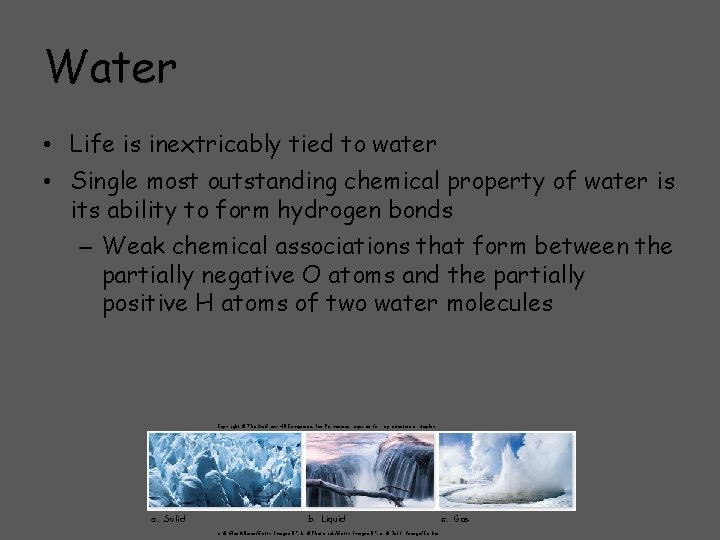
Water • Life is inextricably tied to water • Single most outstanding chemical property of water is its ability to form hydrogen bonds – Weak chemical associations that form between the partially negative O atoms and the partially positive H atoms of two water molecules Copyright © The Mc. Graw-Hill Companies, Inc. Permission required for reproduction or display. a. Solid b. Liquid a: © Glen Allison/Getty Images RF; b: © Photo. Link/Getty Images RF; c: © Jeff Vanuga/Corbis c. Gas 30
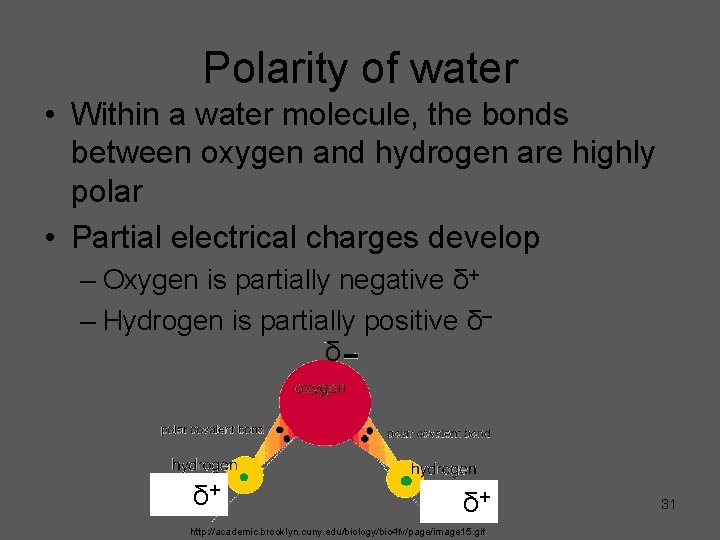
Polarity of water • Within a water molecule, the bonds between oxygen and hydrogen are highly polar • Partial electrical charges develop – Oxygen is partially negative δ+ – Hydrogen is partially positive δ– δ δ+ δ+ http: //academic. brooklyn. cuny. edu/biology/bio 4 fv/page/image 15. gif 31
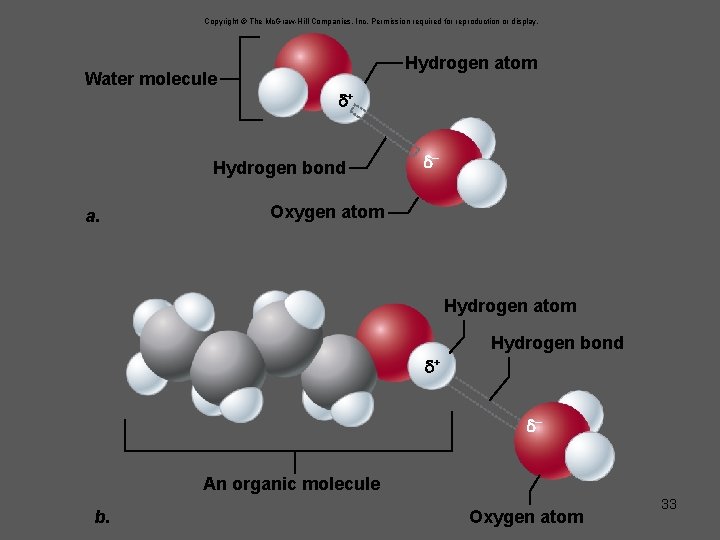
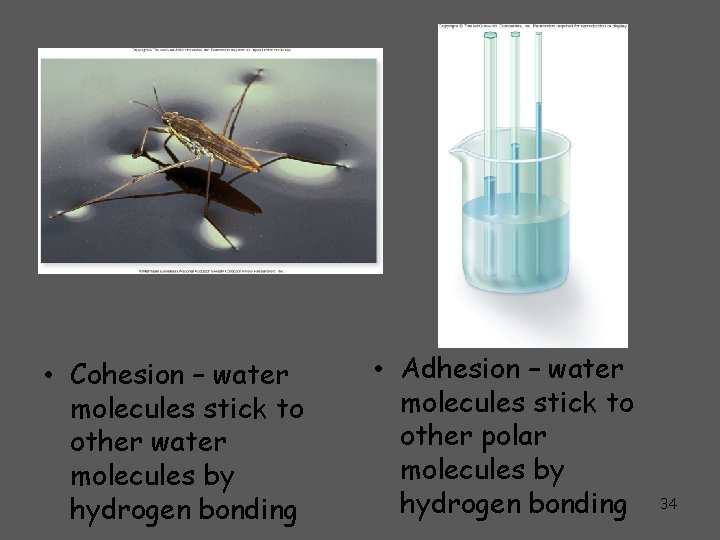
Hydrogen bonds • Cohesion – polarity of water allows water molecules to be attracted to one another • Attraction produces hydrogen bonds • Each individual bond is weak and transitory • Cumulative effects are enormous • Responsible for many of water’s important physical properties 32
Copyright © The Mc. Graw-Hill Companies, Inc. Permission required for reproduction or display. Water molecule Hydrogen atom + Hydrogen bond a. – Oxygen atom Hydrogen bond + – An organic molecule b. Oxygen atom 33
• Cohesion – water molecules stick to other water molecules by hydrogen bonding • Adhesion – water molecules stick to other polar molecules by hydrogen bonding 34
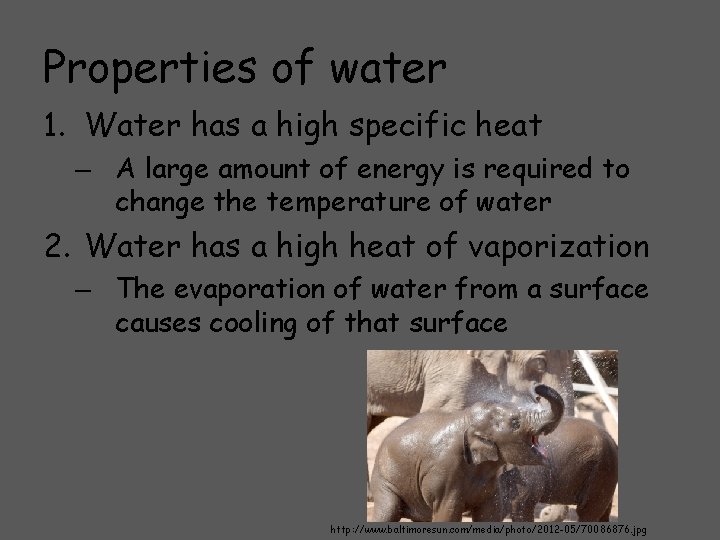
Properties of water 1. Water has a high specific heat – A large amount of energy is required to change the temperature of water 2. Water has a high heat of vaporization – The evaporation of water from a surface causes cooling of that surface 35 http: //www. baltimoresun. com/media/photo/2012 -05/70086876. jpg
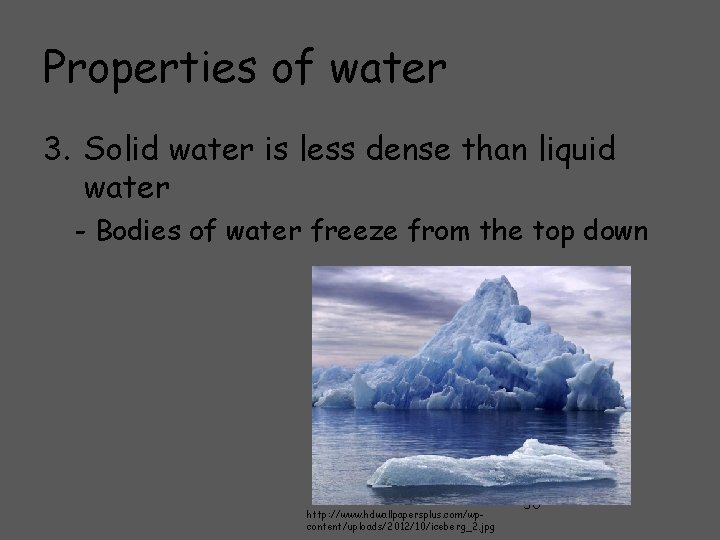
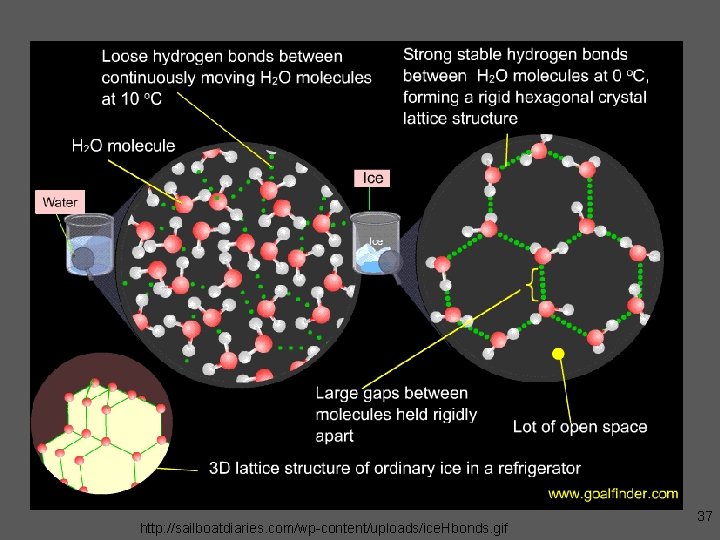
Properties of water 3. Solid water is less dense than liquid water - Bodies of water freeze from the top down http: //www. hdwallpapersplus. com/wpcontent/uploads/2012/10/iceberg_2. jpg 36
http: //sailboatdiaries. com/wp-content/uploads/ice. Hbonds. gif 37
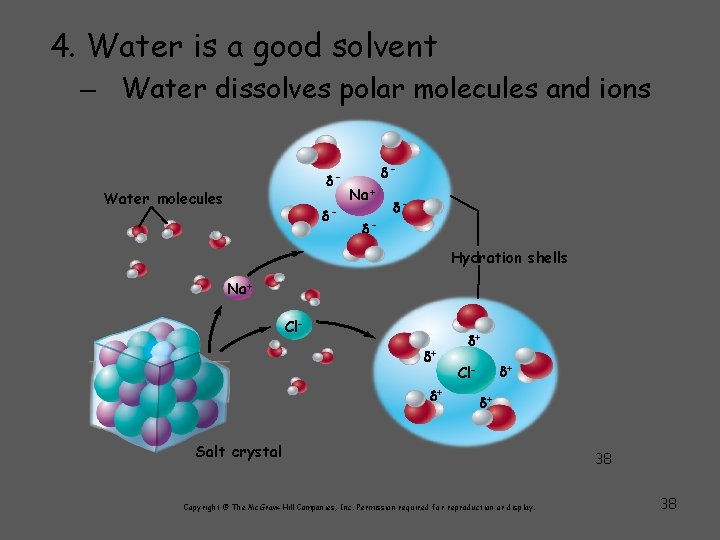
4. Water is a good solvent – Water dissolves polar molecules and ions – Water molecules – – Na+ – – Hydration shells Na+ Cl– + Salt crystal Copyright © The Mc. Graw-Hill Companies, Inc. Permission required for reproduction or display. 38 38
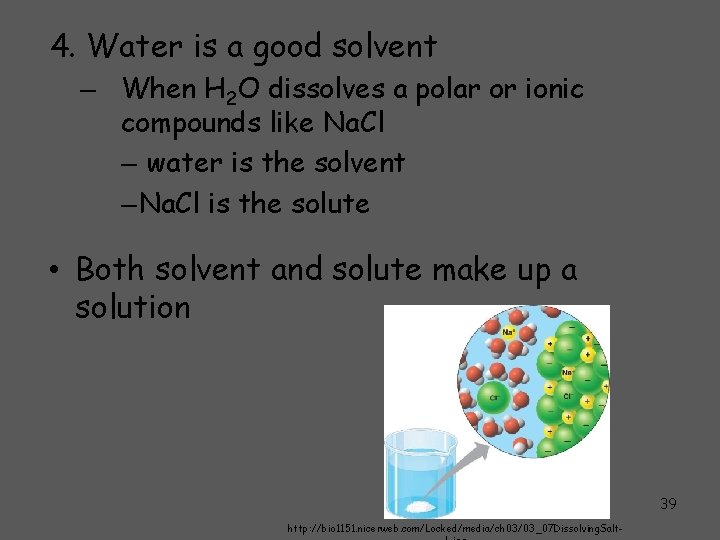
4. Water is a good solvent – When H 2 O dissolves a polar or ionic compounds like Na. Cl – water is the solvent – Na. Cl is the solute • Both solvent and solute make up a solution 39 http: //bio 1151. nicerweb. com/Locked/media/ch 03/03_07 Dissolving. Salt-
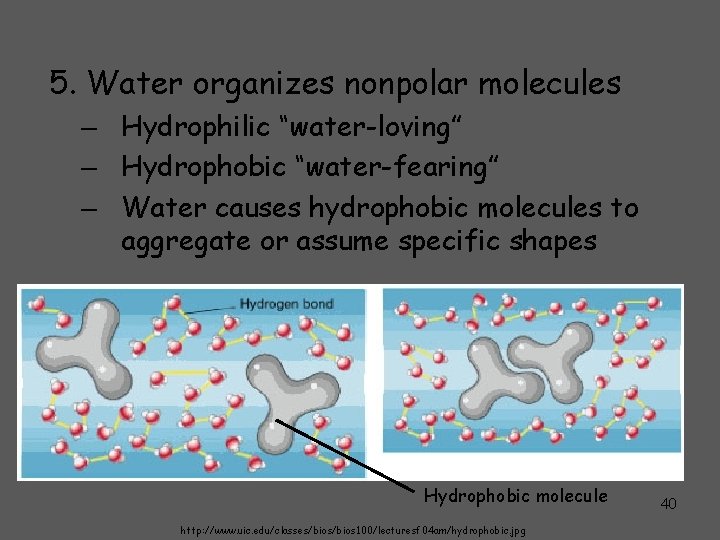
5. Water organizes nonpolar molecules – Hydrophilic “water-loving” – Hydrophobic “water-fearing” – Water causes hydrophobic molecules to aggregate or assume specific shapes Hydrophobic molecule http: //www. uic. edu/classes/bios 100/lecturesf 04 am/hydrophobic. jpg 40
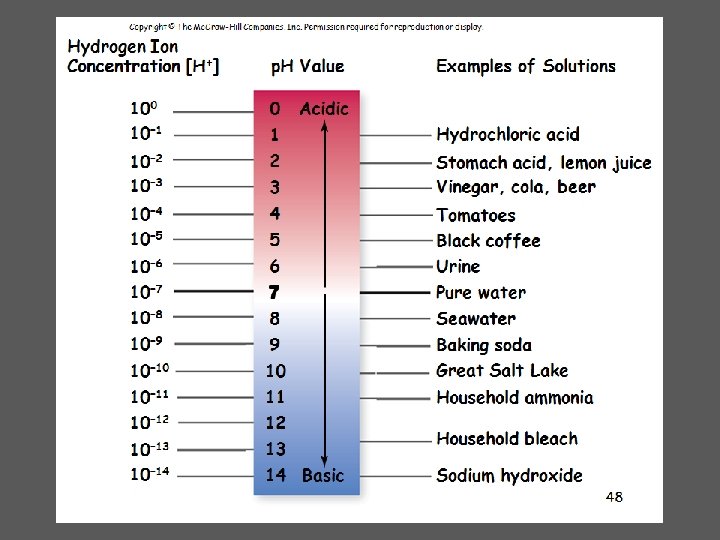
Acids and bases • Pure water – [H+] of 10– 7 mol/L – Considered to be neutral – Neither acidic nor basic – [H+] = [OH-] • p. H is the negative logarithm of hydrogen ion concentration of solution p. H = -log[H+] p. H= –log 10 -7 = -(-7)=7 42
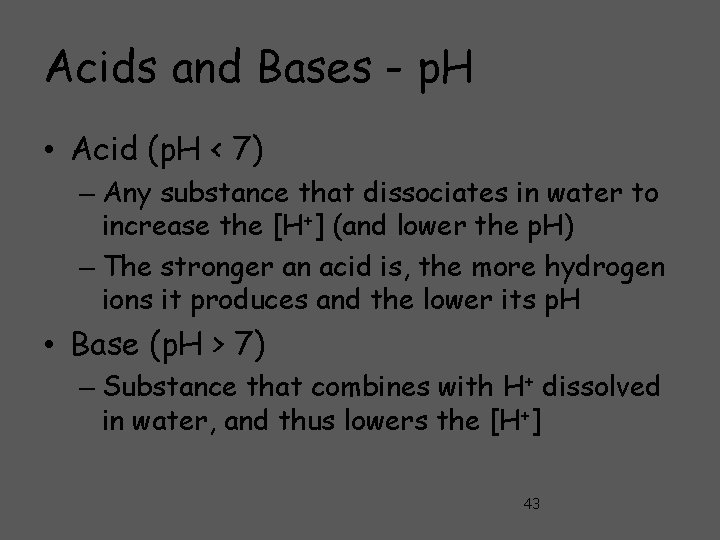
Acids and Bases - p. H • Acid (p. H < 7) – Any substance that dissociates in water to increase the [H+] (and lower the p. H) – The stronger an acid is, the more hydrogen ions it produces and the lower its p. H • Base (p. H > 7) – Substance that combines with H+ dissolved in water, and thus lowers the [H+] 43
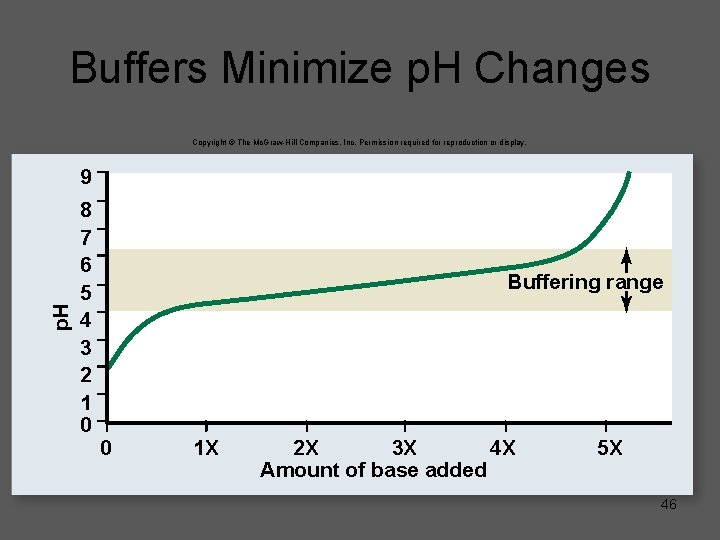
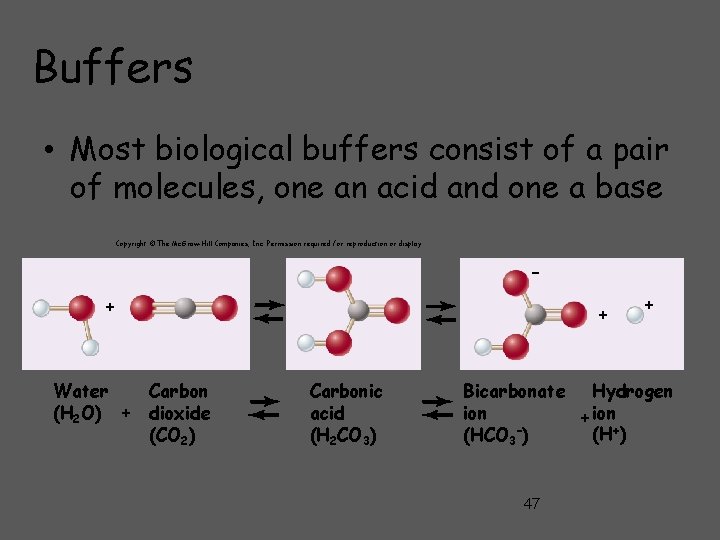
Buffers • Substance that resists changes in p. H • Act by – Releasing hydrogen ions when a base is added – Absorbing hydrogen ions when acid is added • Overall effect of keeping [H+] relatively constant 45
Buffers Minimize p. H Changes Copyright © The Mc. Graw-Hill Companies, Inc. Permission required for reproduction or display. p. H 9 8 7 6 5 4 3 2 1 0 Buffering range 0 1 X 2 X 3 X 4 X Amount of base added 5 X 46
Buffers • Most biological buffers consist of a pair of molecules, one an acid and one a base Copyright © The Mc. Graw-Hill Companies, Inc. Permission required for reproduction or display. – + Water Carbon (H 2 O) + dioxide (CO 2) + Carbonic acid (H 2 CO 3) + Bicarbonate Hydrogen ion + ion (H+) (HCO 3–) 47