
Chapter 2 Java Fundamentals Operators Page Content Group
- Slides: 24
Chapter 2: Java Fundamentals Operators Page
Content • Group of Operators • Arithmetic Operators • Assignment Operator • Order of Precedence • Increment/Decrement Operators • Relational Operators • Logical Operators 2 Dr. S. GANNOUNI & Dr. A. TOUIR Introduction to OOP
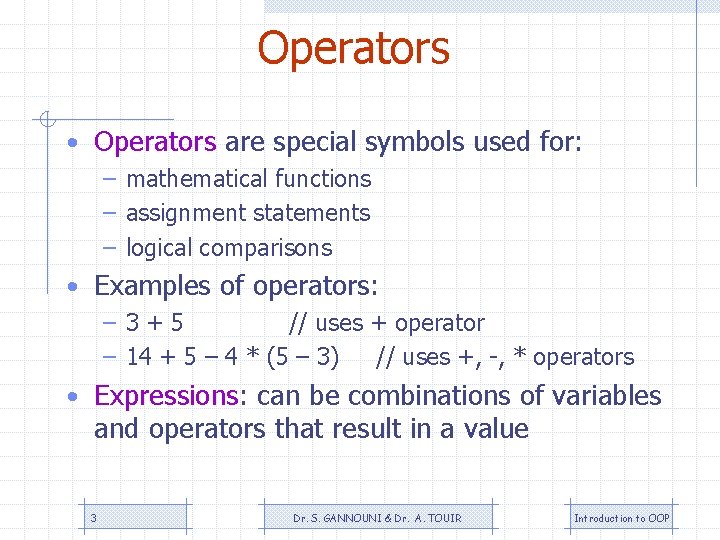
Operators • Operators are special symbols used for: – mathematical functions – assignment statements – logical comparisons • Examples of operators: – 3+5 // uses + operator – 14 + 5 – 4 * (5 – 3) // uses +, -, * operators • Expressions: can be combinations of variables and operators that result in a value 3 Dr. S. GANNOUNI & Dr. A. TOUIR Introduction to OOP
Groups of Operators • There are 5 different groups of operators: – Arithmetic Operators – Assignment Operator – Increment / Decrement Operators – Relational Operators – Logical Operators 4 Dr. S. GANNOUNI & Dr. A. TOUIR Introduction to OOP
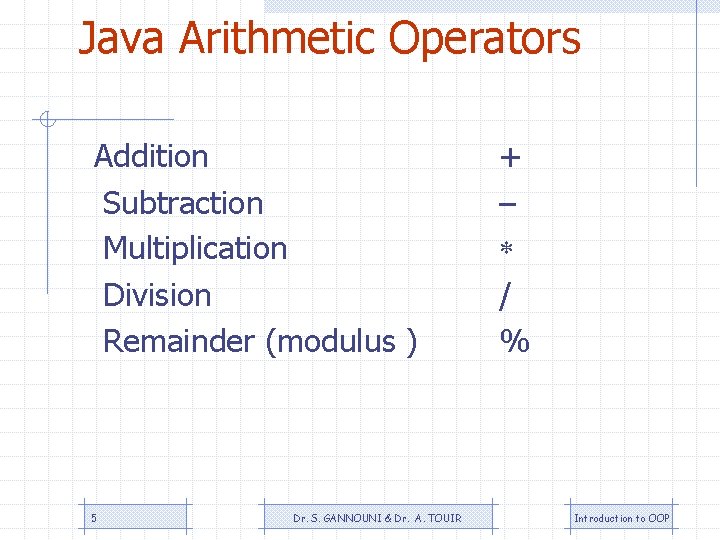
Java Arithmetic Operators Addition Subtraction Multiplication Division Remainder (modulus ) 5 Dr. S. GANNOUNI & Dr. A. TOUIR + – / % Introduction to OOP
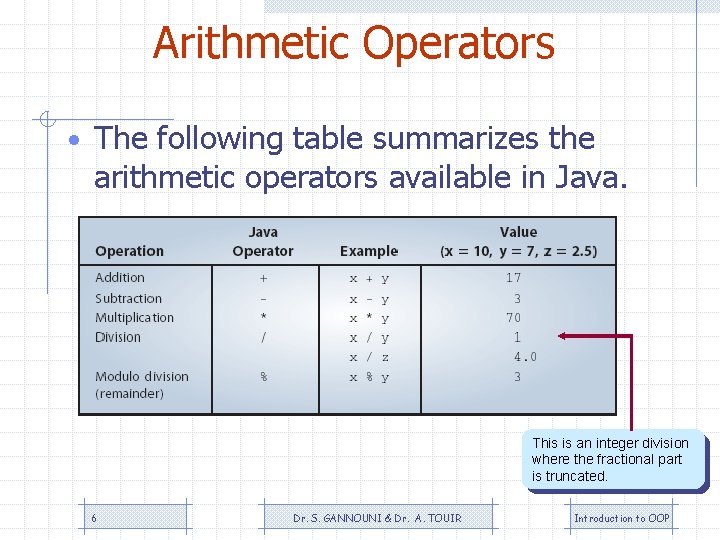
Arithmetic Operators • The following table summarizes the arithmetic operators available in Java. This is an integer division where the fractional part is truncated. 6 Dr. S. GANNOUNI & Dr. A. TOUIR Introduction to OOP
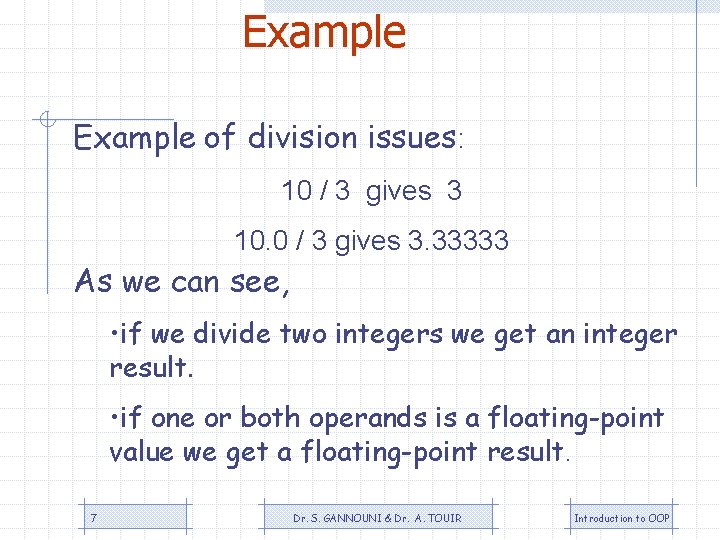
Example of division issues: 10 / 3 gives 3 10. 0 / 3 gives 3. 33333 As we can see, • if we divide two integers we get an integer result. • if one or both operands is a floating-point value we get a floating-point result. 7 Dr. S. GANNOUNI & Dr. A. TOUIR Introduction to OOP
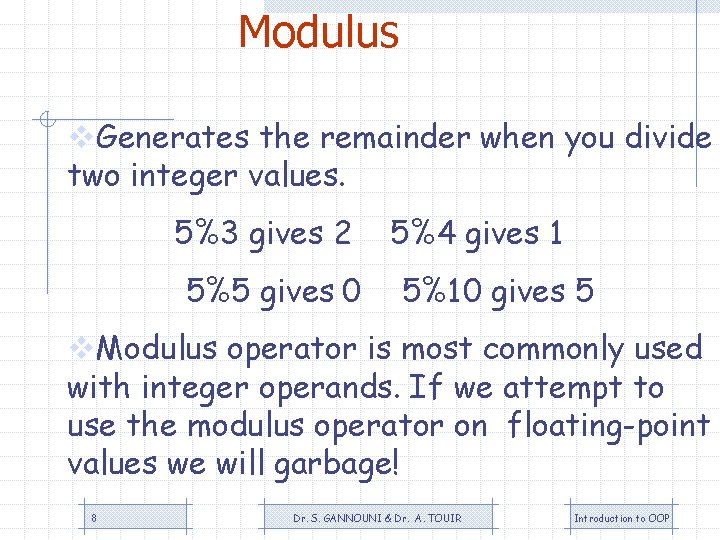
Modulus v. Generates the remainder when you divide two integer values. 5%3 gives 2 5%5 gives 0 5%4 gives 1 5%10 gives 5 v. Modulus operator is most commonly used with integer operands. If we attempt to use the modulus operator on floating-point values we will garbage! 8 Dr. S. GANNOUNI & Dr. A. TOUIR Introduction to OOP
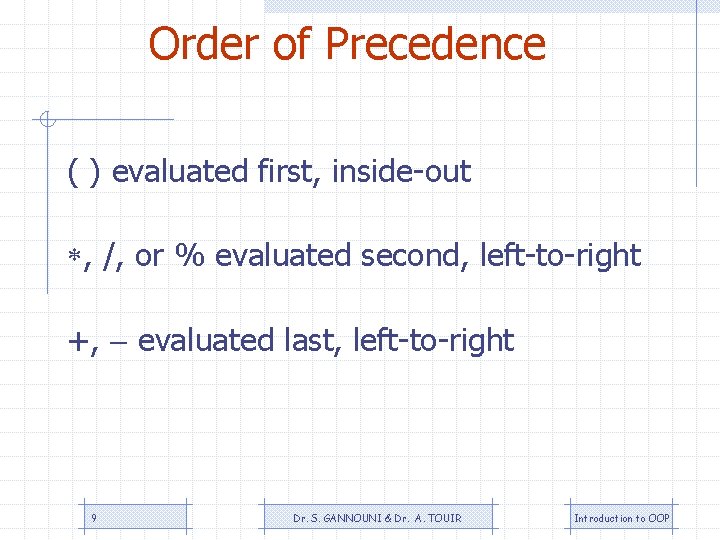
Order of Precedence ( ) evaluated first, inside-out , /, or % evaluated second, left-to-right +, evaluated last, left-to-right 9 Dr. S. GANNOUNI & Dr. A. TOUIR Introduction to OOP
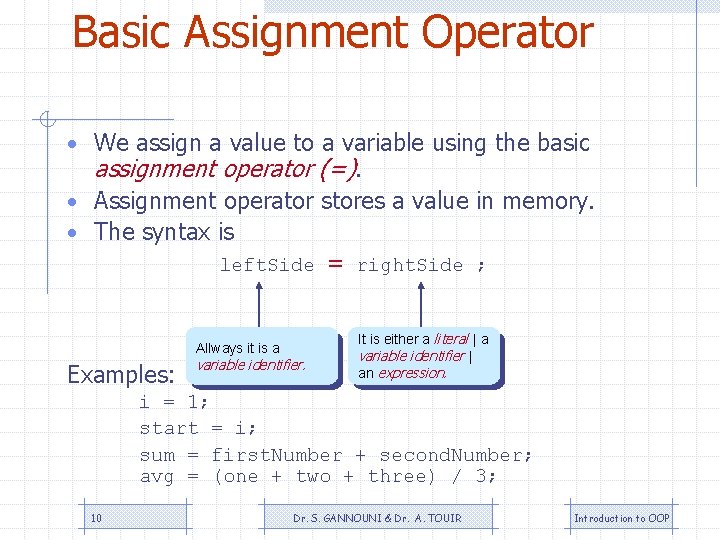
Basic Assignment Operator • We assign a value to a variable using the basic assignment operator (=). • Assignment operator stores a value in memory. • The syntax is left. Side Allways it is a Examples: variable identifier. = right. Side ; It is either a literal | a variable identifier | an expression. i = 1; start = i; sum = first. Number + second. Number; avg = (one + two + three) / 3; 10 Dr. S. GANNOUNI & Dr. A. TOUIR Introduction to OOP
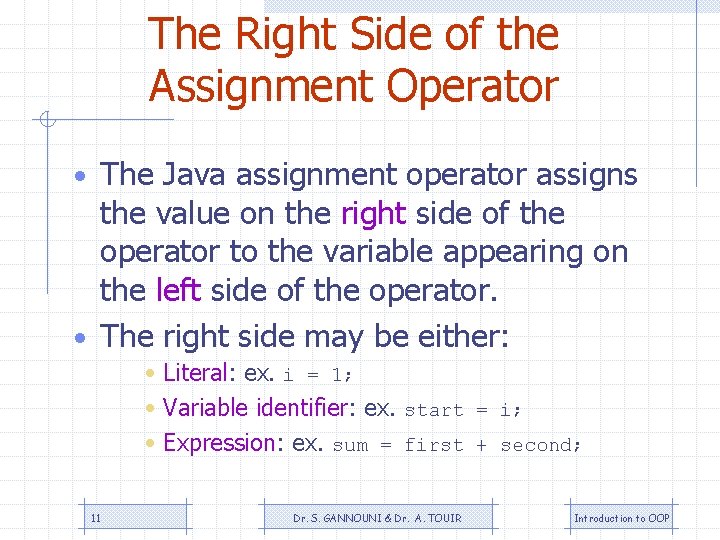
The Right Side of the Assignment Operator • The Java assignment operator assigns the value on the right side of the operator to the variable appearing on the left side of the operator. • The right side may be either: • Literal: ex. i = 1; • Variable identifier: ex. start = i; • Expression: ex. sum = first + second; 11 Dr. S. GANNOUNI & Dr. A. TOUIR Introduction to OOP
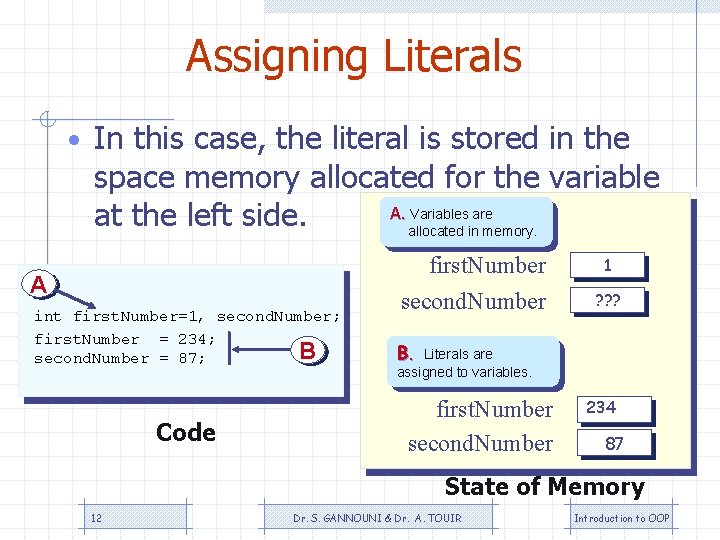
Assigning Literals • In this case, the literal is stored in the space memory allocated for the variable A. Variables are at the left side. allocated in memory. A int first. Number=1, second. Number; first. Number = 234; B second. Number = 87; Code first. Number second. Number 1 ? ? ? B. Literals are assigned to variables. first. Number second. Number 234 87 State of Memory 12 Dr. S. GANNOUNI & Dr. A. TOUIR Introduction to OOP
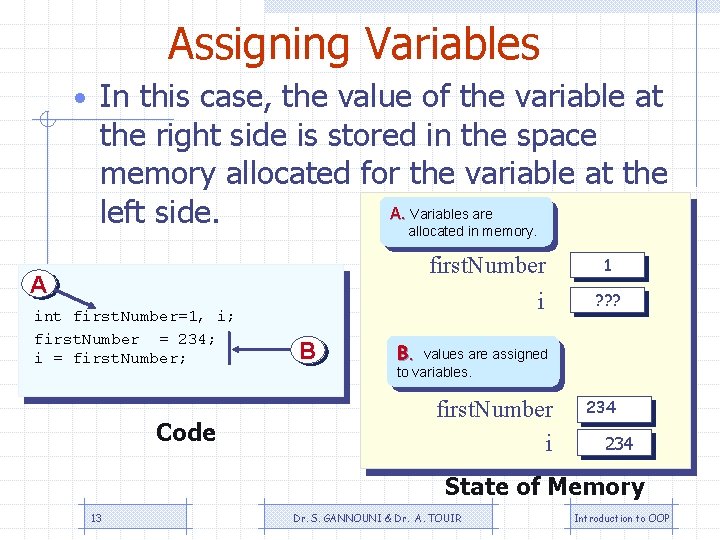
Assigning Variables • In this case, the value of the variable at the right side is stored in the space memory allocated for the variable at the A. Variables are left side. allocated in memory. first. Number i A int first. Number=1, i; first. Number = 234; i = first. Number; Code B 1 ? ? ? B. values are assigned to variables. first. Number i 234 State of Memory 13 Dr. S. GANNOUNI & Dr. A. TOUIR Introduction to OOP
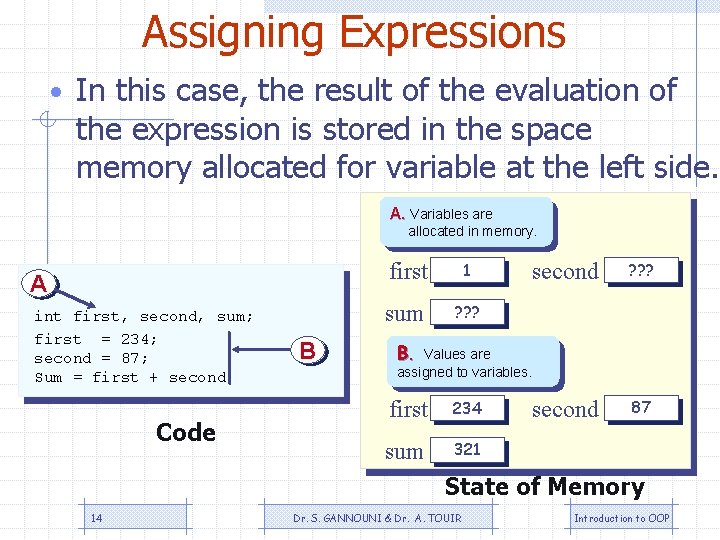
Assigning Expressions • In this case, the result of the evaluation of the expression is stored in the space memory allocated for variable at the left side. A. Variables are allocated in memory. A int first, second, sum; first = 234; second = 87; Sum = first + second Code B first 1 sum ? ? ? second 87 B. Values are assigned to variables. first 234 sum 321 State of Memory 14 Dr. S. GANNOUNI & Dr. A. TOUIR Introduction to OOP
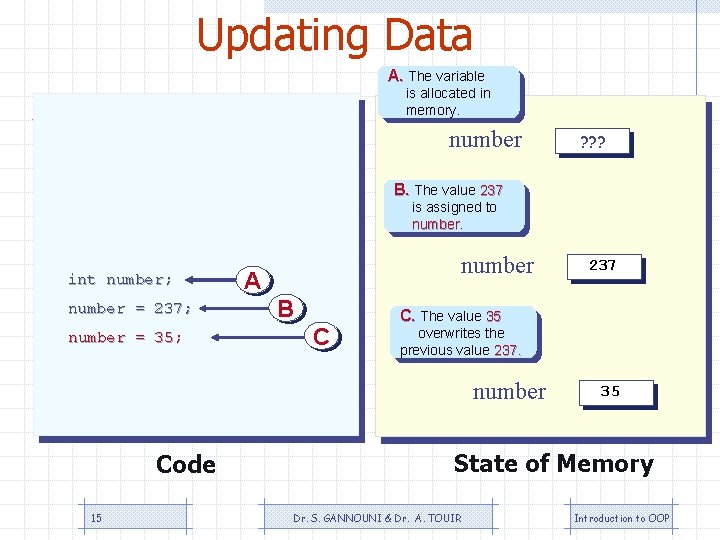
Updating Data A. The variable is allocated in memory. number ? ? ? B. The value 237 is assigned to number int number; number = 237; number = 35; number A B C C. The value 35 overwrites the previous value 237. number Code 15 237 35 State of Memory Dr. S. GANNOUNI & Dr. A. TOUIR Introduction to OOP
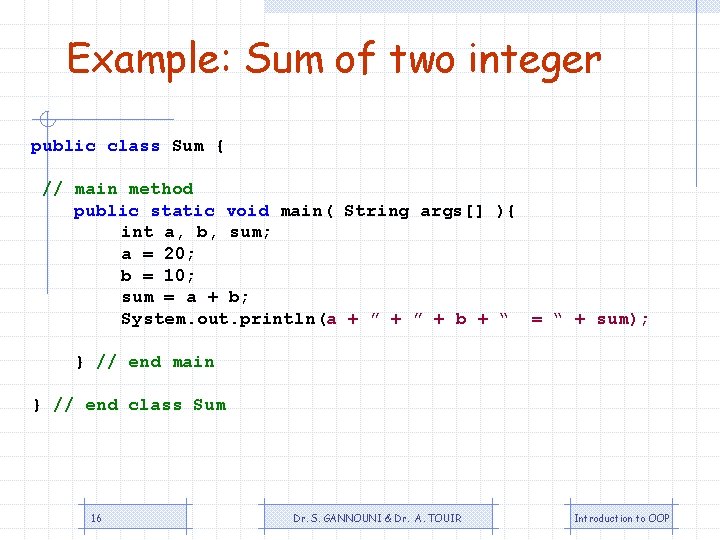
Example: Sum of two integer public class Sum { // main method public static void main( String args[] ){ int a, b, sum; a = 20; b = 10; sum = a + b; System. out. println(a + ” + b + “ = “ + sum); } // end main } // end class Sum 16 Dr. S. GANNOUNI & Dr. A. TOUIR Introduction to OOP
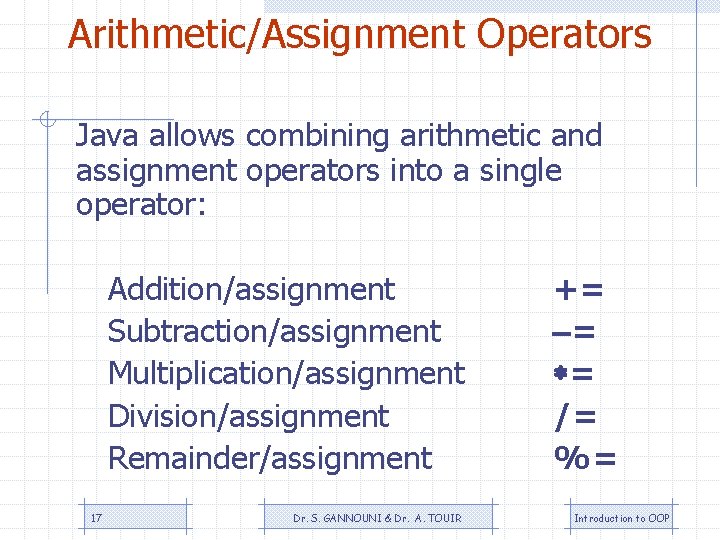
Arithmetic/Assignment Operators Java allows combining arithmetic and assignment operators into a single operator: Addition/assignment Subtraction/assignment Multiplication/assignment Division/assignment Remainder/assignment 17 Dr. S. GANNOUNI & Dr. A. TOUIR += = = /= %= Introduction to OOP
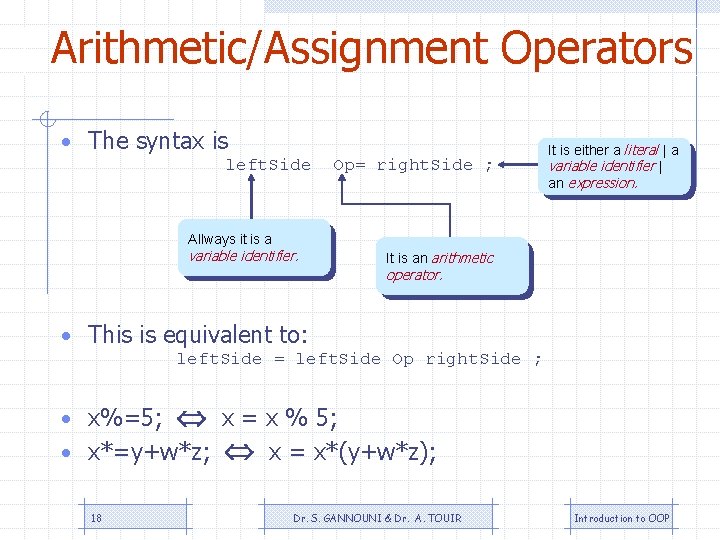
Arithmetic/Assignment Operators • The syntax is left. Side Op= right. Side ; It is either a literal | a variable identifier | an expression. Allways it is a variable identifier. It is an arithmetic operator. • This is equivalent to: left. Side = left. Side Op right. Side ; x = x % 5; x*=y+w*z; x = x*(y+w*z); • x%=5; • 18 Dr. S. GANNOUNI & Dr. A. TOUIR Introduction to OOP
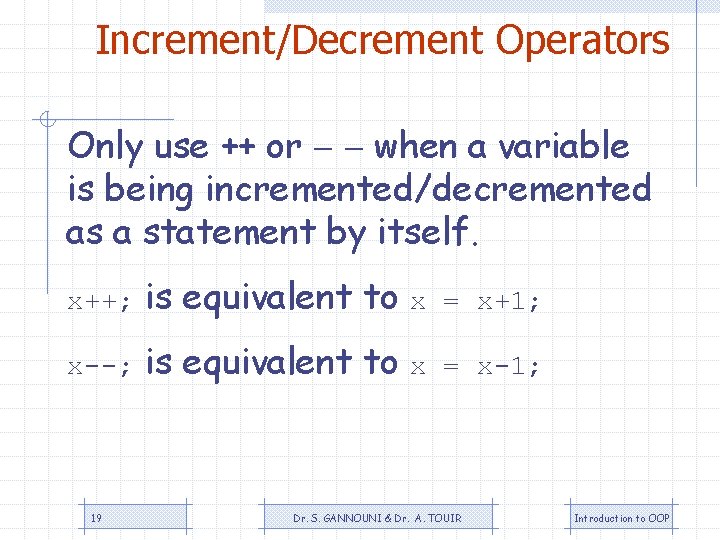
Increment/Decrement Operators Only use ++ or when a variable is being incremented/decremented as a statement by itself. x++; is equivalent to x = x+1; x--; is equivalent to x = x-1; 19 Dr. S. GANNOUNI & Dr. A. TOUIR Introduction to OOP
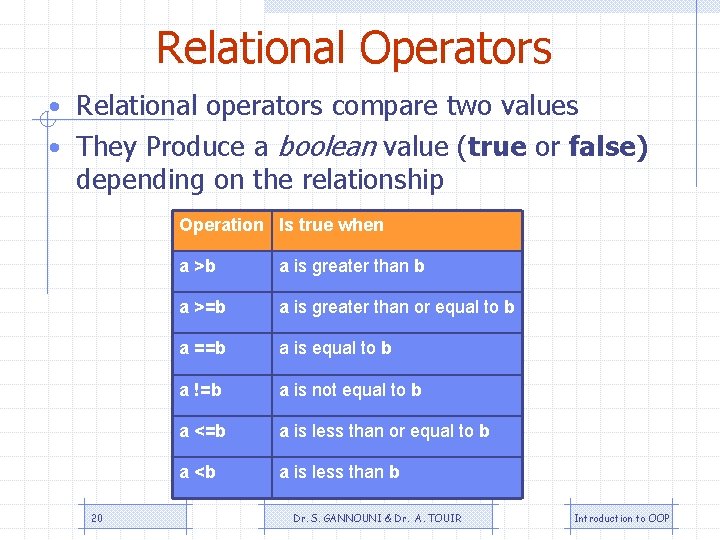
Relational Operators • Relational operators compare two values • They Produce a boolean value (true or false) depending on the relationship Operation Is true when 20 a >b a is greater than b a >=b a is greater than or equal to b a ==b a is equal to b a !=b a is not equal to b a <=b a is less than or equal to b a <b a is less than b Dr. S. GANNOUNI & Dr. A. TOUIR Introduction to OOP
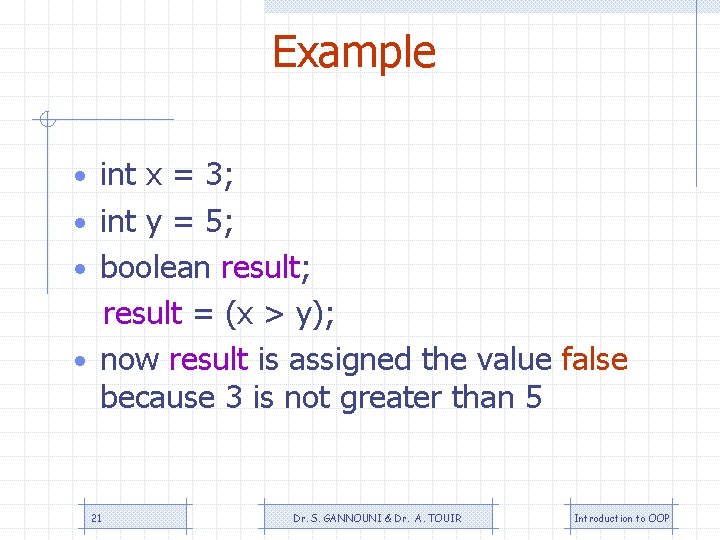
Example • int x = 3; • int y = 5; • boolean result; result = (x > y); • now result is assigned the value false because 3 is not greater than 5 21 Dr. S. GANNOUNI & Dr. A. TOUIR Introduction to OOP
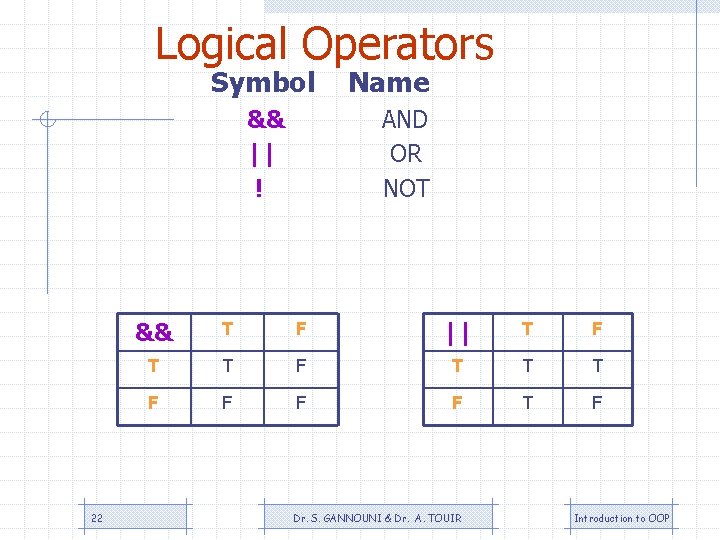
Logical Operators Symbol && || ! 22 Name AND OR NOT && T F || T F T T T F F T F Dr. S. GANNOUNI & Dr. A. TOUIR Introduction to OOP
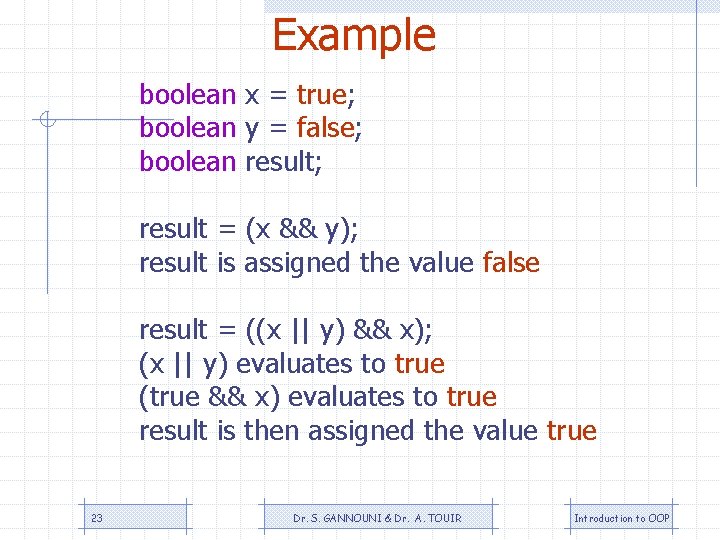
Example boolean x = true; boolean y = false; boolean result; result = (x && y); result is assigned the value false result = ((x || y) && x); (x || y) evaluates to true (true && x) evaluates to true result is then assigned the value true 23 Dr. S. GANNOUNI & Dr. A. TOUIR Introduction to OOP
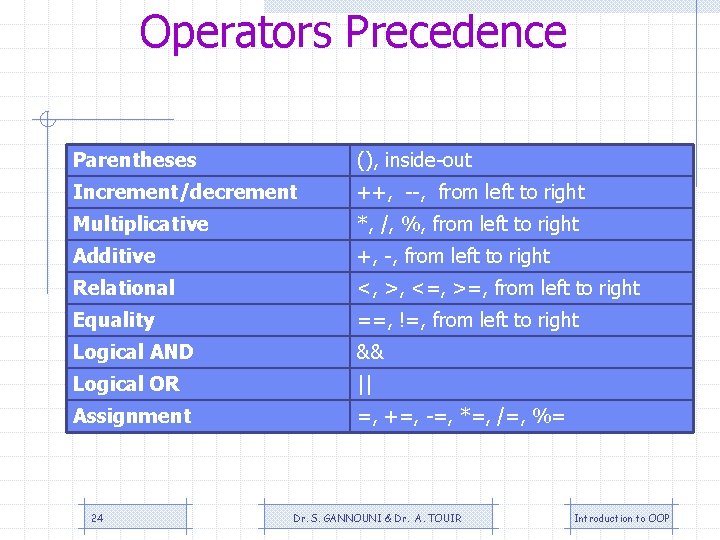
Operators Precedence Parentheses (), inside-out Increment/decrement ++, --, from left to right Multiplicative *, /, %, from left to right Additive +, -, from left to right Relational <, >, <=, >=, from left to right Equality ==, !=, from left to right Logical AND && Logical OR || Assignment =, +=, -=, *=, /=, %= 24 Dr. S. GANNOUNI & Dr. A. TOUIR Introduction to OOP