
Chapter 2 Introduction to Java Applications InputOutput and
![Source code without any comments public class Welcome 1 { public static void main(String[]](https://slidetodoc.com/presentation_image_h/197f14d67d46582934e22fdf55b62d8f/image-12.jpg "Source code without any comments public class Welcome 1 { public static void main(String[]")

- Slides: 104
Chapter 2 Introduction to Java Applications; Input/Output and Operators Java™ How to Program, 10/e Late Objects Version © Copyright 1992 -2015 by Pearson Education, Inc. All Rights Reserved.
© Copyright 1992 -2015 by Pearson Education, Inc. All Rights Reserved.
© Copyright 1992 -2015 by Pearson Education, Inc. All Rights Reserved.
2. 1 Introduction Java application programming Use tools from the JDK to compile and run programs. Videos at www. deitel. com/books/jhtp 10/ § Help you get started with Eclipse, Net. Beans and Intelli. J IDEA integrated development environments. © Copyright 1992 -2015 by Pearson Education, Inc. All Rights Reserved.
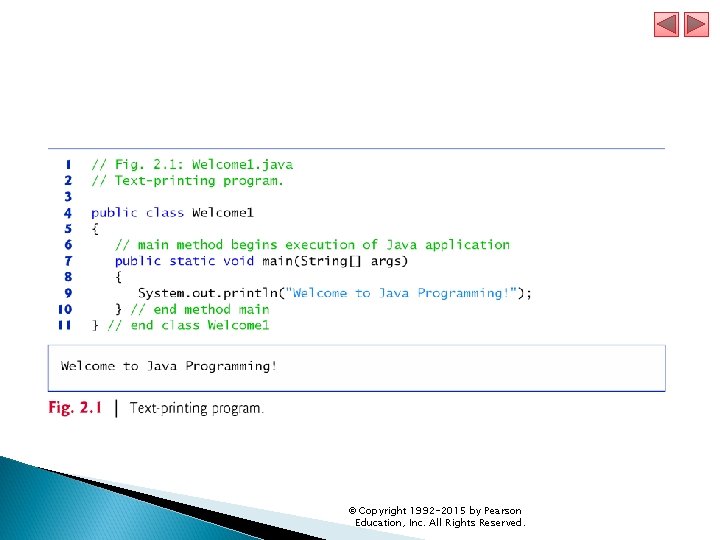
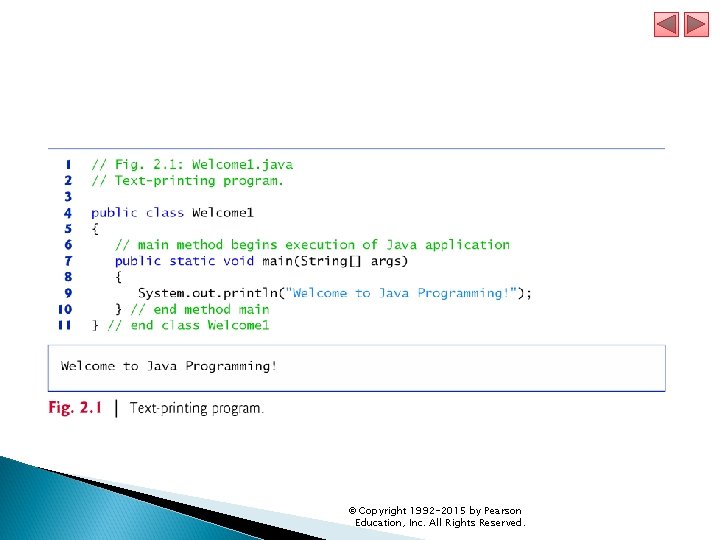
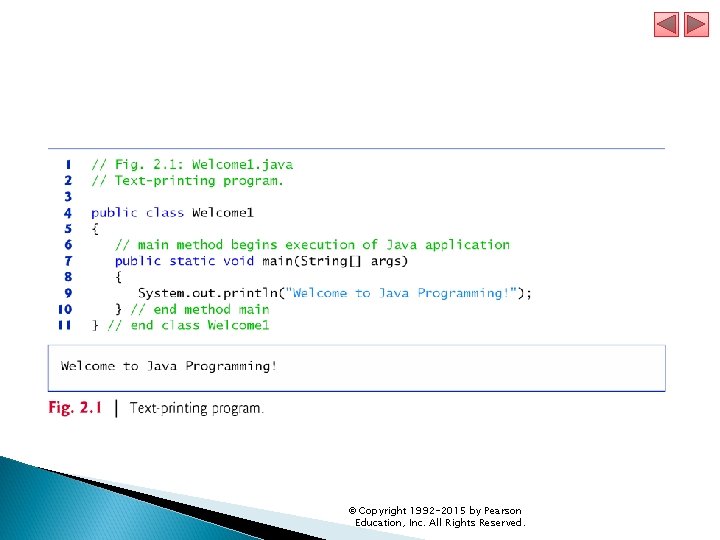
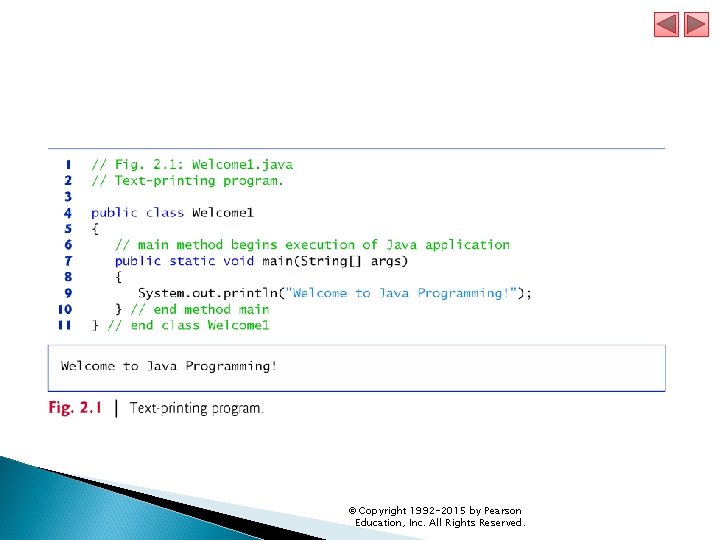
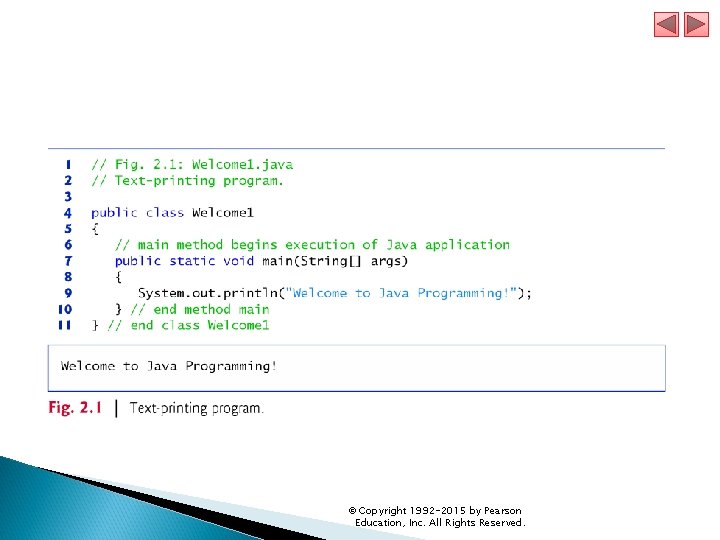
2. 2 Your First Program in Java: Printing a Line of Text Java application § A computer program that executes when you use the java command to launch the Java Virtual Machine (JVM). Sample program in Fig. 2. 1 displays a line of text. © Copyright 1992 -2015 by Pearson Education, Inc. All Rights Reserved.
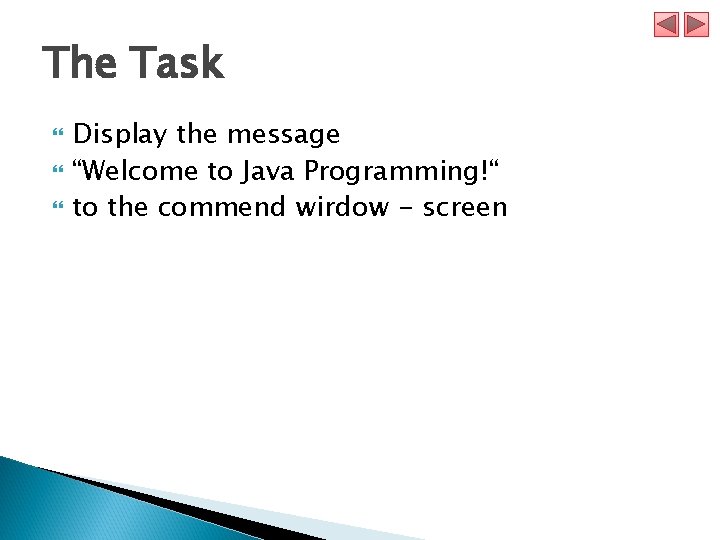
The Task Display the message “Welcome to Java Programming!“ to the commend wirdow - screen
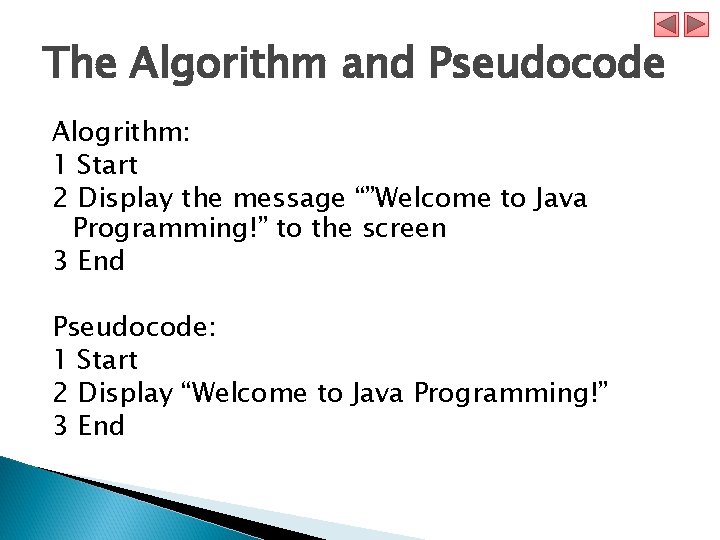
The Algorithm and Pseudocode Alogrithm: 1 Start 2 Display the message “”Welcome to Java Programming!” to the screen 3 End Pseudocode: 1 Start 2 Display “Welcome to Java Programming!” 3 End
© Copyright 1992 -2015 by Pearson Education, Inc. All Rights Reserved.
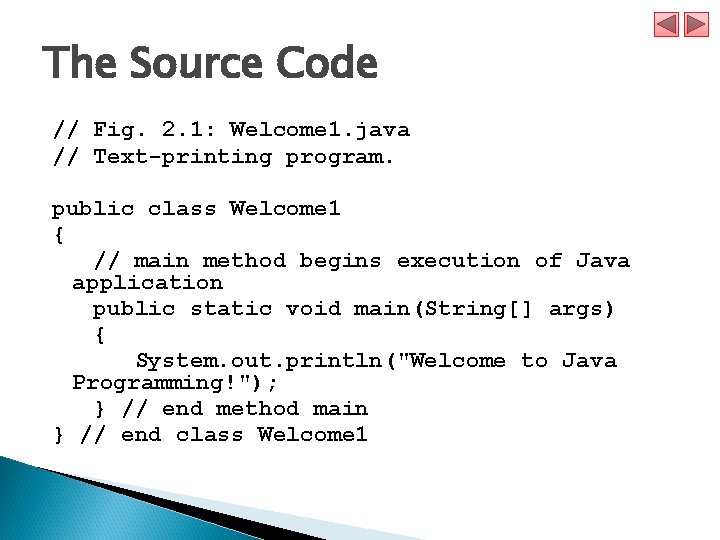
The Source Code // Fig. 2. 1: Welcome 1. java // Text-printing program. public class Welcome 1 { // main method begins execution of Java application public static void main(String[] args) { System. out. println("Welcome to Java Programming!"); } // end method main } // end class Welcome 1
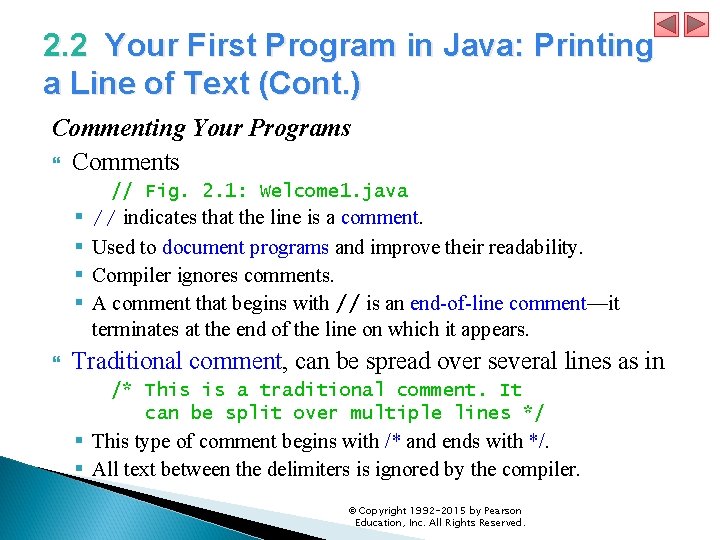
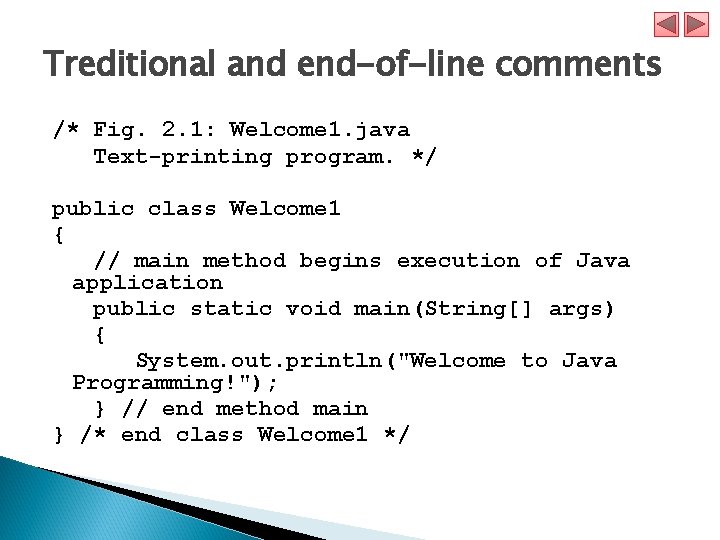
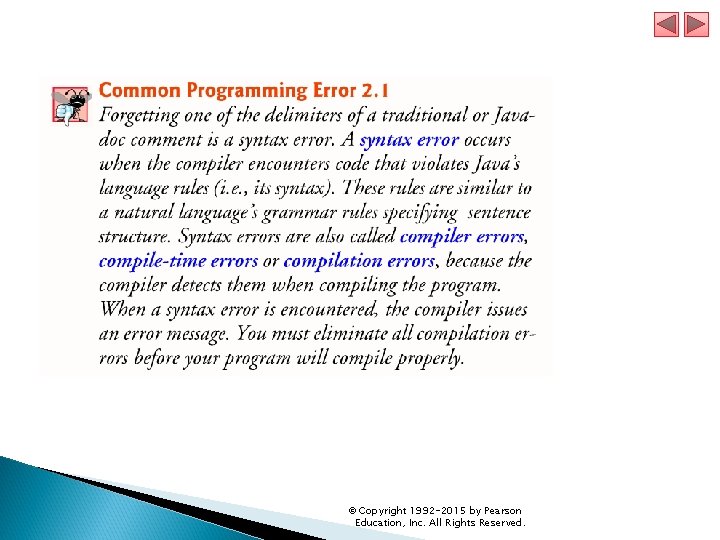
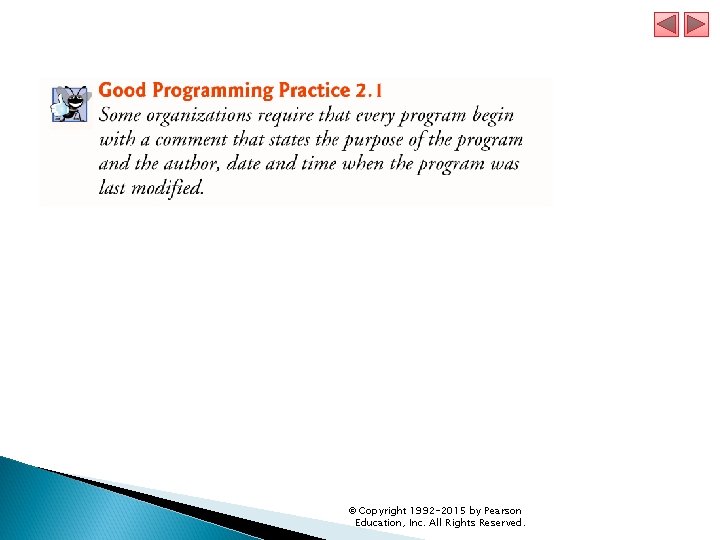
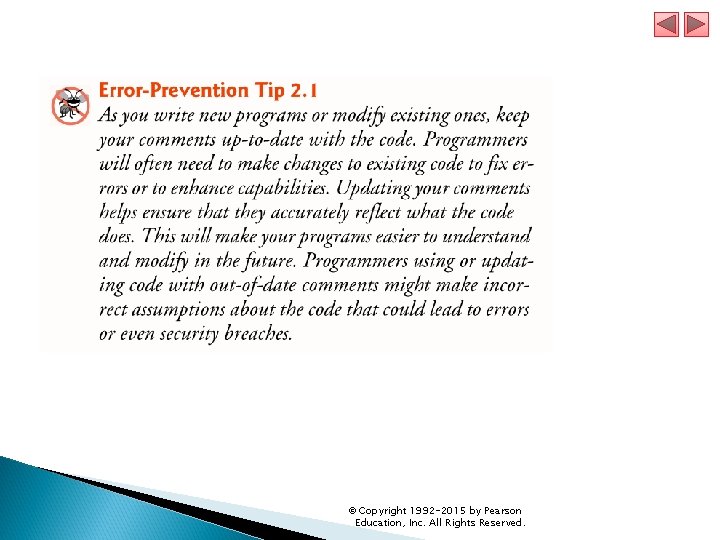
2. 2 Your First Program in Java: Printing a Line of Text (Cont. ) Commenting Your Programs Comments // Fig. 2. 1: Welcome 1. java § § // indicates that the line is a comment. Used to document programs and improve their readability. Compiler ignores comments. A comment that begins with // is an end-of-line comment—it terminates at the end of the line on which it appears. Traditional comment, can be spread over several lines as in /* This is a traditional comment. It can be split over multiple lines */ § This type of comment begins with /* and ends with */. § All text between the delimiters is ignored by the compiler. © Copyright 1992 -2015 by Pearson Education, Inc. All Rights Reserved.
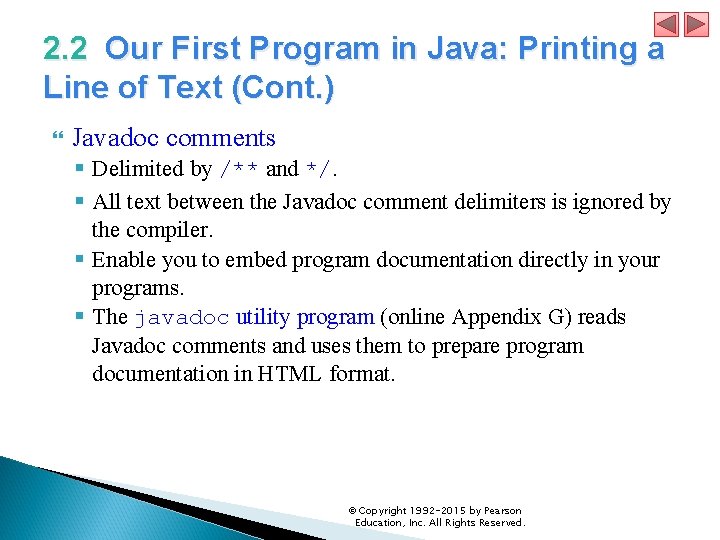
2. 2 Our First Program in Java: Printing a Line of Text (Cont. ) Javadoc comments § Delimited by /** and */. § All text between the Javadoc comment delimiters is ignored by the compiler. § Enable you to embed program documentation directly in your programs. § The javadoc utility program (online Appendix G) reads Javadoc comments and uses them to prepare program documentation in HTML format. © Copyright 1992 -2015 by Pearson Education, Inc. All Rights Reserved.
Source code without any comments public class Welcome 1 { public static void main(String[] args) { System. out. println("Welcome to Java Programming!"); } }
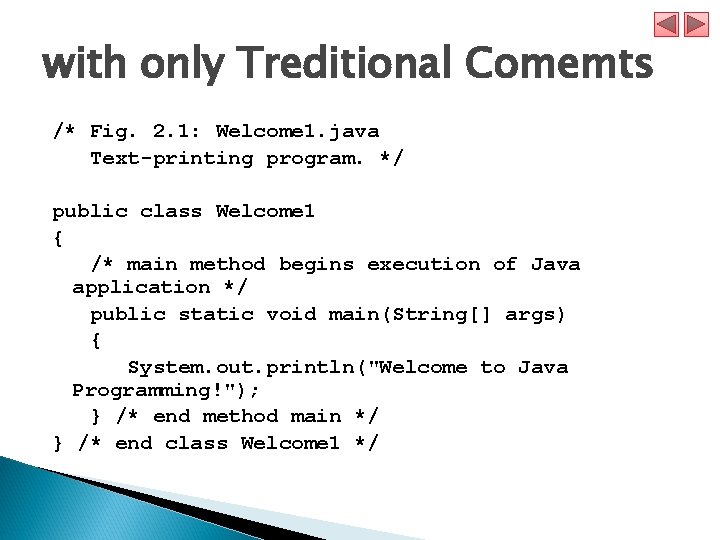
with only Treditional Comemts /* Fig. 2. 1: Welcome 1. java Text-printing program. */ public class Welcome 1 { /* main method begins execution of Java application */ public static void main(String[] args) { System. out. println("Welcome to Java Programming!"); } /* end method main */ } /* end class Welcome 1 */
Treditional and end-of-line comments /* Fig. 2. 1: Welcome 1. java Text-printing program. */ public class Welcome 1 { // main method begins execution of Java application public static void main(String[] args) { System. out. println("Welcome to Java Programming!"); } // end method main } /* end class Welcome 1 */
© Copyright 1992 -2015 by Pearson Education, Inc. All Rights Reserved.
© Copyright 1992 -2015 by Pearson Education, Inc. All Rights Reserved.
© Copyright 1992 -2015 by Pearson Education, Inc. All Rights Reserved.
© Copyright 1992 -2015 by Pearson Education, Inc. All Rights Reserved.
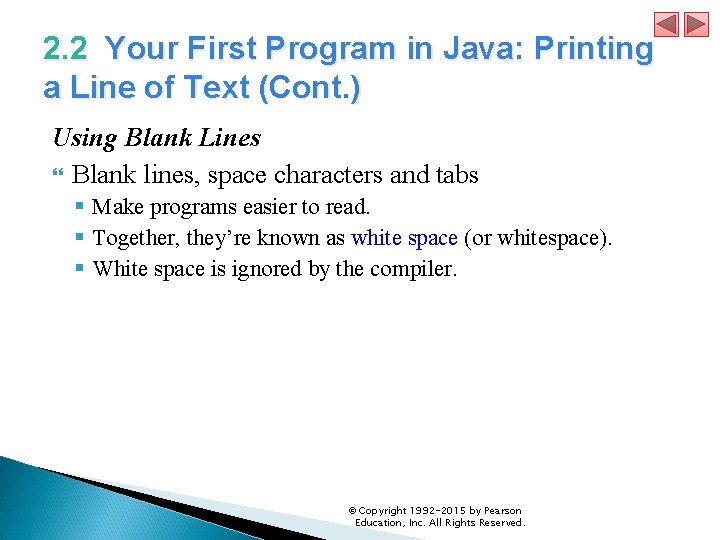
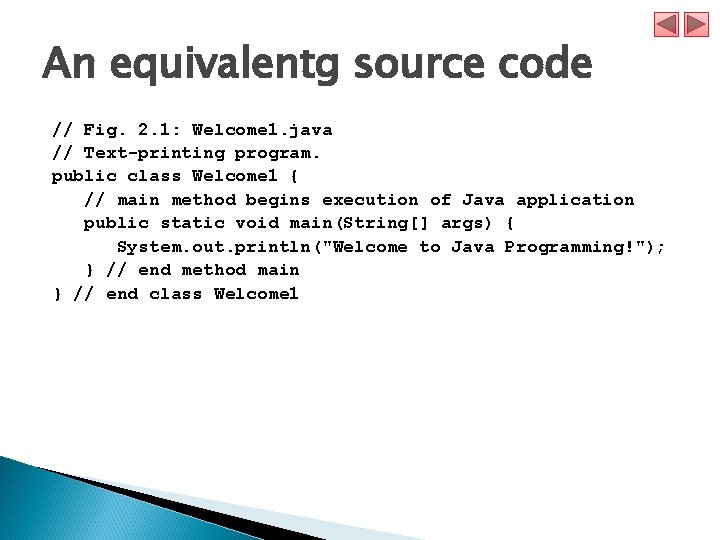
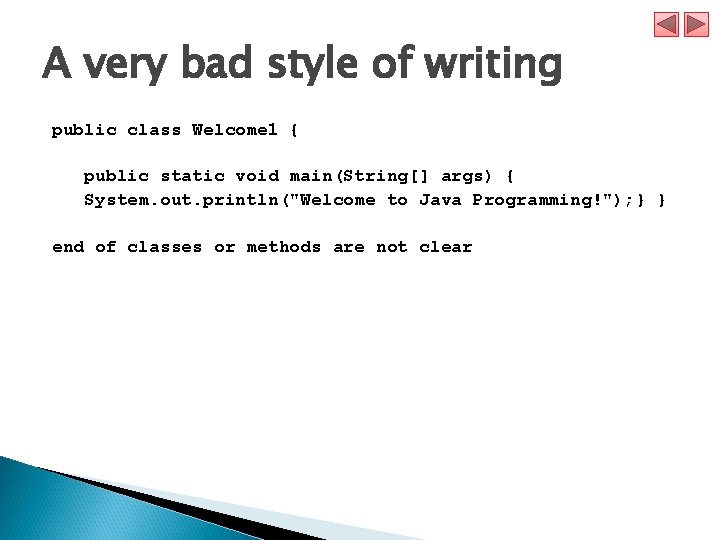
2. 2 Your First Program in Java: Printing a Line of Text (Cont. ) Using Blank Lines Blank lines, space characters and tabs § Make programs easier to read. § Together, they’re known as white space (or whitespace). § White space is ignored by the compiler. © Copyright 1992 -2015 by Pearson Education, Inc. All Rights Reserved.
An equivalentg source code // Fig. 2. 1: Welcome 1. java // Text-printing program. public class Welcome 1 { // main method begins execution of Java application public static void main(String[] args) { System. out. println("Welcome to Java Programming!"); } // end method main } // end class Welcome 1
A very bad style of writing public class Welcome 1 { public static void main(String[] args) { System. out. println("Welcome to Java Programming!"); } } end of classes or methods are not clear
© Copyright 1992 -2015 by Pearson Education, Inc. All Rights Reserved.
© Copyright 1992 -2015 by Pearson Education, Inc. All Rights Reserved.
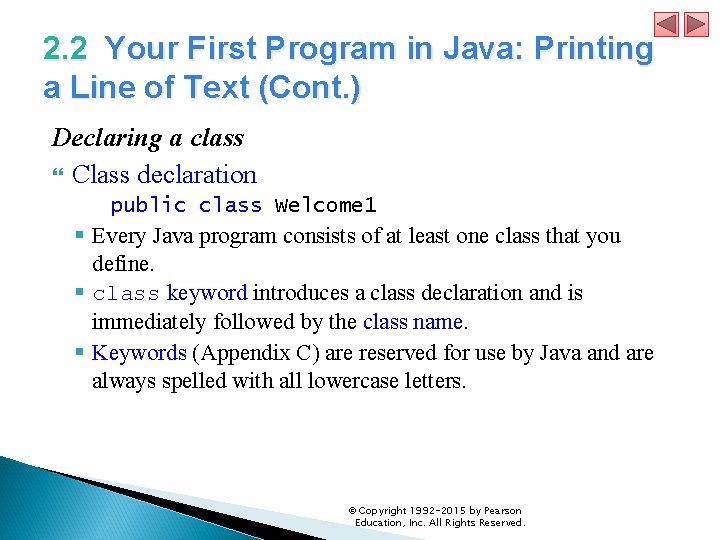
2. 2 Your First Program in Java: Printing a Line of Text (Cont. ) Declaring a class Class declaration public class Welcome 1 § Every Java program consists of at least one class that you define. § class keyword introduces a class declaration and is immediately followed by the class name. § Keywords (Appendix C) are reserved for use by Java and are always spelled with all lowercase letters. © Copyright 1992 -2015 by Pearson Education, Inc. All Rights Reserved.
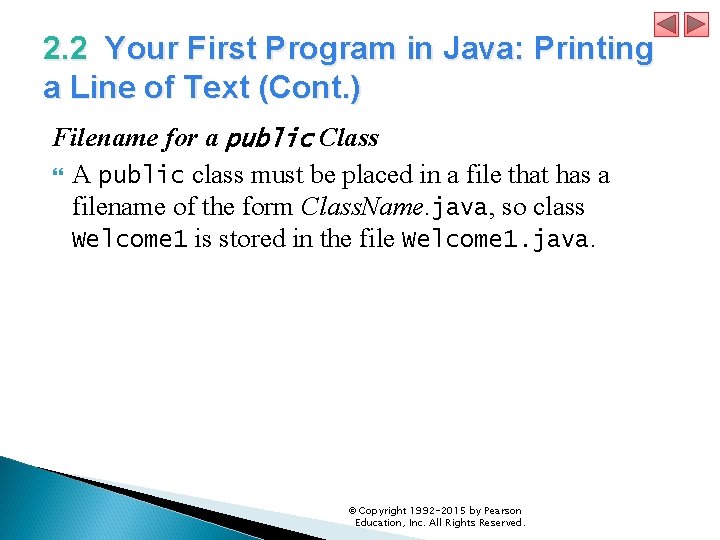
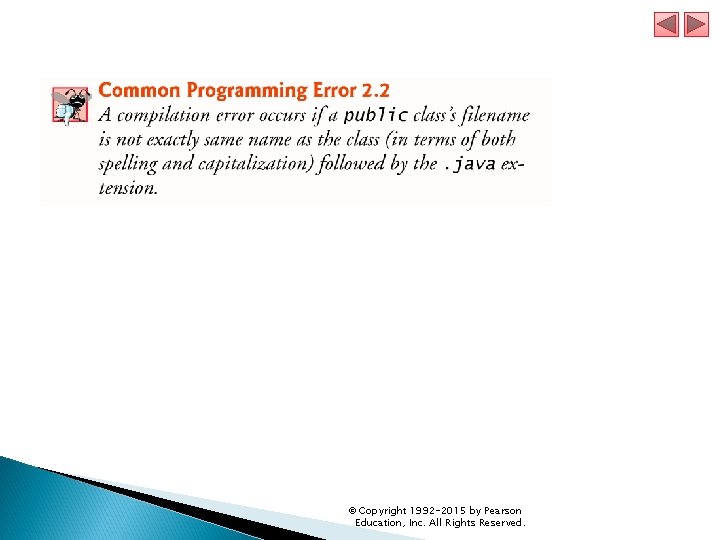
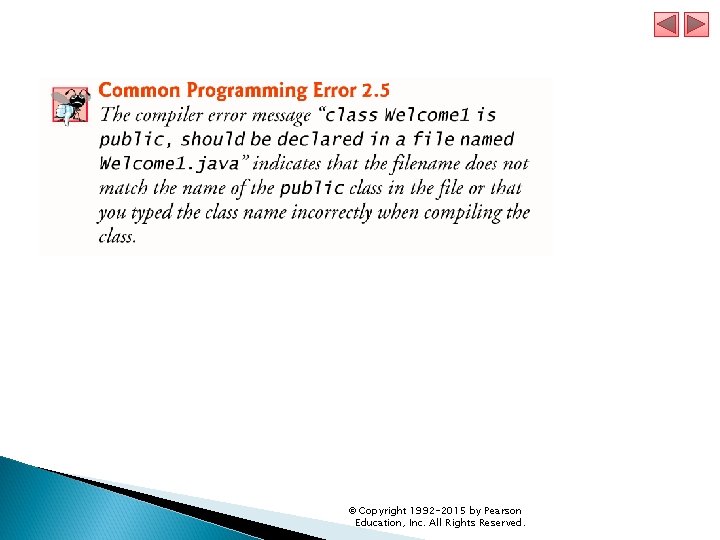
2. 2 Your First Program in Java: Printing a Line of Text (Cont. ) Filename for a public Class A public class must be placed in a file that has a filename of the form Class. Name. java, so class Welcome 1 is stored in the file Welcome 1. java. © Copyright 1992 -2015 by Pearson Education, Inc. All Rights Reserved.
© Copyright 1992 -2015 by Pearson Education, Inc. All Rights Reserved.
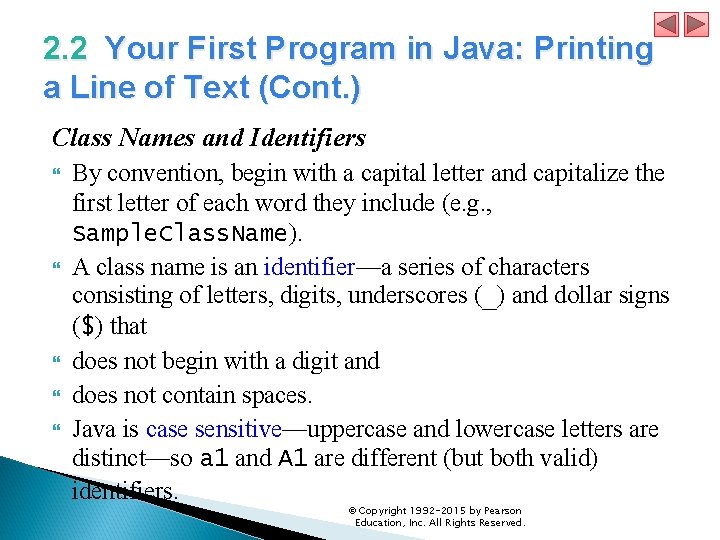
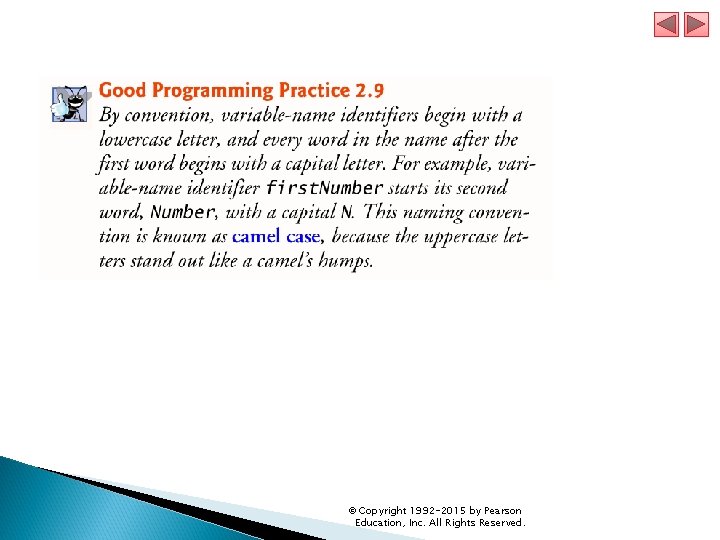
2. 2 Your First Program in Java: Printing a Line of Text (Cont. ) Class Names and Identifiers By convention, begin with a capital letter and capitalize the first letter of each word they include (e. g. , Sample. Class. Name). A class name is an identifier—a series of characters consisting of letters, digits, underscores (_) and dollar signs ($) that does not begin with a digit and does not contain spaces. Java is case sensitive—uppercase and lowercase letters are distinct—so a 1 and A 1 are different (but both valid) identifiers. © Copyright 1992 -2015 by Pearson Education, Inc. All Rights Reserved.
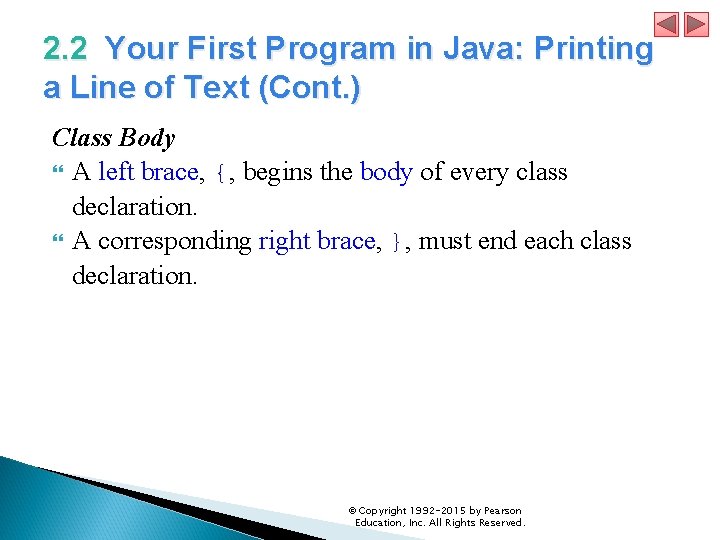
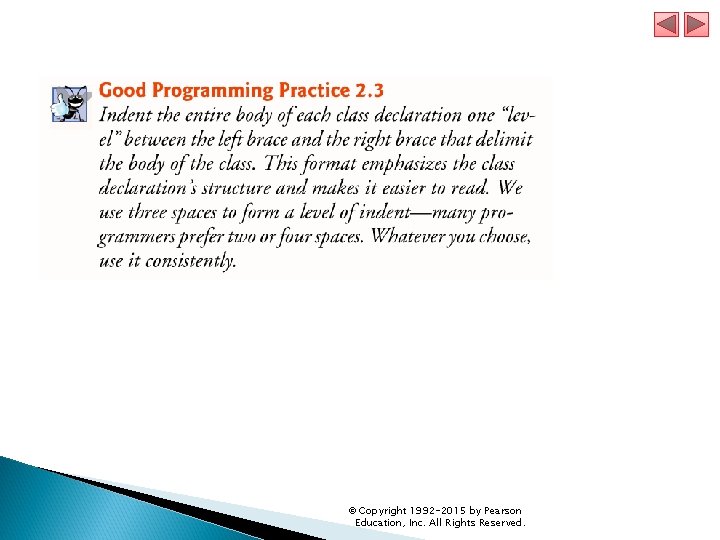
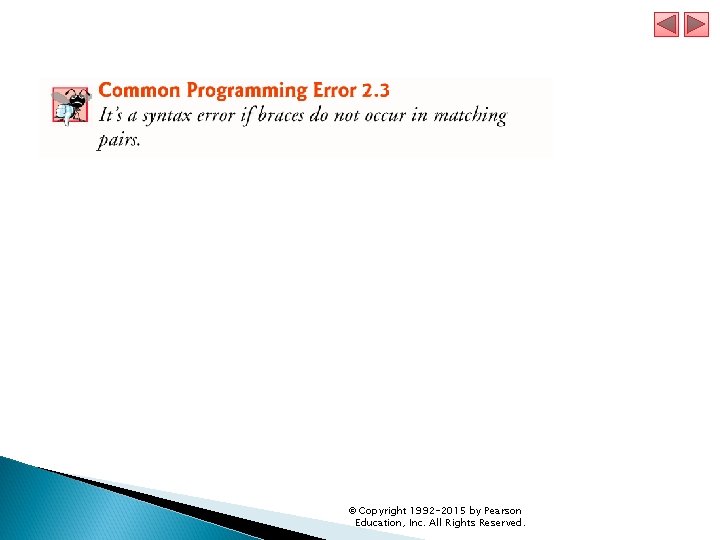
2. 2 Your First Program in Java: Printing a Line of Text (Cont. ) Class Body A left brace, {, begins the body of every class declaration. A corresponding right brace, }, must end each class declaration. © Copyright 1992 -2015 by Pearson Education, Inc. All Rights Reserved.
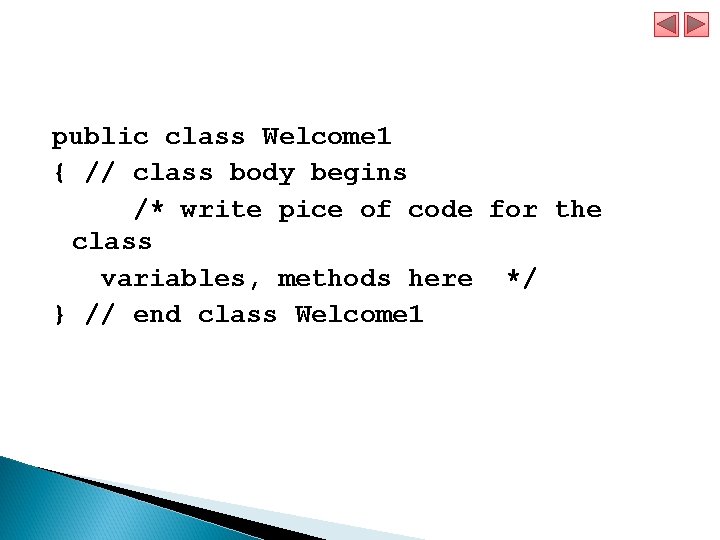
public class Welcome 1 { // class body begins /* write pice of code for the class variables, methods here */ } // end class Welcome 1
© Copyright 1992 -2015 by Pearson Education, Inc. All Rights Reserved.
© Copyright 1992 -2015 by Pearson Education, Inc. All Rights Reserved.
© Copyright 1992 -2015 by Pearson Education, Inc. All Rights Reserved.
© Copyright 1992 -2015 by Pearson Education, Inc. All Rights Reserved.
© Copyright 1992 -2015 by Pearson Education, Inc. All Rights Reserved.
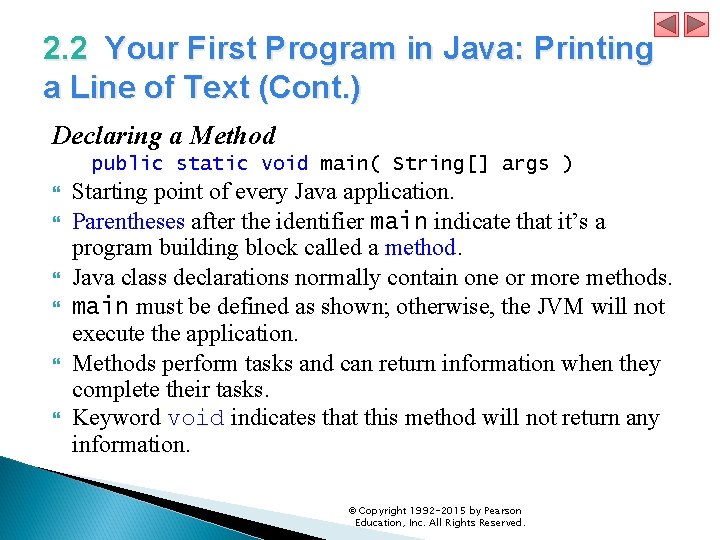
2. 2 Your First Program in Java: Printing a Line of Text (Cont. ) Declaring a Method public static void main( String[] args ) Starting point of every Java application. Parentheses after the identifier main indicate that it’s a program building block called a method. Java class declarations normally contain one or more methods. main must be defined as shown; otherwise, the JVM will not execute the application. Methods perform tasks and can return information when they complete their tasks. Keyword void indicates that this method will not return any information. © Copyright 1992 -2015 by Pearson Education, Inc. All Rights Reserved.
© Copyright 1992 -2015 by Pearson Education, Inc. All Rights Reserved.
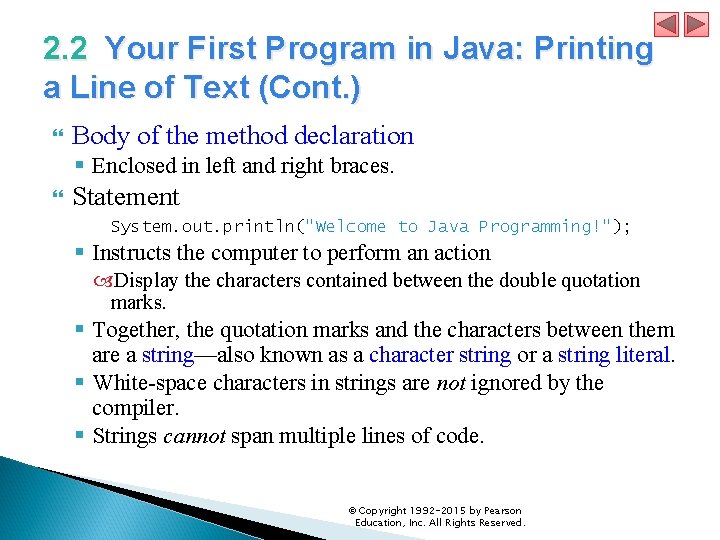
2. 2 Your First Program in Java: Printing a Line of Text (Cont. ) Body of the method declaration § Enclosed in left and right braces. Statement System. out. println("Welcome to Java Programming!"); § Instructs the computer to perform an action Display the characters contained between the double quotation marks. § Together, the quotation marks and the characters between them are a string—also known as a character string or a string literal. § White-space characters in strings are not ignored by the compiler. § Strings cannot span multiple lines of code. © Copyright 1992 -2015 by Pearson Education, Inc. All Rights Reserved.
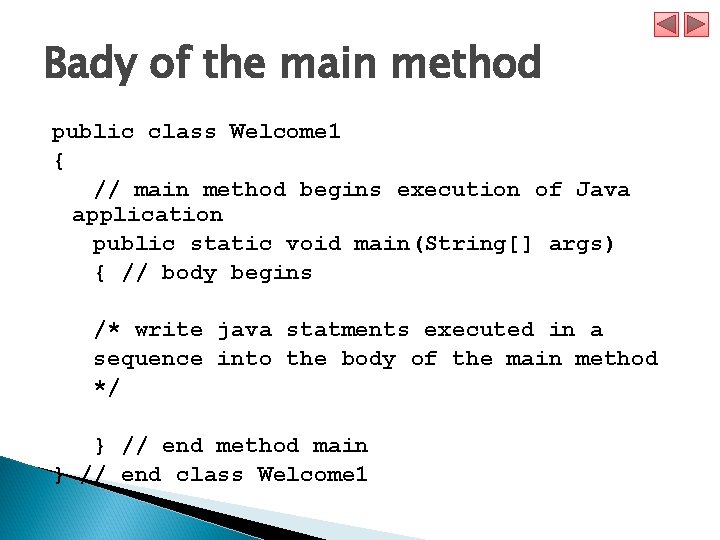
Bady of the main method public class Welcome 1 { // main method begins execution of Java application public static void main(String[] args) { // body begins /* write java statments executed in a sequence into the body of the main method */ } // end method main } // end class Welcome 1
© Copyright 1992 -2015 by Pearson Education, Inc. All Rights Reserved.
© Copyright 1992 -2015 by Pearson Education, Inc. All Rights Reserved.
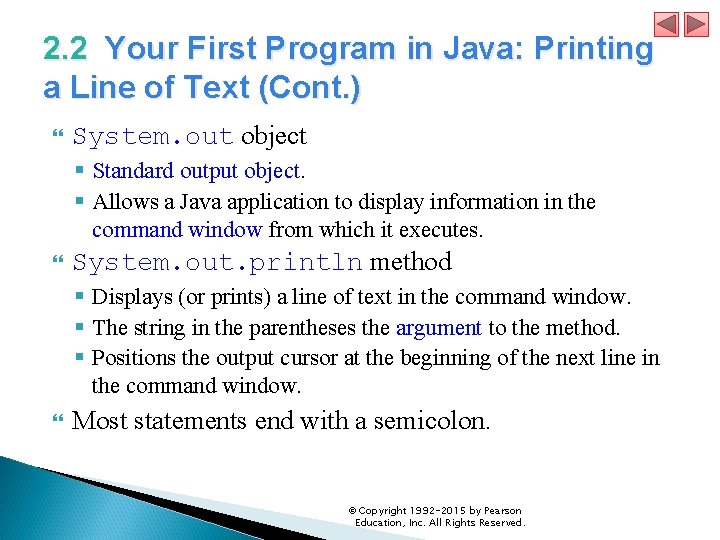
2. 2 Your First Program in Java: Printing a Line of Text (Cont. ) System. out object § Standard output object. § Allows a Java application to display information in the command window from which it executes. System. out. println method § Displays (or prints) a line of text in the command window. § The string in the parentheses the argument to the method. § Positions the output cursor at the beginning of the next line in the command window. Most statements end with a semicolon. © Copyright 1992 -2015 by Pearson Education, Inc. All Rights Reserved.
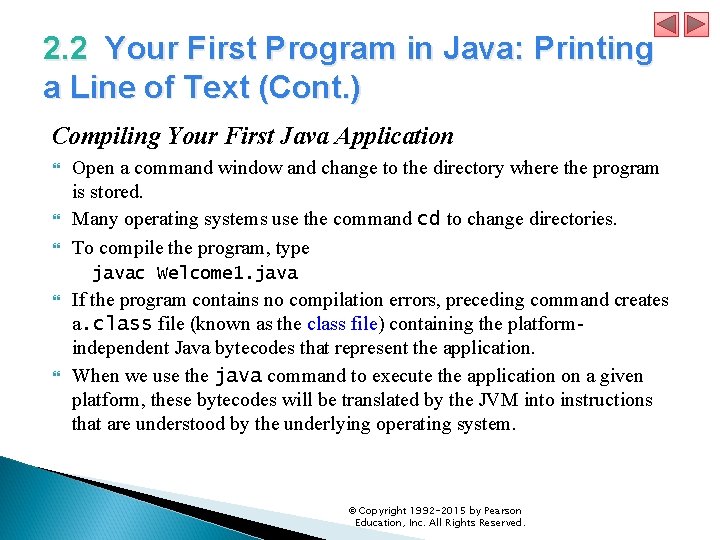
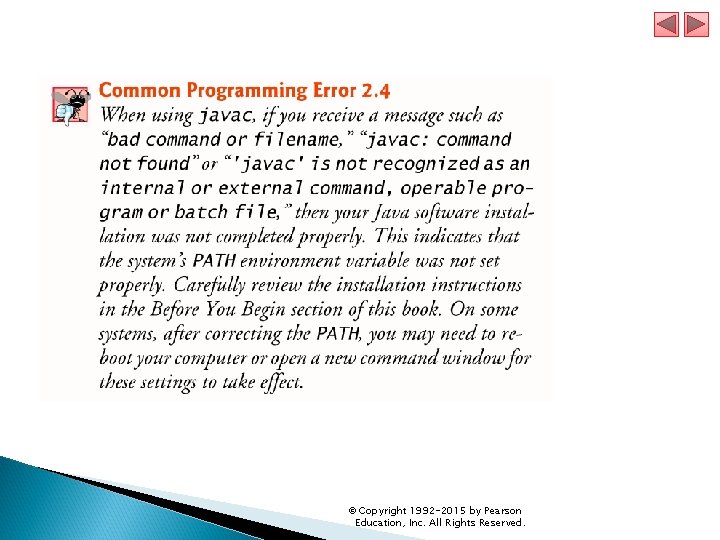
2. 2 Your First Program in Java: Printing a Line of Text (Cont. ) Compiling Your First Java Application Open a command window and change to the directory where the program is stored. Many operating systems use the command cd to change directories. To compile the program, type javac Welcome 1. java If the program contains no compilation errors, preceding command creates a. class file (known as the class file) containing the platformindependent Java bytecodes that represent the application. When we use the java command to execute the application on a given platform, these bytecodes will be translated by the JVM into instructions that are understood by the underlying operating system. © Copyright 1992 -2015 by Pearson Education, Inc. All Rights Reserved.
© Copyright 1992 -2015 by Pearson Education, Inc. All Rights Reserved.
© Copyright 1992 -2015 by Pearson Education, Inc. All Rights Reserved.
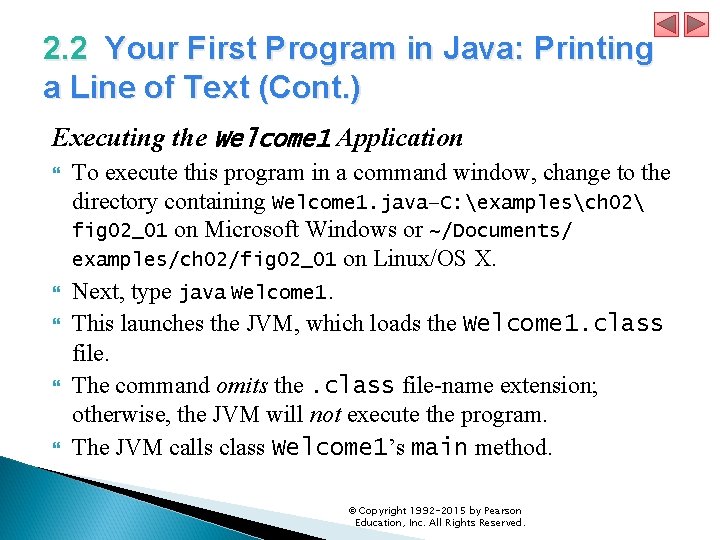
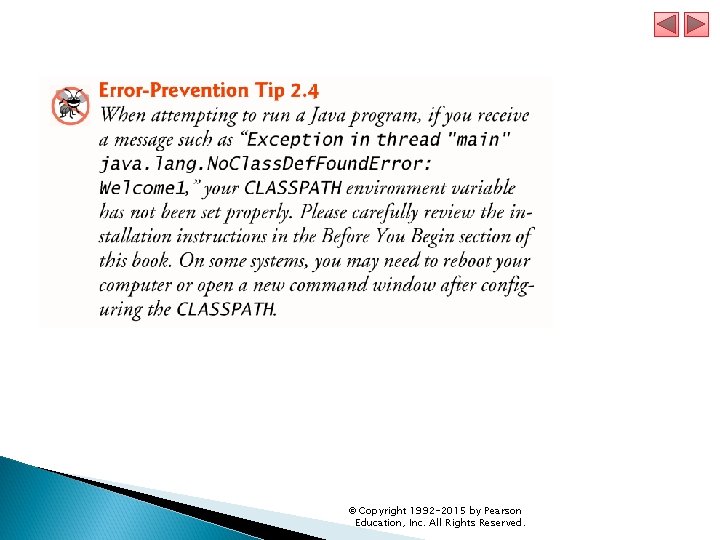
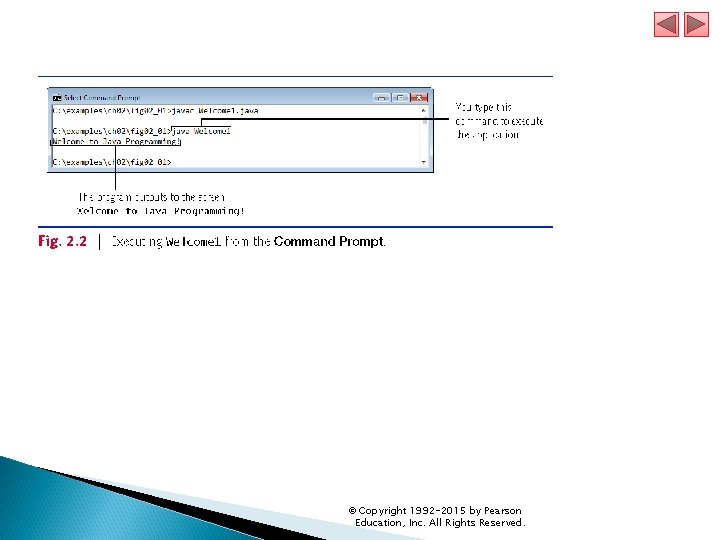
2. 2 Your First Program in Java: Printing a Line of Text (Cont. ) Executing the Welcome 1 Application To execute this program in a command window, change to the directory containing Welcome 1. java—C: examplesch 02 fig 02_01 on Microsoft Windows or ~/Documents/ examples/ch 02/fig 02_01 on Linux/OS X. Next, type java Welcome 1. This launches the JVM, which loads the Welcome 1. class file. The command omits the. class file-name extension; otherwise, the JVM will not execute the program. The JVM calls class Welcome 1’s main method. © Copyright 1992 -2015 by Pearson Education, Inc. All Rights Reserved.
© Copyright 1992 -2015 by Pearson Education, Inc. All Rights Reserved.
© Copyright 1992 -2015 by Pearson Education, Inc. All Rights Reserved.
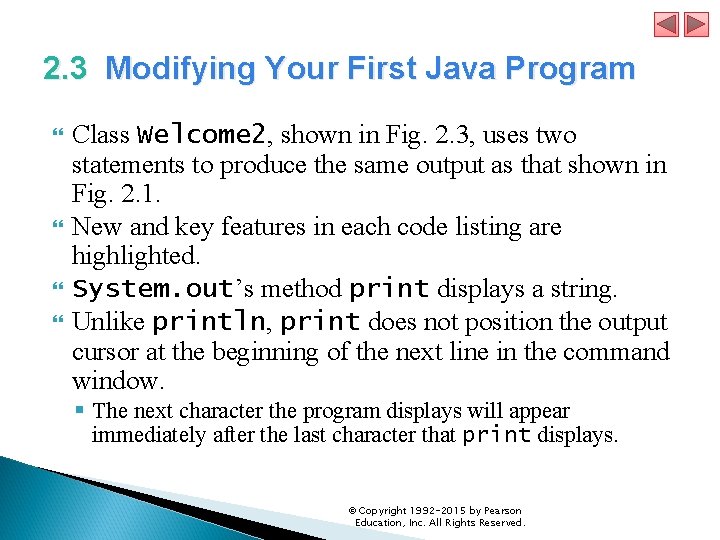
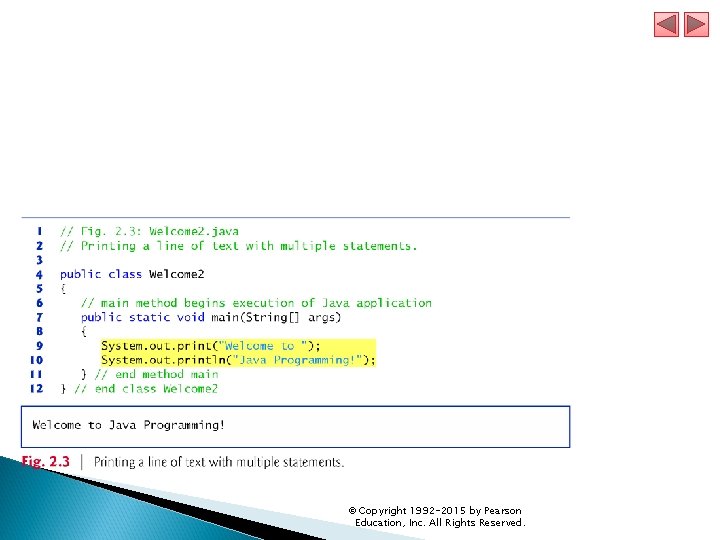
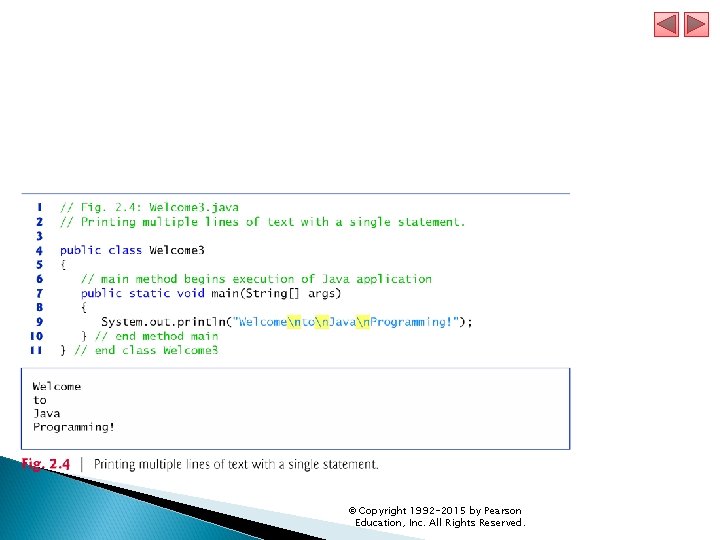
2. 3 Modifying Your First Java Program Class Welcome 2, shown in Fig. 2. 3, uses two statements to produce the same output as that shown in Fig. 2. 1. New and key features in each code listing are highlighted. System. out’s method print displays a string. Unlike println, print does not position the output cursor at the beginning of the next line in the command window. § The next character the program displays will appear immediately after the last character that print displays. © Copyright 1992 -2015 by Pearson Education, Inc. All Rights Reserved.
© Copyright 1992 -2015 by Pearson Education, Inc. All Rights Reserved.
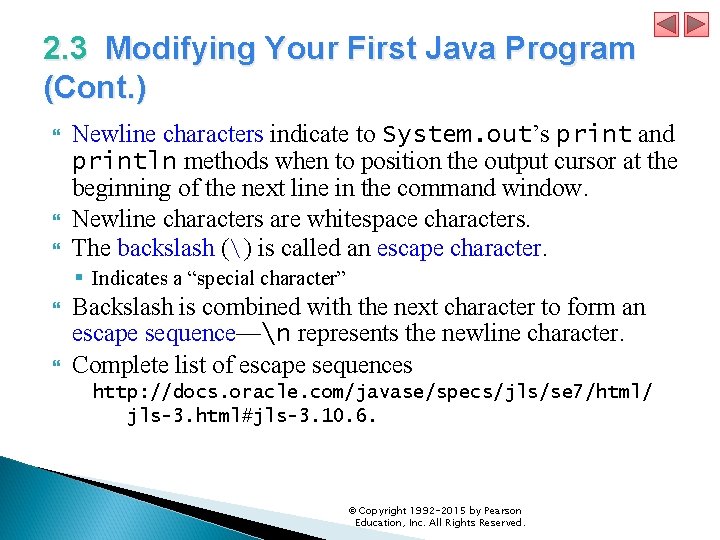
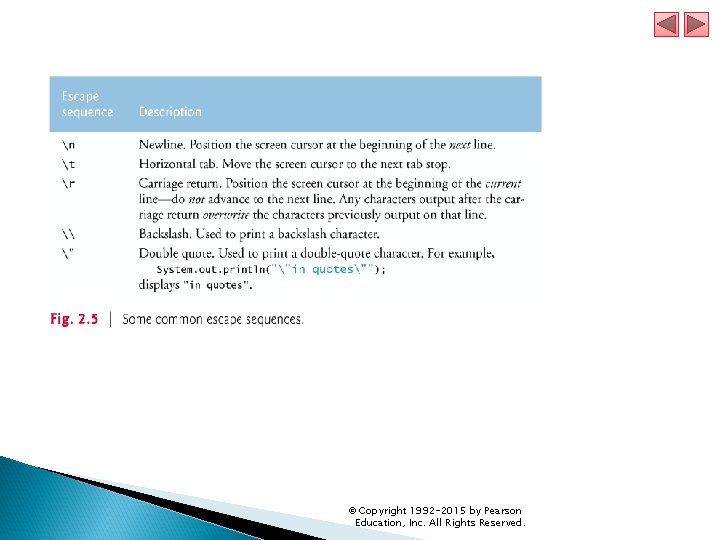
2. 3 Modifying Your First Java Program (Cont. ) Newline characters indicate to System. out’s print and println methods when to position the output cursor at the beginning of the next line in the command window. Newline characters are whitespace characters. The backslash () is called an escape character. § Indicates a “special character” Backslash is combined with the next character to form an escape sequence—n represents the newline character. Complete list of escape sequences http: //docs. oracle. com/javase/specs/jls/se 7/html/ jls-3. html#jls-3. 10. 6. © Copyright 1992 -2015 by Pearson Education, Inc. All Rights Reserved.
© Copyright 1992 -2015 by Pearson Education, Inc. All Rights Reserved.
© Copyright 1992 -2015 by Pearson Education, Inc. All Rights Reserved.
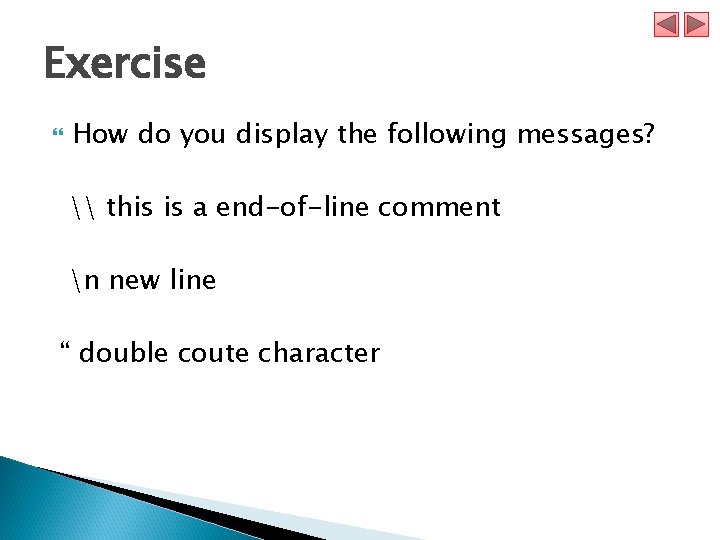
Exercise How do you display the following messages? \ this is a end-of-line comment n new line “ double coute character
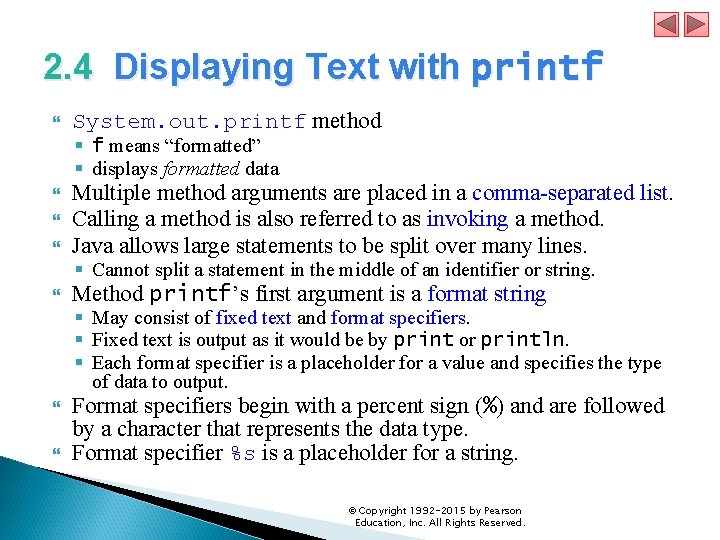
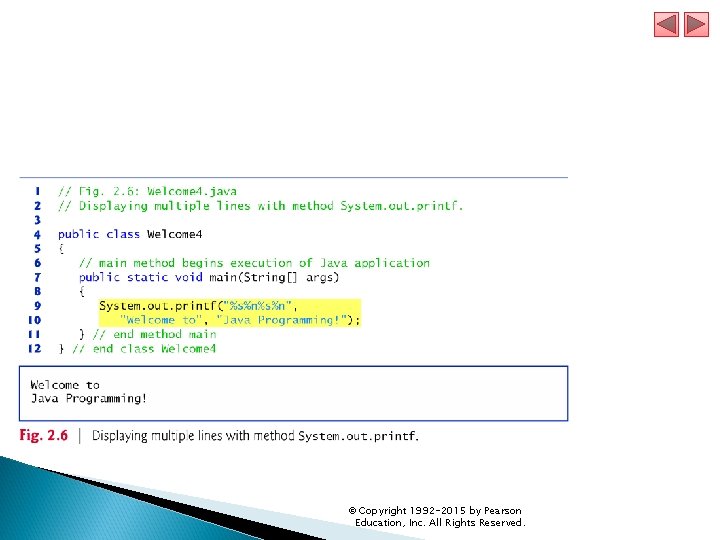
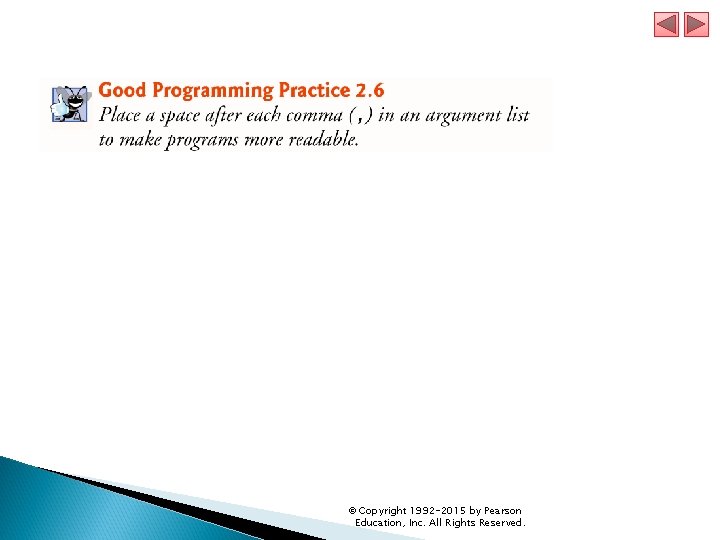
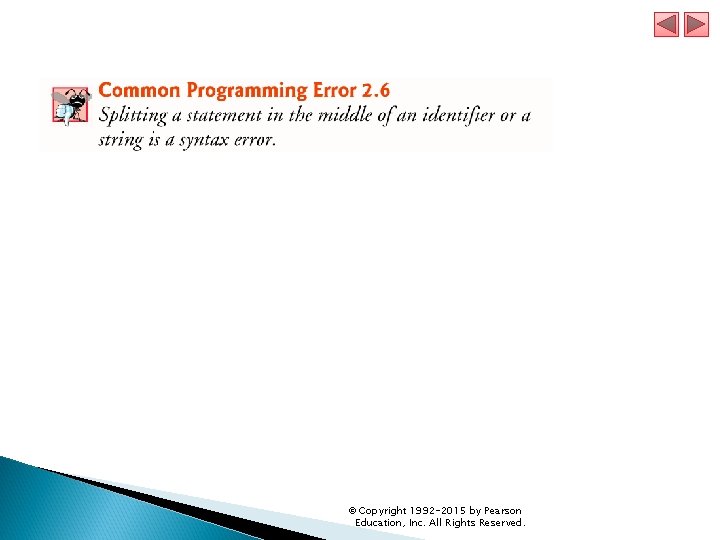
2. 4 Displaying Text with printf System. out. printf method § f means “formatted” § displays formatted data Multiple method arguments are placed in a comma-separated list. Calling a method is also referred to as invoking a method. Java allows large statements to be split over many lines. § Cannot split a statement in the middle of an identifier or string. Method printf’s first argument is a format string § May consist of fixed text and format specifiers. § Fixed text is output as it would be by print or println. § Each format specifier is a placeholder for a value and specifies the type of data to output. Format specifiers begin with a percent sign (%) and are followed by a character that represents the data type. Format specifier %s is a placeholder for a string. © Copyright 1992 -2015 by Pearson Education, Inc. All Rights Reserved.
© Copyright 1992 -2015 by Pearson Education, Inc. All Rights Reserved.
© Copyright 1992 -2015 by Pearson Education, Inc. All Rights Reserved.
© Copyright 1992 -2015 by Pearson Education, Inc. All Rights Reserved.
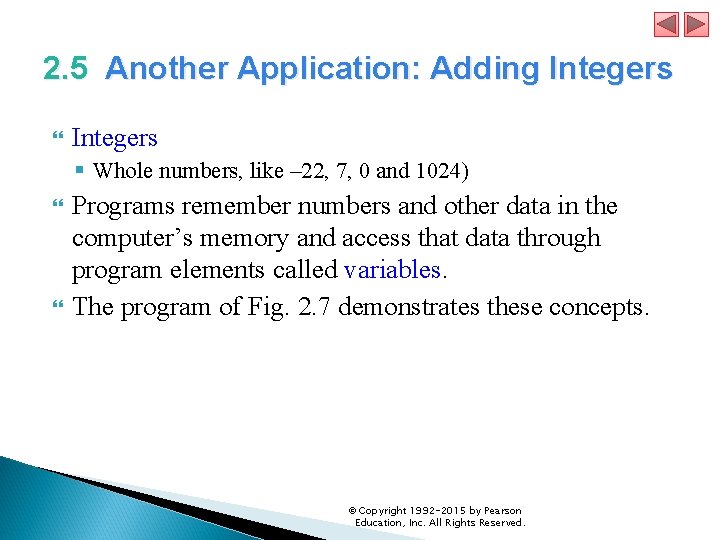
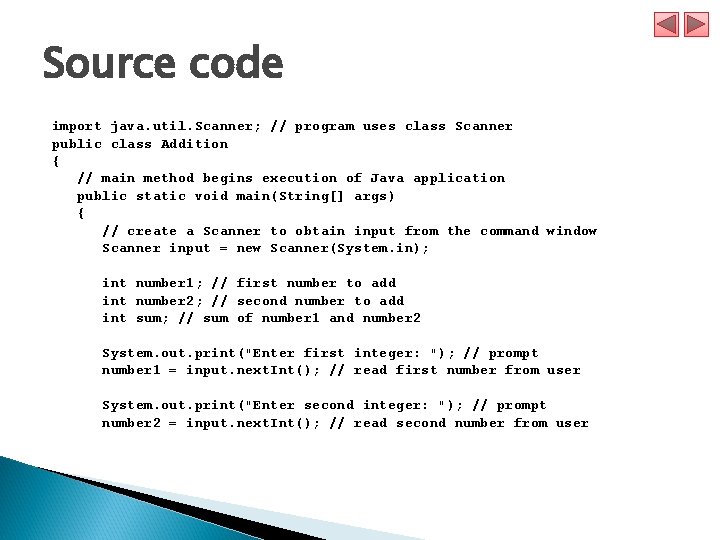
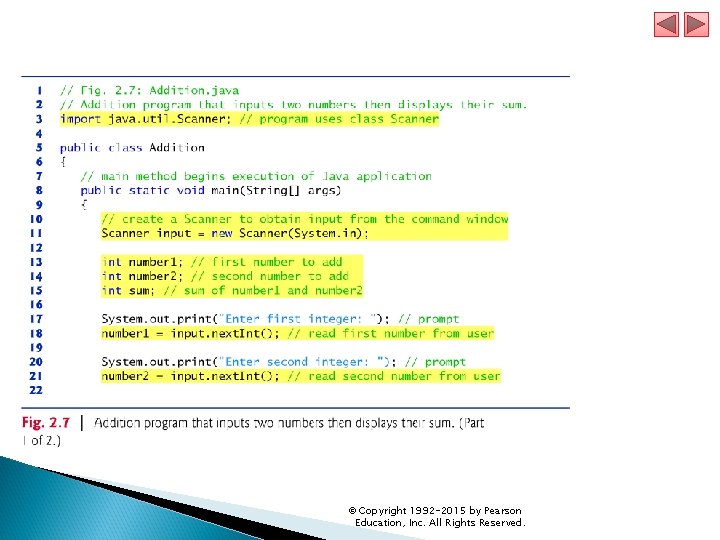
2. 5 Another Application: Adding Integers § Whole numbers, like – 22, 7, 0 and 1024) Programs remember numbers and other data in the computer’s memory and access that data through program elements called variables. The program of Fig. 2. 7 demonstrates these concepts. © Copyright 1992 -2015 by Pearson Education, Inc. All Rights Reserved.
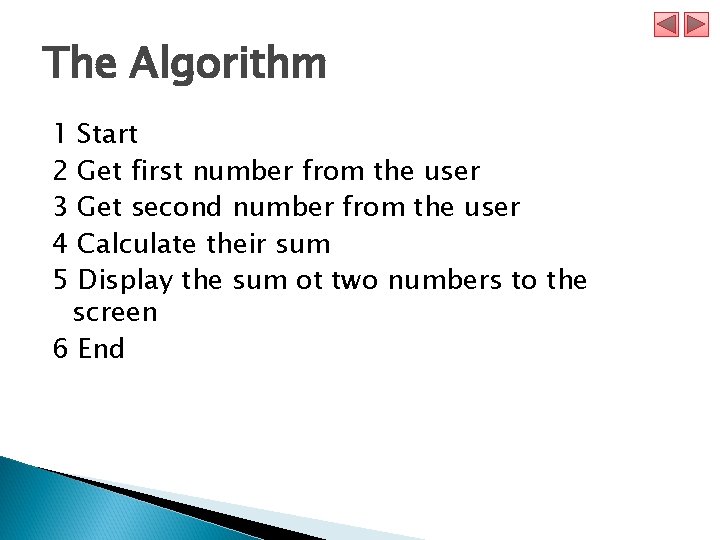
The Algorithm 1 2 3 4 5 Start Get first number from the user Get second number from the user Calculate their sum Display the sum ot two numbers to the screen 6 End
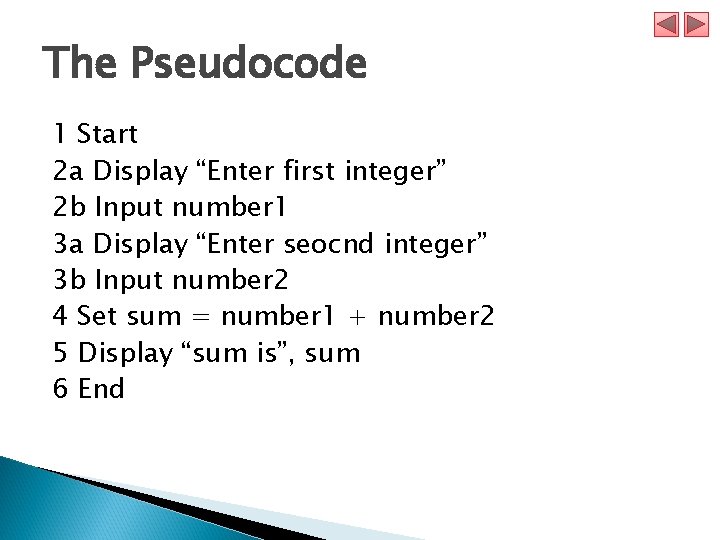
The Pseudocode 1 Start 2 a Display “Enter first integer” 2 b Input number 1 3 a Display “Enter seocnd integer” 3 b Input number 2 4 Set sum = number 1 + number 2 5 Display “sum is”, sum 6 End
© Copyright 1992 -2015 by Pearson Education, Inc. All Rights Reserved.
© Copyright 1992 -2015 by Pearson Education, Inc. All Rights Reserved.
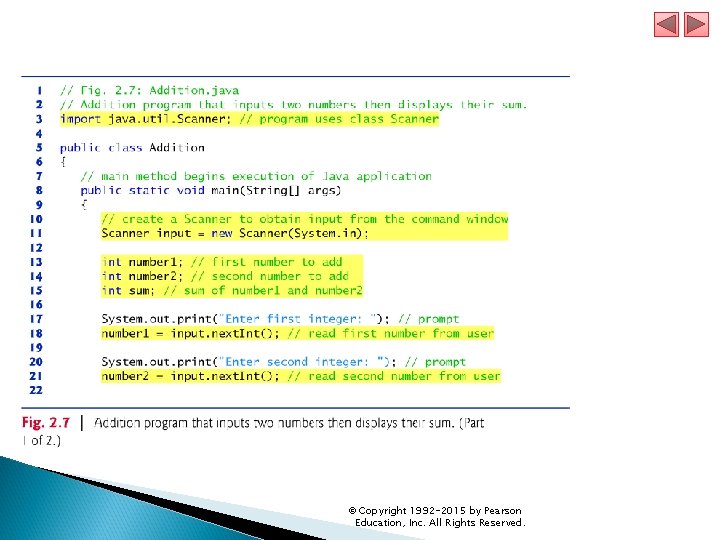
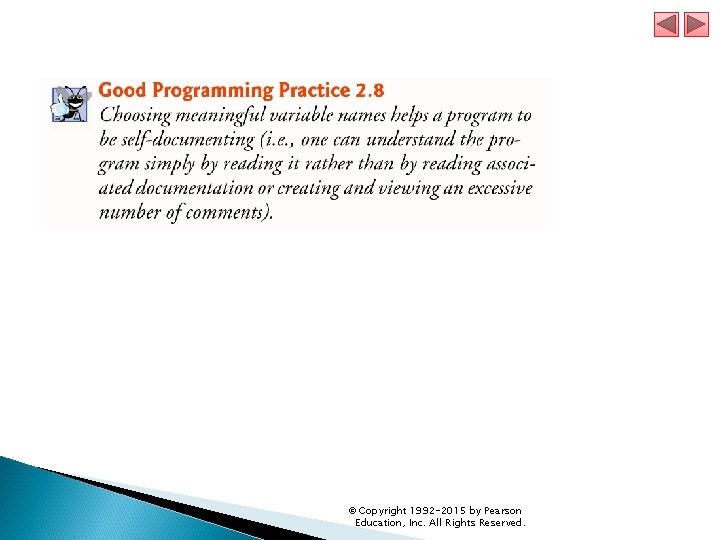
Source code import java. util. Scanner; // program uses class Scanner public class Addition { // main method begins execution of Java application public static void main(String[] args) { // create a Scanner to obtain input from the command window Scanner input = new Scanner(System. in); int number 1; // first number to add int number 2; // second number to add int sum; // sum of number 1 and number 2 System. out. print("Enter first integer: "); // prompt number 1 = input. next. Int(); // read first number from user System. out. print("Enter second integer: "); // prompt number 2 = input. next. Int(); // read second number from user
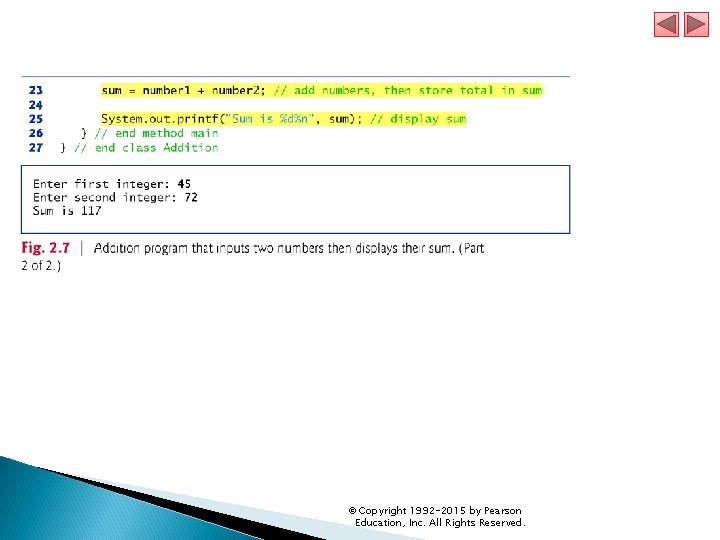
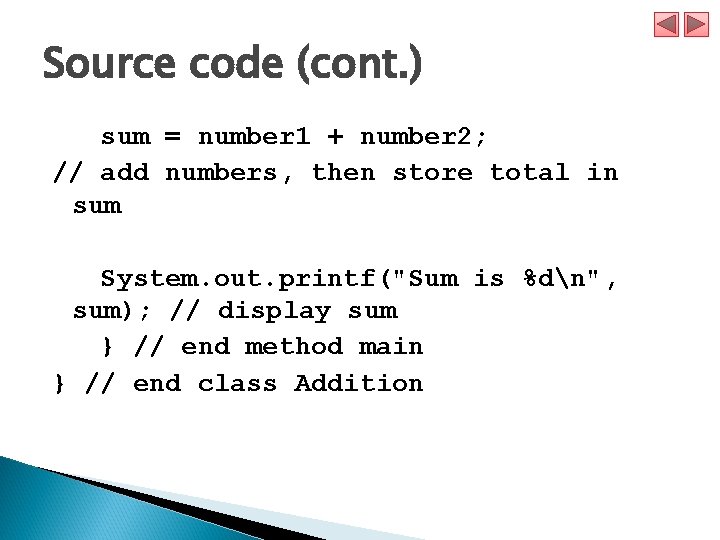
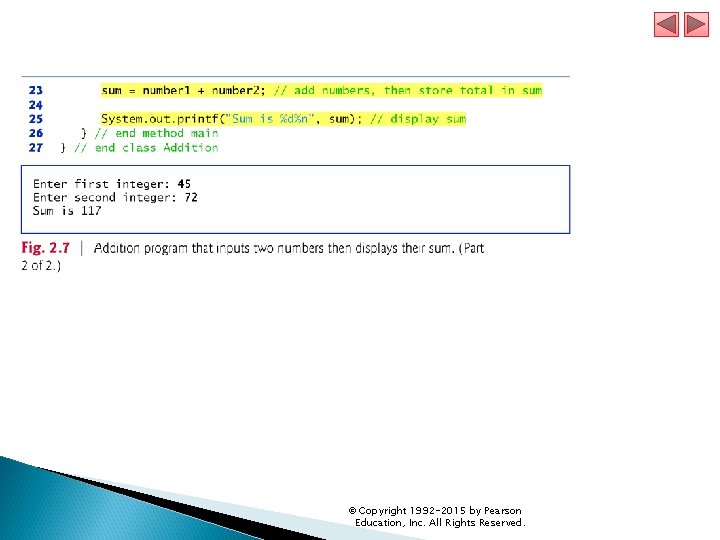
Source code (cont. ) sum = number 1 + number 2; // add numbers, then store total in sum System. out. printf("Sum is %dn", sum); // display sum } // end method main } // end class Addition
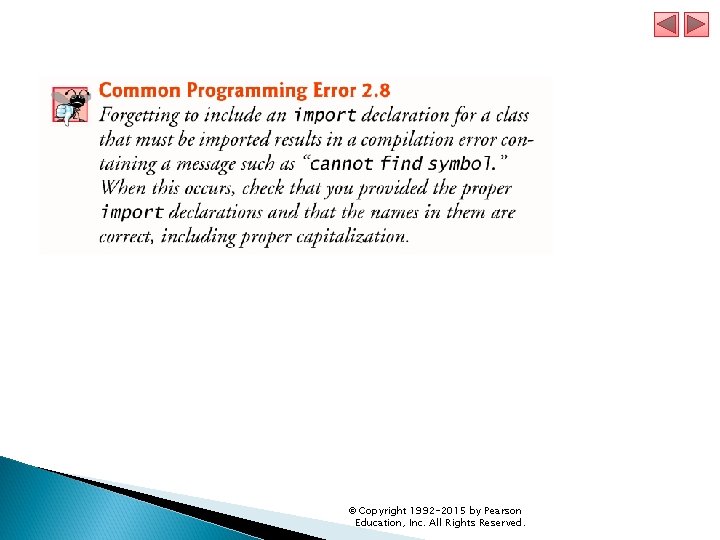
2. 5. 1 import Declarations Helps the compiler locate a class that is used in this program. Rich set of predefined classes that you can reuse rather than “reinventing the wheel. ” Classes are grouped into packages—named groups of related classes—and are collectively referred to as the Java class library, or the Java Application Programming Interface (Java API). You use import declarations to identify the predefined classes used in a Java program. © Copyright 1992 -2015 by Pearson Education, Inc. All Rights Reserved.
© Copyright 1992 -2015 by Pearson Education, Inc. All Rights Reserved.
© Copyright 1992 -2015 by Pearson Education, Inc. All Rights Reserved.
© Copyright 1992 -2015 by Pearson Education, Inc. All Rights Reserved.
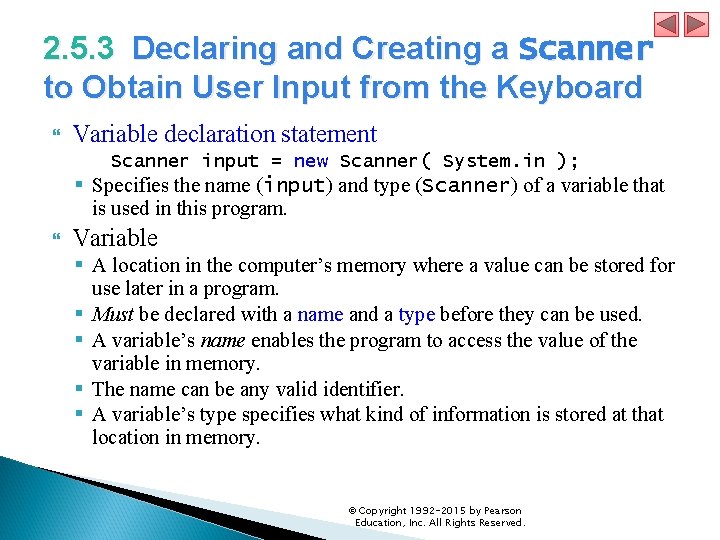
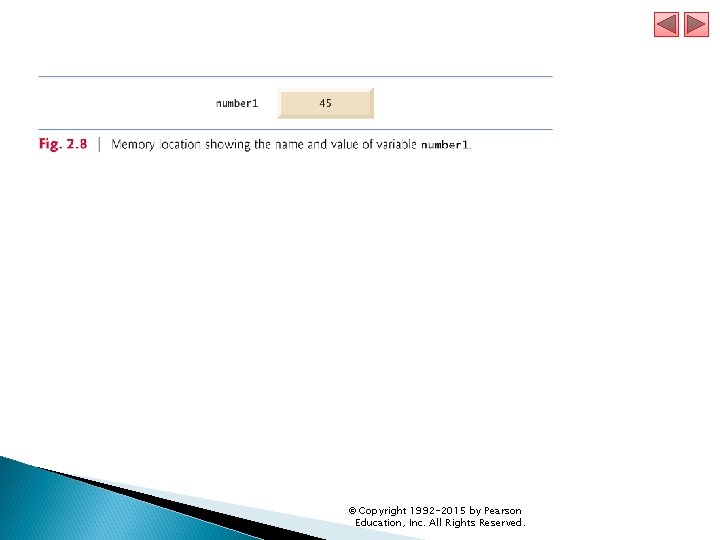
2. 5. 3 Declaring and Creating a Scanner to Obtain User Input from the Keyboard Variable declaration statement Scanner input = new Scanner( System. in ); § Specifies the name (input) and type (Scanner) of a variable that is used in this program. Variable § A location in the computer’s memory where a value can be stored for use later in a program. § Must be declared with a name and a type before they can be used. § A variable’s name enables the program to access the value of the variable in memory. § The name can be any valid identifier. § A variable’s type specifies what kind of information is stored at that location in memory. © Copyright 1992 -2015 by Pearson Education, Inc. All Rights Reserved.
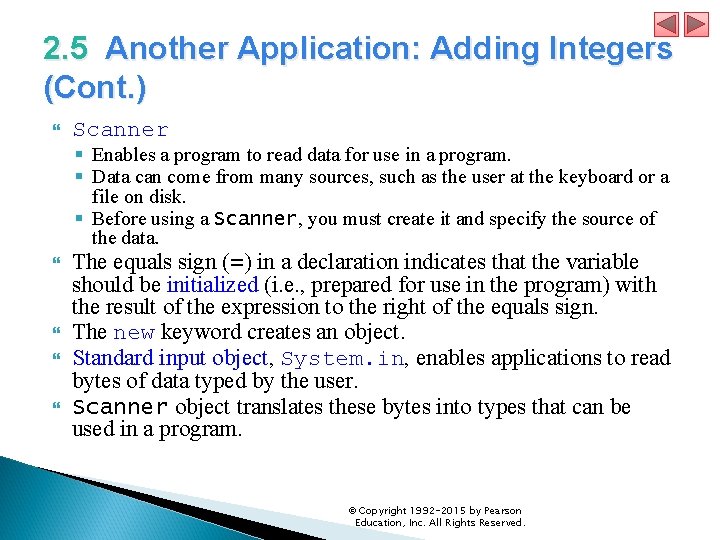
2. 5 Another Application: Adding Integers (Cont. ) Scanner § Enables a program to read data for use in a program. § Data can come from many sources, such as the user at the keyboard or a file on disk. § Before using a Scanner, you must create it and specify the source of the data. The equals sign (=) in a declaration indicates that the variable should be initialized (i. e. , prepared for use in the program) with the result of the expression to the right of the equals sign. The new keyword creates an object. Standard input object, System. in, enables applications to read bytes of data typed by the user. Scanner object translates these bytes into types that can be used in a program. © Copyright 1992 -2015 by Pearson Education, Inc. All Rights Reserved.
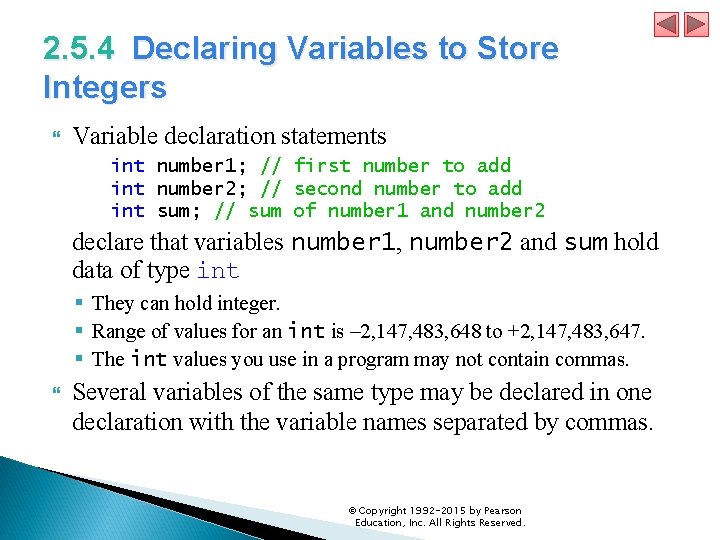
2. 5. 4 Declaring Variables to Store Integers Variable declaration statements int number 1; // first number to add int number 2; // second number to add int sum; // sum of number 1 and number 2 declare that variables number 1, number 2 and sum hold data of type int § They can hold integer. § Range of values for an int is – 2, 147, 483, 648 to +2, 147, 483, 647. § The int values you use in a program may not contain commas. Several variables of the same type may be declared in one declaration with the variable names separated by commas. © Copyright 1992 -2015 by Pearson Education, Inc. All Rights Reserved.
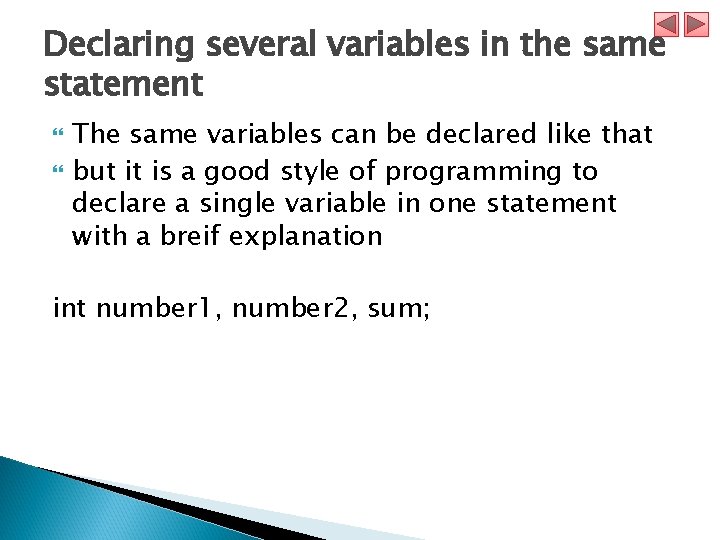
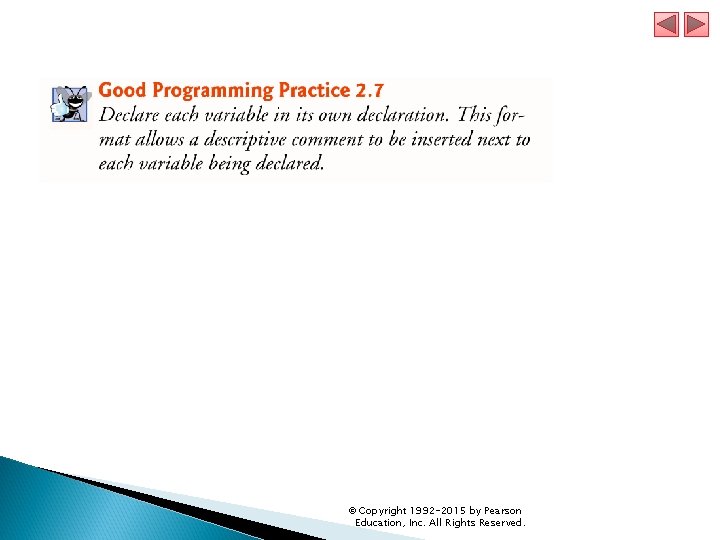
Declaring several variables in the same statement The same variables can be declared like that but it is a good style of programming to declare a single variable in one statement with a breif explanation int number 1, number 2, sum;
© Copyright 1992 -2015 by Pearson Education, Inc. All Rights Reserved.
© Copyright 1992 -2015 by Pearson Education, Inc. All Rights Reserved.
© Copyright 1992 -2015 by Pearson Education, Inc. All Rights Reserved.
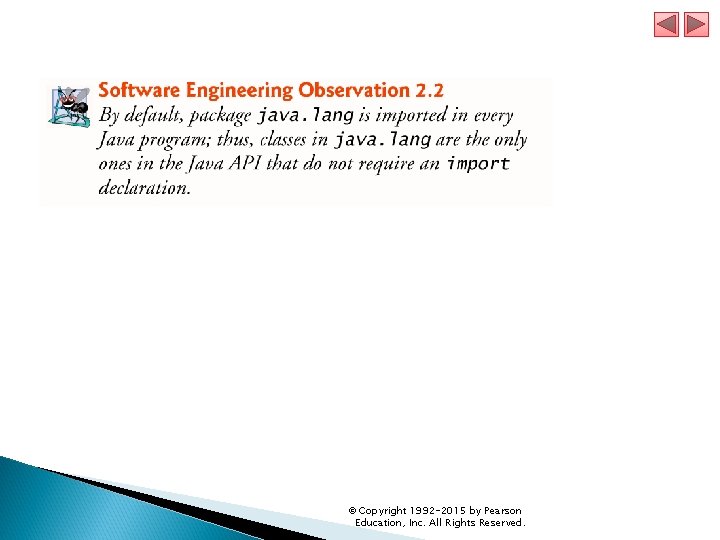
2. 5. 5 Prompting the User for Input Prompt § Output statement that directs the user to take a specific action. Class System § Part of package java. lang. § Class System is not imported with an import declaration at the beginning of the program. © Copyright 1992 -2015 by Pearson Education, Inc. All Rights Reserved.
© Copyright 1992 -2015 by Pearson Education, Inc. All Rights Reserved.
© Copyright 1992 -2015 by Pearson Education, Inc. All Rights Reserved.
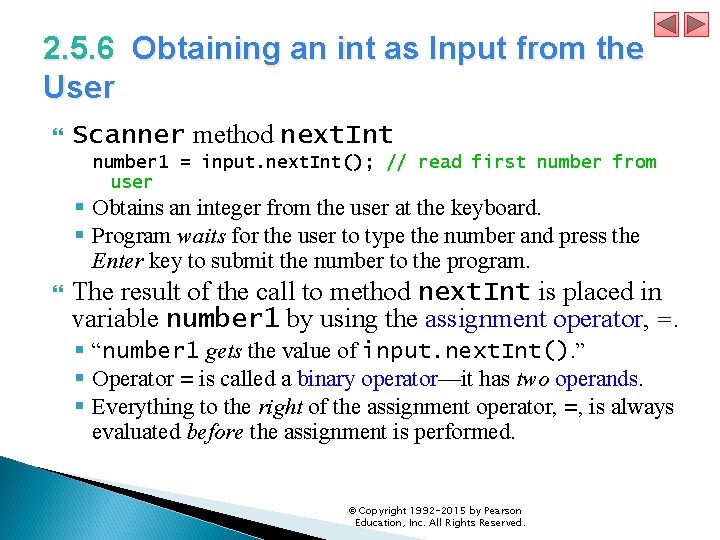
2. 5. 6 Obtaining an int as Input from the User Scanner method next. Int number 1 = input. next. Int(); // read first number from user § Obtains an integer from the user at the keyboard. § Program waits for the user to type the number and press the Enter key to submit the number to the program. The result of the call to method next. Int is placed in variable number 1 by using the assignment operator, =. § “number 1 gets the value of input. next. Int(). ” § Operator = is called a binary operator—it has two operands. § Everything to the right of the assignment operator, =, is always evaluated before the assignment is performed. © Copyright 1992 -2015 by Pearson Education, Inc. All Rights Reserved.
© Copyright 1992 -2015 by Pearson Education, Inc. All Rights Reserved.
© Copyright 1992 -2015 by Pearson Education, Inc. All Rights Reserved.
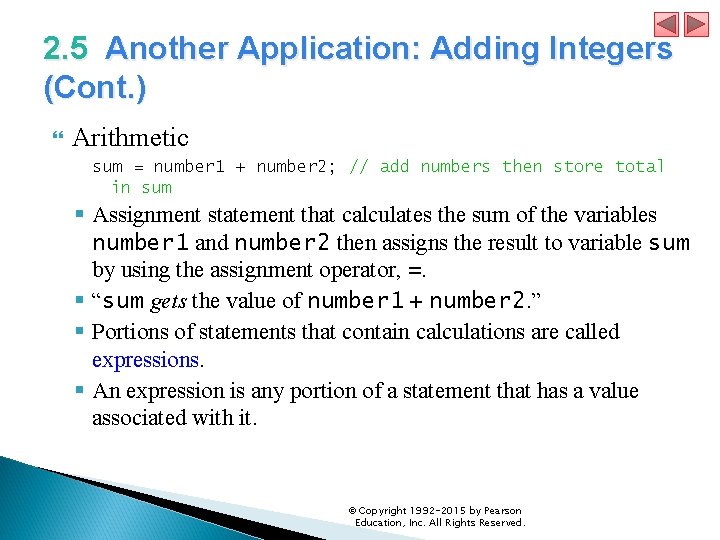
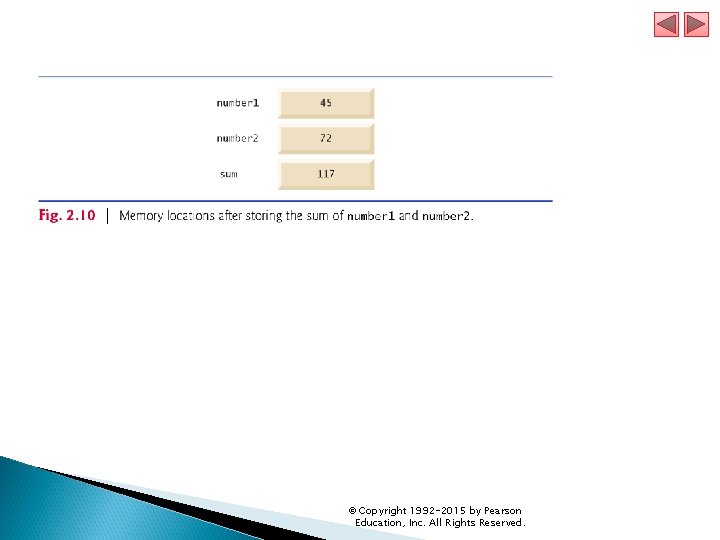
2. 5 Another Application: Adding Integers (Cont. ) Arithmetic sum = number 1 + number 2; // add numbers then store total in sum § Assignment statement that calculates the sum of the variables number 1 and number 2 then assigns the result to variable sum by using the assignment operator, =. § “sum gets the value of number 1 + number 2. ” § Portions of statements that contain calculations are called expressions. § An expression is any portion of a statement that has a value associated with it. © Copyright 1992 -2015 by Pearson Education, Inc. All Rights Reserved.
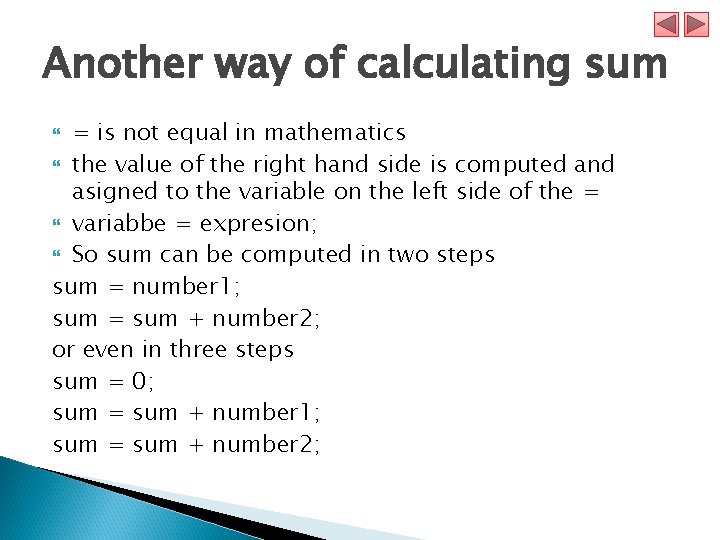
Another way of calculating sum = is not equal in mathematics the value of the right hand side is computed and asigned to the variable on the left side of the = variabbe = expresion; So sum can be computed in two steps sum = number 1; sum = sum + number 2; or even in three steps sum = 0; sum = sum + number 1; sum = sum + number 2;
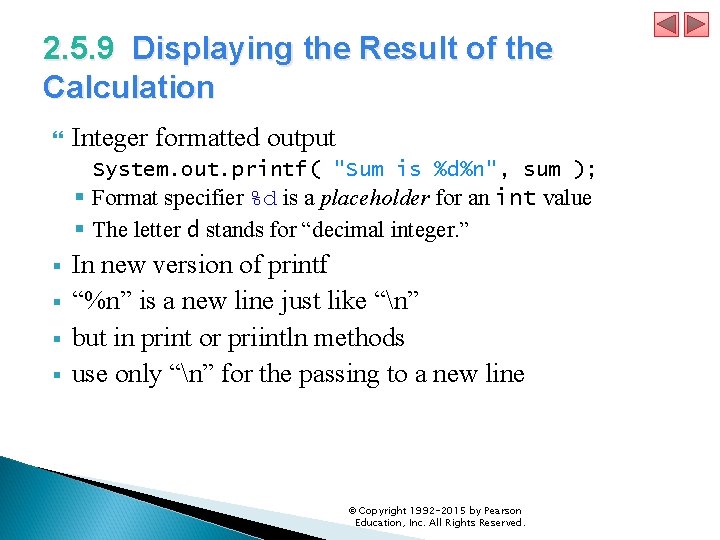
2. 5. 9 Displaying the Result of the Calculation Integer formatted output System. out. printf( "Sum is %d%n", sum ); § Format specifier %d is a placeholder for an int value § The letter d stands for “decimal integer. ” § § In new version of printf “%n” is a new line just like “n” but in print or priintln methods use only “n” for the passing to a new line © Copyright 1992 -2015 by Pearson Education, Inc. All Rights Reserved.
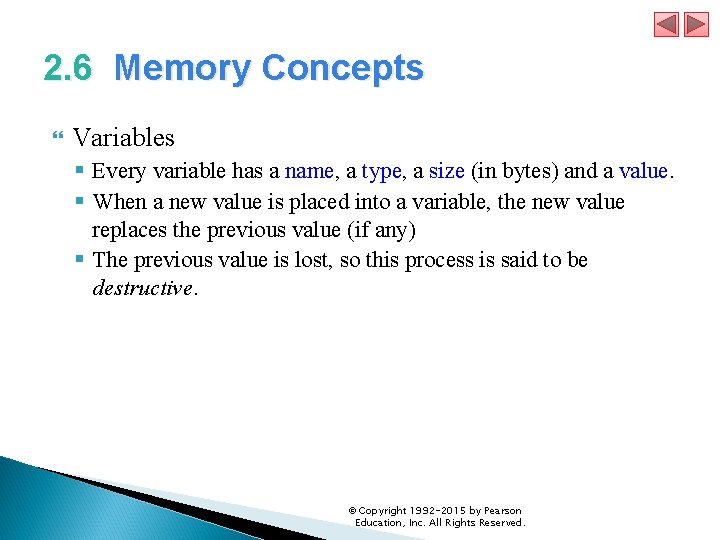
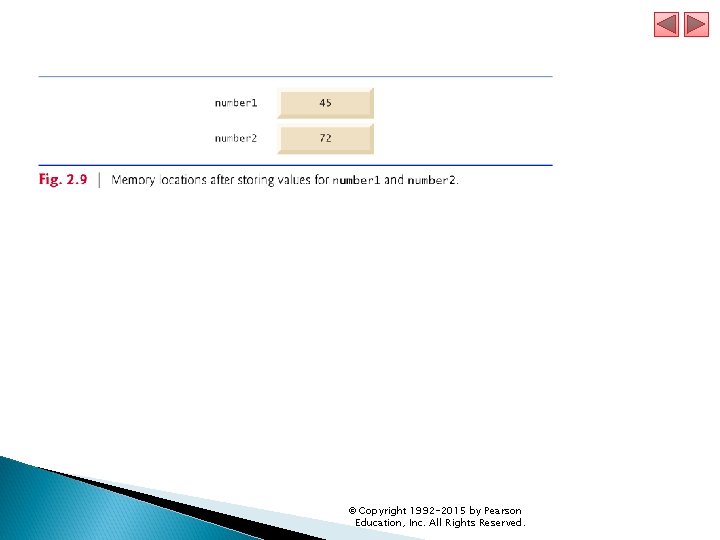
2. 6 Memory Concepts Variables § Every variable has a name, a type, a size (in bytes) and a value. § When a new value is placed into a variable, the new value replaces the previous value (if any) § The previous value is lost, so this process is said to be destructive. © Copyright 1992 -2015 by Pearson Education, Inc. All Rights Reserved.
© Copyright 1992 -2015 by Pearson Education, Inc. All Rights Reserved.
© Copyright 1992 -2015 by Pearson Education, Inc. All Rights Reserved.
© Copyright 1992 -2015 by Pearson Education, Inc. All Rights Reserved.
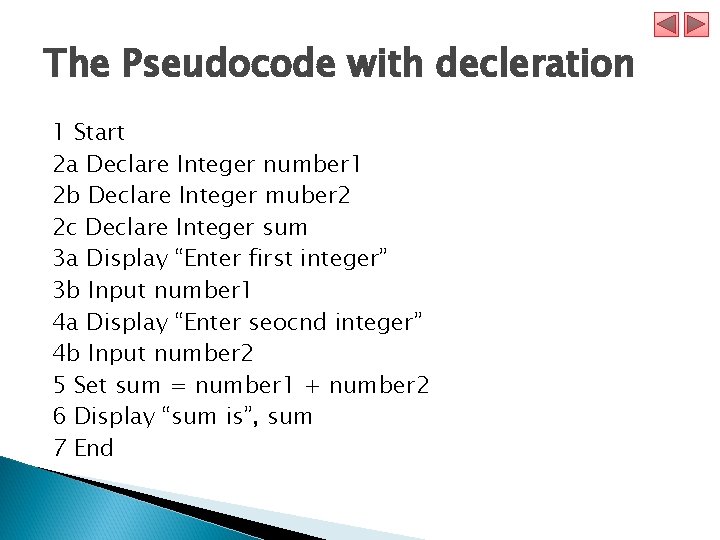
Declare in pseudocodes Pseudocodes are independnet of programming languages Some programming languages does not require variables to be declared before using them – typeless languages such a Java. Script Java as a strongly typed languages requires variables to be declared We can declare variables in our pseudocodes The pseudocode of the previous task can be rewriteen adding declation steps
The Pseudocode with decleration 1 Start 2 a Declare Integer number 1 2 b Declare Integer muber 2 2 c Declare Integer sum 3 a Display “Enter first integer” 3 b Input number 1 4 a Display “Enter seocnd integer” 4 b Input number 2 5 Set sum = number 1 + number 2 6 Display “sum is”, sum 7 End
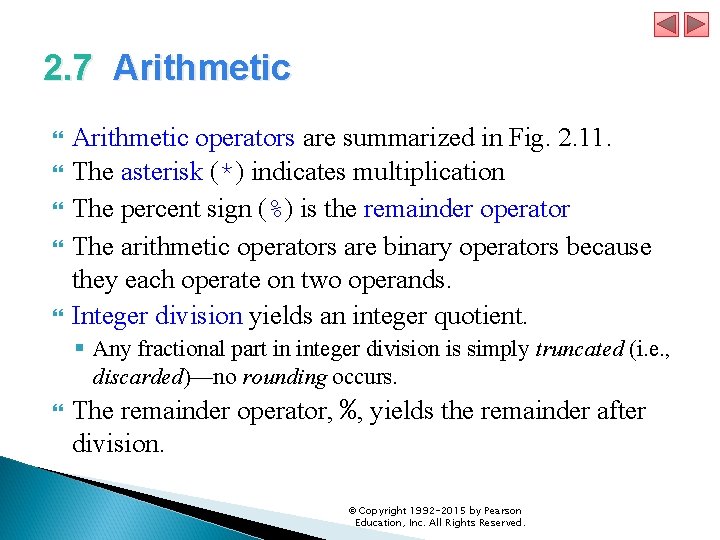
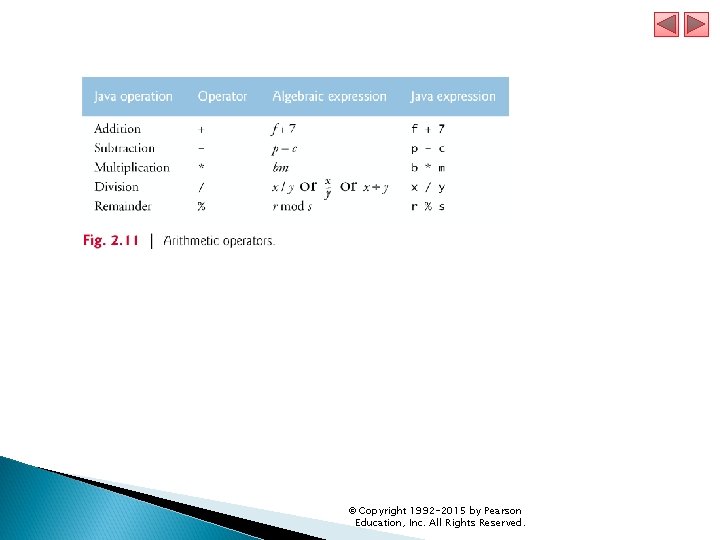
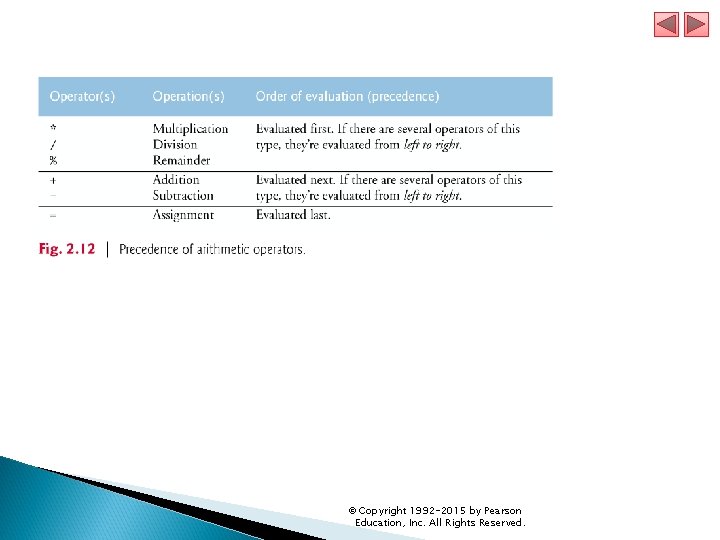
2. 7 Arithmetic operators are summarized in Fig. 2. 11. The asterisk (*) indicates multiplication The percent sign (%) is the remainder operator The arithmetic operators are binary operators because they each operate on two operands. Integer division yields an integer quotient. § Any fractional part in integer division is simply truncated (i. e. , discarded)—no rounding occurs. The remainder operator, %, yields the remainder after division. © Copyright 1992 -2015 by Pearson Education, Inc. All Rights Reserved.
© Copyright 1992 -2015 by Pearson Education, Inc. All Rights Reserved.
2. 7 Arithmetic (Cont. ) Arithmetic expressions in Java must be written in straight-line form to facilitate entering programs into the computer. Expressions such as “a divided by b” must be written as a / b, so that all constants, variables and operators appear in a straight line. Parentheses are used to group terms in expressions in the same manner as in algebraic expressions. If an expression contains nested parentheses, the expression in the innermost set of parentheses is evaluated first. © Copyright 1992 -2015 by Pearson Education, Inc. All Rights Reserved.
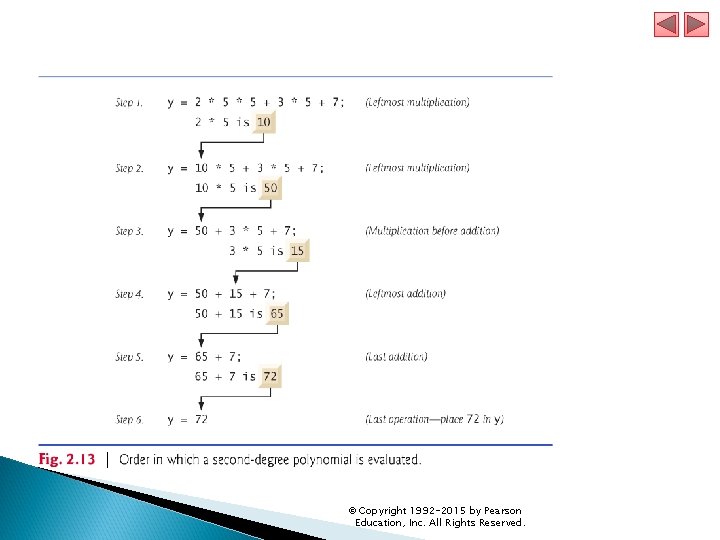
2. 7 Arithmetic (Cont. ) Rules of operator precedence § Multiplication, division and remainder operations are applied first. § If an expression contains several such operations, they are applied from left to right. § Multiplication, division and remainder operators have the same level of precedence. § Addition and subtraction operations are applied next. § If an expression contains several such operations, the operators are applied from left to right. § Addition and subtraction operators have the same level of precedence. When we say that operators are applied from left to right, we are referring to their associativity. Some operators associate from right to left. Complete precedence chart is included in Appendix A. © Copyright 1992 -2015 by Pearson Education, Inc. All Rights Reserved.
© Copyright 1992 -2015 by Pearson Education, Inc. All Rights Reserved.
© Copyright 1992 -2015 by Pearson Education, Inc. All Rights Reserved.
2. 7 Arithmetic (Cont. ) As in algebra, it’s acceptable to place redundant parentheses (unnecessary parentheses) in an expression to make the expression clearer. © Copyright 1992 -2015 by Pearson Education, Inc. All Rights Reserved.
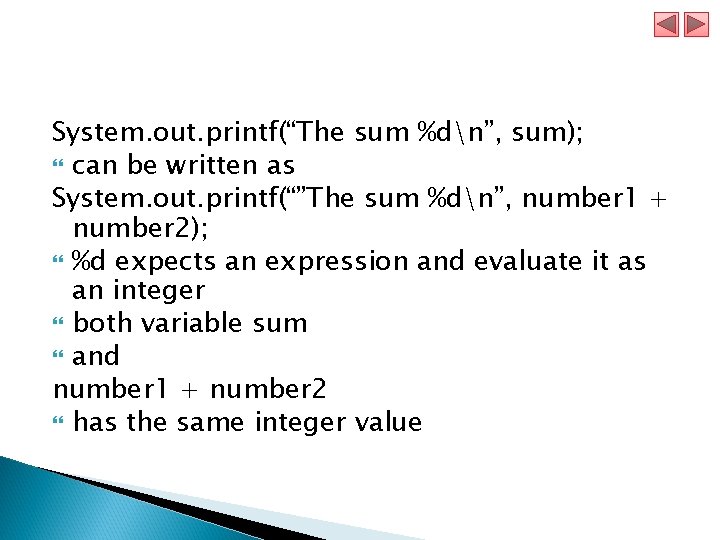
System. out. printf(“The sum %dn”, sum); can be written as System. out. printf(“”The sum %dn”, number 1 + number 2); %d expects an expression and evaluate it as an integer both variable sum and number 1 + number 2 has the same integer value
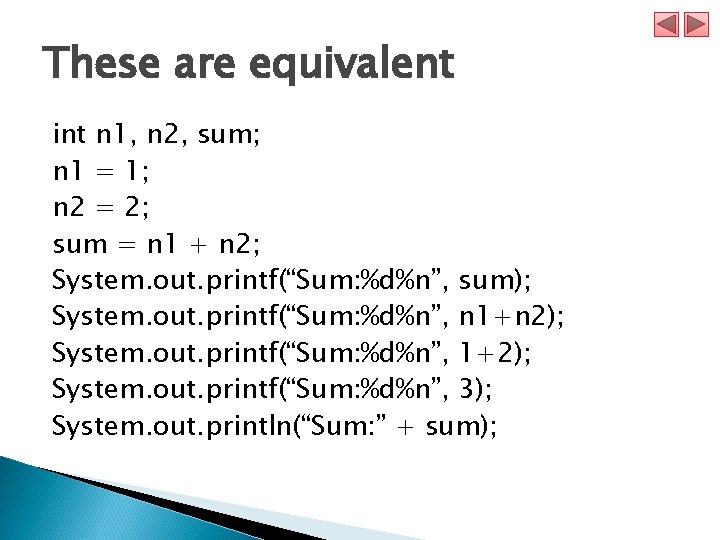
These are equivalent int n 1, n 2, sum; n 1 = 1; n 2 = 2; sum = n 1 + n 2; System. out. printf(“Sum: %d%n”, sum); System. out. printf(“Sum: %d%n”, n 1+n 2); System. out. printf(“Sum: %d%n”, 1+2); System. out. printf(“Sum: %d%n”, 3); System. out. println(“Sum: ” + sum);
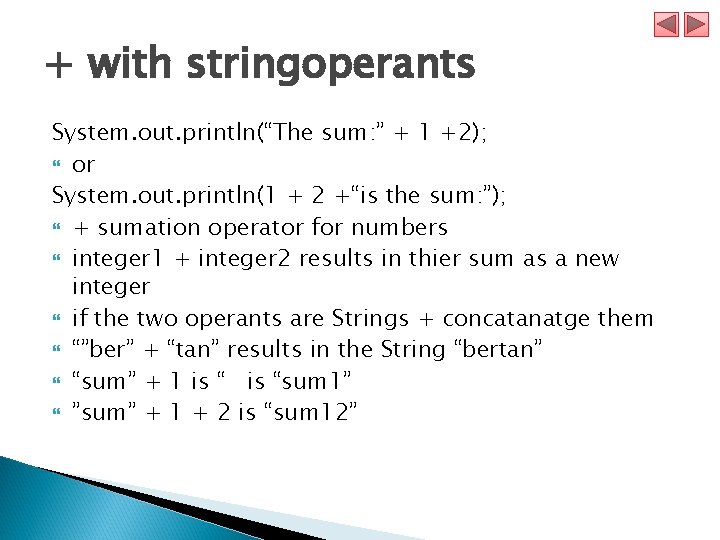
+ with stringoperants System. out. println(“The sum: ” + 1 +2); or System. out. println(1 + 2 +“is the sum: ”); + sumation operator for numbers integer 1 + integer 2 results in thier sum as a new integer if the two operants are Strings + concatanatge them “”ber” + “tan” results in the String “bertan” “sum” + 1 is “sum 1” ”sum” + 1 + 2 is “sum 12”
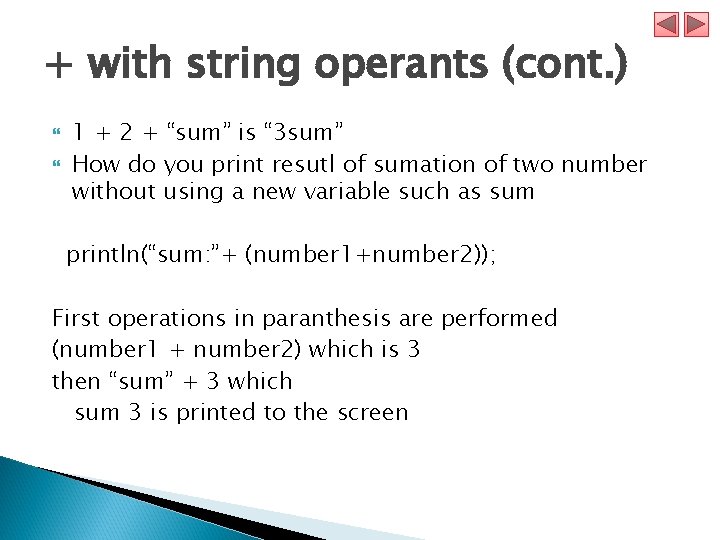
+ with string operants (cont. ) 1 + 2 + “sum” is “ 3 sum” How do you print resutl of sumation of two number without using a new variable such as sum println(“sum: ”+ (number 1+number 2)); First operations in paranthesis are performed (number 1 + number 2) which is 3 then “sum” + 3 which sum 3 is printed to the screen
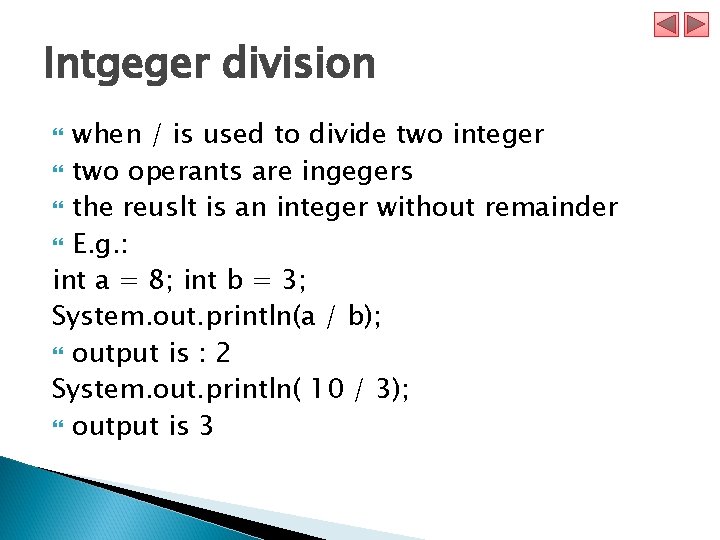
Intgeger division when / is used to divide two integer two operants are ingegers the reuslt is an integer without remainder E. g. : int a = 8; int b = 3; System. out. println(a / b); output is : 2 System. out. println( 10 / 3); output is 3
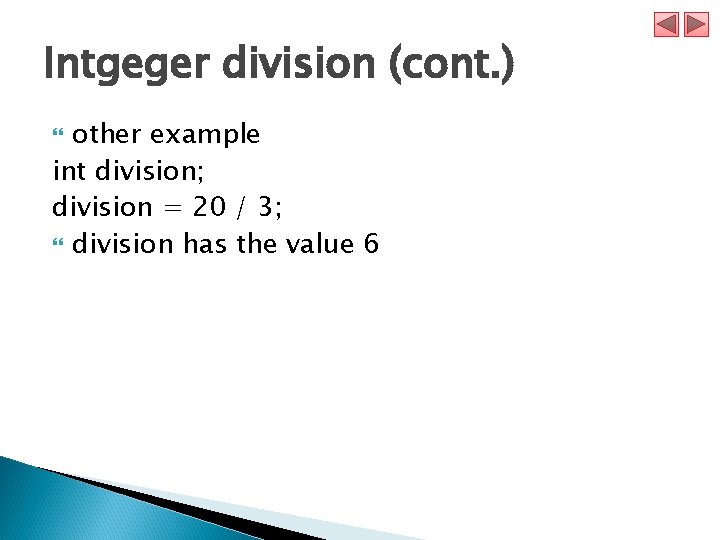
Intgeger division (cont. ) other example int division; division = 20 / 3; division has the value 6
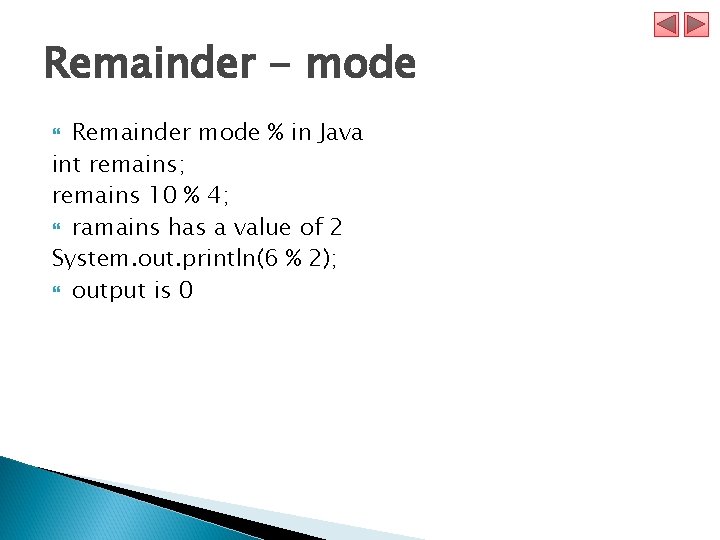
Remainder - mode Remainder mode % in Java int remains; remains 10 % 4; ramains has a value of 2 System. out. println(6 % 2); output is 0