
Chapter 2 Interpreting Social Problems Aging Social Problems
Chapter 2 Interpreting Social Problems: Aging Social Problems: A Down-To-Earth Approach, Tenth Edition by James M. Henslin © 2011 Pearson Education, Inc. All rights reserved
Sociological Theories and Social Problems Uncover and make sense of facts Theory: § Explains how two or more concepts (or facts) are related, such as age and suicide. Sociological Theory: Provides a framework for thinking about a social issue from a perspective that we might otherwise neglect. Social Problems: A Down-To-Earth Approach, Tenth Edition by James M. Henslin © 2011 Pearson Education, Inc. All rights reserved
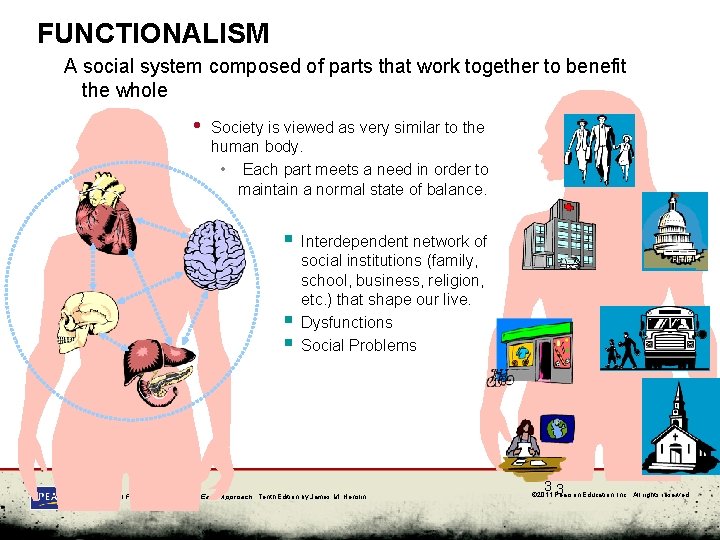
FUNCTIONALISM A social system composed of parts that work together to benefit the whole • Society is viewed as very similar to the human body. • Each part meets a need in order to maintain a normal state of balance. § Interdependent network of § § social institutions (family, school, business, religion, etc. ) that shape our live. Dysfunctions Social Problems: A Down-To-Earth Approach, Tenth Edition by James M. Henslin 33 © 2011 Pearson Education, Inc. All rights reserved
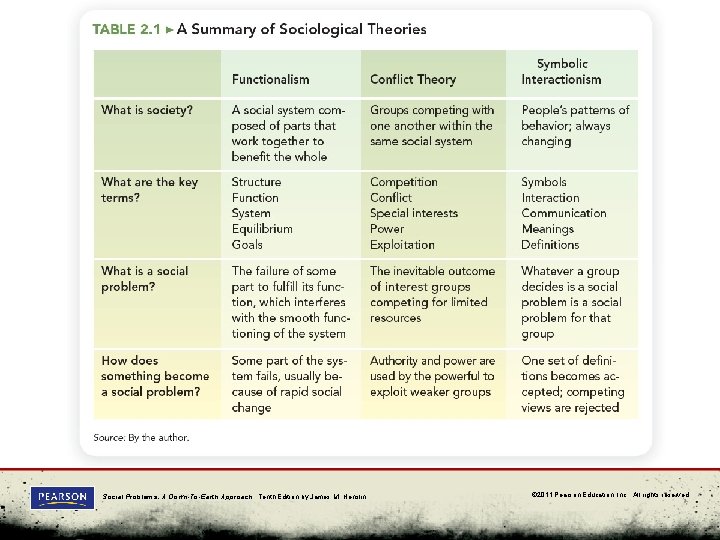
Table 2. 1 Social Problems: A Down-To-Earth Approach, Tenth Edition by James M. Henslin © 2011 Pearson Education, Inc. All rights reserved
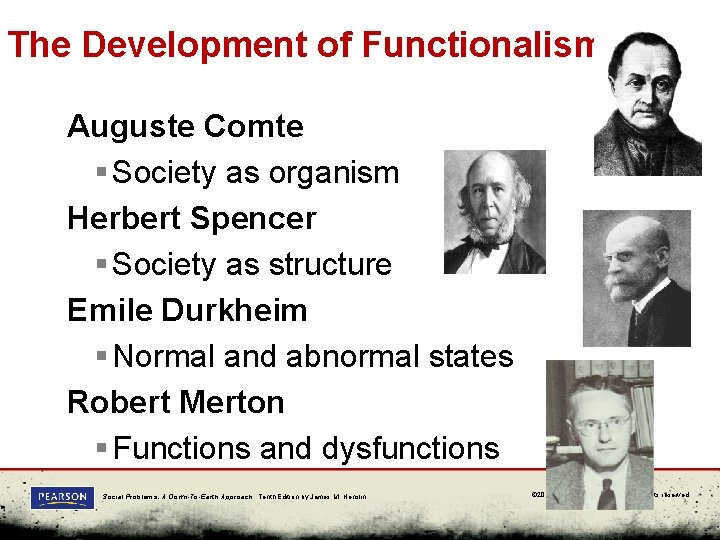
The Development of Functionalism Auguste Comte § Society as organism Herbert Spencer § Society as structure Emile Durkheim § Normal and abnormal states Robert Merton § Functions and dysfunctions Social Problems: A Down-To-Earth Approach, Tenth Edition by James M. Henslin © 2011 Pearson Education, Inc. All rights reserved

Applying Functionalism to Social Problems Social Change Social Problems • Institutional change in one area of society disrupts the • equilibrium of society’s parts, forcing those parts to make new adjustments. Disengagement Theory § Elderly withdrawal from society Social Problems: A Down-To-Earth Approach, Tenth Edition by James M. Henslin © 2011 Pearson Education, Inc. All rights reserved
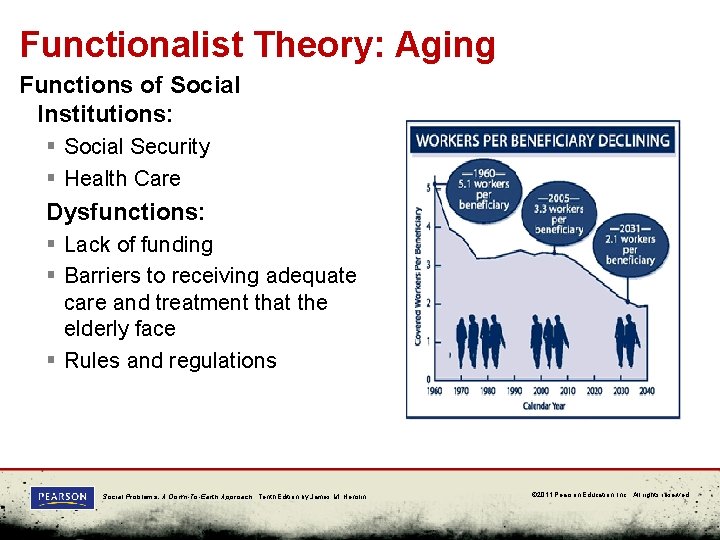
Functionalist Theory: Aging Functions of Social Institutions: § Social Security § Health Care Dysfunctions: § Lack of funding § Barriers to receiving adequate care and treatment that the elderly face § Rules and regulations Social Problems: A Down-To-Earth Approach, Tenth Edition by James M. Henslin © 2011 Pearson Education, Inc. All rights reserved
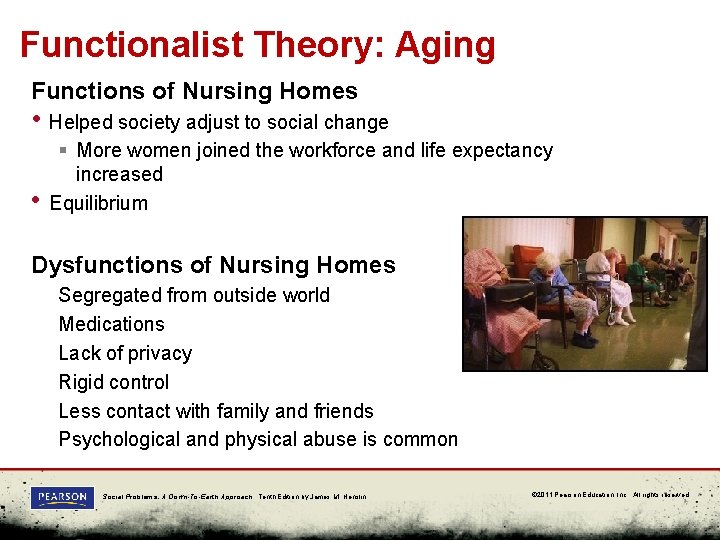
Functionalist Theory: Aging Functions of Nursing Homes • Helped society adjust to social change • § More women joined the workforce and life expectancy increased Equilibrium Dysfunctions of Nursing Homes Segregated from outside world Medications Lack of privacy Rigid control Less contact with family and friends Psychological and physical abuse is common Social Problems: A Down-To-Earth Approach, Tenth Edition by James M. Henslin © 2011 Pearson Education, Inc. All rights reserved
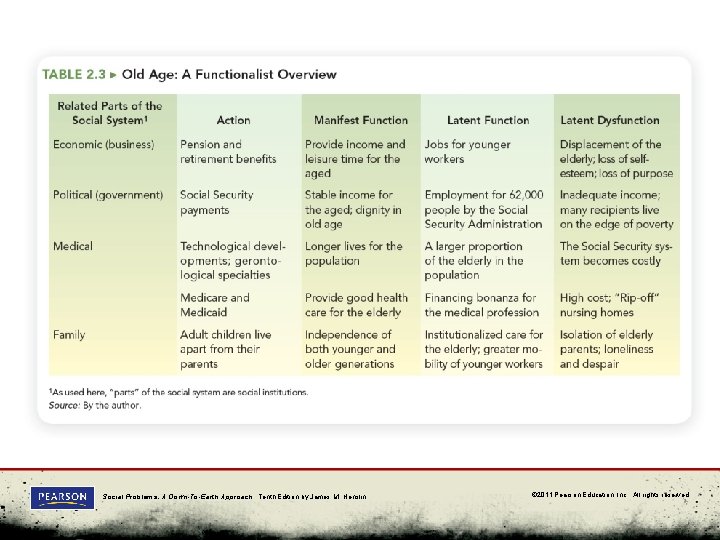
Table 2. 3 Social Problems: A Down-To-Earth Approach, Tenth Edition by James M. Henslin © 2011 Pearson Education, Inc. All rights reserved

CONFLICT THEORY § Groups competing with one another within the same social system Wealth, Power, Prestige Resources, Control, Authority Dominate Groups Subordinate Groups • Social Problems are natural and inevitable outcome of conflict and social struggle. Social Problems: A Down-To-Earth Approach, Tenth Edition by James M. Henslin © 2011 Pearson Education, Inc. All rights reserved

The Development of Conflict Theory Karl Marx § Capitalism and conflict Georg Simmel § Compared the relationships of people who occupy higher positions (superordinates) with those who are in lower positions (subordinates) Lewis Coser § Analyzed why conflict is especially likely to develop among people who have close relationships Social Problems: A Down-To-Earth Approach, Tenth Edition by James M. Henslin © 2011 Pearson Education, Inc. All rights reserved
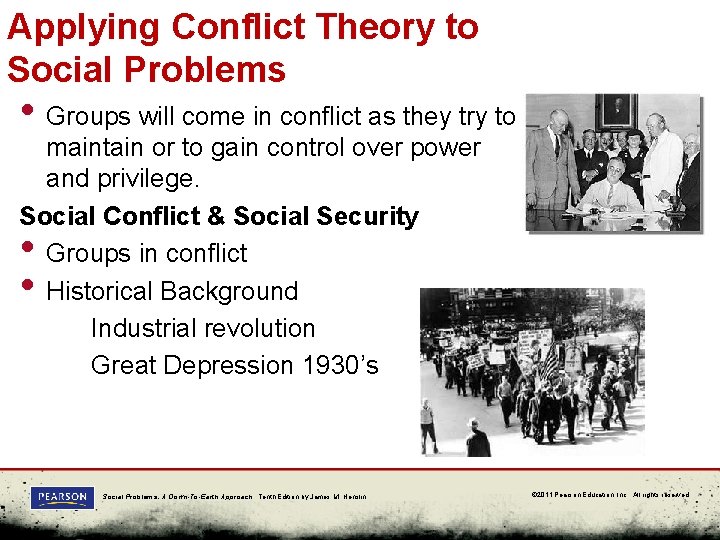
Applying Conflict Theory to Social Problems • Groups will come in conflict as they try to maintain or to gain control over power and privilege. Social Conflict & Social Security Groups in conflict Historical Background Industrial revolution Great Depression 1930’s • • Social Problems: A Down-To-Earth Approach, Tenth Edition by James M. Henslin © 2011 Pearson Education, Inc. All rights reserved
Applying Conflict Theory to Social Problems Two types of social problems: § Trouble experienced by people who are exploited by the powerful § Trouble experienced by the powerful when the exploited resist, rebel, or even appeal to higher values Social Problems: A Down-To-Earth Approach, Tenth Edition by James M. Henslin © 2011 Pearson Education, Inc. All rights reserved
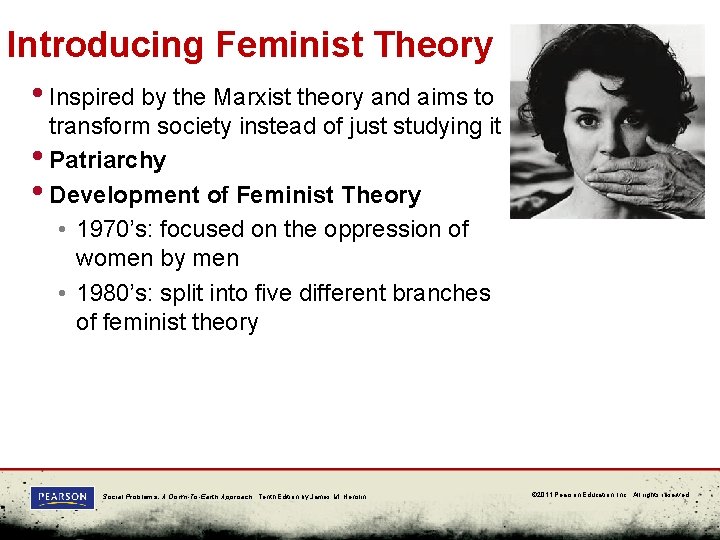
Introducing Feminist Theory • Inspired by the Marxist theory and aims to transform society instead of just studying it • Patriarchy • Development of Feminist Theory • 1970’s: focused on the oppression of women by men • 1980’s: split into five different branches of feminist theory Social Problems: A Down-To-Earth Approach, Tenth Edition by James M. Henslin © 2011 Pearson Education, Inc. All rights reserved

The Development of Feminist Theory • Radical feminism • Liberal feminism • Socialist feminism • Cultural feminism • Ecofeminism Social Problems: A Down-To-Earth Approach, Tenth Edition by James M. Henslin © 2011 Pearson Education, Inc. All rights reserved
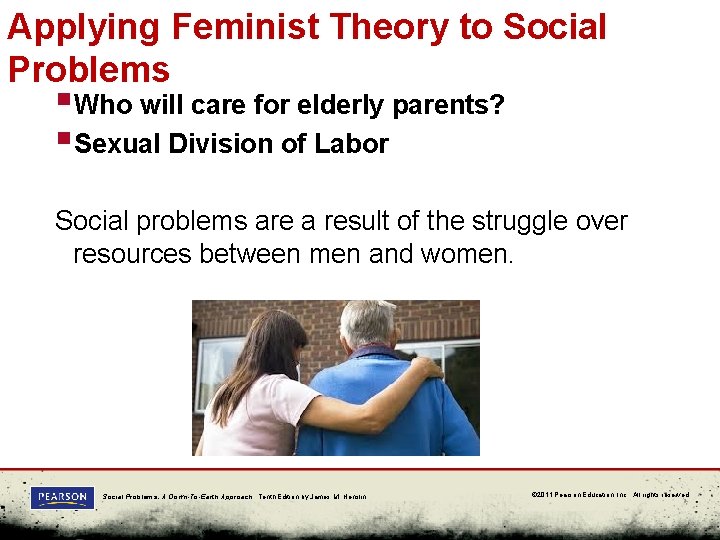
Applying Feminist Theory to Social Problems §Who will care for elderly parents? §Sexual Division of Labor Social problems are a result of the struggle over resources between men and women. Social Problems: A Down-To-Earth Approach, Tenth Edition by James M. Henslin © 2011 Pearson Education, Inc. All rights reserved
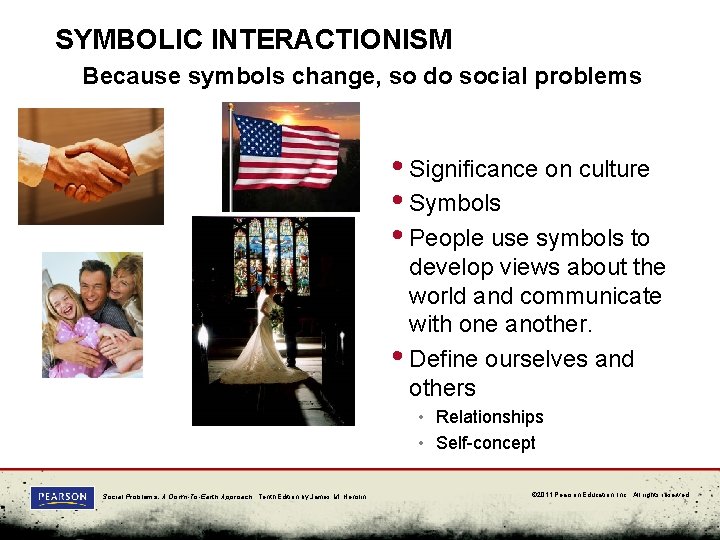
SYMBOLIC INTERACTIONISM Because symbols change, so do social problems • Significance on culture • Symbols • People use symbols to develop views about the world and communicate with one another. • Define ourselves and others • Relationships • Self-concept Social Problems: A Down-To-Earth Approach, Tenth Edition by James M. Henslin © 2011 Pearson Education, Inc. All rights reserved
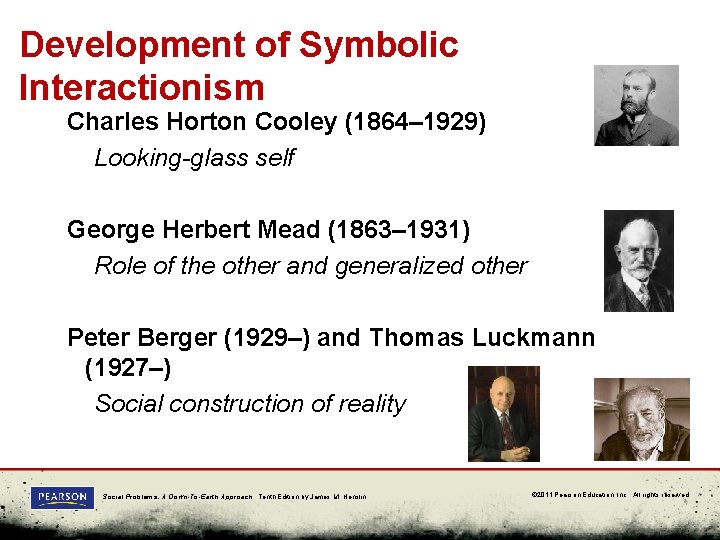
Development of Symbolic Interactionism Charles Horton Cooley (1864– 1929) Looking-glass self George Herbert Mead (1863– 1931) Role of the other and generalized other Peter Berger (1929–) and Thomas Luckmann (1927–) Social construction of reality Social Problems: A Down-To-Earth Approach, Tenth Edition by James M. Henslin © 2011 Pearson Education, Inc. All rights reserved
Symbolic Interactionism and Social Problems Changing Symbols Change Perception • History of Old Age • Old age was viewed as an accomplishment • Change in perception of elderly occurred in the late 1800’s *Economy/technological advances • Old Age was once a personal problem • Old Age is now a social problem Social Problems: A Down-To-Earth Approach, Tenth Edition by James M. Henslin © 2011 Pearson Education, Inc. All rights reserved
Applying Symbolic Interactionism to Social Problems The Social Construction of Social Problems: • Social Problems do not exist until some condition of society is called a problem • Labeling • Simply means that people categorize things • Put tags on other people or on events and then act accordingly Social Problems: A Down-To-Earth Approach, Tenth Edition by James M. Henslin © 2011 Pearson Education, Inc. All rights reserved
The Future of the Problem: The Pendulum Swings Objective Conditions • Economic growth and expansion of federal programs reduced poverty rate for the aged to below nation’s average • In 1970, 25% of the elderly were poor, but now only 10% are poor Subjective Concerns • Past subjective concerns: too many elderly poor Present subjective concerns • Cost of Health Care for the Elderly • Social Security Social Problems: A Down-To-Earth Approach, Tenth Edition by James M. Henslin © 2011 Pearson Education, Inc. All rights reserved
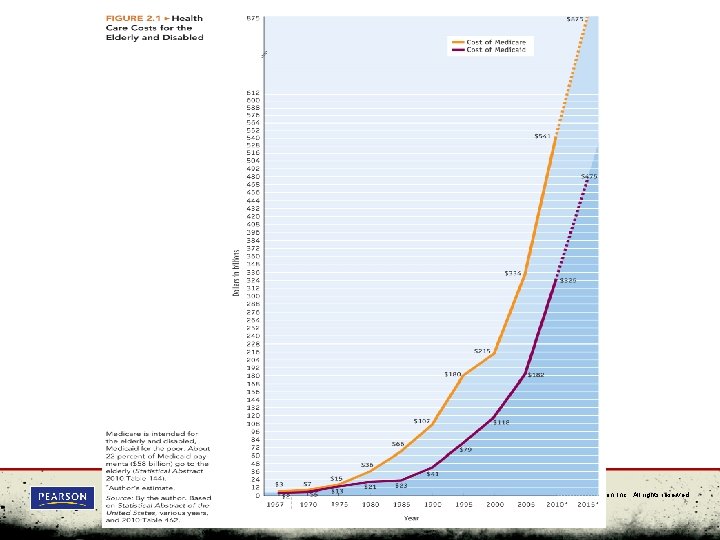
Figure 2. 1 Social Problems: A Down-To-Earth Approach, Tenth Edition by James M. Henslin © 2011 Pearson Education, Inc. All rights reserved
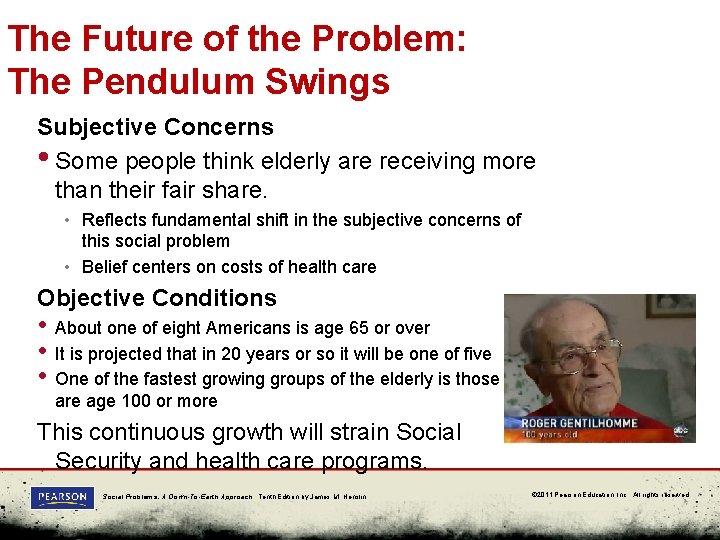
The Future of the Problem: The Pendulum Swings Subjective Concerns • Some people think elderly are receiving more than their fair share. • Reflects fundamental shift in the subjective concerns of this social problem • Belief centers on costs of health care Objective Conditions • • • About one of eight Americans is age 65 or over It is projected that in 20 years or so it will be one of five One of the fastest growing groups of the elderly is those who are age 100 or more This continuous growth will strain Social Security and health care programs. Social Problems: A Down-To-Earth Approach, Tenth Edition by James M. Henslin © 2011 Pearson Education, Inc. All rights reserved
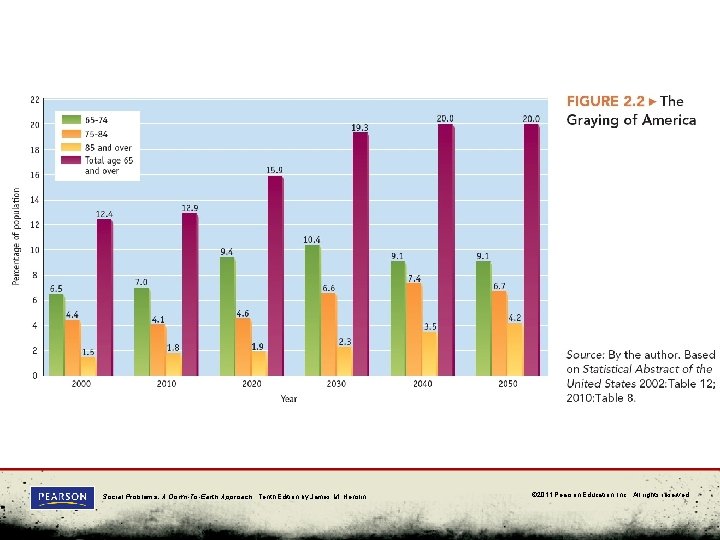
Figure 2. 3 Social Problems: A Down-To-Earth Approach, Tenth Edition by James M. Henslin © 2011 Pearson Education, Inc. All rights reserved
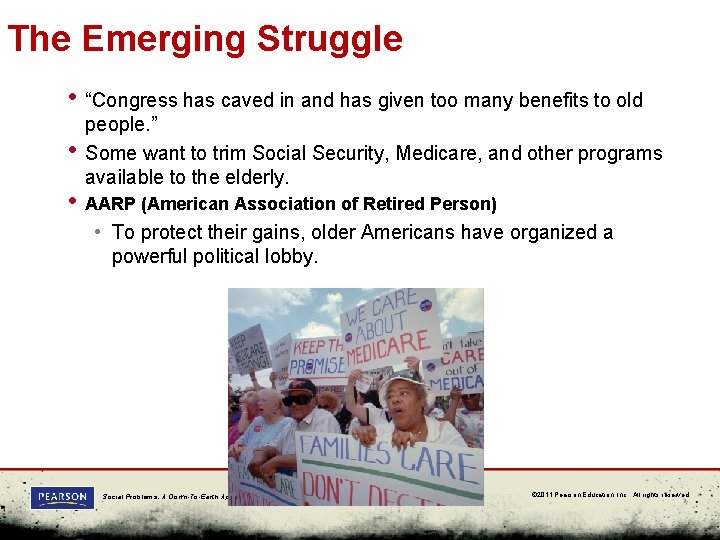
The Emerging Struggle • “Congress has caved in and has given too many benefits to old • • people. ” Some want to trim Social Security, Medicare, and other programs available to the elderly. AARP (American Association of Retired Person) • To protect their gains, older Americans have organized a powerful political lobby. Social Problems: A Down-To-Earth Approach, Tenth Edition by James M. Henslin © 2011 Pearson Education, Inc. All rights reserved
The Emerging Struggle The interests of younger and older groups are on a collision course. Two major problems: § Contributions to Social Security are not put into a worker’s own account. § Proportion that collect Social Security is growing, proportion who are working (those who pay) is shrinking. • Dependency ratio Social Problems: A Down-To-Earth Approach, Tenth Edition by James M. Henslin © 2011 Pearson Education, Inc. All rights reserved
- Slides: 26