
Chapter 2 Internetworking Concepts Overview 2000 Cisco Systems
- Slides: 49
Chapter 2 Internetworking Concepts Overview © 2000, Cisco Systems, Inc. 2 -1
Objectives On completion of this chapter, you will be able to perform the following tasks: • Describe how data traffic is exchanged between source and destination devices • Identify the roles and functions of a hub, switch, and router, and where they best fit in the network • Select the appropriate Cisco equipment for a given set of network requirements © 2000, Cisco Systems, Inc. www. cisco. com ICND v 1. 0 a— 2 -3
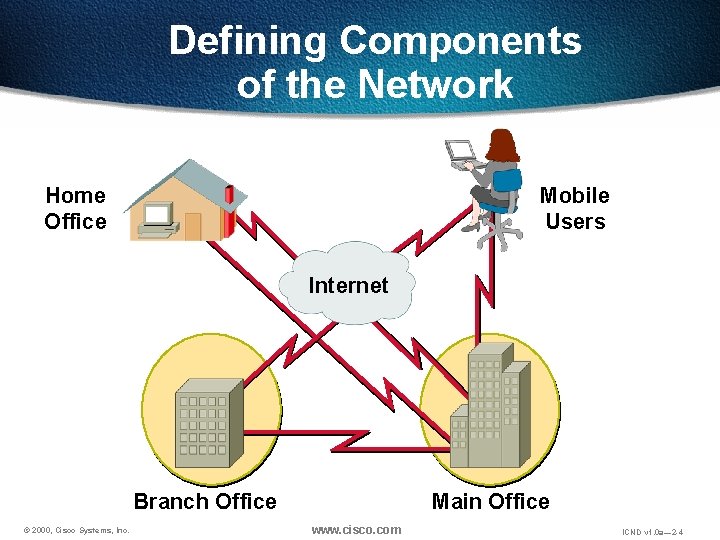
Defining Components of the Network Home Office Mobile Users Internet Branch Office © 2000, Cisco Systems, Inc. Main Office www. cisco. com ICND v 1. 0 a— 2 -4
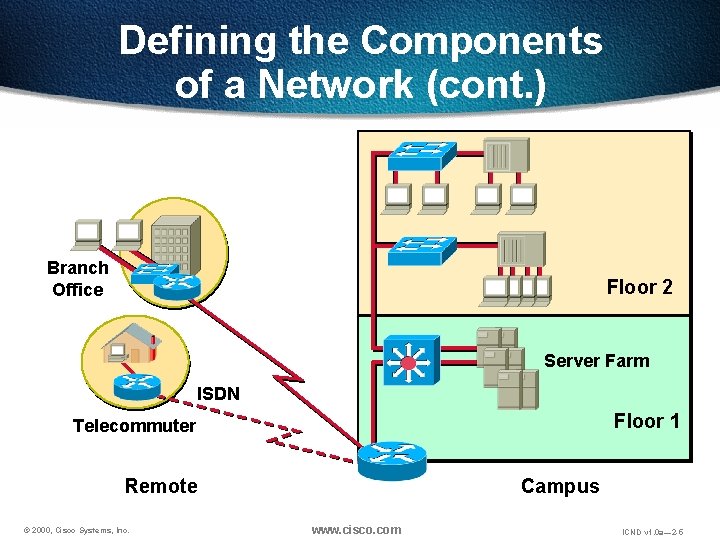
Defining the Components of a Network (cont. ) Branch Office Floor 2 Server Farm ISDN Floor 1 Telecommuter Remote © 2000, Cisco Systems, Inc. Campus www. cisco. com ICND v 1. 0 a— 2 -5
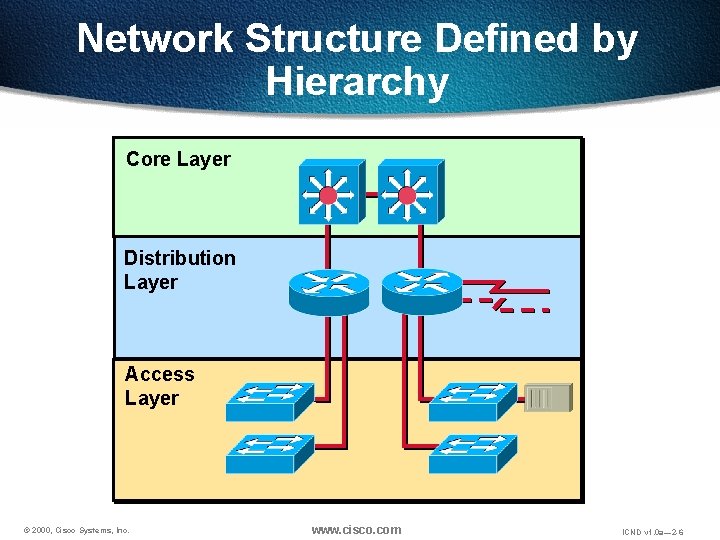
Network Structure Defined by Hierarchy Core Layer Distribution Layer Access Layer © 2000, Cisco Systems, Inc. www. cisco. com ICND v 1. 0 a— 2 -6
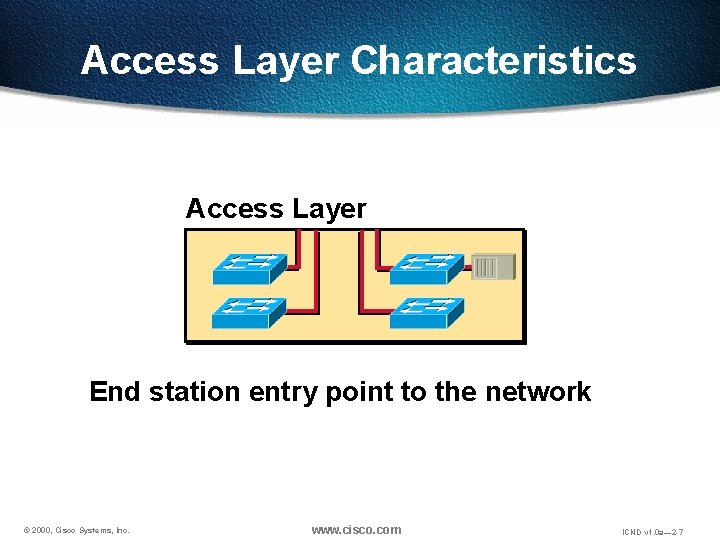
Access Layer Characteristics Access Layer End station entry point to the network © 2000, Cisco Systems, Inc. www. cisco. com ICND v 1. 0 a— 2 -7
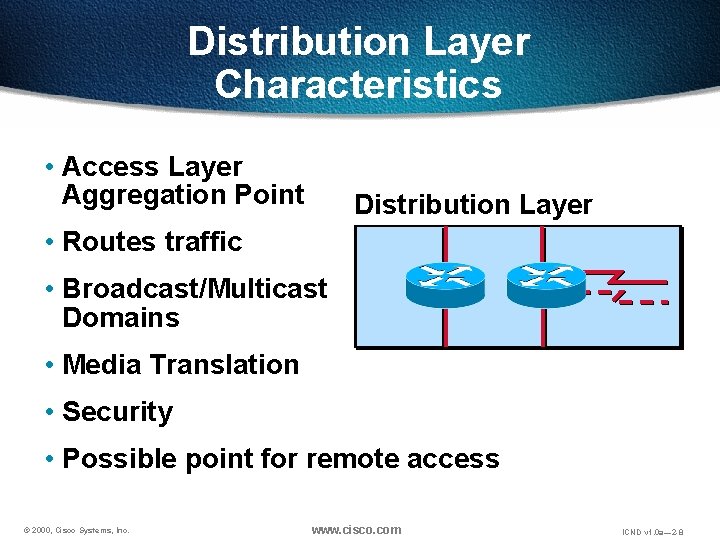
Distribution Layer Characteristics • Access Layer Aggregation Point Distribution Layer • Routes traffic • Broadcast/Multicast Domains • Media Translation • Security • Possible point for remote access © 2000, Cisco Systems, Inc. www. cisco. com ICND v 1. 0 a— 2 -8
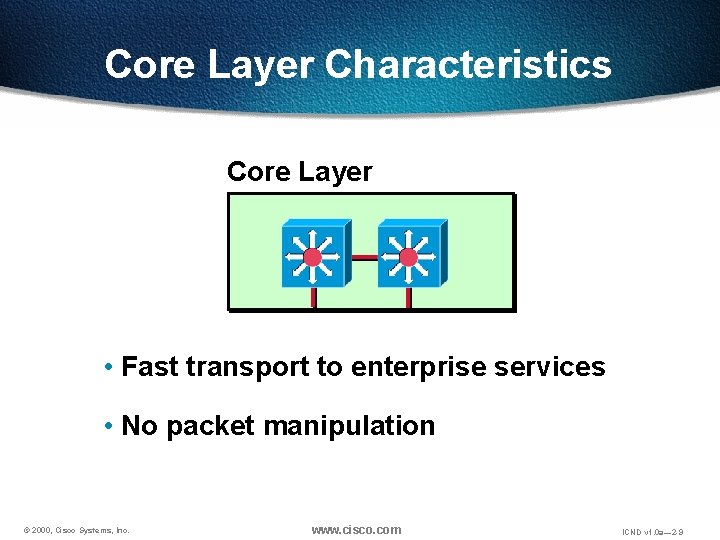
Core Layer Characteristics Core Layer • Fast transport to enterprise services • No packet manipulation © 2000, Cisco Systems, Inc. www. cisco. com ICND v 1. 0 a— 2 -9
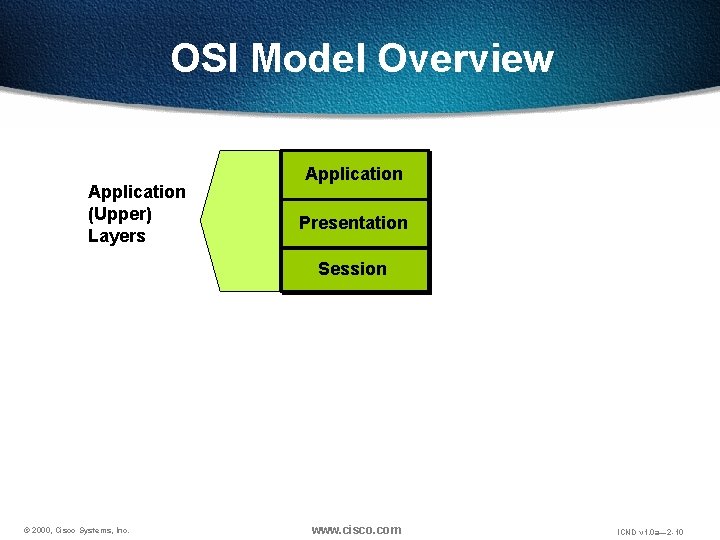
OSI Model Overview Application (Upper) Layers Application Presentation Session © 2000, Cisco Systems, Inc. www. cisco. com ICND v 1. 0 a— 2 -10
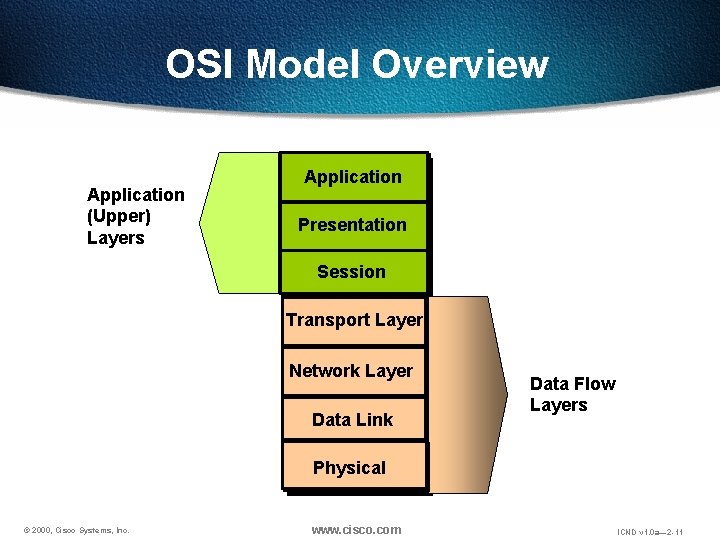
OSI Model Overview Application (Upper) Layers Application Presentation Session Transport Layer Network Layer Data Link Data Flow Layers Physical © 2000, Cisco Systems, Inc. www. cisco. com ICND v 1. 0 a— 2 -11
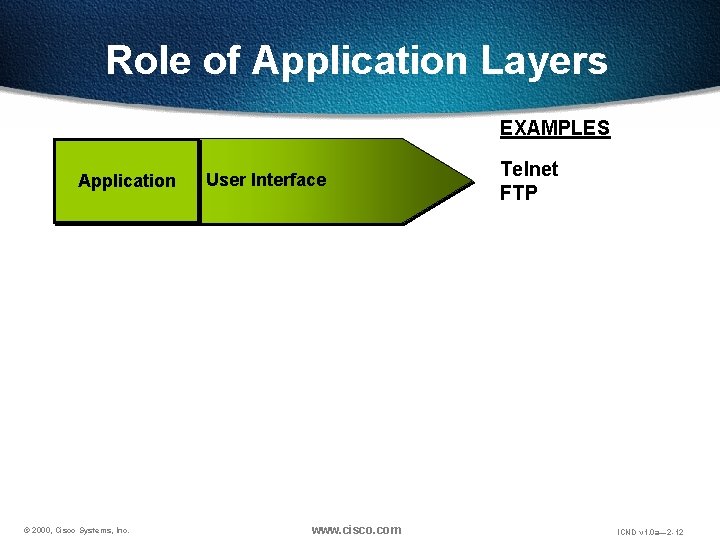
Role of Application Layers EXAMPLES Application © 2000, Cisco Systems, Inc. User Interface www. cisco. com Telnet FTP ICND v 1. 0 a— 2 -12
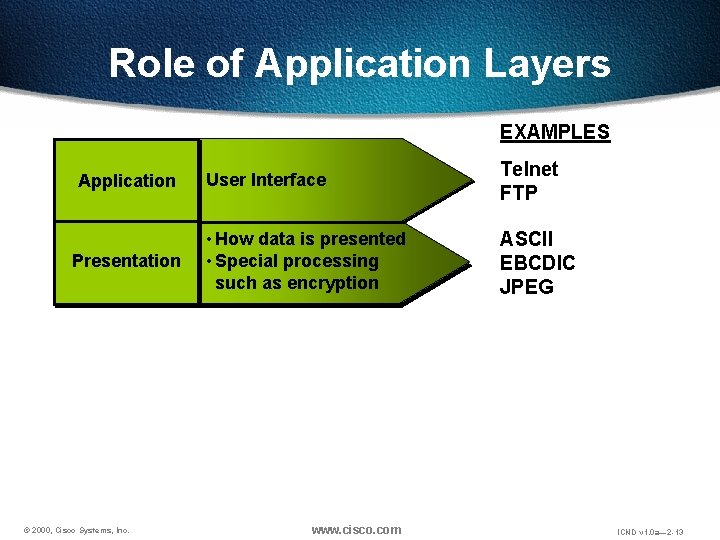
Role of Application Layers EXAMPLES Application Presentation © 2000, Cisco Systems, Inc. User Interface Telnet FTP • How data is presented • Special processing such as encryption ASCII EBCDIC JPEG www. cisco. com ICND v 1. 0 a— 2 -13
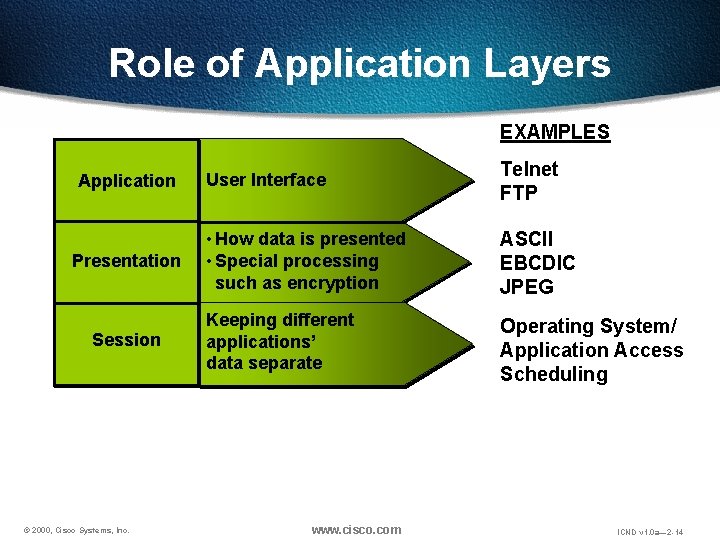
Role of Application Layers EXAMPLES Application Presentation Session © 2000, Cisco Systems, Inc. User Interface Telnet FTP • How data is presented • Special processing such as encryption ASCII EBCDIC JPEG Keeping different applications’ data separate Operating System/ Application Access Scheduling www. cisco. com ICND v 1. 0 a— 2 -14
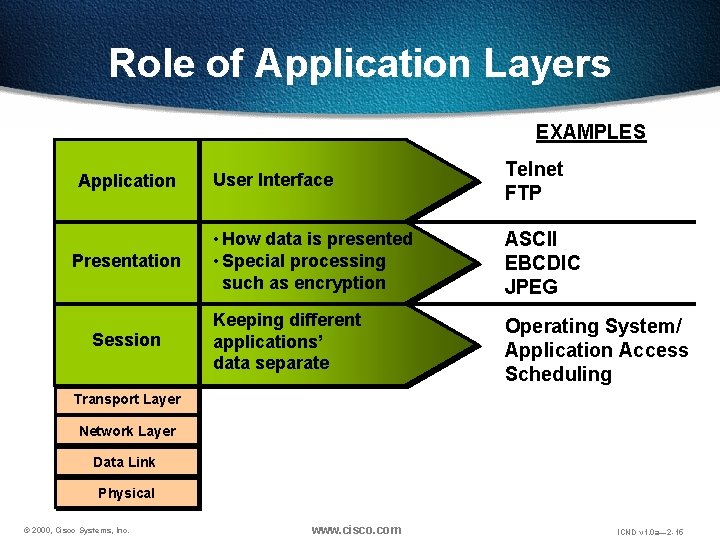
Role of Application Layers EXAMPLES Application Presentation Session User Interface Telnet FTP • How data is presented • Special processing such as encryption ASCII EBCDIC JPEG Keeping different applications’ data separate Operating System/ Application Access Scheduling Transport Layer Network Layer Data Link Physical © 2000, Cisco Systems, Inc. www. cisco. com ICND v 1. 0 a— 2 -15
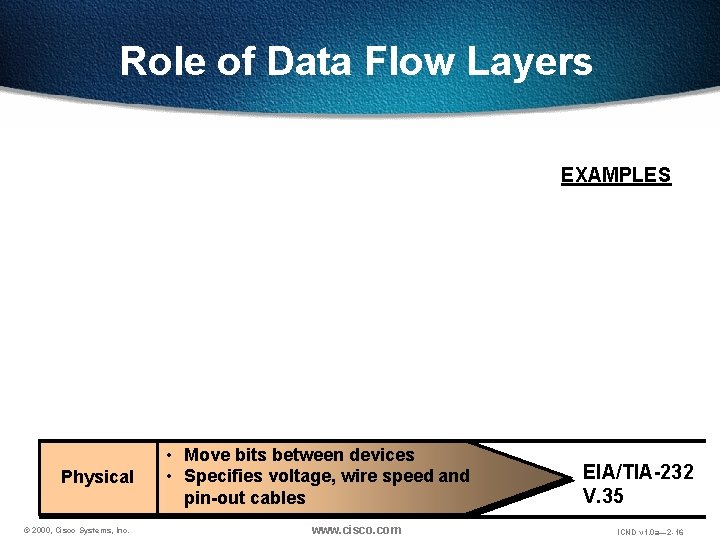
Role of Data Flow Layers EXAMPLES Physical © 2000, Cisco Systems, Inc. • Move bits between devices • Specifies voltage, wire speed and pin-out cables www. cisco. com EIA/TIA-232 V. 35 ICND v 1. 0 a— 2 -16
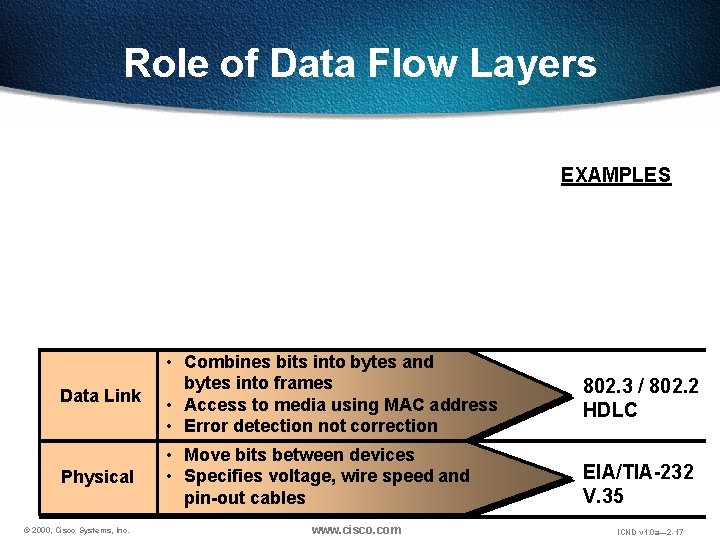
Role of Data Flow Layers EXAMPLES Data Link • Combines bits into bytes and bytes into frames • Access to media using MAC address • Error detection not correction 802. 3 / 802. 2 HDLC Physical • Move bits between devices • Specifies voltage, wire speed and pin-out cables EIA/TIA-232 V. 35 © 2000, Cisco Systems, Inc. www. cisco. com ICND v 1. 0 a— 2 -17
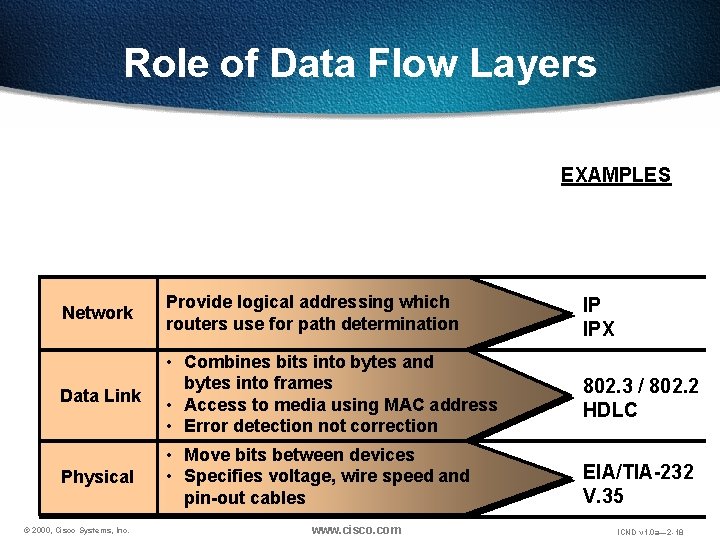
Role of Data Flow Layers EXAMPLES Network Provide logical addressing which routers use for path determination IP IPX Data Link • Combines bits into bytes and bytes into frames • Access to media using MAC address • Error detection not correction 802. 3 / 802. 2 HDLC Physical • Move bits between devices • Specifies voltage, wire speed and pin-out cables EIA/TIA-232 V. 35 © 2000, Cisco Systems, Inc. www. cisco. com ICND v 1. 0 a— 2 -18
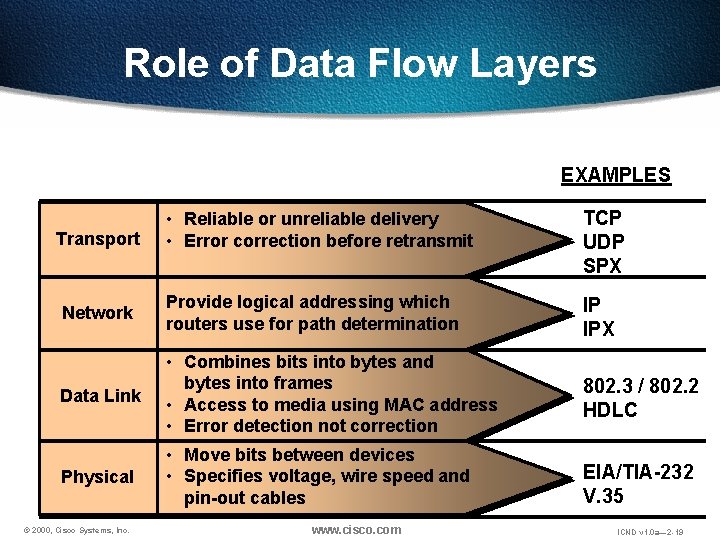
Role of Data Flow Layers EXAMPLES • Reliable or unreliable delivery • Error correction before retransmit TCP UDP SPX Network Provide logical addressing which routers use for path determination IP IPX Data Link • Combines bits into bytes and bytes into frames • Access to media using MAC address • Error detection not correction 802. 3 / 802. 2 HDLC Physical • Move bits between devices • Specifies voltage, wire speed and pin-out cables EIA/TIA-232 V. 35 Transport © 2000, Cisco Systems, Inc. www. cisco. com ICND v 1. 0 a— 2 -19
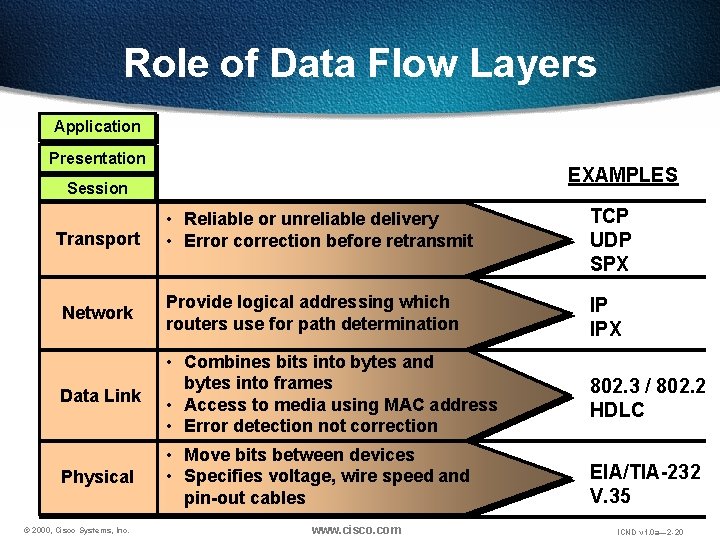
Role of Data Flow Layers Application Presentation EXAMPLES Session • Reliable or unreliable delivery • Error correction before retransmit TCP UDP SPX Network Provide logical addressing which routers use for path determination IP IPX Data Link • Combines bits into bytes and bytes into frames • Access to media using MAC address • Error detection not correction 802. 3 / 802. 2 HDLC Physical • Move bits between devices • Specifies voltage, wire speed and pin-out cables EIA/TIA-232 V. 35 Transport © 2000, Cisco Systems, Inc. www. cisco. com ICND v 1. 0 a— 2 -20
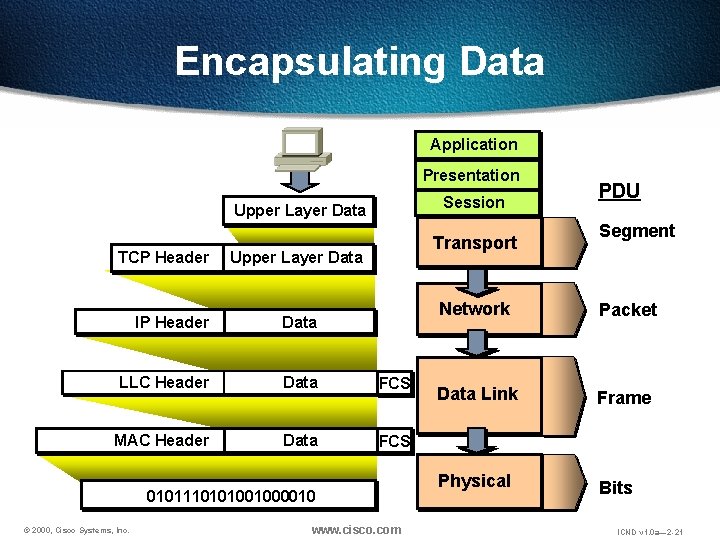
Encapsulating Data Application Presentation Session Upper Layer Data TCP Header Transport Upper Layer Data IP Header Data LLC Header Data FCS MAC Header Data FCS 0101110101001000010 © 2000, Cisco Systems, Inc. www. cisco. com PDU Segment Network Packet Data Link Frame Physical Bits ICND v 1. 0 a— 2 -21
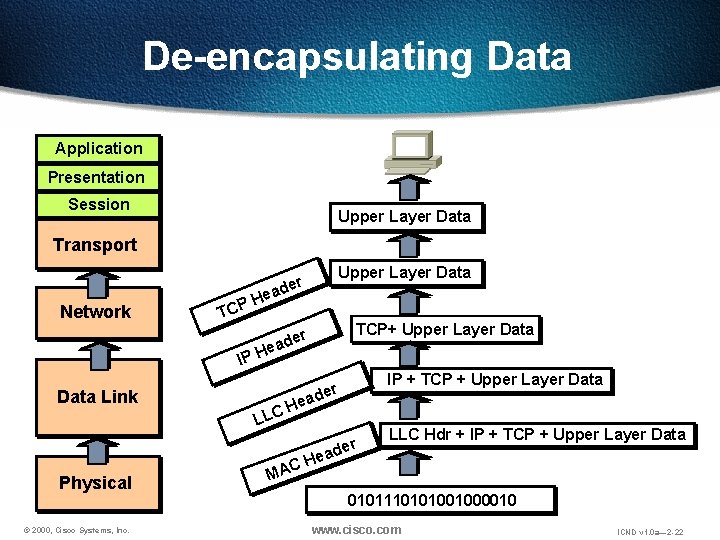
De-encapsulating Data Application Presentation Session Upper Layer Data Transport Network TCP IP Data Link Physical © 2000, Cisco Systems, Inc. Upper Layer Data er d a He TCP+ Upper Layer Data der a e H LLC IP + TCP + Upper Layer Data er d a He C MA der a e H LLC Hdr + IP + TCP + Upper Layer Data 0101110101001000010 www. cisco. com ICND v 1. 0 a— 2 -22
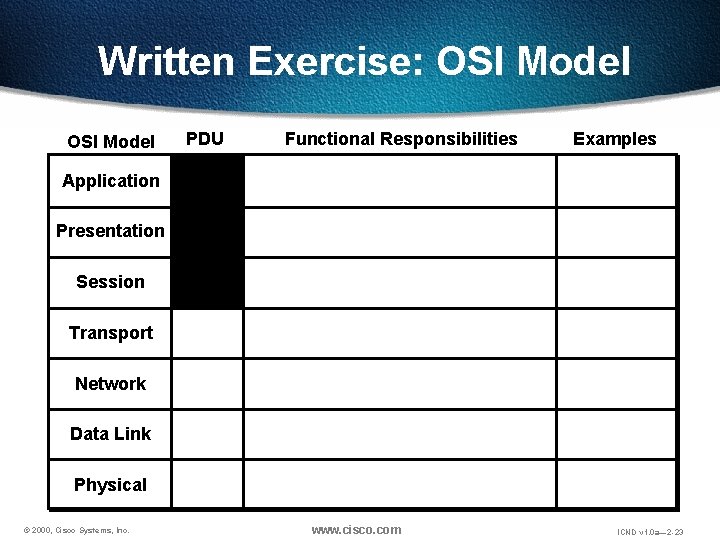
Written Exercise: OSI Model PDU Functional Responsibilities Examples Application Presentation Session Transport Network Data Link Physical © 2000, Cisco Systems, Inc. www. cisco. com ICND v 1. 0 a— 2 -23
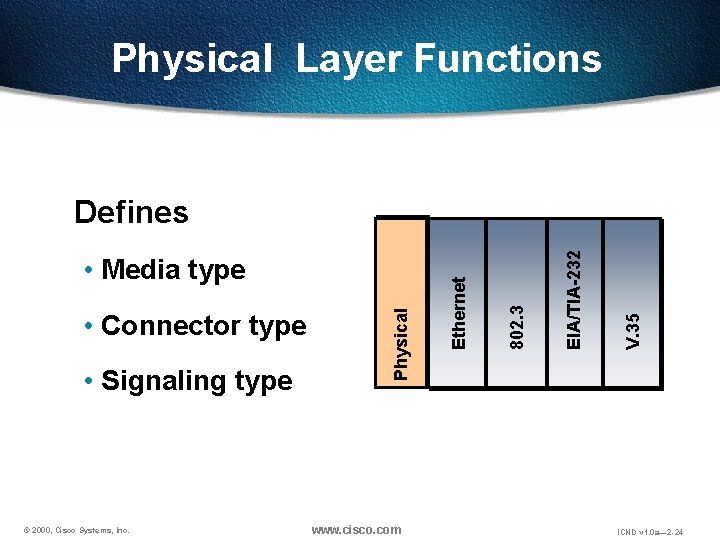
Physical Layer Functions • Signaling type © 2000, Cisco Systems, Inc. www. cisco. com V. 35 EIA/TIA-232 802. 3 • Connector type Physical • Media type Ethernet Defines ICND v 1. 0 a— 2 -24
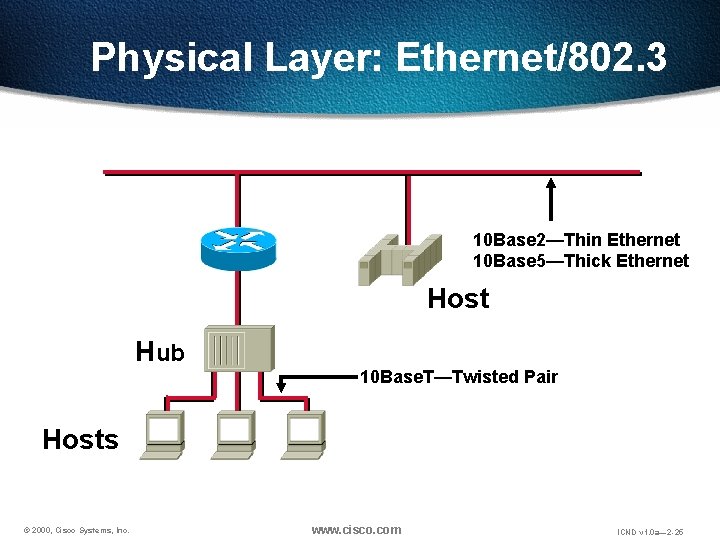
Physical Layer: Ethernet/802. 3 10 Base 2—Thin Ethernet 10 Base 5—Thick Ethernet Host Hub 10 Base. T—Twisted Pair Hosts © 2000, Cisco Systems, Inc. www. cisco. com ICND v 1. 0 a— 2 -25
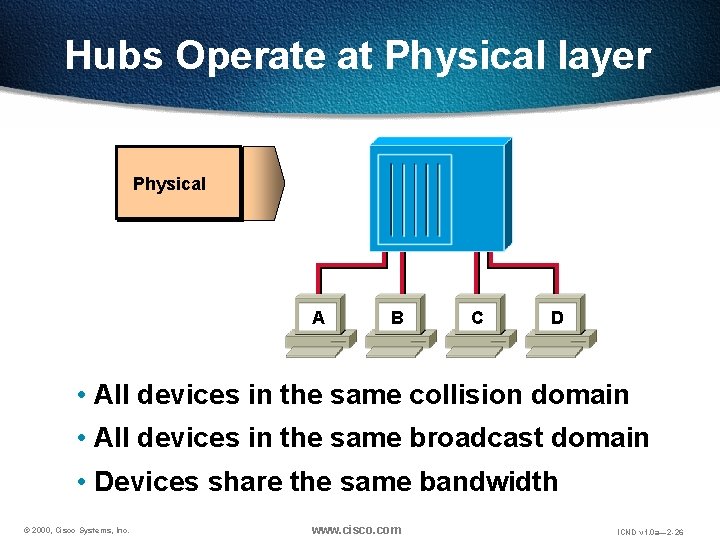
Hubs Operate at Physical layer Physical A B C D • All devices in the same collision domain • All devices in the same broadcast domain • Devices share the same bandwidth © 2000, Cisco Systems, Inc. www. cisco. com ICND v 1. 0 a— 2 -26
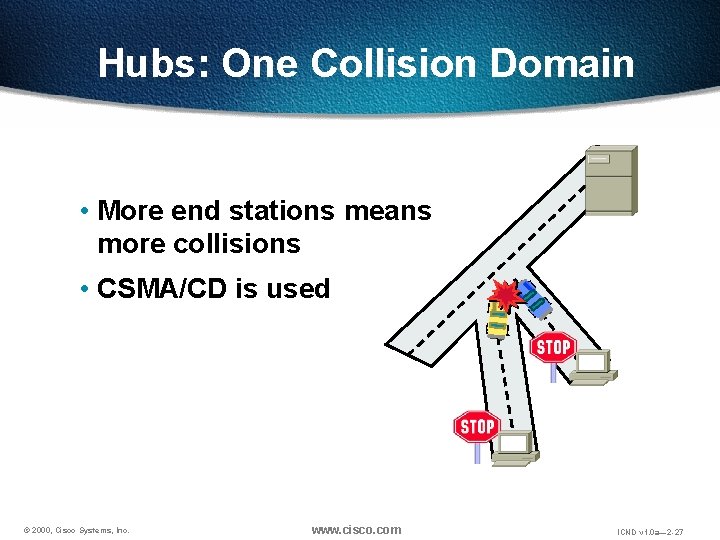
Hubs: One Collision Domain • More end stations means more collisions • CSMA/CD is used © 2000, Cisco Systems, Inc. www. cisco. com ICND v 1. 0 a— 2 -27
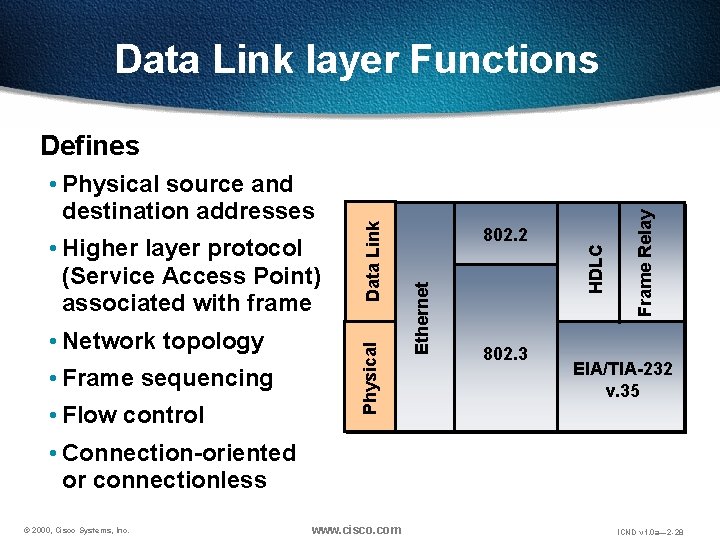
Data Link layer Functions • Network topology • Frame sequencing • Flow control Physical 802. 3 Frame Relay HDLC • Higher layer protocol (Service Access Point) associated with frame 802. 2 Ethernet • Physical source and destination addresses Data Link Defines EIA/TIA-232 v. 35 • Connection-oriented or connectionless © 2000, Cisco Systems, Inc. www. cisco. com ICND v 1. 0 a— 2 -28
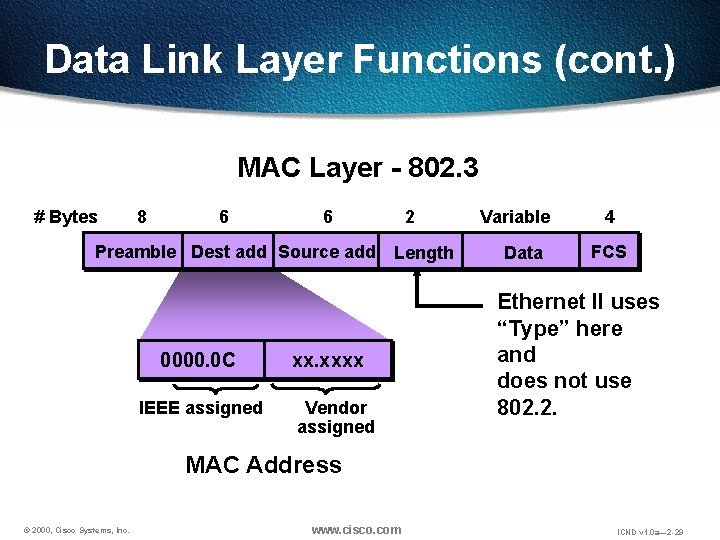
Data Link Layer Functions (cont. ) MAC Layer - 802. 3 # Bytes 8 6 6 Preamble Dest add Source add 0000. 0 C IEEE assigned 2 Length xx. xxxx Vendor assigned Variable Data 4 FCS Ethernet II uses “Type” here and does not use 802. 2. MAC Address © 2000, Cisco Systems, Inc. www. cisco. com ICND v 1. 0 a— 2 -29
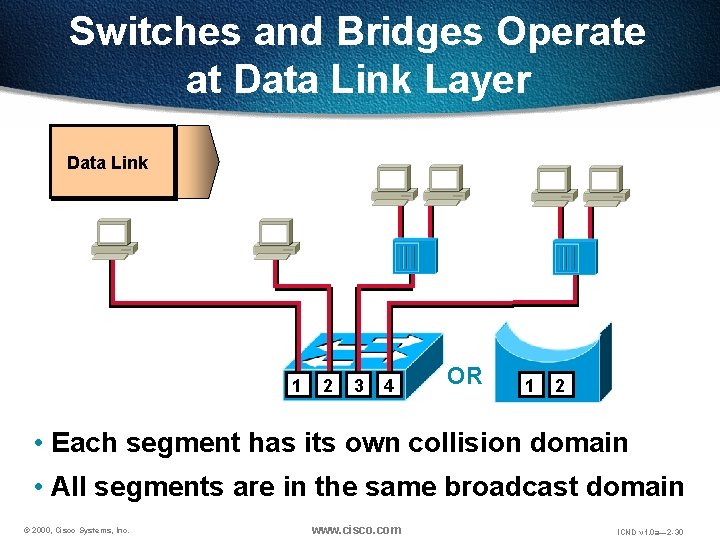
Switches and Bridges Operate at Data Link Layer Data Link 1 2 3 4 OR 1 2 • Each segment has its own collision domain • All segments are in the same broadcast domain © 2000, Cisco Systems, Inc. www. cisco. com ICND v 1. 0 a— 2 -30
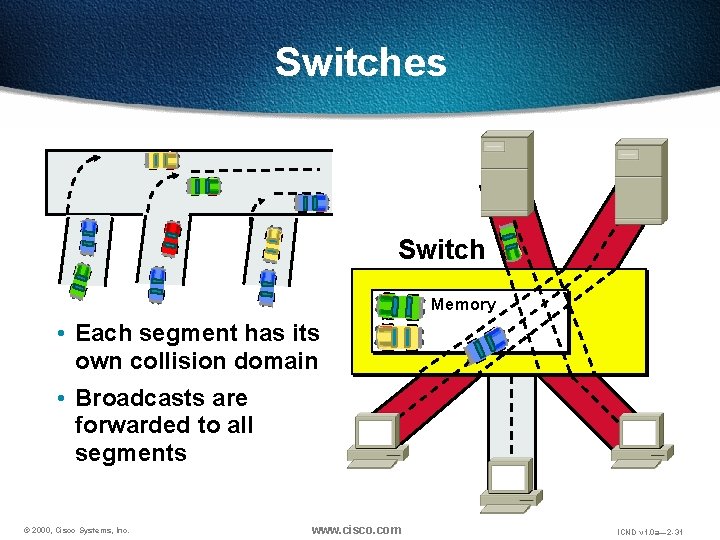
Switches Switch Memory • Each segment has its own collision domain • Broadcasts are forwarded to all segments © 2000, Cisco Systems, Inc. www. cisco. com ICND v 1. 0 a— 2 -31
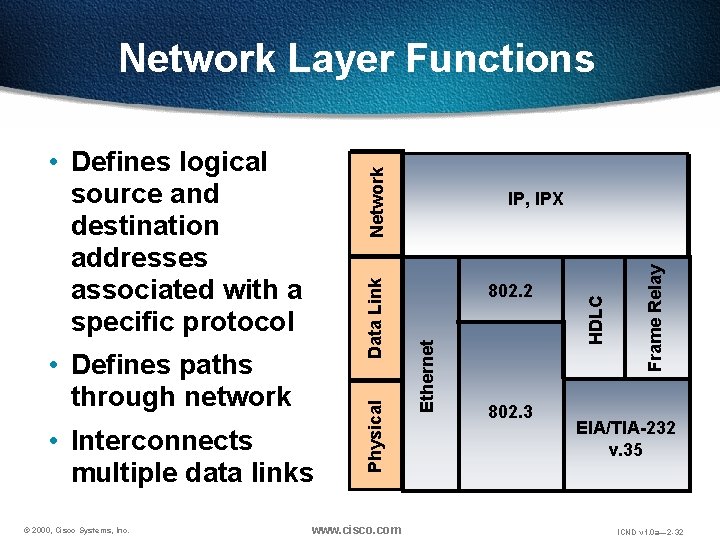
Network Layer Functions • Interconnects multiple data links © 2000, Cisco Systems, Inc. www. cisco. com 802. 3 Frame Relay 802. 2 HDLC IP, IPX Ethernet • Defines paths through network Physical Data Link Network • Defines logical source and destination addresses associated with a specific protocol EIA/TIA-232 v. 35 ICND v 1. 0 a— 2 -32
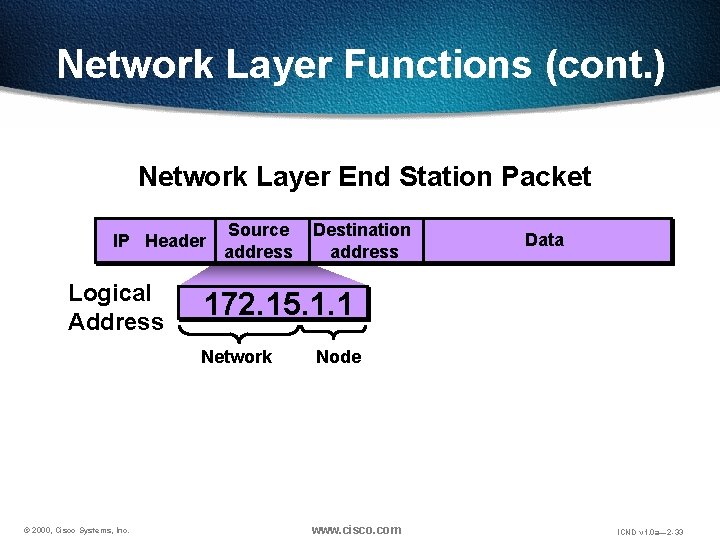
Network Layer Functions (cont. ) Network Layer End Station Packet IP Header Logical Address Source address Data 172. 15. 1. 1 Network © 2000, Cisco Systems, Inc. Destination address Node www. cisco. com ICND v 1. 0 a— 2 -33
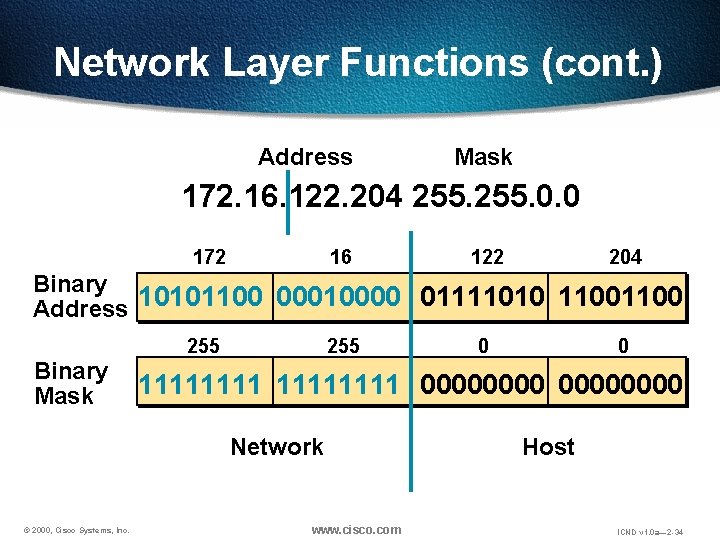
Network Layer Functions (cont. ) Address Mask 172. 16. 122. 204 255. 0. 0 172 16 122 204 Binary Address 10101100 00010000 01111010 1100 Binary Mask 255 0 11111111 00000000 Network © 2000, Cisco Systems, Inc. 0 www. cisco. com Host ICND v 1. 0 a— 2 -34
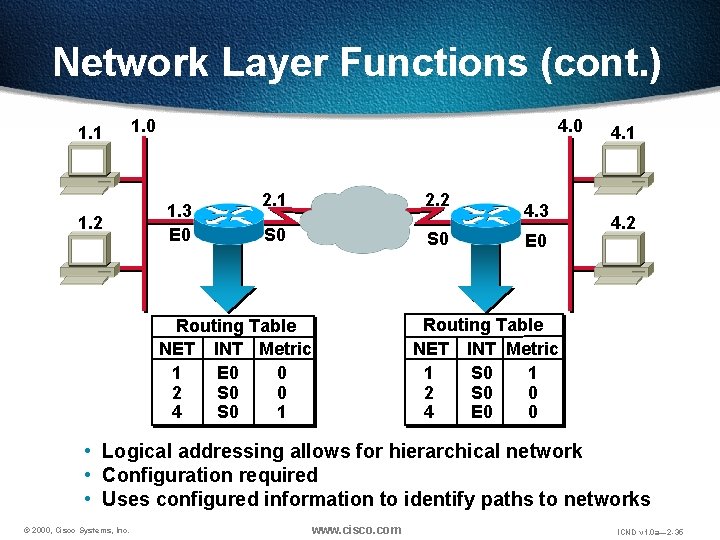
Network Layer Functions (cont. ) 1. 1 1. 2 1. 0 4. 0 1. 3 E 0 2. 1 2. 2 S 0 Routing Table NET INT Metric 1 E 0 0 2 S 0 0 4 S 0 1 4. 3 E 0 4. 1 4. 2 Routing Table NET INT Metric 1 S 0 1 2 S 0 0 4 E 0 0 • Logical addressing allows for hierarchical network • Configuration required • Uses configured information to identify paths to networks © 2000, Cisco Systems, Inc. www. cisco. com ICND v 1. 0 a— 2 -35
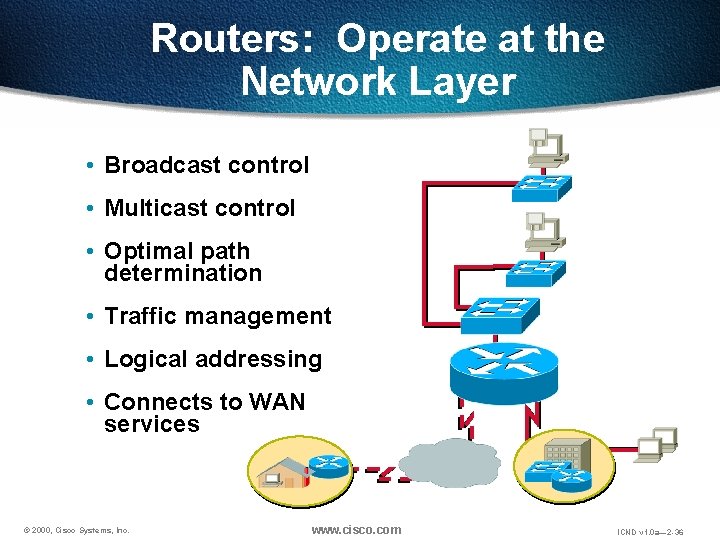
Routers: Operate at the Network Layer • Broadcast control • Multicast control • Optimal path determination • Traffic management • Logical addressing • Connects to WAN services © 2000, Cisco Systems, Inc. www. cisco. com ICND v 1. 0 a— 2 -36
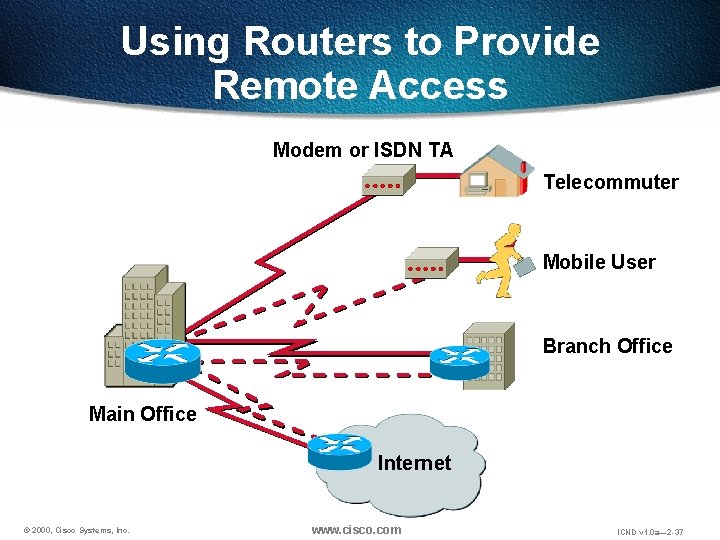
Using Routers to Provide Remote Access Modem or ISDN TA Telecommuter Mobile User Branch Office Main Office Internet © 2000, Cisco Systems, Inc. www. cisco. com ICND v 1. 0 a— 2 -37
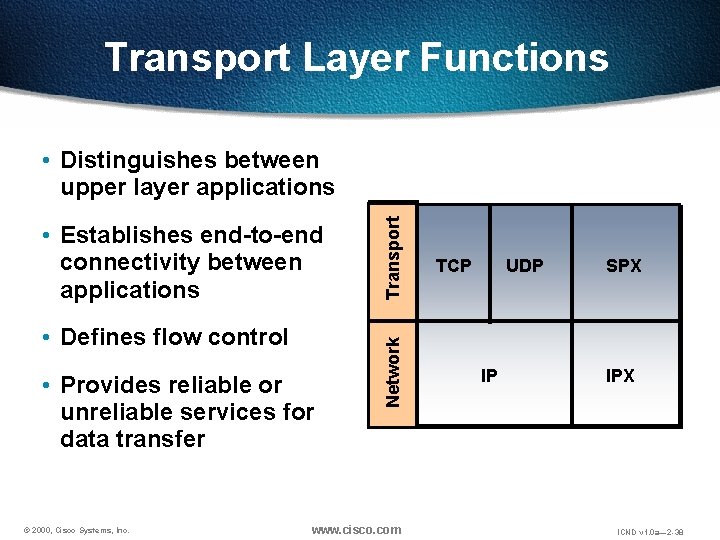
Transport Layer Functions • Defines flow control • Provides reliable or unreliable services for data transfer © 2000, Cisco Systems, Inc. Network • Establishes end-to-end connectivity between applications Transport • Distinguishes between upper layer applications www. cisco. com TCP UDP IP SPX ICND v 1. 0 a— 2 -38
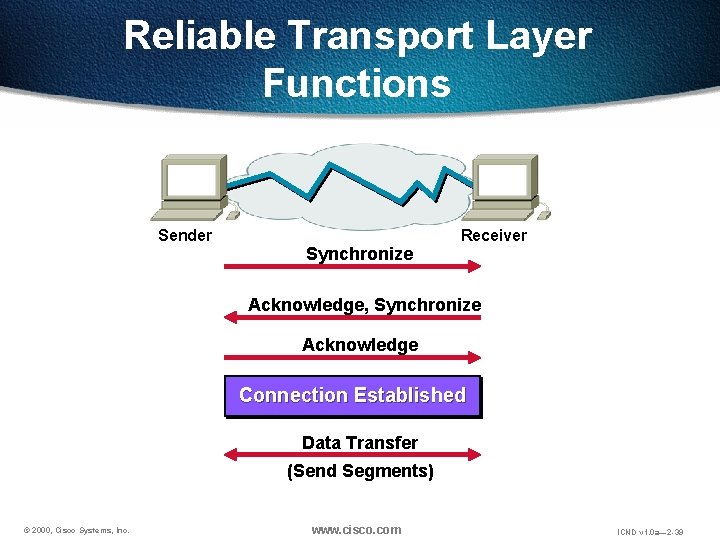
Reliable Transport Layer Functions Sender Synchronize Receiver Acknowledge, Synchronize Acknowledge Connection Established Data Transfer (Send Segments) © 2000, Cisco Systems, Inc. www. cisco. com ICND v 1. 0 a— 2 -39
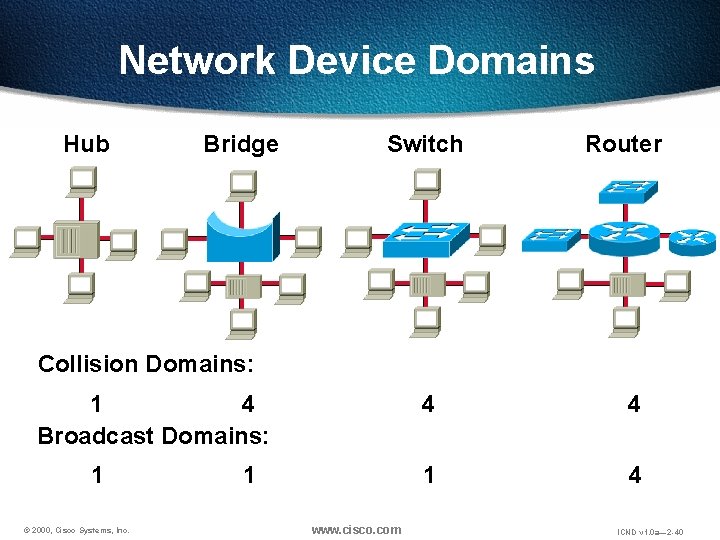
Network Device Domains Hub Bridge Switch Router Collision Domains: 1 4 Broadcast Domains: 1 © 2000, Cisco Systems, Inc. 1 www. cisco. com 4 4 1 4 ICND v 1. 0 a— 2 -40
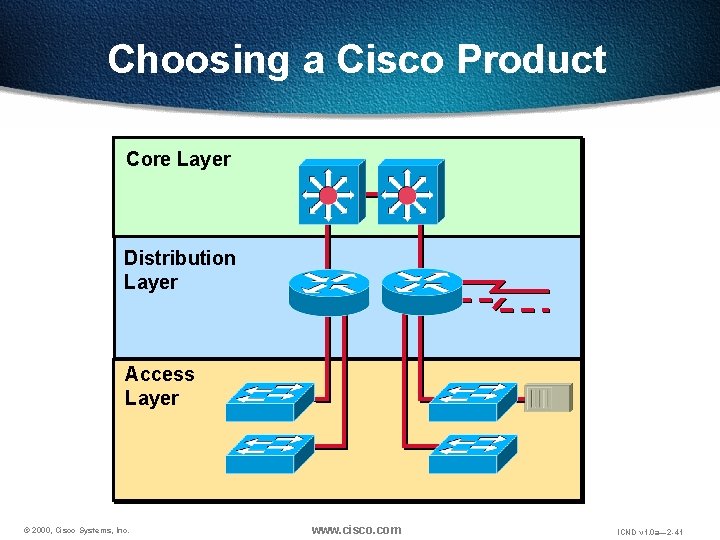
Choosing a Cisco Product Core Layer Distribution Layer Access Layer © 2000, Cisco Systems, Inc. www. cisco. com ICND v 1. 0 a— 2 -41
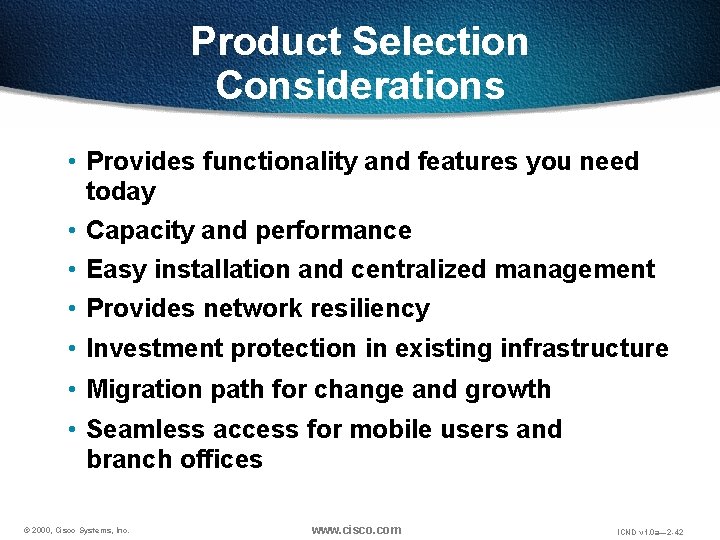
Product Selection Considerations • Provides functionality and features you need today • Capacity and performance • Easy installation and centralized management • Provides network resiliency • Investment protection in existing infrastructure • Migration path for change and growth • Seamless access for mobile users and branch offices © 2000, Cisco Systems, Inc. www. cisco. com ICND v 1. 0 a— 2 -42
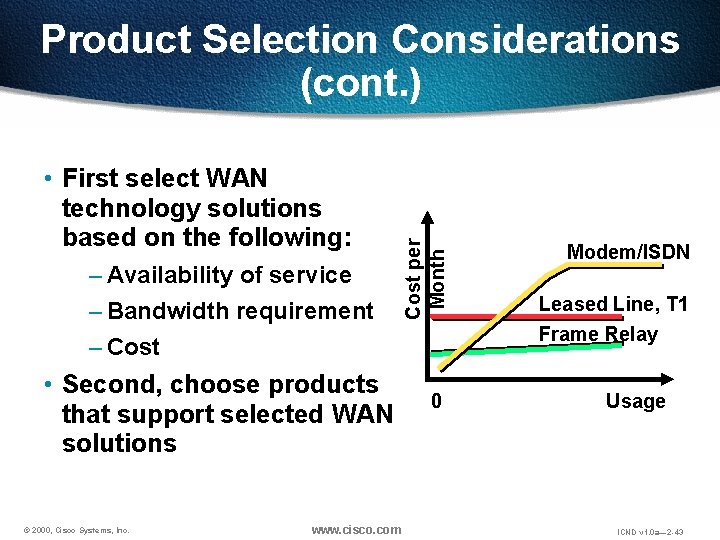
• First select WAN technology solutions based on the following: – Availability of service – Bandwidth requirement – Cost • Second, choose products that support selected WAN solutions © 2000, Cisco Systems, Inc. www. cisco. com Cost per Month Product Selection Considerations (cont. ) Modem/ISDN Leased Line, T 1 Frame Relay 0 Usage ICND v 1. 0 a— 2 -43
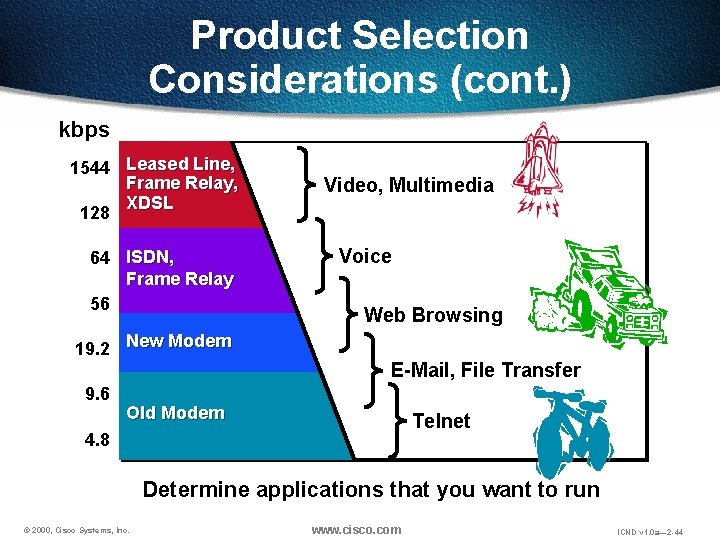
Product Selection Considerations (cont. ) kbps 1544 Leased Line, Frame Relay, XDSL 128 64 ISDN, Frame Relay 56 Video, Multimedia Voice Web Browsing 19. 2 New Modem E-Mail, File Transfer 9. 6 Old Modem Telnet 4. 8 Determine applications that you want to run © 2000, Cisco Systems, Inc. www. cisco. com ICND v 1. 0 a— 2 -44
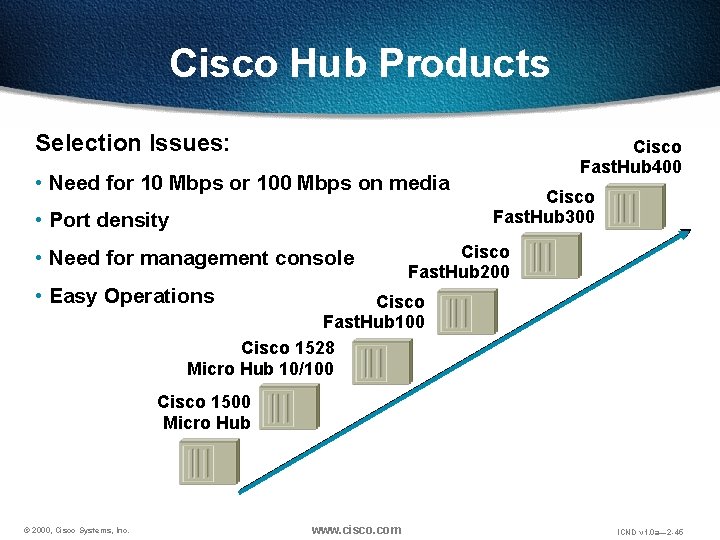
Cisco Hub Products Selection Issues: • Need for 10 Mbps or 100 Mbps on media • Port density • Need for management console Cisco Fast. Hub 400 Cisco Fast. Hub 300 Cisco Fast. Hub 200 • Easy Operations Cisco Fast. Hub 100 Cisco 1528 Micro Hub 10/100 Cisco 1500 Micro Hub © 2000, Cisco Systems, Inc. www. cisco. com ICND v 1. 0 a— 2 -45
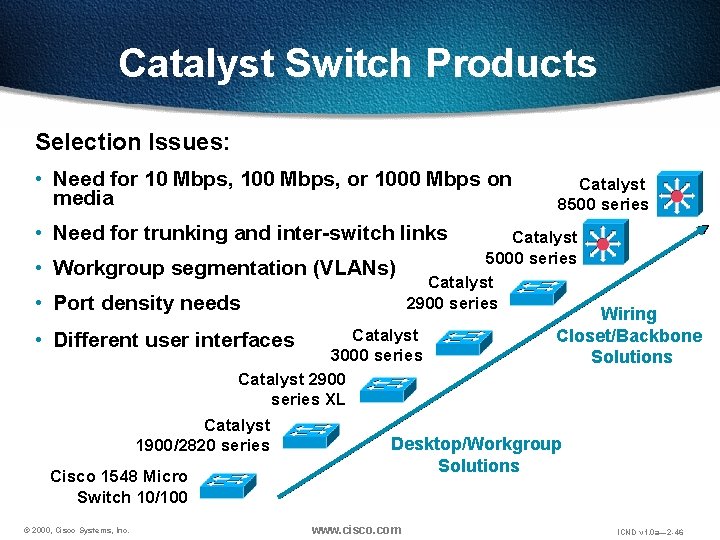
Catalyst Switch Products Selection Issues: • Need for 10 Mbps, 100 Mbps, or 1000 Mbps on media Catalyst 8500 series • Need for trunking and inter-switch links • Workgroup segmentation (VLANs) • Port density needs Catalyst 5000 series Catalyst 2900 series Catalyst 3000 series Catalyst 2900 series XL • Different user interfaces Catalyst 1900/2820 series Cisco 1548 Micro Switch 10/100 © 2000, Cisco Systems, Inc. Wiring Closet/Backbone Solutions Desktop/Workgroup Solutions www. cisco. com ICND v 1. 0 a— 2 -46
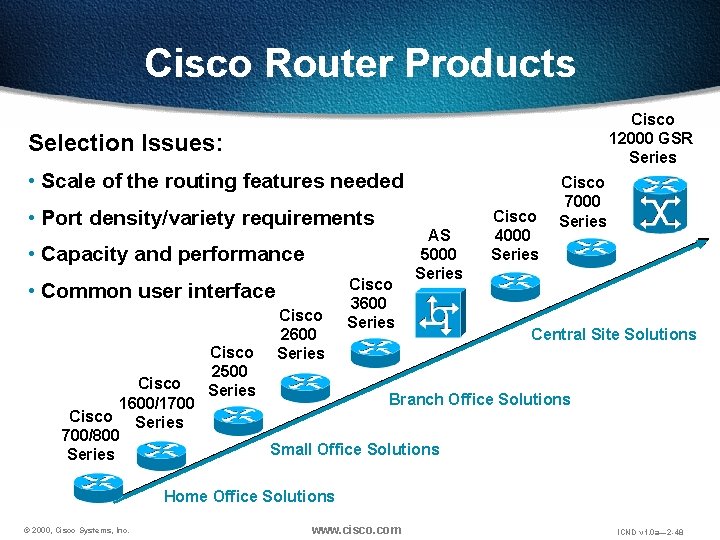
Cisco Router Products Cisco 12000 GSR Series Selection Issues: • Scale of the routing features needed • Port density/variety requirements • Capacity and performance • Common user interface Cisco 1600/1700 Cisco Series 700/800 Series Cisco 2500 Series Cisco 2600 Series Cisco 3600 Series AS 5000 Series Cisco 4000 Series Cisco 7000 Series Central Site Solutions Branch Office Solutions Small Office Solutions Home Office Solutions © 2000, Cisco Systems, Inc. www. cisco. com ICND v 1. 0 a— 2 -48
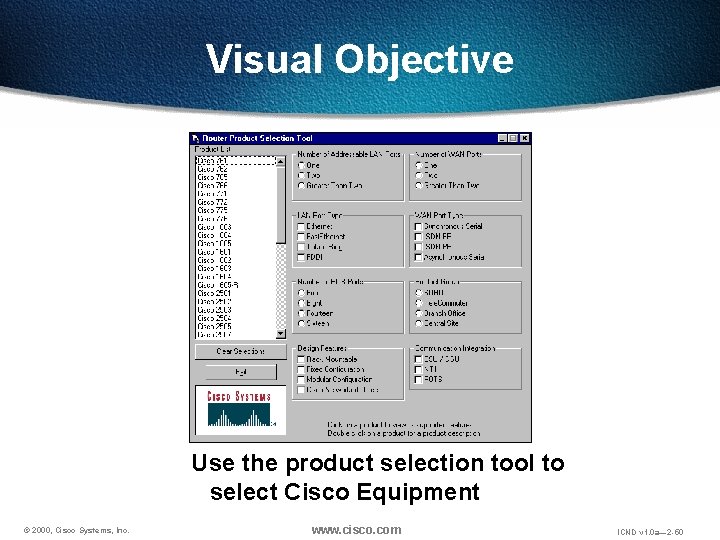
Visual Objective Use the product selection tool to select Cisco Equipment © 2000, Cisco Systems, Inc. www. cisco. com ICND v 1. 0 a— 2 -50
Summary After completing this chapter, you should be able to perform the following tasks: • Describe how data moves through a network • Identify the roles and functions of routers, switches and hubs, and specify where each device best fits in the network • Select the appropriate Cisco equipment for a network that combines switching, routing and remote access requirements © 2000, Cisco Systems, Inc. www. cisco. com ICND v 1. 0 a— 2 -51
Review Questions 1. What are some of the advantages of using the OSI model in a networking environment? 2. Describe the encapsulation process. 3. How many broadcast and collision domains are on a hub? © 2000, Cisco Systems, Inc. www. cisco. com ICND v 1. 0 a— 2 -52