
Chapter 2 Interactions of Radiation with Matter Slide
- Slides: 52
Chapter 2: Interactions of Radiation with Matter Slide set of 52 slides based on the chapter authored by J. R. Cunningham and D. R. Dance of the IAEA publication (ISBN 978 -92 -0 -131010 -1): Diagnostic Radiology Physics: A Handbook for Teachers and Students Objective: To familiarize students with the physics of events that occur when photons and electrons interact with matter Slide set prepared by E. Okuno (S. Paulo, Brazil, Institute of Physics of S. Paulo University) IAEA International Atomic Energy Agency
Chapter 2. TABLE OF CONTENTS 2. 1. Introduction 2. 2. Interactions of photons with matter 2. 3. Photon attenuation coefficients 2. 4. Interactions of electrons with matter 2. 5. Data sources IAEA Diagnostic Radiology Physics: a Handbook for Teachers and Students – chapter 2, 2
2. 1. INTRODUCTION This chapter deals with the physics of events that occur when photons and electrons interact with matter. These are the radiations that are important for diagnostic radiology, and only those interactions which result in their attenuation, absorption and scattering are dealt with The energy range used for diagnostic radiology is generally on the boundary between classical and quantum physics and following the “Complementarity Principle”, the numerical details of the interactions will be treated by classical reasoning where that is appropriate and by quantum mechanical considerations where that gives superior results IAEA Diagnostic Radiology Physics: a Handbook for Teachers and Students – chapter 2, 3
2. 1. INTRODUCTION The interaction of photons and electrons, as they traverse matter, are stochastic and obey the laws of chance, although, with very different behaviour: • Photons in general have none, one or a few interactions and are exponentially attenuated Photon interactions are expressed in terms of cross-sections for individual interactions and attenuation coefficients for passage through bulk media • Electrons experience large numbers of interactions and in general gradually lose energy until they are stopped. This is expressed in terms of electron range and material stopping powers IAEA Diagnostic Radiology Physics: a Handbook for Teachers and Students – chapter 2, 4
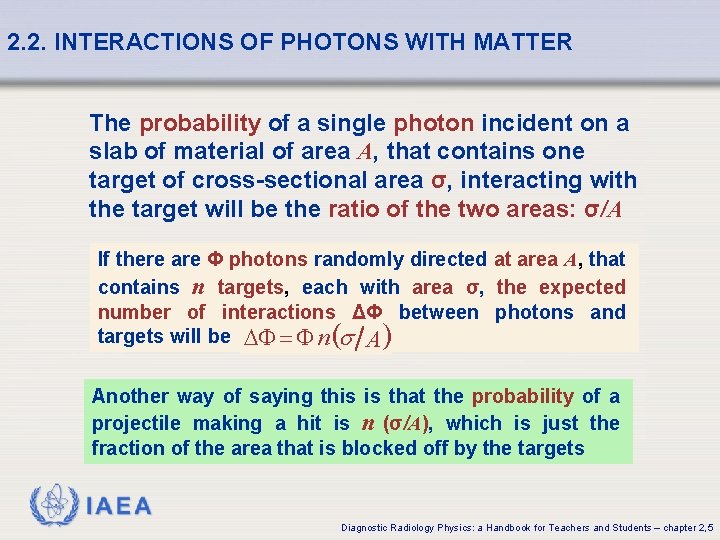
2. 2. INTERACTIONS OF PHOTONS WITH MATTER The probability of a single photon incident on a slab of material of area A, that contains one target of cross-sectional area σ, interacting with the target will be the ratio of the two areas: σ/A If there are Φ photons randomly directed at area A, that contains n targets, each with area σ, the expected number of interactions ΔΦ between photons and targets will be DF = F n (s A) Another way of saying this is that the probability of a projectile making a hit is n (σ/A), which is just the fraction of the area that is blocked off by the targets IAEA Diagnostic Radiology Physics: a Handbook for Teachers and Students – chapter 2, 5
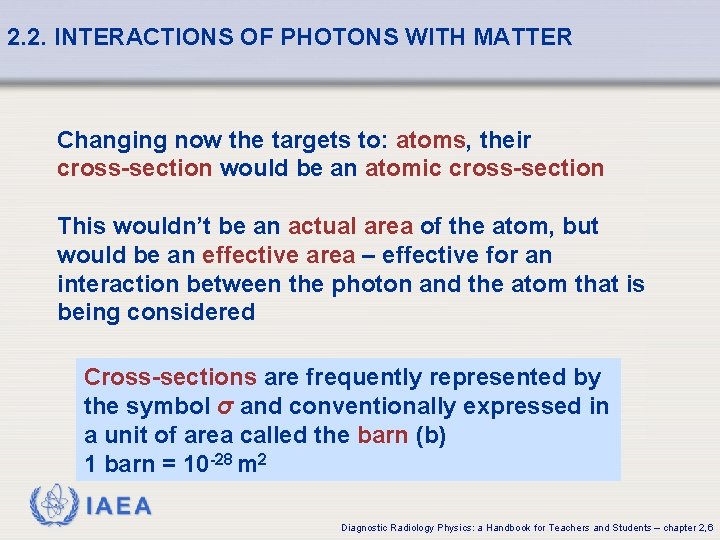
2. 2. INTERACTIONS OF PHOTONS WITH MATTER Changing now the targets to: atoms, their cross-section would be an atomic cross-section This wouldn’t be an actual area of the atom, but would be an effective area – effective for an interaction between the photon and the atom that is being considered Cross-sections are frequently represented by the symbol σ and conventionally expressed in a unit of area called the barn (b) 1 barn = 10 -28 m 2 IAEA Diagnostic Radiology Physics: a Handbook for Teachers and Students – chapter 2, 6
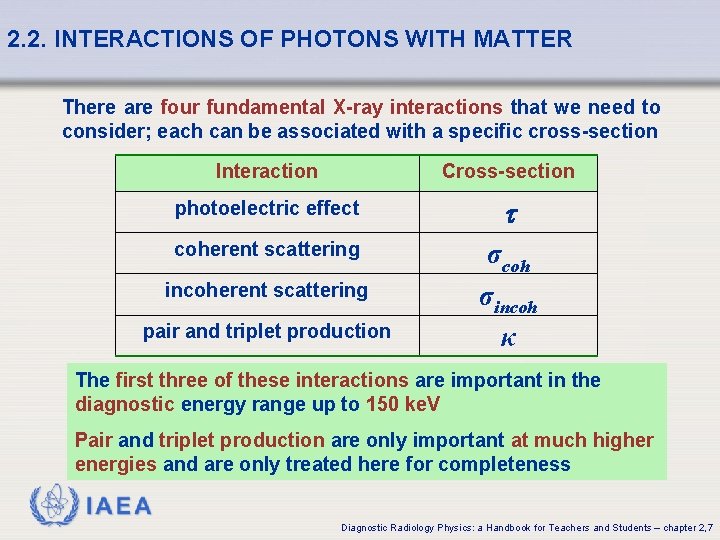
2. 2. INTERACTIONS OF PHOTONS WITH MATTER There are four fundamental X-ray interactions that we need to consider; each can be associated with a specific cross-section Interaction Cross-section photoelectric effect coherent scattering σcoh σincoh κ incoherent scattering pair and triplet production The first three of these interactions are important in the diagnostic energy range up to 150 ke. V Pair and triplet production are only important at much higher energies and are only treated here for completeness IAEA Diagnostic Radiology Physics: a Handbook for Teachers and Students – chapter 2, 7
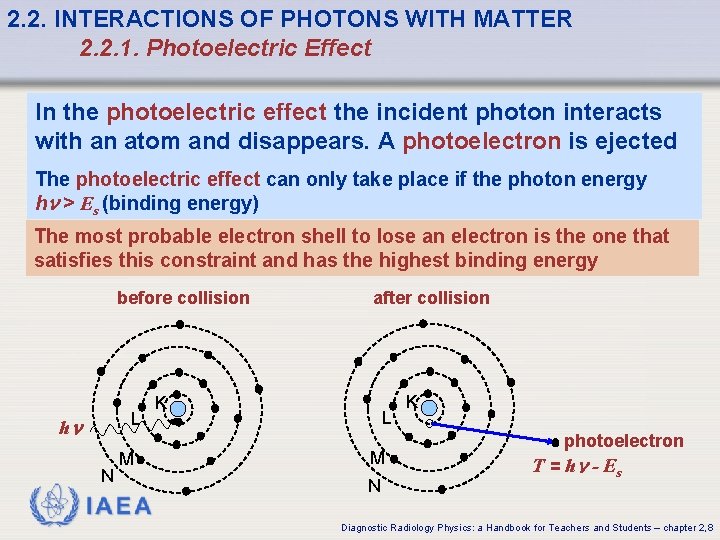
2. 2. INTERACTIONS OF PHOTONS WITH MATTER 2. 2. 1. Photoelectric Effect In the photoelectric effect the incident photon interacts with an atom and disappears. A photoelectron is ejected The photoelectric effect can only take place if the photon energy h > Es (binding energy) The most probable electron shell to lose an electron is the one that satisfies this constraint and has the highest binding energy before collision L h N M IAEA after collision K L M N K photoelectron T = h - E s Diagnostic Radiology Physics: a Handbook for Teachers and Students – chapter 2, 8
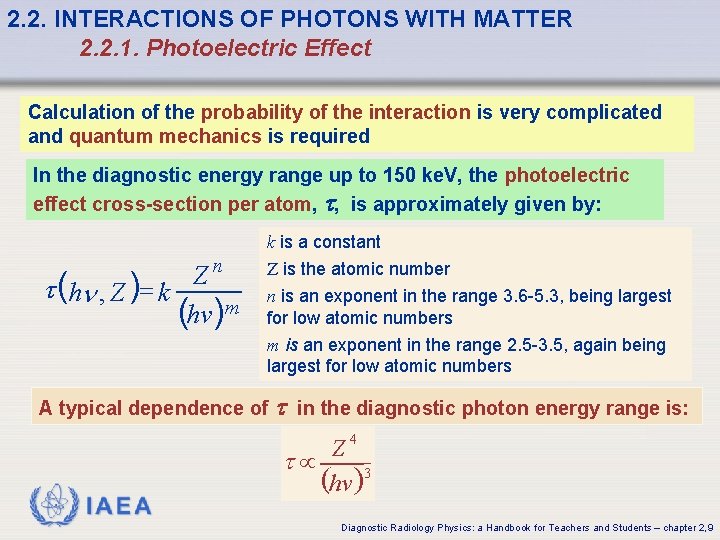
2. 2. INTERACTIONS OF PHOTONS WITH MATTER 2. 2. 1. Photoelectric Effect Calculation of the probability of the interaction is very complicated and quantum mechanics is required In the diagnostic energy range up to 150 ke. V, the photoelectric effect cross-section per atom, , is approximately given by: k is a constant n Z (hn , Z )= k (hv )m Z is the atomic number n is an exponent in the range 3. 6 -5. 3, being largest for low atomic numbers m is an exponent in the range 2. 5 -3. 5, again being largest for low atomic numbers A typical dependence of in the diagnostic photon energy range is: IAEA Z 4 µ (hv )3 Diagnostic Radiology Physics: a Handbook for Teachers and Students – chapter 2, 9
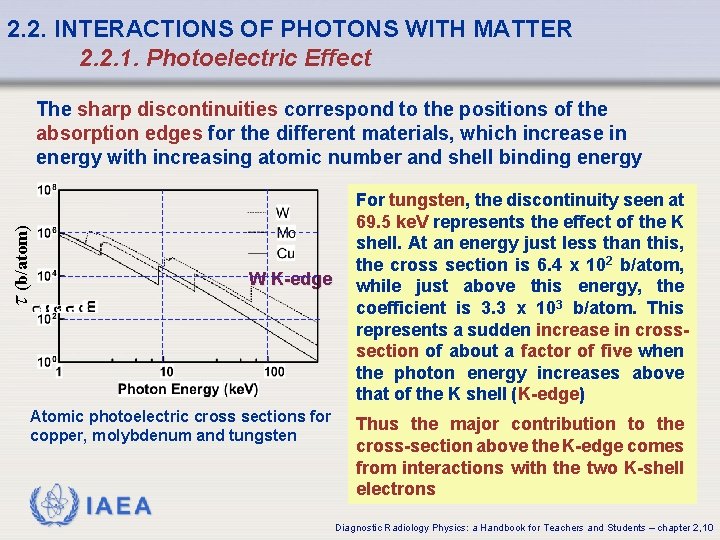
2. 2. INTERACTIONS OF PHOTONS WITH MATTER 2. 2. 1. Photoelectric Effect (b/atom) The sharp discontinuities correspond to the positions of the absorption edges for the different materials, which increase in energy with increasing atomic number and shell binding energy W K-edge Atomic photoelectric cross sections for copper, molybdenum and tungsten IAEA For tungsten, the discontinuity seen at 69. 5 ke. V represents the effect of the K shell. At an energy just less than this, the cross section is 6. 4 x 10² b/atom, while just above this energy, the coefficient is 3. 3 x 10³ b/atom. This represents a sudden increase in crosssection of about a factor of five when the photon energy increases above that of the K shell (K-edge) Thus the major contribution to the cross-section above the K-edge comes from interactions with the two K-shell electrons Diagnostic Radiology Physics: a Handbook for Teachers and Students – chapter 2, 10
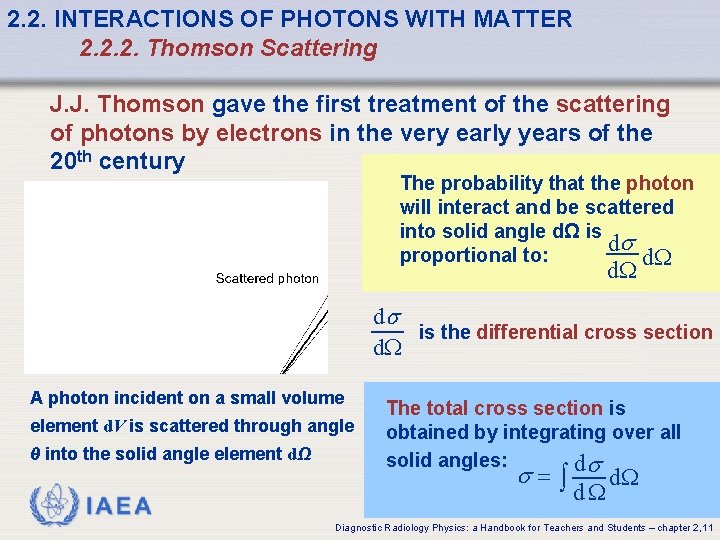
2. 2. INTERACTIONS OF PHOTONS WITH MATTER 2. 2. 2. Thomson Scattering J. J. Thomson gave the first treatment of the scattering of photons by electrons in the very early years of the 20 th century The probability that the photon will interact and be scattered into solid angle dΩ is ds proportional to: d. W ds is the differential cross section d. W A photon incident on a small volume element d. V is scattered through angle θ into the solid angle element dΩ IAEA The total cross section is obtained by integrating over all solid angles: ds s=ò d. W Diagnostic Radiology Physics: a Handbook for Teachers and Students – chapter 2, 11
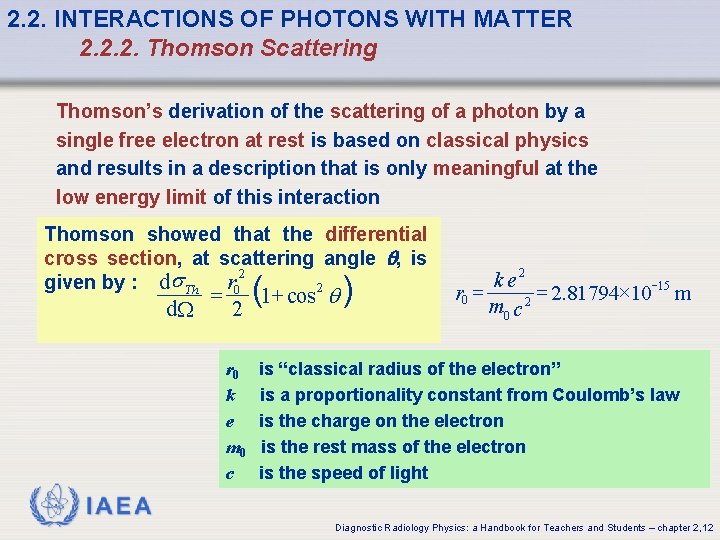
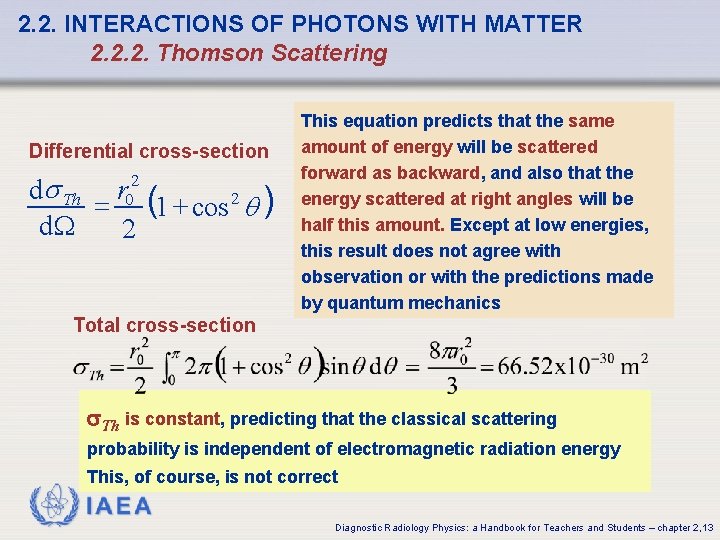
2. 2. INTERACTIONS OF PHOTONS WITH MATTER 2. 2. 2. Thomson Scattering Thomson’s derivation of the scattering of a photon by a single free electron at rest is based on classical physics and results in a description that is only meaningful at the low energy limit of this interaction Thomson showed that the differential cross section, at scattering angle , is 2 given by : ds Th r 0 2 d. W = 2 r 0 k e m 0 c (1+ cos q ) k e 2 -15 = ´ r 0 = 2. 81794 10 m m 0 c 2 is “classical radius of the electron” is a proportionality constant from Coulomb’s law is the charge on the electron is the rest mass of the electron is the speed of light IAEA Diagnostic Radiology Physics: a Handbook for Teachers and Students – chapter 2, 12
2. 2. INTERACTIONS OF PHOTONS WITH MATTER 2. 2. 2. Thomson Scattering Differential cross-section ds Th r 02 ( 2 = + 1 cos q ) d. W 2 This equation predicts that the same amount of energy will be scattered forward as backward, and also that the energy scattered at right angles will be half this amount. Except at low energies, this result does not agree with observation or with the predictions made by quantum mechanics Total cross-section Th is constant, predicting that the classical scattering probability is independent of electromagnetic radiation energy This, of course, is not correct IAEA Diagnostic Radiology Physics: a Handbook for Teachers and Students – chapter 2, 13
2. 2. INTERACTIONS OF PHOTONS WITH MATTER 2. 2. 3. Coherent (Rayleigh) Scattering In deriving the expression for Thomson scattering it was assumed that the electron was free, alone and at rest In reality the photon is scattered collectively by the atomic electrons which are not free, and their proximity to one another is not very different from the wavelength of the radiation In coherent scattering essentially no energy is lost by the photon as it transfers momentum to the atom and is scattered through angle θ The scattering by the different electrons is in phase and the resultant angular distribution is determined by an interference pattern which is characteristic of the atom IAEA Diagnostic Radiology Physics: a Handbook for Teachers and Students – chapter 2, 14
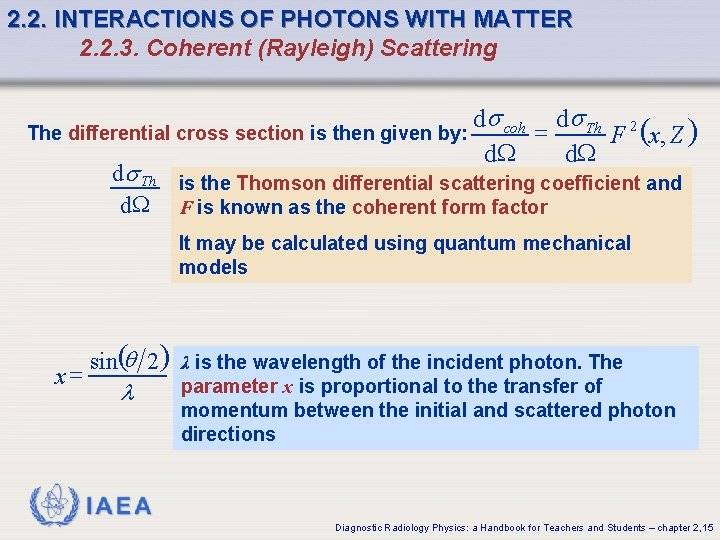
2. 2. INTERACTIONS OF PHOTONS WITH MATTER 2. 2. 3. Coherent (Rayleigh) Scattering ds coh ds Th 2 = The differential cross section is then given by: F (x, Z ) d. W ds Th is the Thomson differential scattering coefficient and d. W F is known as the coherent form factor It may be calculated using quantum mechanical models x= sin(q 2) λ is the wavelength of the incident photon. The l parameter x is proportional to the transfer of momentum between the initial and scattered photon directions IAEA Diagnostic Radiology Physics: a Handbook for Teachers and Students – chapter 2, 15
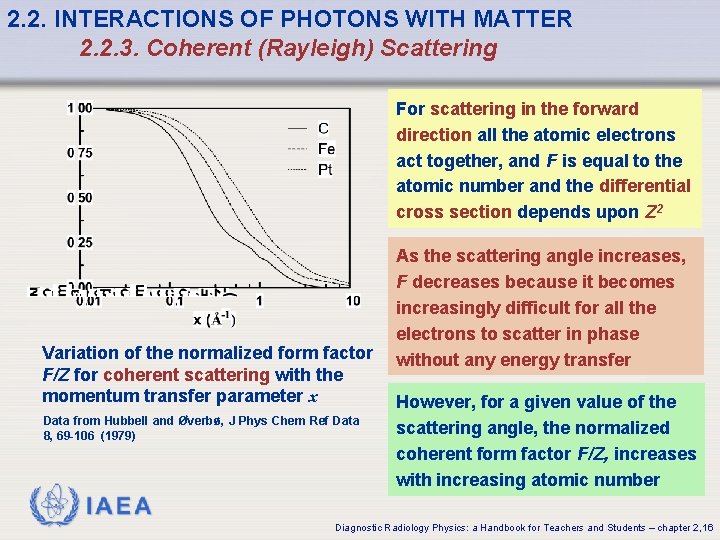
2. 2. INTERACTIONS OF PHOTONS WITH MATTER 2. 2. 3. Coherent (Rayleigh) Scattering For scattering in the forward direction all the atomic electrons act together, and F is equal to the atomic number and the differential cross section depends upon Z 2 Variation of the normalized form factor F/Z for coherent scattering with the momentum transfer parameter x Data from Hubbell and Øverbø, J Phys Chem Ref Data 8, 69 -106 (1979) As the scattering angle increases, F decreases because it becomes increasingly difficult for all the electrons to scatter in phase without any energy transfer However, for a given value of the scattering angle, the normalized coherent form factor F/Z, increases with increasing atomic number IAEA Diagnostic Radiology Physics: a Handbook for Teachers and Students – chapter 2, 16
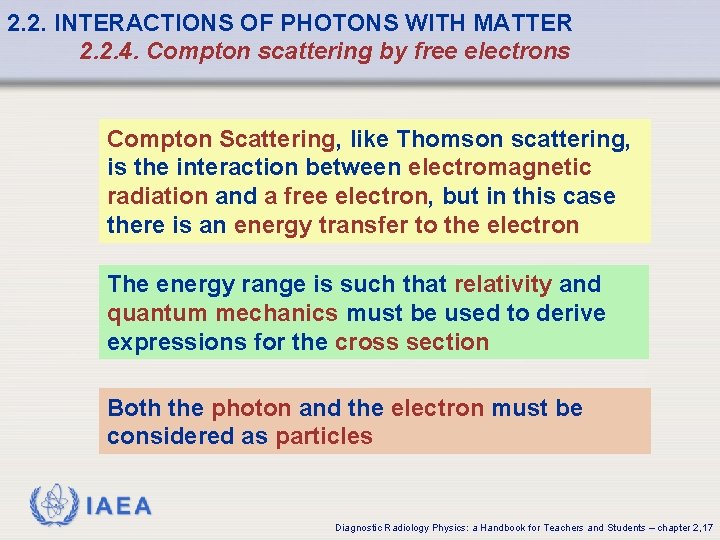
2. 2. INTERACTIONS OF PHOTONS WITH MATTER 2. 2. 4. Compton scattering by free electrons Compton Scattering, like Thomson scattering, is the interaction between electromagnetic radiation and a free electron, but in this case there is an energy transfer to the electron The energy range is such that relativity and quantum mechanics must be used to derive expressions for the cross section Both the photon and the electron must be considered as particles IAEA Diagnostic Radiology Physics: a Handbook for Teachers and Students – chapter 2, 17
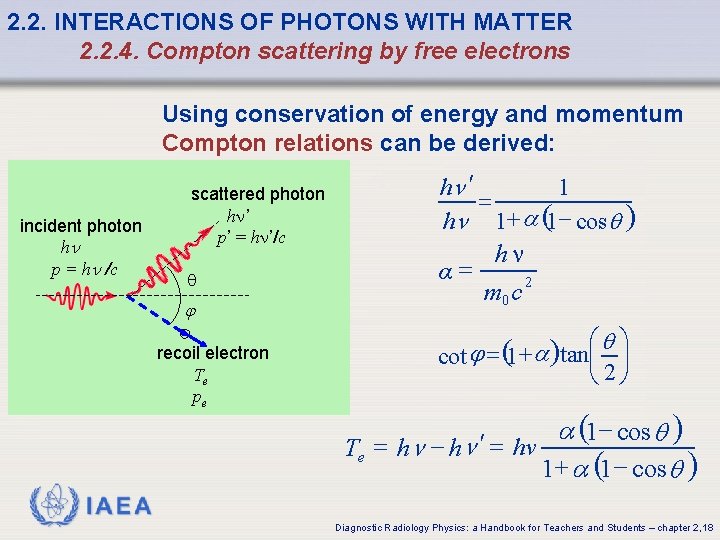
2. 2. INTERACTIONS OF PHOTONS WITH MATTER 2. 2. 4. Compton scattering by free electrons Using conservation of energy and momentum Compton relations can be derived: incident photon hn p = hn /c scattered photon hn’ p’ = hn’/c q j recoil electron Te pe hn ¢ 1 = hn 1+ a (1 - cosq ) hn α= m 0 c 2 æq ö cot j = (1+ a )tanç ÷ è 2ø - cos q ) ( a 1 Te = hn - hn ¢ = hv 1 + a (1 - cos q ) IAEA Diagnostic Radiology Physics: a Handbook for Teachers and Students – chapter 2, 18
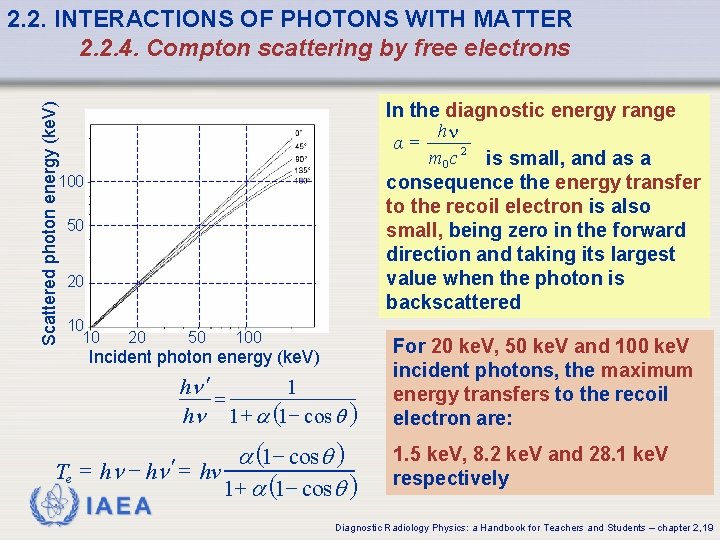
Scattered photon energy (ke. V) 2. 2. INTERACTIONS OF PHOTONS WITH MATTER 2. 2. 4. Compton scattering by free electrons In the diagnostic energy range α= hn m 0 c 2 is small, and as a consequence the energy transfer to the recoil electron is also small, being zero in the forward direction and taking its largest value when the photon is backscattered 100 50 20 10 10 20 50 100 Incident photon energy (ke. V) hn ¢ 1 = hn 1 + a (1 - cos q ) ( a 1 - cosq ) ¢ Te = hn - hn = hv 1 + a (1 - cosq ) IAEA For 20 ke. V, 50 ke. V and 100 ke. V incident photons, the maximum energy transfers to the recoil electron are: 1. 5 ke. V, 8. 2 ke. V and 28. 1 ke. V respectively Diagnostic Radiology Physics: a Handbook for Teachers and Students – chapter 2, 19
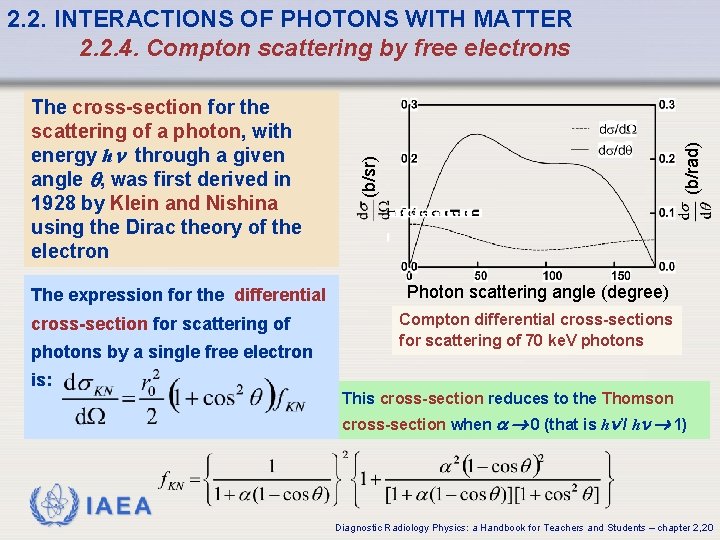
The expression for the differential cross-section for scattering of photons by a single free electron (b/sr) The cross-section for the scattering of a photon, with energy h through a given angle , was first derived in 1928 by Klein and Nishina using the Dirac theory of the electron (b/rad) 2. 2. INTERACTIONS OF PHOTONS WITH MATTER 2. 2. 4. Compton scattering by free electrons Photon scattering angle (degree) Compton differential cross-sections for scattering of 70 ke. V photons is: This cross-section reduces to the Thomson cross-section when 0 (that is h ’/ h 1) IAEA Diagnostic Radiology Physics: a Handbook for Teachers and Students – chapter 2, 20
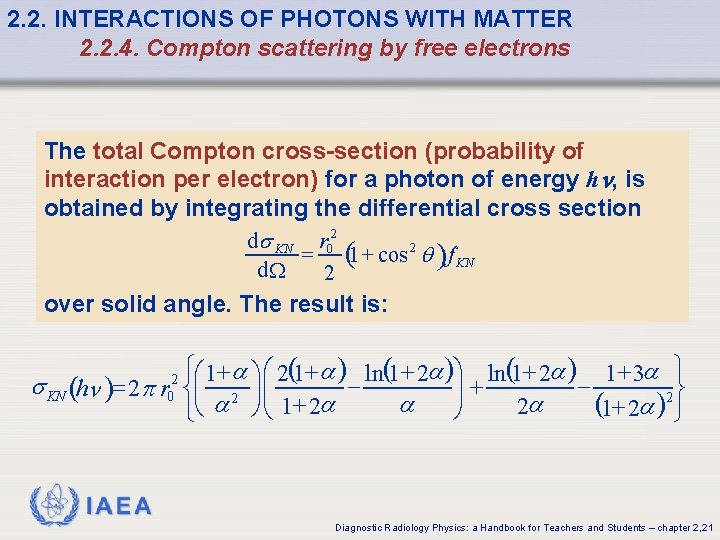
2. 2. INTERACTIONS OF PHOTONS WITH MATTER 2. 2. 4. Compton scattering by free electrons The total Compton cross-section (probability of interaction per electron) for a photon of energy h , is obtained by integrating the differential cross section ds KN r 02 = (1 + cos 2 q ) f KN d. W 2 over solid angle. The result is: ìæ 1+ a ö æ 2(1+ a ) ln(1+ 2 a )ö ln(1+ 2 a ) 1+ 3 a ü ÷÷ + s KN (hn )= 2 p r íç 2 ÷ çç 2ý a (1+ 2 a ) þ 2 a ø îè a ø è 1+ 2 a 2 0 IAEA Diagnostic Radiology Physics: a Handbook for Teachers and Students – chapter 2, 21
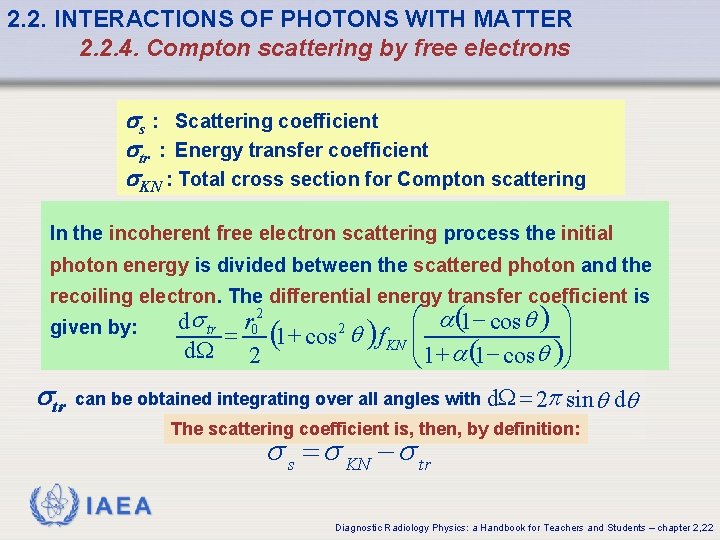
2. 2. INTERACTIONS OF PHOTONS WITH MATTER 2. 2. 4. Compton scattering by free electrons ss : Scattering coefficient str : Energy transfer coefficient s. KN : Total cross section for Compton scattering In the incoherent free electron scattering process the initial photon energy is divided between the scattered photon and the recoiling electron. The differential energy transfer coefficient is given by: str æ a (1 - cos q ) ö ds tr r 02 2 ÷÷ = (1+ cos q ) f KN çç d. W 2 è 1 + a (1 - cos q )ø can be obtained integrating over all angles with d. W = 2 p sin q dq The scattering coefficient is, then, by definition: s s = s KN - s tr IAEA Diagnostic Radiology Physics: a Handbook for Teachers and Students – chapter 2, 22
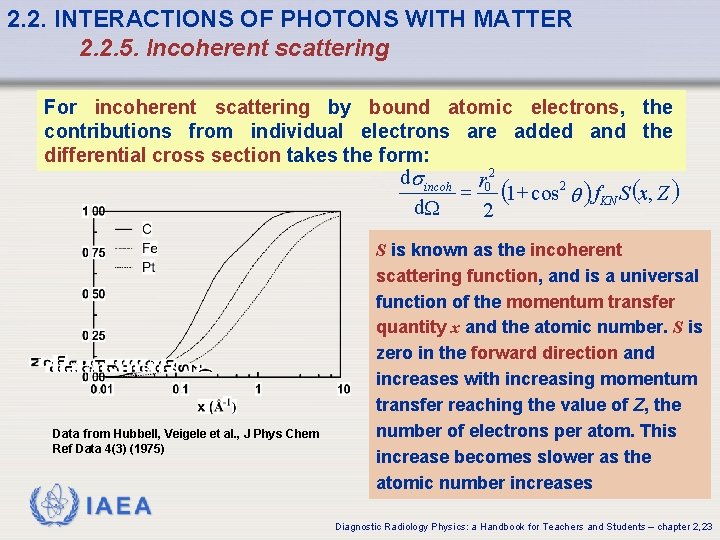
2. 2. INTERACTIONS OF PHOTONS WITH MATTER 2. 2. 5. Incoherent scattering For incoherent scattering by bound atomic electrons, the contributions from individual electrons are added and the differential cross section takes the form: ds incoh r 02 = (1+ cos 2 q ) f KN S (x, Z ) d. W 2 Data from Hubbell, Veigele et al. , J Phys Chem Ref Data 4(3) (1975) S is known as the incoherent scattering function, and is a universal function of the momentum transfer quantity x and the atomic number. S is zero in the forward direction and increases with increasing momentum transfer reaching the value of Z, the number of electrons per atom. This increase becomes slower as the atomic number increases IAEA Diagnostic Radiology Physics: a Handbook for Teachers and Students – chapter 2, 23
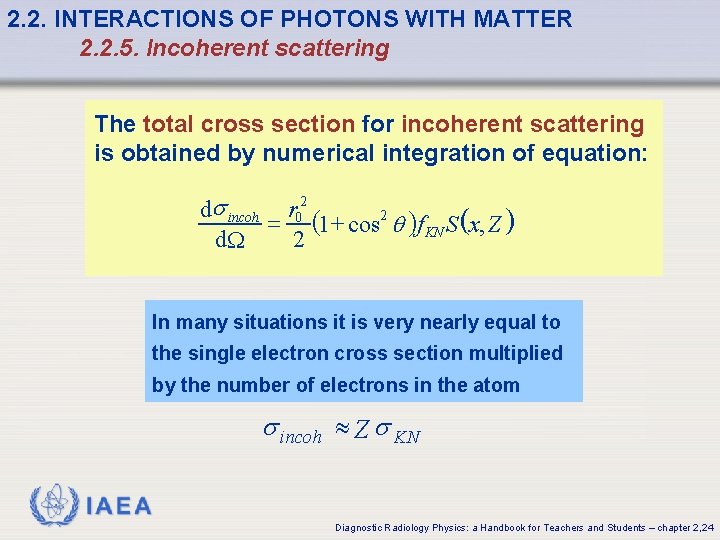
2. 2. INTERACTIONS OF PHOTONS WITH MATTER 2. 2. 5. Incoherent scattering The total cross section for incoherent scattering is obtained by numerical integration of equation: ds incoh r 02 = (1 + cos 2 q )f KN S (x, Z ) d. W 2 In many situations it is very nearly equal to the single electron cross section multiplied by the number of electrons in the atom s incoh » Z s KN IAEA Diagnostic Radiology Physics: a Handbook for Teachers and Students – chapter 2, 24
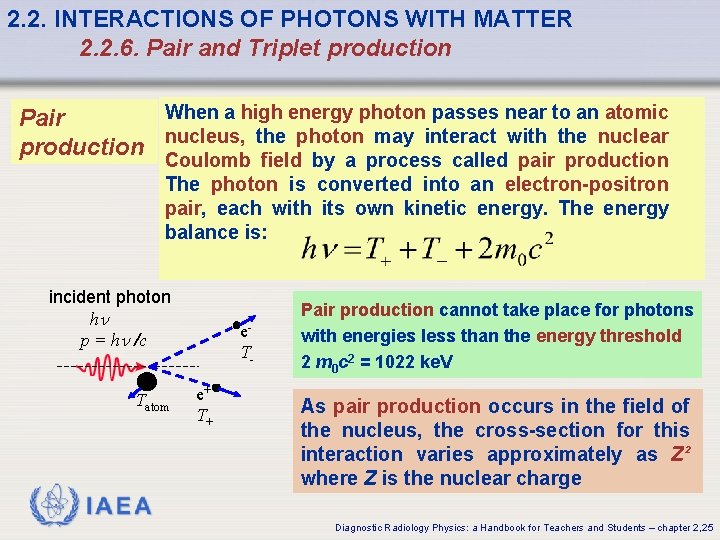
2. 2. INTERACTIONS OF PHOTONS WITH MATTER 2. 2. 6. Pair and Triplet production When a high energy photon passes near to an atomic Pair production nucleus, the photon may interact with the nuclear Coulomb field by a process called pair production The photon is converted into an electron-positron pair, each with its own kinetic energy. The energy balance is: incident photon hn p = hn /c Tatom e. Te+ T+ Pair production cannot take place for photons with energies less than the energy threshold 2 m 0 c 2 = 1022 ke. V As pair production occurs in the field of the nucleus, the cross-section for this interaction varies approximately as Z² where Z is the nuclear charge IAEA Diagnostic Radiology Physics: a Handbook for Teachers and Students – chapter 2, 25
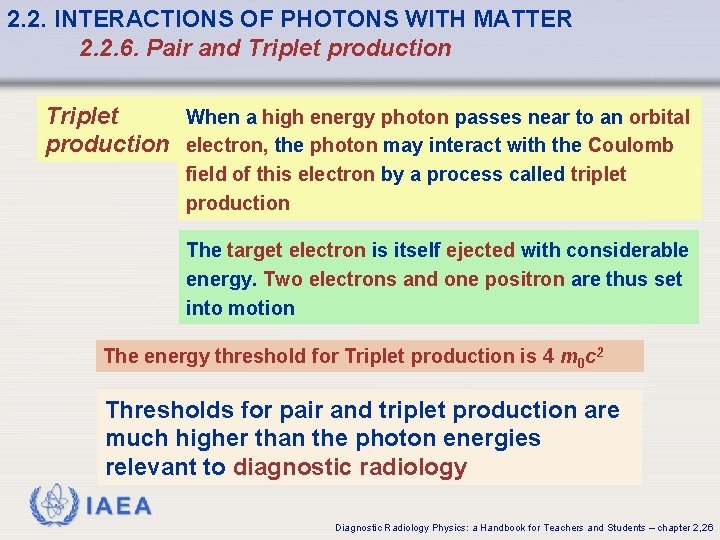
2. 2. INTERACTIONS OF PHOTONS WITH MATTER 2. 2. 6. Pair and Triplet production Triplet When a high energy photon passes near to an orbital production electron, the photon may interact with the Coulomb field of this electron by a process called triplet production The target electron is itself ejected with considerable energy. Two electrons and one positron are thus set into motion The energy threshold for Triplet production is 4 m 0 c 2 Thresholds for pair and triplet production are much higher than the photon energies relevant to diagnostic radiology IAEA Diagnostic Radiology Physics: a Handbook for Teachers and Students – chapter 2, 26
2. 3. PHOTON ATTENUATION COEFFICIENTS Photons may undergo more than one interaction as they pass through bulk material: An initial scatter interaction might be followed by a second scattering process which in turn might be followed by a third scatter, photoelectric absorption or no further interactions with the photon leaving the bulk material, for example To consider this macroscopic behaviour of primary photons traversing matter • linear attenuation coefficients and • mass attenuation coefficients are used, which are simply related to the total cross section The exit beam from the bulk material will also comprise both primary and scattered photons. Such effects are best estimated using Monte Carlo techniques IAEA Diagnostic Radiology Physics: a Handbook for Teachers and Students – chapter 2, 27
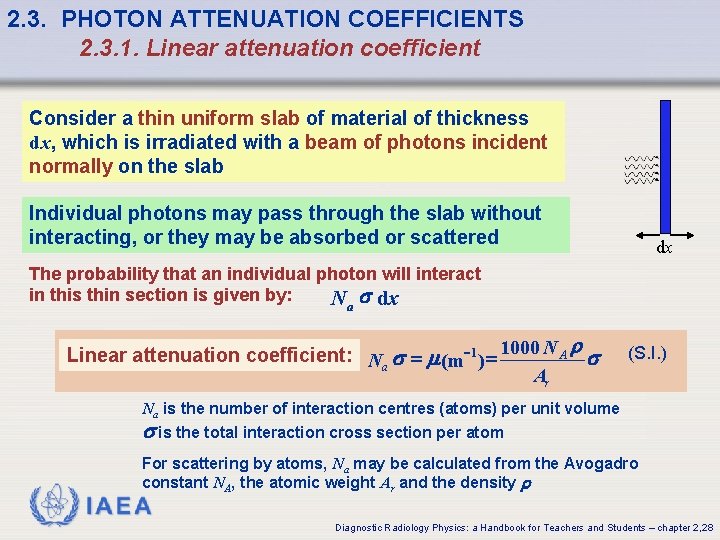
2. 3. PHOTON ATTENUATION COEFFICIENTS 2. 3. 1. Linear attenuation coefficient Consider a thin uniform slab of material of thickness dx, which is irradiated with a beam of photons incident normally on the slab Individual photons may pass through the slab without interacting, or they may be absorbed or scattered dx The probability that an individual photon will interact in this thin section is given by: N s dx a Linear attenuation coefficient: Na s = m (m-1 ) = 1000 N A r s Ar (S. I. ) Na is the number of interaction centres (atoms) per unit volume s is the total interaction cross section per atom IAEA For scattering by atoms, Na may be calculated from the Avogadro constant NA, the atomic weight Ar and the density r Diagnostic Radiology Physics: a Handbook for Teachers and Students – chapter 2, 28
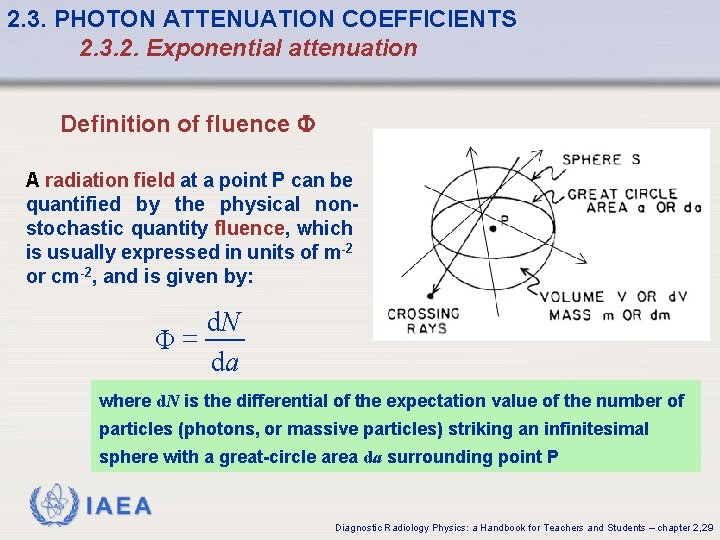
2. 3. PHOTON ATTENUATION COEFFICIENTS 2. 3. 2. Exponential attenuation Definition of fluence A radiation field at a point P can be quantified by the physical nonstochastic quantity fluence, which is usually expressed in units of m-2 or cm-2, and is given by: d. N Φ= da where d. N is the differential of the expectation value of the number of particles (photons, or massive particles) striking an infinitesimal sphere with a great-circle area da surrounding point P IAEA Diagnostic Radiology Physics: a Handbook for Teachers and Students – chapter 2, 29
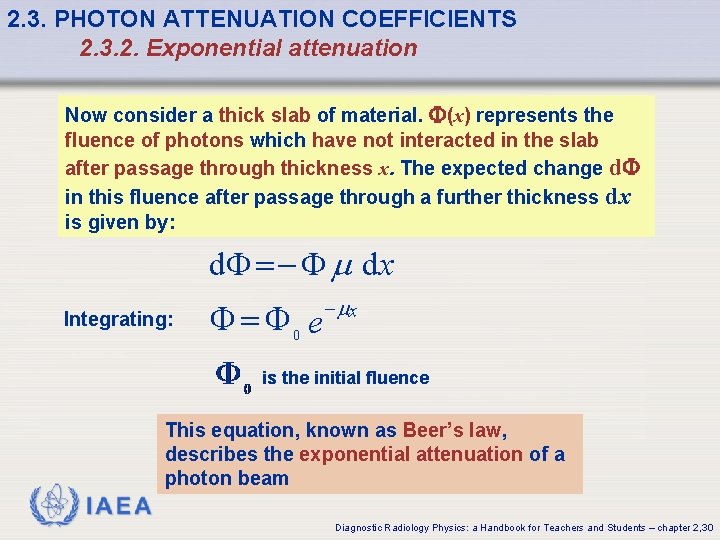
2. 3. PHOTON ATTENUATION COEFFICIENTS 2. 3. 2. Exponential attenuation Now consider a thick slab of material. (x) represents the fluence of photons which have not interacted in the slab after passage through thickness x. The expected change d in this fluence after passage through a further thickness dx is given by: d. F = - F m dx Integrating: F = F 0 e - mx is the initial fluence This equation, known as Beer’s law, describes the exponential attenuation of a photon beam IAEA Diagnostic Radiology Physics: a Handbook for Teachers and Students – chapter 2, 30
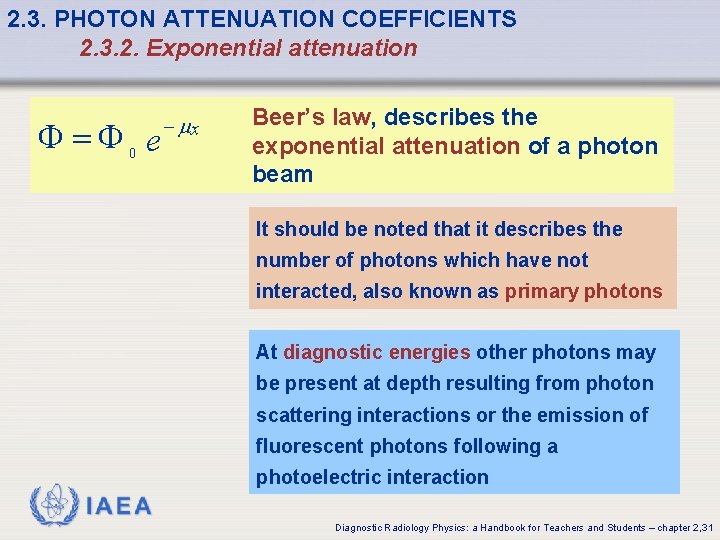
2. 3. PHOTON ATTENUATION COEFFICIENTS 2. 3. 2. Exponential attenuation F =F 0 e - mx Beer’s law, describes the exponential attenuation of a photon beam It should be noted that it describes the number of photons which have not interacted, also known as primary photons At diagnostic energies other photons may be present at depth resulting from photon scattering interactions or the emission of fluorescent photons following a photoelectric interaction IAEA Diagnostic Radiology Physics: a Handbook for Teachers and Students – chapter 2, 31
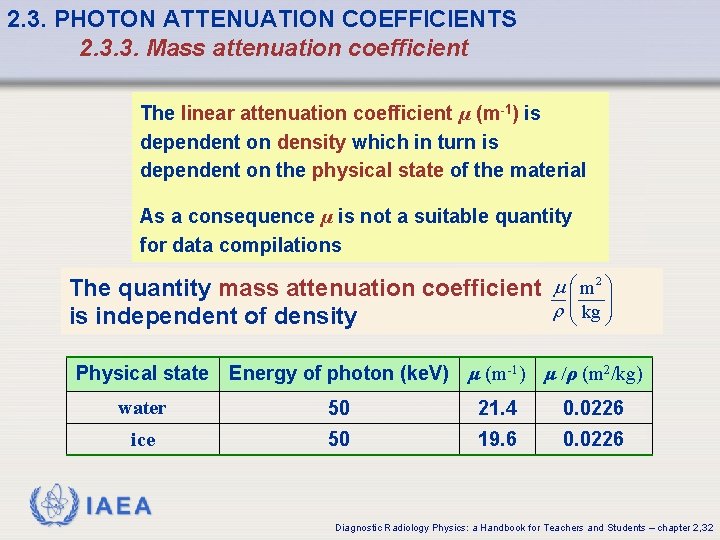
2. 3. PHOTON ATTENUATION COEFFICIENTS 2. 3. 3. Mass attenuation coefficient The linear attenuation coefficient µ (m-1) is dependent on density which in turn is dependent on the physical state of the material As a consequence µ is not a suitable quantity for data compilations The quantity mass attenuation coefficient m æç m 2 ö÷ ç kg ÷ r è ø is independent of density Physical state Energy of photon (ke. V) μ (m-1) μ /ρ (m 2/kg) water 50 21. 4 0. 0226 ice 50 19. 6 0. 0226 IAEA Diagnostic Radiology Physics: a Handbook for Teachers and Students – chapter 2, 32
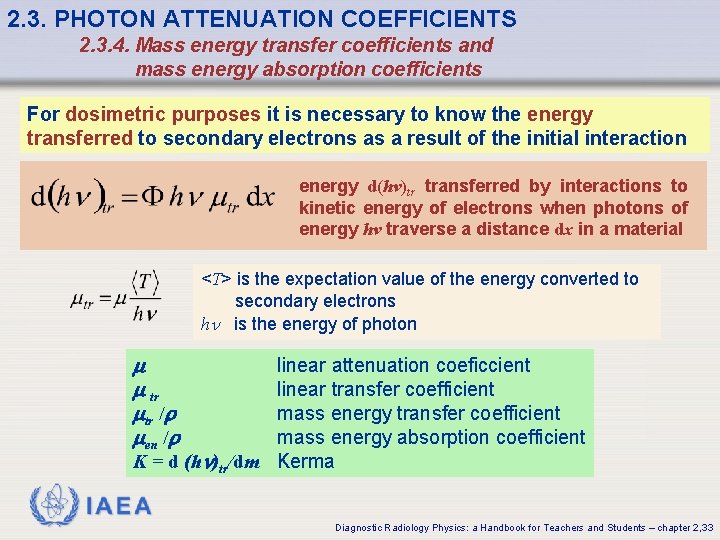
2. 3. PHOTON ATTENUATION COEFFICIENTS 2. 3. 4. Mass energy transfer coefficients and mass energy absorption coefficients For dosimetric purposes it is necessary to know the energy transferred to secondary electrons as a result of the initial interaction energy d(hν)tr transferred by interactions to kinetic energy of electrons when photons of energy hν traverse a distance dx in a material <T> is the expectation value of the energy converted to secondary electrons hn is the energy of photon m m tr mtr /r men /r linear attenuation coeficcient linear transfer coefficient mass energy absorption coefficient K = d (h )tr/dm Kerma IAEA Diagnostic Radiology Physics: a Handbook for Teachers and Students – chapter 2, 33
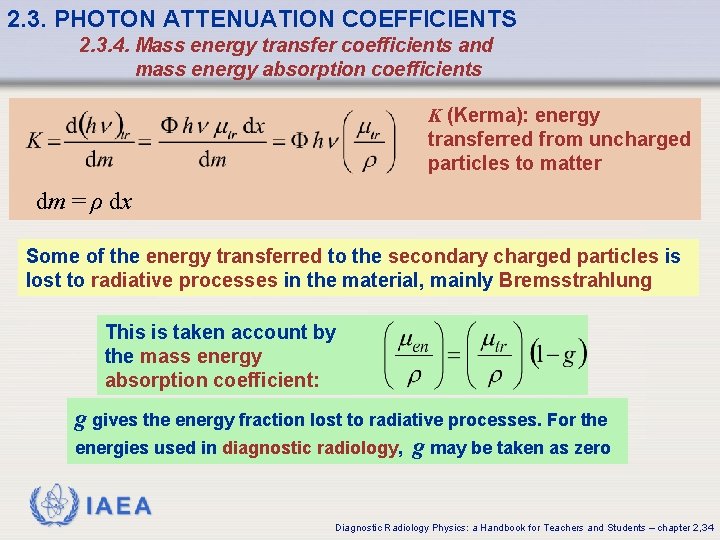
2. 3. PHOTON ATTENUATION COEFFICIENTS 2. 3. 4. Mass energy transfer coefficients and mass energy absorption coefficients K (Kerma): energy transferred from uncharged particles to matter dm = ρ dx Some of the energy transferred to the secondary charged particles is lost to radiative processes in the material, mainly Bremsstrahlung This is taken account by the mass energy absorption coefficient: g gives the energy fraction lost to radiative processes. For the energies used in diagnostic radiology, g may be taken as zero IAEA Diagnostic Radiology Physics: a Handbook for Teachers and Students – chapter 2, 34
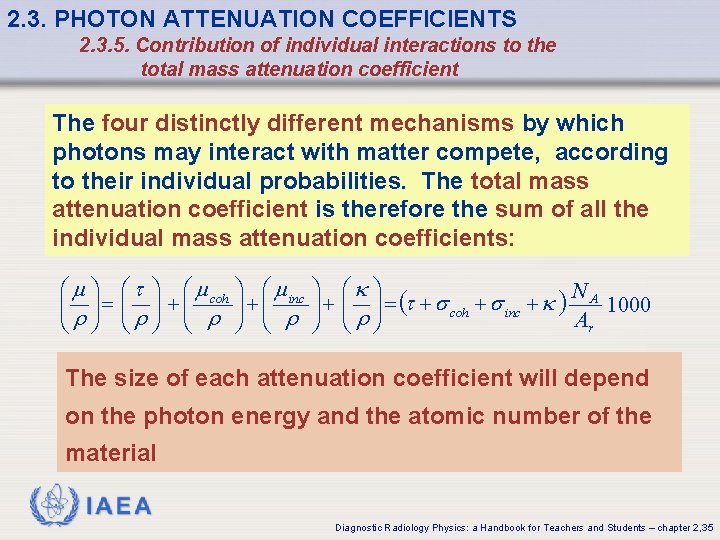
2. 3. PHOTON ATTENUATION COEFFICIENTS 2. 3. 5. Contribution of individual interactions to the total mass attenuation coefficient The four distinctly different mechanisms by which photons may interact with matter compete, according to their individual probabilities. The total mass attenuation coefficient is therefore the sum of all the individual mass attenuation coefficients: æm ö æ ö çç ÷÷ = çç ÷÷ èrø æ m coh + çç è r ö æ m inc ÷÷ + çç ø è r ö ÷÷ + ø æk ö N çç ÷÷ = ( + s coh + s inc + k ) A 1000 Ar èrø The size of each attenuation coefficient will depend on the photon energy and the atomic number of the material IAEA Diagnostic Radiology Physics: a Handbook for Teachers and Students – chapter 2, 35
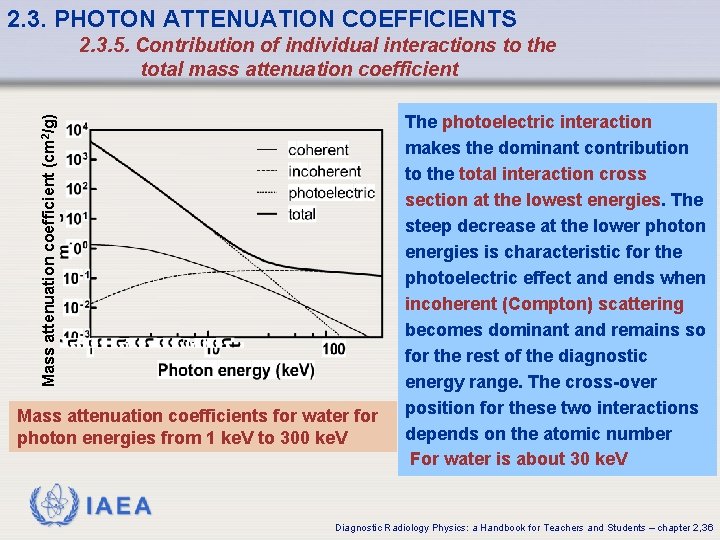
2. 3. PHOTON ATTENUATION COEFFICIENTS Mass attenuation coefficient (cm 2/g) 2. 3. 5. Contribution of individual interactions to the total mass attenuation coefficient Mass attenuation coefficients for water for photon energies from 1 ke. V to 300 ke. V The photoelectric interaction makes the dominant contribution to the total interaction cross section at the lowest energies. The steep decrease at the lower photon energies is characteristic for the photoelectric effect and ends when incoherent (Compton) scattering becomes dominant and remains so for the rest of the diagnostic energy range. The cross-over position for these two interactions depends on the atomic number For water is about 30 ke. V IAEA Diagnostic Radiology Physics: a Handbook for Teachers and Students – chapter 2, 36
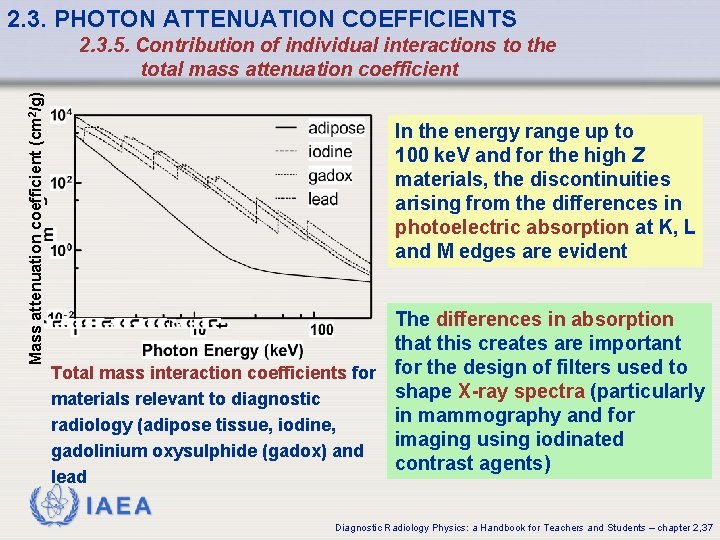
2. 3. PHOTON ATTENUATION COEFFICIENTS Mass attenuation coefficient (cm 2/g) 2. 3. 5. Contribution of individual interactions to the total mass attenuation coefficient In the energy range up to 100 ke. V and for the high Z materials, the discontinuities arising from the differences in photoelectric absorption at K, L and M edges are evident The differences in absorption that this creates are important Total mass interaction coefficients for the design of filters used to shape X-ray spectra (particularly materials relevant to diagnostic in mammography and for radiology (adipose tissue, iodine, imaging using iodinated gadolinium oxysulphide (gadox) and contrast agents) lead IAEA Diagnostic Radiology Physics: a Handbook for Teachers and Students – chapter 2, 37
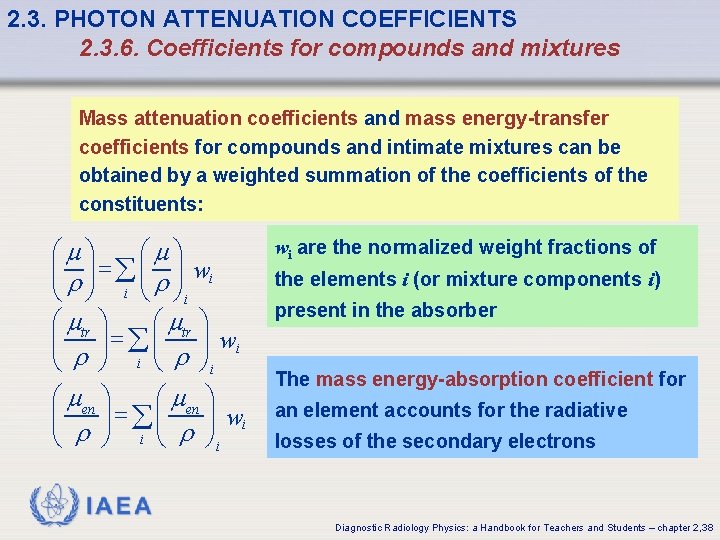
2. 3. PHOTON ATTENUATION COEFFICIENTS 2. 3. 6. Coefficients for compounds and mixtures Mass attenuation coefficients and mass energy-transfer coefficients for compounds and intimate mixtures can be obtained by a weighted summation of the coefficients of the constituents: æmö çç ÷÷ = å çç ÷÷ wi è r øi æ mtr ö çç ÷÷ = å çç ÷÷ wi è r øi æ men ö çç ÷÷ = å çç ÷÷ wi è r øi wi are the normalized weight fractions of the elements i (or mixture components i) present in the absorber The mass energy-absorption coefficient for an element accounts for the radiative losses of the secondary electrons IAEA Diagnostic Radiology Physics: a Handbook for Teachers and Students – chapter 2, 38
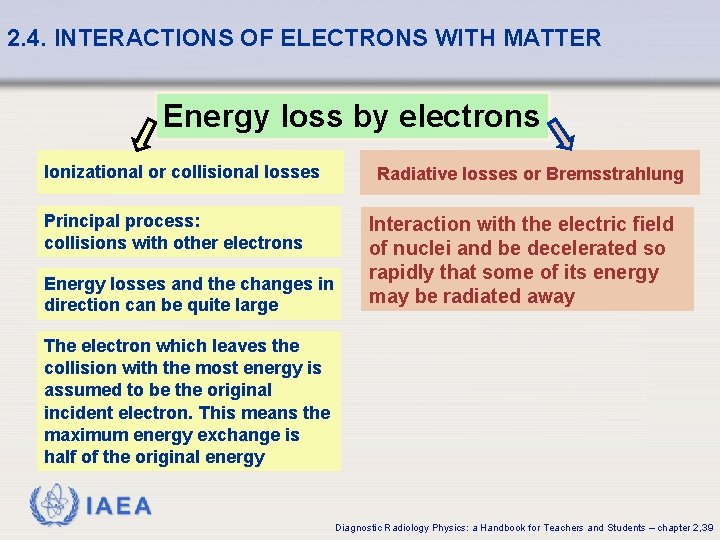
2. 4. INTERACTIONS OF ELECTRONS WITH MATTER Energy loss by electrons Ionizational or collisional losses Principal process: collisions with other electrons Energy losses and the changes in direction can be quite large Radiative losses or Bremsstrahlung Interaction with the electric field of nuclei and be decelerated so rapidly that some of its energy may be radiated away The electron which leaves the collision with the most energy is assumed to be the original incident electron. This means the maximum energy exchange is half of the original energy IAEA Diagnostic Radiology Physics: a Handbook for Teachers and Students – chapter 2, 39
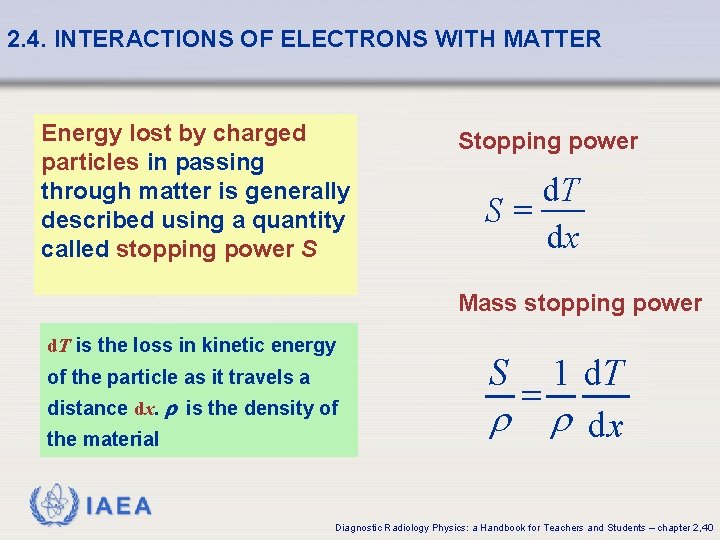
2. 4. INTERACTIONS OF ELECTRONS WITH MATTER Energy lost by charged particles in passing through matter is generally described using a quantity called stopping power S Stopping power d. T S= dx Mass stopping power d. T is the loss in kinetic energy of the particle as it travels a distance dx. r is the density of the material S 1 d. T = r r dx IAEA Diagnostic Radiology Physics: a Handbook for Teachers and Students – chapter 2, 40
2. 4. INTERACTIONS OF ELECTRONS WITH MATTER 2. 4. 1. Ionizational (Collisional) Interactions and Ionizational Stopping Power This process involves collisions between electrons travelling through matter and electrons from atoms that are part of the material, leaving the atoms ionized It is rather difficult to measure the rate of energy lost by these interactions but is relatively easy to calculate it. Relativity and Quantum Mechanics must be used IAEA Diagnostic Radiology Physics: a Handbook for Teachers and Students – chapter 2, 41
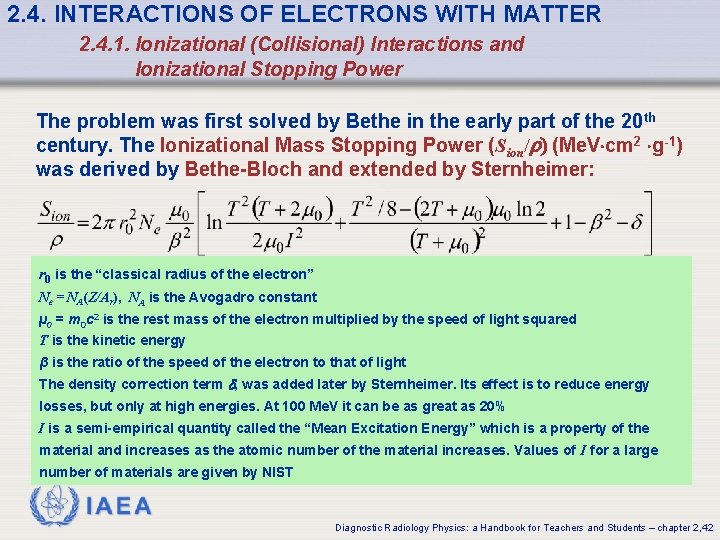
2. 4. INTERACTIONS OF ELECTRONS WITH MATTER 2. 4. 1. Ionizational (Collisional) Interactions and Ionizational Stopping Power The problem was first solved by Bethe in the early part of the 20 th century. The Ionizational Mass Stopping Power (Sion/r) (Me. V cm 2 g-1) was derived by Bethe-Bloch and extended by Sternheimer: r 0 is the “classical radius of the electron” Ne = NA(Z/Ar), NA is the Avogadro constant µ 0 = m 0 c 2 is the rest mass of the electron multiplied by the speed of light squared T is the kinetic energy β is the ratio of the speed of the electron to that of light The density correction term , was added later by Sternheimer. Its effect is to reduce energy losses, but only at high energies. At 100 Me. V it can be as great as 20% I is a semi-empirical quantity called the “Mean Excitation Energy” which is a property of the material and increases as the atomic number of the material increases. Values of I for a large number of materials are given by NIST IAEA Diagnostic Radiology Physics: a Handbook for Teachers and Students – chapter 2, 42
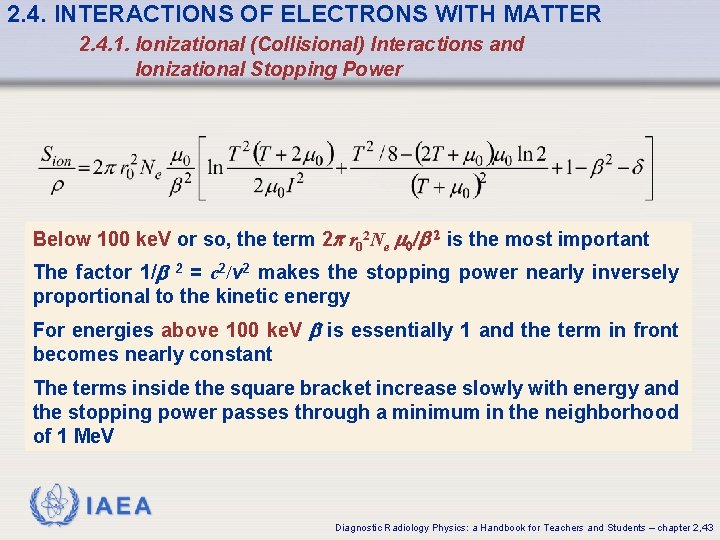
2. 4. INTERACTIONS OF ELECTRONS WITH MATTER 2. 4. 1. Ionizational (Collisional) Interactions and Ionizational Stopping Power Below 100 ke. V or so, the term 2 p r 02 Ne m 0/ 2 is the most important The factor 1/ 2 = c 2/v 2 makes the stopping power nearly inversely proportional to the kinetic energy For energies above 100 ke. V is essentially 1 and the term in front becomes nearly constant The terms inside the square bracket increase slowly with energy and the stopping power passes through a minimum in the neighborhood of 1 Me. V IAEA Diagnostic Radiology Physics: a Handbook for Teachers and Students – chapter 2, 43
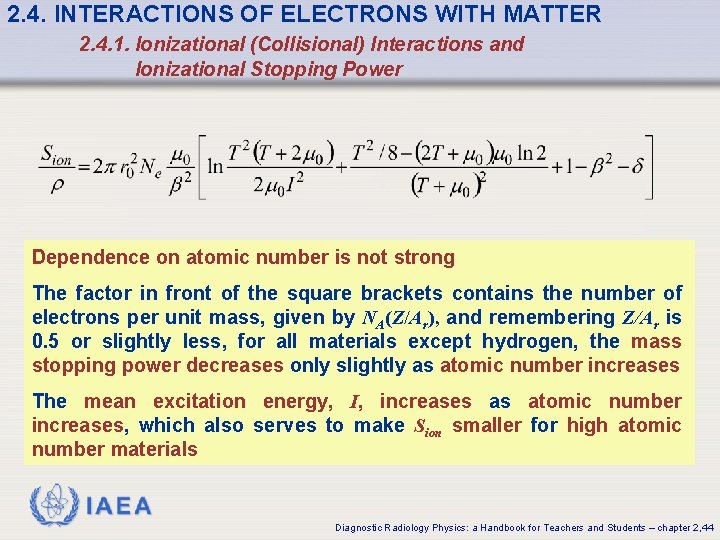
2. 4. INTERACTIONS OF ELECTRONS WITH MATTER 2. 4. 1. Ionizational (Collisional) Interactions and Ionizational Stopping Power Dependence on atomic number is not strong The factor in front of the square brackets contains the number of electrons per unit mass, given by NA(Z/Ar), and remembering Z/Ar is 0. 5 or slightly less, for all materials except hydrogen, the mass stopping power decreases only slightly as atomic number increases The mean excitation energy, I, increases as atomic number increases, which also serves to make Sion smaller for high atomic number materials IAEA Diagnostic Radiology Physics: a Handbook for Teachers and Students – chapter 2, 44
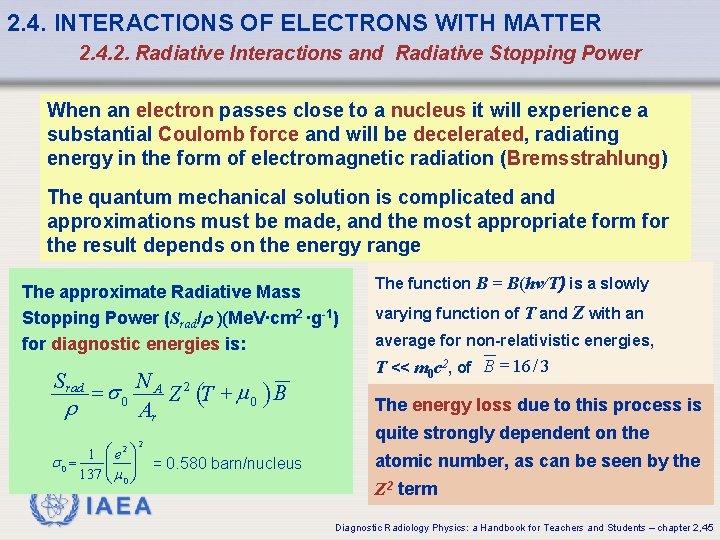
2. 4. INTERACTIONS OF ELECTRONS WITH MATTER 2. 4. 2. Radiative Interactions and Radiative Stopping Power When an electron passes close to a nucleus it will experience a substantial Coulomb force and will be decelerated, radiating energy in the form of electromagnetic radiation (Bremsstrahlung) The quantum mechanical solution is complicated and approximations must be made, and the most appropriate form for the result depends on the energy range The approximate Radiative Mass Stopping Power (Srad/r )(Me. V∙cm 2 ∙g-1) for diagnostic energies is: S rad r s 0 = =s 0 NA 2 Z (T + m 0 ) B Ar 2 1 æç e ö÷ = 0. 580 barn/nucleus 137 çè m 0 ÷ø 2 IAEA The function B = B(hν/T) is a slowly varying function of T and Z with an average for non-relativistic energies, T << m 0 c 2, of B = 16 / 3 The energy loss due to this process is quite strongly dependent on the atomic number, as can be seen by the Z 2 term Diagnostic Radiology Physics: a Handbook for Teachers and Students – chapter 2, 45
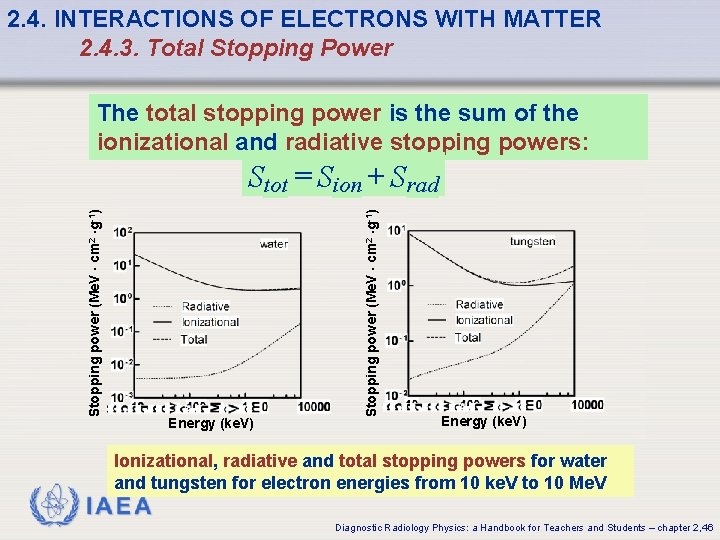
2. 4. INTERACTIONS OF ELECTRONS WITH MATTER 2. 4. 3. Total Stopping Power The total stopping power is the sum of the ionizational and radiative stopping powers: Energy (ke. V) Stopping power (Me. V cm 2 g-1) Stot = Sion + Srad Energy (ke. V) Ionizational, radiative and total stopping powers for water and tungsten for electron energies from 10 ke. V to 10 Me. V IAEA Diagnostic Radiology Physics: a Handbook for Teachers and Students – chapter 2, 46
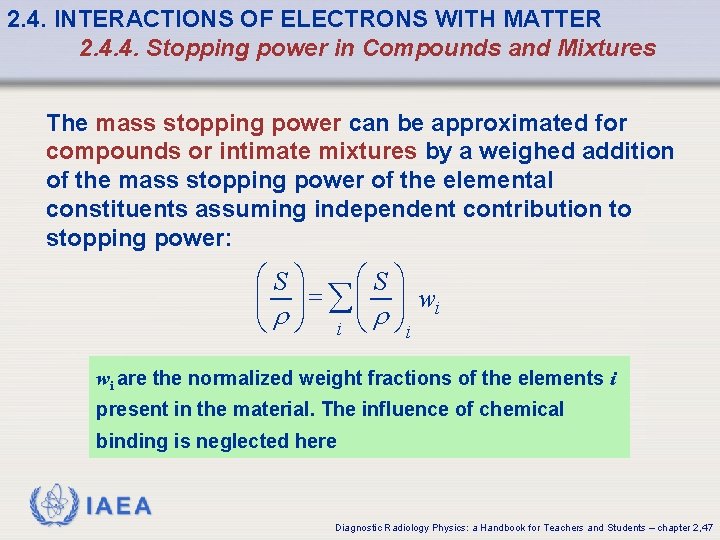
2. 4. INTERACTIONS OF ELECTRONS WITH MATTER 2. 4. 4. Stopping power in Compounds and Mixtures The mass stopping power can be approximated for compounds or intimate mixtures by a weighed addition of the mass stopping power of the elemental constituents assuming independent contribution to stopping power: æSö çç ÷÷ = å çç ÷÷ wi è r øi wi are the normalized weight fractions of the elements i present in the material. The influence of chemical binding is neglected here IAEA Diagnostic Radiology Physics: a Handbook for Teachers and Students – chapter 2, 47
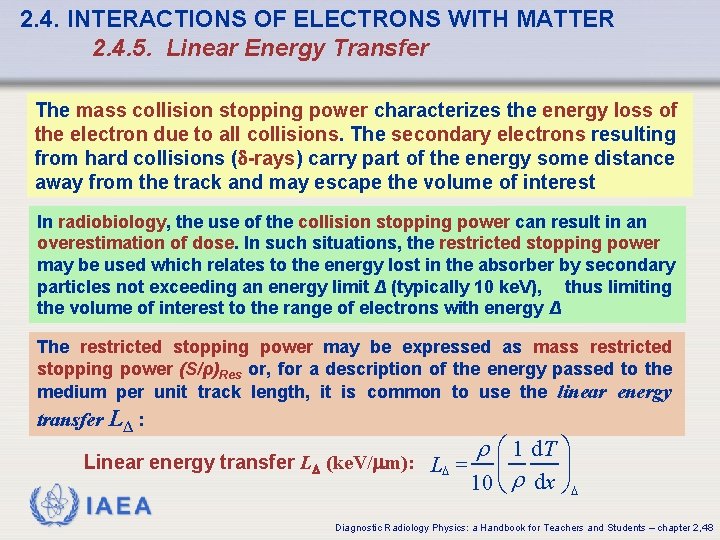
2. 4. INTERACTIONS OF ELECTRONS WITH MATTER 2. 4. 5. Linear Energy Transfer The mass collision stopping power characterizes the energy loss of the electron due to all collisions. The secondary electrons resulting from hard collisions ( -rays) carry part of the energy some distance away from the track and may escape the volume of interest In radiobiology, the use of the collision stopping power can result in an overestimation of dose. In such situations, the restricted stopping power may be used which relates to the energy lost in the absorber by secondary particles not exceeding an energy limit Δ (typically 10 ke. V), thus limiting the volume of interest to the range of electrons with energy Δ The restricted stopping power may be expressed as mass restricted stopping power (S/ρ)Res or, for a description of the energy passed to the medium per unit track length, it is common to use the linear energy transfer LΔ : r æ 1 d. T ö Linear energy transfer LD (ke. V/mm): LD = çç ÷÷ 10 è r dx ø D IAEA Diagnostic Radiology Physics: a Handbook for Teachers and Students – chapter 2, 48
2. 5. DATA SOURCES Data for photon attenuation coefficients and stopping powers can be found in many textbooks but are conveniently obtained from web based data sources provided by: • NIST (Berger, Hubbell et al. , 2005; Berger, Coursey, et al, 2005) or from the tabulations in: • ICRU (1992) The composition of body tissues and phantom materials are given in: • • ICRU (1989) and ICRP (2003) IAEA Diagnostic Radiology Physics: a Handbook for Teachers and Students – chapter 2, 49
BIBLIOGRAPHY • BERGER, M. J. , ESTAR, PSTAR AND ASTAR: Computer Programs for Calculating Stopping-Power and Ranges for Electrons, Protons and Helium Ions. NIST Report NISTIR-4999 (1992) • BERGER, M. J. , COURSEY, J. S. , ZUCKER, M. A. AND CHANG, J. , ESTAR, PSTAR, and ASTAR: Computer Programs for Calculating Stopping-Power and Range Tables for Electrons, Protons and Helium Ions (version 1. 2. 3), NIST, Gaithersburg, MD (2005) Available: http: //physics. nist. gov/Star [2008, February 7] • BERGER, M. J. , HUBBELL, J. H. , SELTZER, S. M. , CHANG, J. , COURSEY, J. S. , SUKUMAR, R. , and ZUCKER, D. S. (2005), XCOM: Photon Cross Section Database (version 1. 3). Available: http: //physics. nist. gov/xcom [2008, March 20]. NIST, Gaithersburg, MD IAEA Diagnostic Radiology Physics: a Handbook for Teachers and Students – chapter 2, 50
BIBLIOGRAPHY • HUBBELL, J. H. , Review of Photon Interaction Cross Section Data in the Medical and Biological Context, Phys. Med. Biol. 44 R 1 -22 (1999) • INTERNATIONAL COMMISSION ON RADIATION UNITS AND MEASUREMENTS, Stopping Powers for Electrons and Positrons, Rep. 37, ICRU, Bethesda, MD (1984) • INTERNATIONAL COMMISSION ON RADIATION UNITS AND MEASUREMENTS, Tissue Substitutes in Radiation Dosimetry and Measurement, Rep. 44, ICRU, Bethesda, MD (1989) • INTERNATIONAL COMMISSION ON RADIATION UNITS AND MEASUREMENTS, Photon, Electron, Proton and Neutron Interaction Data for Body Tissues, Rep. 46, ICRU, Bethesda, MD (1992) IAEA Diagnostic Radiology Physics: a Handbook for Teachers and Students – chapter 2, 51
BIBLIOGRAPHY • INTERNATIONAL COMMISSION ON RADIOLOGICAL PROTECTION, Basic Anatomical and Physiological Data for use in Radiological Protection: Reference Values ICRP Rep. 85, Pergamon Press, Oxford, (2003) • JOHNS, H. E. and CUNNINGHAM J. R. The Physics of Radiology (Fourth Edition), Charles C Thomas, Springfield, Illinois (1983) • NATIONAL INSTITUTE OF STANDARDS AND TECHNOLOGY (NIST), 100 Bureau Drive, Stop 1070, Gaithersburg, MD 208991070. Available: http: //www. nist. gov/index. html • SELTZER, S. M. , BERGER, M. J. , Evaluation of the Collision Stopping Power of Elements and Compounds for Electrons and Positrons, Int J Appl Radiat Isot 33, 1189 -1218 (1982) IAEA Diagnostic Radiology Physics: a Handbook for Teachers and Students – chapter 2, 52