
Chapter 2 Integers and Introduction to Solving Equations

- Slides: 12
Chapter 2 Integers and Introduction to Solving Equations Copyright © 2011 Pearson Education, Inc. Publishing as Prentice Hall.
2. 1 Introduction to Integers Copyright © 2011 Pearson Education, Inc. Publishing as Prentice Hall.
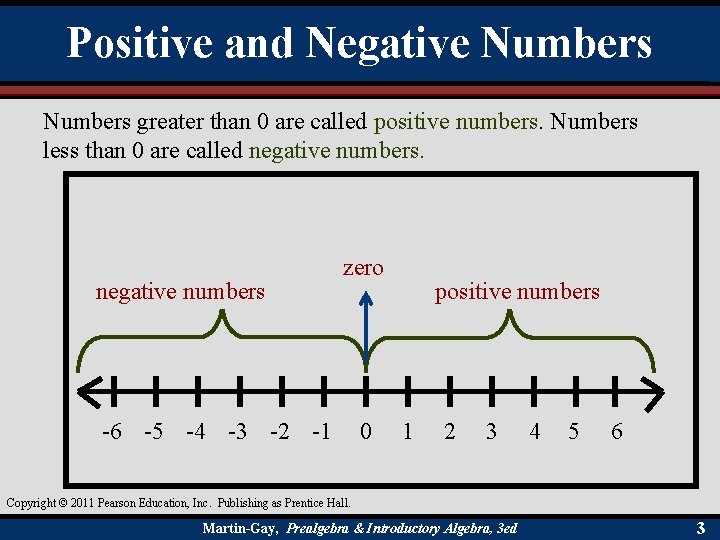
Positive and Negative Numbers greater than 0 are called positive numbers. Numbers less than 0 are called negative numbers zero -6 -5 -4 -3 -2 -1 0 positive numbers 1 2 3 4 5 6 Copyright © 2011 Pearson Education, Inc. Publishing as Prentice Hall. Martin-Gay, Prealgebra & Introductory Algebra, 3 ed 3
Integers Some signed numbers are integers. The integers are { …, – 6, – 5, – 4, – 3, – 2, – 1, 0, 1, 2, 3, 4, 5, 6, …} negative numbers zero – 6 – 5 – 4 – 3 – 2 – 1 0 positive numbers 1 2 3 4 5 6 Copyright © 2011 Pearson Education, Inc. Publishing as Prentice Hall. Martin-Gay, Prealgebra & Introductory Algebra, 3 ed 4
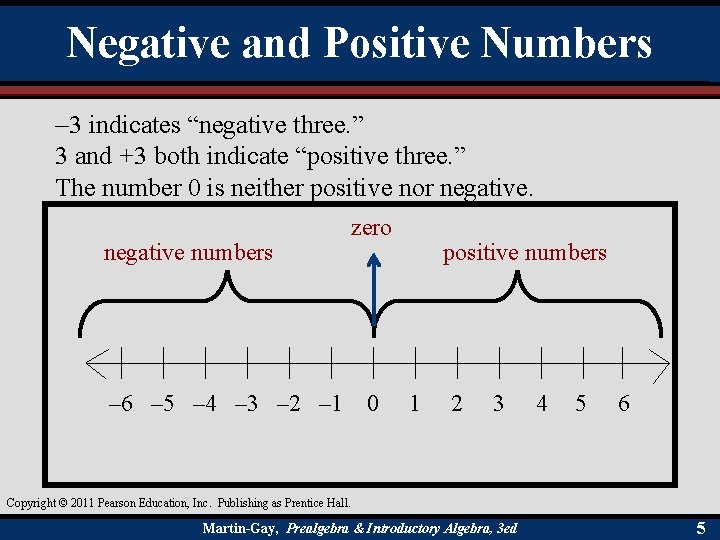
Negative and Positive Numbers – 3 indicates “negative three. ” 3 and + 3 both indicate “positive three. ” The number 0 is neither positive nor negative numbers zero – 6 – 5 – 4 – 3 – 2 – 1 0 positive numbers 1 2 3 4 5 6 Copyright © 2011 Pearson Education, Inc. Publishing as Prentice Hall. Martin-Gay, Prealgebra & Introductory Algebra, 3 ed 5
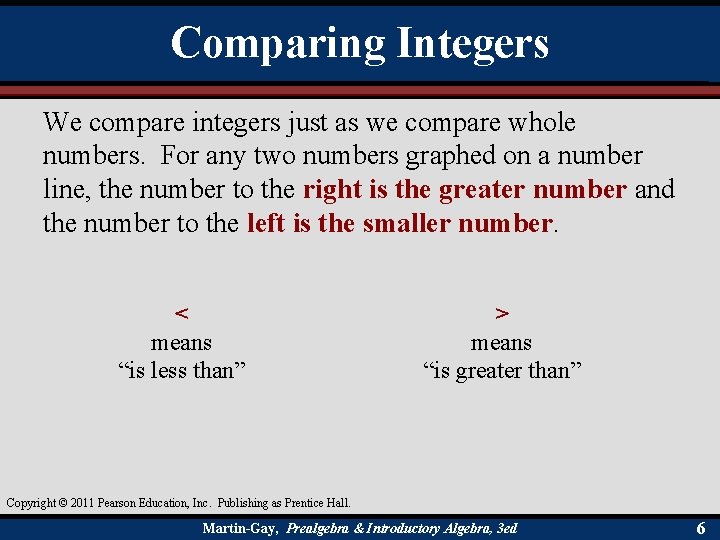
Comparing Integers We compare integers just as we compare whole numbers. For any two numbers graphed on a number line, the number to the right is the greater number and the number to the left is the smaller number. < means “is less than” > means “is greater than” Copyright © 2011 Pearson Education, Inc. Publishing as Prentice Hall. Martin-Gay, Prealgebra & Introductory Algebra, 3 ed 6
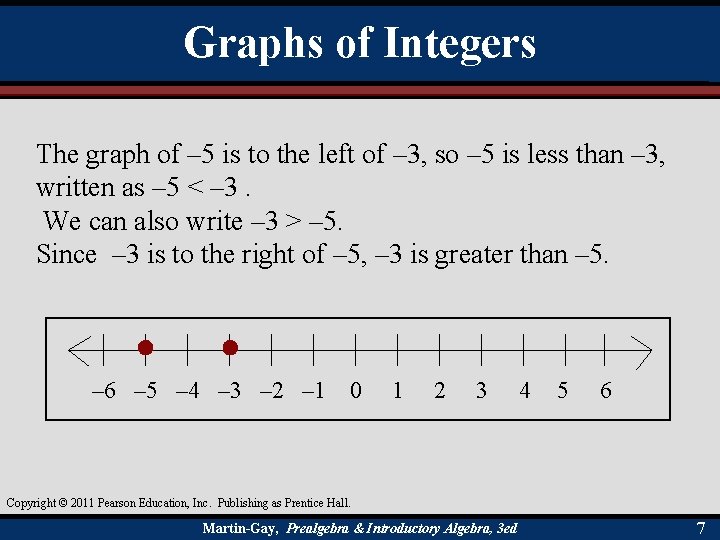
Graphs of Integers The graph of – 5 is to the left of – 3, so – 5 is less than – 3, written as – 5 < – 3. We can also write – 3 > – 5. Since – 3 is to the right of – 5, – 3 is greater than – 5. – 6 – 5 – 4 – 3 – 2 – 1 0 1 2 3 4 5 6 -6 -5 -4 -3 -2 -1 0 1 2 3 4 5 6 Copyright © 2011 Pearson Education, Inc. Publishing as Prentice Hall. Martin-Gay, Prealgebra & Introductory Algebra, 3 ed 7
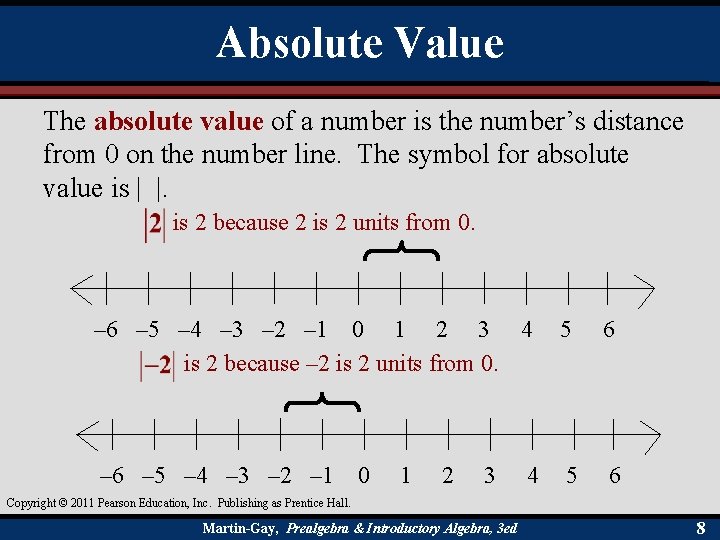
Absolute Value The absolute value of a number is the number’s distance from 0 on the number line. The symbol for absolute value is | |. is 2 because 2 is 2 units from 0. – 6 – 5 – 4 – 3 – 2 – 1 0 1 2 3 4 is 2 because – 2 is 2 units from 0. 5 6 – 5 – 4 – 3 – 2 – 1 0 5 6 1 2 3 4 Copyright © 2011 Pearson Education, Inc. Publishing as Prentice Hall. Martin-Gay, Prealgebra & Introductory Algebra, 3 ed 8
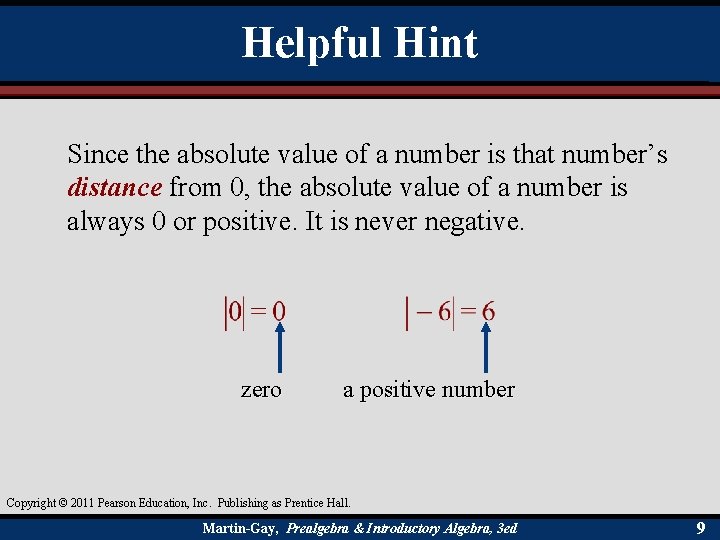
Helpful Hint Since the absolute value of a number is that number’s distance from 0, the absolute value of a number is always 0 or positive. It is never negative. zero a positive number Copyright © 2011 Pearson Education, Inc. Publishing as Prentice Hall. Martin-Gay, Prealgebra & Introductory Algebra, 3 ed 9
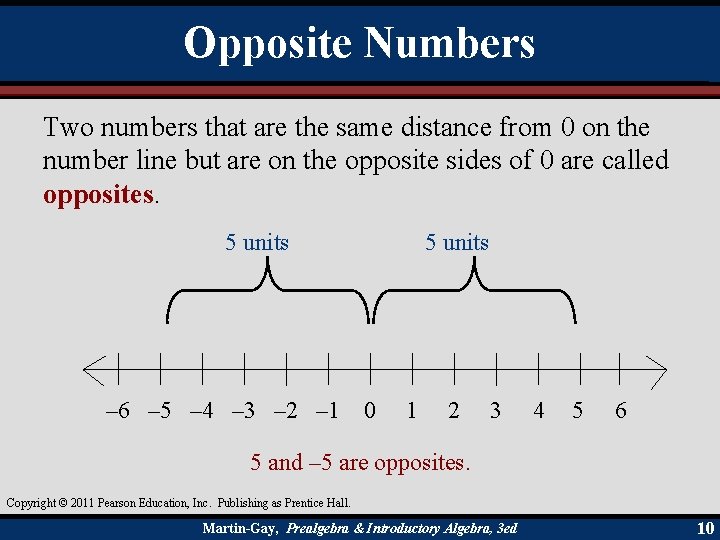
Opposite Numbers Two numbers that are the same distance from 0 on the number line but are on the opposite sides of 0 are called opposites. 5 units – 6 – 5 – 4 – 3 – 2 – 1 0 5 units 1 2 3 4 5 6 5 and – 5 are opposites. Copyright © 2011 Pearson Education, Inc. Publishing as Prentice Hall. Martin-Gay, Prealgebra & Introductory Algebra, 3 ed 10
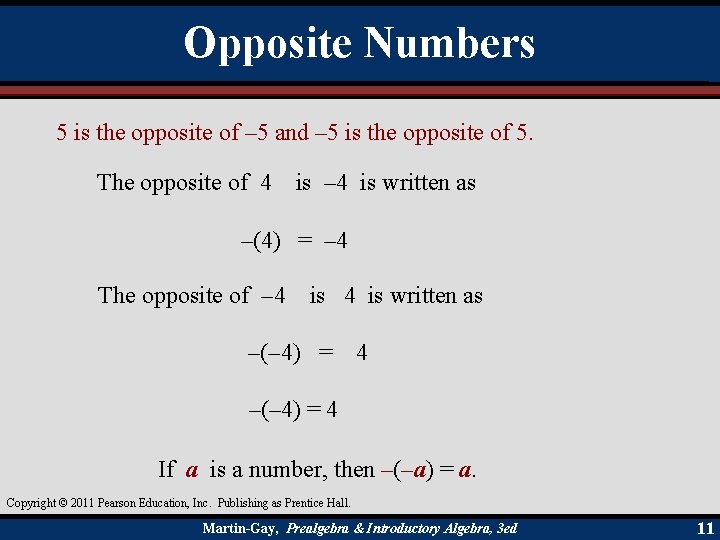
Opposite Numbers 5 is the opposite of – 5 and – 5 is the opposite of 5. The opposite of 4 is – 4 is written as –(4) = – 4 The opposite of – 4 is written as –(– 4) = 4 If a is a number, then –(–a) = a. Copyright © 2011 Pearson Education, Inc. Publishing as Prentice Hall. Martin-Gay, Prealgebra & Introductory Algebra, 3 ed 11
Helpful Hint Remember that 0 is neither positive nor negative. Therefore, the opposite of 0 is 0. Copyright © 2011 Pearson Education, Inc. Publishing as Prentice Hall. Martin-Gay, Prealgebra & Introductory Algebra, 3 ed 12