
Chapter 2 Information Systems in Organization By M
Chapter 2 Information Systems in Organization By: -M. R. Mohamed Nowfeek Chapter 2 1
Information System : Concepts and Definitions An information system (IS) collects, processes, stores, analyzes, and disseminates information for a specific purpose “Application”. Hardware Software Data Network Procedures People Chapter 2 2
Information System – Primary Purpose Collects data, processes it into information then converts information into knowledge for a specific purpose. Data ◦ Elementary description of things, events, activities, and transactions that are recorded, classified, and stored, but not organized to convey any specific meaning Information ◦ Data that has been organized so that they have meaning and value to the recipient Knowledge ◦ Information that has been organized and processed to convey understanding, experience, and expertise as they apply to a current problem or activity Chapter 2 3
Information System – Classification By Organizational Structure An information system (IS) can span departments, business units and corporations. Chapter 2 4
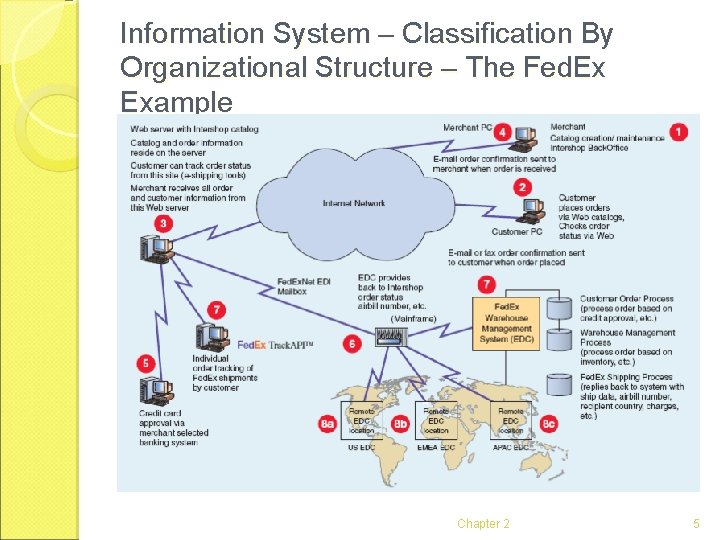
Information System – Classification By Organizational Structure – The Fed. Ex Example Chapter 2 5
Basic Components of Information Systems Hardware Software Network Procedures People Chapter 2 6
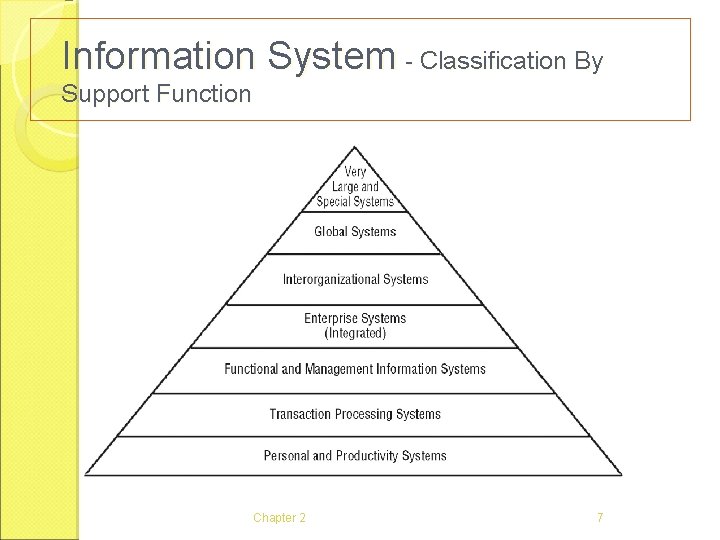
Information System - Classification By Support Function Chapter 2 7
Information System - Classification By Function (Department) An information system (IS) support each department in a corporation. Insert Figure 2. 5 about here Chapter 2 8
Transaction Processing System (TPS) TPS automates routine and repetitive tasks that are critical to the operation of the organization, such as preparing a payroll, billing customers, Point-of-Sale, and Warehouse operations Data collected from this operation supports the MIS and DSS systems employed by Middle Management Computerizes the primary and most of the secondary activities on the Value Chain Primary purpose to perform transactions and collect data Chapter 2 9
Management Information Systems (MIS) These systems access, organize, summarize, and display information for supporting routine decision making in the functional areas. Geared toward middle managers, MIS are characterized mainly by their ability to produce periodic reports such as a daily list of employees and the hours they work, or a monthly report of expenses as compared to a budget Typical uses would be in Replenishment, Pricing Analysis (Markdowns) and Sales Management Decisions supported are more structured Primary purpose to process data into information Chapter 2 10
Decision Support Systems (DSS) These systems support complex non-routine decisions Primary purpose to process data into information DSS systems are typically employed by tactical level management whose decisions and what-if analyses are less structured This information system not only presents the results but also expands the information with alternatives Some DSS methodologies ◦ ◦ ◦ Mathematical Modeling Simulation Queries What-If (OLAP-Cubes) Data mining Chapter 2 11
Intelligent Support Systems (ISS) Essentially, artificial intelligence (AI) these systems perform intelligent problem solving. One application of AI is expert systems. Expert systems (ESs) provide the stored knowledge of experts to nonexperts, so the latter can solve difficult or timeconsuming problems. These advisory systems differ from TPS, which centers on data, and from MIS and DSS, which concentrates on processing information. With DSS, users make their decisions according to the information generated from the systems. With ES, the system makes recommended decisions for the users based on the built-in expertise and knowledge. Chapter 2 12
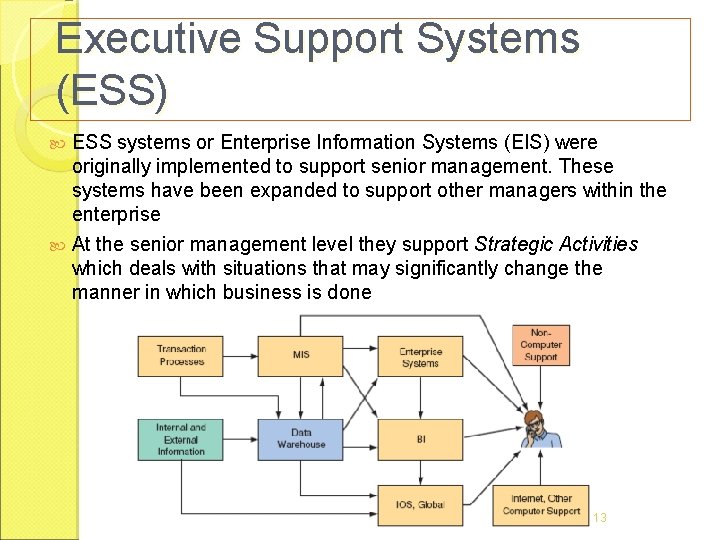
Executive Support Systems (ESS) ESS systems or Enterprise Information Systems (EIS) were originally implemented to support senior management. These systems have been expanded to support other managers within the enterprise At the senior management level they support Strategic Activities which deals with situations that may significantly change the manner in which business is done Chapter 2 13
Office Automation Systems (OAS) Electronic communication is only one aspect of what is now known as an office automation system (OAS). Other aspects include word processing systems, document management systems, and desktop publishing systems OAS systems are predominantly used by clerical workers who support managers at all levels. Among clerical workers, those who use, manipulate, or disseminate information are referred to as data workers Chapter 2 14
Knowledge Management Systems (KMS) An additional level of staff support now exists between top and middle management. These are professional people, such as financial and marketing analysts that act as advisors and assistants to both top and middle management. They are responsible for finding or developing new knowledge (External Content) for the organization and integrating it with existing knowledge (Internal Content) KMS that support these knowledge workers range from Internet search engines and expert systems, to Web-based computer-aided design and sophisticated data management systems Chapter 2 15
Expand our Scope to Include External Environments C o m po n e n ts o f th e S u ppl y C h a i n The flow of materials, information, money, and services from raw material suppliers through factories and warehouses to the end customers is a supply chain. ◦ Upstream supply chain includes the organizations first-tier suppliers and their suppliers ◦ Internal supply chain includes all the processes used by an organization in transforming the inputs of the suppliers to outputs ◦ Downstream supply chain includes all the processes involved in delivering the products to final customers Chapter 2 16
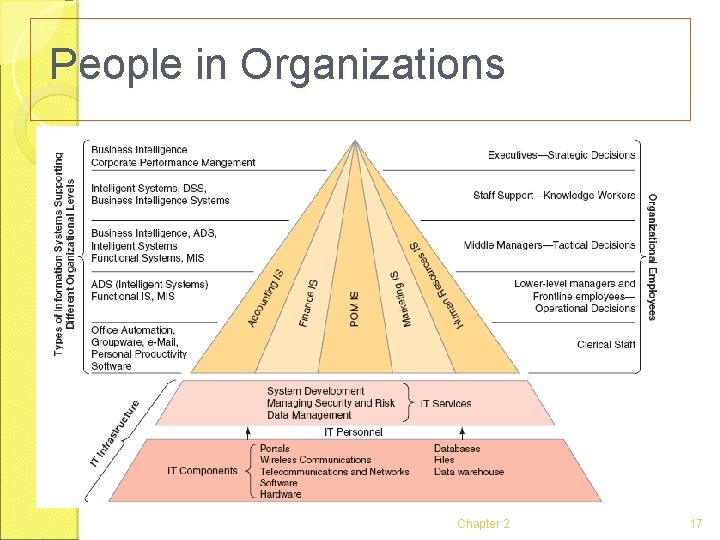
People in Organizations Chapter 2 17
Inter-Organizational Systems (IOS) IOS are systems that connect two or more organizations. These systems are common among business partners and play a major role in e-commerce as well as in supply chain management support The first type of IT system that was developed in the 1980 s to improve communications with business partners was electronic data interchange (EDI), which involved computer-to-computer direct communication of standard business documents (such as purchase orders and order confirmations) between business partners. These systems became the basis for electronic markets, which later developed into electronic commerce. Web-based systems (many using XML) deliver business applications via the Internet. Using browsers and the Internet, people in different organizations communicate, collaborate, access vast amounts of information, and run most of the organization’s tasks and processes. Chapter 2 18
Information Infrastructure Hardware Software Networks & communication facilities Databases IS personnel Chapter 2 19
Information Architecture Classified by Hardware A common way to classify information architecture is by computing paradigms, which are the core of the architecture. Mainframe PC Environment PC-LAN Environment Distributed Computing Environment Client/Server Environment Enterprise-wide Legacy Computing Environment systems Chapter 2 20
The Web Based IT Architectures Web-based systems refer to applications or services that are resident on a server that is accessible using a Web browser. The only clientside software needed to access and execute these applications is a Web browser environment. The Internet Intranets Extranets Corporate Portals E-commerce Systems l. Electronic Storefronts l. Electronic Markets l. Electronic Exchanges l. M-Commerce l. Enterprise Web Chapter 2 21
Extranets Connect several intranets via the Internet, by adding a security mechanism and some additional functionalities Form a larger virtual network that allows remote users (such as business partners or mobile employees) to securely connect over the Internet to the enterprise’s main intranet Extranets are also employed by two or more enterprises (suppliers & buyers) to share information in a controlled fashion, and therefore they play a major role in the development of business-to-business electronic commerce and Supply Chain systems Chapter 2 22
Managing Information Systems (IS) have enormous strategic value. When they are not working (even for a short time), an organization cannot function. Furthermore, the Life Cycle Costs (acquisition, operation, security, and maintenance) of these systems are considerable. Therefore, it is essential to manage them properly. The planning, organizing, implementing, operating, and controlling of the infrastructures and the organization’s portfolio of applications must be done with great skill The responsibility for the management of information resources is divided between two organizational entities: ◦ The information systems department (ISD), which is a corporate entity ◦ the end users, who are scattered throughout the organization. Chapter 2 23
Thanks Any Question. ? ? ? ? ? Chapter 2 24
- Slides: 24