
Chapter 2 Identifying a Research Problem This multimedia
Chapter 2 Identifying a Research Problem This multimedia product and its contents are protected under copyright law. The following are prohibited by law: any public performance or display including transmission of any image over a network; preparation of any derivative work, including the extraction, in whole or in part, of any images; any rental, lease, or lending of the program. Creswell, Educational Research: Planning, Conducting, and Evaluating Quantitative and Qualitative Research, 4 e © 2012, 2008, 2005, 2002 Pearson Education, Inc. All rights reserved.
By the end of this chapter, you should be able to: n n n Define and identify a research problem and explain its importance in a study Distinguish between a research problem and other parts of the research process Identify criteria for deciding whether you can or should study a research problem Describe how quantitative and qualitative research problems differ Learn the five elements that compromise a “statement of the problem” section Identify strategies useful in writing a “statement of the problem” section Educational Research: Planning, Conducting, and Evaluating Quantitative and Qualitative Research, 4 e – Creswell ISBN: 0132755912 2 -2 © 2012, 2008, 2005, 2002 Pearson Education, Inc. All rights reserved.
What Is a Research Problem? A research problem is an educational issue or concern that an investigator presents and justifies in a research study. Educational Research: Planning, Conducting, and Evaluating Quantitative and Qualitative Research, 4 e – Creswell ISBN: 0132755912 2 -3 © 2012, 2008, 2005, 2002 Pearson Education, Inc. All rights reserved.
Locating the Research Problem Look in the opening paragraphs of the study for one or more of the following: n n What is the issue or problem? What controversy leads to the need for a study? What concern is being addressed behind the study? Is there a sentence such as, “The problem being addressed in this study is…”? Educational Research: Planning, Conducting, and Evaluating Quantitative and Qualitative Research, 4 e – Creswell ISBN: 0132755912 2 -4 © 2012, 2008, 2005, 2002 Pearson Education, Inc. All rights reserved.
Why the Research Problem Is Important n n n It establishes the importance of the topic. It creates reader interest. It focuses the reader’s attention on how the study will add to the literature. Educational Research: Planning, Conducting, and Evaluating Quantitative and Qualitative Research, 4 e – Creswell ISBN: 0132755912 2 -5 © 2012, 2008, 2005, 2002 Pearson Education, Inc. All rights reserved.
How the Problem Differs From Other Parts of Research n n A research problem is an educational issue or problem in the study. A research topic is the broad subject matter being addressed in a study. A purpose is the major intent or objective of the study. Research questions are those that the researcher would like answered or addressed in the study. Educational Research: Planning, Conducting, and Evaluating Quantitative and Qualitative Research, 4 e – Creswell ISBN: 0132755912 2 -6 © 2012, 2008, 2005, 2002 Pearson Education, Inc. All rights reserved.

Differences among the Topic, Problem, Purpose, and Questions General Specific Educational Research: Planning, Conducting, and Evaluating Quantitative and Qualitative Research, 4 e – Creswell ISBN: 0132755912 Topic Distance learning Research Problem Lack of students in distance classes Purpose Statement To study why students do not attend distance education classes at a community college Research Question Does the use of Web site technology in the classroom deter students from enrolling in a distance education class? 2 -7 © 2012, 2008, 2005, 2002 Pearson Education, Inc. All rights reserved.
Determining Whether a Problem Should Be Researched n Can you study the problem? n n n Do you have access to the research site? Do you have the time, resources, and skills to carry out the research? Should you study the problem? n n Does it advance knowledge? Does it contribute to practice? Educational Research: Planning, Conducting, and Evaluating Quantitative and Qualitative Research, 4 e – Creswell ISBN: 0132755912 2 -8 © 2012, 2008, 2005, 2002 Pearson Education, Inc. All rights reserved.
Determining Whether a Problem Should Be Researched (cont’d) n n n Will your study fill a gap or void in the existing literature? Will your study replicate a past study but examine different participants and different research sites? Will your study extend past research or examine the topic more thoroughly? Will your study give voice to people not heard, silenced, or rejected in society? Will your study inform practice? Educational Research: Planning, Conducting, and Evaluating Quantitative and Qualitative Research, 4 e – Creswell ISBN: 0132755912 2 -9 © 2012, 2008, 2005, 2002 Pearson Education, Inc. All rights reserved.
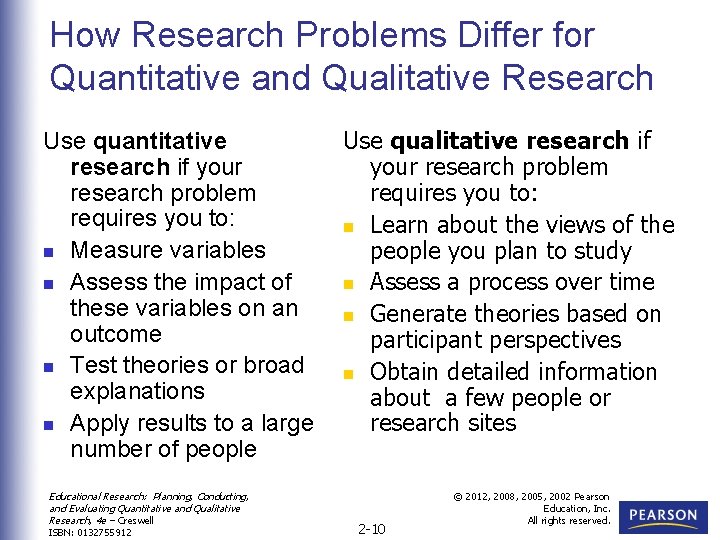
How Research Problems Differ for Quantitative and Qualitative Research Use quantitative research if your research problem requires you to: n Measure variables n Assess the impact of these variables on an outcome n Test theories or broad explanations n Apply results to a large number of people Educational Research: Planning, Conducting, and Evaluating Quantitative and Qualitative Research, 4 e – Creswell ISBN: 0132755912 Use qualitative research if your research problem requires you to: n Learn about the views of the people you plan to study n Assess a process over time n Generate theories based on participant perspectives n Obtain detailed information about a few people or research sites 2 -10 © 2012, 2008, 2005, 2002 Pearson Education, Inc. All rights reserved.
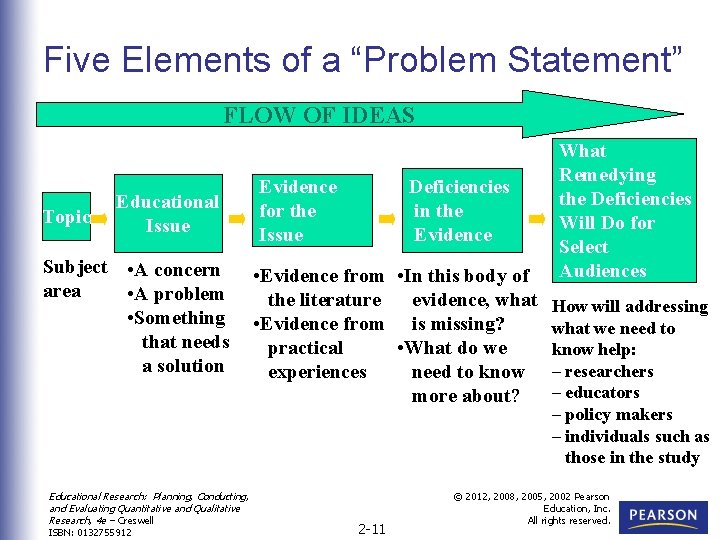
Five Elements of a “Problem Statement” FLOW OF IDEAS Topic Educational Issue Subject • A concern area • A problem • Something that needs a solution Educational Research: Planning, Conducting, and Evaluating Quantitative and Qualitative Research, 4 e – Creswell ISBN: 0132755912 Evidence for the Issue Deficiencies in the Evidence • Evidence from • In this body of the literature evidence, what • Evidence from is missing? practical • What do we experiences need to know more about? 2 -11 What Remedying the Deficiencies Will Do for Select Audiences How will addressing what we need to know help: – researchers – educators – policy makers – individuals such as those in the study © 2012, 2008, 2005, 2002 Pearson Education, Inc. All rights reserved.
Advancing the Topic n n n The topic is introduced in the first paragraphs. The topic includes the general subject matter. The topic must be introduced so that the reader can relate to it. Educational Research: Planning, Conducting, and Evaluating Quantitative and Qualitative Research, 4 e – Creswell ISBN: 0132755912 2 -12 © 2012, 2008, 2005, 2002 Pearson Education, Inc. All rights reserved.
The Narrative Hook n n n The narrative hook should be the first sentence of the study. Functions of the narrative hook n Causes the reader to pay attention n Elicits an emotional or attitudinal response from the reader n Causes the reader to continue reading Information that can be included in the narrative hook n Statistics n A provocative question n Need for research n Intent of the study Educational Research: Planning, Conducting, and Evaluating Quantitative and Qualitative Research, 4 e – Creswell ISBN: 0132755912 2 -13 © 2012, 2008, 2005, 2002 Pearson Education, Inc. All rights reserved.
Stating the Research Problem n n State the problem in the opening paragraph Identify an issue n n n Research-based research problems Practical problems Reference the problem using the literature Educational Research: Planning, Conducting, and Evaluating Quantitative and Qualitative Research, 4 e – Creswell ISBN: 0132755912 2 -14 © 2012, 2008, 2005, 2002 Pearson Education, Inc. All rights reserved.
Justifying the Importance of the Research Problem n n n Justification based on what other researchers have found Justification based on personal or workplace experiences Justification based on the experiences others have had in the workplace Educational Research: Planning, Conducting, and Evaluating Quantitative and Qualitative Research, 4 e – Creswell ISBN: 0132755912 2 -15 © 2012, 2008, 2005, 2002 Pearson Education, Inc. All rights reserved.
Identifying Deficiencies in the Evidence n n What do we still need to know? What else do we need to know to improve practice? Educational Research: Planning, Conducting, and Evaluating Quantitative and Qualitative Research, 4 e – Creswell ISBN: 0132755912 2 -16 © 2012, 2008, 2005, 2002 Pearson Education, Inc. All rights reserved.
Identify the Audience Ask the following question: “Who will profit from reading my study? ” n n Other researchers Practitioners Policy makers Special populations (e. g. , parents) Educational Research: Planning, Conducting, and Evaluating Quantitative and Qualitative Research, 4 e – Creswell ISBN: 0132755912 2 -17 © 2012, 2008, 2005, 2002 Pearson Education, Inc. All rights reserved.
Writing the Statement of the Problem Section n n Include one paragraph for each of the five elements Heavily reference this section to the literature Provide statistics to support trends Use quotes from participants (in moderation) Educational Research: Planning, Conducting, and Evaluating Quantitative and Qualitative Research, 4 e – Creswell ISBN: 0132755912 2 -18 © 2012, 2008, 2005, 2002 Pearson Education, Inc. All rights reserved.
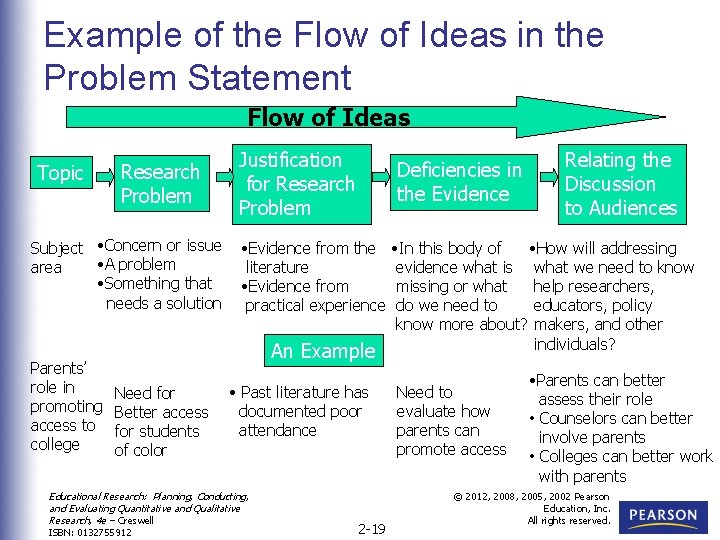
Example of the Flow of Ideas in the Problem Statement Flow of Ideas Topic Research Problem Subject • Concern or issue • A problem area • Something that needs a solution Parents’ role in promoting access to college Justification for Research Problem Deficiencies in the Evidence • Evidence from the literature • Evidence from practical experience An Example Need for Better access for students of color • Past literature has documented poor attendance Educational Research: Planning, Conducting, and Evaluating Quantitative and Qualitative Research, 4 e – Creswell ISBN: 0132755912 2 -19 Relating the Discussion to Audiences • In this body of • How will addressing evidence what is what we need to know missing or what help researchers, do we need to educators, policy know more about? makers, and other individuals? Need to evaluate how parents can promote access • Parents can better assess their role • Counselors can better involve parents • Colleges can better work with parents © 2012, 2008, 2005, 2002 Pearson Education, Inc. All rights reserved.
- Slides: 19