
Chapter 2 Hospitality Facilities Management Tools Techniques and
- Slides: 24
Chapter 2 Hospitality Facilities Management Tools, Techniques, and Trends Hospitality Facilities Management and Design Fourth Edition
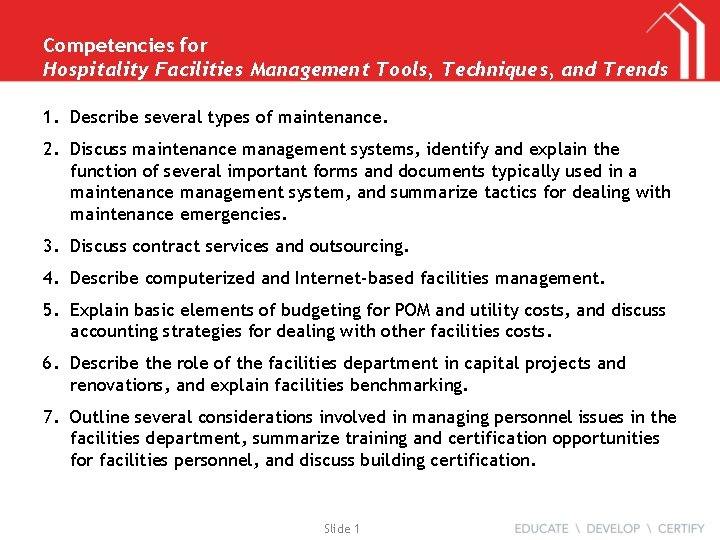
Competencies for Hospitality Facilities Management Tools, Techniques, and Trends 1. Describe several types of maintenance. 2. Discuss maintenance management systems, identify and explain the function of several important forms and documents typically used in a maintenance management system, and summarize tactics for dealing with maintenance emergencies. 3. Discuss contract services and outsourcing. 4. Describe computerized and Internet-based facilities management. 5. Explain basic elements of budgeting for POM and utility costs, and discuss accounting strategies for dealing with other facilities costs. 6. Describe the role of the facilities department in capital projects and renovations, and explain facilities benchmarking. 7. Outline several considerations involved in managing personnel issues in the facilities department, summarize training and certification opportunities for facilities personnel, and discuss building certification. Slide 1
Facilities Maintenance and Repair • A significant portion of the property operation and maintenance (POM) budget is consumed by maintenance and repair demands • Maintenance activities are those done to keep something in an existing state or to preserve something from failure or decline • Repair activities are those that restore something by replacing a part or putting together what is torn or broken • There is value in functioning in a maintenance mode rather than a repair mode; an appropriate mix of maintenance methods and capital expenditures is a sound approach to keeping repair to a minimum Slide 2
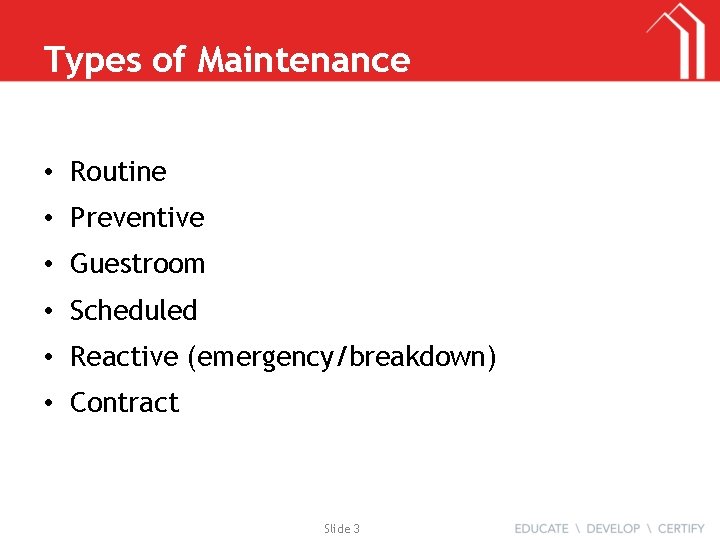
Types of Maintenance • Routine • Preventive • Guestroom • Scheduled • Reactive (emergency/breakdown) • Contract Slide 3
Routine Maintenance • Routine maintenance pertains to the general upkeep of the property • Routine maintenance recurs on a regular basis and requires relatively minimal skill or training • Activities such as grass cutting, leaf raking, snow shoveling, carpet/floor cleaning, and so on are considered routine maintenance Slide 4
Preventive Maintenance • Preventive maintenance is characterized by inspections, lubrication, minor repairs or adjustments, and work order initiation • Preventive maintenance on equipment is generally performed using manufacturers’ information • This type of maintenance may be performed to comply with code requirements, corporate requirements, and insurance standards, as well as in response to the usage of the equipment and the impacts of the equipment’s operating environment • Preventive maintenance may also result from test and inspection activities that indicate action is needed Slide 5
Guestroom Maintenance • Guestroom maintenance is a form of preventive maintenance • This maintenance involves the inspection of a number of items in the guestroom, filter changes in air conditioning units, minor lubrication of doors and other equipment, repair of obvious small problems, and the initiation of a work order for more substantial problems or needs Slide 6
Scheduled Maintenance • Scheduled maintenance is the type of maintenance that requires advance planning, a significant amount of time to perform, specialized tools and equipment, and high levels of coordination between departments • Scheduled maintenance includes preparing equipment for seasonal changes and performing other activities that are periodically required to keep equipment operating efficiently • This maintenance may also involve more substantial activities, such as replacing major equipment components, or replacing elements of the building itself (e. g. , windows) Slide 7
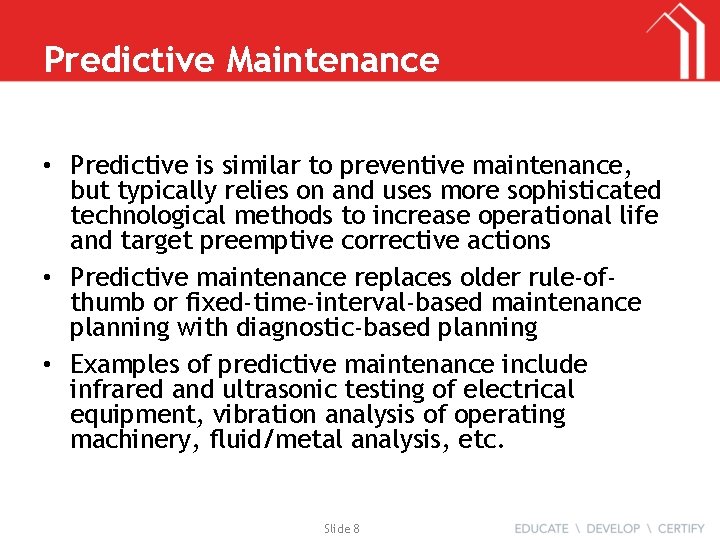
Predictive Maintenance • Predictive is similar to preventive maintenance, but typically relies on and uses more sophisticated technological methods to increase operational life and target preemptive corrective actions • Predictive maintenance replaces older rule-ofthumb or fixed-time-interval-based maintenance planning with diagnostic-based planning • Examples of predictive maintenance include infrared and ultrasonic testing of electrical equipment, vibration analysis of operating machinery, fluid/metal analysis, etc. Slide 8
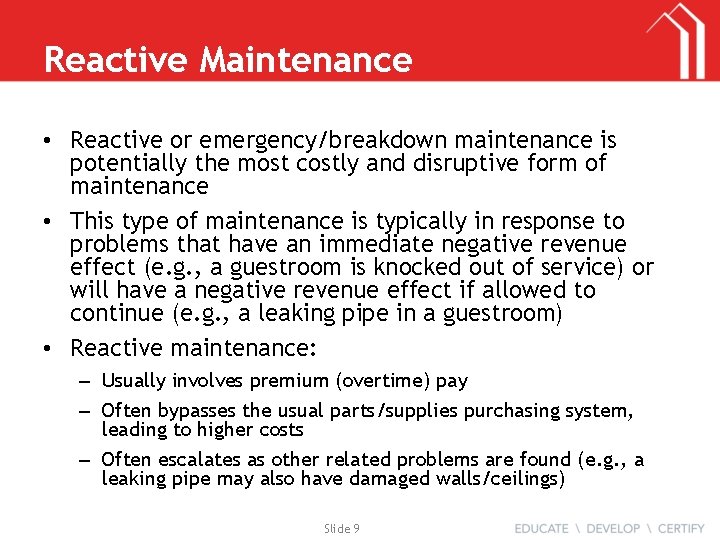
Reactive Maintenance • Reactive or emergency/breakdown maintenance is potentially the most costly and disruptive form of maintenance • This type of maintenance is typically in response to problems that have an immediate negative revenue effect (e. g. , a guestroom is knocked out of service) or will have a negative revenue effect if allowed to continue (e. g. , a leaking pipe in a guestroom) • Reactive maintenance: – Usually involves premium (overtime) pay – Often bypasses the usual parts/supplies purchasing system, leading to higher costs – Often escalates as other related problems are found (e. g. , a leaking pipe may also have damaged walls/ceilings) Slide 9
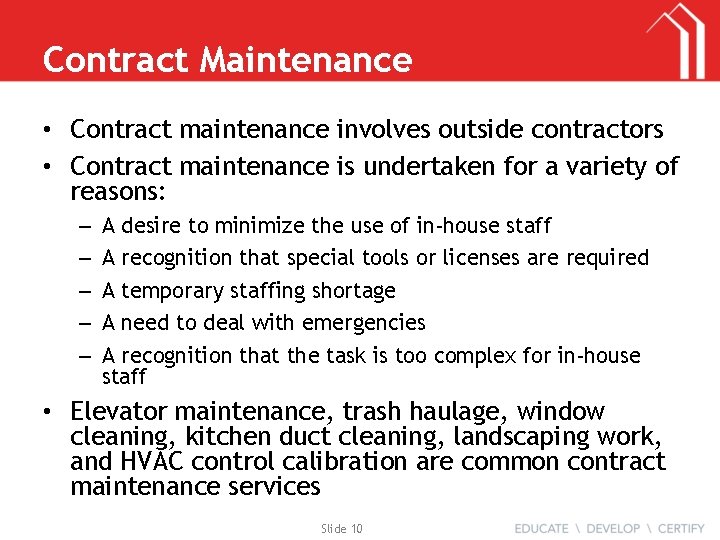
Contract Maintenance • Contract maintenance involves outside contractors • Contract maintenance is undertaken for a variety of reasons: – – – A desire to minimize the use of in-house staff A recognition that special tools or licenses are required A temporary staffing shortage A need to deal with emergencies A recognition that the task is too complex for in-house staff • Elevator maintenance, trash haulage, window cleaning, kitchen duct cleaning, landscaping work, and HVAC control calibration are common contract maintenance services Slide 10
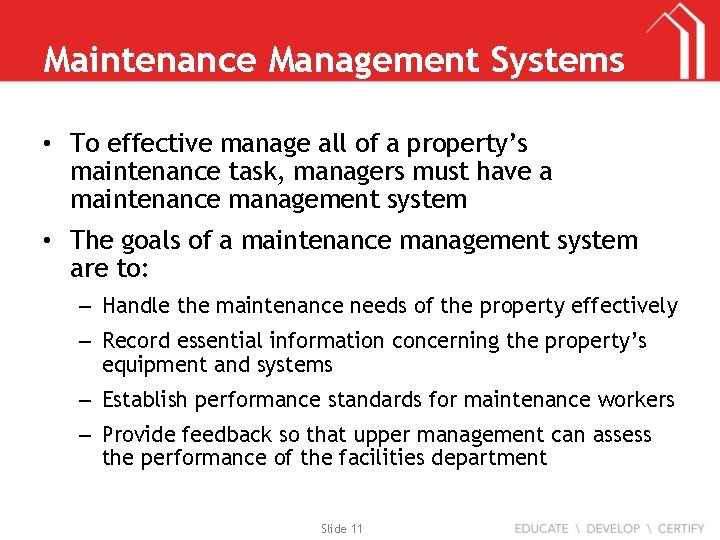
Maintenance Management Systems • To effective manage all of a property’s maintenance task, managers must have a maintenance management system • The goals of a maintenance management system are to: – Handle the maintenance needs of the property effectively – Record essential information concerning the property’s equipment and systems – Establish performance standards for maintenance workers – Provide feedback so that upper management can assess the performance of the facilities department Slide 11
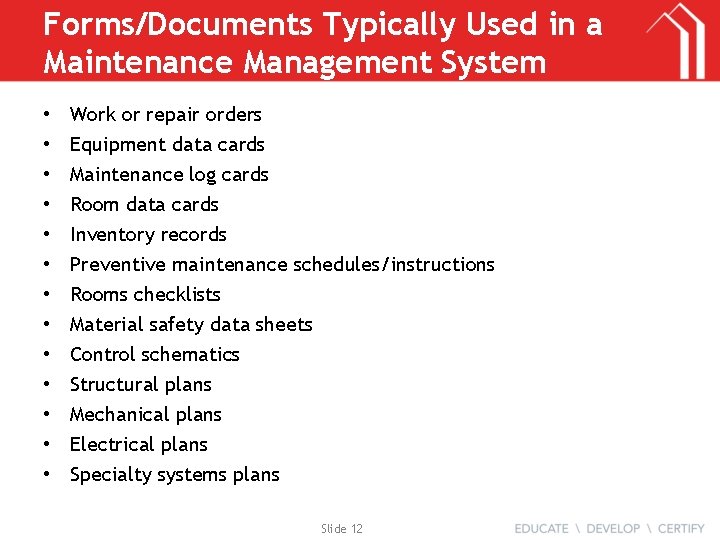
Forms/Documents Typically Used in a Maintenance Management System • • • • Work or repair orders Equipment data cards Maintenance log cards Room data cards Inventory records Preventive maintenance schedules/instructions Rooms checklists Material safety data sheets Control schematics Structural plans Mechanical plans Electrical plans Specialty systems plans Slide 12
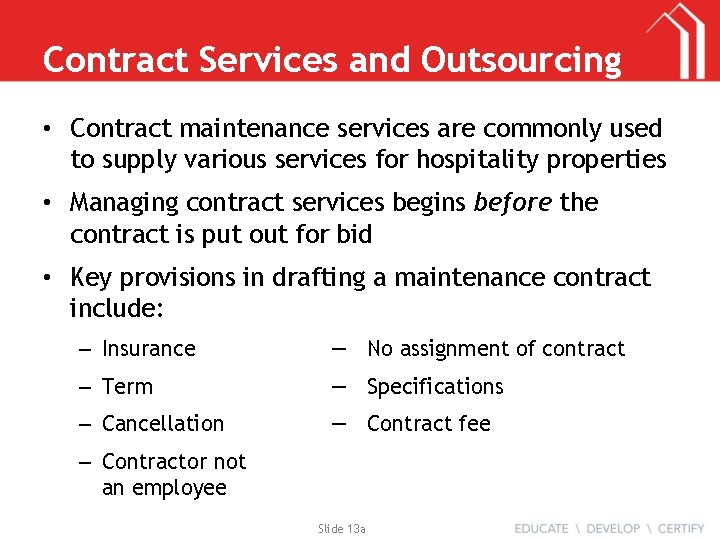
Contract Services and Outsourcing • Contract maintenance services are commonly used to supply various services for hospitality properties • Managing contract services begins before the contract is put out for bid • Key provisions in drafting a maintenance contract include: – Insurance — No assignment of contract – Term — Specifications – Cancellation — Contract fee – Contractor not an employee Slide 13 a
Contract Services and Outsourcing • Properties should use a relatively short contract term, especially in the early stages of a relationship with a contractor • Once a contract is signed, the facilities manager (or someone else at the property) must make sure that the contracted work is done properly • A growing trend in commercial real estate is outsourcing, a process by which facilities services are provided not by in-house staff but by contract service firms; the U. S. lodging industry has not embraced facilities outsourcing • Outsourcing can go both ways; a lodging property could decide to provide facilities services to other businesses Slide 13 b
Computerized and Internet-Based Facilities Management • Computerized maintenance management systems (CMMSs) not only control HVAC equipment operation and building comfort but also fire protection interfaces, security systems, and electric power management • Preventive, scheduled, and guestroom maintenance along with work orders can all be a part of a CMMS • CMMSs can bridge the gap between the housekeeping and maintenance departments • CMMSs are being used both at the unit level and the regional/corporate level, enabling regional/corporate managers to oversee unit-level facilities activity • Today, many CMMS implementers are not loading their systems into individual computers at the property level; rather, they are using the Internet to provide greater access to more people to more building information Slide 14
Budgeting for POM and Utilities • The facilities department’s expenditures for property operation and maintenance (POM) and utilities are 8 to 9 percent of a U. S. property’s revenue • For most properties, salaries, wages, and employee benefits constitute about 40– 50 percent of the POM expenditure • Contract maintenance costs can constitute 25 percent or more of the non-labor element of the POM budget • Utility costs include not only energy (fuels and electricity) but also water and sewer charges • When budgeting for POM, the labor portion is approached as it would be for any department; the non-labor portion is usually adjusted by applying a percentage increase (or decrease) to the previous year’s portion • Budgeting for utilities is best handled by dealing with the actual units of energy purchased (kwh, gallons, liters, etc. ) and attempting to secure price estimates for the coming year from suppliers Slide 15
Contract Services, Responsibility Accounting, and Facilities Costs • There was a time when many contract services were charged to the POM budget regardless of which department used those contract services; now charges are assigned to the Contract Services line of the affected departments • The income of a revenue department is computed by subtracting from departmental revenue a number of expenses; however, departmental expenses omit a number of significant costs that a revenue department may incur indirectly • Managers may ascribe many of the undistributed operating expenses and deductions from gross operating profit to the revenue department in order to get a better picture of the actual departmental performance; submetering of utilities may be a part of this effort • Arguably, the easiest facilities expense to charge to areas using the service is that of POM • Expenses incurred by the facilities department for providing special customer services (such as for trade shows or weddings) are to be charged to the department receiving the revenue for these events • An additional cost-tracking opportunity is to allocate capital expenditure costs to departments Slide 16
Capital Expenditure (Cap. Ex) Management • The management of capital expenditures (Cap. Ex) is a significant task • At small properties, the owner or general manager may be extensively involved in the planning decision and implementation of capital expenditures; at large properties, the owner and general manager are also heavily involved, but the facilities manager may play a more significant role • Two major managerial functions related to capital expenditures must be addressed: (1) planning and budgeting, and (2) execution • Planning and budgeting for Cap. Ex requires knowledge of the expected lifetime of various elements of the facility and the cost of their replacement Slide 17 a
Capital Expenditure (Cap. Ex) Management • Generally speaking, Cap. Ex activity becomes heightened beginning in approximately year five of a property’s existence • A property should have a Cap. Ex plan that addresses at a minimum its near-term needs (2 to 5 years), with the management team being at least aware of expected longerterm needs (6 to 25 years) • With Cap. Ex expenditures, some years see dramatically higher expenditures than others, since some Cap. Ex costs can’t be spread over a number of years • In some cases, the planning and even the execution of Cap. Ex at hotels is under the oversight of an asset manager • Cap. Ex expenditures are made by the owner and represent large outflows of cash Slide 17 b
Facilities Benchmarking • Facilities benchmarking involves developing numerical (and other) standards that allow comparison of a given facility to itself and to other facilities • The goal of facilities benchmarking is improved cost control and better service • Facilities-related costs and other facilities measurements are best compared on a per-square-foot/square-meter basis • The most readily used benchmarking data source is the property itself; comparing performance with similar time periods in previous years or monitoring long-term trends in performance is readily done • The creation of benchmarks for the POM budget can be expressed in total expenditures per room or as a percent of revenue • The introduction of computerized maintenance management systems has significantly increased the ability of managers to use new benchmarks Slide 18
Personnel Management in Facilities • Key concerns in the management of facilities department personnel include job qualifications, on-the-job supervision, and employee productivity • Management personnel in the facilities department must have some level of mechanical and electrical skill; the smaller the property, the more the department manager will have a “hands-on” maintenance role • Line staff members in the department need very broad skills in maintenance at the small property level • Facilities staff members must be reliable and capable of working on their own; they should not only have trade training but also training in the property’s standards Slide 19
Training and Certification • Providing the necessary training for facilities employees and managers is not difficult but it does require commitment, time, and money • The American Hotel & Lodging Educational Institute offers a Maintenance Employee Hospitality Skills Certification program, along with other instructional materials • Facilities line staff can benefit from training programs offered by technical schools, trade associations, and equipment suppliers • Training and certification programs for the facilities department’s management staff are also widely available; managers need training in not only technical skills but also managerial and communication skills Slide 20
Building Certification • In recent years there has been increasing interest in establishing standards for “green” or “sustainable” products of many types, including buildings • One early building certification program was created by the Building Research Establishment’s Environmental Assessment Method (BREEAM) in the United Kingdom; BREEAM also has a presence in various European Union countries and elsewhere • BREEAM assesses new and existing structures, awards points, and rates buildings on a star system • In the United States, the U. S. Green Buildings Council (USGBC) has developed a certification program for new and existing buildings that is referred to as LEED (Leadership in Energy and Environmental Design) • The LEED certification program recognizes best-in-class building strategies and practices Slide 21