
Chapter 2 Guest Arrival PREREGISTRATION ACTIVITIES To speed


- Slides: 29
Chapter 2 Guest Arrival
PRE-REGISTRATION ACTIVITIES To speed up the Check-in process, pre-registration activities are carried out in advance, that is, before the arrival of the guests in hotel. By guests, here, it is meant a guest with confirmed reservation. These are done by front desk personnel. The pre-registration activities are as follows: The expected arrival list is prepared daily. This list has the details of the number and names of expected guests to arrive. This list also has the guest’s time of arrival, date of departure, rooms requested, reservation status, special requests and instructions.
PRE-REGISTRATION ACTIVITIES Room availability status for the day is calculated. This is done based on the expected arrivals, departures and stay-over including factors like overstay under stay, no-shows and out-of-order rooms. It helps the front desk in deciding the number of walk-ins or last minute reservations to be accepted for the day Amenity vouchers are prepared for arriving guests. These vouchers carry instructions to provide various items in the guest rooms like- cookies, fruits, flowers, etc. They are sent to housekeeping and food & beverage department as the amenities must be placed prior to guest’s arrival.
PRE-REGISTRATION ACTIVITIES It is the task of the front office to co-ordinate with housekeeping department to know the status of vacant rooms so that they may be allotted to the arrivals. Guest registration card (GRC) is pre-printed with available details and kept aside to be presented to the guest at the time of arrival. The required information can be taken from reservation form and guest history card. This helps in taking a quick check-in as the guest just needs to verify the information on GRC and sign to check-in. At times rooms may also be assigned during pre-registration according to the availability, agreed upon rate during reservation and guest preferences. Meal coupons for those guests who are on a plan where meals are included in the room tariff are prepared in advance and handed over to the guest at the time of check in
REGISTRATION PROCESS According to the foreigner’s act, 1946 and the registration of foreigner’s rules, 1992, the innkeeper should keep the record of the guests staying in his premises in form- F (of the registration of foreigner’s rules, 1992). Registration is a formal legal contract whereby the hotel agrees to provide the guest safe and secure accommodation with related services while the guest accepts to pay for the same. In this process, the front office personnel gather all pertinent information from the guest on GRC at reception desk. It takes less time for a guest with confirmed reservation to complete registration, provided the GRC is already filled as a pre- registration activity. The guest just needs to verify the details and sign. For a walk-in guest, it is a longer procedure, as the guest needs to fill in all details. Registration process may be manual, semi-automated and fully automated.
PRE-REGISTRATION ACTIVITIES MANUAL : It involves all paper work. Reservations are entered into loose leaf notebook or index cards. Reservation information is placed on advance letting chart (ALC) or density control chart (DCC) to know room availability. On arrival, guests fill in registration card or book. Room is assigned using manual card replacement in room rack, which also has color coded flags indicating housekeeping status of rooms.
PRE-REGISTRATION ACTIVITIES SEMI-AUTOMATED : Here, the hotel uses property management system (PMS) as well as paper documentation as a double check. The PMS downloads and transfers reservations from reservation software and shows the arrival list. All departments of the hotel can access this PMS. All point of sale (POS) are connected with it to fill in guest folios. Housekeeping updates the room status from its end to show lettability. It is a lot easier for front desk personnel to retrieve information regarding both guests and rooms. GRC are pre-filled for reserved guests which only needs verification. Electronic room keys are made as soon as the check-in is showed in PMS and the room status gets updated automatically from the front office end. The front desk personnel need only to update new or amend information in the system if required. In case, hotel is not using the computers than use of machines like type-writer, NCR machine for billing, credit card imprinter, etc may also put the hotel system under the category of semiautomated.
PRE-REGISTRATION ACTIVITIES FULLY AUTOMATED: In fully automated registration system the entire recordkeeping is computer based. PMS itself retrieves the guest reservation from reservation software through interface and automatically quotes rates and allots room according to a predetermined pattern. Its only for a walk-in guest that front desk personnel feeds in the details. On-line credit card authorization terminals are installed to enable front desk personnel receive timely credit card approval. Registration data are stored in computer memory and can be retrieved as and when necessary. Guest folios are maintained and accessed through computer’s memory as well. Self-service terminals have enabled guests to have self check-in and check-out
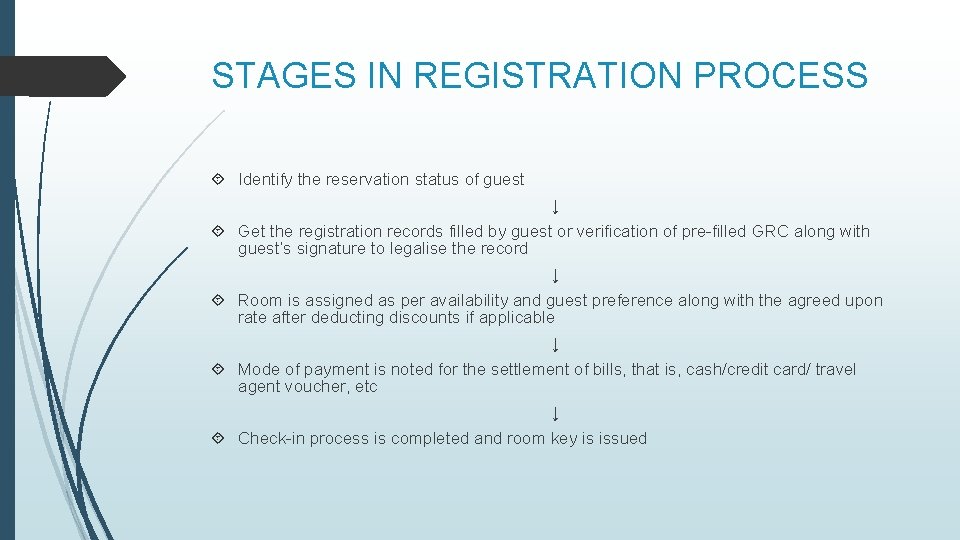
STAGES IN REGISTRATION PROCESS Identify the reservation status of guest ↓ Get the registration records filled by guest or verification of pre-filled GRC along with guest’s signature to legalise the record ↓ Room is assigned as per availability and guest preference along with the agreed upon rate after deducting discounts if applicable ↓ Mode of payment is noted for the settlement of bills, that is, cash/credit card/ travel agent voucher, etc ↓ Check-in process is completed and room key is issued
STAGES IN REGISTRATION PROCESS Identification of guest: - It is important, as the hotel is liable to provide room to guests with confirmed reservation first. A walk-in guest will be offered a room only if it is available. Registration records: - Signature of guest on registration record after filling it or verifying it legalises and completes it. Other hotel records like guest folio, arrival notification slip, etc. , are made on the basis of registration record. This record is stored for minimum 3 years or as prescribed by the law of the state, so that authorities can check it as and when required.
STAGES IN REGISTRATION PROCESS Room & rate assignment: - As a pre-registration activity, the front desk is ready with a record of the rooms available with their detailed features and rate. A guest with confirmed reservation is allotted room according to his/her preference based on availability on the agreed upon rate, whereas, for a walk-in guest, up selling may be done. Mode of payment: - It helps in assessing the credibility of a guest. Hotel prefers to be on the safe side by charging an advance amount which includes total room nights and a substantial amount for incidental charges. This allows the guest to avail credit facility in various Points of Sale. It may be cash/credit card/ travel agent voucher/ bill to company. In case of credit card, front desk personnel block an amount on the card as authorisation from the credit card company by swiping it. On check-out, the required amount can be deducted as a sale from the authorised amount.
STAGES IN REGISTRATION PROCESS Check-in process and issuing room key: - Once all the above mentioned stages are complete, the front desk personnel issues the room key to the guest. GRE is asked to escort the guest to room and complete the rooming process, while the bell boy is asked to carry the guest’s luggage to room. In case Guest Relation Executive (GRE) is not available, bell boy does the entire job. It must be noted that the guest must always be escorted.
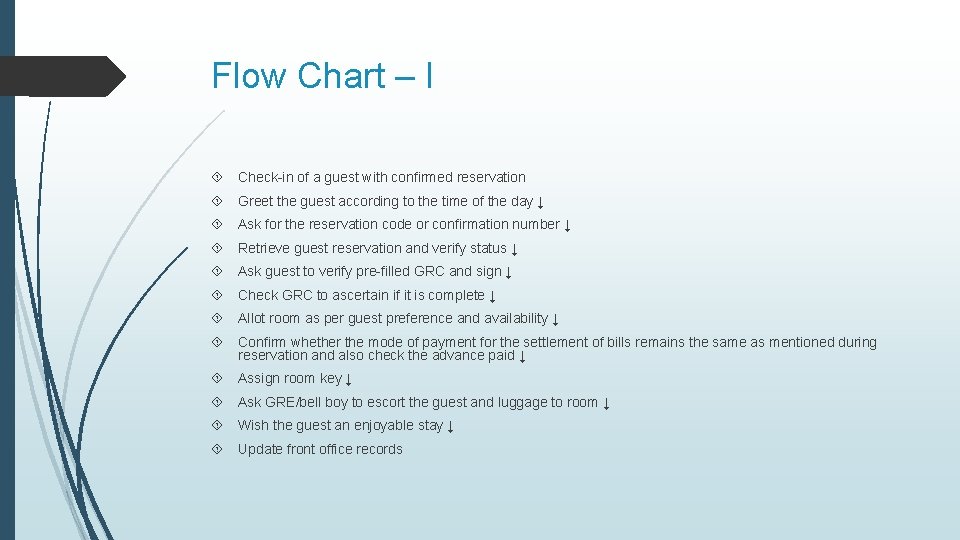
Flow Chart – I Check-in of a guest with confirmed reservation Greet the guest according to the time of the day ↓ Ask for the reservation code or confirmation number ↓ Retrieve guest reservation and verify status ↓ Ask guest to verify pre-filled GRC and sign ↓ Check GRC to ascertain if it is complete ↓ Allot room as per guest preference and availability ↓ Confirm whether the mode of payment for the settlement of bills remains the same as mentioned during reservation and also check the advance paid ↓ Assign room key ↓ Ask GRE/bell boy to escort the guest and luggage to room ↓ Wish the guest an enjoyable stay ↓ Update front office records
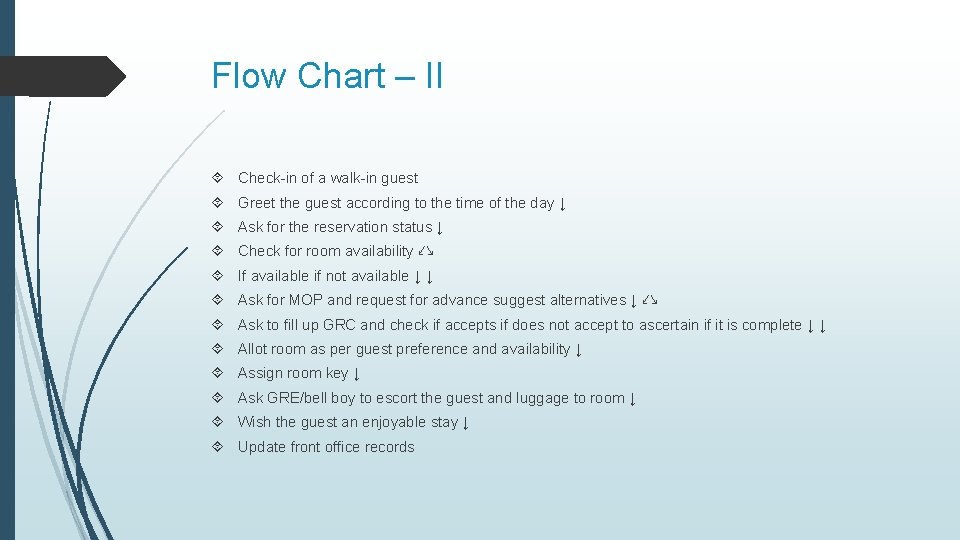
Flow Chart – II Check-in of a walk-in guest Greet the guest according to the time of the day ↓ Ask for the reservation status ↓ Check for room availability ↙↘ If available if not available ↓ ↓ Ask for MOP and request for advance suggest alternatives ↓ ↙↘ Ask to fill up GRC and check if accepts if does not accept to ascertain if it is complete ↓ ↓ Allot room as per guest preference and availability ↓ Assign room key ↓ Ask GRE/bell boy to escort the guest and luggage to room ↓ Wish the guest an enjoyable stay ↓ Update front office records
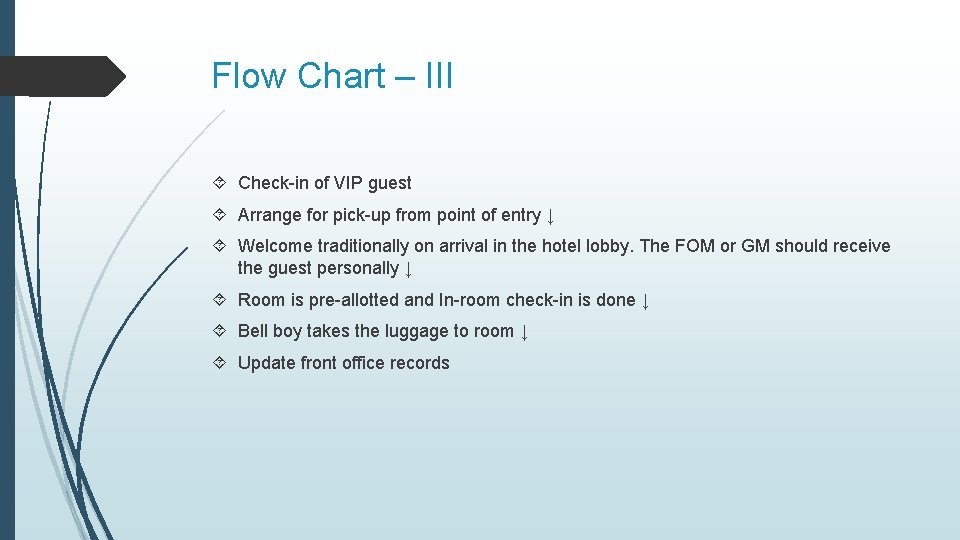
Flow Chart – III Check-in of VIP guest Arrange for pick-up from point of entry ↓ Welcome traditionally on arrival in the hotel lobby. The FOM or GM should receive the guest personally ↓ Room is pre-allotted and In-room check-in is done ↓ Bell boy takes the luggage to room ↓ Update front office records
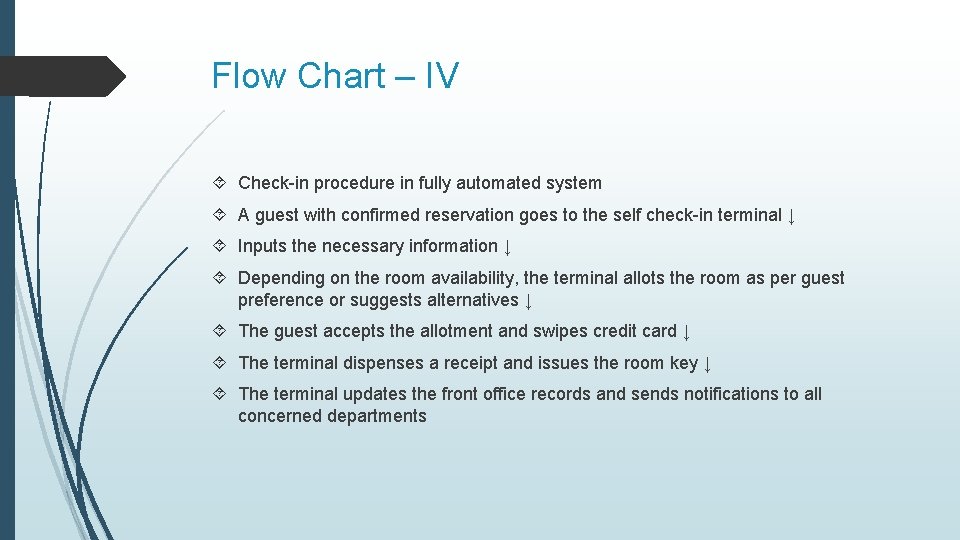
Flow Chart – IV Check-in procedure in fully automated system A guest with confirmed reservation goes to the self check-in terminal ↓ Inputs the necessary information ↓ Depending on the room availability, the terminal allots the room as per guest preference or suggests alternatives ↓ The guest accepts the allotment and swipes credit card ↓ The terminal dispenses a receipt and issues the room key ↓ The terminal updates the front office records and sends notifications to all concerned departments
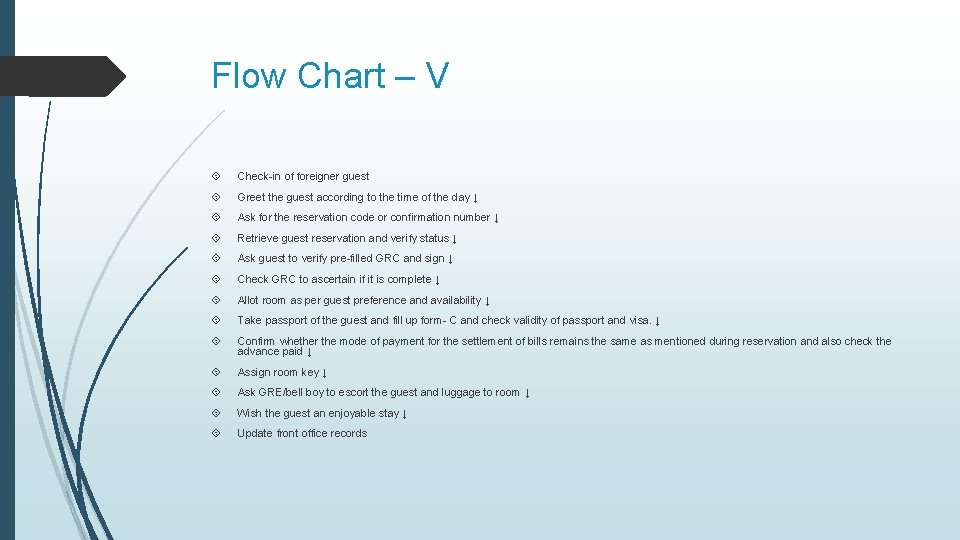
Flow Chart – V Check-in of foreigner guest Greet the guest according to the time of the day ↓ Ask for the reservation code or confirmation number ↓ Retrieve guest reservation and verify status ↓ Ask guest to verify pre-filled GRC and sign ↓ Check GRC to ascertain if it is complete ↓ Allot room as per guest preference and availability ↓ Take passport of the guest and fill up form- C and check validity of passport and visa. ↓ Confirm whether the mode of payment for the settlement of bills remains the same as mentioned during reservation and also check the advance paid ↓ Assign room key ↓ Ask GRE/bell boy to escort the guest and luggage to room ↓ Wish the guest an enjoyable stay ↓ Update front office records
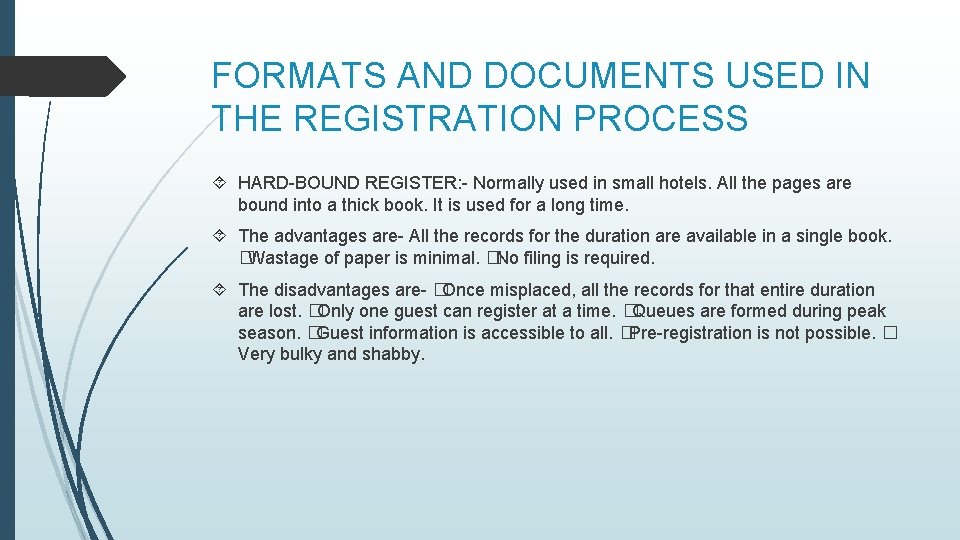
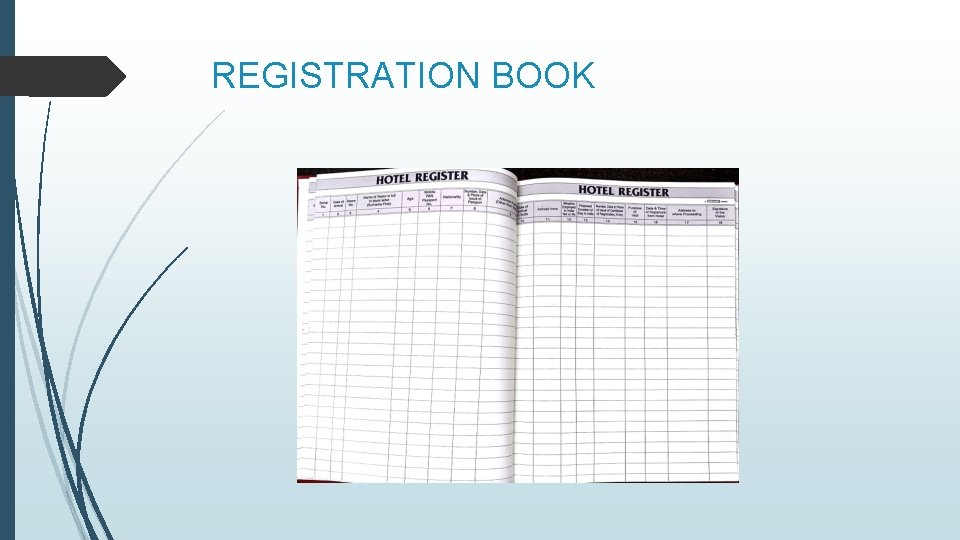
FORMATS AND DOCUMENTS USED IN THE REGISTRATION PROCESS HARD-BOUND REGISTER: - Normally used in small hotels. All the pages are bound into a thick book. It is used for a long time. The advantages are- All the records for the duration are available in a single book. �Wastage of paper is minimal. �No filing is required. The disadvantages are- �Once misplaced, all the records for that entire duration are lost. �Only one guest can register at a time. �Queues are formed during peak season. �Guest information is accessible to all. �Pre-registration is not possible. � Very bulky and shabby.
REGISTRATION BOOK
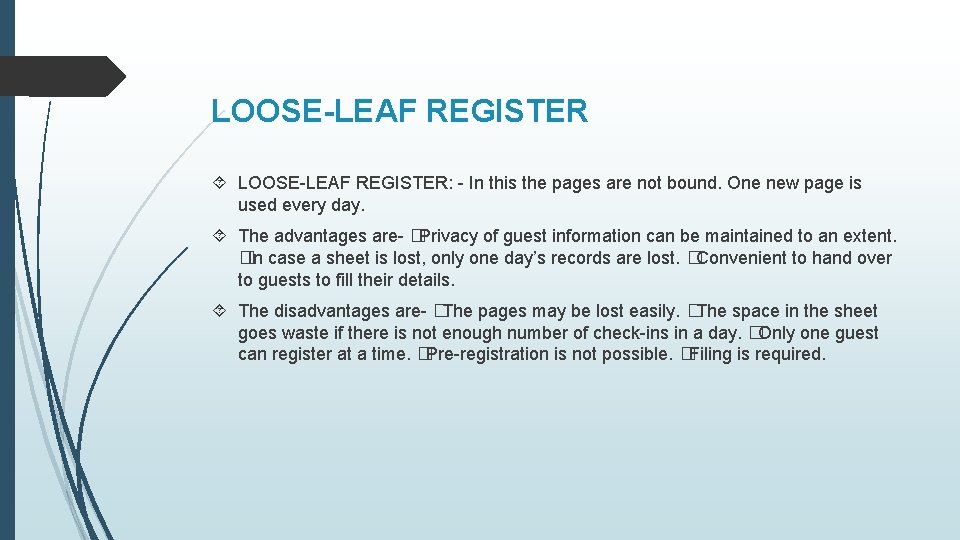
LOOSE-LEAF REGISTER LOOSE-LEAF REGISTER: - In this the pages are not bound. One new page is used every day. The advantages are- �Privacy of guest information can be maintained to an extent. �In case a sheet is lost, only one day’s records are lost. �Convenient to hand over to guests to fill their details. The disadvantages are- �The pages may be lost easily. �The space in the sheet goes waste if there is not enough number of check-ins in a day. �Only one guest can register at a time. �Pre-registration is not possible. �Filing is required.
GUEST REGISTRATION CARD GUEST REGISTRATION CARD: - These are individual registration cards used by most hotels to overcome the problems of Hard-bound and Loose-leaf register. These may be made in duplicate or triplicate. It is filled in by guests on arrival to complete the legalisation of the process. The advantages are- �Many guests can register at the same time. �Privacy of guest’s information can be maintained. �Pre-registration is possible. �Presentable and aesthetic The disadvantages are- �Relatively expensive. �Can get lost or misplaced, if not stored properly.
PASSPORT During the registration of a foreign national, passport is checked as a proof of identity. A passport is a document issued by a government to allow its citizens to travel abroad, requesting other governments to facilitate their passage and protection. No person can move within a foreign territory without a valid passport. VISA: It is an endorsement on the passport, allowing the holder to enter the territory of the issuing country for specific purposes and for a specific length of time.
ROOMING LIST: - A list prepared for groups and crews, containing the names of the group members and other relevant details. FORM F: - A document that has all required information to be maintained by the innkeeper for all visitors arriving in the hotel. EXPECTED ARRIVAL LIST: - A list generated by the reservation section of front office department, enlisting data of the guests expected to arrive on a particular day.
POST REGISTRATION ACTIVITIES After checking in the guest, the front desk personnel updates room status report, prepares arrival notification slips for all concerned departments, creates guest folio and fills C-form (for foreigners) to send to concerned authorities. The postregistration activities which are carried out after the guest has proceeded to his room are as follows: Check-in of the guest in the PMS or computer system. This enables al other departments to know about the check-in of a guest, his credit status and also to activate all guest services for his benefit. In a manual system this objective is achieved by sending arrival notification slips to different departments of the hotel. The departments where arrival is notified are housekeeping, Laundry, Food and Beverage service, Telephone operator, Cashier, Information and Bell desk.
Opening of guest folio: The guest folio is opened by the front office cashier. Any advance received from the guest is considered as the opening balance of the folio. Preparing the arrival errand card : Bell desk prepares an arrival errand card which has the details of luggage sent to the guest room. Updating the guest profile: The guest profile in the computer is updated on the basis of any information given by the guest in the registration card. The update may include guest address, passport details, credit card number, and date of birth etc. for future usage.
Updating the A & D register: Arrival and Departure register is updated for every arrival and departure in a hotel Therefore, as part of post-registration activity the arrival side of A&D register is updated by the receptionist. Preparing ‘C’ form: The C- form is a mandatory document which is prepared for all foreigner guests and sent to FRRO (Foreigners regional registration office) or Police commissioner’s office within 24 hours of a guest’s check-in.
FORM C It is mandatory for the hotel owner to send information about all foreign guests in the format of form C to the nearest Foreigner’s Regional Registration Office (FRRO) or to the Local Intelligence Unit (LIU) within 24 hours of the foreigner’s arrival. All foreign nationals except people holding passport of Nepal and Bhutan are termed as foreigner in India. In case of Pakistani, Bangladeshi and Chinese nationals, information should reach within 12 hours to the nearest FRRO or LIU and local police station. This form is prepared in duplicate and serial numbered. The duplicate copy is kept for permanent records as specified by law.
Bibliography Ø Bardi A. James, Hotel Front Office Management (third Edition). Hoboken, New Jersey: John Wiley & Sons, Inc. 2003 Ø Tewari R. Jatashankar, Hotel Front Office Operations and Management. New Delhi ; New York : Oxford University Press, 2009. Ø Confederation of Tourism and Hospitality, CHT Diploma in Hotel Management, Front Office Operations, Study Guide. London W 12 8 AA: BPP Learning Media Ltd, July, 2009. Ø https: //www. tutorialspoint. com/front_office_management _introduction. htm. 2020.