
Chapter 2 Greek and Roman Empires Ancient Rome
- Slides: 25
Chapter 2 Greek and Roman Empires
Ancient Rome
The Emergence of Rome • Indo. Europeans moved into Italy about 1500 -1000 BC • Spoke Latin, were mainly herders and farmers
Early Rome • ruled by Kings who were Etruscans • 509 B. C Romans overthrew Etruscans King and established a republic. A republic: the leader is not a King and certain citizens have the right to vote. • By 267 B. C. , Rome ruled all of Italy, Greece and Etruscan States
Roman Confederation • some people had full citizenship • Allies who gave soldiers to Rome could become citizens. This is why conquered people felt invested in Rome’s success.
Punic Wars • Rome fought 3 wars with Carthage, who was a large Mediterranean power located in Northern Africa • Led by Hannibal, after the 2 nd war Rome was almost destroyed, they had to rebuild a new Army and Navy
Punic Wars Rome fought 3 wars with Carthage, who were a large Mediterranean power located in Northern Africa. • 2 nd Punic War: Romans struggle, but refuses to give up and ends up winning after surprise invasion from Carthaginian General Hannibal. • Spain became a Roman province. • 3 rd Punic War: Rome overtakes all of Carthage survivors were either killed or put into slavery.
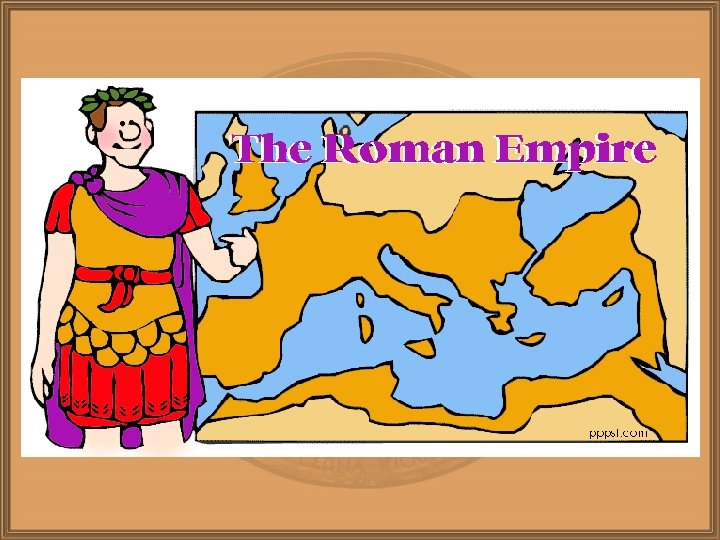
Punic Wars • Rome then controlled Spain, Macedonia, Pergamum and basically all of the Mediterranean Sea. • By 200 A. D. the Roman Empire covered 3. 5 million square miles and had 50 million people
Patricians and Plebeians • Two groups in control; • Patricians: large landowners were Rome’s ruling Class • Plebeians: less wealthy landowners, craftspeople, merchants and small farmers • Both groups were citizens and could vote, but only Patricians could be elected to public office.
Consuls and Praetors • Chief executive officers • Two consuls ran the government and led army • Praetors directed the civil law to citizens
Roman Senate • • • 300 patricians served for life. By 300 B. C. , had the power to force laws. Organized by classes based on wealth Always conflict between Patricians and Plebeians The Plebeians wanted political and social equality 471 B. C. , Council of the Plebs was created and was there to protect the Plebs. • By 287 B. C. all male Romans were equal under the law but wealthy Patrician and Plebeians formed a ruling senatorial class that dominated politics.
From Republic to Empire • From 509 to 264 B. C. – Rome expanded to control Italy • Senate became the real governing power • Roman leaders began to recruit armies that swore allegiance to the general, not the state.
From Republic to Empire • Various people took power including Julius Caesar. • 31 B. C. Caesar was assassinated and his grandnephew Octavian took control • Octavian had great power because he controlled the Roman Army. Octavian later became the Augustus (the revered one)
The Early Empire 14 – 180 A. D. • Octavian was given the title-Imperatorwhich means commander and chief (this is where the word Empire comes from)
Pax Romana (Roman Peace) • 5 emperors – Nerva, Trajan, Hadrian, Anitonius Pius, Marcus Aurelius • These rulers respected the ruling classes, ended arbitrary executions, maintained peace and supported domestic policies • Took power away from the Senate • Instituted programs to help people, building public works, aqueducts, bridges, roads, and harbor families, help educate the children and poor
Roman Law • One of Rome’s most important contributions was its laws • Twelve Tables, first code of law in 450 B. C. • Law of Nations- a person was innocent until proven guilty; people accused of wrongdoing were allowed to defend themselves and judges weighed evidence carefully before arriving at a decision
Slavery in Rome • Romans relied on slavery more than any group of people • Each area Rome conquered the captives were brought to Rome. • Greeks were prized as slaves - tutors, musicians, doctors, and artists • Slaves worked in shops, made crafts, cleaned, gardened
Daily Life in the City of Rome • Population of almost 1 million people by the time of Augustus • Overcrowded and noisy – wagons and carts banned from the streets during the day • High rents made families live in 1 room – no plumbing, no central heat – making Romans always go out to the streets
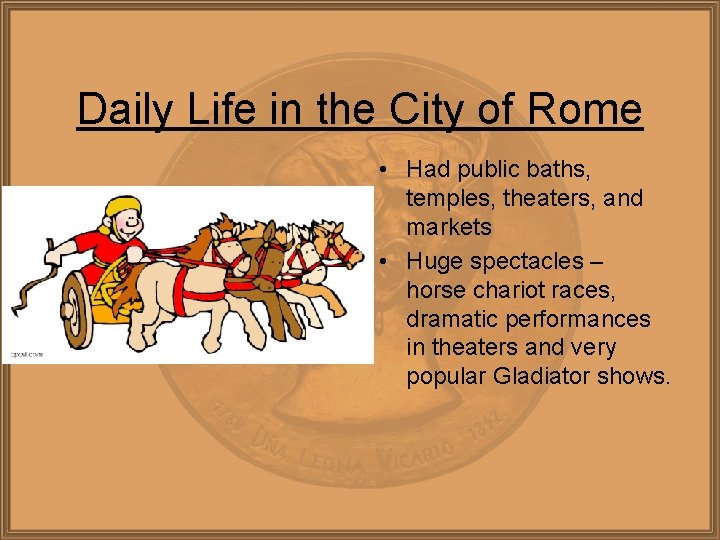
Daily Life in the City of Rome • Had public baths, temples, theaters, and markets • Huge spectacles – horse chariot races, dramatic performances in theaters and very popular Gladiator shows.
Roman Culture • Virgil – wrote epic poem Aeneid – show virtues of ideal Roman: duty, piety, and loyalty. • Greek Art – statues adorned homes • Architecture – Greek Style and created forms based on curved lines; domes, arches, and vault – first to use concrete on massive scale • Engineers – roads, bridges and aqueducts
The Decline of Rome • Civil War, political disorder, and economic downfall followed the death of Marcus Aurelius in 180 A. D. • The emperors Diocletian and Constantine revived Rome
Diocletian • split the empire into 4 zones each with its own ruler, but he had ultimate authority
Constantine • Expanded bureaucracy and enlarged the military, but drained the treasury and needed more money. He was solo ruler of the empire • Built a new capital city, filled with a forum, large palaces and an amphitheater • Constantinople – would become the center of the Roman Empire and one of the world’s largest cities.
The Fall • the Empire now was split into two parts and two capitals – Rome in the West and Constantinople in the East
The Fall • Huns from Asia moved into Europe, pushed the Germans into the South into Roman territory and defeated the Romans in 378 A. D. • 410 A. D. More Germans came into Rome and sacked the city • 455 A. D. A group of Vandals sacked the city • 476 A. D. Western roman Emperor Romulus Augustulus was disposed by the German Empire • But the Eastern Roman Empire (Byzantine Empire) thrived