
Chapter 2 Government Agencies that Impact the Hospitality
- Slides: 47
Chapter 2 Government Agencies that Impact the Hospitality Industry 017 Stephen C. Barth P. C. , Diana S. Barber, JD and John Wiley & Sons, Inc. All Rights Reserved Images used under license from Shutterstock. com
Government Agencies that Impact the Hospitality Industry q q q q Federal Regulatory and Administrative Agencies State Regulatory and Administrative Agencies Local Regulatory and Administrative Agencies Regulatory Interaction and Oversight Impacting Travel and Tourism Managing Conflicting Regulations Responding to an Inquiry Monitoring Regulatory Change 017 Stephen C. Barth P. C. , Diana S. Barber, JD and John Wiley & Sons, Inc. All Rights Reserved
In This Chapter, You Will Learn: 1. 2. 3. 4. 5. 6. 7. How federal governmental agencies are involved in regulating the hospitality industry. How to analyze the various roles of state governmental agencies that regulate the hospitality industry. How to identify local governmental agencies involved in regulating the hospitality industry. How to recognize those national and international agencies and departments charged with monitoring and regulating the travel industry. How to manage conflicting regulations. How to properly respond to an official inquiry or complaint from a regulatory entity. How to keep abreast of regulatory changes. 017 Stephen C. Barth P. C. , Diana S. Barber, JD and John Wiley & Sons, Inc. All Rights Reserved
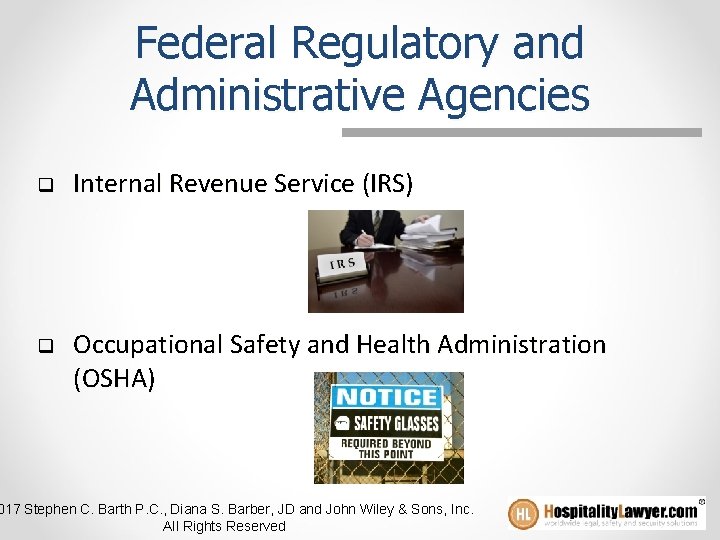
Federal Regulatory and Administrative Agencies q q Internal Revenue Service (IRS) Occupational Safety and Health Administration (OSHA) 017 Stephen C. Barth P. C. , Diana S. Barber, JD and John Wiley & Sons, Inc. All Rights Reserved
Analyze the Situation 2. 1 Carlos Magana was a Spanish-speaking custodian working in a health-care facility kitchen. Bert La. Colle was the new food and beverage director. Mr. La. Colle instructed Mr. Magana to clean the grout between the red quarry kitchen tile with a powerful cleaner that Mr. La. Colle had purchased from a chemical cleaning supply vendor. Mr. La. Colle, who did not speak Spanish, demonstrated to Mr. Magana how he should pour the chemical directly from the bottle to the grout, then brush the grout with a wire brush until it was white. 017 Stephen C. Barth P. C. , Diana S. Barber, JD and John Wiley & Sons, Inc. All Rights Reserved
Analyze the Situation 2. 1 Because the cleaner was so strong, and because Mr. Magana did not wear protective gloves, his hands were seriously irritated by the chemicals in the cleaner. In an effort to lessen the irritation to his hands, Mr. Magana decided to dilute the chemical. He added water to the bottle of cleaner, not realizing that the addition of water would cause toxic fumes. Mr. Magana inhaled the fumes while he continued cleaning, and later suffered serious lung damage as a result. 017 Stephen C. Barth P. C. , Diana S. Barber, JD and John Wiley & Sons, Inc. All Rights Reserved
Analyze the Situation 2. 1 Mr. La. Colle was subsequently contacted by OSHA, which cited and fined the facility for an Safety Data Sheets (SDS) violation. Mr. La. Colle maintained that SDS sheets, including the one for the cleaner in question, were in fact available for inspection by employees. 017 Stephen C. Barth P. C. , Diana S. Barber, JD and John Wiley & Sons, Inc. All Rights Reserved
Analyze the Situation 2. 1 1. 2. Did the facility fulfill its obligation to provide a safe working environment for Mr. Magana? What should Mr. La. Colle have done to avoid an OSHA violation? 017 Stephen C. Barth P. C. , Diana S. Barber, JD and John Wiley & Sons, Inc. All Rights Reserved
Federal Regulatory and Administrative Agencies q q q Environmental Protection Agency (EPA) Food and Drug Administration (FDA) Equal Employment Opportunity Commission (EEOC) Bureau of Alcohol, Tobacco, and Firearms, and Explosives (ATF) Alcohol and Tobacco Tax and Trade Bureau (TTB) 017 Stephen C. Barth P. C. , Diana S. Barber, JD and John Wiley & Sons, Inc. All Rights Reserved
Federal Regulatory and Administrative Agencies q Department of Labor (DOL) q q q q Wages and Hours Employee Benefit Security Plant Closings and Layoffs Employee Polygraph Protection Act Family and Medical Leave Act Department of Justice (DOJ) U. S. Department of Homeland Security (DHS) 017 Stephen C. Barth P. C. , Diana S. Barber, JD and John Wiley & Sons, Inc. All Rights Reserved
State Regulatory and Administrative Agencies q q q Employment Security Agency Alcohol Beverage Commission (ABC) Treasury Department/Controller Attorney General Public Health Department of Transportation 017 Stephen C. Barth P. C. , Diana S. Barber, JD and John Wiley & Sons, Inc. All Rights Reserved
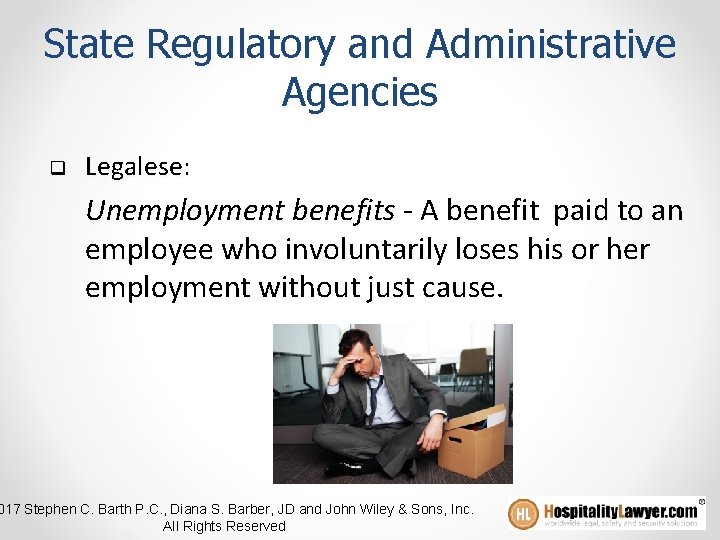
State Regulatory and Administrative Agencies q Legalese: Unemployment benefits - A benefit paid to an employee who involuntarily loses his or her employment without just cause. 017 Stephen C. Barth P. C. , Diana S. Barber, JD and John Wiley & Sons, Inc. All Rights Reserved
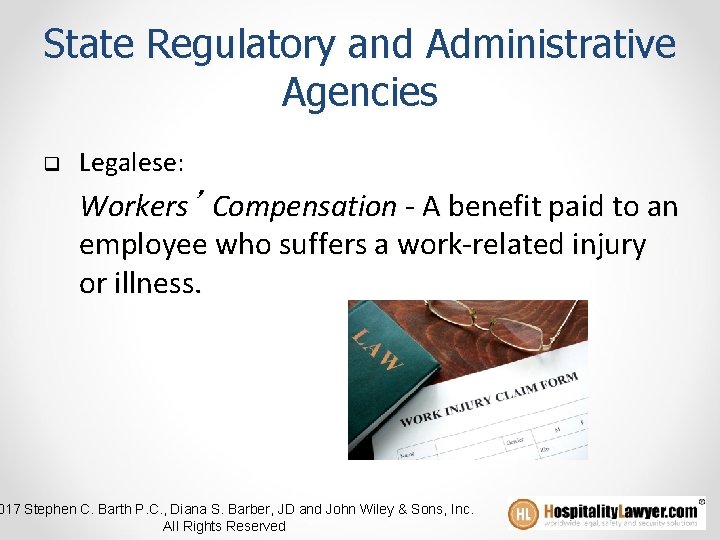
State Regulatory and Administrative Agencies q Legalese: Workers’ Compensation - A benefit paid to an employee who suffers a work-related injury or illness. 017 Stephen C. Barth P. C. , Diana S. Barber, JD and John Wiley & Sons, Inc. All Rights Reserved
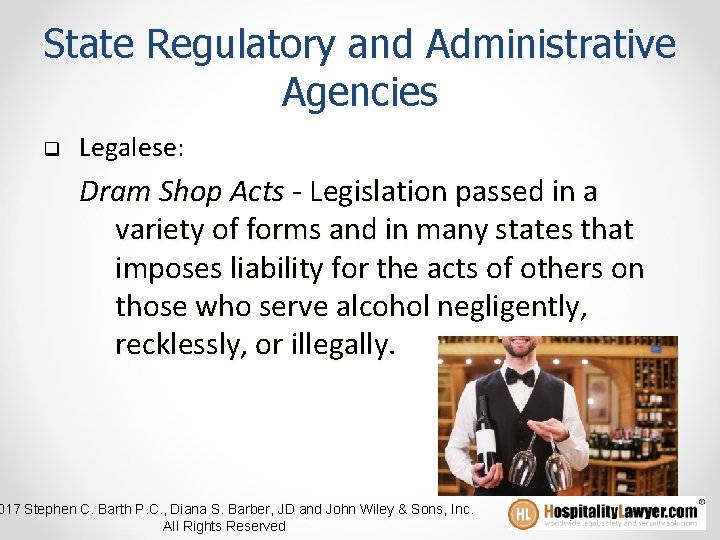
State Regulatory and Administrative Agencies q Legalese: Dram Shop Acts - Legislation passed in a variety of forms and in many states that imposes liability for the acts of others on those who serve alcohol negligently, recklessly, or illegally. 017 Stephen C. Barth P. C. , Diana S. Barber, JD and John Wiley & Sons, Inc. All Rights Reserved
Analyze the Situation 2. 2 Trixie Mitchell managed The Dusty Cellar, a bar near a college campus. She was active in her business community and served on the college's Presidential Advisory Board for Responsible Drinking. All servers and bartenders in her facility were required to undergo a mandatory 4 -hour alcohol service training program before they began their employment, and to take a required refresher course each year. Each server was certified in responsible alcohol service by the national office of Ms. Mitchell's hospitality trade association. 017 Stephen C. Barth P. C. , Diana S. Barber, JD and John Wiley & Sons, Inc. All Rights Reserved
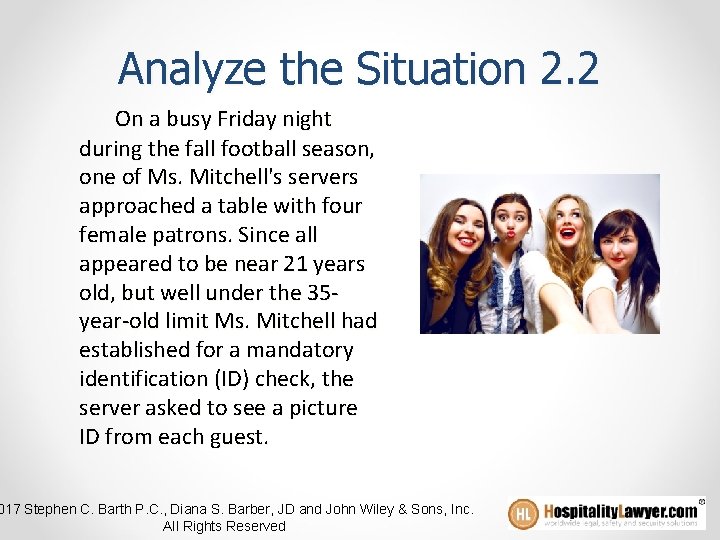
Analyze the Situation 2. 2 On a busy Friday night during the fall football season, one of Ms. Mitchell's servers approached a table with four female patrons. Since all appeared to be near 21 years old, but well under the 35 year-old limit Ms. Mitchell had established for a mandatory identification (ID) check, the server asked to see a picture ID from each guest. 017 Stephen C. Barth P. C. , Diana S. Barber, JD and John Wiley & Sons, Inc. All Rights Reserved
Analyze the Situation 2. 2 The server checked each guest's ID - verifying the age, hair color, general likeness, and the absence of alterations to the ID card - and then requested - in a practice unique to Dusty's - the mandatory recitation by each patron of the birthdate and address printed on the ID. Since all four guests passed their ID checks, the server served the patrons. Each guest had three glasses of wine over a period of 90 minutes. 017 Stephen C. Barth P. C. , Diana S. Barber, JD and John Wiley & Sons, Inc. All Rights Reserved
Analyze the Situation 2. 2 The next day, Ms. Mitchell was contacted by the state ABC and an attorney for the parents of a teenager whose car was involved in an accident with one of the four patrons served the prior night. It had been established that one of the patrons, whose ID had been professionally altered, was 20 years old, not 21. This patron was involved in the auto accident as she left the bar and drove back to her dorm room. 017 Stephen C. Barth P. C. , Diana S. Barber, JD and John Wiley & Sons, Inc. All Rights Reserved
Analyze the Situation 2. 2 The ABC began an investigation into the sale of alcohol to minors, while the attorney scheduled an appointment with Ms. Mitchell’s attorney to discuss a settlement based on the potential liability arising from the dram shop act legislation enacted in Ms. Mitchell’s state. 017 Stephen C. Barth P. C. , Diana S. Barber, JD and John Wiley & Sons, Inc. All Rights Reserved
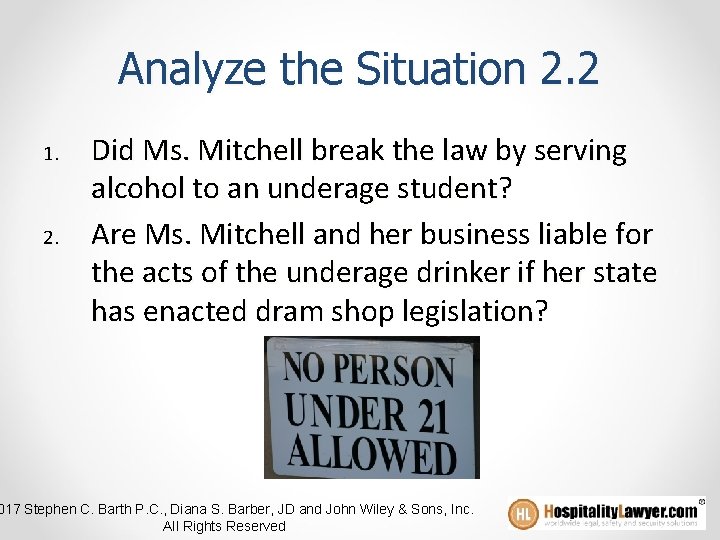
Analyze the Situation 2. 2 1. 2. Did Ms. Mitchell break the law by serving alcohol to an underage student? Are Ms. Mitchell and her business liable for the acts of the underage drinker if her state has enacted dram shop legislation? 017 Stephen C. Barth P. C. , Diana S. Barber, JD and John Wiley & Sons, Inc. All Rights Reserved
Local Regulatory and Administrative Agencies q q q q Health and Sanitation Building and Zoning Courts and Garnishment Historical Preservation Fire Department Law Enforcement Tax Assessor/Collector 017 Stephen C. Barth P. C. , Diana S. Barber, JD and John Wiley & Sons, Inc. All Rights Reserved
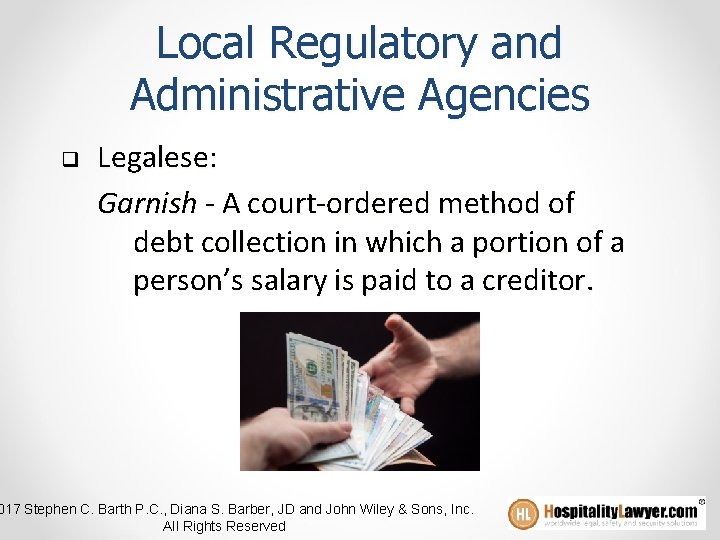
Local Regulatory and Administrative Agencies q Legalese: Garnish - A court-ordered method of debt collection in which a portion of a person’s salary is paid to a creditor. 017 Stephen C. Barth P. C. , Diana S. Barber, JD and John Wiley & Sons, Inc. All Rights Reserved
Regulatory Interaction and Oversight Impacting Travel and Tourism q U. S. Government Agencies: q q q q q Federal Trade Commission (FTC) Centers for Disease Control (CDC) Department of Commerce (DOC) Department of the Interior (DOI) Department of State Department of Homeland Security (DHS) Treasury Department of Transportation (DOT) Tourism Policy Council (TPC) 017 Stephen C. Barth P. C. , Diana S. Barber, JD and John Wiley & Sons, Inc. All Rights Reserved
Search the Web 2. 2 One of the most popular services offered by the CDC is its online “Travelers’Health” information. It seeks to inform travelers about the health risks they may encounter when traveling in various parts of the world. To view a sample of the information provided, go to www. cdc/gov/travel. Under the “Destinations” tab, select a region to find out about the health risks you might encounter in an area of the world you would someday like to visit. 017 Stephen C. Barth P. C. , Diana S. Barber, JD and John Wiley & Sons, Inc. All Rights Reserved
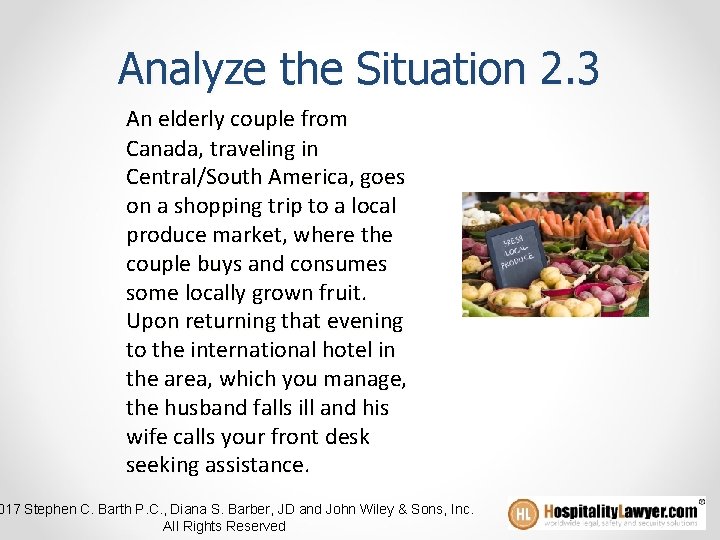
Analyze the Situation 2. 3 An elderly couple from Canada, traveling in Central/South America, goes on a shopping trip to a local produce market, where the couple buys and consumes some locally grown fruit. Upon returning that evening to the international hotel in the area, which you manage, the husband falls ill and his wife calls your front desk seeking assistance. 017 Stephen C. Barth P. C. , Diana S. Barber, JD and John Wiley & Sons, Inc. All Rights Reserved
Analyze the Situation 2. 3 1. 2. 3. What is the likely cause of the man’s illness? Based upon what you know about reasonable care for guests, what action would you expect your management team to take relative to the man’s illness? What would your position be if your hotel was later sued by the couple, claiming you had failed to warn them of local health risks? 017 Stephen C. Barth P. C. , Diana S. Barber, JD and John Wiley & Sons, Inc. All Rights Reserved
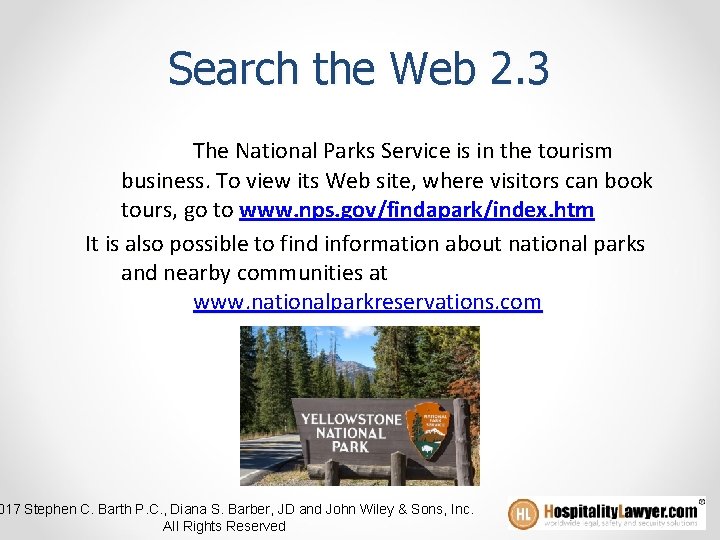
Search the Web 2. 3 The National Parks Service is in the tourism business. To view its Web site, where visitors can book tours, go to www. nps. gov/findapark/index. htm It is also possible to find information about national parks and nearby communities at www. nationalparkreservations. com 017 Stephen C. Barth P. C. , Diana S. Barber, JD and John Wiley & Sons, Inc. All Rights Reserved
Search the Web 2. 4 An important service provided by the Department of State is that of issuing travel advisories and warnings to Americans planning to travel outside the United States. Travelers can access these warnings at https: //travel. state. gov/content/passports/en/alertswarnings. html 017 Stephen C. Barth P. C. , Diana S. Barber, JD and John Wiley & Sons, Inc. All Rights Reserved
Analyze the Situation 2. 4 Ted Flood had a reservation at the Sleep Right hotel for the night of Oct. 15. According to the reservation policy explained to Mr. Flood at the time he reserved the room from Sleep Right’s national reservation system, the nonguaranteed reservation was to be held until 4: 00 p. m. the afternoon of Mr. Flood’s arrival. 017 Stephen C. Barth P. C. , Diana S. Barber, JD and John Wiley & Sons, Inc. All Rights Reserved
Analyze the Situation 2. 4 Unfortunately, Mr. Flood’s flight to the city where the Sleep Right was located was delayed, because the plane had to spend four hours on the airport runway because of mechanical difficulties. Mr. Flood was unable to contact the hotel and, as a result, his room was released by the hotel at 4: 30 p. m. and sold to another guest at 5: 00 p. m. Consequently, the hotel had no rooms available when Mr. Flood, tired and frustrated, arrived at the front desk at 8: 00 p. m. 017 Stephen C. Barth P. C. , Diana S. Barber, JD and John Wiley & Sons, Inc. All Rights Reserved
Analyze the Situation 2. 4 1. 2. 3. What could Mr. Flood have done to avoid his difficulty? What responsibility, if any, does the hotel now have to Mr. Flood? What role did the FAA likely play in this situation? 017 Stephen C. Barth P. C. , Diana S. Barber, JD and John Wiley & Sons, Inc. All Rights Reserved
Regulatory Interaction and Oversight Impacting Travel & Tourism q International Organizations q q q World Tourism Organization (UNWTO) International Civil Aviation Organization (ICAO) World Health Organization (WHO) 017 Stephen C. Barth P. C. , Diana S. Barber, JD and John Wiley & Sons, Inc. All Rights Reserved
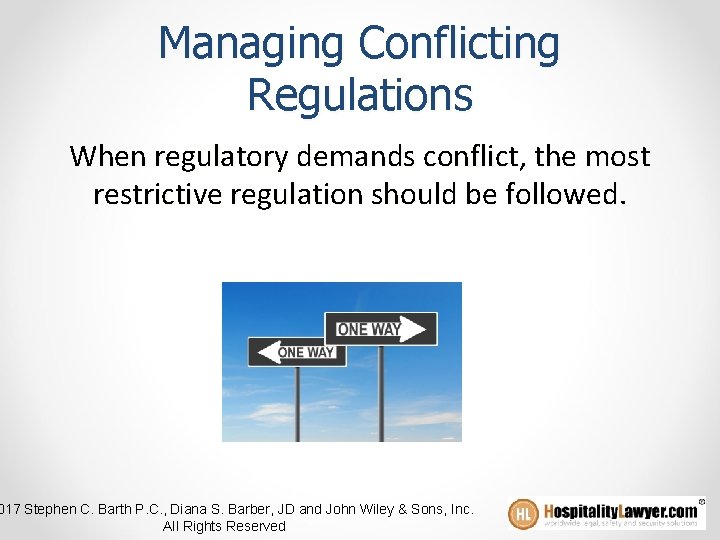
Managing Conflicting Regulations When regulatory demands conflict, the most restrictive regulation should be followed. 017 Stephen C. Barth P. C. , Diana S. Barber, JD and John Wiley & Sons, Inc. All Rights Reserved
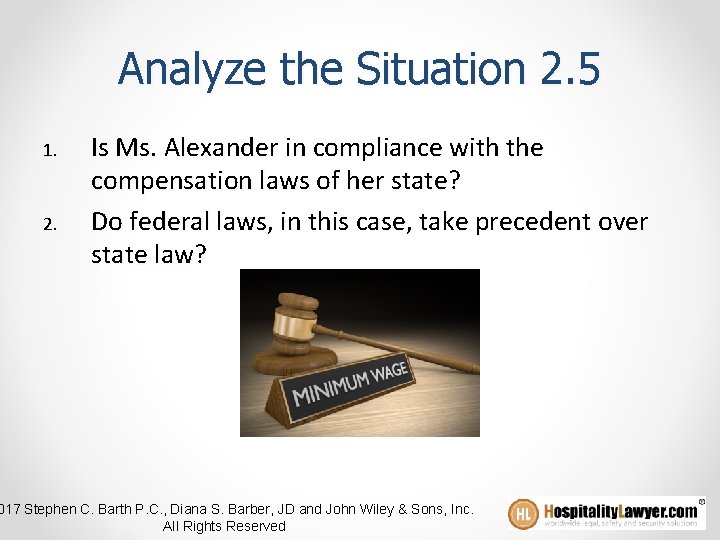
Analyze the Situation 2. 5 Sharon Alexander operated The Texas Saloon, an upscale steakhouse restaurant that also served beer and wine. Its average menu item sold for $10. Employees were allowed to eat one meal during their shift. For those who voluntarily elected to eat this meal, Sharon would deduct $0. 25 per hour ($2 per eight-hour shift) from the federal minimum wage rate she paid her entry-level dishwashers, which reflected the reasonable cost of the meal. 017 Stephen C. Barth P. C. , Diana S. Barber, JD and John Wiley & Sons, Inc. All Rights Reserved
Analyze the Situation 2. 5 Ms. Alexander relied on the Fair Labor Standards Act (FLSA) Section 3(m), which states that employers can consider, as wages, “reasonable costs. . . to the employer of furnishing such employees with board, lodging, or other facilities if such board, lodging, or other facilities are customarily furnished by such employer to his [or her] employees. ” She interpreted this regulation to mean that she could pay the entrylevel dishwashers a rate that, when added to the $0. 25 per hour meal deduction, equaled the federal minimum wage. 017 Stephen C. Barth P. C. , Diana S. Barber, JD and John Wiley & Sons, Inc. All Rights Reserved
Analyze the Situation 2. 5 One day, Ms. Alexander was contacted by her state department of employment, which charged that she was in violation of the state minimum wage law. The law stated that “total voluntary deductions for meals and uniforms may not decrease an employee's wages below the federal minimum wage on an hourly basis. ” Ms. Alexander maintained that because she was in compliance with the federal law, she was allowed to take the meal credit against the wages paid to her entrylevel dishwashers. 017 Stephen C. Barth P. C. , Diana S. Barber, JD and John Wiley & Sons, Inc. All Rights Reserved
Analyze the Situation 2. 5 1. 2. Is Ms. Alexander in compliance with the compensation laws of her state? Do federal laws, in this case, take precedent over state law? 017 Stephen C. Barth P. C. , Diana S. Barber, JD and John Wiley & Sons, Inc. All Rights Reserved
Responding to an Inquiry 1. 2. 3. Upon notification of a complaint or violation, document the date and time that all paperwork was received; and be sure to check all correspondence for required deadlines. Assess the severity of the complaint. Determine if legal consultation is necessary. Develop a plan of action. q With an attorney q Without an attorney 017 Stephen C. Barth P. C. , Diana S. Barber, JD and John Wiley & Sons, Inc. All Rights Reserved
What Would You Do? After the highly publicized death of a college student, a local sports bar in your town lost its liquor license for 60 days. The student had consumed 21 shots of alcohol on his birthday, and later died in his dorm room from alcohol poisoning. The bar was crowded, and because the shots had been purchased by a variety of friends of the victim, the bar manager and staff were not aware of the impending problem. 017 Stephen C. Barth P. C. , Diana S. Barber, JD and John Wiley & Sons, Inc. All Rights Reserved
What Would You Do? Subsequently, the college’s student newspaper published editorials warning against the perils of binge drinking, and accused the management of the facility of negligence or indifference. Sorrow in the community and outrage in the local press prompted the mayor of the city in which you operate your own Italian restaurant/pizzeria to propose a local ordinance banning the sale of more than three drinks per day to any individual. 017 Stephen C. Barth P. C. , Diana S. Barber, JD and John Wiley & Sons, Inc. All Rights Reserved
What Would You Do? A drink, under the ordinance, would be defined as either a 12 -ounce beer, a 4 -ounce glass of table wine, or a 1½ ounce shot of liquor. Violators would face a fine of $5, 000 per incident. Enforcement would fall to the local police. It is widely known in the community that the mayor, generally a strong promoter of business, is a nondrinker, and support for the ordinance is strong because of the accident. 017 Stephen C. Barth P. C. , Diana S. Barber, JD and John Wiley & Sons, Inc. All Rights Reserved
What Would You Do? As the elected president of your local restaurant association, you have been asked to address the proposed ordinance at the next meeting of the city council. Develop a plan of action and outline for your address to the city council. In your plan, answer the following five questions: 017 Stephen C. Barth P. C. , Diana S. Barber, JD and John Wiley & Sons, Inc. All Rights Reserved
What Would You Do? 1. 2. 3. 4. 5. What issues will you consider as you prepare your statement to the city council? What message do you believe the majority of citizens in your community will support? Where will you turn for advice and counsel in preparing your statement? Will it make a difference to you if you know that the local television station will cover the council meeting? How will social media play into your plan? 017 Stephen C. Barth P. C. , Diana S. Barber, JD and John Wiley & Sons, Inc. All Rights Reserved
Rapid Review 1. 2. 3. Analyze the role of at least three federal entities that regulate the hospitality industry. Why do you think the federal government feels the need to be involved with regulation in each of these three areas? Tip reporting is mandatory. Create a memo to a restaurant staff describing why they should comply. Secure a Safety Data Sheet, and compare its content to the list of required items detailed in this chapter. 017 Stephen C. Barth P. C. , Diana S. Barber, JD and John Wiley & Sons, Inc. All Rights Reserved
Rapid Review 4. 5. 6. 7. Review the protected classes identified by the EEOC and determine if others should be added. List five reasons a state’s Alcohol Beverage Commission might revoke a liquor license. Prepare a five-minute bartender training session that addresses one of these reasons and how a restaurant or bar might avoid the difficulty. Discuss the role of at least five of the ten federal regulatory bodies examined in this chapter. Define the roles of the UNWTO, the ICAO, and the WHO as they relate to travel. 017 Stephen C. Barth P. C. , Diana S. Barber, JD and John Wiley & Sons, Inc. All Rights Reserved
Rapid Review 8. 9. 10. 11. Assess the rationale behind the “most restrictive” concept as it relates to regulatory conflict. Prepare, in detail, a management checklist for responding to an administrative inquiry. Using the Internet, locate the home page of your state hotel and restaurant association. Secure the name of the person in that organization responsible for monitoring regulatory changes affecting the hospitality industry, and cite one such recent change in your state. Log on to www. Hospitality. Lawyer. com and review the OSHA summary update in the National Library. 017 Stephen C. Barth P. C. , Diana S. Barber, JD and John Wiley & Sons, Inc. All Rights Reserved
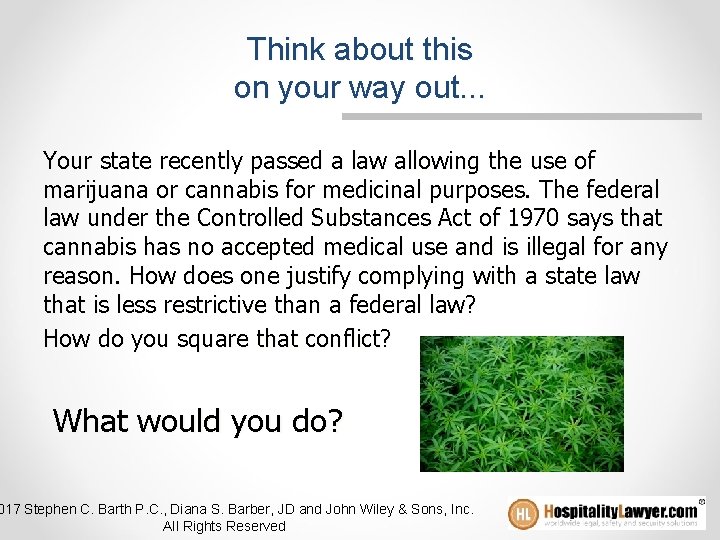
Think about this on your way out. . . Your state recently passed a law allowing the use of marijuana or cannabis for medicinal purposes. The federal law under the Controlled Substances Act of 1970 says that cannabis has no accepted medical use and is illegal for any reason. How does one justify complying with a state law that is less restrictive than a federal law? How do you square that conflict? What would you do? 017 Stephen C. Barth P. C. , Diana S. Barber, JD and John Wiley & Sons, Inc. All Rights Reserved