
CHAPTER 2 Global MarketEntry Strategies Learning Objectives 1

CHAPTER 2 Global Market-Entry Strategies
Learning Objectives 1. Explain the advantages and disadvantages of using licensing as a market-entry strategy. 2. Compare and contrast the different forms that a company’s foreign investments can take. 3. Discuss the factors that contribute to the successful launch of a global strategic partnership. 4. Explain the growth of cooperative strategies in the 21 st century.
Introduction § Trade barriers are falling around the world § Companies need to have a strategy to enter world markets.
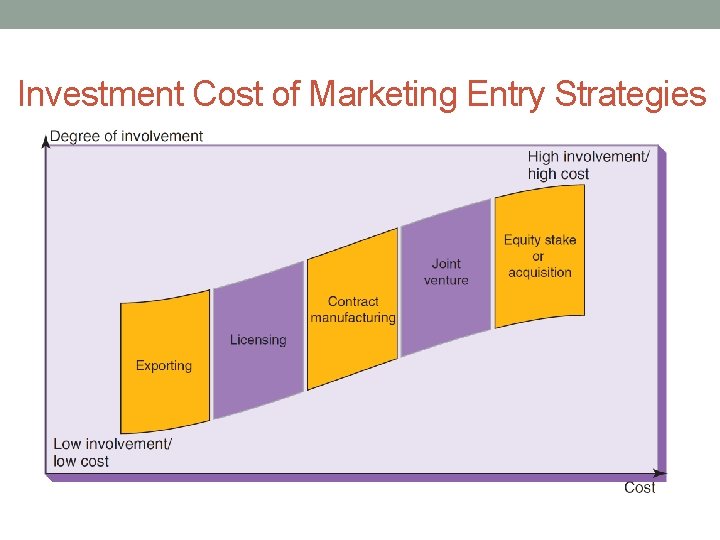
Investment Cost of Marketing Entry Strategies
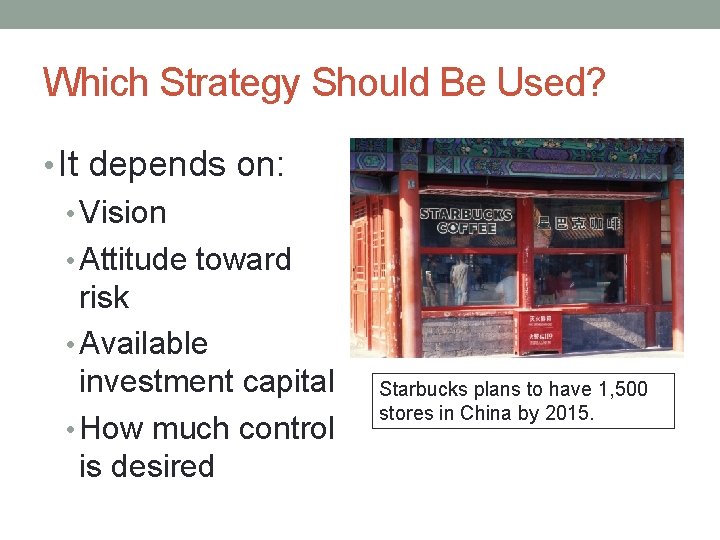
Which Strategy Should Be Used? • It depends on: • Vision • Attitude toward risk • Available investment capital • How much control is desired Starbucks plans to have 1, 500 stores in China by 2015.

How Do Firms Go International? • Foreign market entry strategies vary in: • Degree of risk they present, • The control and commitment of resources they require, and • The return on investment they promise.
Which strategy should be used? • It depends on: • Vision • Attitude toward risk • How much investment capital is available • How much control is desired
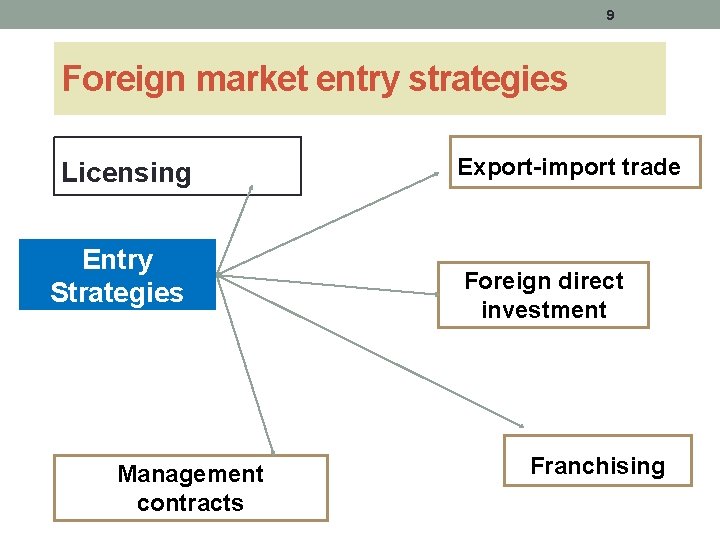
9 Foreign market entry strategies Licensing Entry Strategies Management contracts Export-import trade Foreign direct investment Franchising
Licensing • A contractual agreement whereby one company (the licensor) makes an asset available to another company (the licensee) in exchange for royalties, license fees, or some other form of compensation. • Worldwide sales of licensed goods totaled $241. 5 billion in 2014. Disney is the world’s top licensor.
Advantages to Licensing • Provides additional profitability with little initial investment. • Provides method of avoiding tariffs, quotas, and other export barriers. • Low costs to implement. • Licensees have autonomy to adapt products to local tastes.
Disadvantages to Licensing • Limited market control. • Returns may be lost. • The agreement may be short-lived. • Licensee may become competitor.
Joint Ventures • Entry strategy for a single target country in which the partners share ownership of a newly -created business entity • Builds upon each partner’s strengths. • Examples: Budweiser and Kirin (Japan), GM and Toyota, GM and Daewoo in S. Korea, Ford and Mazda.
Joint Ventures • Advantages • Disadvantages – Allows for risk sharing– – Requires more investment financial and political – Provides opportunity to learn new environment – Provides opportunity to achieve interaction by combining strengths of partners – May be the only way to enter market given barriers to entry than a licensing agreement – Must share rewards as well as risks – Requires strong coordination – Potential for conflict among partners – Partner may become a competitor
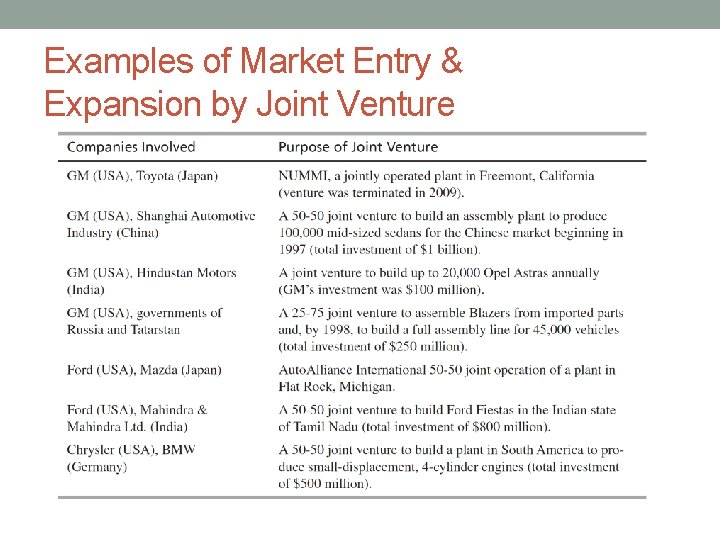
Examples of Market Entry & Expansion by Joint Venture
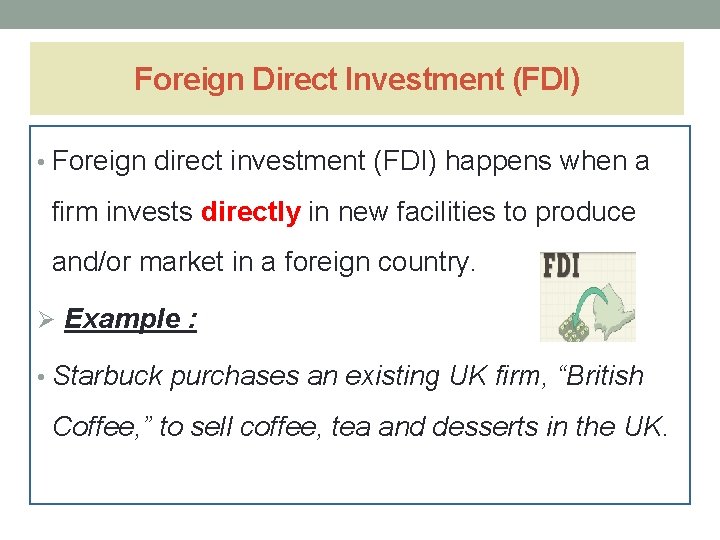
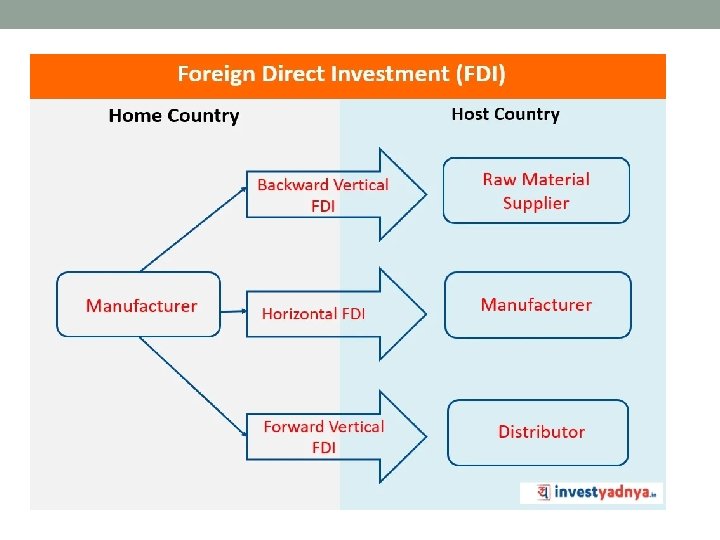
Foreign Direct Investment (FDI) • Foreign direct investment (FDI) happens when a firm invests directly in new facilities to produce and/or market in a foreign country. Ø Example : • Starbuck purchases an existing UK firm, “British Coffee, ” to sell coffee, tea and desserts in the UK.
q Indirect investments Ø Direct investments are when companies make physical investments and purchases in buildings, factories, machines, and other equipment outside of their home country. Ø Indirect investments are when companies or financial institutions purchase shares in companies on a foreign stock exchange. • No managerial involvement = portfolio investment (Indirect Investment).
Foreign Direct Investment (FDI) q FDI Involves ownership of unit abroad for: • Production • Marketing/service • R&D • Raw materials or other resource access • Parent company has direct managerial control. • The degree of direct managerial control depends on the extent of ownership of the foreign entity and on other contractual terms of the FDI.
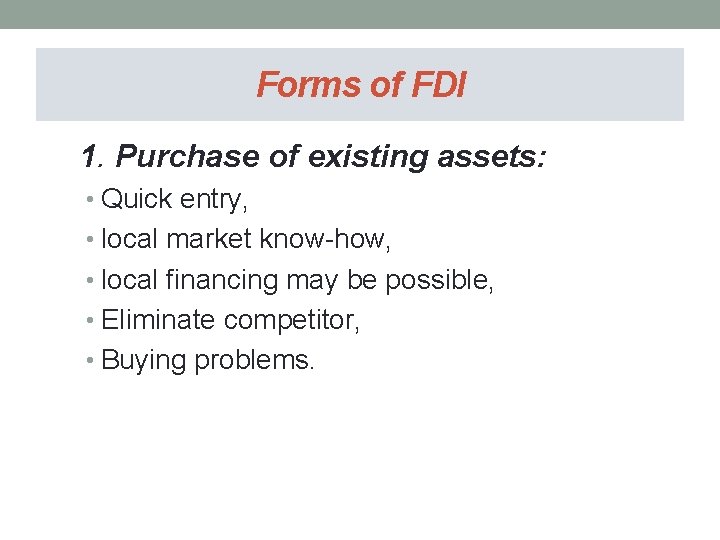
Forms of FDI 1. Purchase of existing assets: • Quick entry, • local market know-how, • local financing may be possible, • Eliminate competitor, • Buying problems.
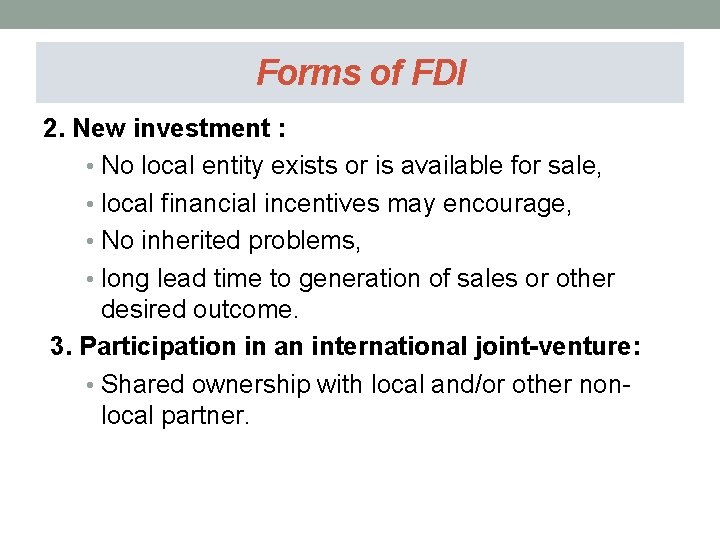
Forms of FDI 2. New investment : • No local entity exists or is available for sale, • local financial incentives may encourage, • No inherited problems, • long lead time to generation of sales or other desired outcome. 3. Participation in an international joint-venture: • Shared ownership with local and/or other nonlocal partner.
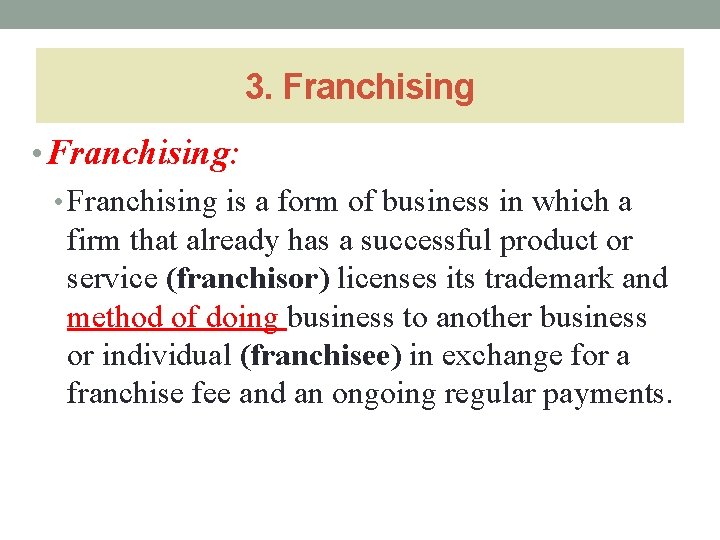
3. Franchising • Franchising: • Franchising is a form of business in which a firm that already has a successful product or service (franchisor) licenses its trademark and method of doing business to another business or individual (franchisee) in exchange for a franchise fee and an ongoing regular payments.
Franchisor–Franchisee relationship Ø Regulated by contract which usually covers: • Initial fee. • Royalty fee/Management fee. • Capital required from franchisee. • Area of operation. • Duration of license and renewal • Termination (End).
Management contracts • A management contract: is an arrangement under which operational functions of a company is assigned by contract to another company which performs the necessary managerial functions in return for a fee. • Management contracts involve not just selling a method of doing things but involve actually doing them. • A management contract can involve a wide range of functions, such as management of personnel, accounting, marketing services and training.
Management Contracts- Examples q Sports Facility Managers q Property Management q Artist Managers
Contract Manufacturing • Contract Manufacturing: • A firm producing goods under the brand name of a different firm. • In the computer and electronics fields, thousands of products are manufactured by contract manufacturers. • These products are ordered by and branded with the OEM's "original design manufacturer“ name, which sells them to its customers.
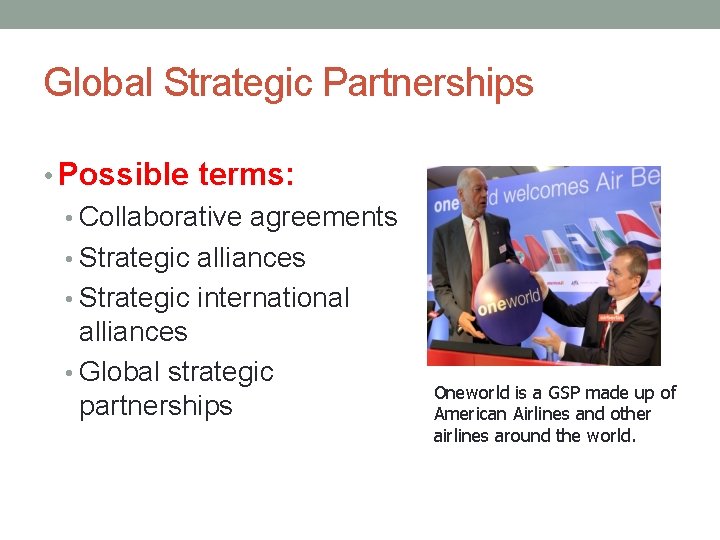
Global Strategic Partnerships • Possible terms: • Collaborative agreements • Strategic alliances • Strategic international alliances • Global strategic partnerships Oneworld is a GSP made up of American Airlines and other airlines around the world.
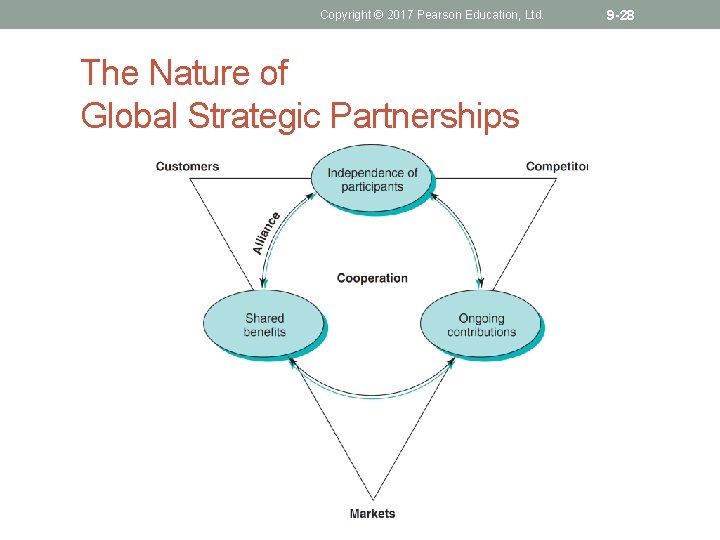
Copyright © 2017 Pearson Education, Ltd. The Nature of Global Strategic Partnerships 9 -28
Copyright © 2017 Pearson Education, Ltd. 9 -29 Characteristics of Global Strategic Partnerships • Participants remain independent following formation of the alliance • Participants share benefits of alliance as well as control over performance of assigned tasks • Participants make ongoing contributions in technology, products, and other key strategic areas
Copyright © 2017 Pearson Education, Ltd. 9 -30 Success Factors of Alliances • Mission: Successful GSPs create win-win situations, where participants pursue objectives on the basis of related need or advantage. • Strategy: A company may establish separate GSPs with different partners; strategy must be thought out up front to avoid conflicts. • Governance: Discussion and agreement must be the norms. Partners must be viewed as equals.
Copyright © 2017 Pearson Education, Ltd. 9 -31 Success Factors (Con’t) • Culture: Personal chemistry is important, as is the successful development of a shared set of values. • Organization: Innovative structures and designs may be needed to balance the complexity of multi-country management. • Management: Potentially divisive issues must be identified in advance and clear, unitary lines of authority established that will result in commitment by all partners.
Copyright © 2017 Pearson Education, Ltd. 9 -32 21 st Century Cooperative Strategies: Targeting the Digital Future • Alliances between companies in several industries that are undergoing transformation and convergence • Computers • Communications • Consumer electronics • Entertainment
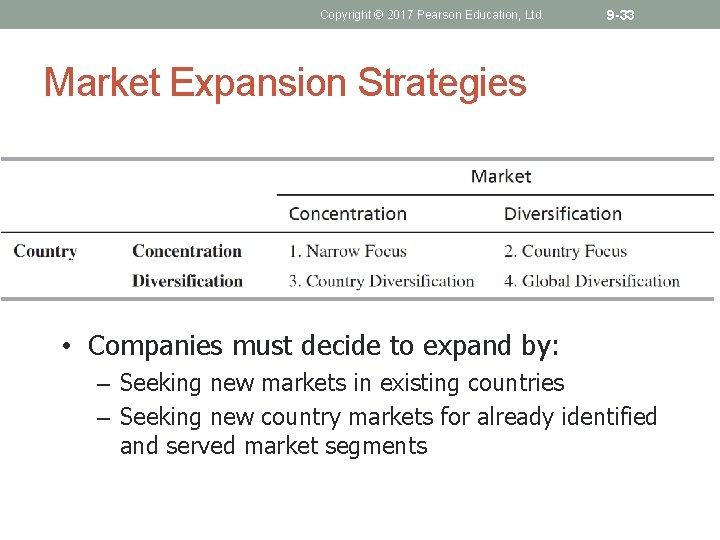
Copyright © 2017 Pearson Education, Ltd. 9 -33 Market Expansion Strategies • Companies must decide to expand by: – Seeking new markets in existing countries – Seeking new country markets for already identified and served market segments

The End
- Slides: 34