
Chapter 2 Gain Scheduling Adaptive controllers Contents Model
- Slides: 39
Chapter 2 Gain Scheduling Adaptive controllers
Contents • Model of a system/ plant – State space models – Input/output models – Plant parametric models • Stability – Input/output stability – Lyapunove stability • Gain scheduling adaptive controller
Model of a plant • A plant model can be given by – State space model – Input output model – Plant parametric model • The type of model to be used depends on the design method to be followed and the type of the plant
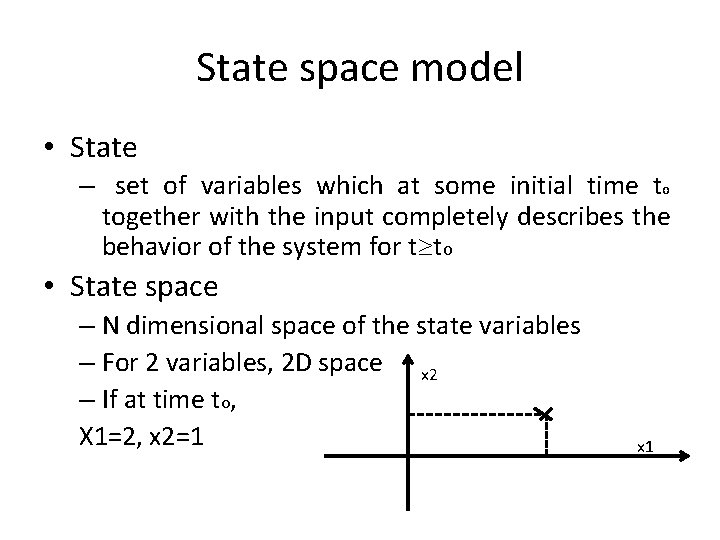
State space model • State – set of variables which at some initial time to together with the input completely describes the behavior of the system for t to • State space – N dimensional space of the state variables – For 2 variables, 2 D space x 2 – If at time to, X 1=2, x 2=1 x 1
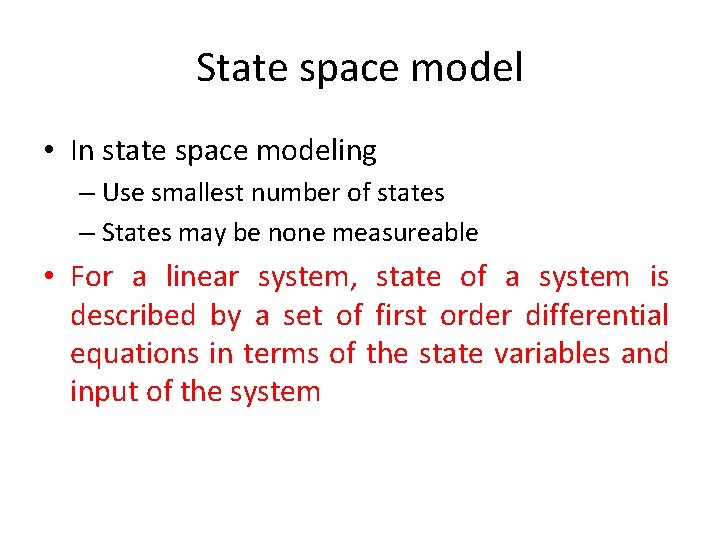
State space model • In state space modeling – Use smallest number of states – States may be none measureable • For a linear system, state of a system is described by a set of first order differential equations in terms of the state variables and input of the system
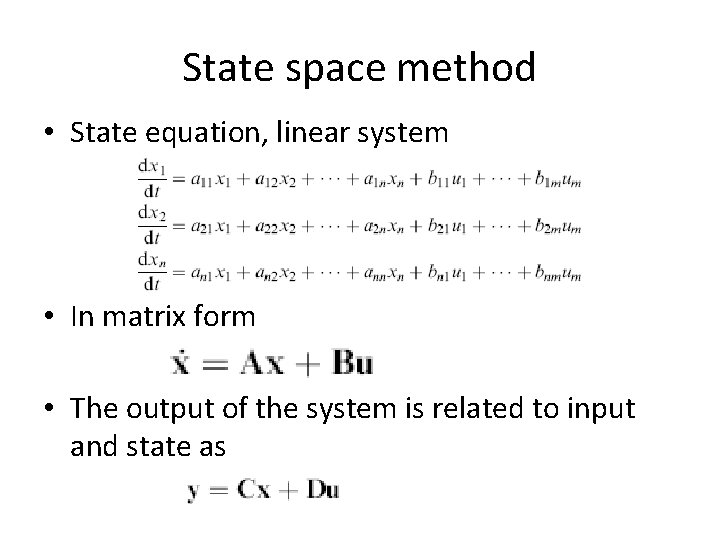
State space method • State equation, linear system • In matrix form • The output of the system is related to input and state as
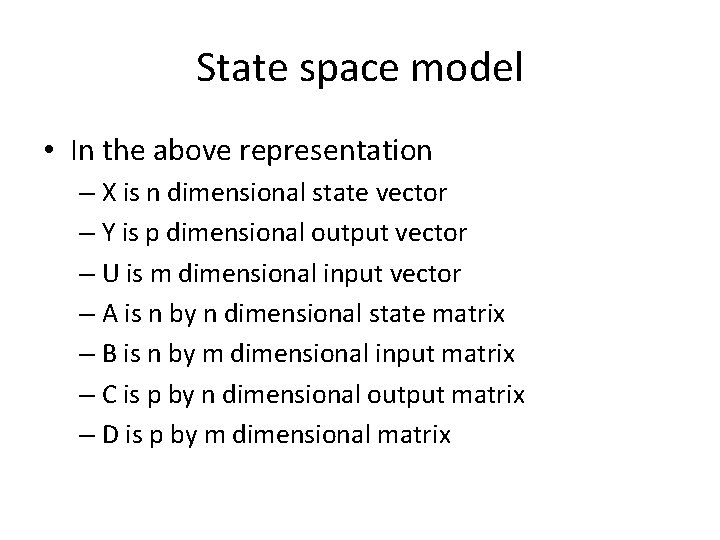
State space model • In the above representation – X is n dimensional state vector – Y is p dimensional output vector – U is m dimensional input vector – A is n by n dimensional state matrix – B is n by m dimensional input matrix – C is p by n dimensional output matrix – D is p by m dimensional matrix
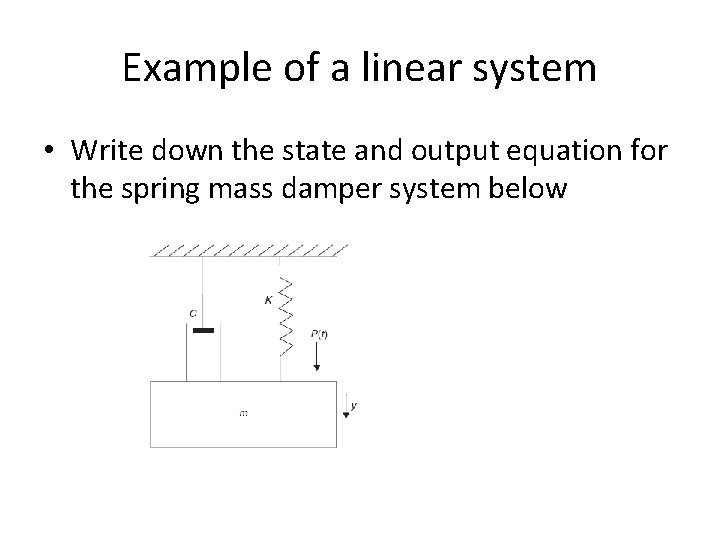
Example of a linear system • Write down the state and output equation for the spring mass damper system below
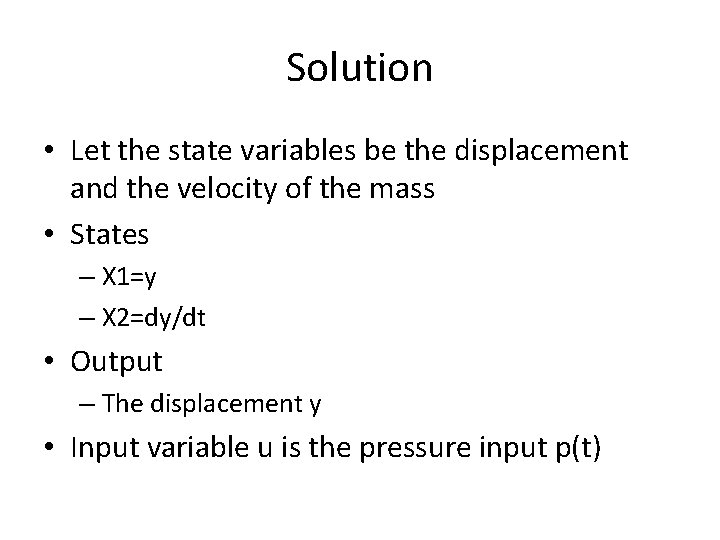
Solution • Let the state variables be the displacement and the velocity of the mass • States – X 1=y – X 2=dy/dt • Output – The displacement y • Input variable u is the pressure input p(t)
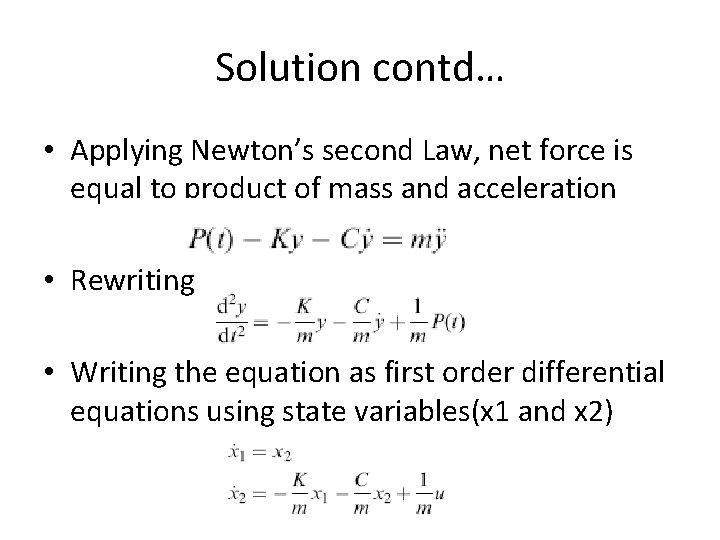
Solution contd… • Applying Newton’s second Law, net force is equal to product of mass and acceleration • Rewriting • Writing the equation as first order differential equations using state variables(x 1 and x 2)
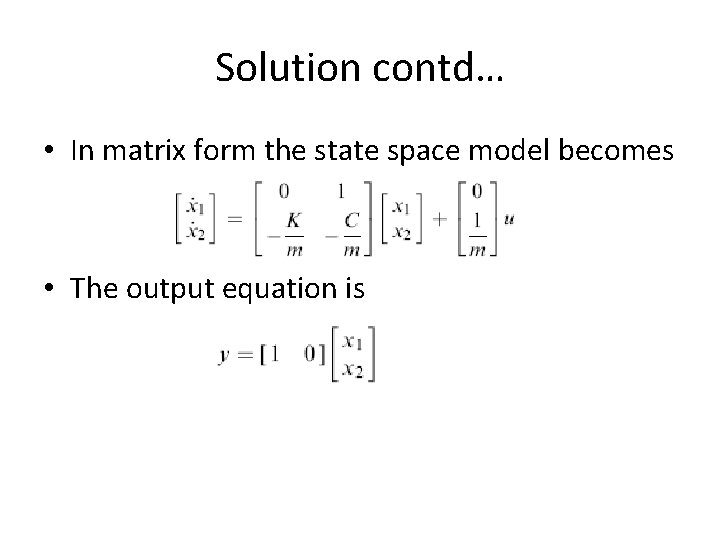
Solution contd… • In matrix form the state space model becomes • The output equation is
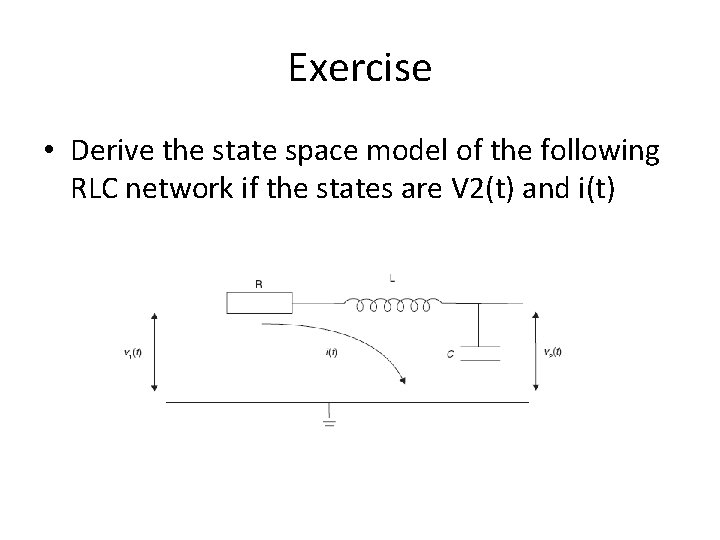
Exercise • Derive the state space model of the following RLC network if the states are V 2(t) and i(t)
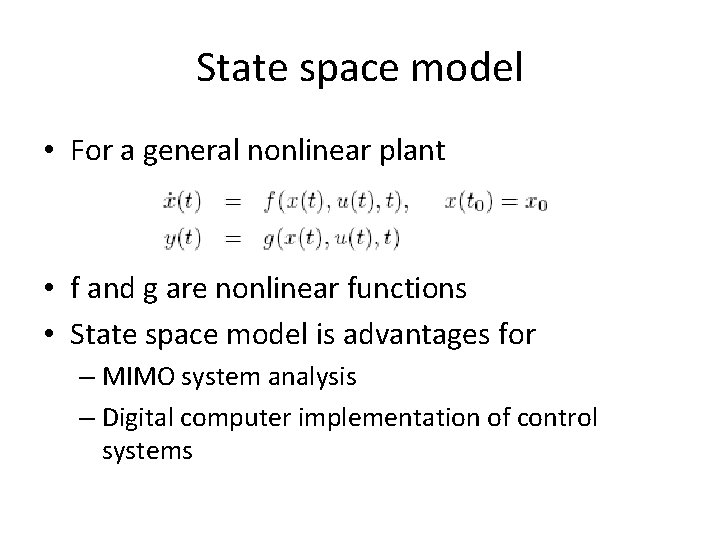
State space model • For a general nonlinear plant • f and g are nonlinear functions • State space model is advantages for – MIMO system analysis – Digital computer implementation of control systems
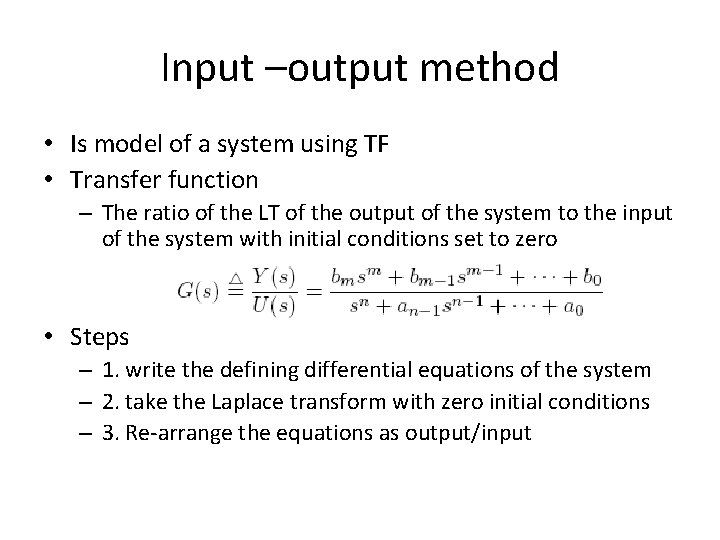
Input –output method • Is model of a system using TF • Transfer function – The ratio of the LT of the output of the system to the input of the system with initial conditions set to zero • Steps – 1. write the defining differential equations of the system – 2. take the Laplace transform with zero initial conditions – 3. Re-arrange the equations as output/input
Input-output method contd… • In the above representation – If m<n, the system is said to be proper – If all the roots of the numerator have real parts in the negative half s-plane, the system is said to be minimum phase – If all the roots of the denumerator have real parts in the negative half of the s-plane the system is said to be stable
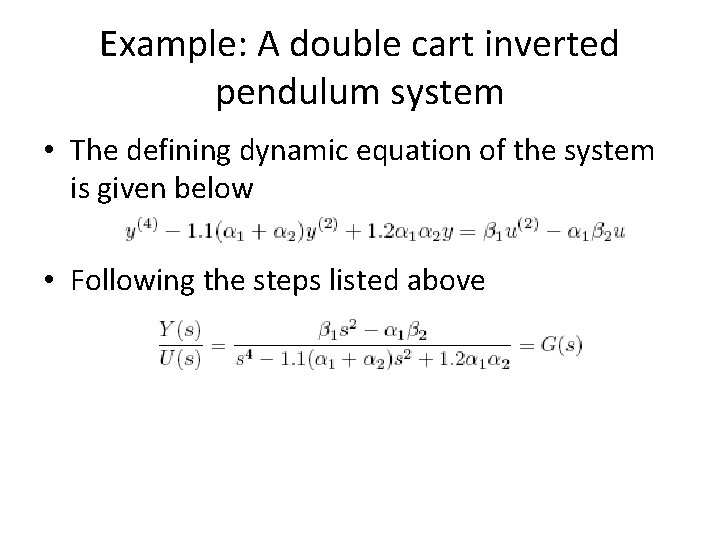
Example: A double cart inverted pendulum system • The defining dynamic equation of the system is given below • Following the steps listed above
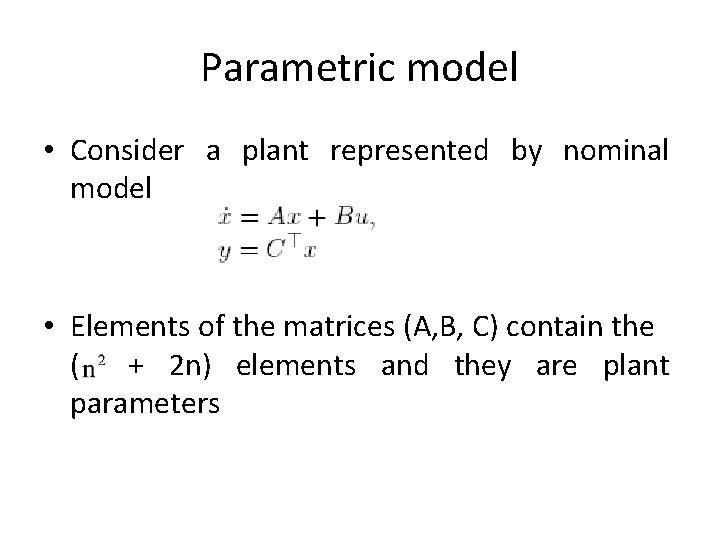
Parametric model • Consider a plant represented by nominal model • Elements of the matrices (A, B, C) contain the ( + 2 n) elements and they are plant parameters
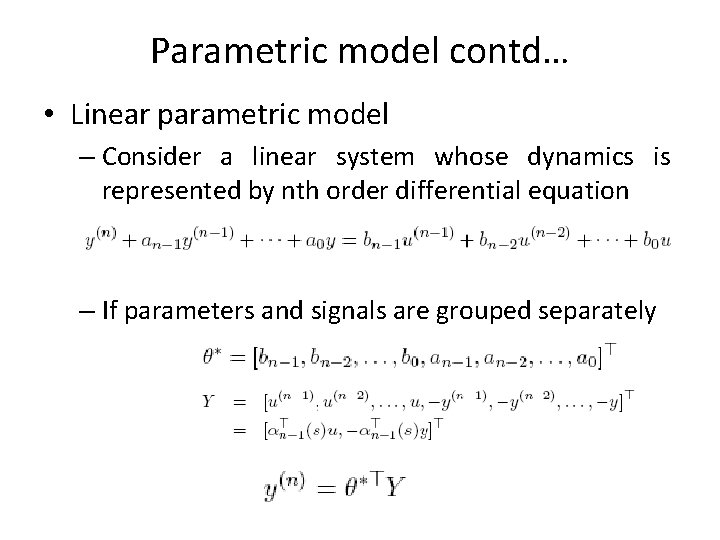
Parametric model contd… • Linear parametric model – Consider a linear system whose dynamics is represented by nth order differential equation – If parameters and signals are grouped separately
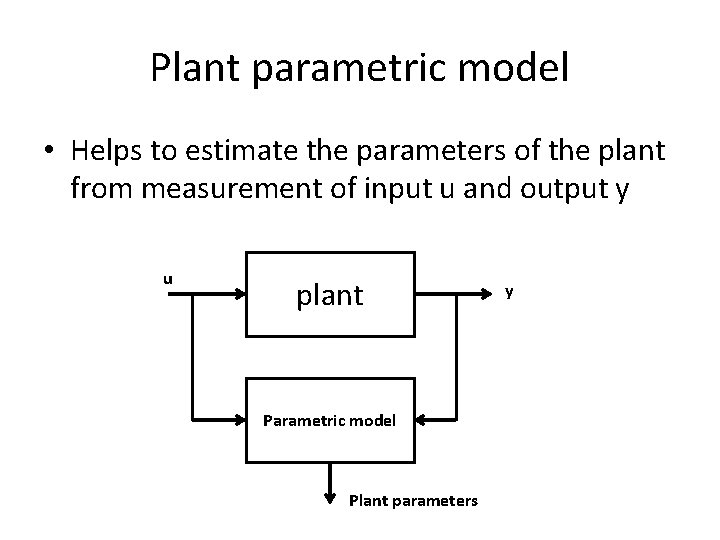
Plant parametric model • Helps to estimate the parameters of the plant from measurement of input u and output y u plant Parametric model Plant parameters y
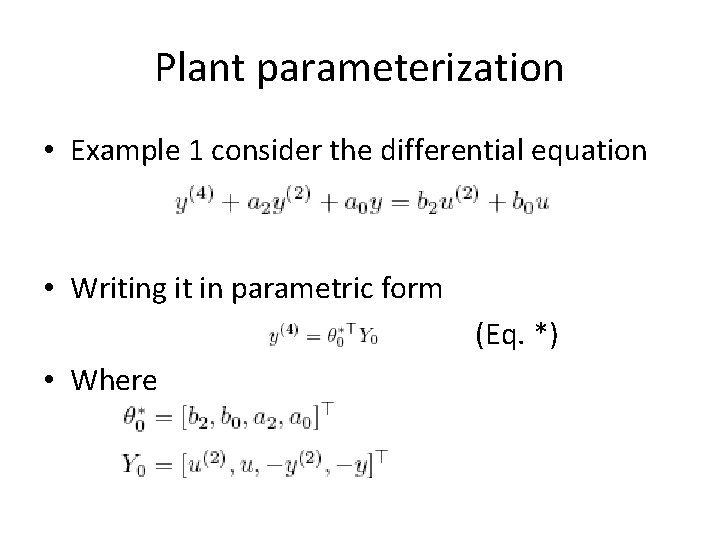
Plant parameterization • Example 1 consider the differential equation • Writing it in parametric form (Eq. *) • Where
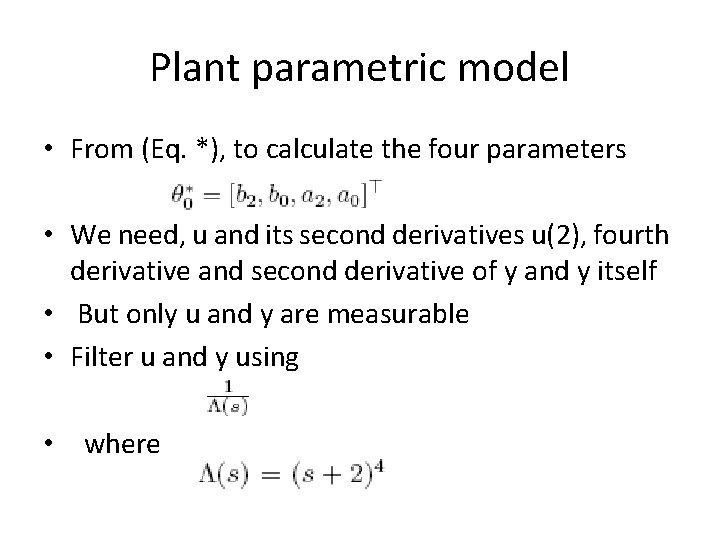
Plant parametric model • From (Eq. *), to calculate the four parameters • We need, u and its second derivatives u(2), fourth derivative and second derivative of y and y itself • But only u and y are measurable • Filter u and y using • where
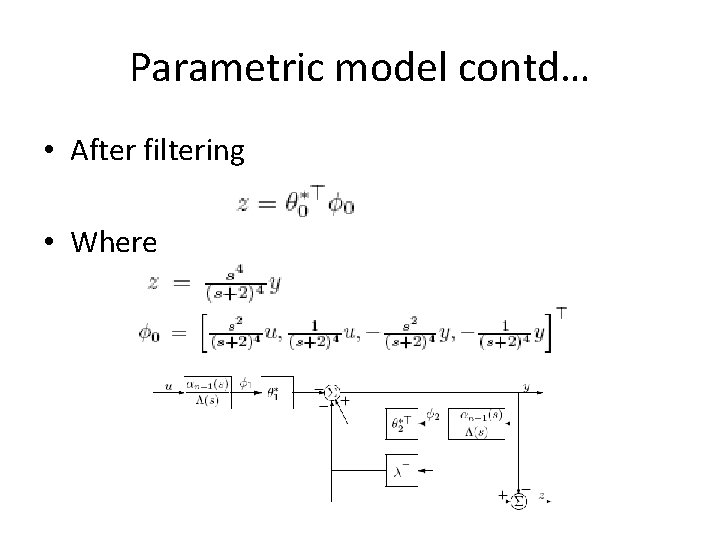
Parametric model contd… • After filtering • Where
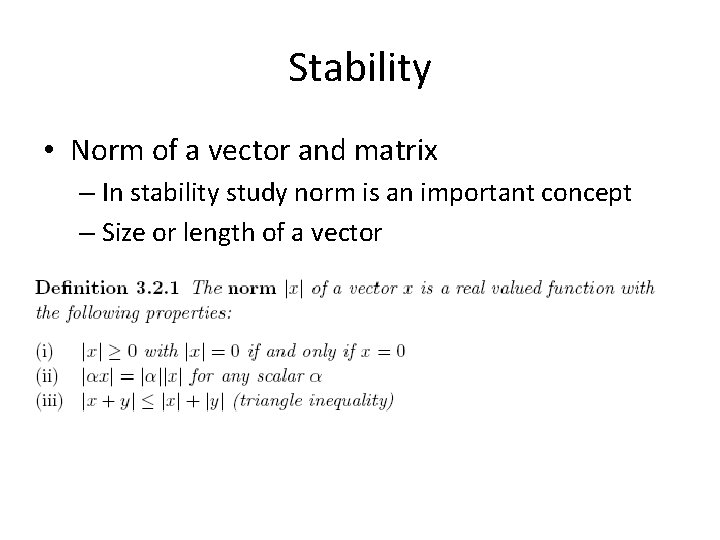
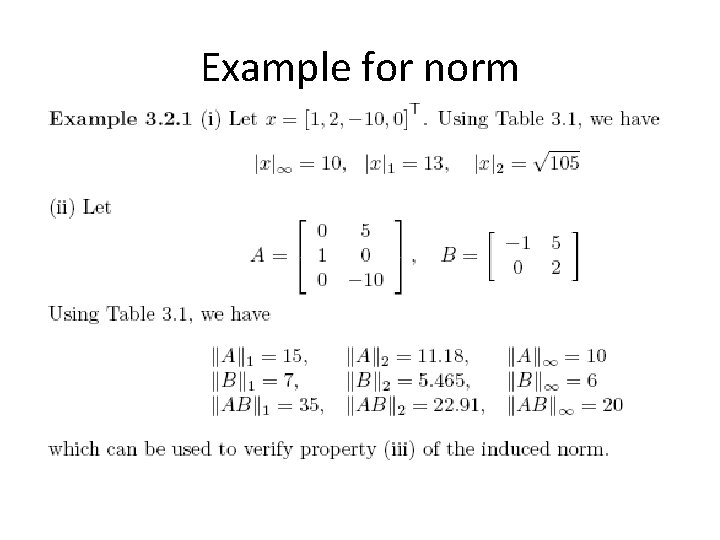
Stability • Norm of a vector and matrix – In stability study norm is an important concept – Size or length of a vector
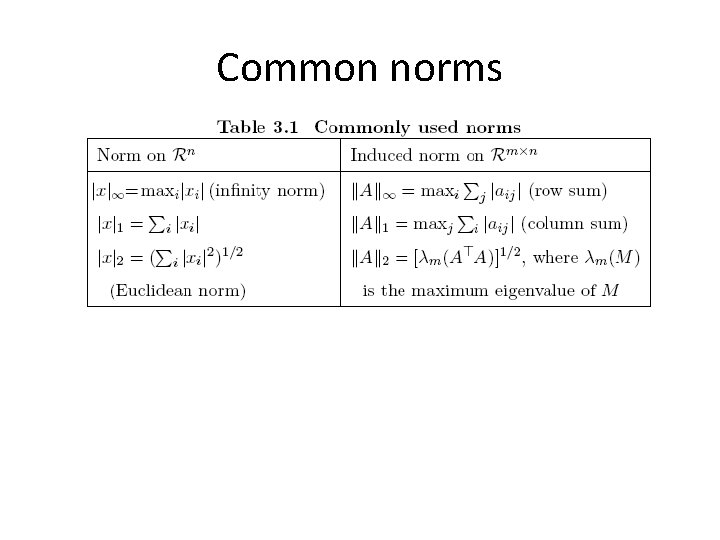
Common norms
Example for norm
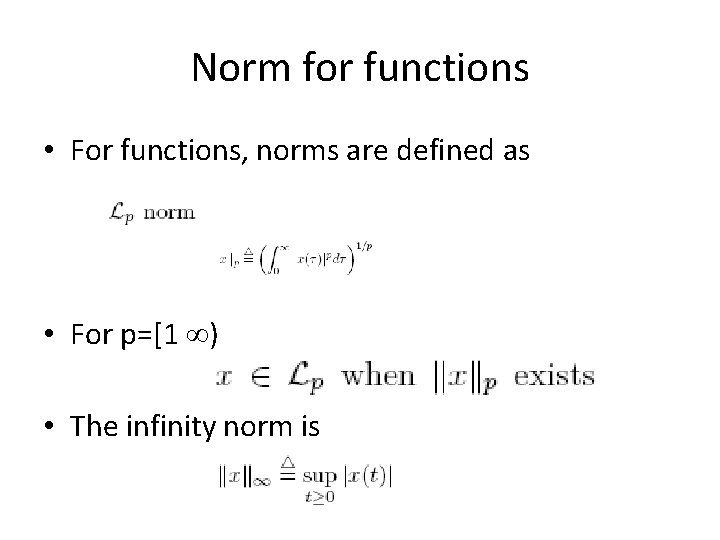
Norm for functions • For functions, norms are defined as • For p=[1 ) • The infinity norm is
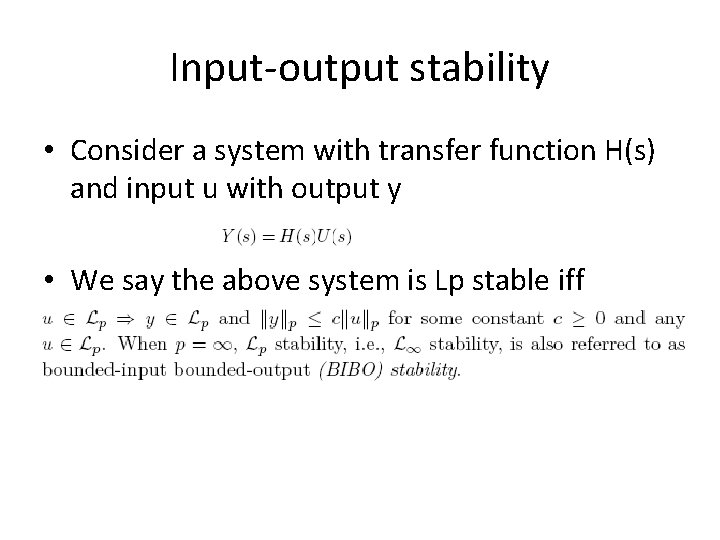
Input-output stability • Consider a system with transfer function H(s) and input u with output y • We say the above system is Lp stable iff
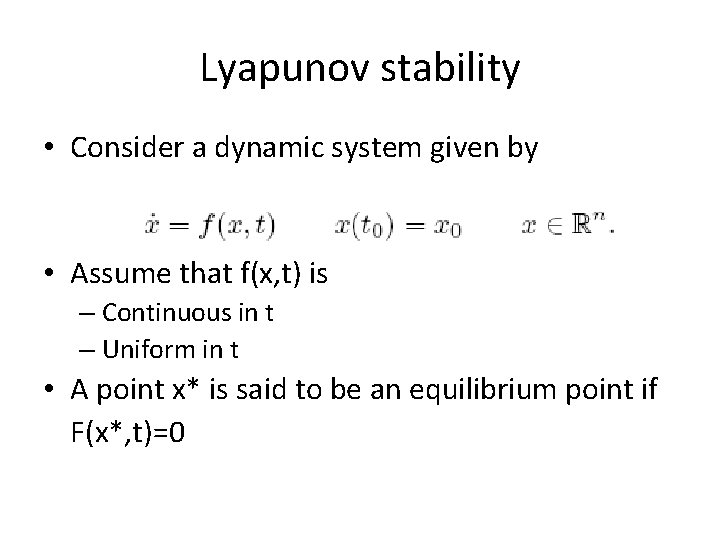
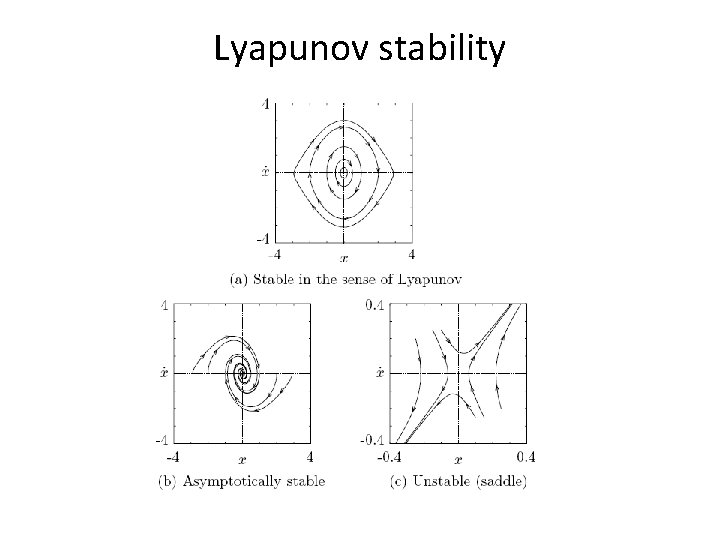
Lyapunov stability • Consider a dynamic system given by • Assume that f(x, t) is – Continuous in t – Uniform in t • A point x* is said to be an equilibrium point if F(x*, t)=0
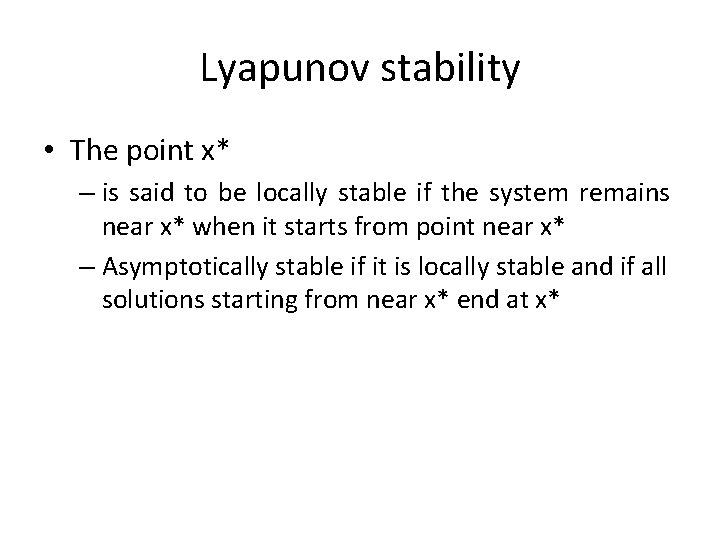
Lyapunov stability • The point x* – is said to be locally stable if the system remains near x* when it starts from point near x* – Asymptotically stable if it is locally stable and if all solutions starting from near x* end at x*
Lyapunov stability
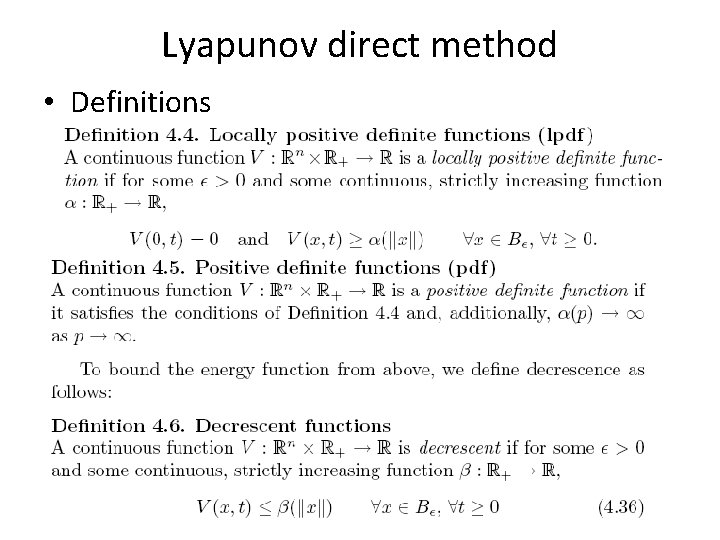
Lyapunov direct method • Definitions
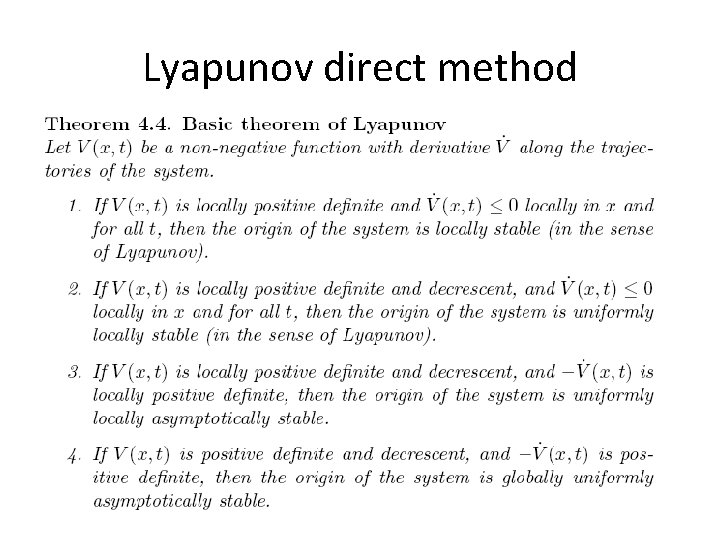
Lyapunov direct method
Gain scheduling controller • Gain scheduling is an adaptive control strategy, where the gain of the system is determined and based on its value the controller parameters are changed. • In many cases, it is possible to find measurable variables that correlate well with changes in process dynamics. • These variables can then be used to change the controller parameters. • This approach is called gain scheduling because the scheme was originally used to measure the gain and then change, that is, schedule the controller to compensate for changes in the process gain.
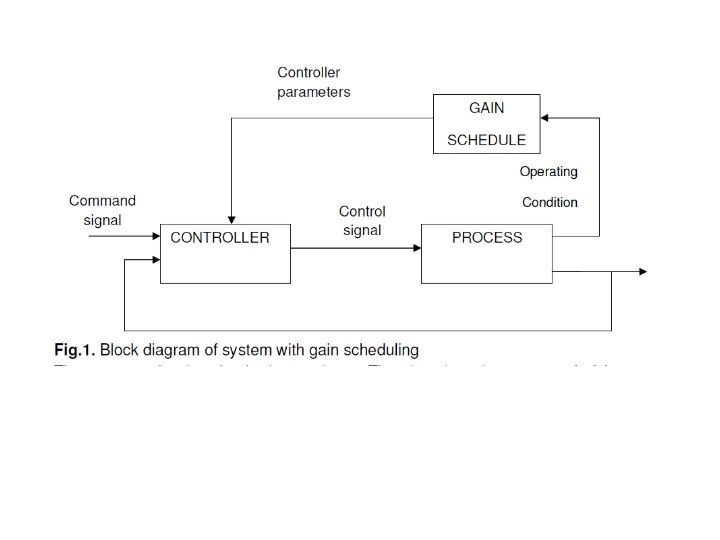
• The system can be viewed as having two loops. • There is an inner loop composed of the process and the controller • Outer loop contains components that adjust the controller parameters on the basis of the operating conditions. • Gain scheduling can be regarded as mapping from process parameters to controller parameters. • It can be implemented as a function or a table lookup. • The concept of gain scheduling originated in connection with the development of flight control systems. • In this application, the Mach number and the altitude are measured by air data sensors and used as scheduling variables. This was used, for instance, in the X-15. • In process control the production rate can be often chosen as a scheduling variable, since time constants and time delays are often inversely proportional to production rate. • Gain scheduling is thus a very useful technique for reducing the effects of parameter variations.
Advantages: • Parameters can be changed quickly in response to changes in plant dynamics • This strategy is very easy to apply if the plant dynamics depends in a well known fashion on a relatively few easily measurable variables Drawbacks: • It is an open-loop adaptation scheme, with no real learning or intelligence • The design required for its implementation is enormous.
Design of gain scheduling controllers • The key issue in the design of gain scheduling controllers is the determination of variables that can be used as scheduling variables. • One criterion for selection of the scheduling variable is that these auxiliary variables must reflect the operating conditions of the plant. • Ideally there should be simple expressions for how the controller parameters relate to the scheduling variables. • It is thus necessary to have a good insight into the dynamics of the process if gain scheduling is to be used.
Design of gain scheduling controllers • Design of gain scheduling controllers can be carried out by one of the following techniques: – Gain scheduling based on measurement of auxiliary variables – Time scaling based on the production rate and – Nonlinear transformations • It should be noted here that by linearizing of nonlinear actuators, we get a very improved performance, but this should not be regarded as gain scheduling because, gain scheduling should consist of a measurement of variable related to the operating condition of the process.
• But often it is not easy to determine the controller parameters as a function of measured variables. • The design of controller must then be redone for different working points of the process. Some care must also be taken if the measured signals are noisy. They should be filtered properly before they are used as scheduling variables.