
Chapter 2 Fundamentals of Geographic Information and Maps
- Slides: 38
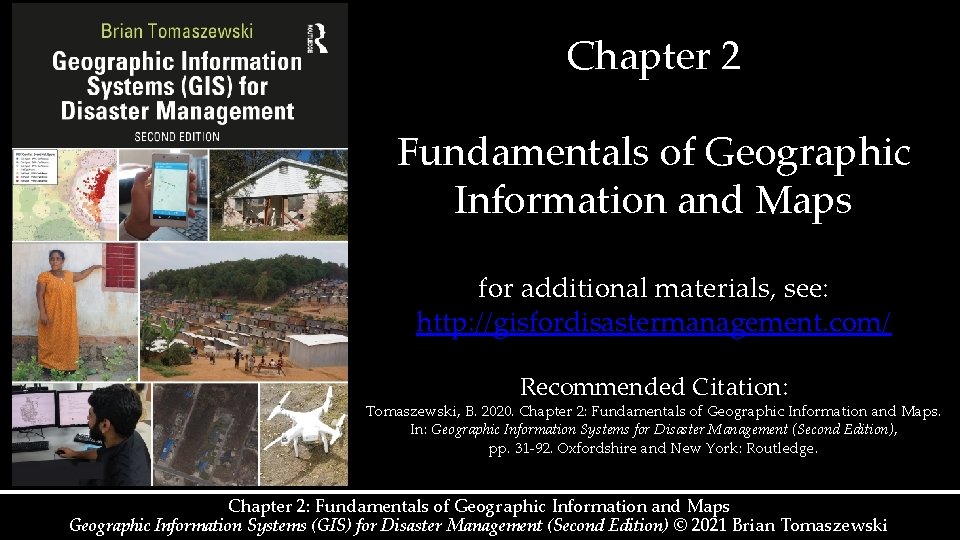
Chapter 2 Fundamentals of Geographic Information and Maps for additional materials, see: http: //gisfordisastermanagement. com/ Recommended Citation: Tomaszewski, B. 2020. Chapter 2: Fundamentals of Geographic Information and Maps. In: Geographic Information Systems for Disaster Management (Second Edition), pp. 31 92. Oxfordshire and New York: Routledge. Chapter 2: Fundamentals of Geographic Information and Maps Geographic Information Systems (GIS) for Disaster Management (Second Edition) © 2021 Brian Tomaszewski
Chapter 2 Objectives • Understand the difference between data and information • Describe the concept of map scale and how map scale is represented • Understand what map projections are and discern the differences between different map projection types • Be familiar with common map coordinate systems • Understand mapping principles such as data measurement, visual variables, and figure/ground relationships • Discern the differences between reference and thematic maps • Be familiar with common map design elements and • Identify common errors when first learning to use Geographic Information Systems (GIS) to create maps Chapter 2: Fundamentals of Geographic Information and Maps Geographic Information Systems (GIS) for Disaster Management (Second Edition) © 2021 Brian Tomaszewski
Introduction • Important scientific principles related to the fundamentals of geographic information and maps • Maps scale, map projections, coordinate systems, and datums • Mapping topics focus on cartographic concepts and map design Chapter 2: Fundamentals of Geographic Information and Maps Geographic Information Systems (GIS) for Disaster Management (Second Edition) © 2021 Brian Tomaszewski
Data vs. Information • Data and information often used interchangeably • Data: raw facts or observations • Information: data with context or making sense of data so that it is actionable or useful • Examples of each? Chapter 2: Fundamentals of Geographic Information and Maps Geographic Information Systems (GIS) for Disaster Management (Second Edition) © 2021 Brian Tomaszewski
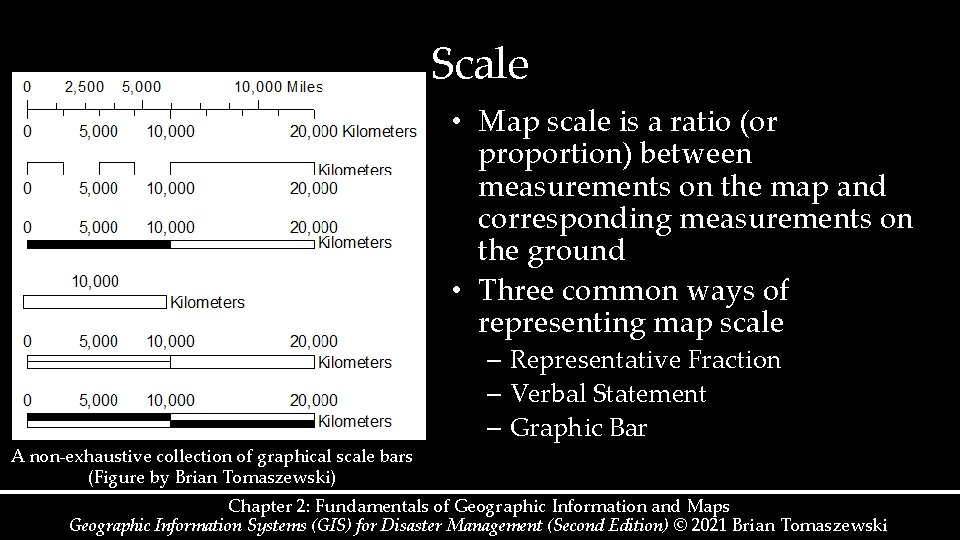
Scale • Map scale is a ratio (or proportion) between measurements on the map and corresponding measurements on the ground • Three common ways of representing map scale A non exhaustive collection of graphical scale bars (Figure by Brian Tomaszewski) – Representative Fraction – Verbal Statement – Graphic Bar Chapter 2: Fundamentals of Geographic Information and Maps Geographic Information Systems (GIS) for Disaster Management (Second Edition) © 2021 Brian Tomaszewski
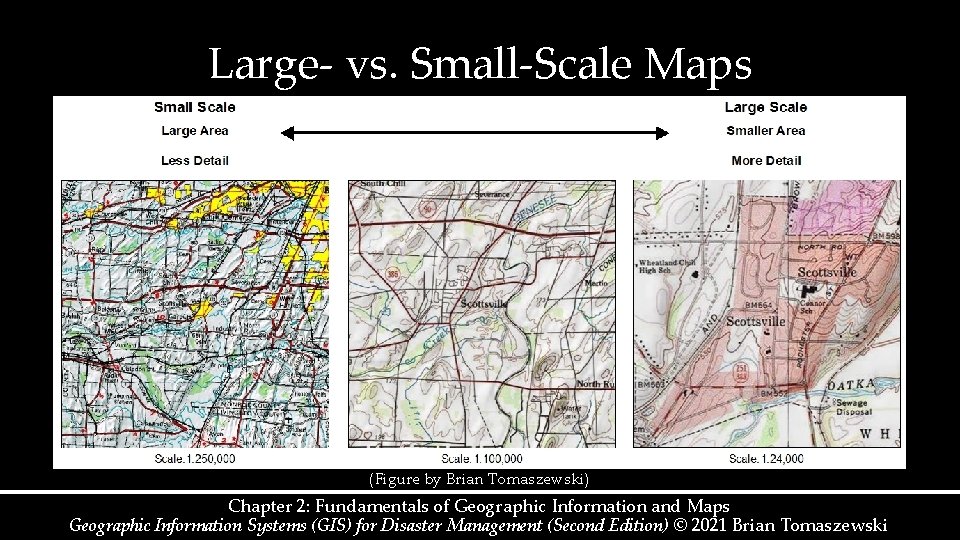
Scale • • Small scale maps show a larger area with less detail A large scale map shows a smaller area with more detail Examples of each? Why Scale Matters: Detail and Accuracy – data detail is scale dependent – accuracy is scale dependent Chapter 2: Fundamentals of Geographic Information and Maps Geographic Information Systems (GIS) for Disaster Management (Second Edition) © 2021 Brian Tomaszewski
Large vs. Small Scale Maps (Figure by Brian Tomaszewski) Chapter 2: Fundamentals of Geographic Information and Maps Geographic Information Systems (GIS) for Disaster Management (Second Edition) © 2021 Brian Tomaszewski
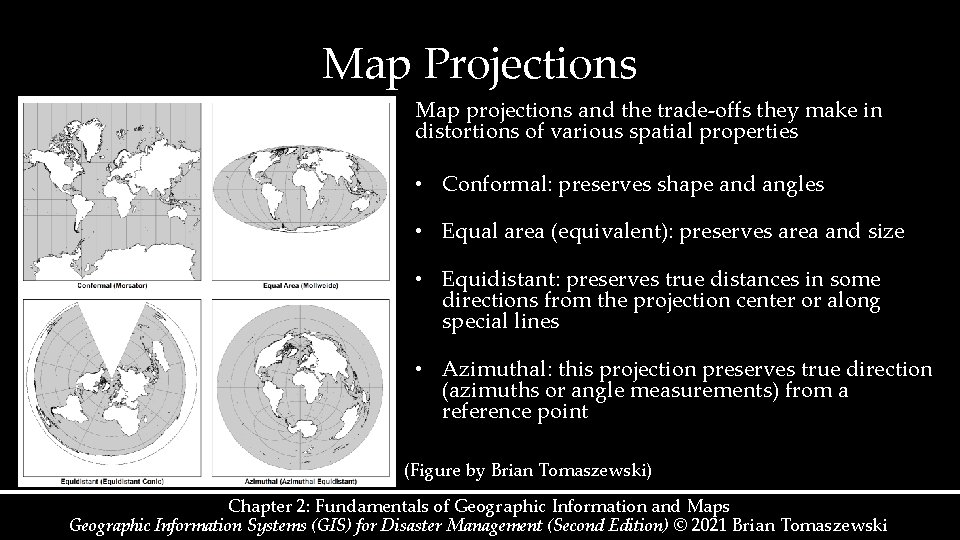
Map Projections 1. 2. 3. 4. 5. 6. 7. Projections are mathematical transformations Scale is true only in certain places Many different types of projections have been devised All map projections distort Distortion characteristics vary among projection types Some types are better for some applications than others A few types are used widely Chapter 2: Fundamentals of Geographic Information and Maps Geographic Information Systems (GIS) for Disaster Management (Second Edition) © 2021 Brian Tomaszewski
Map Projections Map projections and the trade offs they make in distortions of various spatial properties • Conformal: preserves shape and angles • Equal area (equivalent): preserves area and size • Equidistant: preserves true distances in some directions from the projection center or along special lines • Azimuthal: this projection preserves true direction (azimuths or angle measurements) from a reference point (Figure by Brian Tomaszewski) Chapter 2: Fundamentals of Geographic Information and Maps Geographic Information Systems (GIS) for Disaster Management (Second Edition) © 2021 Brian Tomaszewski
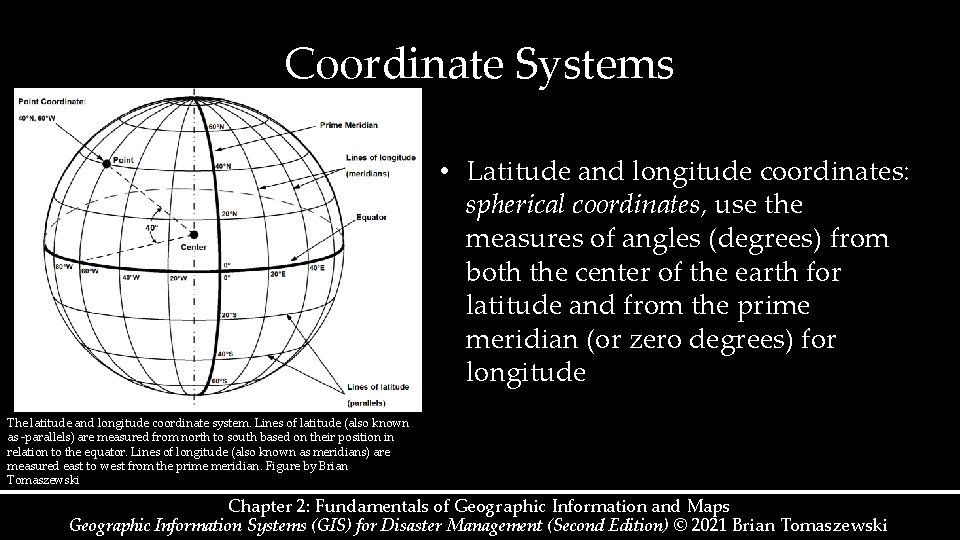
Coordinate Systems • Latitude and longitude coordinates: spherical coordinates, use the measures of angles (degrees) from both the center of the earth for latitude and from the prime meridian (or zero degrees) for longitude The latitude and longitude coordinate system. Lines of latitude (also known as parallels) are measured from north to south based on their position in relation to the equator. Lines of longitude (also known as meridians) are measured east to west from the prime meridian. Figure by Brian Tomaszewski Chapter 2: Fundamentals of Geographic Information and Maps Geographic Information Systems (GIS) for Disaster Management (Second Edition) © 2021 Brian Tomaszewski
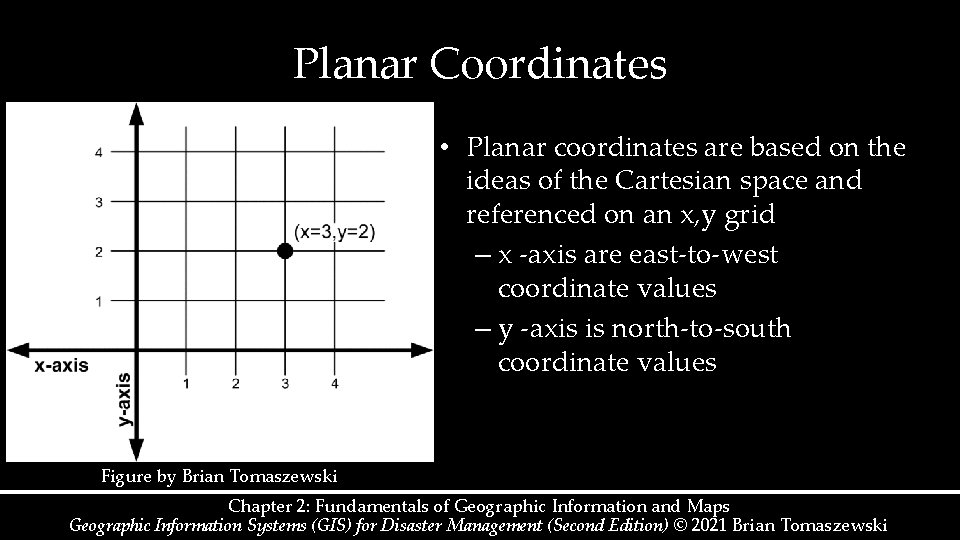
Planar Coordinates • Planar coordinates are based on the ideas of the Cartesian space and referenced on an x, y grid – x axis are east to west coordinate values – y axis is north to south coordinate values Figure by Brian Tomaszewski Chapter 2: Fundamentals of Geographic Information and Maps Geographic Information Systems (GIS) for Disaster Management (Second Edition) © 2021 Brian Tomaszewski
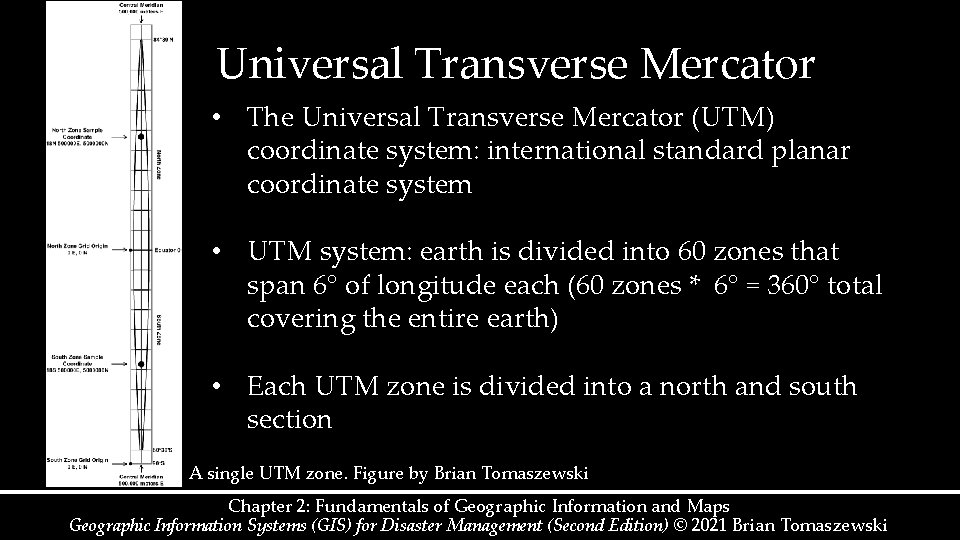
Universal Transverse Mercator • The Universal Transverse Mercator (UTM) coordinate system: international standard planar coordinate system • UTM system: earth is divided into 60 zones that span 6° of longitude each (60 zones * 6° = 360° total covering the entire earth) • Each UTM zone is divided into a north and south section A single UTM zone. Figure by Brian Tomaszewski Chapter 2: Fundamentals of Geographic Information and Maps Geographic Information Systems (GIS) for Disaster Management (Second Edition) © 2021 Brian Tomaszewski
Universal Transverse Mercator Issues • 60 zones of the UTM system do not conform to political boundaries or jurisdictions • Can be unusable in situations where a geographical referencing system is needed across an entire political or jurisdictional Figure by Brian Tomaszewski Chapter 2: Fundamentals of Geographic Information and Maps Geographic Information Systems (GIS) for Disaster Management (Second Edition) © 2021 Brian Tomaszewski
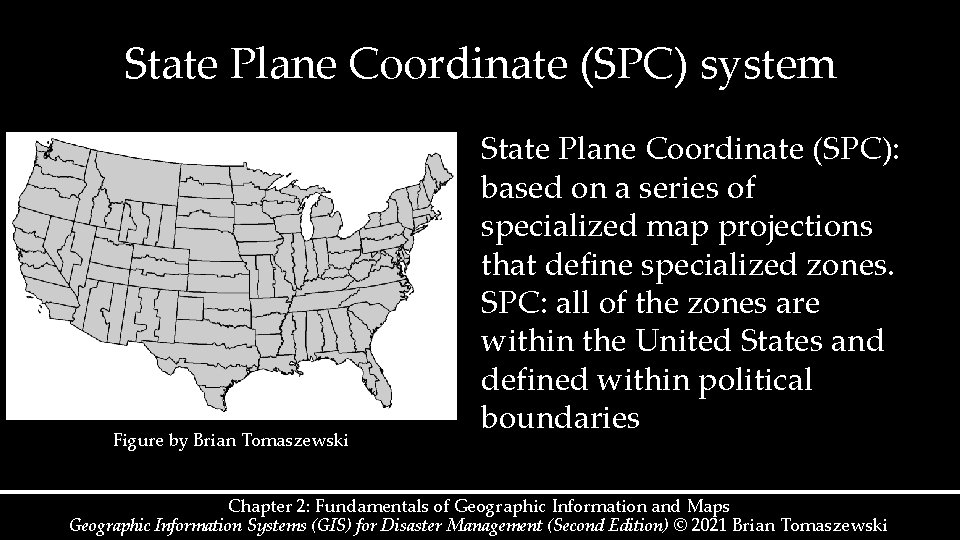
State Plane Coordinate (SPC) system Figure by Brian Tomaszewski State Plane Coordinate (SPC): based on a series of specialized map projections that define specialized zones. SPC: all of the zones are within the United States and defined within political boundaries Chapter 2: Fundamentals of Geographic Information and Maps Geographic Information Systems (GIS) for Disaster Management (Second Edition) © 2021 Brian Tomaszewski
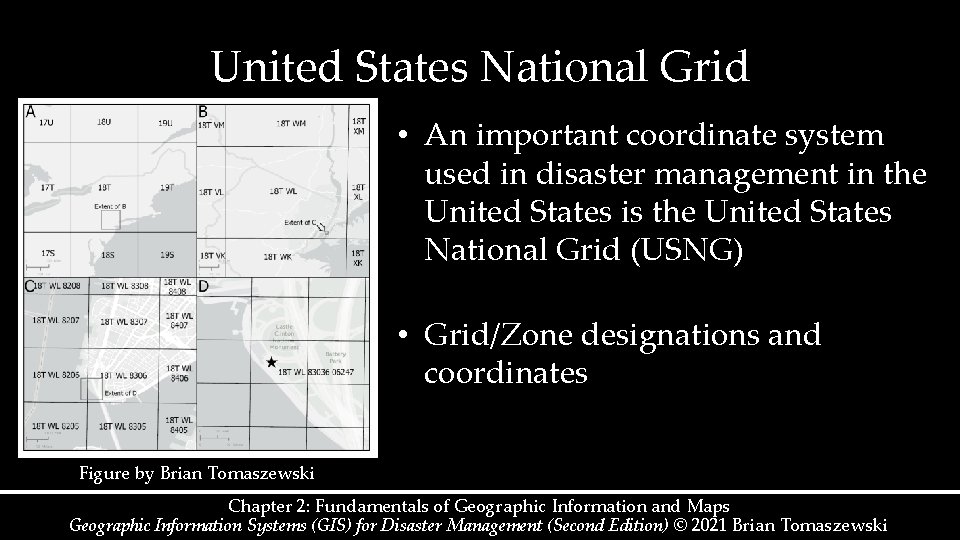
United States National Grid • An important coordinate system used in disaster management in the United States is the United States National Grid (USNG) • Grid/Zone designations and coordinates Figure by Brian Tomaszewski Chapter 2: Fundamentals of Geographic Information and Maps Geographic Information Systems (GIS) for Disaster Management (Second Edition) © 2021 Brian Tomaszewski
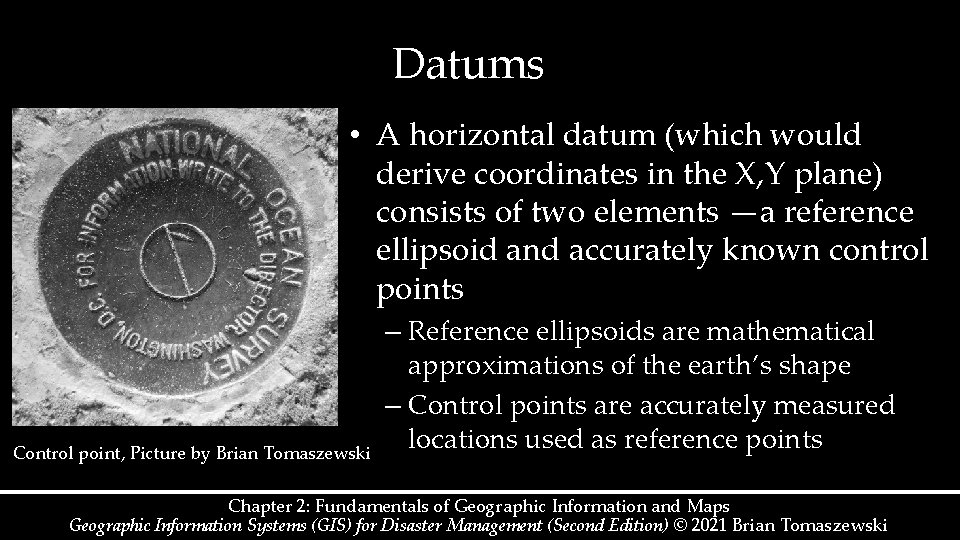
Datums • A horizontal datum (which would derive coordinates in the X, Y plane) consists of two elements —a reference ellipsoid and accurately known control points Control point, Picture by Brian Tomaszewski – Reference ellipsoids are mathematical approximations of the earth’s shape – Control points are accurately measured locations used as reference points Chapter 2: Fundamentals of Geographic Information and Maps Geographic Information Systems (GIS) for Disaster Management (Second Edition) © 2021 Brian Tomaszewski
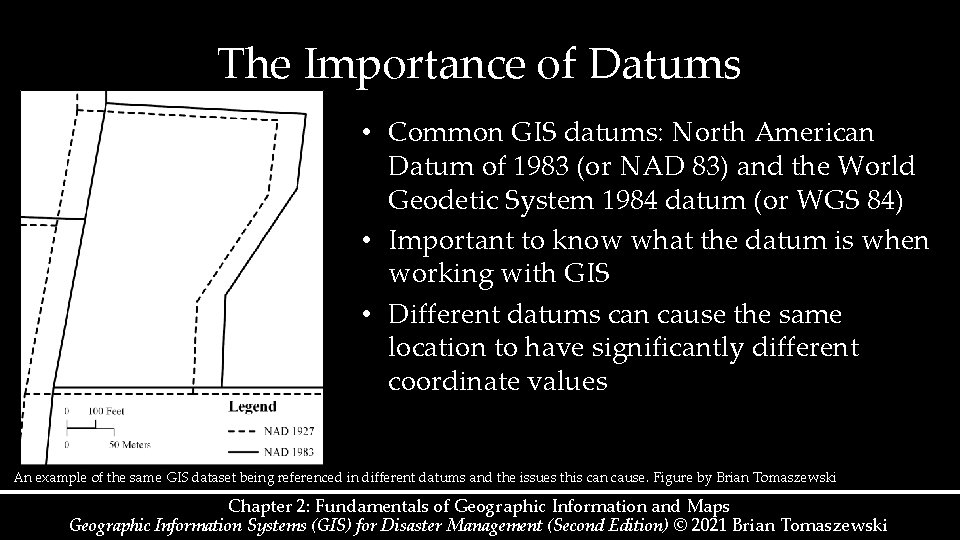
The Importance of Datums • Common GIS datums: North American Datum of 1983 (or NAD 83) and the World Geodetic System 1984 datum (or WGS 84) • Important to know what the datum is when working with GIS • Different datums can cause the same location to have significantly different coordinate values An example of the same GIS dataset being referenced in different datums and the issues this can cause. Figure by Brian Tomaszewski Chapter 2: Fundamentals of Geographic Information and Maps Geographic Information Systems (GIS) for Disaster Management (Second Edition) © 2021 Brian Tomaszewski
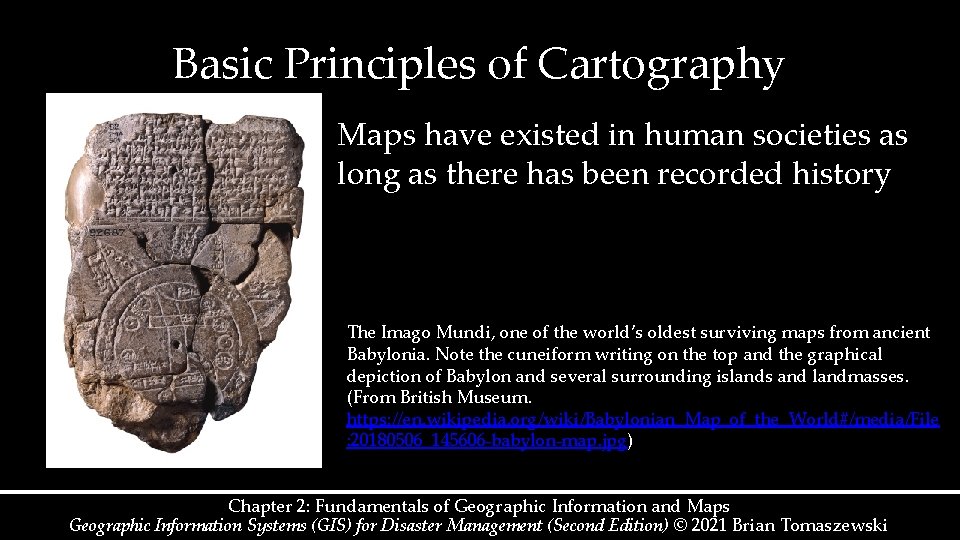
Basic Principles of Cartography Maps have existed in human societies as long as there has been recorded history The Imago Mundi, one of the world’s oldest surviving maps from ancient Babylonia. Note the cuneiform writing on the top and the graphical depiction of Babylon and several surrounding islands and landmasses. (From British Museum. https: //en. wikipedia. org/wiki/Babylonian_Map_of_the_World#/media/File : 20180506_145606 babylon map. jpg) Chapter 2: Fundamentals of Geographic Information and Maps Geographic Information Systems (GIS) for Disaster Management (Second Edition) © 2021 Brian Tomaszewski
Mapping Principles: Data Measurement • Raw data are measured in four standard ways for map based presentation: 1. 2. 3. 4. Nominal Ordinal Interval Ratio • Describe examples of each? Chapter 2: Fundamentals of Geographic Information and Maps Geographic Information Systems (GIS) for Disaster Management (Second Edition) © 2021 Brian Tomaszewski
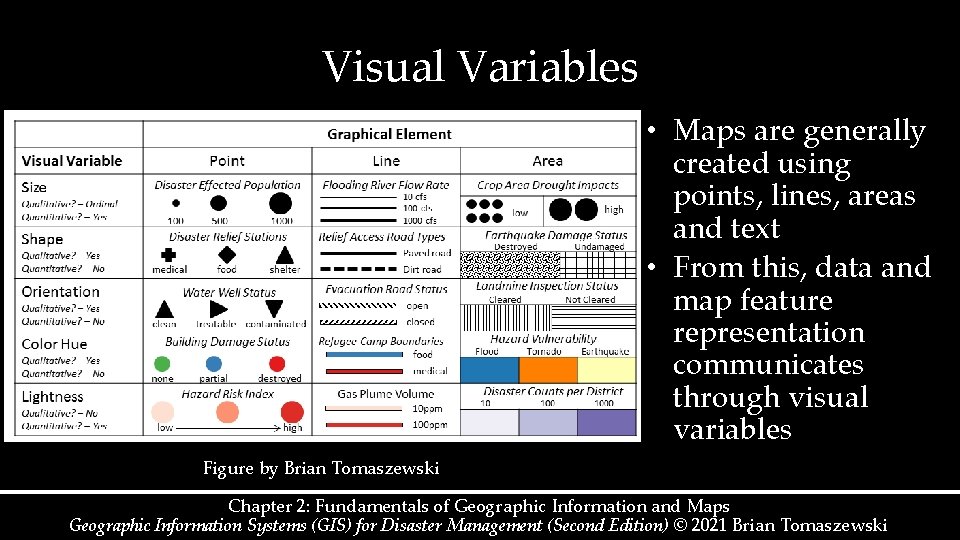
Visual Variables • Maps are generally created using points, lines, areas and text • From this, data and map feature representation communicates through visual variables Figure by Brian Tomaszewski Chapter 2: Fundamentals of Geographic Information and Maps Geographic Information Systems (GIS) for Disaster Management (Second Edition) © 2021 Brian Tomaszewski
Other Mapping Principles • Visual Hierarchy: map features are presented in a manner that implies the relative importance of each feature • Figure and Ground Relationships: the visual display of information , elements intended to be the map’s focus of attention, or the figure(s), are visually contrasted from map elements that provide context, or ground, to the figure elements Chapter 2: Fundamentals of Geographic Information and Maps Geographic Information Systems (GIS) for Disaster Management (Second Edition) © 2021 Brian Tomaszewski
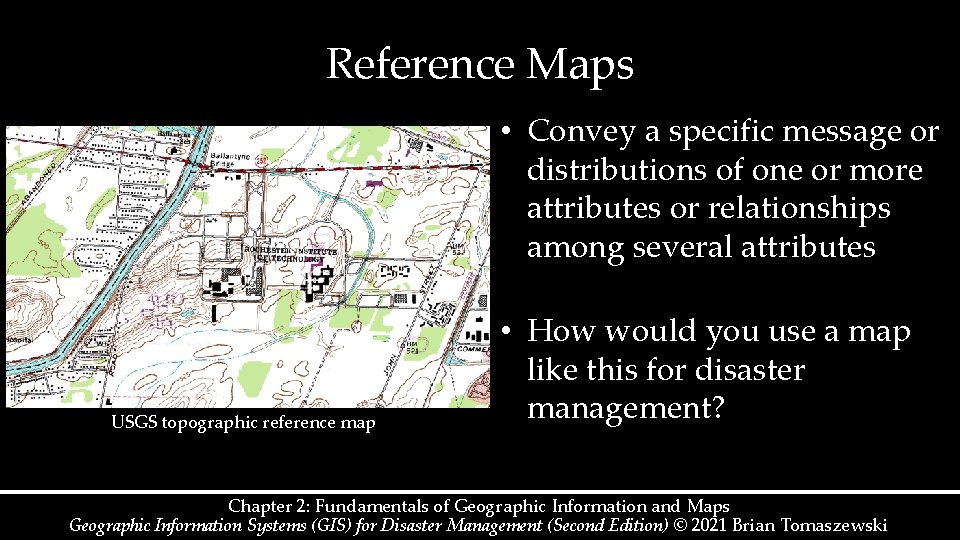
Reference Maps • Convey a specific message or distributions of one or more attributes or relationships among several attributes USGS topographic reference map • How would you use a map like this for disaster management? Chapter 2: Fundamentals of Geographic Information and Maps Geographic Information Systems (GIS) for Disaster Management (Second Edition) © 2021 Brian Tomaszewski
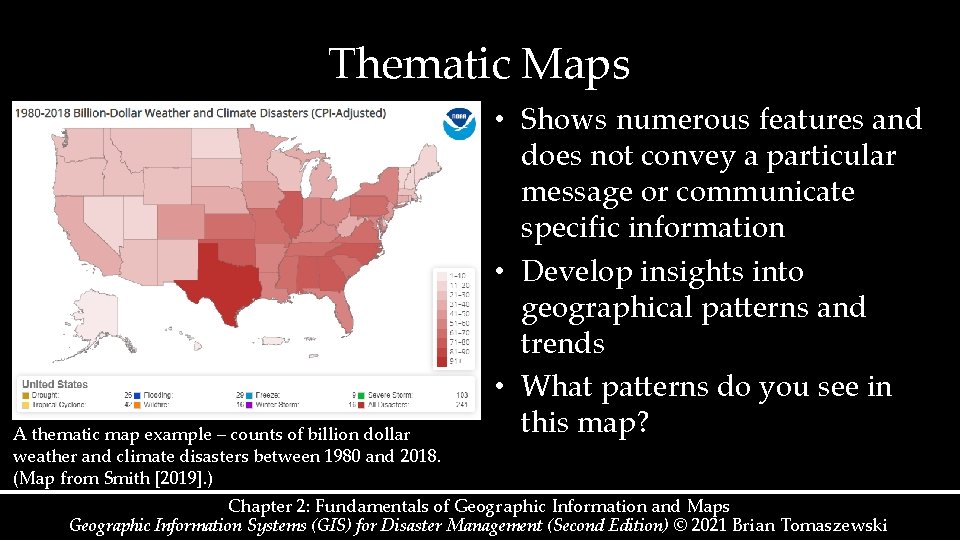
Thematic Maps A thematic map example – counts of billion dollar weather and climate disasters between 1980 and 2018. (Map from Smith [2019]. ) • Shows numerous features and does not convey a particular message or communicate specific information • Develop insights into geographical patterns and trends • What patterns do you see in this map? Chapter 2: Fundamentals of Geographic Information and Maps Geographic Information Systems (GIS) for Disaster Management (Second Edition) © 2021 Brian Tomaszewski
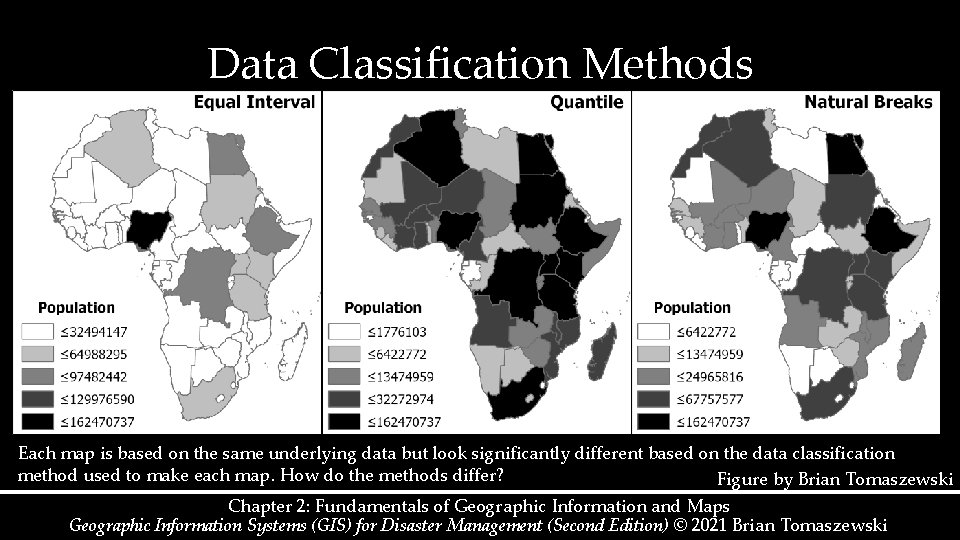
More on Thematic Maps • Choropleth map: aggregates data for display in a preexisting region such as a state or country • Data are displayed in two ways 1. Qualitative distinction between entities such as different color hues 2. Quantitative distinction where magnitudes of data are shown using different levels of color lightness (or saturation) • Examples of each? Chapter 2: Fundamentals of Geographic Information and Maps Geographic Information Systems (GIS) for Disaster Management (Second Edition) © 2021 Brian Tomaszewski
Data Classification Methods Each map is based on the same underlying data but look significantly different based on the data classification method used to make each map. How do the methods differ? Figure by Brian Tomaszewski Chapter 2: Fundamentals of Geographic Information and Maps Geographic Information Systems (GIS) for Disaster Management (Second Edition) © 2021 Brian Tomaszewski
More on Thematic Maps • Proportional Symbol Map: use symbols of varying sizes that are proportional to the value or magnitude being shown • Isarithmic Map: use line symbols to display phenomena that are continuous in nature • Dot density Map: distribution of an observation or observations at specific points • Examples of each kind? Chapter 2: Fundamentals of Geographic Information and Maps Geographic Information Systems (GIS) for Disaster Management (Second Edition) © 2021 Brian Tomaszewski
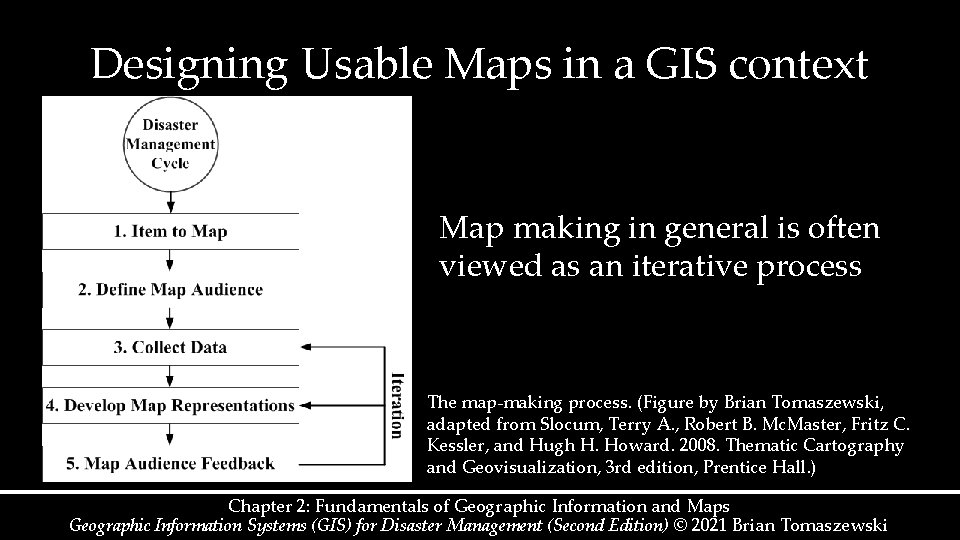
Designing Usable Maps in a GIS context Map making in general is often viewed as an iterative process The map making process. (Figure by Brian Tomaszewski, adapted from Slocum, Terry A. , Robert B. Mc. Master, Fritz C. Kessler, and Hugh H. Howard. 2008. Thematic Cartography and Geovisualization, 3 rd edition, Prentice Hall. ) Chapter 2: Fundamentals of Geographic Information and Maps Geographic Information Systems (GIS) for Disaster Management (Second Edition) © 2021 Brian Tomaszewski
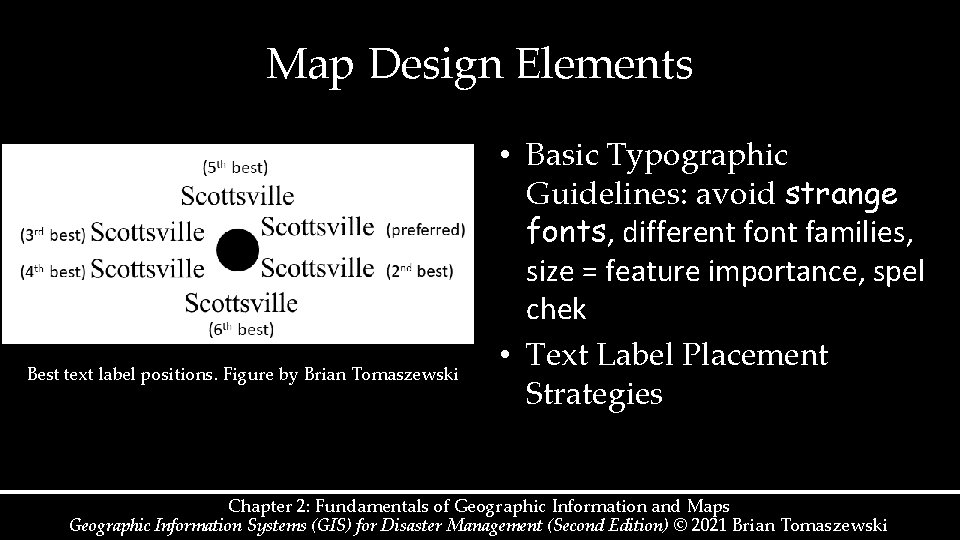
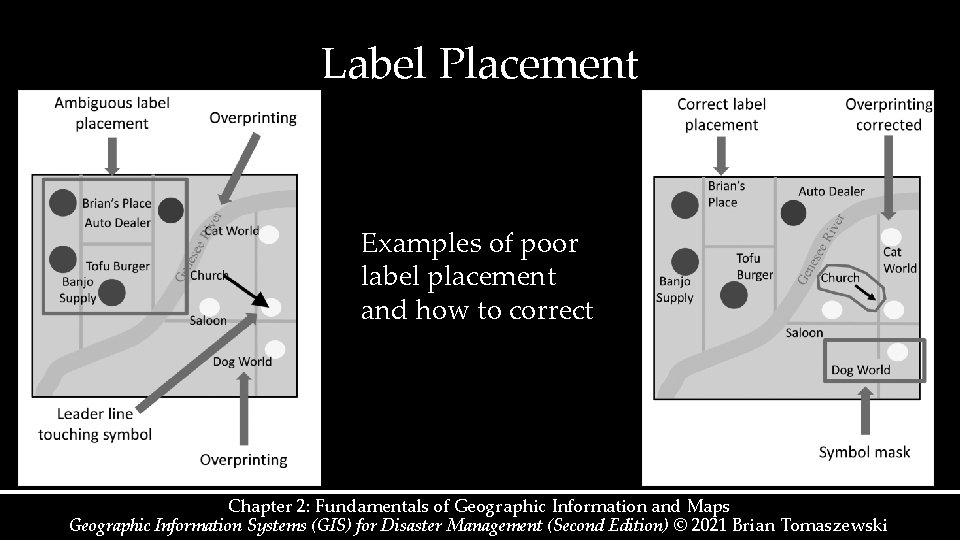
Map Design Elements Best text label positions. Figure by Brian Tomaszewski • Basic Typographic Guidelines: avoid strange fonts, different font families, size = feature importance, spel chek • Text Label Placement Strategies Chapter 2: Fundamentals of Geographic Information and Maps Geographic Information Systems (GIS) for Disaster Management (Second Edition) © 2021 Brian Tomaszewski
Label Placement Examples of poor label placement and how to correct Chapter 2: Fundamentals of Geographic Information and Maps Geographic Information Systems (GIS) for Disaster Management (Second Edition) © 2021 Brian Tomaszewski
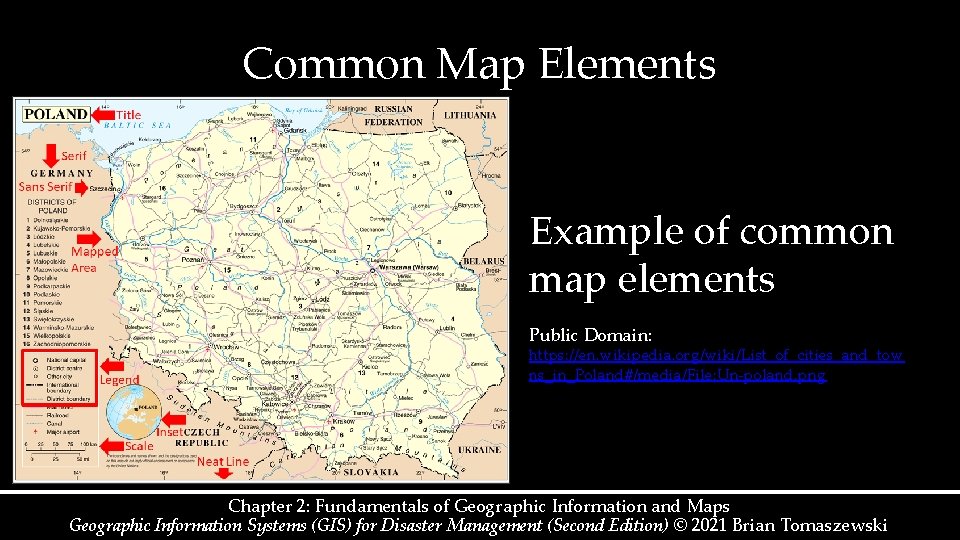
Common Map Elements Example of common map elements Public Domain: https: //en. wikipedia. org/wiki/List_of_cities_and_tow ns_in_Poland#/media/File: Un poland. png Chapter 2: Fundamentals of Geographic Information and Maps Geographic Information Systems (GIS) for Disaster Management (Second Edition) © 2021 Brian Tomaszewski
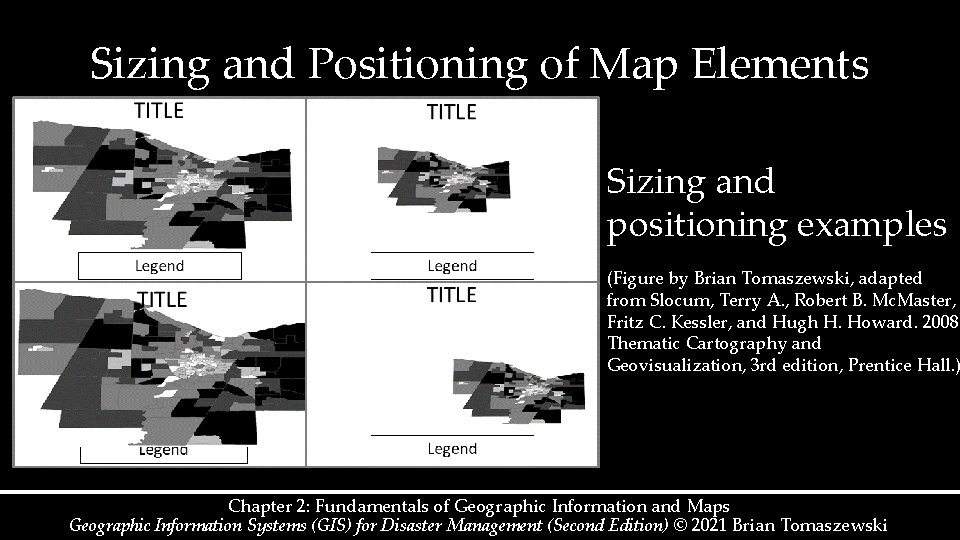
Sizing and Positioning of Map Elements Sizing and positioning examples (Figure by Brian Tomaszewski, adapted from Slocum, Terry A. , Robert B. Mc. Master, Fritz C. Kessler, and Hugh H. Howard. 2008. Thematic Cartography and Geovisualization, 3 rd edition, Prentice Hall. ) Chapter 2: Fundamentals of Geographic Information and Maps Geographic Information Systems (GIS) for Disaster Management (Second Edition) © 2021 Brian Tomaszewski
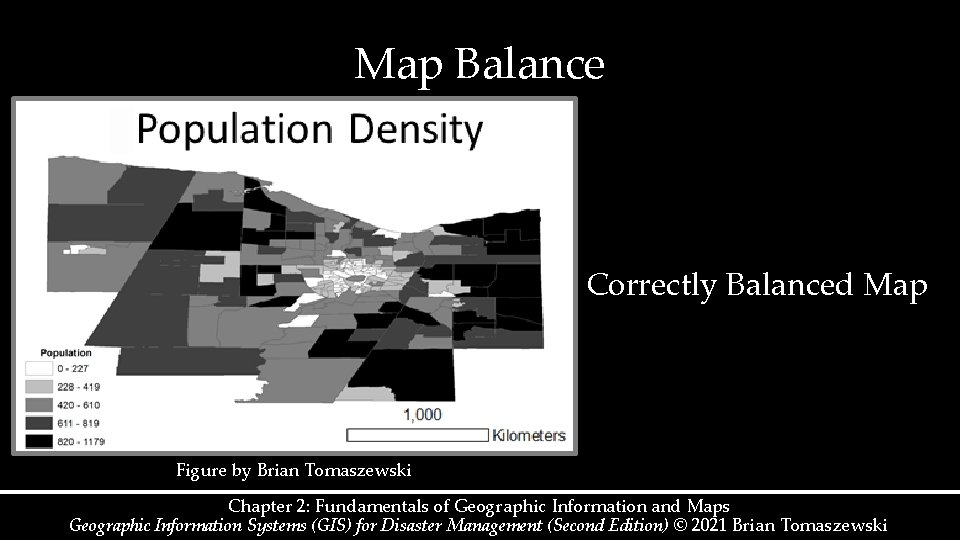
Map Balance Correctly Balanced Map Figure by Brian Tomaszewski Chapter 2: Fundamentals of Geographic Information and Maps Geographic Information Systems (GIS) for Disaster Management (Second Edition) © 2021 Brian Tomaszewski
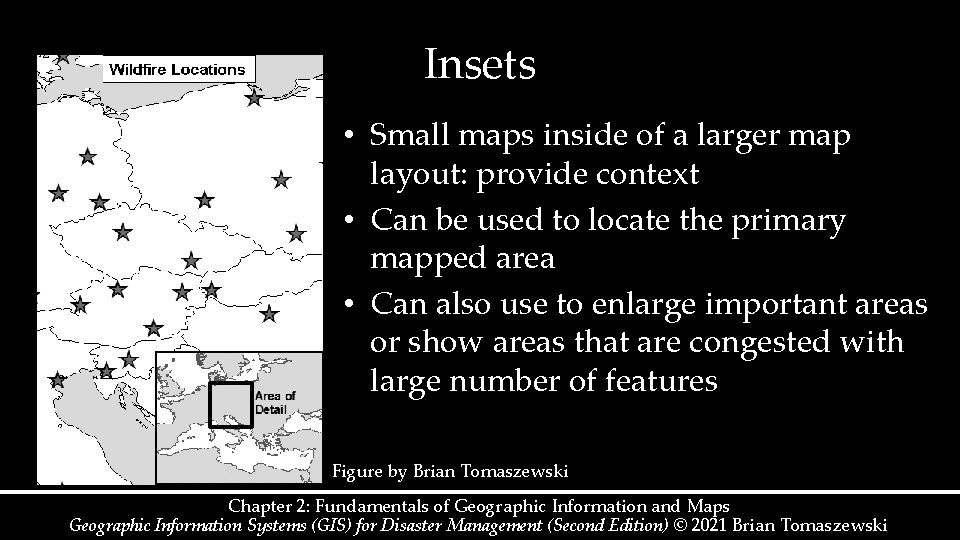
Insets • Small maps inside of a larger map layout: provide context • Can be used to locate the primary mapped area • Can also use to enlarge important areas or show areas that are congested with large number of features Figure by Brian Tomaszewski Chapter 2: Fundamentals of Geographic Information and Maps Geographic Information Systems (GIS) for Disaster Management (Second Edition) © 2021 Brian Tomaszewski
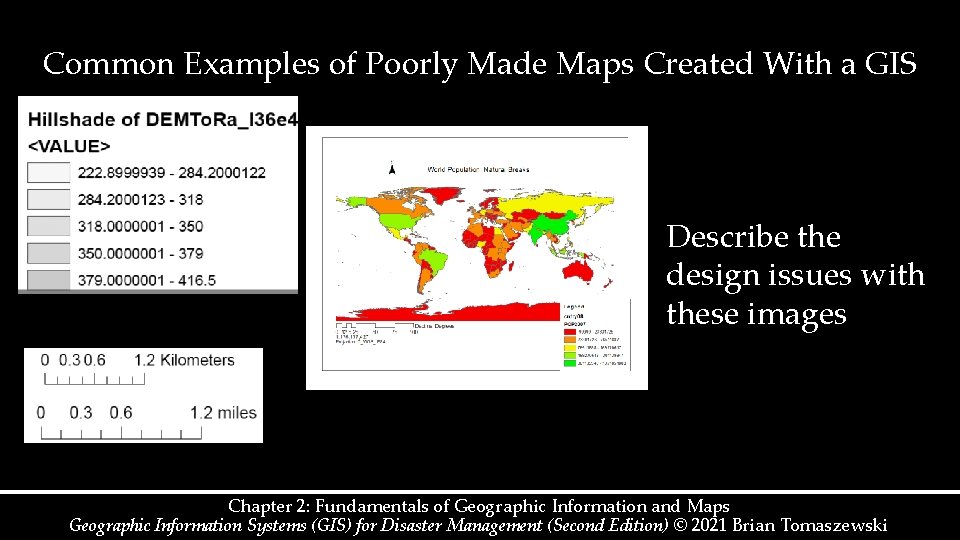
Common Examples of Poorly Made Maps Created With a GIS Describe the design issues with these images Chapter 2: Fundamentals of Geographic Information and Maps Geographic Information Systems (GIS) for Disaster Management (Second Edition) © 2021 Brian Tomaszewski
Summary Data is different than information Three ways of representing scale Difference between large and small scale maps Map projections: trade offs Coordinate systems: Lat/Long, UTM, SPC, National Grid Principles of cartography: data measurement, visual variables, figure– ground relationships • Reference and Thematic Maps • Map design: typographic guidelines, text label placement, common elements, sizing and positioning, balance, insets • Common new map makers problems • • • Chapter 2: Fundamentals of Geographic Information and Maps Geographic Information Systems (GIS) for Disaster Management (Second Edition) © 2021 Brian Tomaszewski
Discussion Questions 1. What scale would you approximately need to use for the following types of emergencies and disasters: (1) a neighborhood blackout, (2) a snow storm affecting a small (<250, 000 people) city, (3) a hurricane hitting the east coast of the United States, and (4) a major tsunami in the western Pacific ocean? 2. What types of classes of map projections might you use for the scenarios listed in Question 1 and why? 3. What types of disaster situations would lend themselves to choropleth mapping? 4. How might you combine different visual variables for multivariable mapping. For example, size and lightness? 5. Suppose you have to make a disaster map and differing color hue is not an option due to lack of a color printer. How would you reconsider the use of visual variables? 6. Referring back to Figure 2. 49 (Common Legend Issue 4), what other issues can you find with this legend? Chapter 2: Fundamentals of Geographic Information and Maps Geographic Information Systems (GIS) for Disaster Management (Second Edition) © 2021 Brian Tomaszewski
Chapter 2 Exercises • Exercise 2. 1 – Fundamentals of Geographic Information – Mechanics of how geographic maps work as communication devices and to understand basic principles of geographic information as represented in paper maps • Exercise 2. 2 – Basic Thematic Map Making with GIS Software – Cartographic design by constructing a basic thematic map related to disaster management using either Arc. GIS Pro or QGIS, build a basic thematic map to investigate the relationship between earthquakes, population levels and roads categories in California, USA – A video walkthrough tutorial of this exercises is available from the book’s companion website: http: //gisfordisastermanagement. com Chapter 2: Fundamentals of Geographic Information and Maps Geographic Information Systems (GIS) for Disaster Management (Second Edition) © 2021 Brian Tomaszewski
References Used in the Slides • Smith, Adam B. 2018's Billion Dollar Disasters in Context 2019 [cited 5 August 2019]. Available from https: //www. climate. gov/news features/blogs/beyond data/2018 s billion dollar disasters context. Chapter 2: Fundamentals of Geographic Information and Maps Geographic Information Systems (GIS) for Disaster Management (Second Edition) © 2021 Brian Tomaszewski