
Chapter 2 Fractions Part 1 Day 1 Fraction







- Slides: 32
Chapter 2 Fractions Part 1
Day…. . 1 – Fraction Models 2 – Comparing Fractions 3 –Ordering Fraction 4 – No School 5 - Adding and Subtracting Fractions
Day 1
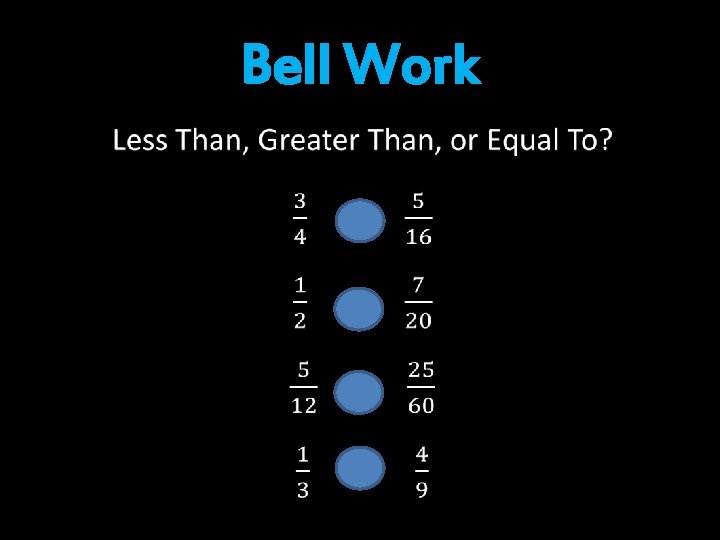
Bell Work Vocabulary List
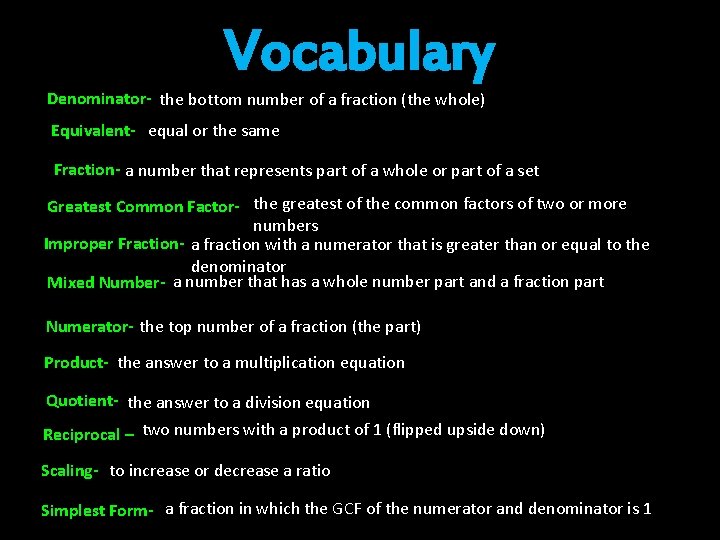
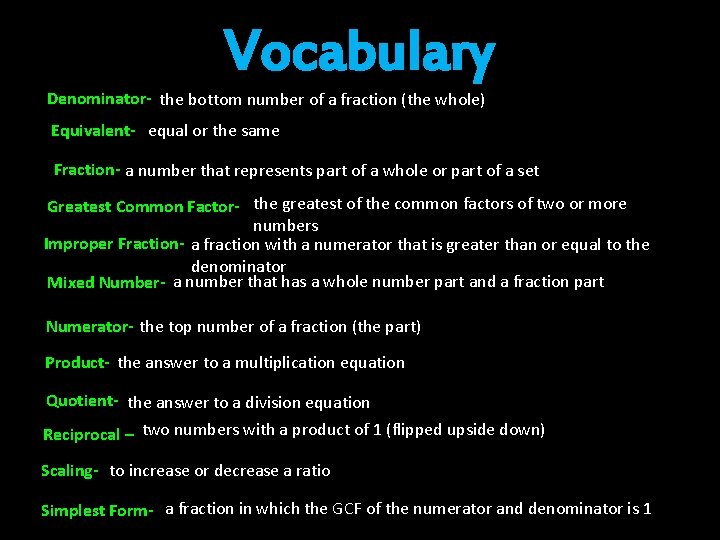
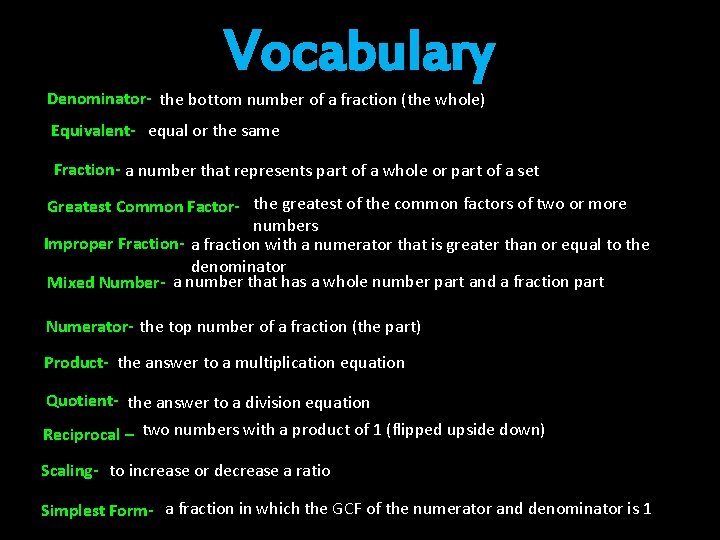
Vocabulary Denominator- the bottom number of a fraction (the whole) Equivalent- equal or the same Fraction- a number that represents part of a whole or part of a set Greatest Common Factor- the greatest of the common factors of two or more numbers Improper Fraction- a fraction with a numerator that is greater than or equal to the denominator Mixed Number- a number that has a whole number part and a fraction part Numerator- the top number of a fraction (the part) Product- the answer to a multiplication equation Quotient- the answer to a division equation Reciprocal – two numbers with a product of 1 (flipped upside down) Scaling- to increase or decrease a ratio Simplest Form- a fraction in which the GCF of the numerator and denominator is 1
I Can…… Use models to explore part of a number.
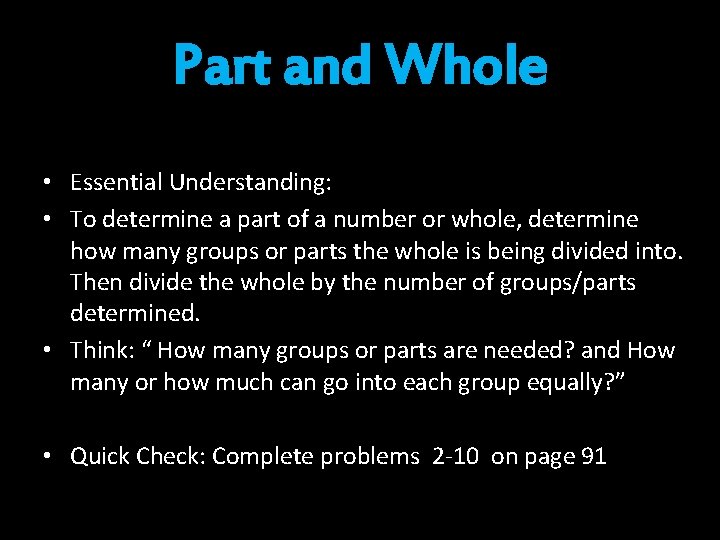
Part and Whole • Essential Understanding: • To determine a part of a number or whole, determine how many groups or parts the whole is being divided into. Then divide the whole by the number of groups/parts determined. • Think: “ How many groups or parts are needed? and How many or how much can go into each group equally? ” • Quick Check: Complete problems 2 -10 on page 91
Explore Group Work Activities 1) Buttons Galore 2) Pizza Pie You will have 20 minutes to complete each activity.
Day 2
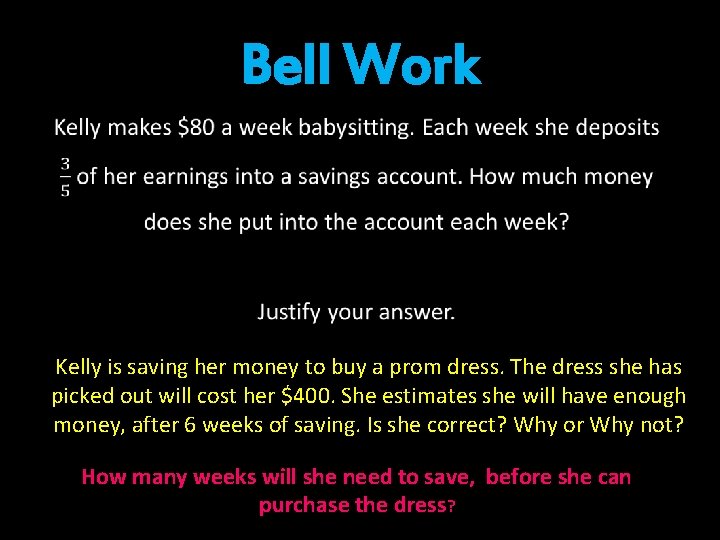
Bell Work • Kelly is saving her money to buy a prom dress. The dress she has picked out will cost her $400. She estimates she will have enough money, after 6 weeks of saving. Is she correct? Why or Why not? How many weeks will she need to save, before she can purchase the dress?
Vocabulary Denominator- the bottom number of a fraction (the whole) Equivalent- equal or the same Fraction- a number that represents part of a whole or part of a set Greatest Common Factor- the greatest of the common factors of two or more numbers Improper Fraction- a fraction with a numerator that is greater than or equal to the denominator Mixed Number- a number that has a whole number part and a fraction part Numerator- the top number of a fraction (the part) Product- the answer to a multiplication equation Quotient- the answer to a division equation Reciprocal – two numbers with a product of 1 (flipped upside down) Scaling- to increase or decrease a ratio Simplest Form- a fraction in which the GCF of the numerator and denominator is 1
I Can…. Compare fractions.
Comparing Fractions Essential Understanding: There are several strategies we can use to compare fractions. In this lesson, you will use your knowledge of LCMs to generate equivalent fractions with common denominators before comparing. This can be accomplished easily by using the least common multiple to generate equivalent fractions. Remember to multiply both the numerator (top) and the denominator (bottom) by the same number (this process is called scaling). Once all fractions have a common denominator, you can simply compare the numerators. • Quick Check: Complete problems 1 -6 on page 231
Explore Group Work Activities 1) Fraction War
Wrap it Up • Review • Questions • Station Work
Day 3
Bell Work •
Vocabulary Denominator- the bottom number of a fraction (the whole) Equivalent- equal or the same Fraction- a number that represents part of a whole or part of a set Greatest Common Factor- the greatest of the common factors of two or more numbers Improper Fraction- a fraction with a numerator that is greater than or equal to the denominator Mixed Number- a number that has a whole number part and a fraction part Numerator- the top number of a fraction (the part) Product- the answer to a multiplication equation Quotient- the answer to a division equation Reciprocal – two numbers with a product of 1 (flipped upside down) Scaling- to increase or decrease a ratio Simplest Form- a fraction in which the GCF of the numerator and denominator is 1
I Can…. Order fractions on a number line.
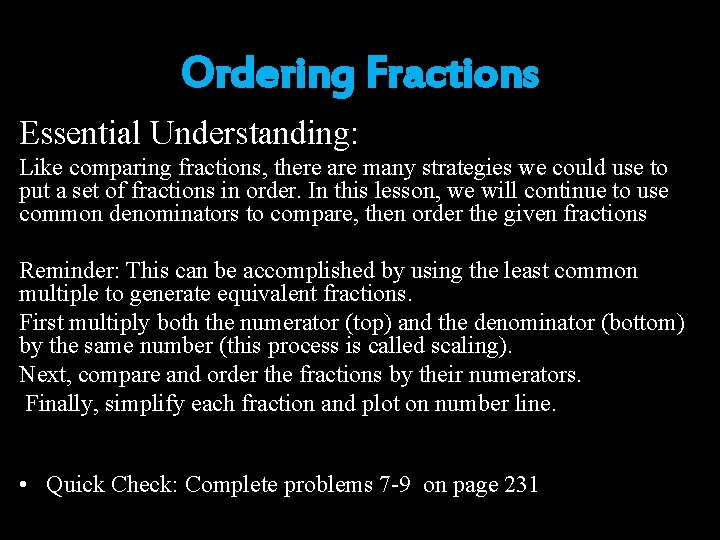
Ordering Fractions Essential Understanding: Like comparing fractions, there are many strategies we could use to put a set of fractions in order. In this lesson, we will continue to use common denominators to compare, then order the given fractions Reminder: This can be accomplished by using the least common multiple to generate equivalent fractions. First multiply both the numerator (top) and the denominator (bottom) by the same number (this process is called scaling). Next, compare and order the fractions by their numerators. Finally, simplify each fraction and plot on number line. • Quick Check: Complete problems 7 -9 on page 231
Explore Group Work Activities 1) Line Em’ Up 2) Number Line Poster Project
Wrap it Up • Review • Questions • Station Work
Day 4
No School
Vocabulary Denominator- the bottom number of a fraction (the whole) Equivalent- equal or the same Fraction- a number that represents part of a whole or part of a set Greatest Common Factor- the greatest of the common factors of two or more numbers Improper Fraction- a fraction with a numerator that is greater than or equal to the denominator Mixed Number- a number that has a whole number part and a fraction part Numerator- the top number of a fraction (the part) Product- the answer to a multiplication equation Quotient- the answer to a division equation Reciprocal – two numbers with a product of 1 (flipped upside down) Scaling- to increase or decrease a ratio Simplest Form- a fraction in which the GCF of the numerator and denominator is 1
Day 5
Bell Work Mr. Washington will make 7 batches of fresh pasta. He will use 2/3 cups of flour for each batch. How many cups of flour will Mr. Washington use altogether? Justify your answer.
Vocabulary Denominator- the bottom number of a fraction (the whole) Equivalent- equal or the same Fraction- a number that represents part of a whole or part of a set Greatest Common Factor- the greatest of the common factors of two or more numbers Improper Fraction- a fraction with a numerator that is greater than or equal to the denominator Mixed Number- a number that has a whole number part and a fraction part Numerator- the top number of a fraction (the part) Product- the answer to a multiplication equation Quotient- the answer to a division equation Reciprocal – two numbers with a product of 1 (flipped upside down) Scaling- to increase or decrease a ratio Simplest Form- a fraction in which the GCF of the numerator and denominator is 1
I Can…. Add and Subtract fractions.
Adding and Subtracting Fractions Essential Understanding: To find the sum or difference of fractions, you must first identify a common denominator. Remember to scale both fractions up or down until you reach the LCM. Once all fractions have a common denominator, you can simply add or subtract the numerators (the denominator will stay the same). Simplify when possible. • Quick Check: Complete problems 1 -16 even on page 15
Explore Group Work Activities 1) Partner work hand out 2) Create a story problem project
Wrap it Up • Review • Questions • Station Work