
Chapter 2 Foundations of Individual Behavior ORGANIZATIONAL BEHAVIOR
Chapter 2: Foundations of Individual Behavior ORGANIZATIONAL BEHAVIOR S T E P H E N P. R O B B I N S Reporter: Jessica Chou 2007/09/20

Objectives 1. Identify two types of ability 2. Define the key biographical characteristics. 3. Understand how to shape the behavior of others. Ø Learning theory Ø Distinguish between the four schedules of reinforcement. Ø OB Mod

Ability • Why we concern – by knowing how people different in abilities, we may use the knowledge to increase /enhance people’s performance • What is ability – An individual’s capacity to perform the various tasks in a job. – Made up of two factors: Intellectual and physical Ability Intellectual physical

Intellectual Ability Intellectual • The capacity to do mental activities—thinking, reasoning, and problem solving 1. Number aptitude 7 Dimensions of Intellectual Ability 2. Verbal comprehension 3. Perceptual speed 4. Inductive reasoning 5. Deductive reasoning 6. Spatial visualization 7. Memory physical

Dimensions of Intellectual Ability 1. Number Aptitude: Ability to do speedy and accurate arithmetic Ability Intellectual physical 2. Verbal Comprehension: Ability to understand what is read or heard and the relationship of words to each other. 3. Perceptual Speed: Ability to identify visual similarities and differences quickly and accurately. 4. Inductive Reasoning: Ability to identify a logical sequence in a problem and then solve the problem. 5. Deductive Reasoning: Ability to use logic and assess the implications of an argument. 6. Spatial Visualization: Ability to imagine how an object would look if its position in space were changed. 7. Memory: Ability to retain and recall past experiences.
Intelligence is one of the predictors Ability Intellectual physical 1. intelligence is one of the predictors of job performance. 2. Use IQ test as hiring tools 3. Correlation between intelligence and Job satisfaction is about zero
Multiple intelligences Ability Intellectual • Intelligences contains four subparts: cognitive, social, emotional, cultural – Cognitive: traditional intelligence test. – Social: ability to relate effectively to others – Emotional: ability to identify, understand, and manage emotions. – Cultural: awareness of cross-culture differences and the ability to function successfully in cross-cultural situation. physical
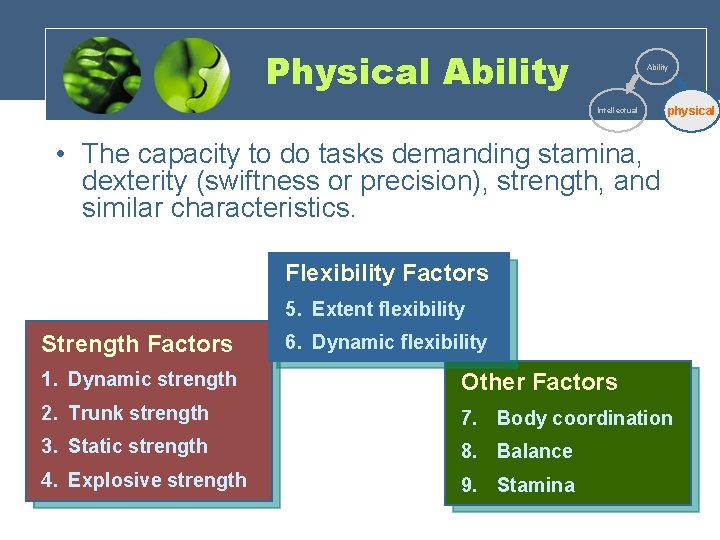
Physical Ability Intellectual physical • The capacity to do tasks demanding stamina, dexterity (swiftness or precision), strength, and similar characteristics. Flexibility Factors 5. Extent flexibility Strength Factors 6. Dynamic flexibility 1. Dynamic strength Other Factors 2. Trunk strength 7. Body coordination 3. Static strength 8. Balance 4. Explosive strength 9. Stamina
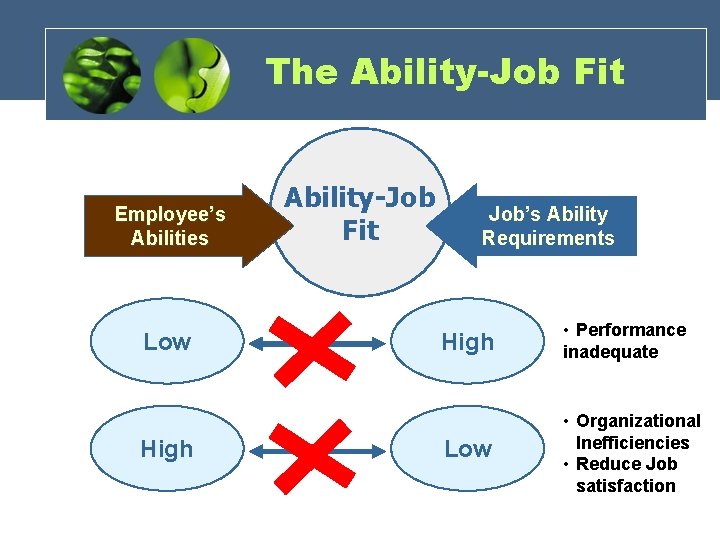
The Ability-Job Fit Employee’s Abilities Low High Ability-Job Fit Job’s Ability Requirements High • Performance inadequate Low • Organizational Inefficiencies • Reduce Job satisfaction
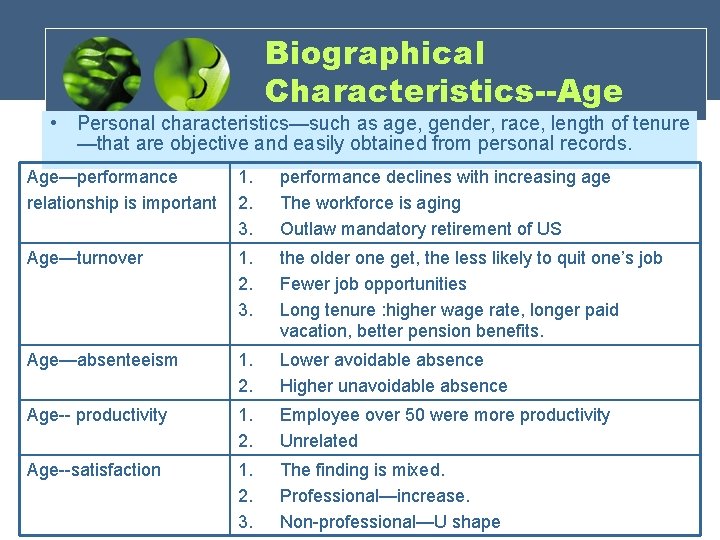
Biographical Characteristics--Age • Personal characteristics—such as age, gender, race, length of tenure —that are objective and easily obtained from personal records. Age—performance relationship is important 1. 2. 3. performance declines with increasing age The workforce is aging Outlaw mandatory retirement of US Age—turnover 1. 2. 3. the older one get, the less likely to quit one’s job Fewer job opportunities Long tenure : higher wage rate, longer paid vacation, better pension benefits. Age—absenteeism 1. 2. Lower avoidable absence Higher unavoidable absence Age-- productivity 1. 2. Employee over 50 were more productivity Unrelated Age--satisfaction 1. 2. 3. The finding is mixed. Professional—increase. Non-professional—U shape
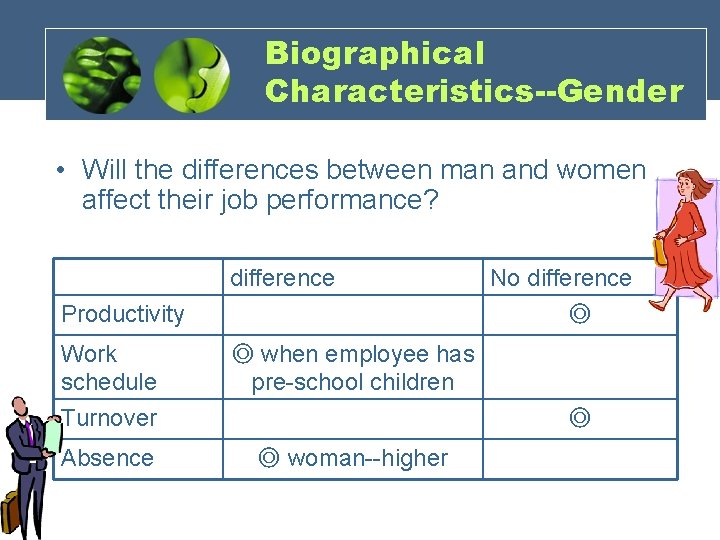
Biographical Characteristics--Gender • Will the differences between man and women affect their job performance? difference Productivity Work schedule ◎ when employee has pre-school children Turnover Absence No difference ◎ ◎ ◎ woman--higher
Biographical Characteristics--Race • Individuals tend to favor colleagues of their own race in performance evaluation, promotion decisions, and pay raises. • African Americans approve affirmative action to a greater degree than White • The issue of racial differences in cognitive ability test---is still on debate
Biographical Characteristics--Tenure • Seniority negatively related to absence. • Seniority negatively related to turnover. • Tenure on one’s previous job is a powerful predictor of the one’s future turnover. • Tenure positively related to satisfaction.
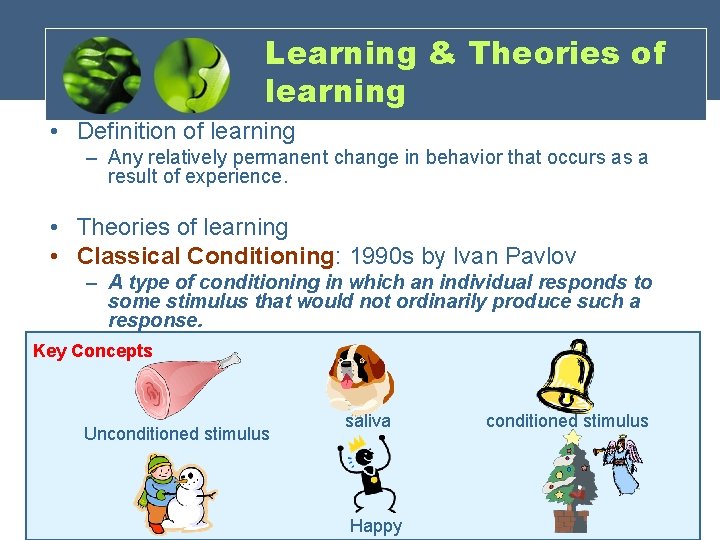
Learning & Theories of learning • Definition of learning – Any relatively permanent change in behavior that occurs as a result of experience. • Theories of learning • Classical Conditioning: 1990 s by Ivan Pavlov – A type of conditioning in which an individual responds to some stimulus that would not ordinarily produce such a response. Key Concepts Unconditioned stimulus saliva Happy conditioned stimulus
Theories of learning • Operant conditioning – by psychologist B. F. Skinner (behaviorism) – A type conditioning in which desired voluntary behavior leads to a reward or prevents a punishment. – better explain voluntary behaviors Key Concepts • People will most likely engage in desired behavior if they are positively reinforced for doing so • Rewards are most effective if they immediately follow the desired response
Theories of learning • Social learning – The view that people can learn through observation and direct experience Key Concepts • The influence of model • Four processes • Attentional processes • Retention processes • Motor reproduction process • Reinforcement processes
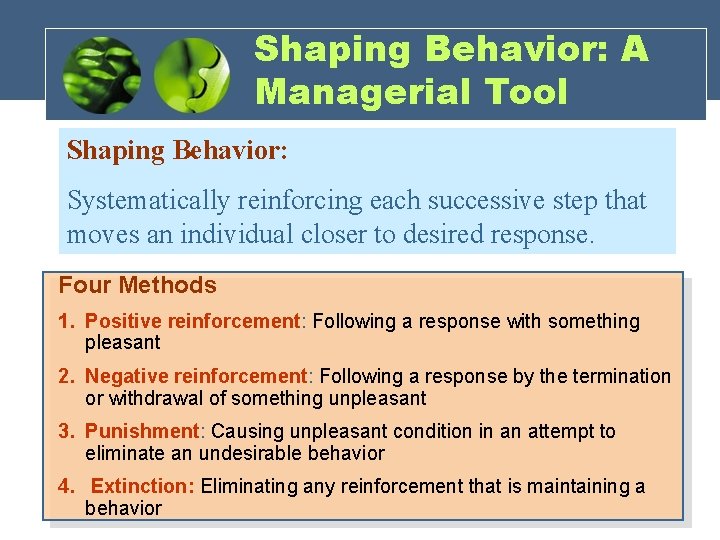
Shaping Behavior: A Managerial Tool Shaping Behavior: Systematically reinforcing each successive step that moves an individual closer to desired response. Four Methods 1. Positive reinforcement: Following a response with something pleasant 2. Negative reinforcement: Following a response by the termination or withdrawal of something unpleasant 3. Punishment: Causing unpleasant condition in an attempt to eliminate an undesirable behavior 4. Extinction: Eliminating any reinforcement that is maintaining a behavior
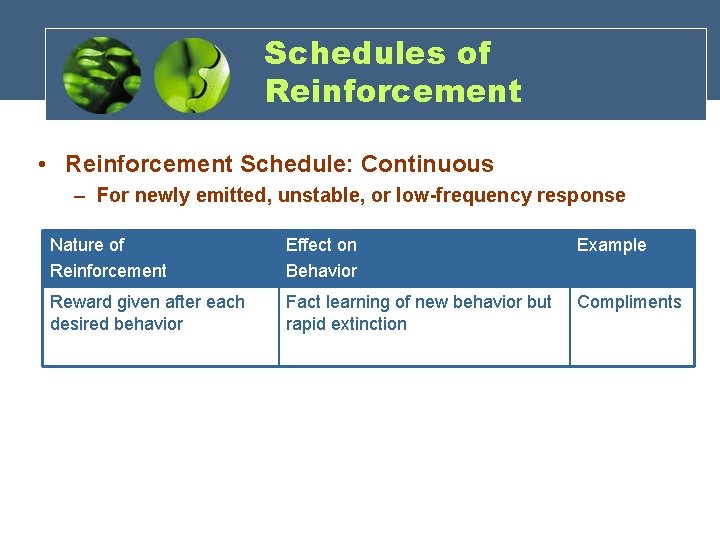
Schedules of Reinforcement • Reinforcement Schedule: Continuous – For newly emitted, unstable, or low-frequency response Nature of Reinforcement Effect on Behavior Example Reward given after each desired behavior Fact learning of new behavior but rapid extinction Compliments
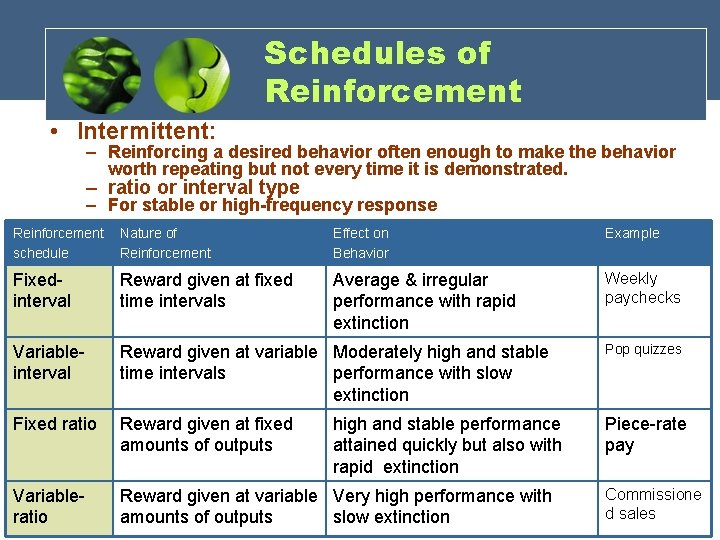
Schedules of Reinforcement • Intermittent: – Reinforcing a desired behavior often enough to make the behavior worth repeating but not every time it is demonstrated. – ratio or interval type – For stable or high-frequency response Reinforcement schedule Nature of Reinforcement Effect on Behavior Example Fixedinterval Reward given at fixed time intervals Average & irregular performance with rapid extinction Weekly paychecks Variableinterval Reward given at variable Moderately high and stable time intervals performance with slow extinction Pop quizzes Fixed ratio Reward given at fixed amounts of outputs Piece-rate pay Variableratio Reward given at variable Very high performance with amounts of outputs slow extinction high and stable performance attained quickly but also with rapid extinction Commissione d sales
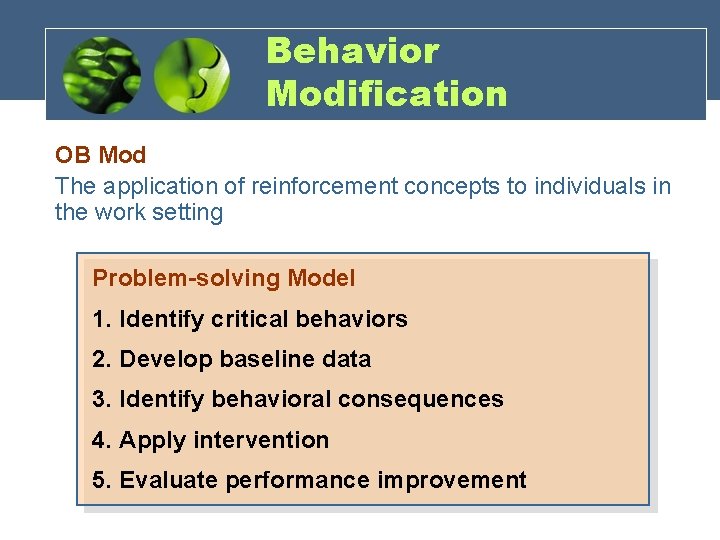
Behavior Modification OB Mod The application of reinforcement concepts to individuals in the work setting Problem-solving Model 1. Identify critical behaviors 2. Develop baseline data 3. Identify behavioral consequences 4. Apply intervention 5. Evaluate performance improvement
Problems with OB Mod and Reinforcement Theory • OB Mod has been used by a number of org. to improve productivity, to reduce errors, absenteeism…and so on. • Problem with behaviorism – Assume that people’s inner-most thoughts and feelings in response to the environment are irrelevant. – research showing that thoughts and feelings immediately follow environmental stimuli • Other approach— cognitive process
Summary & Implications • Three individual variables – Ability: intellectual & physical • An effective selection process will improve the fit • Promotion and transfer decisions should reflect the abilities of candidates • The fit can be improved by fine-tuning the job to better match an incumbent’s abilities. – Biographical Characteristics: age, race, gender… • Readily observable • Doesn’t mean should be explicitly used in management decision – Learning • Positive reinforcement is a powerful tool for modifying behavior • Reinforcement is a more effective tool than punishment
- Slides: 22