
CHAPTER 2 FINANCIAL STATEMENTS TAXES AND CASH FLOW

- Slides: 25
CHAPTER 2 FINANCIAL STATEMENTS, TAXES, AND CASH FLOW Copyright © 2016 by Mc. Graw-Hill Global Education LLC. All rights reserved.
KEY CONCEPTS AND SKILLS • Know the difference between book value and market value • Know the difference between accounting income and cash flow • Know the difference between average and marginal tax rates • Know how to determine a firm’s cash flow from its financial statements Copyright © 2016 by Mc. Graw-Hill Global Education LLC. All rights reserved. 2 -2
CHAPTER OUTLINE • The Balance Sheet • The Income Statement • Taxes • Cash Flow Copyright © 2016 by Mc. Graw-Hill Global Education LLC. All rights reserved. 2 -3
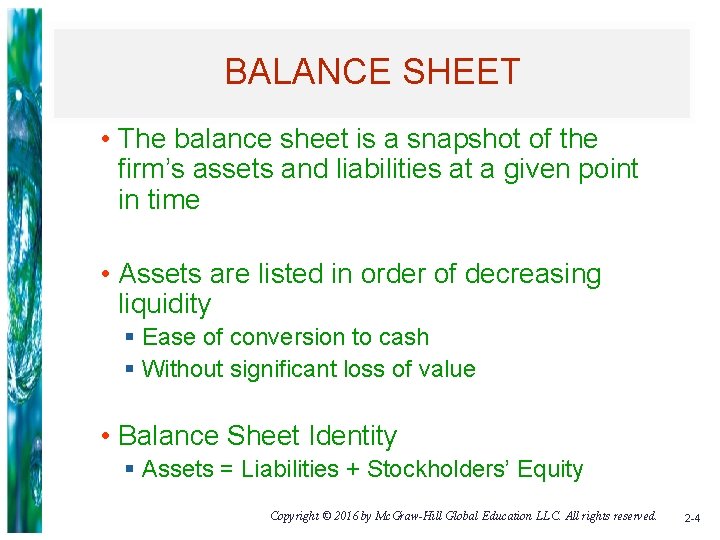
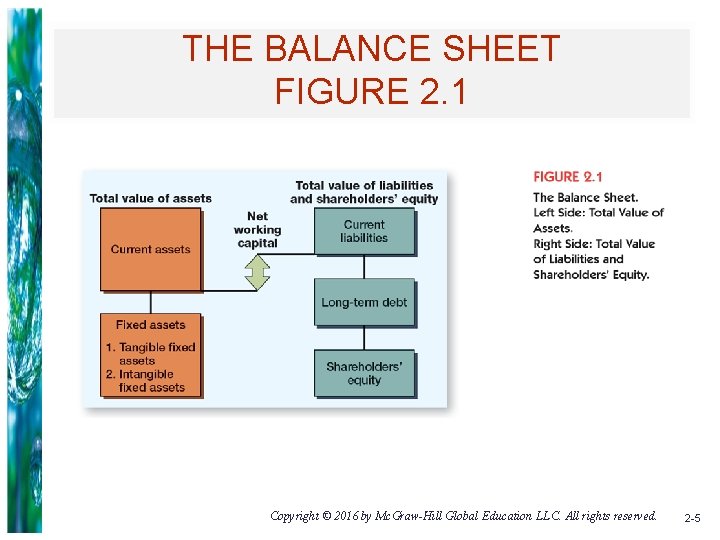
BALANCE SHEET • The balance sheet is a snapshot of the firm’s assets and liabilities at a given point in time • Assets are listed in order of decreasing liquidity § Ease of conversion to cash § Without significant loss of value • Balance Sheet Identity § Assets = Liabilities + Stockholders’ Equity Copyright © 2016 by Mc. Graw-Hill Global Education LLC. All rights reserved. 2 -4
THE BALANCE SHEET FIGURE 2. 1 Copyright © 2016 by Mc. Graw-Hill Global Education LLC. All rights reserved. 2 -5
NET WORKING CAPITAL AND LIQUIDITY • Net Working Capital § = Current Assets – Current Liabilities § Positive when the cash that will be received over the next 12 months exceeds the cash that will be paid out § Usually positive in a healthy firm • Liquidity § Ability to convert to cash quickly without a significant loss in value § Liquid firms are less likely to experience financial distress § But liquid assets typically earn a lower return § Trade-off to find balance between liquid and illiquid assets Copyright © 2016 by Mc. Graw-Hill Global Education LLC. All rights reserved. 2 -6
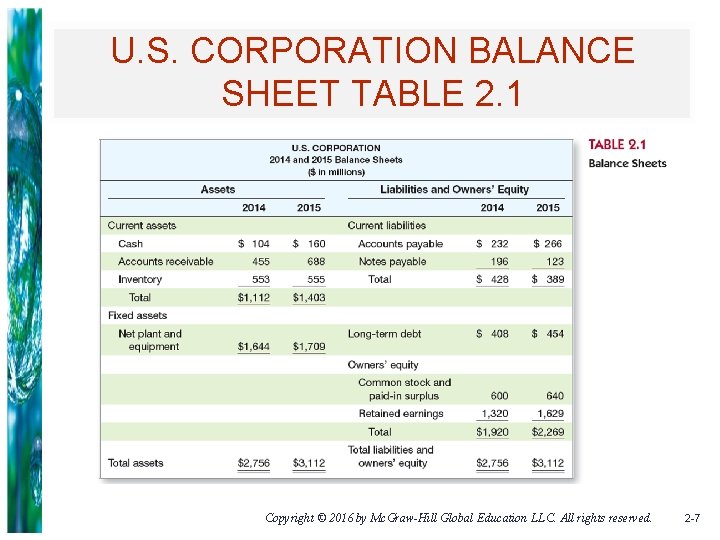
U. S. CORPORATION BALANCE SHEET TABLE 2. 1 Copyright © 2016 by Mc. Graw-Hill Global Education LLC. All rights reserved. 2 -7
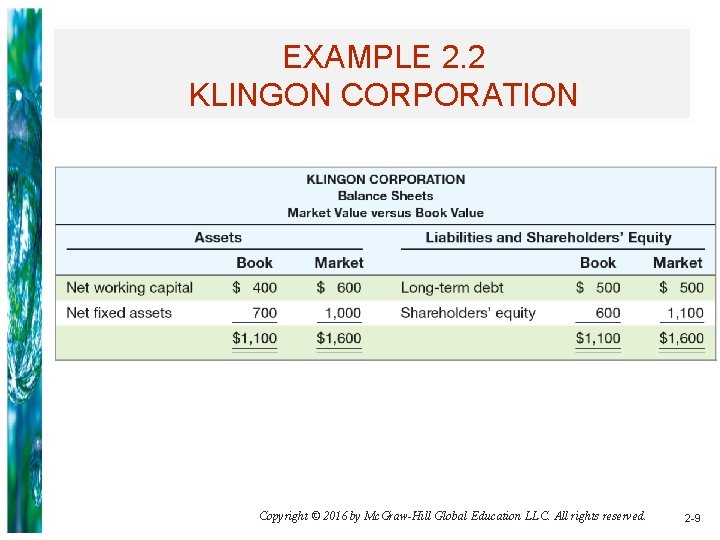
MARKET VALUE VS. BOOK VALUE • The balance sheet provides the book value of the assets, liabilities, and equity. • Market value is the price at which the assets, liabilities, or equity can actually be bought or sold. • Market value and book value are often very different. Why? • Which is more important to the decision-making process? Copyright © 2016 by Mc. Graw-Hill Global Education LLC. All rights reserved. 2 -8
EXAMPLE 2. 2 KLINGON CORPORATION Copyright © 2016 by Mc. Graw-Hill Global Education LLC. All rights reserved. 2 -9
INCOME STATEMENT • The income statement is more like a video of the firm’s operations for a specified period of time. • You generally report revenues first and then deduct any expenses for the period • Matching principle – GAAP says to show revenue when it accrues and match the expenses required to generate the revenue Copyright © 2016 by Mc. Graw-Hill Global Education LLC. All rights reserved. 2 -10
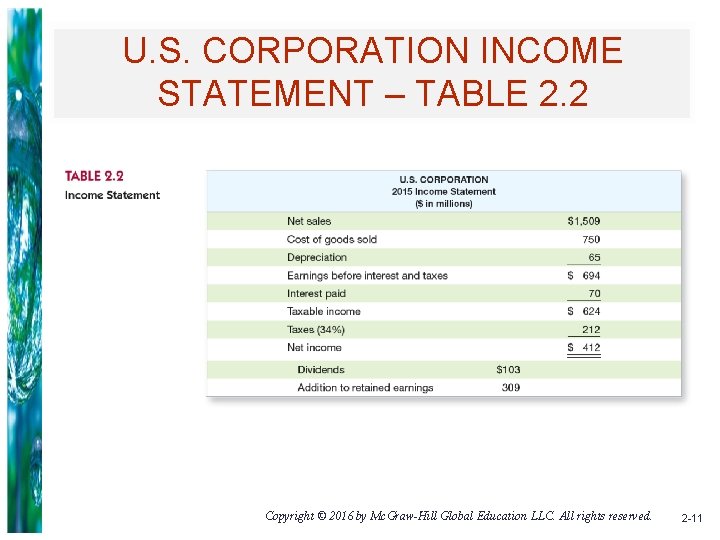
U. S. CORPORATION INCOME STATEMENT – TABLE 2. 2 Copyright © 2016 by Mc. Graw-Hill Global Education LLC. All rights reserved. 2 -11
WORK THE WEB EXAMPLE • Publicly traded companies must file regular reports with the Securities and Exchange Commission • These reports are usually filed electronically and can be searched at the SEC public site called EDGAR • Click on the web surfer, pick a company, and see what you can find! Copyright © 2016 by Mc. Graw-Hill Global Education LLC. All rights reserved. 2 -12
TAXES • The one thing we can rely on with taxes is that they are always changing • Marginal vs. average tax rates § Marginal tax rate – the percentage paid on the next dollar earned § Average tax rate – the tax bill / taxable income § Average tax rates vary widely across different companies and industries • Other taxes Copyright © 2016 by Mc. Graw-Hill Global Education LLC. All rights reserved. 2 -13
EXAMPLE: MARGINAL VS. AVERAGE RATES • Suppose your firm earns $4 million in taxable income. § What is the firm’s tax liability? § What is the average tax rate? § What is the marginal tax rate? • If you are considering a project that will increase the firm’s taxable income by $1 million, what tax rate should you use in your analysis? Copyright © 2016 by Mc. Graw-Hill Global Education LLC. All rights reserved. 2 -14
THE CONCEPT OF CASH FLOW • Cash flow is one of the most important pieces of information that a financial manager can derive from financial statements • The statement of cash flows does not provide us with the same information that we are looking at here • We will look at how cash is generated from utilizing assets and how it is paid to those that finance the purchase of the assets Copyright © 2016 by Mc. Graw-Hill Global Education LLC. All rights reserved. 2 -15
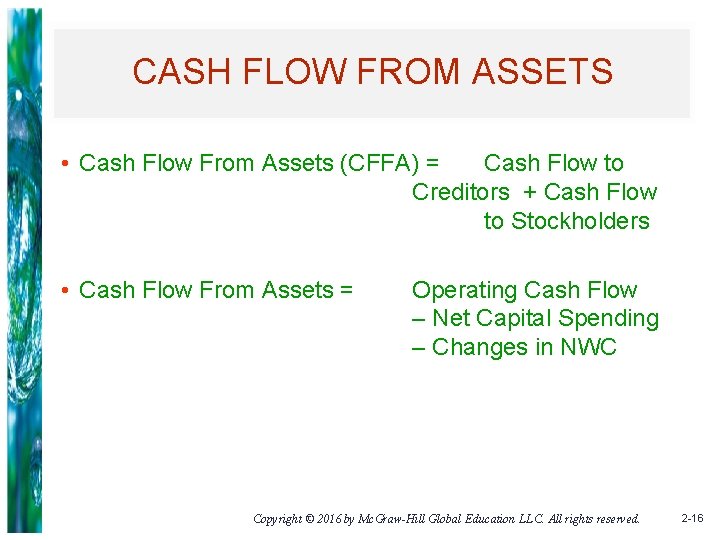
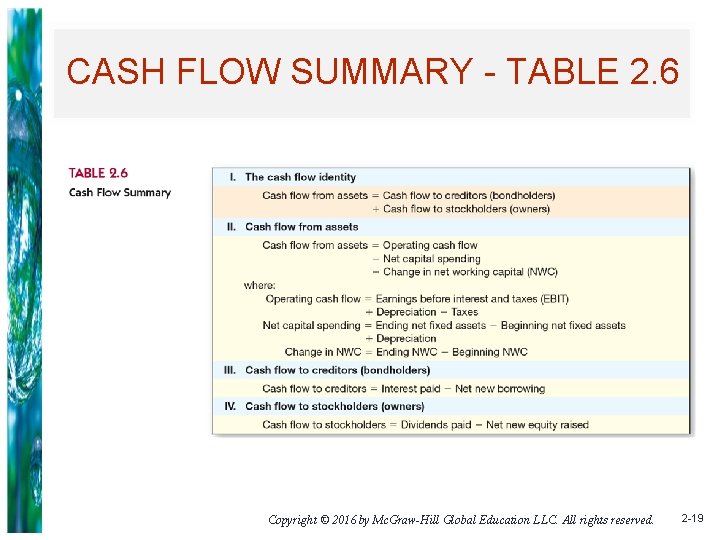
CASH FLOW FROM ASSETS • Cash Flow From Assets (CFFA) = Cash Flow to Creditors + Cash Flow to Stockholders • Cash Flow From Assets = Operating Cash Flow – Net Capital Spending – Changes in NWC Copyright © 2016 by Mc. Graw-Hill Global Education LLC. All rights reserved. 2 -16
EXAMPLE: U. S. CORPORATION – PART I • OCF (I/S) = EBIT + depreciation – taxes = $547 • NCS (B/S and I/S) = ending net fixed assets – beginning net fixed assets + depreciation = $130 • Changes in NWC (B/S) = ending NWC – beginning NWC = $330 • CFFA = 547 – 130 – 330 = $87 Copyright © 2016 by Mc. Graw-Hill Global Education LLC. All rights reserved. 2 -17
EXAMPLE: U. S. CORPORATION – PART II • CF to Creditors (B/S and I/S) = interest paid – net new borrowing = $24 • CF to Stockholders (B/S and I/S) = dividends paid – net new equity raised = $63 • CFFA = 24 + 63 = $87 Copyright © 2016 by Mc. Graw-Hill Global Education LLC. All rights reserved. 2 -18
CASH FLOW SUMMARY - TABLE 2. 6 Copyright © 2016 by Mc. Graw-Hill Global Education LLC. All rights reserved. 2 -19
EXAMPLE: BALANCE SHEET AND INCOME STATEMENT INFO • Current Accounts § 2015: CA = 3625; CL = 1787 § 2014: CA = 3596; CL = 2140 • Fixed Assets and Depreciation § 2015: NFA = 2194; 2014: NFA = 2261 § Depreciation Expense = 500 • Long-term Debt and Equity § 2015: LTD = 538; Common stock & APIC = 462 § 2014: LTD = 581; Common stock & APIC = 372 • Income Statement § EBIT = 1014; Taxes = 368 § Interest Expense = 93; Dividends = 285 Copyright © 2016 by Mc. Graw-Hill Global Education LLC. All rights reserved. 2 -20
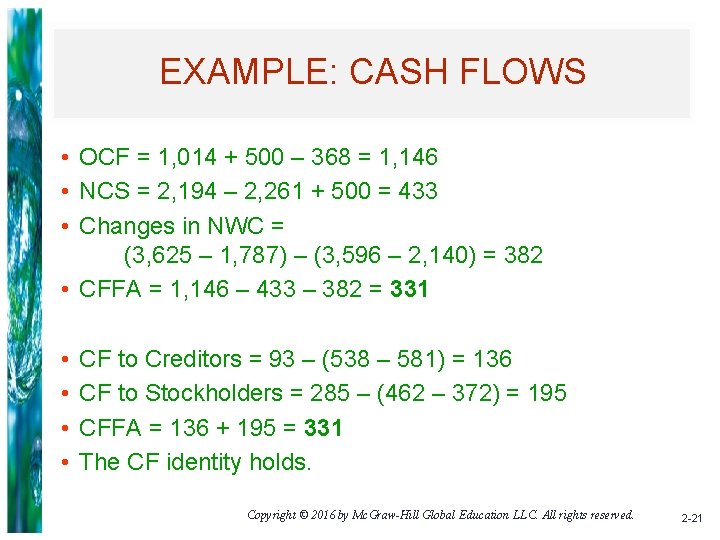
EXAMPLE: CASH FLOWS • OCF = 1, 014 + 500 – 368 = 1, 146 • NCS = 2, 194 – 2, 261 + 500 = 433 • Changes in NWC = (3, 625 – 1, 787) – (3, 596 – 2, 140) = 382 • CFFA = 1, 146 – 433 – 382 = 331 • • CF to Creditors = 93 – (538 – 581) = 136 CF to Stockholders = 285 – (462 – 372) = 195 CFFA = 136 + 195 = 331 The CF identity holds. Copyright © 2016 by Mc. Graw-Hill Global Education LLC. All rights reserved. 2 -21
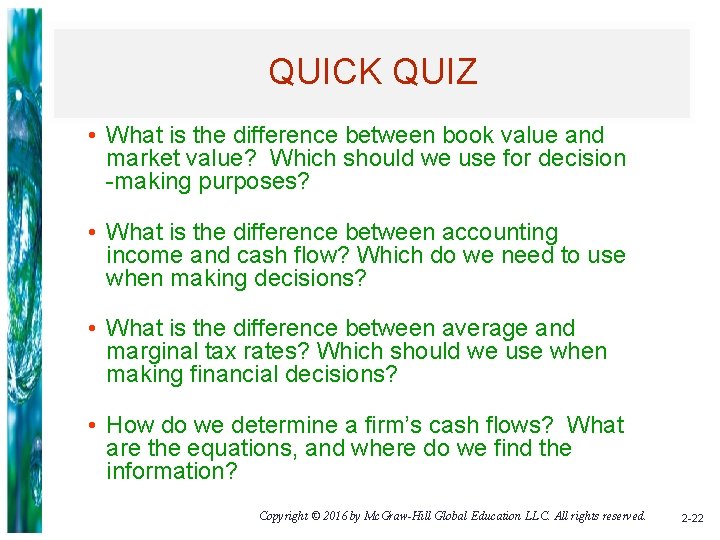
QUICK QUIZ • What is the difference between book value and market value? Which should we use for decision -making purposes? • What is the difference between accounting income and cash flow? Which do we need to use when making decisions? • What is the difference between average and marginal tax rates? Which should we use when making financial decisions? • How do we determine a firm’s cash flows? What are the equations, and where do we find the information? Copyright © 2016 by Mc. Graw-Hill Global Education LLC. All rights reserved. 2 -22
ETHICS ISSUES • Why is manipulation of financial statements not only unethical and illegal, but also bad for stockholders? Copyright © 2016 by Mc. Graw-Hill Global Education LLC. All rights reserved. 2 -23
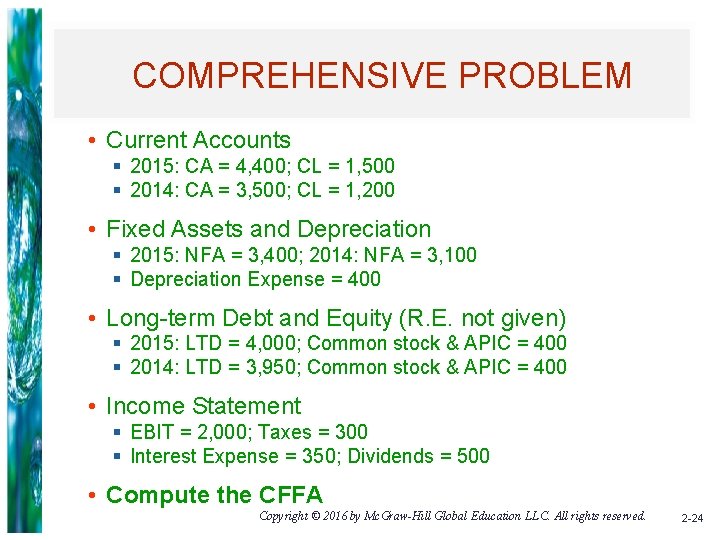
COMPREHENSIVE PROBLEM • Current Accounts § 2015: CA = 4, 400; CL = 1, 500 § 2014: CA = 3, 500; CL = 1, 200 • Fixed Assets and Depreciation § 2015: NFA = 3, 400; 2014: NFA = 3, 100 § Depreciation Expense = 400 • Long-term Debt and Equity (R. E. not given) § 2015: LTD = 4, 000; Common stock & APIC = 400 § 2014: LTD = 3, 950; Common stock & APIC = 400 • Income Statement § EBIT = 2, 000; Taxes = 300 § Interest Expense = 350; Dividends = 500 • Compute the CFFA Copyright © 2016 by Mc. Graw-Hill Global Education LLC. All rights reserved. 2 -24
CHAPTER 2 END OF CHAPTER Copyright © 2016 by Mc. Graw-Hill Global Education LLC. All rights reserved. 2 -25