
Chapter 2 February 1 2016 Oral Language Development
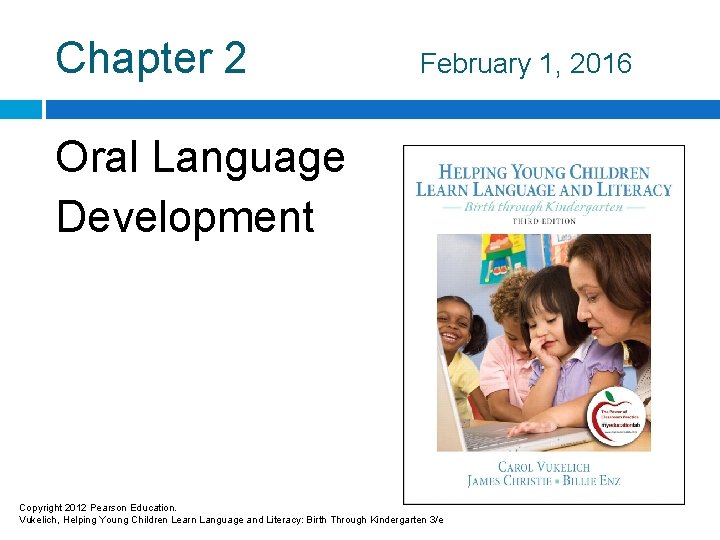
Chapter 2 February 1, 2016 Oral Language Development Copyright 2012 Pearson Education. Vukelich, Helping Young Children Learn Language and Literacy: Birth Through Kindergarten 3/e
Reflection 2 When you were growing up were children expected to speak up and answer adults’ questions? Were children expected to ask questions? Were they expected to be seen and not heard —to watch and listen and respect the authority of their elders? What is it like today for children? Copyright 2012 Pearson Education. Vukelich, Helping Young Children Learn Language and Literacy: Birth Through Kindergarten 3/e
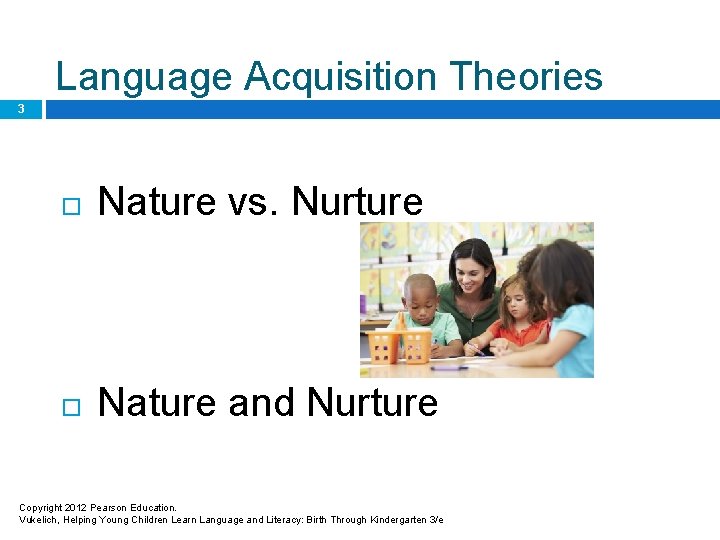
Language Acquisition Theories 3 Nature vs. Nurture Nature and Nurture Copyright 2012 Pearson Education. Vukelich, Helping Young Children Learn Language and Literacy: Birth Through Kindergarten 3/e
Nature vs Nurture 4 Nature or Nativist Perspective says that human infants are born with the capacity to learn language. Nurture or Behaviorist perspective says that language acquisition is a result of imitation and reinforcement. Copyright 2012 Pearson Education. Vukelich, Helping Young Children Learn Language and Literacy: Birth Through Kindergarten 3/e
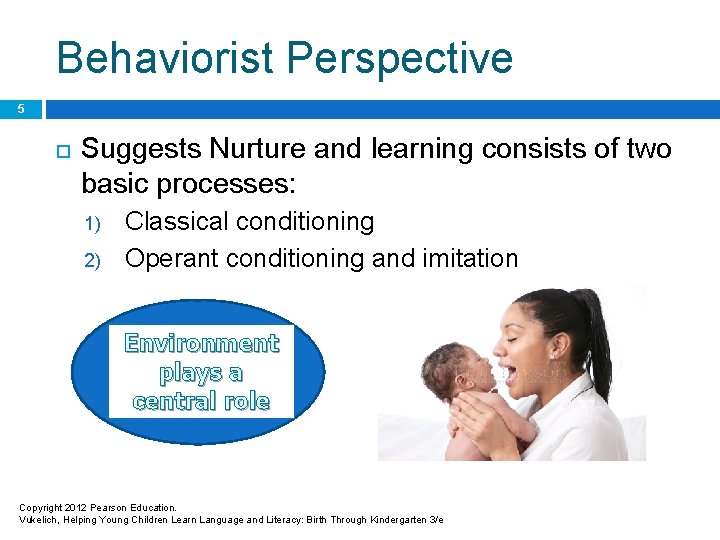
Behaviorist Perspective 5 Suggests Nurture and learning consists of two basic processes: 1) 2) Classical conditioning Operant conditioning and imitation Environment plays a central role Copyright 2012 Pearson Education. Vukelich, Helping Young Children Learn Language and Literacy: Birth Through Kindergarten 3/e
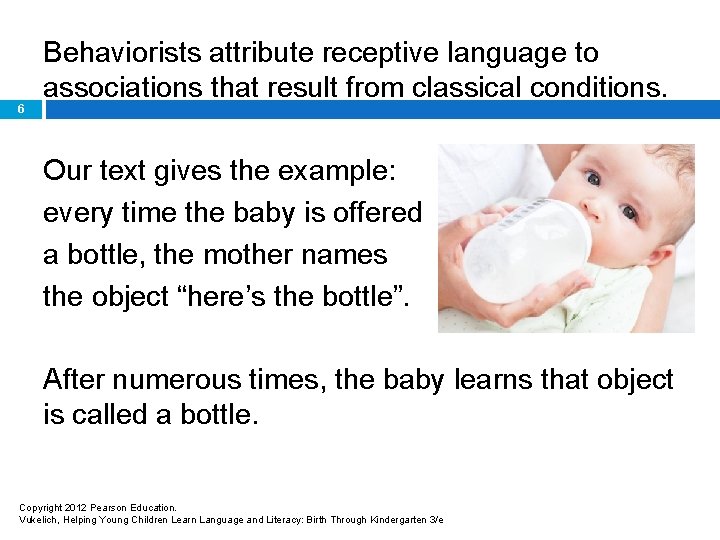
6 Behaviorists attribute receptive language to associations that result from classical conditions. Our text gives the example: every time the baby is offered a bottle, the mother names the object “here’s the bottle”. After numerous times, the baby learns that object is called a bottle. Copyright 2012 Pearson Education. Vukelich, Helping Young Children Learn Language and Literacy: Birth Through Kindergarten 3/e
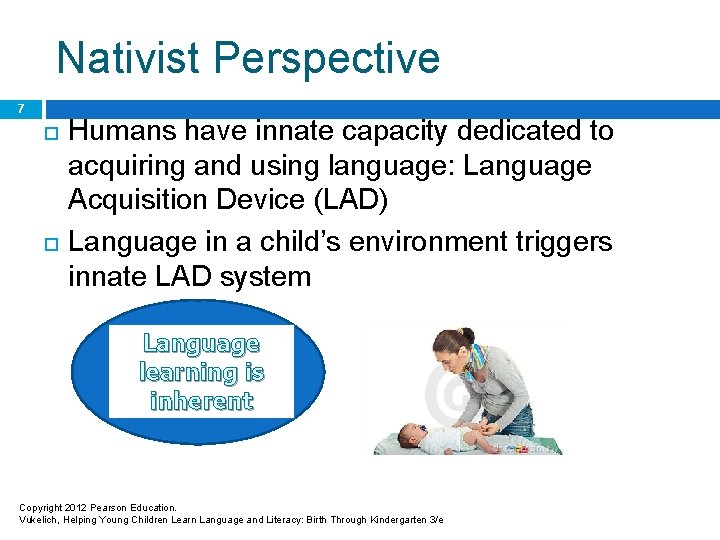
Nativist Perspective 7 Humans have innate capacity dedicated to acquiring and using language: Language Acquisition Device (LAD) Language in a child’s environment triggers innate LAD system Language learning is inherent Copyright 2012 Pearson Education. Vukelich, Helping Young Children Learn Language and Literacy: Birth Through Kindergarten 3/e
Wikipedia explains LAD: 8 “The Language Acquisition Device (LAD) is a hypothetical module of the human mind posited to account for children's innate predisposition for language acquisition. First proposed by Noam Chomsky in the 1960 s, the LAD concept is an instinctive mental capacity which enables an infant to acquire and produce language. It is component of the nativist theory of language. This theory asserts that humans are born with the instinct or "innate facility" for acquiring language. ” https: //en. wikipedia. org/wiki/Language_acquisition_device Copyright 2012 Pearson Education. Vukelich, Helping Young Children Learn Language and Literacy: Birth Through Kindergarten 3/e
Social Interactionist 9 Child actively and intentionally participates in language learning and the construction of meaning. Child’s interactions with caretakers, siblings and others support, shape and confirm the child’s construction of language. Language is meaningful and intentional even from the earliest interactions. Copyright 2012 Pearson Education. Vukelich, Helping Young Children Learn Language and Literacy: Birth Through Kindergarten 3/e
Neurobiological Perspective 10 Interaction of Nature and Nurture Neurological growth of the brain create a blueprint that causes the brain to develop distinct but interdependent systems. Neurobiology supports elements of the nativist, behaviorist and social interactionist views of language development. Copyright 2012 Pearson Education. Vukelich, Helping Young Children Learn Language and Literacy: Birth Through Kindergarten 3/e
11 Infants are born with key brain areas genetically dedicated to language function. Yet for children to learn the language of their culture, it is necessary that they have consistent, frequent opportunities to interact with a persistent caregiver who models the language with the child. Copyright 2012 Pearson Education. Vukelich, Helping Young Children Learn Language and Literacy: Birth Through Kindergarten 3/e
12 The language that a child learns is dependent on the language that the child hears spoken in the home. For children to learn the language of their culture, it is necessary that thy have consistent, frequent opportunities to interact with a persistent caregiver who models the language with the child. Copyright 2012 Pearson Education. Vukelich, Helping Young Children Learn Language and Literacy: Birth Through Kindergarten 3/e
13 Language …. is more than the sum of its linguistic parts. Copyright 2012 Pearson Education. Vukelich, Helping Young Children Learn Language and Literacy: Birth Through Kindergarten 3/e
Linguistic Structures 14 Phonology Morphology Syntax Semantics Pragmatics Copyright 2012 Pearson Education. Vukelich, Helping Young Children Learn Language and Literacy: Birth Through Kindergarten 3/e
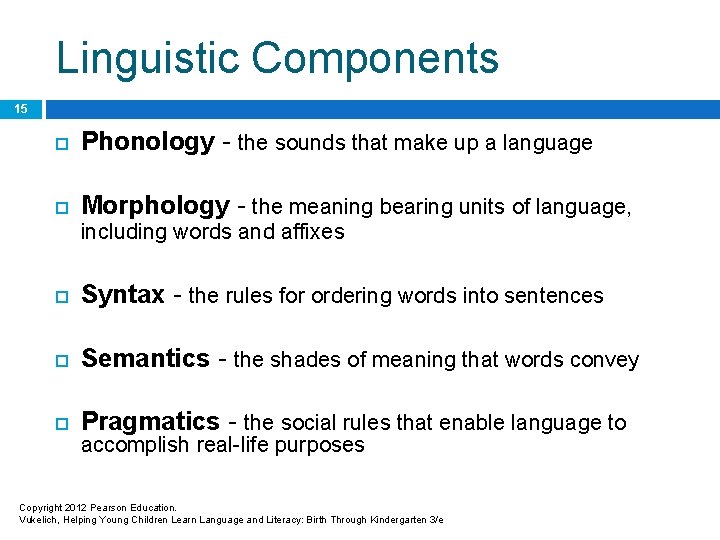
Linguistic Components 15 Phonology - the sounds that make up a language Morphology - the meaning bearing units of language, including words and affixes Syntax - the rules for ordering words into sentences Semantics - the shades of meaning that words convey Pragmatics - the social rules that enable language to accomplish real-life purposes Copyright 2012 Pearson Education. Vukelich, Helping Young Children Learn Language and Literacy: Birth Through Kindergarten 3/e
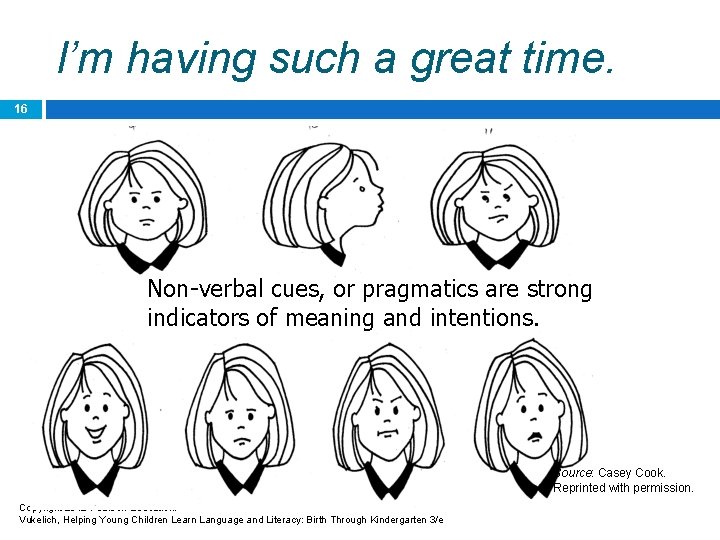
I’m having such a great time. 16 Non-verbal cues, or pragmatics are strong indicators of meaning and intentions. Source: Casey Cook. Reprinted with permission. Copyright 2012 Pearson Education. Vukelich, Helping Young Children Learn Language and Literacy: Birth Through Kindergarten 3/e
Teaching Language 17 Dad: Ok, buddy, it’s bath time. Let’s start with the soap. Is this a manly soap? Baby: (6 months), begins to laugh at his daddy Dad: Yeah, a manly baby soap for a cool dude. Baby: Makes whooping sounds Dad: Let’s take this soap and wash your tummy. Where’s your tummy? Consider how this father is teaching language. Copyright 2012 Pearson Education. Vukelich, Helping Young Children Learn Language and Literacy: Birth Through Kindergarten 3/e
Baby Talk vs. PARENTESE? 18 Baby Talk is not human speech and has no meaning. “oh do do goo dada” Parentese exaggerated, higher-pitched, slowed, sing-song speech allows the baby to see and hear language, connected to a specific event. “Loook at the Baaaby’s toes. ” Copyright 2012 Pearson Education. Vukelich, Helping Young Children Learn Language and Literacy: Birth Through Kindergarten 3/e
The Human Baby 19 https: //www. youtube. com/playlist? list=PLFD 372 E 539 A 5 FF 8 E 3 Copy link above and paste into your brouser to view the you tube video. As you view, consider the cultural context of language acquisition coupled capacity for learning at different ages. Copyright 2012 Pearson Education. Vukelich, Helping Young Children Learn Language and Literacy: Birth Through Kindergarten 3/e
Reasons for Language Delay 20 While language development follows a predictable sequence, the rate at which children acquire language varies tremendously. These are a few of reasons language can be delayed. Gender differences Socio-economic level Cultural influences Medical concerns Congenital language disorders Copyright 2012 Pearson Education. Vukelich, Helping Young Children Learn Language and Literacy: Birth Through Kindergarten 3/e
2 for 1…. 21 A child’s brain is capable of learning two languages at once. Parents should talk to their child in the language they feel most comfortable. Turtle = Tortuga When a child is grounded in their home language, their capacity to learn a second language is enhanced. Copyright 2012 Pearson Education. Vukelich, Helping Young Children Learn Language and Literacy: Birth Through Kindergarten 3/e
Self reflection 22 Are you someone who doesn’t talk or some who talks a lot? Are you a good listener? Do you consciously help others talk? How can others help you (a) to talk or (b) not to talk too much? If you are leading a group time with young children, who gets most of the talking practice? You or the children? Is that okay? Does that help them learn? Copyright 2012 Pearson Education. Vukelich, Helping Young Children Learn Language and Literacy: Birth Through Kindergarten 3/e
- Slides: 22