
Chapter 2 Exportoriented Strategy Globalization and FTA The
Chapter 2: Export-oriented Strategy, Globalization and FTA - The Experience of Korea 16 October, 2014
Part-01 Export-Oriented Growth and Industrialization in Korea - Overview
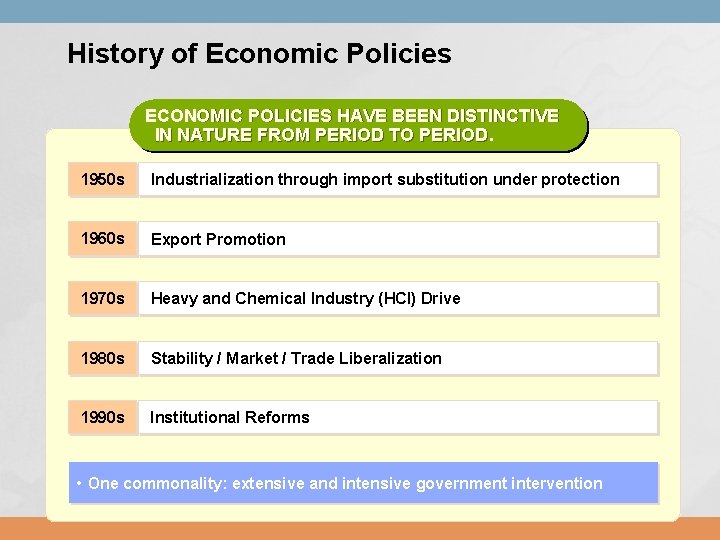
History of Economic Policies ECONOMIC POLICIES HAVE BEEN DISTINCTIVE IN NATURE FROM PERIOD TO PERIOD 1950 s Industrialization through import substitution under protection 1960 s Export Promotion 1970 s Heavy and Chemical Industry (HCI) Drive 1980 s Stability / Market / Trade Liberalization 1990 s Institutional Reforms • One commonality: extensive and intensive government intervention
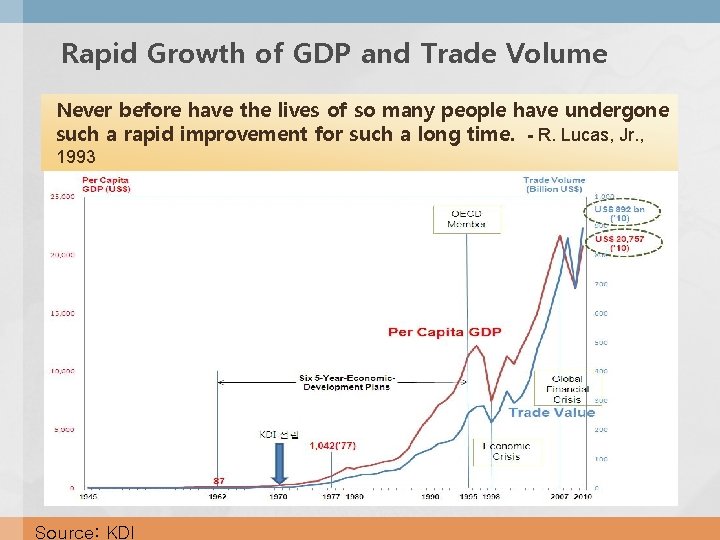
Rapid Growth of GDP and Trade Volume Never before have the lives of so many people have undergone such a rapid improvement for such a long time. - R. Lucas, Jr. , 1993 Source: KDI
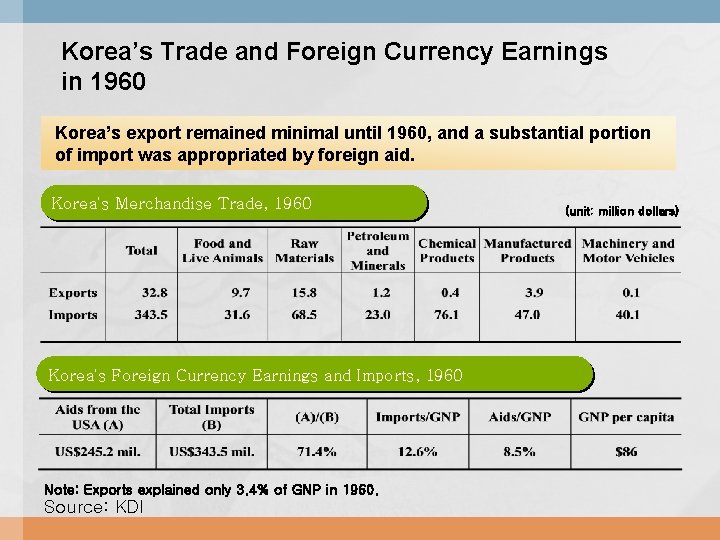
Korea’s Trade and Foreign Currency Earnings in 1960 Korea’s export remained minimal until 1960, and a substantial portion of import was appropriated by foreign aid. Korea’s Merchandise Trade, 1960 Korea’s Foreign Currency Earnings and Imports, 1960 Note: Exports explained only 3. 4% of GNP in 1960. Source: KDI (unit: million dollars)
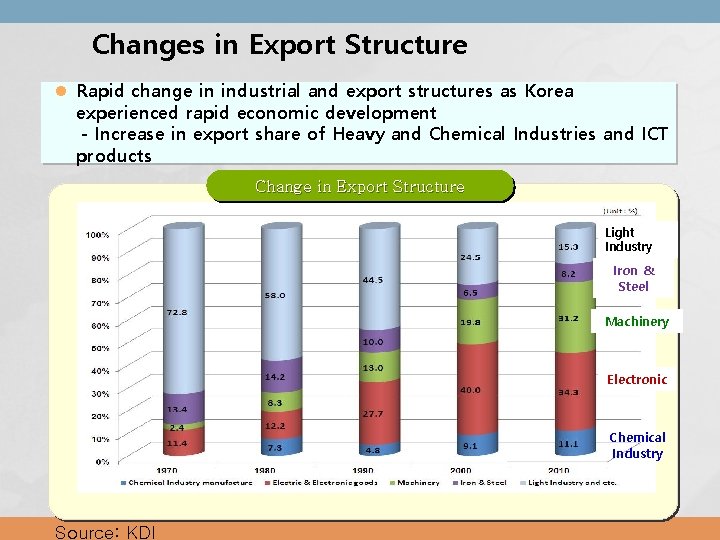
Changes in Export Structure l Rapid change in industrial and export structures as Korea experienced rapid economic development - Increase in export share of Heavy and Chemical Industries and ICT products Change in Export Structure Light Industry Iron & Steel Machinery Electronic Chemical Industry Source: KDI
Part-02 Export-oriented Growth Strategy since 1961
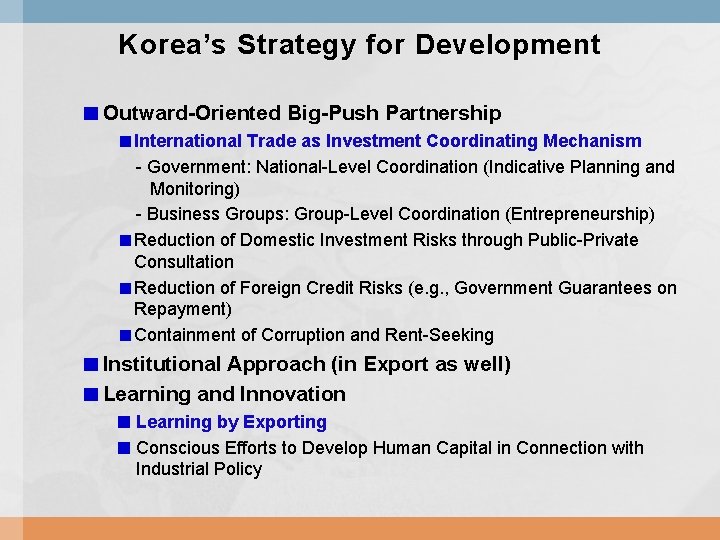
Korea’s Strategy for Development Outward-Oriented Big-Push Partnership International Trade as Investment Coordinating Mechanism - Government: National-Level Coordination (Indicative Planning and Monitoring) - Business Groups: Group-Level Coordination (Entrepreneurship) Reduction of Domestic Investment Risks through Public-Private Consultation Reduction of Foreign Credit Risks (e. g. , Government Guarantees on Repayment) Containment of Corruption and Rent-Seeking Institutional Approach (in Export as well) Learning and Innovation Learning by Exporting Conscious Efforts to Develop Human Capital in Connection with Industrial Policy
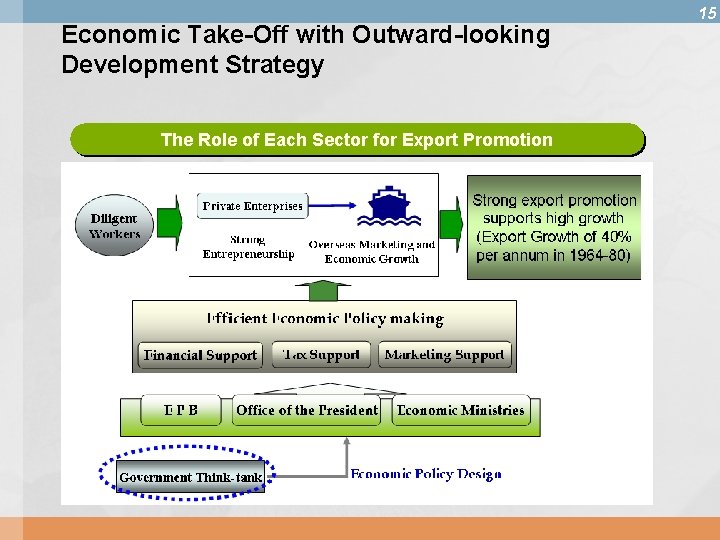
Economic Take-Off with Outward-looking Development Strategy The Role of Each Sector for Export Promotion 15
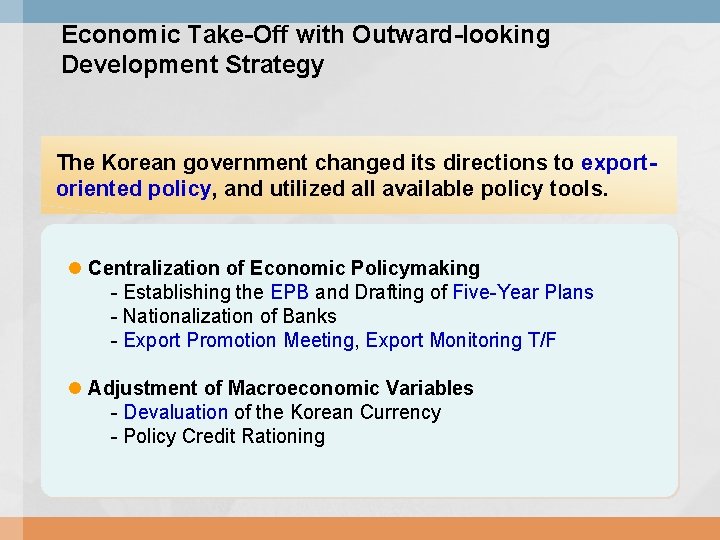
Economic Take-Off with Outward-looking Development Strategy The Korean government changed its directions to exportoriented policy, and utilized all available policy tools. l Centralization of Economic Policymaking - Establishing the EPB and Drafting of Five-Year Plans - Nationalization of Banks - Export Promotion Meeting, Export Monitoring T/F l Adjustment of Macroeconomic Variables - Devaluation of the Korean Currency - Policy Credit Rationing
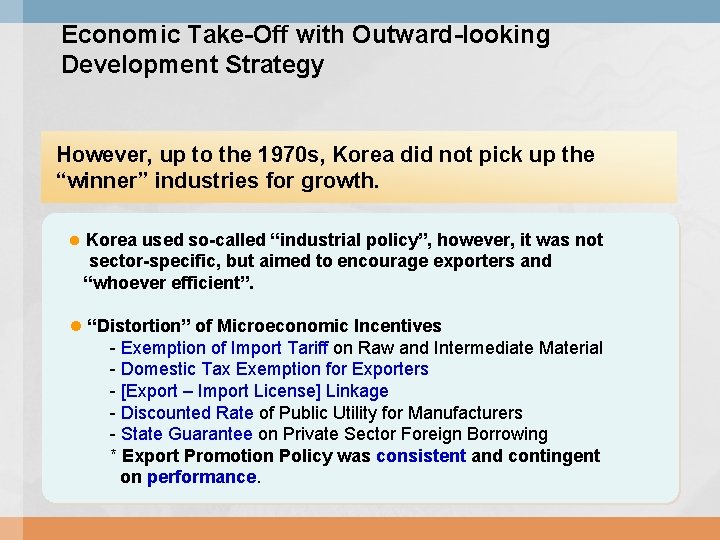
Economic Take-Off with Outward-looking Development Strategy However, up to the 1970 s, Korea did not pick up the “winner” industries for growth. l Korea used so-called “industrial policy”, however, it was not sector-specific, but aimed to encourage exporters and “whoever efficient”. l “Distortion” of Microeconomic Incentives - Exemption of Import Tariff on Raw and Intermediate Material - Domestic Tax Exemption for Exporters - [Export – Import License] Linkage - Discounted Rate of Public Utility for Manufacturers - State Guarantee on Private Sector Foreign Borrowing * Export Promotion Policy was consistent and contingent on performance.
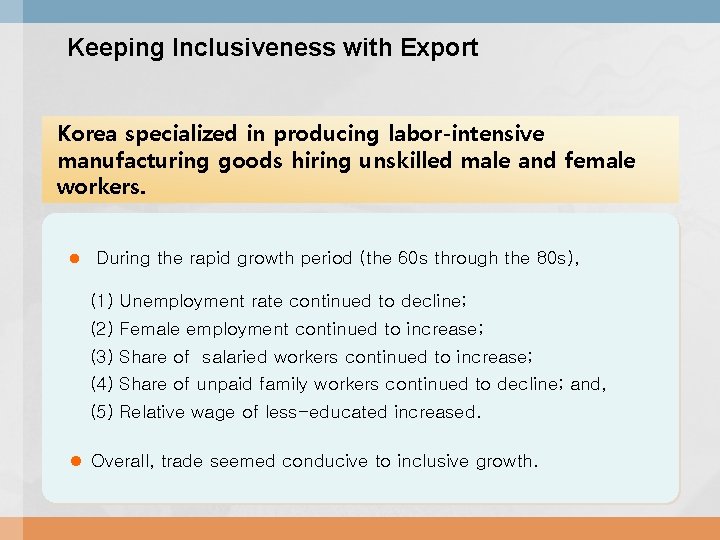
Keeping Inclusiveness with Export Korea specialized in producing labor-intensive manufacturing goods hiring unskilled male and female workers. l During the rapid growth period (the 60 s through the 80 s), (1) Unemployment rate continued to decline; (2) Female employment continued to increase; (3) Share of salaried workers continued to increase; (4) Share of unpaid family workers continued to decline; and, (5) Relative wage of less-educated increased. l Overall, trade seemed conducive to inclusive growth.
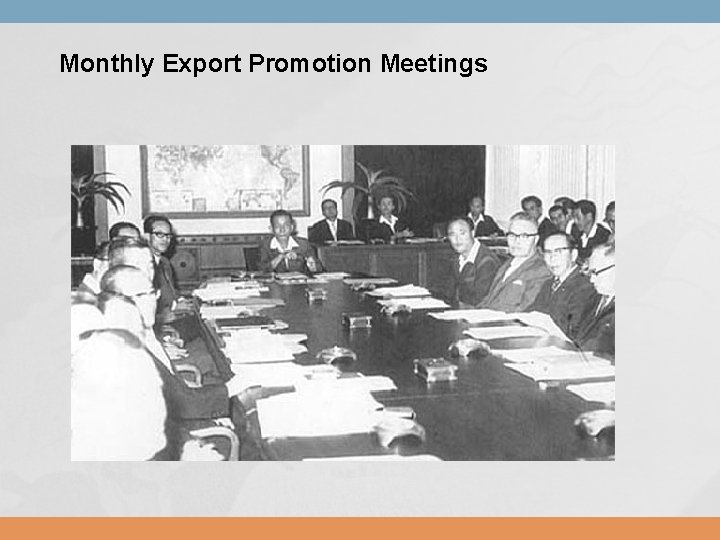
Monthly Export Promotion Meetings
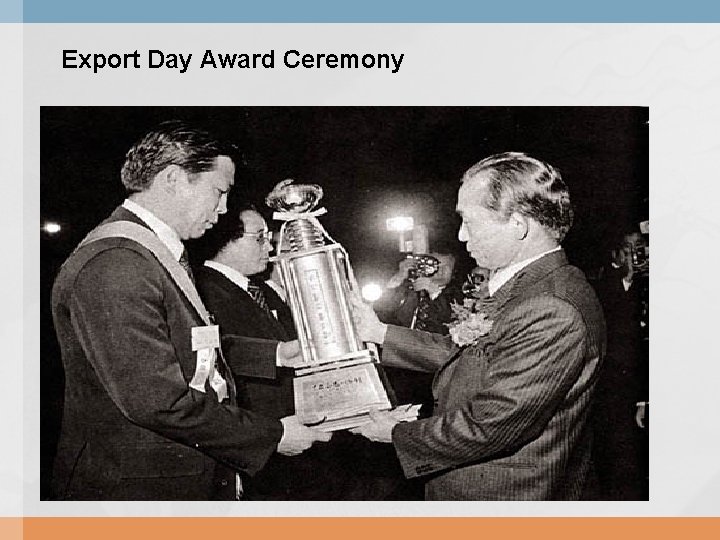
Export Day Award Ceremony
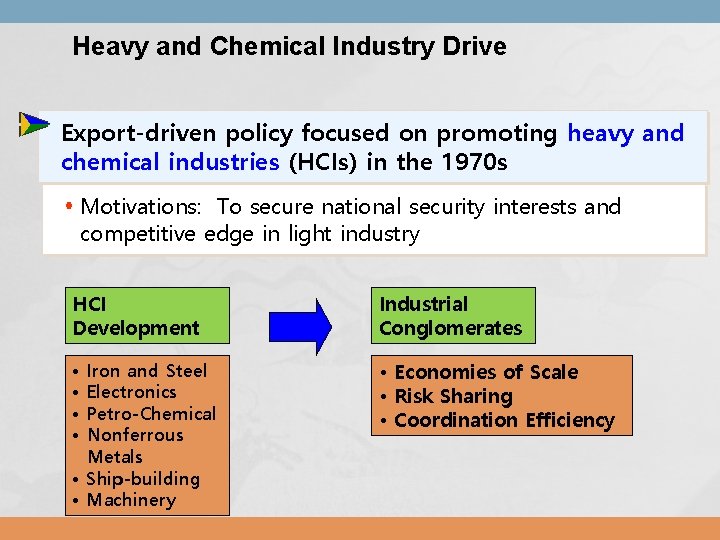
Heavy and Chemical Industry Drive Export-driven policy focused on promoting heavy and chemical industries (HCIs) in the 1970 s Motivations: To secure national security interests and competitive edge in light industry HCI Development Industrial Conglomerates • • • Economies of Scale • Risk Sharing • Coordination Efficiency Iron and Steel Electronics Petro-Chemical Nonferrous Metals • Ship-building • Machinery
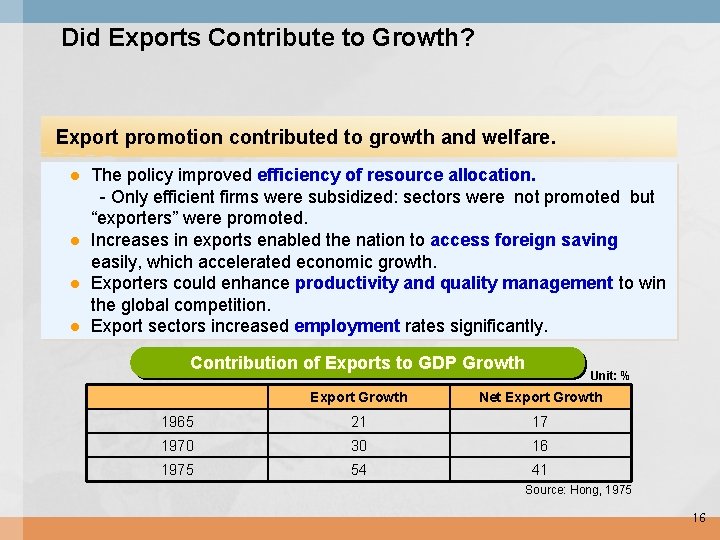
Did Exports Contribute to Growth? Export promotion contributed to growth and welfare. The policy improved efficiency of resource allocation. - Only efficient firms were subsidized: sectors were not promoted but “exporters” were promoted. l Increases in exports enabled the nation to access foreign saving easily, which accelerated economic growth. l Exporters could enhance productivity and quality management to win the global competition. l Export sectors increased employment rates significantly. l Contribution of Exports to GDP Growth Unit: % Export Growth Net Export Growth 1965 21 17 1970 30 16 1975 54 41 Source: Hong, 1975 16
Part-03 Trade Liberalization and Globalization since 1980
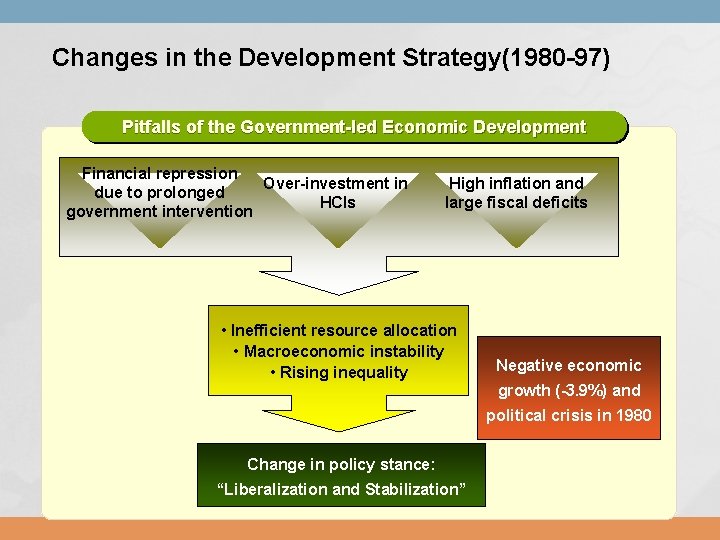
Changes in the Development Strategy(1980 -97) Pitfalls of the Government-led Economic Development Financial repression Over-investment in due to prolonged HCIs government intervention High inflation and large fiscal deficits • Inefficient resource allocation • Macroeconomic instability • Rising inequality Negative economic growth (-3. 9%) and political crisis in 1980 Change in policy stance: “Liberalization and Stabilization”
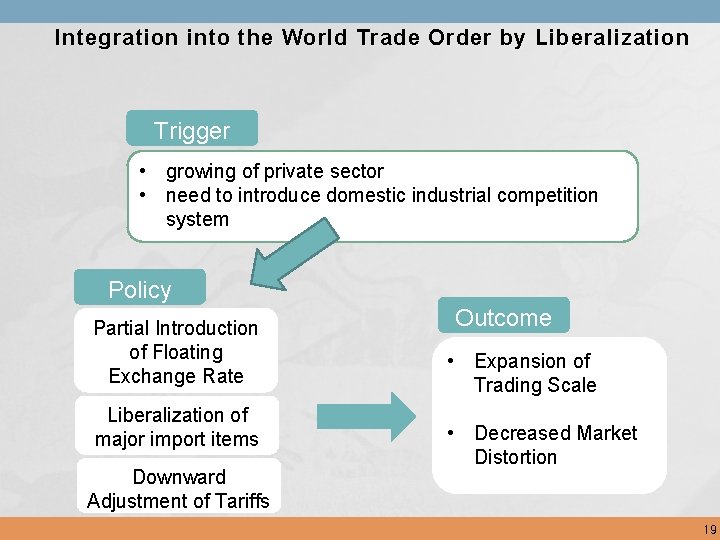
Integration into the World Trade Order by Liberalization Trigger • growing of private sector • need to introduce domestic industrial competition system Policy Partial Introduction of Floating Exchange Rate Liberalization of major import items Downward Adjustment of Tariffs Outcome • Expansion of Trading Scale • Decreased Market Distortion 19
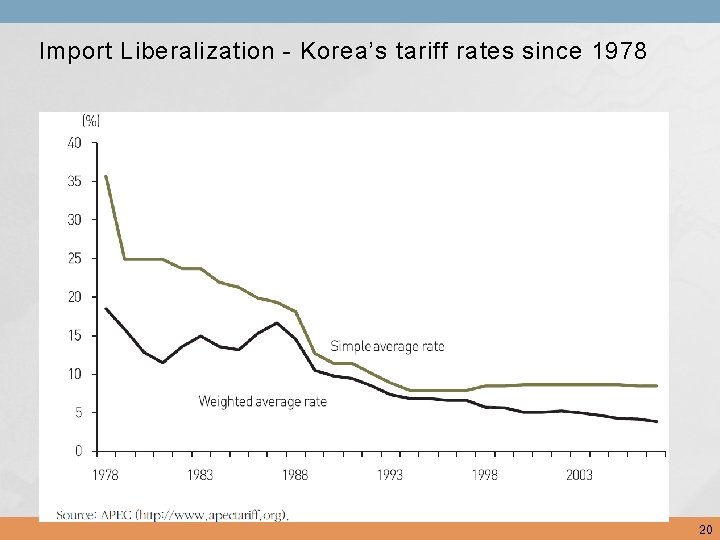
Import Liberalization - Korea’s tariff rates since 1978 20
Effects of Structural Changes and Liberalization Korea started to upgrade industrial structure, specializing in capital-intensive (and skill-intensive) manufacturing goods. However, increased openness and globalization started to create so-called “bi-polarization”: (1) Large enterprise groups (“Chaebol ”) Vs. SMEs; (2) Globalized exporting sectors Vs. domestic sectors; and, (3) Manufacturing sectors Vs. service sectors. As globalization could create not only winners but also losers, we need to prepare policy measures for facilitating trade and maintaining social cohesion.
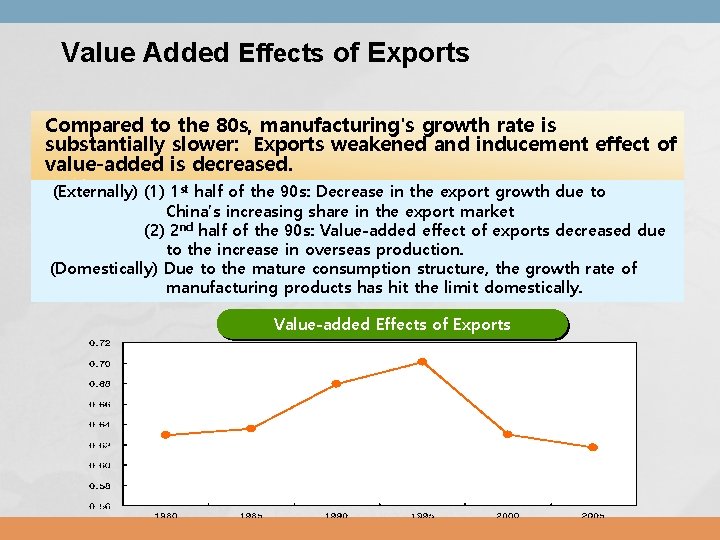
Value Added Effects of Exports Compared to the 80 s, manufacturing's growth rate is substantially slower: Exports weakened and inducement effect of value-added is decreased. (Externally) (1) 1 st half of the 90 s: Decrease in the export growth due to China’s increasing share in the export market (2) 2 nd half of the 90 s: Value-added effect of exports decreased due to the increase in overseas production. (Domestically) Due to the mature consumption structure, the growth rate of manufacturing products has hit the limit domestically. Value-added Effects of Exports
Promoting Openness Korea pursues to be a global leader, through FTA and the plan to be a Northeast Asian Economic Hub. l Korea aims to enhance regional cooperation and to be a center of R&D, logistics and financial services in Asia. l It also endeavors to transform into an open and globalized economy, promoting FTA with a variety of economies. l The increased trade, FDI and welfare due to FTA will consolidate its momentum for continuous economic growth. l More active participation into global production network will improve efficiency and competitiveness of its industries. l Upgrading social and institutional systems to meet global standard will provide new opportunities for future development.
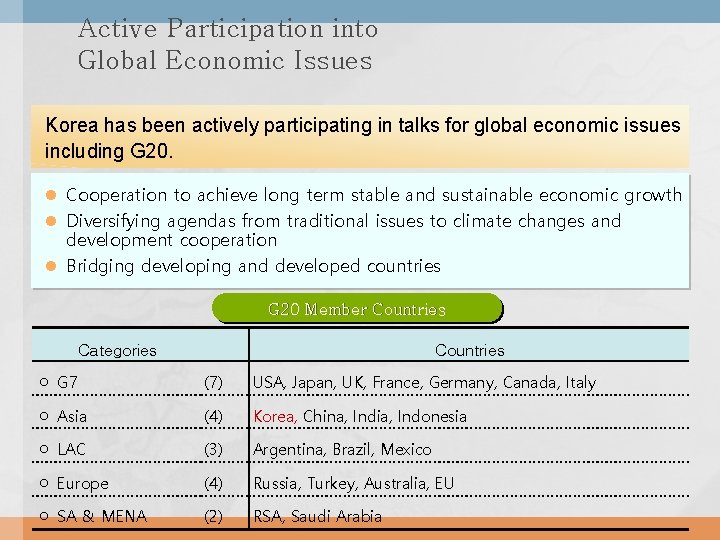
Active Participation into Global Economic Issues Korea has been actively participating in talks for global economic issues including G 20. l Cooperation to achieve long term stable and sustainable economic growth l Diversifying agendas from traditional issues to climate changes and development cooperation l Bridging developing and developed countries G 20 Member Countries Categories Countries ㅇ G 7 (7) USA, Japan, UK, France, Germany, Canada, Italy ㅇ Asia (4) Korea, China, India, Indonesia ㅇ LAC (3) Argentina, Brazil, Mexico ㅇ Europe (4) Russia, Turkey, Australia, EU ㅇ SA & MENA (2) RSA, Saudi Arabia
Part-05 Needs of and Strategies for FTA with Large Economies
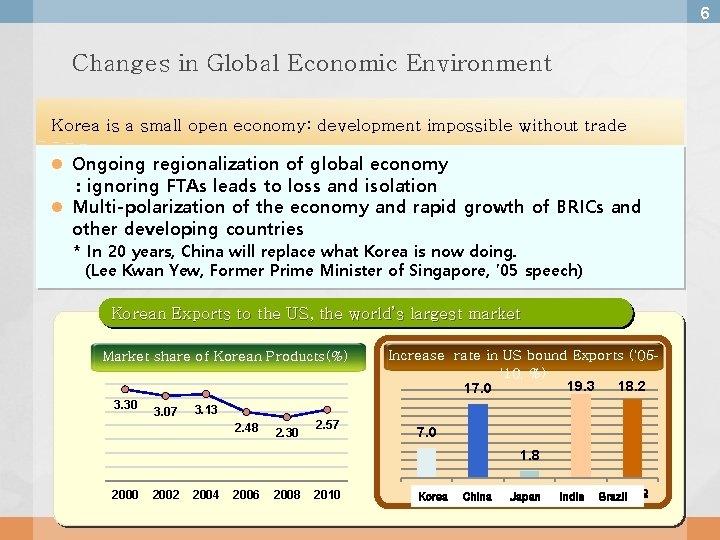
6 Changes in Global Economic Environment Korea is a small open economy: development impossible without trade l Ongoing regionalization of global economy : ignoring FTAs leads to loss and isolation l Multi-polarization of the economy and rapid growth of BRICs and other developing countries * In 20 years, China will replace what Korea is now doing. (Lee Kwan Yew, Former Prime Minister of Singapore, ’ 05 speech) Korean Exports to the US, the world’s largest market Market share of Korean Products(%) 3. 30 3. 07 Increase rate in US bound Exports (’ 05’ 10, %) 19. 3 18. 2 17. 0 3. 13 2. 48 2. 30 2. 57 7. 0 1. 8 2000 2002 2004 2006 2008 2010 한국 Korea 중국 China 일본 Japan 인도 Brazil 브라질 India
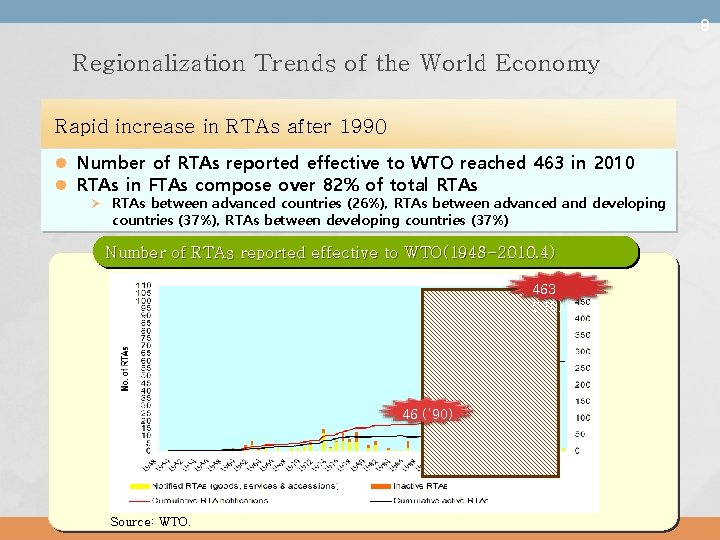
8 Regionalization Trends of the World Economy Rapid increase in RTAs after 1990 l Number of RTAs reported effective to WTO reached 463 in 2010 l RTAs in FTAs compose over 82% of total RTAs Ø RTAs between advanced countries (26%), RTAs between advanced and developing countries (37%), RTAs between developing countries (37%) Number of RTAs reported effective to WTO(1948 -2010. 4) 463 (’ 10) 46 (’ 90) Source: WTO.
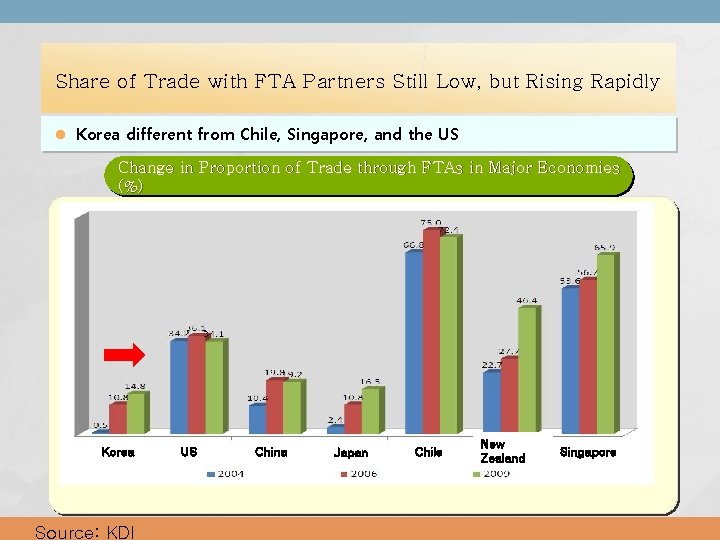
Share of Trade with FTA Partners Still Low, but Rising Rapidly l Korea different from Chile, Singapore, and the US Change in Proportion of Trade through FTAs in Major Economies (%) Korea Source: KDI US China Japan Chile New Zealand Singapore
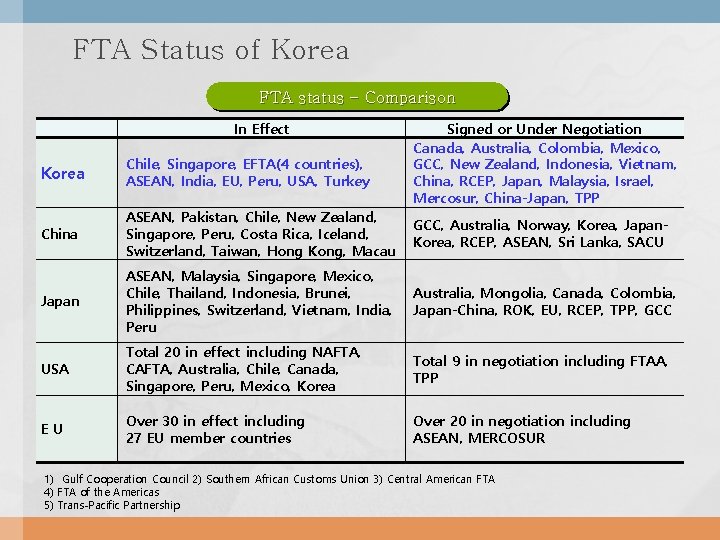
FTA Status of Korea FTA status - Comparison In Effect Signed or Under Negotiation Canada, Australia, Colombia, Mexico, GCC, New Zealand, Indonesia, Vietnam, China, RCEP, Japan, Malaysia, Israel, Mercosur, China-Japan, TPP Korea Chile, Singapore, EFTA(4 countries), ASEAN, India, EU, Peru, USA, Turkey China ASEAN, Pakistan, Chile, New Zealand, Singapore, Peru, Costa Rica, Iceland, Switzerland, Taiwan, Hong Kong, Macau GCC, Australia, Norway, Korea, Japan. Korea, RCEP, ASEAN, Sri Lanka, SACU Japan ASEAN, Malaysia, Singapore, Mexico, Chile, Thailand, Indonesia, Brunei, Philippines, Switzerland, Vietnam, India, Peru Australia, Mongolia, Canada, Colombia, Japan-China, ROK, EU, RCEP, TPP, GCC USA Total 20 in effect including NAFTA, CAFTA, Australia, Chile, Canada, Singapore, Peru, Mexico, Korea Total 9 in negotiation including FTAA, TPP EU Over 30 in effect including 27 EU member countries Over 20 in negotiation including ASEAN, MERCOSUR 1) Gulf Cooperation Council 2) Southern African Customs Union 3) Central American FTA 4) FTA of the Americas 5) Trans-Pacific Partnership
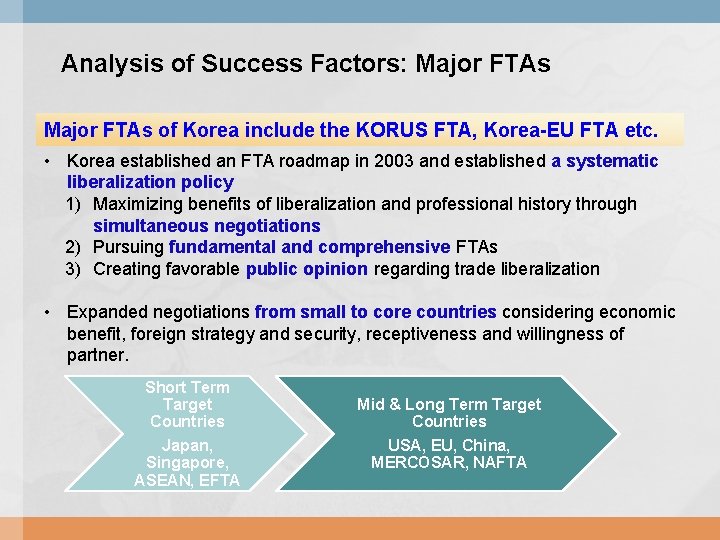
Analysis of Success Factors: Major FTAs of Korea include the KORUS FTA, Korea-EU FTA etc. • Korea established an FTA roadmap in 2003 and established a systematic liberalization policy 1) Maximizing benefits of liberalization and professional history through simultaneous negotiations 2) Pursuing fundamental and comprehensive FTAs 3) Creating favorable public opinion regarding trade liberalization • Expanded negotiations from small to core countries considering economic benefit, foreign strategy and security, receptiveness and willingness of partner. Short Term Target Countries Japan, Singapore, ASEAN, EFTA Mid & Long Term Target Countries USA, EU, China, MERCOSAR, NAFTA
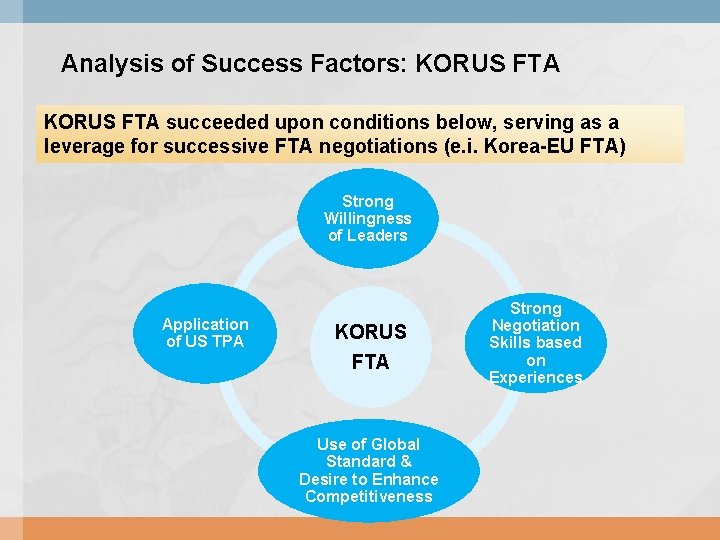
Analysis of Success Factors: KORUS FTA succeeded upon conditions below, serving as a leverage for successive FTA negotiations (e. i. Korea-EU FTA) Strong Willingness of Leaders Application of US TPA KORUS FTA Use of Global Standard & Desire to Enhance Competitiveness Strong Negotiation Skills based on Experiences
Part-06 Challenges and Policy Direction
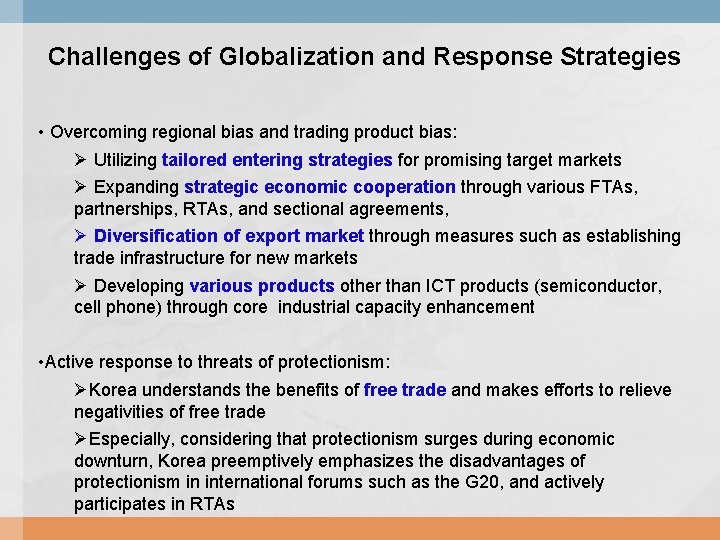
Challenges of Globalization and Response Strategies • Overcoming regional bias and trading product bias: Ø Utilizing tailored entering strategies for promising target markets Ø Expanding strategic economic cooperation through various FTAs, partnerships, RTAs, and sectional agreements, Ø Diversification of export market through measures such as establishing trade infrastructure for new markets Ø Developing various products other than ICT products (semiconductor, cell phone) through core industrial capacity enhancement • Active response to threats of protectionism: ØKorea understands the benefits of free trade and makes efforts to relieve negativities of free trade ØEspecially, considering that protectionism surges during economic downturn, Korea preemptively emphasizes the disadvantages of protectionism in international forums such as the G 20, and actively participates in RTAs
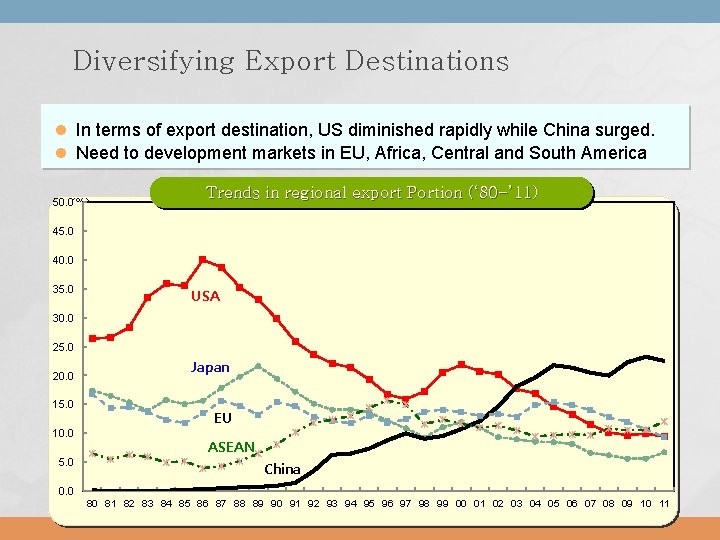
Diversifying Export Destinations l In terms of export destination, US diminished rapidly while China surged. l Need to development markets in EU, Africa, Central and South America 50. 0(%) Trends in regional export Portion (‘ 80 -’ 11) 45. 0 40. 0 35. 0 USA 30. 0 25. 0 20. 0 15. 0 10. 0 5. 0 Japan EU ASEAN China 0. 0 80 81 82 83 84 85 86 87 88 89 90 91 92 93 94 95 96 97 98 99 00 01 02 03 04 05 06 07 08 09 10 11
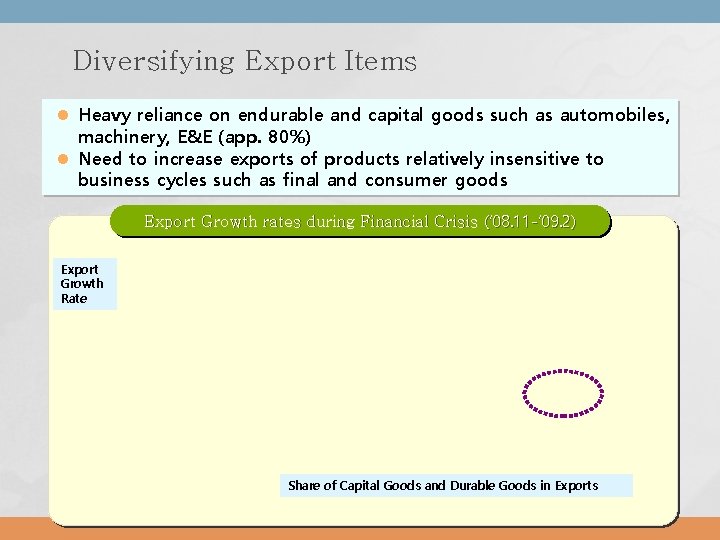
Diversifying Export Items l Heavy reliance on endurable and capital goods such as automobiles, machinery, E&E (app. 80%) l Need to increase exports of products relatively insensitive to business cycles such as final and consumer goods Export Growth rates during Financial Crisis (‘ 08. 11 -’ 09. 2) Export Growth Rate Share of Capital Goods and Durable Goods in Exports
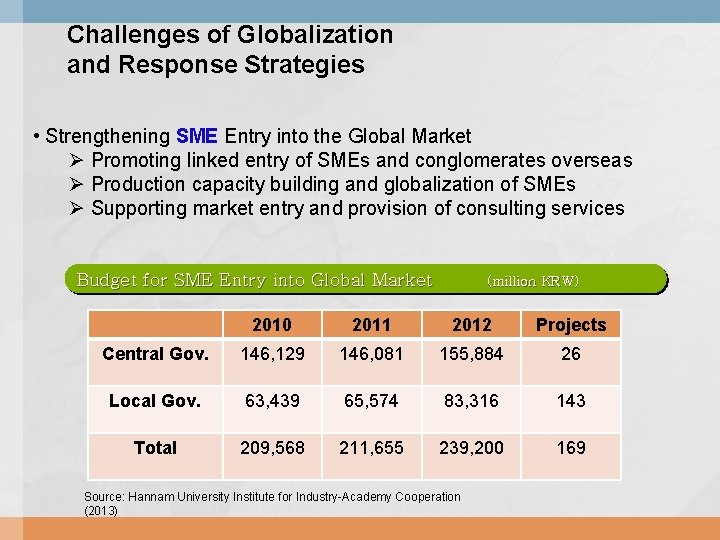
Challenges of Globalization and Response Strategies • Strengthening SME Entry into the Global Market Ø Promoting linked entry of SMEs and conglomerates overseas Ø Production capacity building and globalization of SMEs Ø Supporting market entry and provision of consulting services Budget for SME Entry into Global Market (million KRW) 2010 2011 2012 Projects Central Gov. 146, 129 146, 081 155, 884 26 Local Gov. 63, 439 65, 574 83, 316 143 Total 209, 568 211, 655 239, 200 169 Source: Hannam University Institute for Industry-Academy Cooperation (2013)
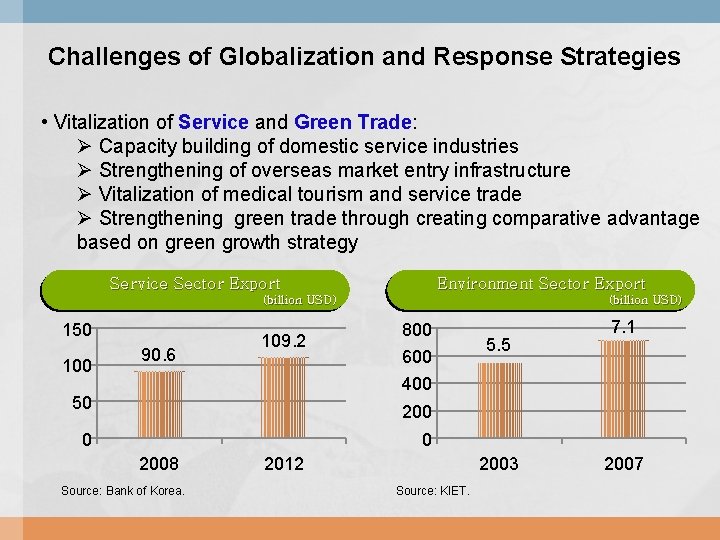
Challenges of Globalization and Response Strategies • Vitalization of Service and Green Trade: Ø Capacity building of domestic service industries Ø Strengthening of overseas market entry infrastructure Ø Vitalization of medical tourism and service trade Ø Strengthening green trade through creating comparative advantage based on green growth strategy Service Sector Export Environment Sector Export (billion USD) 150 100 90. 6 109. 2 50 (billion USD) 800 600 400 5. 5 7. 1 200 0 0 2008 Source: Bank of Korea. 2012 2003 Source: KIET. 2007
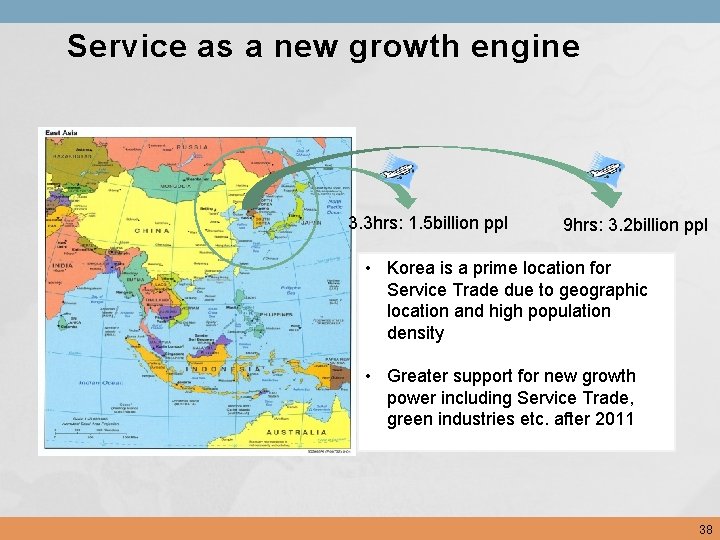
Service as a new growth engine 3. 3 hrs: 1. 5 billion ppl 9 hrs: 3. 2 billion ppl • Korea is a prime location for Service Trade due to geographic location and high population density • Greater support for new growth power including Service Trade, green industries etc. after 2011 38
Part-07 Evaluation and Implications of Globalization
Assessment • Korea’s liberalization policy contributed to high growth through export enhancement. • Possibility of continuous change and sophistication(creation and utilization of comparative advantages) of the economic structure. • Distortion of economic structure(price system) and arrestment of competitiveness due to excessive intervention of the government. • Distortion of public perception (export=good, import=evil) due to pro-export policies. • Criticism from abroad that Korea’s globalization was asymmetrically built on exports: Despite active import liberalization after 1980, its pace delayed due to domestic issues such as conflict of interest between industries. • Korea still lags behind in receptiveness regarding foreign goods or culture.
Implications • Utilization of dynamic comparative advantage in the global market essential for economic development. • Static fixation of comparative advantage inevitably leads to elimination from the global market. • Combination of adequate policy measures of the government and entrepreneurship of the private sector necessary in order to avoid such scenario. • Direct and excessive government intervention in the market risks serious side effects by thwarting originality of the private sector and distorting the market. • Must actively utilize RTAs etc. to engage and integrate into the global trading system.
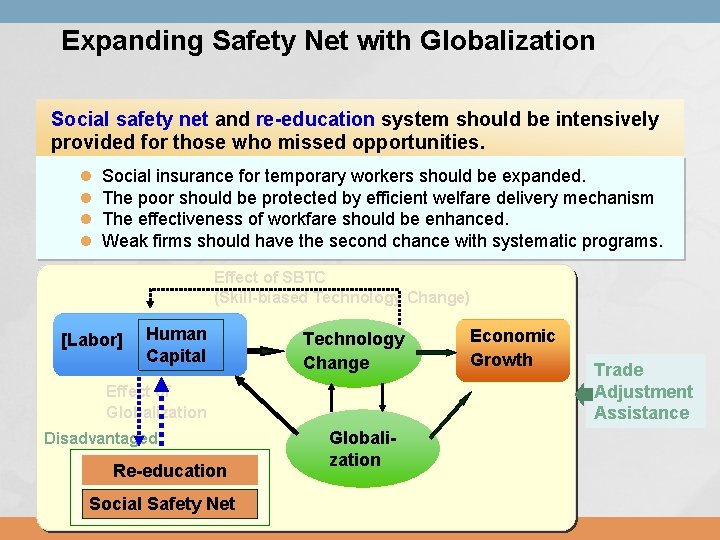
Expanding Safety Net with Globalization Social safety net and re-education system should be intensively provided for those who missed opportunities. l l Social insurance for temporary workers should be expanded. The poor should be protected by efficient welfare delivery mechanism The effectiveness of workfare should be enhanced. Weak firms should have the second chance with systematic programs. Effect of SBTC (Skill-biased Technology Change) [Labor] Human Capital Technology Change Effect of Globalization Disadvantaged Re-education Social Safety Net Globalization Economic Growth Trade Adjustment Assistance
- Slides: 42